
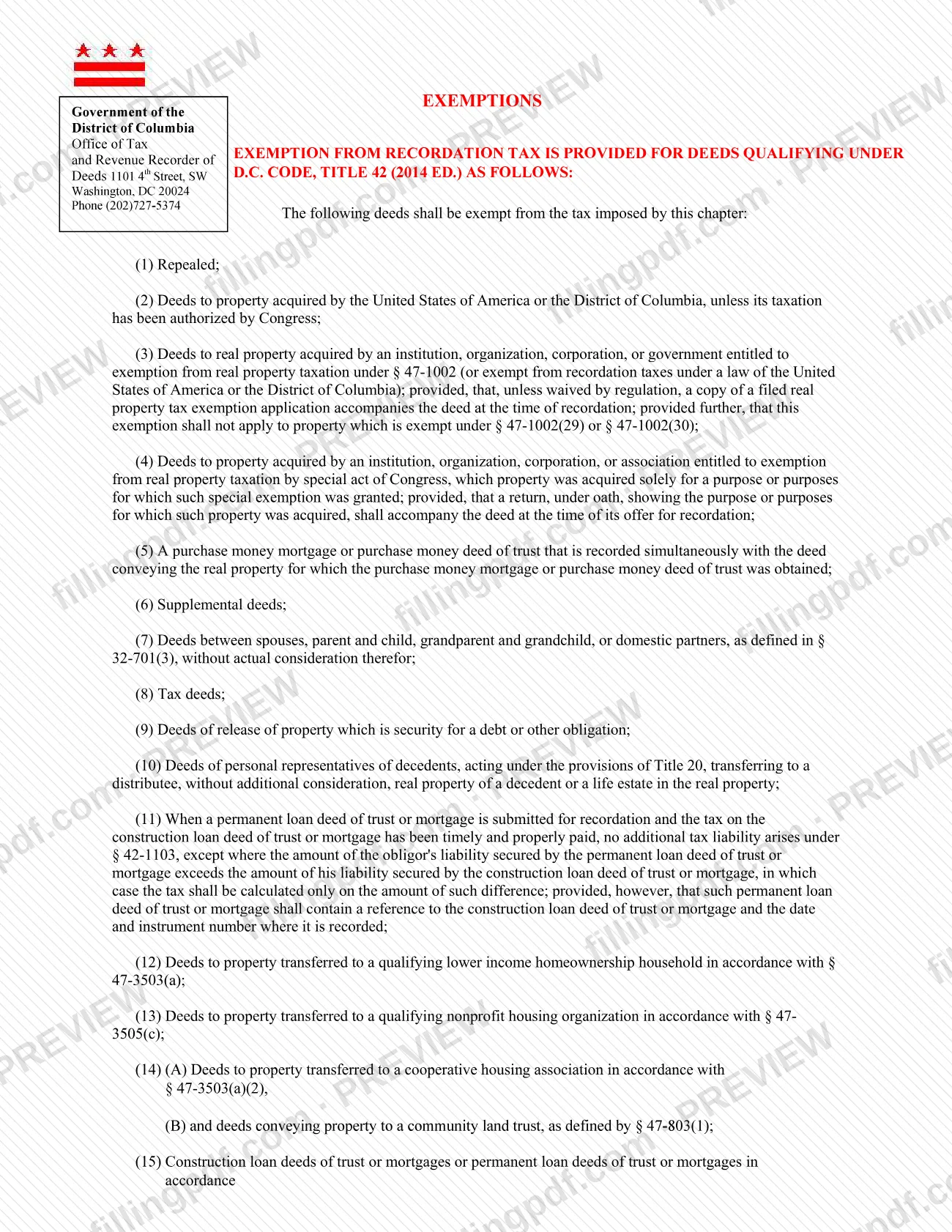
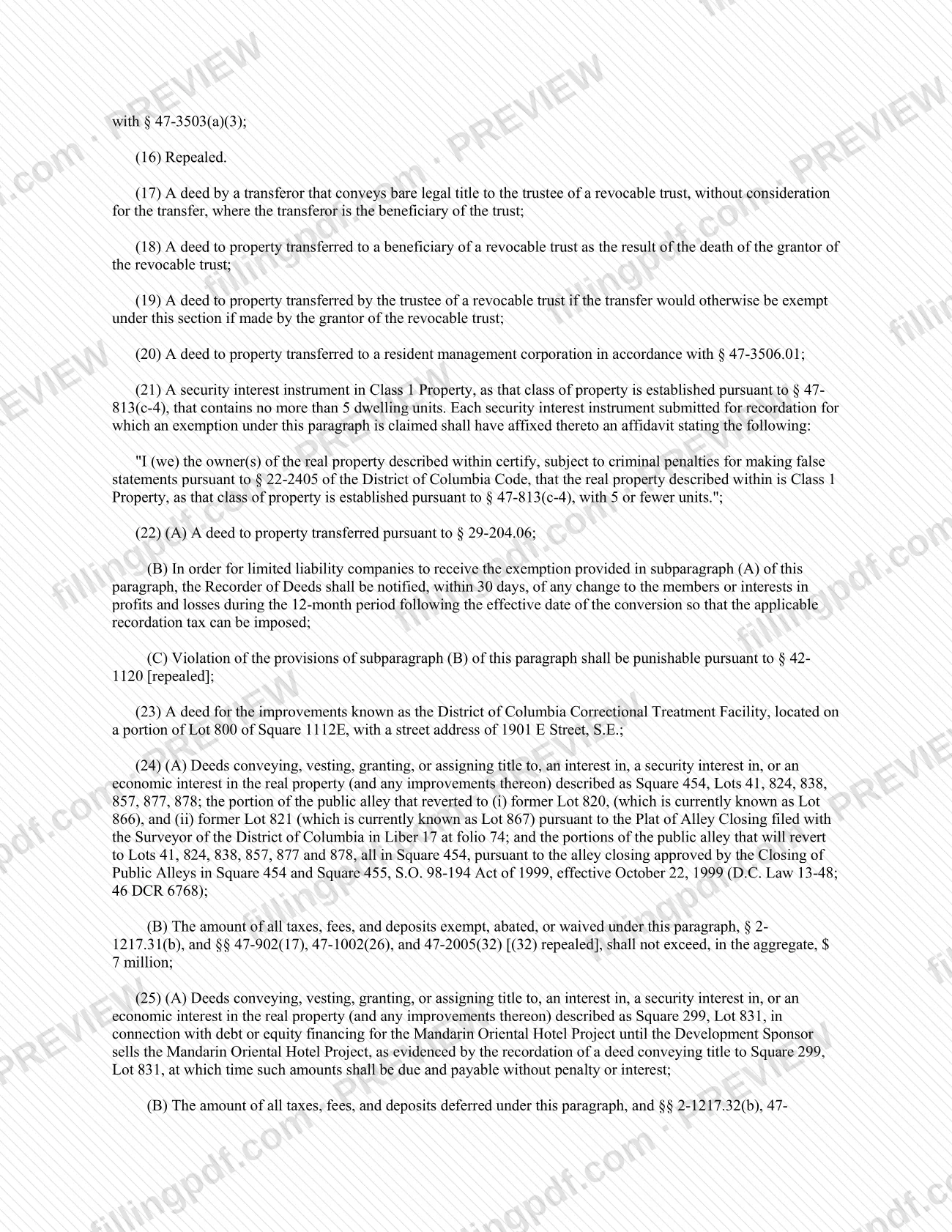
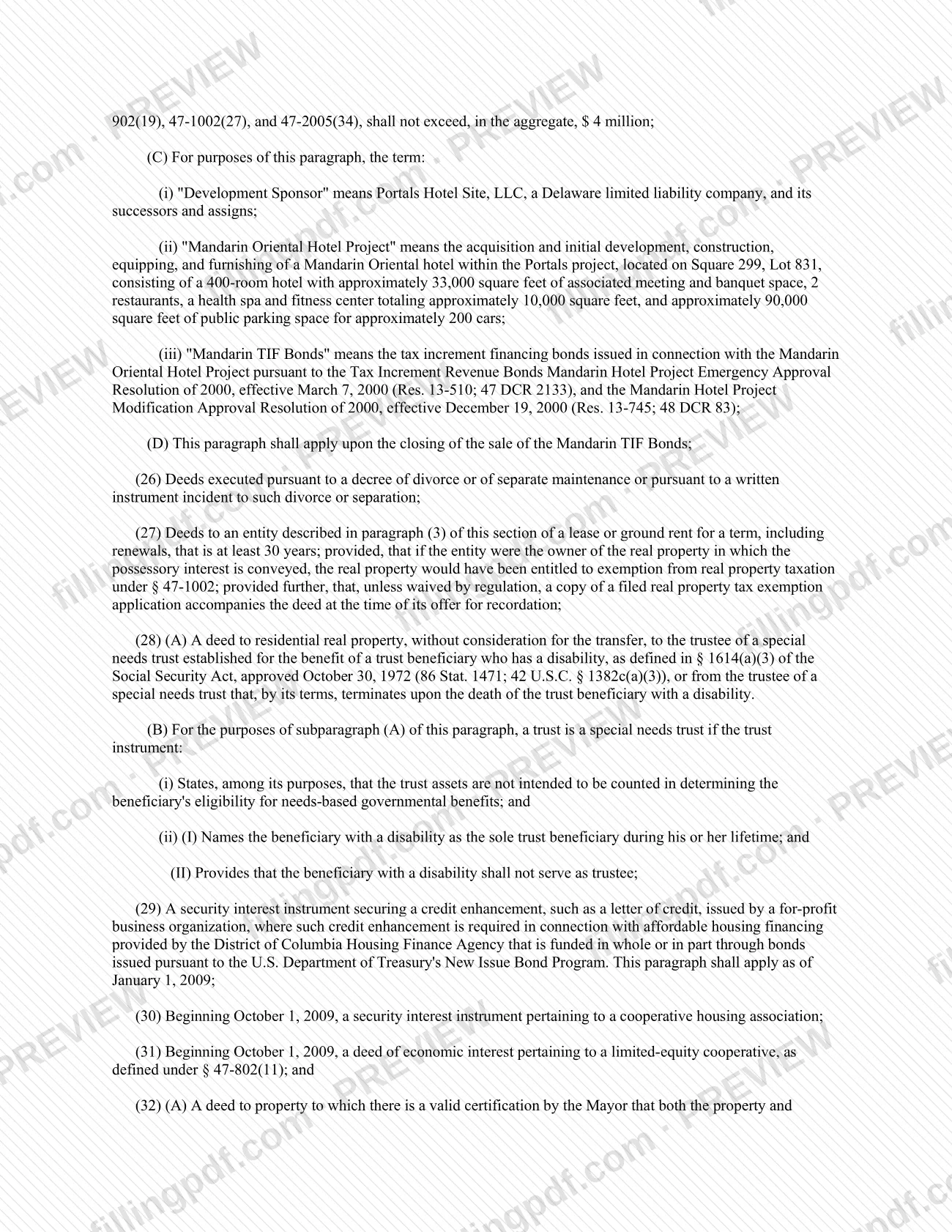
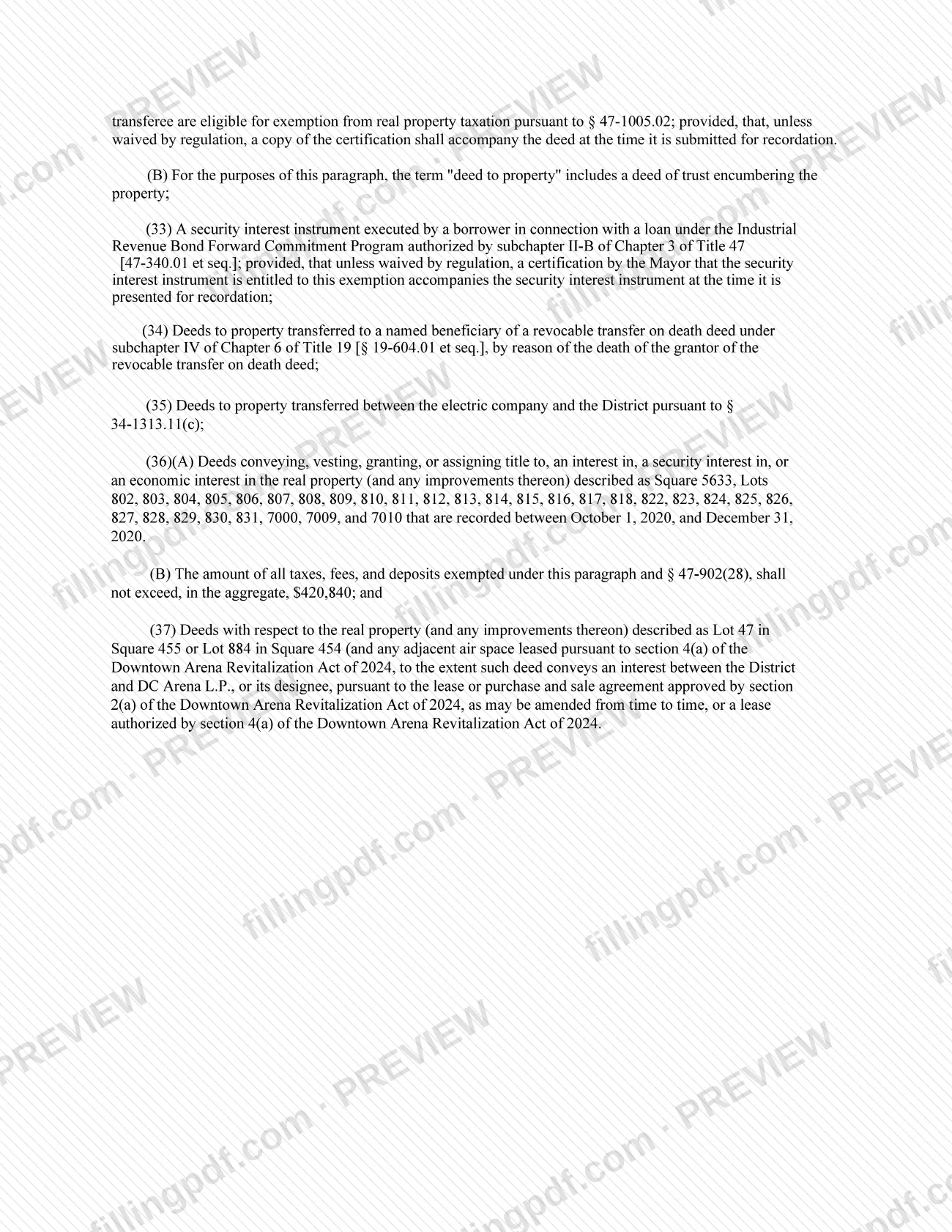
ROD 7 - Exemptions (Recordation) is the District of Columbia Office of Tax and Revenue (OTR) document that lists which deeds and security instruments are exempt from the recordation tax. Searches for DC property tax often lead here, but ROD 7 deals with the tax on recording deeds: its exemptions cover transfers between family members, deeds of release, revocable trust transfers, divorce decrees and more. On this page you can fill out the PDF online on FillingPDF and download or print it; the original is published by OTR on its ROD 7 page.
Last updated
What is ROD 7?
ROD 7 - Exemptions (Recordation) is the DC Office of Tax and Revenue (OTR) publication that lists the deeds and security instruments exempt from the recordation tax in the District of Columbia, with the conditions and accompanying papers some exemptions require.
The PDF is a numbered list of exemptions. Paragraphs (1) and (16) are marked repealed. The rest cover, among others:
- deeds to property acquired by the United States or the District of Columbia, unless Congress has authorized its taxation (paragraph 2);
- deeds to organizations entitled to real property tax exemption under § 47-1002 (paragraph 3);
- purchase money mortgages and deeds of trust recorded with the deed (paragraph 5);
- deeds between spouses, parent and child, grandparent and grandchild, or domestic partners without actual consideration (paragraph 7);
- tax deeds and deeds of release (paragraphs 8 and 9);
- transfers by a personal representative to a distributee (paragraph 10);
- revocable trust transfers (paragraphs 17 to 19);
- deeds executed under a divorce or separate maintenance decree (paragraph 26);
- special needs trust transfers of residential property (paragraph 28).
Several paragraphs name property, projects or housing programs specifically, such as lower income homeownership households, cooperative housing associations, resident management corporations and limited-equity cooperatives.
ROD 7 is not a tax return and not a bill. It identifies when no recordation tax is imposed and what must accompany the deed when it is offered for recordation.
Who needs to file ROD 7?
The main group is anyone offering a deed or security interest instrument for recordation in the District of Columbia who believes it falls within one of the listed exemptions. Each exemption has its own condition:
- Family transfers: deeds between spouses, parent and child, grandparent and grandchild, or domestic partners qualify only when made without actual consideration.
- Exempt organizations: deeds to an institution, organization, corporation or government entitled to exemption under § 47-1002 qualify, but not property exempt under § 47-1002(29) or § 47-1002(30).
- Estates: deeds of personal representatives acting under Title 20 transferring a decedent's real property to a distributee without additional consideration.
- Revocable trusts: a deed conveying bare legal title to the trustee where the transferor is the beneficiary and no consideration is given; a transfer to a beneficiary after the grantor's death; and a transfer by the trustee that would be exempt if made by the grantor.
- Divorce: deeds executed under a decree of divorce or separate maintenance, or a written instrument incident to it.
- Lenders and owners of Class 1 Property with no more than 5 dwelling units: security interest instruments, with an affidavit affixed.
Paragraphs 23 to 25 apply only to the specific properties and projects they describe.
When to file ROD 7
The triggering event is the moment a deed or security instrument is offered for recordation: that is when the paperwork supporting an exemption must accompany it. ROD 7 sets no calendar due date of its own.
Some timing rules appear in the exemptions themselves:
- Paragraphs (3), (4), (27) and (32) require specific papers to accompany the deed at the time of recordation or at the time it is offered for recordation.
- Under paragraph (22), a limited liability company relying on the exemption must notify the Recorder of Deeds within 30 days of any change to the members or interests in profits and losses during the 12-month period after the conversion's effective date.
- Paragraph (29) applies as of January 1, 2009, and paragraphs (30) and (31) apply beginning October 1, 2009.
Documents you need
- Copy of a filed real property tax exemption application, accompanying the deed, for exemptions under paragraph (3) or (27), unless waived by regulation.
- Return under oath showing the purposes for which the property was acquired, accompanying the deed, for property acquired under a special act of Congress (paragraph 4).
- Affidavit affixed to each security interest instrument claiming the Class 1 Property exemption with 5 or fewer units (paragraph 21).
- Copy of the Mayor's certification that the property and transferee are eligible for exemption under § 47-1005.02, accompanying the deed, unless waived by regulation (paragraph 32).
- Reference in a permanent loan deed of trust or mortgage to the construction loan deed of trust or mortgage, with its recording date and instrument number (paragraph 11).
How to fill out ROD 7
Open the ROD 7 PDF
Use the ROD 7 - Exemptions (Recordation) PDF on this page. It is a numbered list of exemptions, so the first task is identifying the one that fits your deed.
Find the matching exemption paragraph
Read the numbered paragraphs and pick the one describing your transfer, for example paragraph (7) for family deeds or paragraph (26) for divorce deeds. Paragraphs (1) and (16) are repealed.
Check the paragraph's conditions
Confirm every condition: no actual consideration for paragraph (7), a non-excluded exemption under § 47-1002 for paragraph (3), or the unit limit of 5 for paragraph (21).
Enter your details in the PDF
Complete any fillable fields that appear on your copy, and note the paragraph number of the exemption you claim.
Gather the accompanying papers
Prepare what your paragraph requires, such as the filed exemption application copy, sworn return, affidavit, Mayor's certification or construction-loan reference, as listed under Required documents.
Review and download the completed PDF
Check that the paragraph and papers match your deed, then download or print the completed PDF from FillingPDF and keep it with the deed for recordation.
How to submit ROD 7
ROD 7 names no filing portal, mailing address or fee of its own. Its text says that supporting papers go with the deed when it is offered for recordation, and it refers to the Recorder of Deeds in the notice rule for limited liability companies. In practice, the documents each exemption requires travel with the deed or instrument being recorded.
What to include depends on the exemption you claim:
- Paragraphs (3) and (27): a copy of a filed real property tax exemption application, unless waived by regulation.
- Paragraph (4): a return, under oath, showing the purposes for which the property was acquired.
- Paragraph (21): an affidavit affixed to each security interest instrument.
- Paragraph (32): a copy of the Mayor's certification, unless waived by regulation.
- Paragraph (11): a reference in the permanent loan deed to the construction loan deed and its recording date and instrument number.
For questions about how or where to record, contact OTR through its publication page for ROD 7 at https://otr.cfo.dc.gov/publication/rod-7-exemptions-recordation. FillingPDF lets you fill out and download the PDF; submission follows the agency's channels.
Common mistakes to avoid
- Offering a deed to an exempt organization under paragraph (3) or (27) without a copy of the filed real property tax exemption application, when no regulation waives it.
- Claiming the paragraph (3) exemption for property exempt under § 47-1002(29) or § 47-1002(30), which the paragraph excludes.
- Claiming the family-transfer exemption in paragraph (7) when actual consideration was given for the deed.
- Submitting a deed for property acquired under a special act of Congress without the sworn return stating the purposes of the acquisition.
- Claiming the paragraph (21) exemption without the affidavit affixed to the instrument, or for property with more than 5 dwelling units.
- Recording a permanent loan deed of trust or mortgage without a reference to the construction loan instrument's recording date and instrument number.
- Failing to notify the Recorder of Deeds within 30 days of a change in members or profit interests of a limited liability company relying on paragraph (22).
- Claiming paragraph (32) without a copy of the Mayor's certification accompanying the deed, when no regulation waives it.
Frequently asked questions
What is ROD 7 - Exemptions (Recordation)?
ROD 7 is a DC Office of Tax and Revenue document listing the deeds and security instruments exempt from recordation tax in the District of Columbia. It also states the papers some exemptions require, such as a sworn return or an affidavit, when the deed is offered for recordation.
Is ROD 7 the same as a DC property tax exemption?
No. ROD 7 concerns exemption from the tax on recording deeds, not the annual DC property tax. It does refer to real property tax exemption, though: paragraph (3) covers deeds to organizations entitled to exemption under § 47-1002 and requires a copy of the filed application.
Are deeds between family members exempt under ROD 7?
Yes, in limited cases. Paragraph (7) exempts deeds between spouses, parent and child, grandparent and grandchild, or domestic partners, but only without actual consideration for the transfer. Deeds executed under a divorce decree fall under paragraph (26).
What do I attach to claim an exemption for a nonprofit or government buyer?
For paragraph (3), a copy of a filed real property tax exemption application must accompany the deed at recordation, unless waived by regulation. Paragraph (27), for long leases and ground rents, has the same requirement. Paragraph (4) instead requires a return under oath.
Are transfers into a revocable trust exempt?
Yes, if the conditions are met. Paragraph (17) exempts a deed conveying bare legal title to the trustee without consideration where the transferor is the beneficiary. Paragraphs (18) and (19) cover transfers to beneficiaries after the grantor's death and transfers by the trustee.
Do I need an affidavit for a mortgage on a small residential property?
Yes, if you claim paragraph (21). Each security interest instrument for Class 1 Property with no more than 5 dwelling units must have an affidavit affixed, certifying the property is Class 1 Property with 5 or fewer units, under criminal penalties for false statements.
What is the 30-day notice for limited liability companies?
Under paragraph (22), a limited liability company relying on the exemption must notify the Recorder of Deeds within 30 days of any change to its members or interests in profits and losses during the 12 months after the conversion's effective date, so the recordation tax can be imposed.
Can I fill out ROD 7 online on FillingPDF?
You can fill out the PDF online on FillingPDF and download or print it. FillingPDF is an independent service, not affiliated with OTR, and does not file or record anything; supporting papers go with the deed through the agency's recording process.
Ready to fill out ROD 7?
Fill out ROD 7 now