
ROD 9, Lower Income Homeownership Exemption Program, is the application the District of Columbia Office of Tax and Revenue (OTR) uses to grant the lower income and shared equity homeownership exemption under D.C. Law 5-31. It is one of the DC property tax forms, and a qualifying household that is approved has its real property taxes abated for the first five years in the home, depending on when it applies. Individual buyers, non-profit organizations, shared equity investors and cooperative housing associations each complete different parts of it. On FillingPDF you can fill out ROD 9 online and download or print the completed PDF; the original form is published by OTR.
Last updated
What is ROD 9?
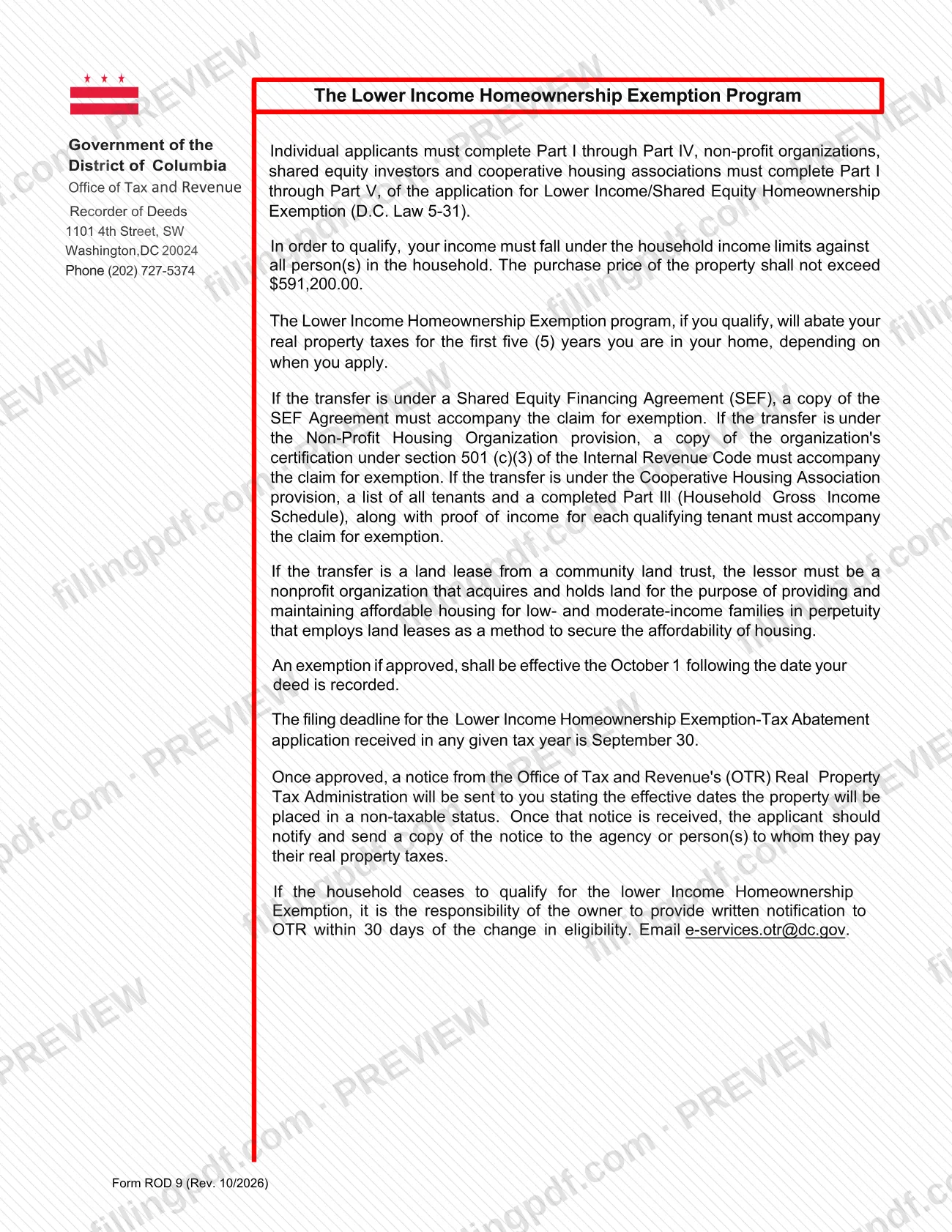
ROD 9, Lower Income Homeownership Exemption Program, is the District of Columbia Office of Tax and Revenue (OTR) application for the lower income and shared equity homeownership exemption (D.C. Law 5-31), which abates real property taxes on the home.
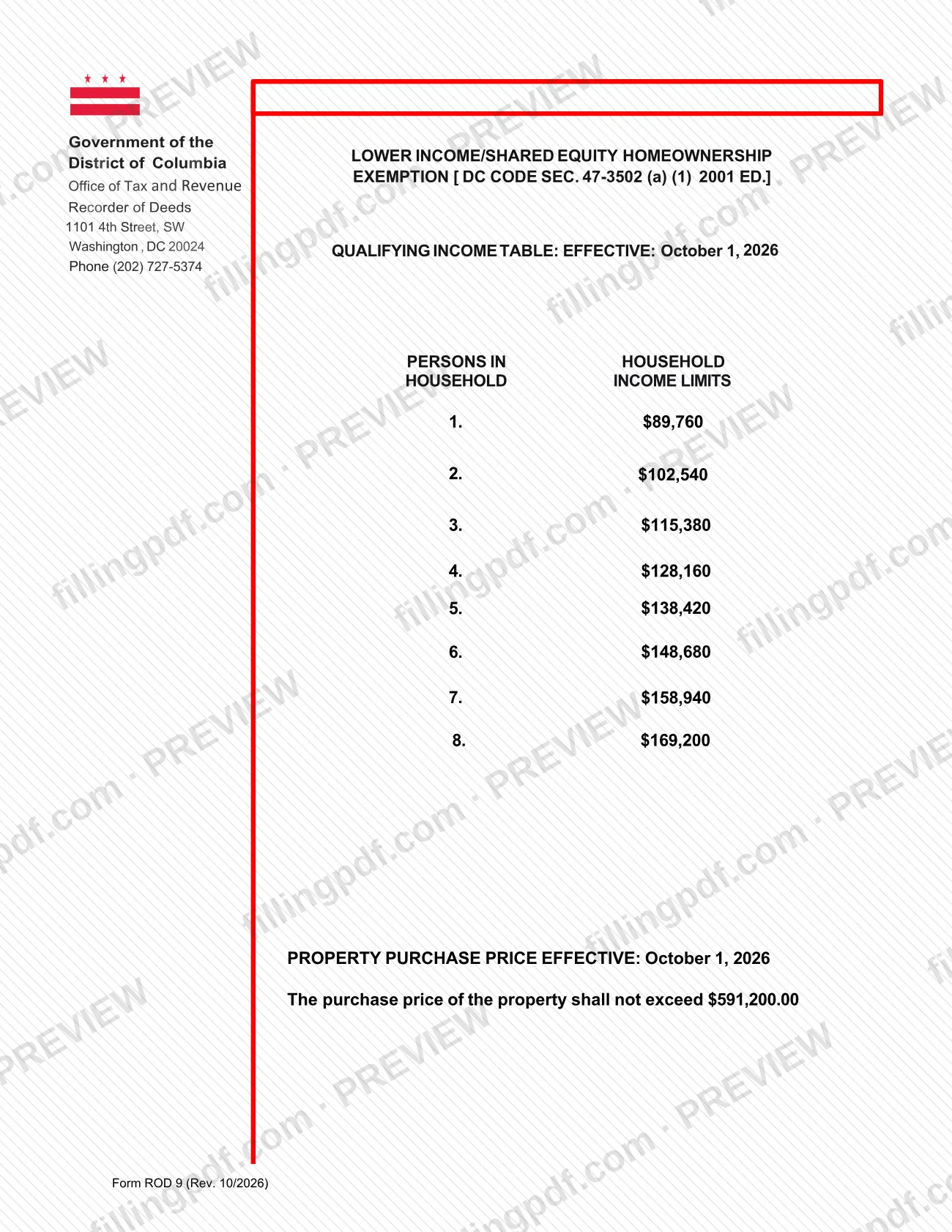
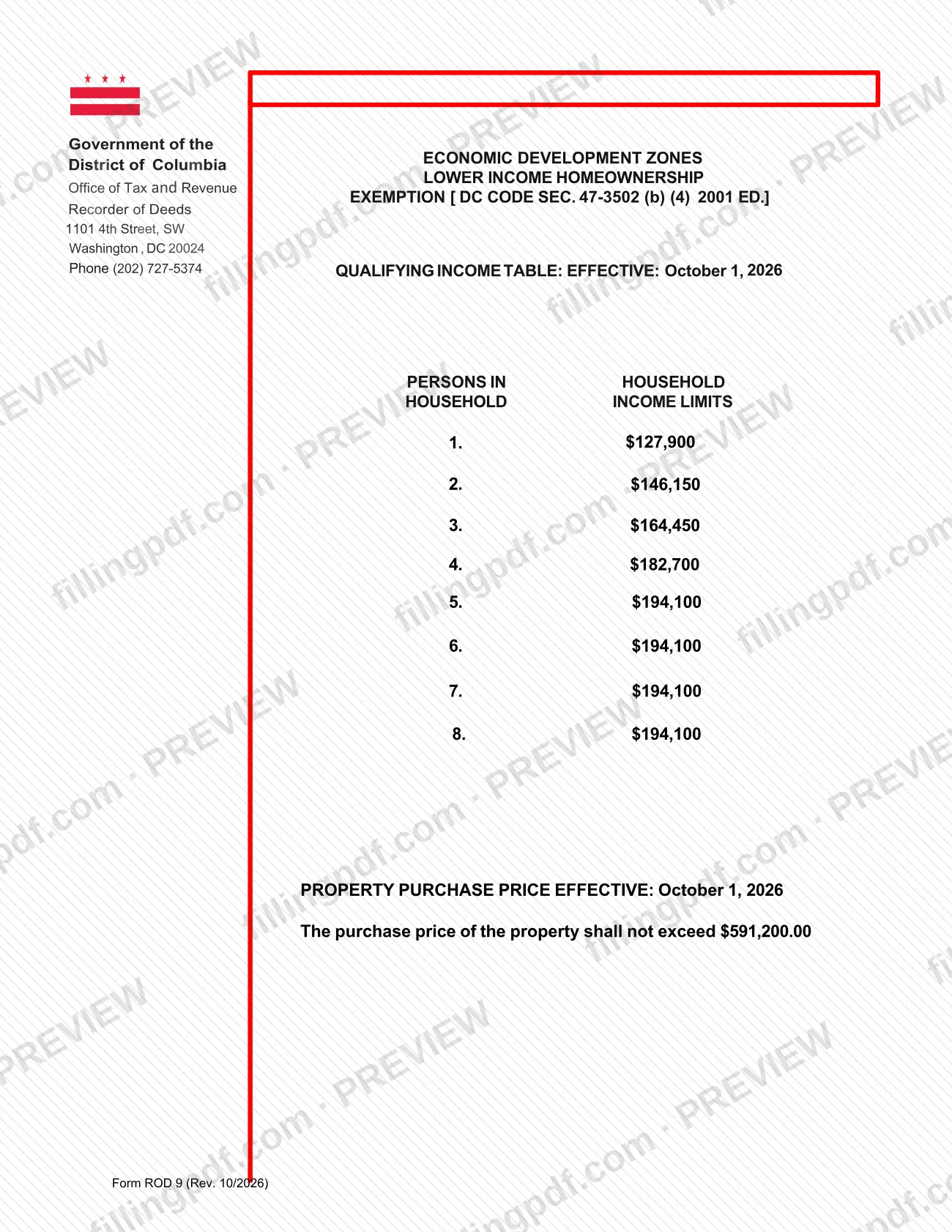
If you qualify, the program abates your real property taxes for the first five years you are in your home, depending on when you apply. To qualify, household income must fall under the household income limits for the number of persons in the household, and the purchase price of the property must not exceed the limit printed on the form. The form carries two qualifying income tables effective October 1, 2026: one for the lower income/shared equity exemption (D.C. Code Sec. 47-3502 (a) (1), 2001 Ed.) and one for economic development zones (D.C. Code Sec. 47-3502 (b) (4), 2001 Ed.).
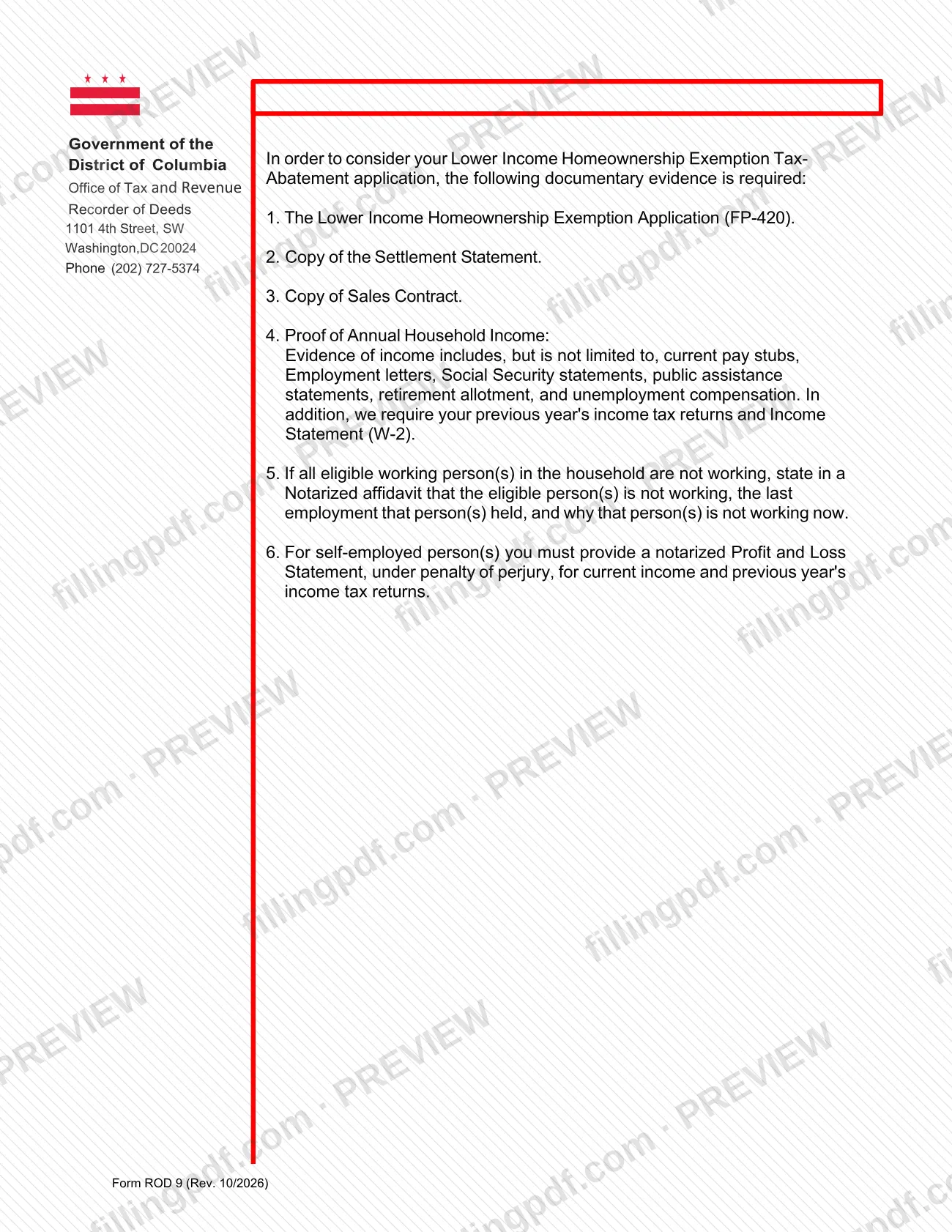
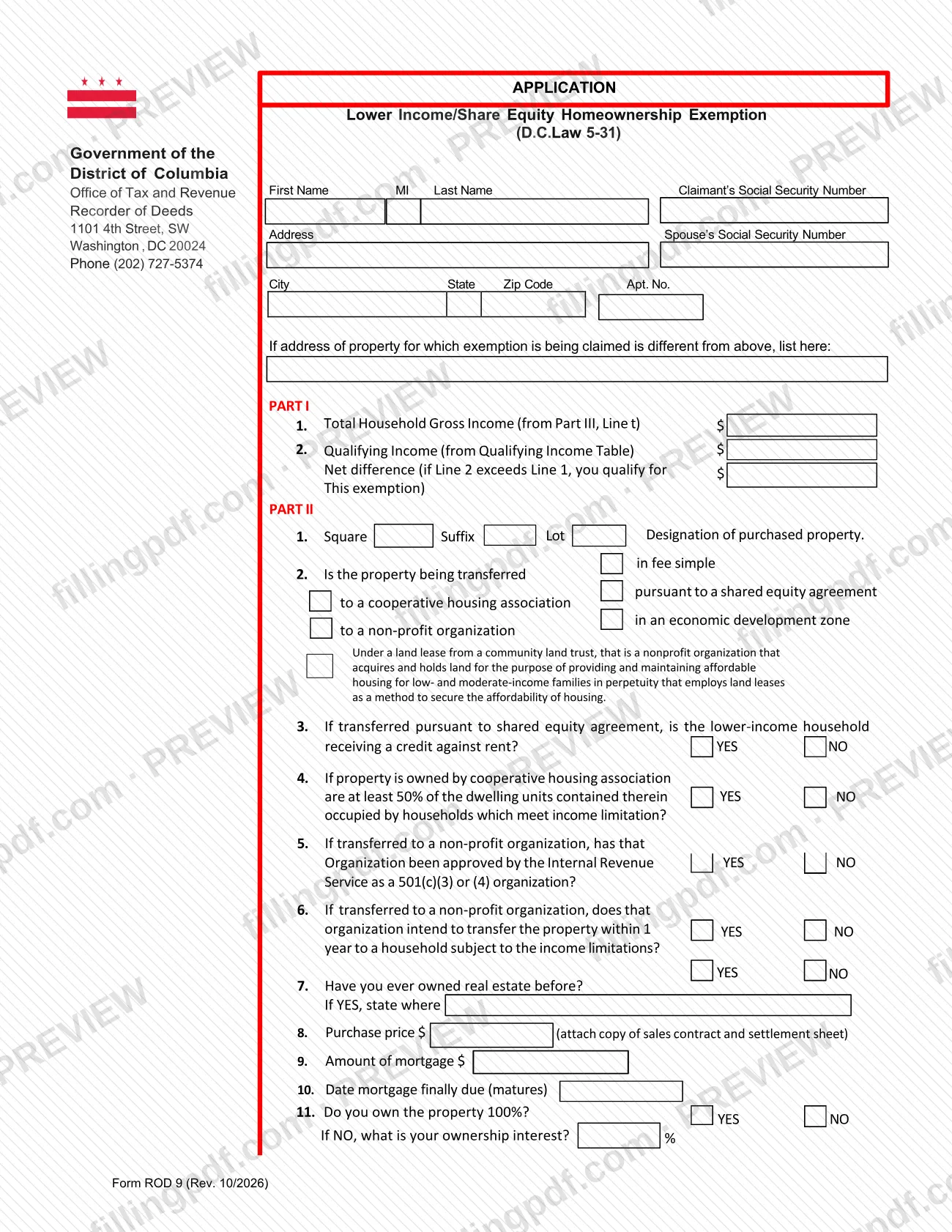
The package has an application page with Part I (income test), Part II (the property and the transfer), Part III (Household Gross Income Schedule), a list of household residents other than the claimant, and a sworn signature block. Part V holds certifications for non-profit organizations, shared equity investors and cooperative housing associations. The checklist page refers to the application as the Lower Income Homeownership Exemption Application (FP-420).
An approved exemption takes effect on the October 1 following the date your deed is recorded.
Who needs to file ROD 9?
Buyers who want the lower income homeownership exemption on a home they purchase file ROD 9, provided household income is under the limit for their household size and the purchase price is within the limit printed on the form. Individual applicants complete Part I through Part IV.
Non-profit organizations, shared equity investors and cooperative housing associations complete Part I through Part V. Part II, line 2 identifies the kind of transfer:
- in fee simple;
- pursuant to a shared equity agreement;
- to a cooperative housing association;
- in an economic development zone;
- to a non-profit organization;
- under a land lease from a community land trust, where the lessor is a nonprofit that acquires and holds land to provide and maintain affordable housing for low- and moderate-income families in perpetuity and uses land leases to secure that affordability.
The income you report must cover all members living in the household you own or rent. Where the property sits in an economic development zone, the form has its own qualifying income table. If your household stops qualifying later, the owner must notify OTR in writing.
When to file ROD 9
The filing deadline for a Lower Income Homeownership Exemption-Tax Abatement application received in any given tax year is September 30. An approved exemption is effective the October 1 following the date your deed is recorded, so the date of recording matters for when the abatement starts.
After approval, OTR's Real Property Tax Administration sends a notice stating the effective dates the property is placed in a non-taxable status. Send a copy of that notice to the agency or person to whom you pay your real property taxes.
If the household ceases to qualify, the owner must notify OTR in writing within 30 days of the change in eligibility, by email to [email protected].
Documents you need
- Copy of the Settlement Statement for the purchase of the property.
- Copy of the Sales Contract; the form also asks you to attach it, with the settlement sheet, next to the purchase price on Part II, line 8.
- Proof of annual household income, such as current pay stubs, employment letters, Social Security statements, public assistance statements, retirement allotment or unemployment compensation; the list is not limited to these.
- Previous year's income tax returns and Income Statement (W-2), required in addition to the proof of current income.
- Notarized affidavit, if all eligible working persons in the household are not working, stating that they are not working, the last employment held and why they are not working now.
- Notarized Profit and Loss Statement, under penalty of perjury, for current income, plus previous year's income tax returns, for self-employed persons.
- Copy of the Shared Equity Financing (SEF) Agreement, if the transfer is under a Shared Equity Financing Agreement.
- Copy of the organization's certification under section 501 (c)(3) of the Internal Revenue Code, if the transfer is under the Non-Profit Housing Organization provision.
- List of all tenants, a completed Part III (Household Gross Income Schedule) and proof of income for each qualifying tenant, if the transfer is under the Cooperative Housing Association provision.
How to fill out ROD 9
Enter claimant and property address
At the top of the application, enter the claimant's first name, middle initial and last name, Social Security number, spouse's Social Security number, address, city, state, ZIP code and apartment number. If the property for which you claim the exemption has a different address, list it in the line provided.
Identify the property in Part II
On line 1, enter the square, suffix and lot designation of the purchased property. On line 2, mark how the property is being transferred: in fee simple, under a shared equity agreement, to a cooperative housing association, in an economic development zone, to a non-profit organization, or under a land lease from a community land trust.
Answer the transfer-specific questions
Answer lines 3 to 6 only if they match your transfer: line 3 for a shared equity agreement (credit against rent), line 4 for a cooperative housing association (at least 50% of units occupied by households within the income limits), and lines 5 and 6 for a non-profit organization (501(c)(3) or (4) approval and intent to transfer within 1 year).
Complete purchase and ownership details
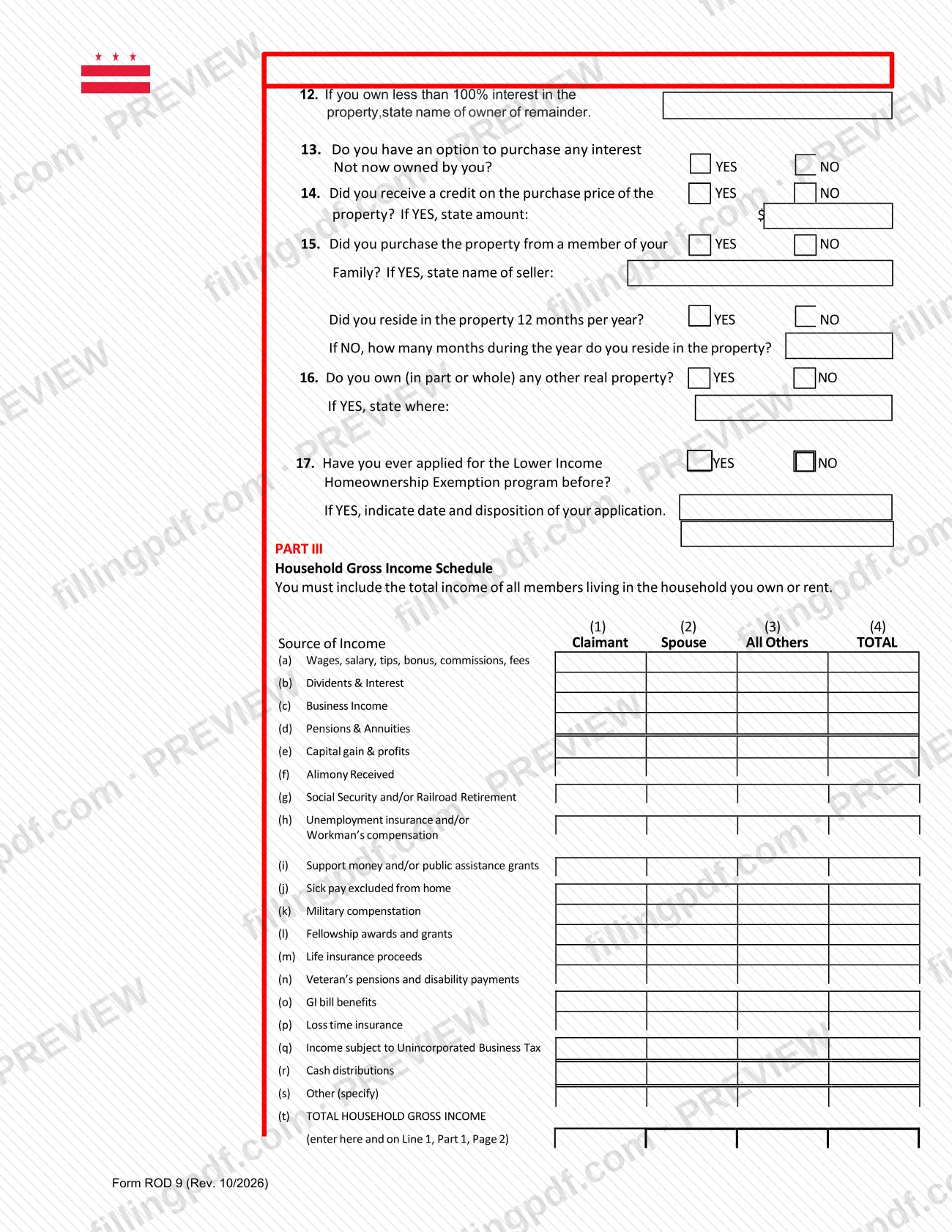
Answer lines 7 to 17: prior real estate ownership, purchase price (line 8), mortgage amount and maturity date (lines 9 and 10), your ownership percentage and any other owner (lines 11 and 12), purchase options, credits, family sellers and months of residence. Also tell whether you own other real property and whether you applied for the program before.
Fill in the Household Gross Income Schedule
In Part III, enter income for each source (a) through (s) in the Claimant, Spouse and All Others columns, then the TOTAL column. Line (t) is the TOTAL HOUSEHOLD GROSS INCOME; use "Other (specify)" on line (s) for income not listed.
List other household residents
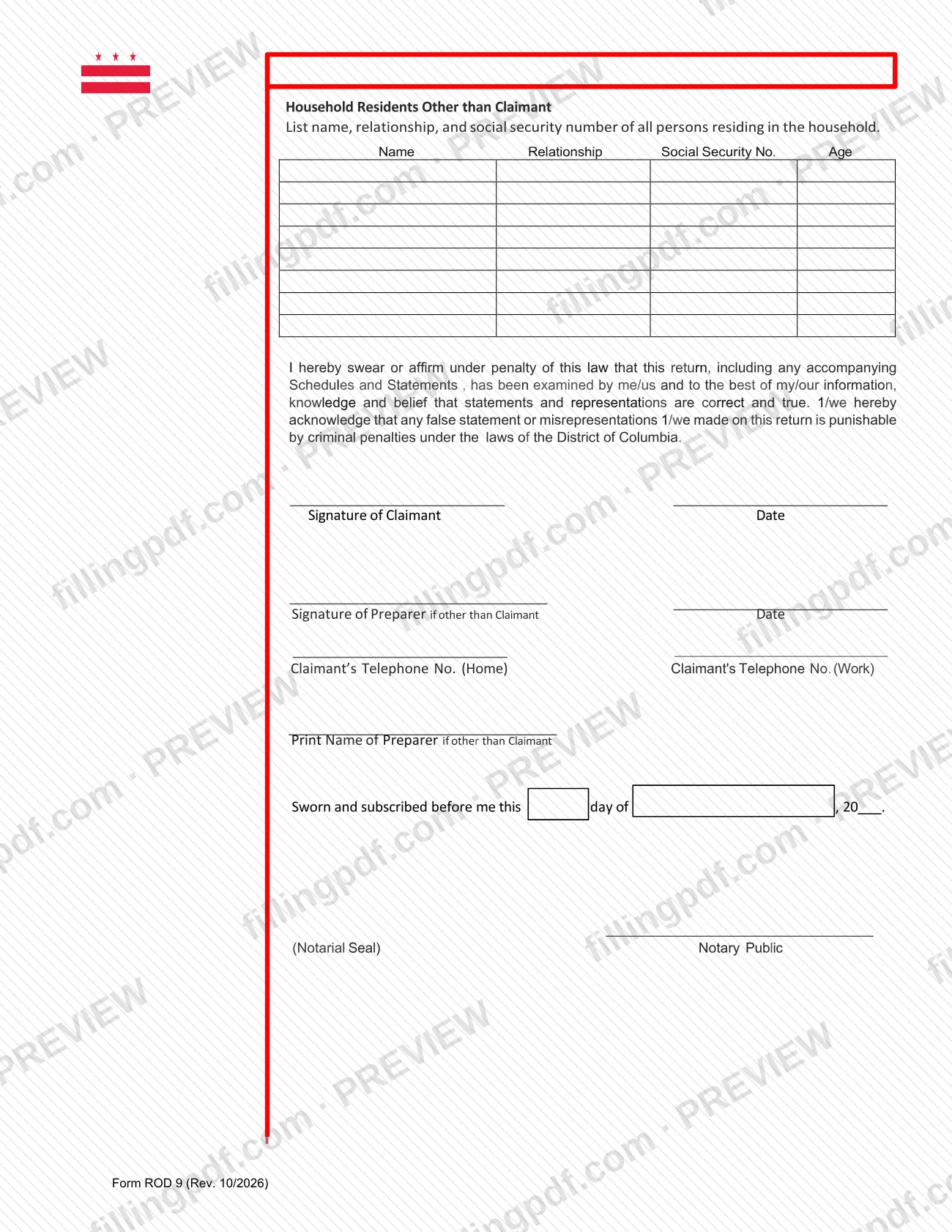
Under Household Residents Other than Claimant, list the name, relationship, Social Security number and age of every other person residing in the household.
Complete the Part I income test
On Part I, line 1, enter the Total Household Gross Income from Part III, line (t). On line 2, enter the qualifying income from the Qualifying Income Table for your household size, then the net difference; the form says that if line 2 exceeds line 1 you qualify for the exemption.
Sign, date and have the oath notarized
The claimant signs and dates the sworn statement and gives home and work telephone numbers; a preparer other than the claimant signs and prints their name. The "Sworn and subscribed before me" block, with notarial seal, is completed by a notary public.
Complete Part V if you are an organization
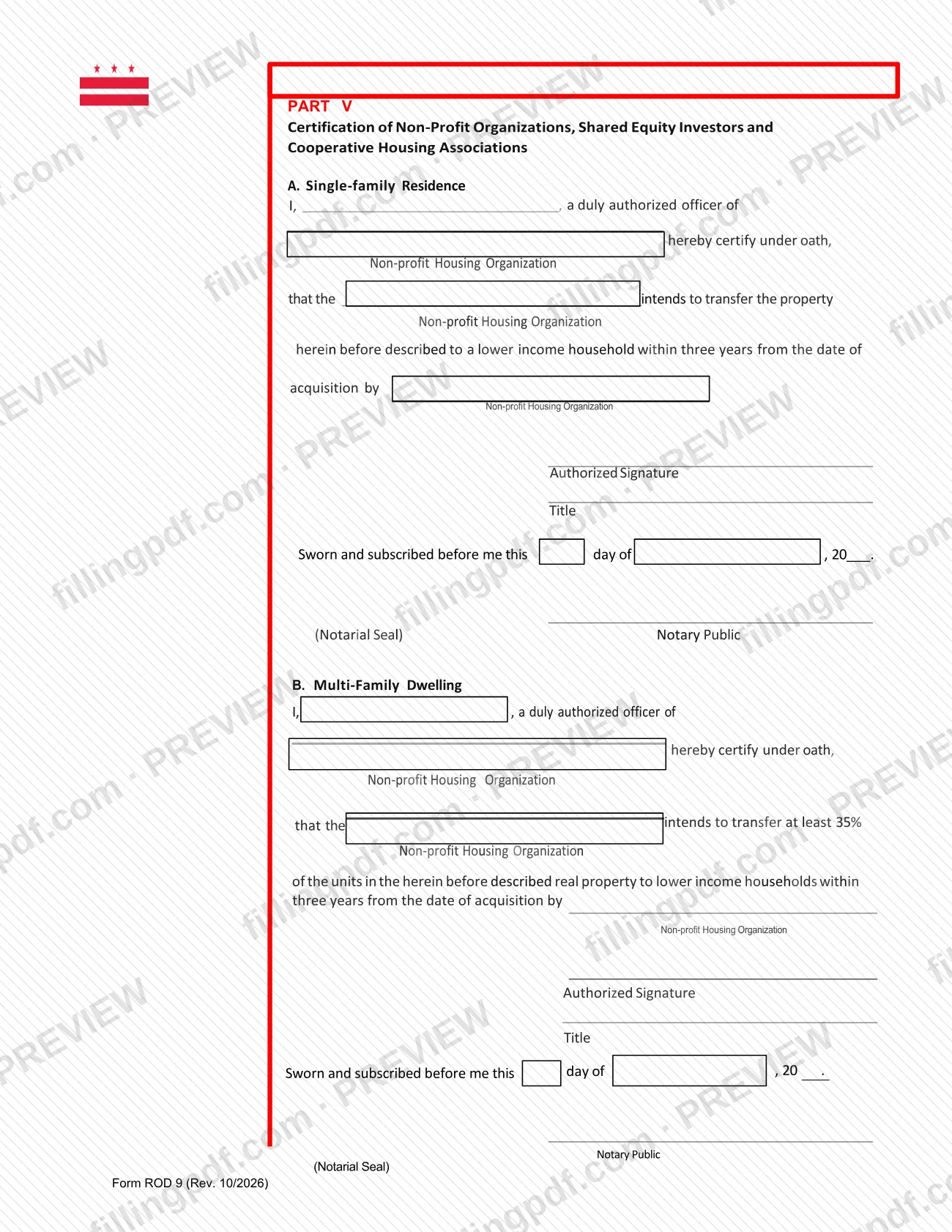
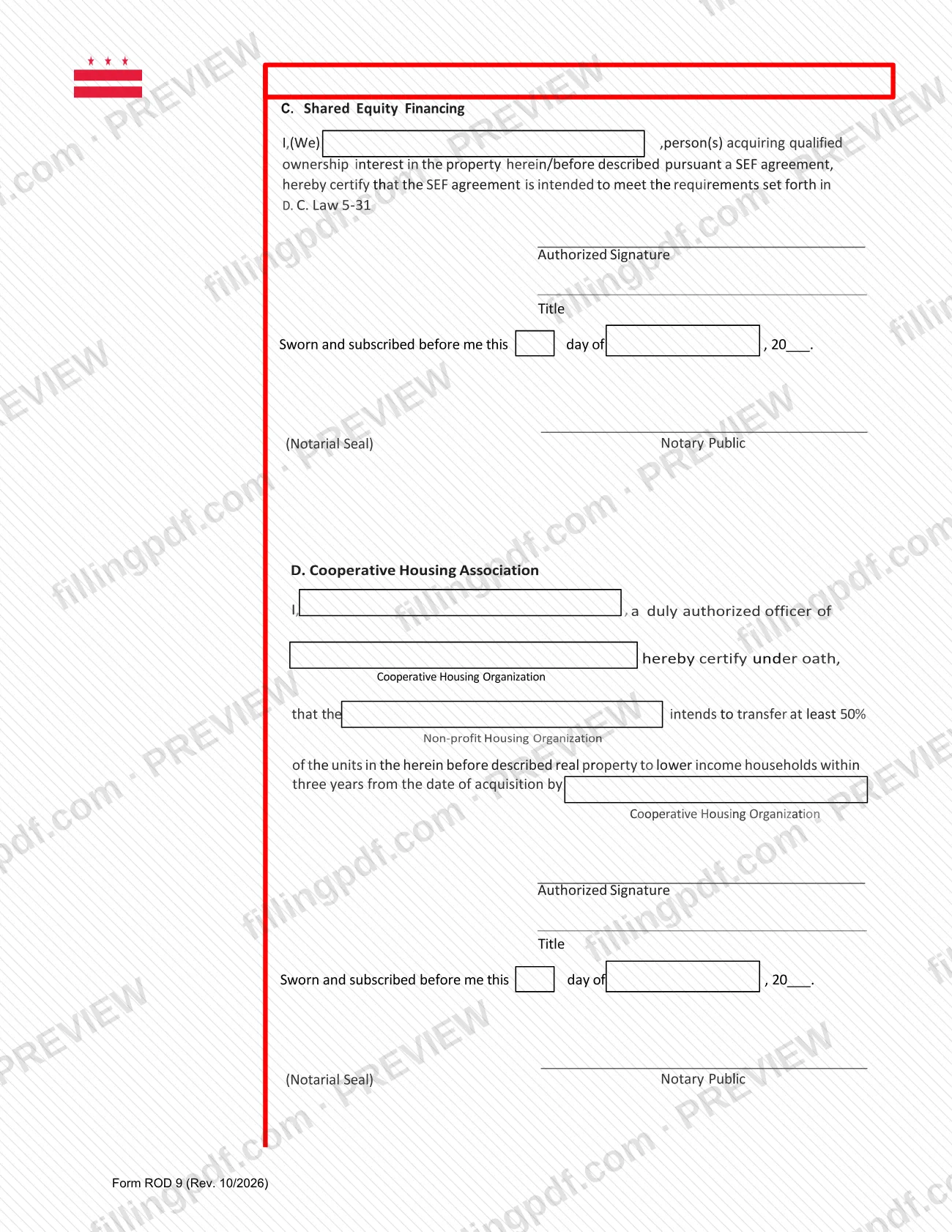
Non-profit organizations, shared equity investors and cooperative housing associations complete the certification that applies: A (single-family residence), B (multi-family dwelling), C (shared equity financing) or D (cooperative housing association), each signed with title and notarized.
Review, download and assemble the package
Check every line and that the income total in Part III matches Part I. Download or print the completed PDF from FillingPDF, then assemble it with the documents listed under required documents as described under How to submit.
How to submit ROD 9
The form does not name a filing channel of its own. Every page carries the letterhead of the Office of Tax and Revenue, Recorder of Deeds, 1101 4th Street, SW, Washington, DC 20024, phone (202) 727-5374; contact that office to confirm how and where to deliver the application and its supporting documents.
Whatever channel you use, assemble the package the checklist page asks for: the signed and notarized application, the settlement statement, the sales contract, proof of annual household income and any affidavit or statement that applies to your situation. Transfers under a shared equity agreement, to a non-profit organization or to a cooperative housing association need the extra documents listed under required documents.
Only the notice of a change in eligibility has an email address: [email protected]. Use it within 30 days after the household stops qualifying.
FillingPDF lets you fill out and download the PDF; submission follows the channels above.
Common mistakes to avoid
- Missing the September 30 filing deadline for the tax year in which the application is received.
- Leaving out the settlement statement or sales contract; the checklist lists both as required evidence.
- Reporting only the claimant's income in Part III; the schedule must include the total income of all members living in the household you own or rent.
- Submitting proof of current income without the previous year's income tax returns and W-2, which the checklist requires in addition.
- Not including a notarized affidavit when all eligible working persons in the household are not working.
- Self-employed applicants sending a Profit and Loss Statement that is not notarized or not made under penalty of perjury.
- Filing a shared equity, non-profit or cooperative transfer without the SEF Agreement, the 501(c)(3) certification, or the tenant list with Part III and proof of income.
- Using the wrong qualifying income table, for example the standard table for a property in an economic development zone.
- Not sending the OTR approval notice to the agency or person to whom you pay real property taxes.
- Failing to notify OTR in writing within 30 days after the household stops qualifying.
Frequently asked questions
What is ROD 9 used for?
ROD 9 is the application for the Lower Income Homeownership Exemption from the DC Office of Tax and Revenue. If you qualify, it abates your real property taxes for the first five years you are in your home, depending on when you apply.
What is the deadline to file the Lower Income Homeownership Exemption application?
September 30 is the filing deadline for an application received in any given tax year. An approved exemption is effective the October 1 following the date your deed is recorded.
Who qualifies for the DC lower income homeownership exemption?
Households whose income falls under the household income limit for the number of persons in the household, buying a property whose price does not exceed the limit printed on ROD 9. The form has a separate income table for economic development zones.
What documents do I need to send with ROD 9?
The settlement statement, the sales contract, proof of annual household income, and the previous year's tax returns and W-2. Depending on your case, you also need a notarized affidavit, a notarized Profit and Loss Statement, the SEF Agreement, a 501(c)(3) certification or a tenant list.
Who completes Part V of ROD 9?
Non-profit organizations, shared equity investors and cooperative housing associations complete Part I through Part V. Individual applicants complete only Part I through Part IV.
What happens if my household stops qualifying for the exemption?
The owner must notify OTR in writing within 30 days of the change in eligibility. The form directs you to email [email protected].
What do I do after OTR approves my exemption?
OTR's Real Property Tax Administration sends a notice with the effective dates the property is placed in a non-taxable status. Send a copy of that notice to the agency or person to whom you pay your real property taxes.
Can I fill out ROD 9 online on FillingPDF?
Yes. You can fill out the fillable PDF online on FillingPDF and download or print it. FillingPDF is an independent service and does not file the application with OTR; you deliver it through OTR's channels.
Ready to fill out ROD 9?
Fill out ROD 9 now