
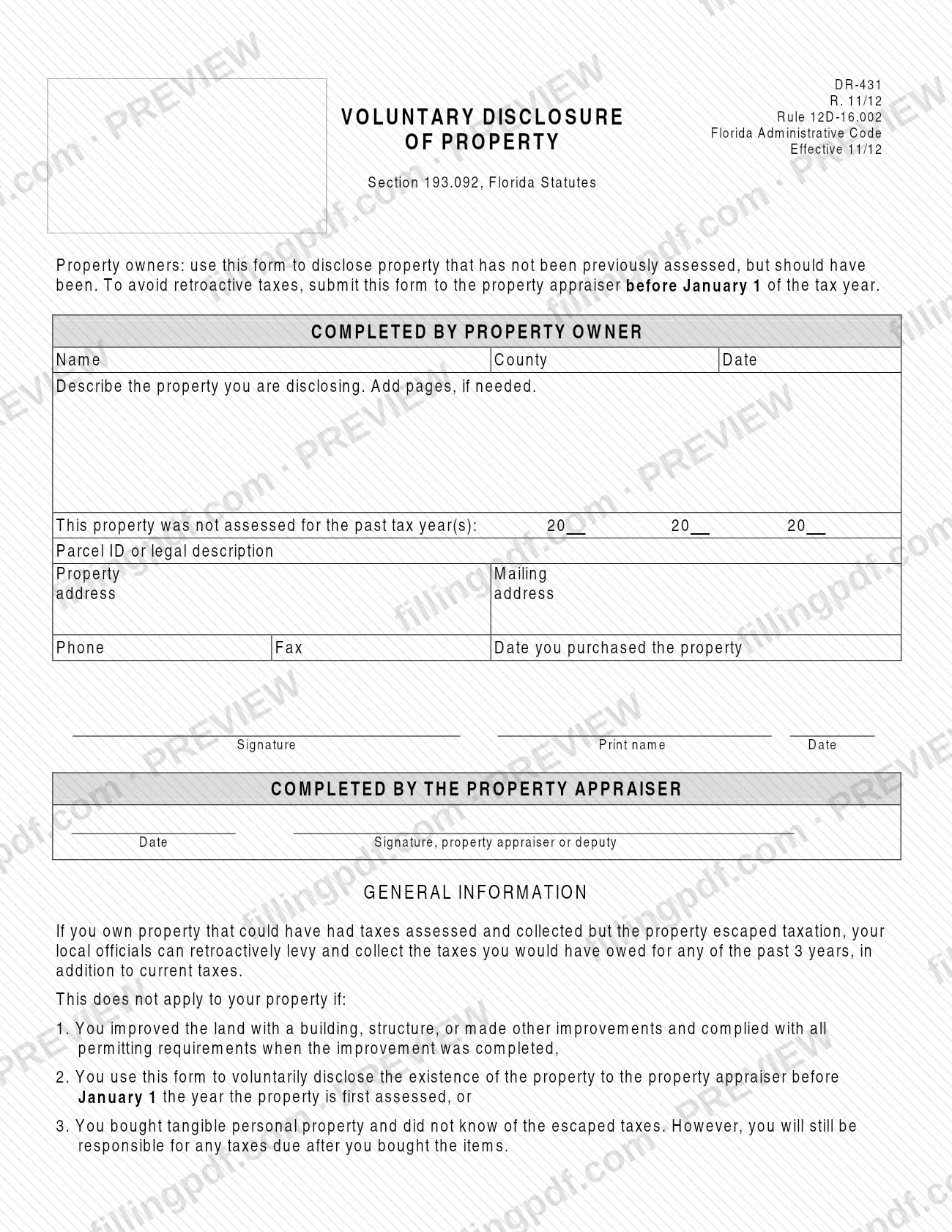
Form DR-431, Voluntary Disclosure of Property, is the form a property owner submits to the property appraiser to disclose property that has not been previously assessed but should have been. It is one of the Alachua County property tax forms published on the Alachua County Property Appraiser website, and it is printed under Rule 12D-16.002, Florida Administrative Code. On this page you can fill out the form online on FillingPDF and download or print the completed PDF; the form itself is published by the property appraiser at the official URL below.
Last updated
What is DR-431?
Form DR-431, Voluntary Disclosure of Property, is the form property owners use to disclose to the property appraiser property that has not been previously assessed but should have been, under Rule 12D-16.002, Florida Administrative Code, and Section 193.092, Florida Statutes.
The form is printed with the revision mark R. 11/12 and an effective date of 11/12. The owner completes the top block: name, county, date, a description of the property, the tax years in which it was not assessed, the parcel ID or legal description, the property and mailing addresses, phone, fax, the date the property was purchased, and a signature. A second block, "Completed by the property appraiser," carries the appraiser's date and signature.
Its purpose is stated on the form. Property that escaped taxation can be taxed retroactively: local officials can levy and collect the taxes the owner would have owed for any of the past 3 years, in addition to current taxes. Submitting this form to the property appraiser before January 1 of the tax year is how the owner avoids those retroactive taxes.
The form also lists three situations in which the retroactive rule does not apply to your property. They are described under "Who needs to file it."
Who needs to file DR-431?
Property owners use Form DR-431 when they own property that has not been previously assessed but should have been, and they want to disclose it to the property appraiser themselves.
The General Information on the form says the retroactive-tax rule does not apply to your property in these cases:
- You improved the land with a building, structure or other improvements and complied with all permitting requirements when the improvement was completed.
- You use this form to voluntarily disclose the existence of the property to the property appraiser before January 1 of the year the property is first assessed.
- You bought tangible personal property and did not know of the escaped taxes. You are still responsible for any taxes due after you bought the items.
The owner completes the form and signs it. The property appraiser or a deputy completes only the block marked "Completed by the property appraiser." The form does not describe filing on behalf of another owner.
When to file DR-431
Submit Form DR-431 to the property appraiser before January 1 of the tax year to avoid retroactive taxes. The form's General Information repeats the point for newly assessed property: disclosure before January 1 of the year the property is first assessed means the retroactive rule does not apply.
If property escaped taxation and is not disclosed in time, local officials can retroactively levy and collect the taxes you would have owed for any of the past 3 years, in addition to current taxes. The form has space to list up to three tax years in which the property was not assessed. The form prints no other deadline.
Documents you need
- Additional pages describing the property, only if the description space on the form is not enough; the form says to add pages, if needed.
How to fill out DR-431
Enter your name, county and date
In the COMPLETED BY PROPERTY OWNER block, write your name, the county and today's date.
Describe the property
Under "Describe the property you are disclosing," explain what the property is. Add pages if you need more room.
List the unassessed tax years
On the line "This property was not assessed for the past tax year(s)," enter the years, up to the three spaces printed as 20__.
Enter the parcel ID or legal description
Write the parcel ID or the legal description of the property you are disclosing.
Enter the property and mailing addresses
Give the property address and, in the next space, your mailing address.
Add phone, fax and purchase date
Enter your phone and fax numbers and the date you purchased the property.
Sign, print your name and date
Sign the form, print your name and enter the date in the owner block.
Leave the appraiser block blank
Do not complete the date and signature under COMPLETED BY THE PROPERTY APPRAISER; the property appraiser or a deputy completes it.
Review and download the completed PDF
Check the parcel ID, the listed years and your signature, then download or print the completed PDF from FillingPDF and submit it to the property appraiser before January 1 of the tax year.
How to submit DR-431
Form DR-431 is submitted to the property appraiser, and the form says to do so before January 1 of the tax year. It prints no mailing address, portal or office hours, so confirm the delivery method with the Alachua County Property Appraiser, which publishes the form.
- Complete the owner block. Enter your name, county and date, describe the property, list the unassessed tax years, and sign and print your name.
- Add pages if needed. The form says to add pages if the description does not fit.
- Leave the appraiser block alone. The date and signature under "Completed by the property appraiser" are for the property appraiser or a deputy.
Keep a copy of what you submit. FillingPDF lets you fill out and download the PDF; submission follows the property appraiser's channels.
Common mistakes to avoid
- Submitting the form on or after January 1 of the tax year and expecting to avoid retroactive taxes; the form says to submit before January 1.
- Leaving out the tax years in which the property was not assessed; the form asks you to list them.
- Giving no parcel ID or legal description, so the property appraiser cannot tell which property you are disclosing.
- Writing in the block marked "Completed by the property appraiser"; the date and signature there are for the appraiser or a deputy.
- Sending the form unsigned or without your printed name and the date in the owner block.
- Assuming improvements are covered by the exemption when permitting requirements were not met; the exclusion applies only if you complied with all of them.
- Assuming a purchase of tangible personal property removes later taxes; you remain responsible for taxes due after you bought the items.
- Not adding pages when the property description does not fit in the space provided.
Frequently asked questions
What is Form DR-431 used for?
Form DR-431, Voluntary Disclosure of Property, is used by property owners to disclose to the property appraiser property that has not been previously assessed but should have been. Disclosing it before January 1 of the tax year is how the owner avoids retroactive taxes.
When do I have to submit Form DR-431 to avoid retroactive taxes?
Before January 1 of the tax year. The form says to submit it to the property appraiser before that date to avoid retroactive taxes. It prints no other deadline.
How many years back can unassessed property be taxed?
Local officials can retroactively levy and collect the taxes you would have owed for any of the past 3 years, in addition to current taxes. The form has room to list up to three tax years in which the property was not assessed.
Does the retroactive tax rule always apply to unassessed property?
No. The form says it does not apply if you improved the land and met all permitting requirements, if you disclose the property before January 1 of the year it is first assessed, or if you bought tangible personal property without knowing of the escaped taxes.
Who signs Form DR-431?
The property owner signs the owner block and prints their name and the date. The property appraiser or a deputy dates and signs the separate block marked "Completed by the property appraiser."
Where do I send Form DR-431?
To the property appraiser. The form gives no address or portal, so ask the Alachua County Property Appraiser, which publishes the form, how it accepts submissions.
Can I fill out Form DR-431 online?
You can fill out the PDF online on FillingPDF and download or print it. FillingPDF is an independent service and does not submit the form; you deliver it to the property appraiser yourself.
What if the property description doesn't fit on the form?
Add pages. The form says to add pages, if needed, under the instruction to describe the property you are disclosing.
Ready to fill out DR-431?
Fill out DR-431 now