
Form DR-570, Application for Homestead Tax Deferral, is the form a homeowner submits to the tax collector to defer payment of part or all of the ad valorem taxes and non-ad valorem assessments on a homestead. This copy is published by the Alachua County Tax Collector and is one of the Alachua County property tax forms for homeowners who qualify for the homestead exemption. On this page you can fill out the form online on FillingPDF and download or print the completed PDF; the original is published by the tax collector at alachuacollector.com.
Last updated
What is DR-570?
Form DR-570, Application for Homestead Tax Deferral, is the form a homeowner uses to ask the tax collector to defer part or all of the ad valorem taxes and non-ad valorem assessments on a homestead.
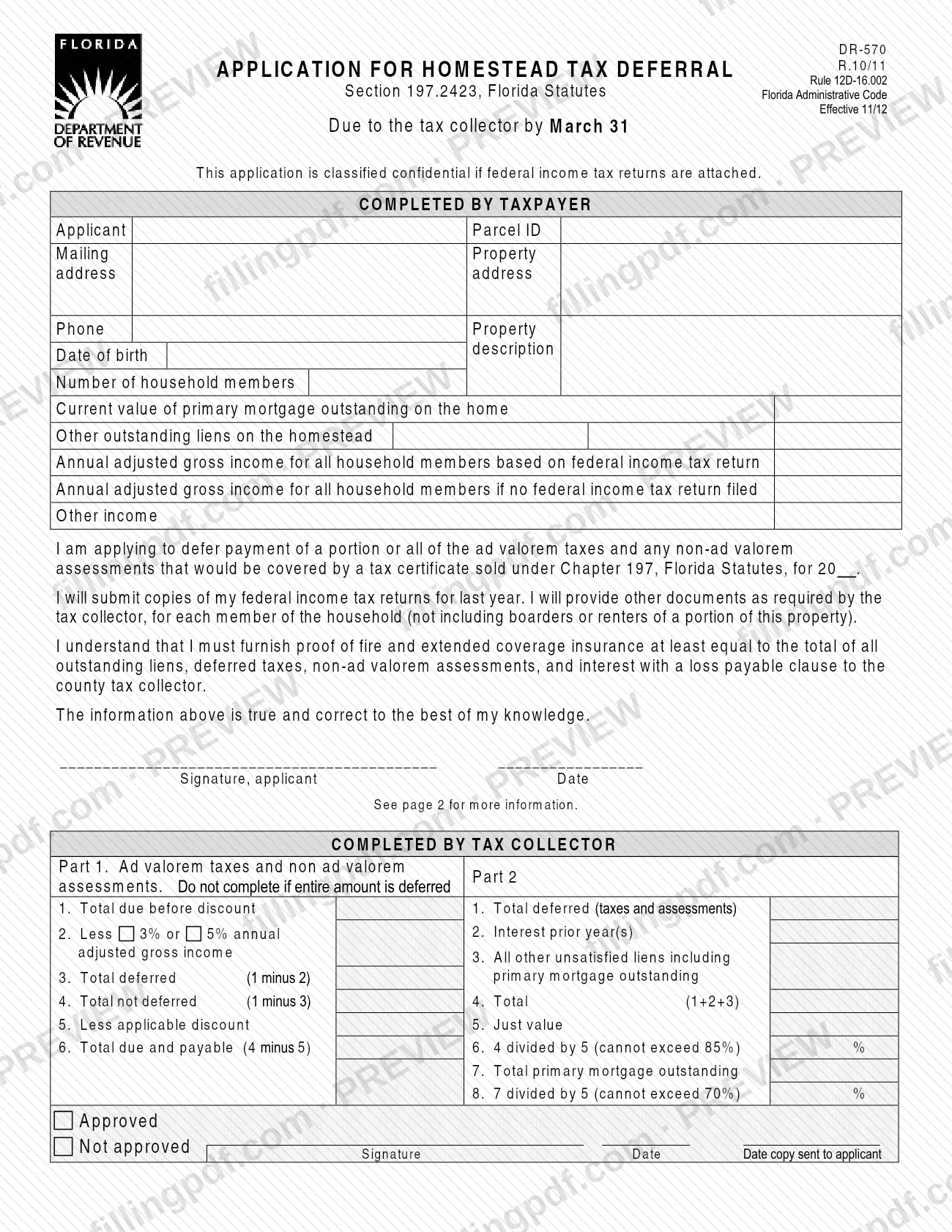
In the application, the taxpayer states that they are applying to defer taxes and assessments that would be covered by a tax certificate sold under Chapter 197, Florida Statutes, for the tax year written on the form. The form cites Rule 12D-16.002 of the Florida Administrative Code and Section 197.2423, Florida Statutes, and prints the revision R.10/11, effective 11/12.
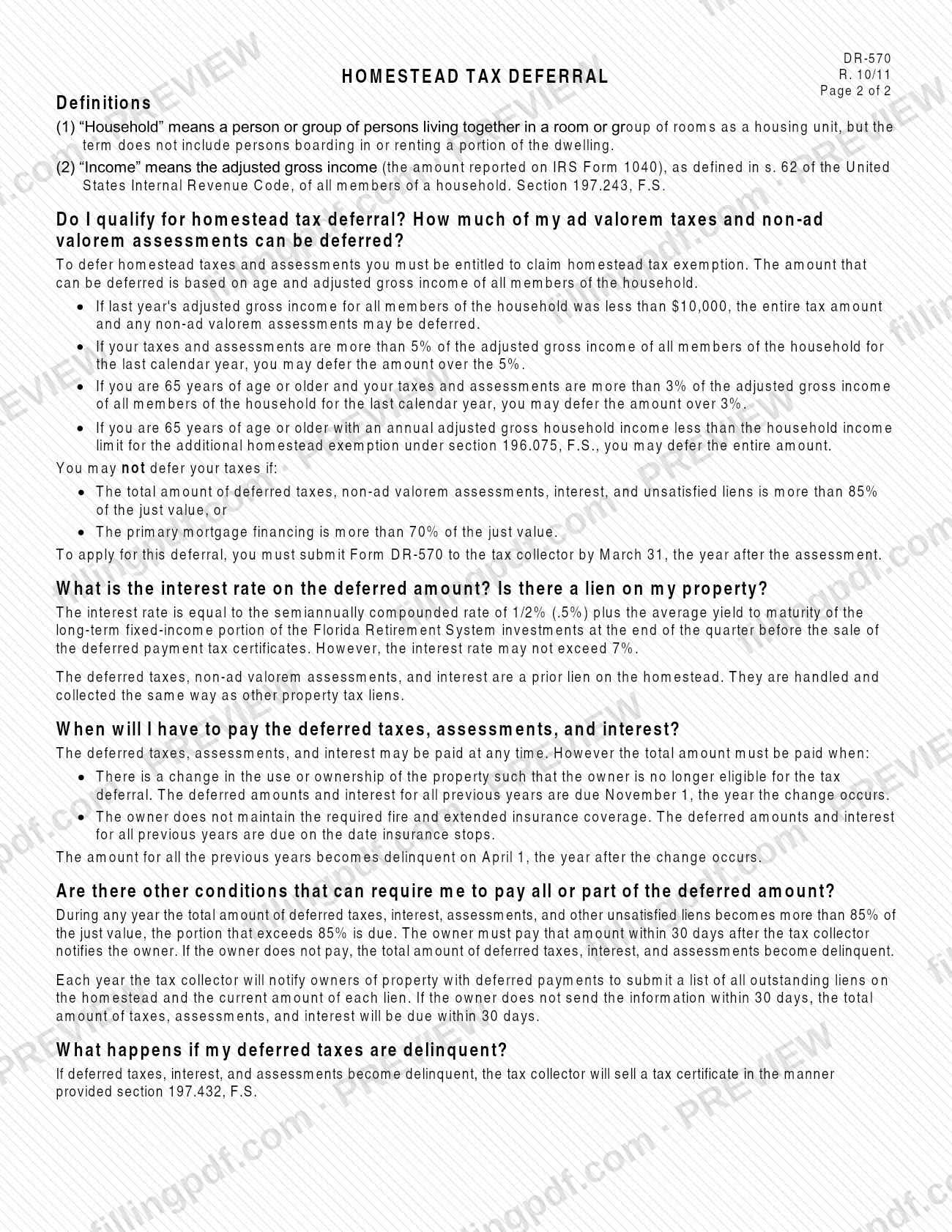
The form has two pages. Page 1 has a section completed by the taxpayer (applicant, parcel, mortgage, liens and household income) and a section completed by the tax collector, with Part 1 (taxes and assessments, discount and amount deferred) and Part 2 (deferred total, prior interest, other liens, just value and the 85% and 70% limit ratios), plus an Approved or Not approved decision. Page 2 gives definitions of "household" and "income" and answers questions about qualifying, interest, the lien on the property, repayment and delinquency.
The form states that it is classified confidential if federal income tax returns are attached.
Who needs to file DR-570?
Homeowners who are entitled to claim the homestead tax exemption and want to defer homestead taxes and assessments use Form DR-570. The form's instructions say the amount you can defer depends on the age and adjusted gross income of all members of the household:
- If last year's adjusted gross income for all household members was less than $10,000, the entire tax amount and any non-ad valorem assessments may be deferred.
- If your taxes and assessments are more than 5% of the household's adjusted gross income for the last calendar year, you may defer the amount over 5%.
- If you are 65 or older and your taxes and assessments are more than 3% of that income, you may defer the amount over 3%.
- If you are 65 or older with household income below the limit for the additional homestead exemption under section 196.075, F.S., you may defer the entire amount.
You may not defer your taxes if total deferred taxes, non-ad valorem assessments, interest and unsatisfied liens exceed 85% of the just value, or if the primary mortgage financing exceeds 70% of the just value.
"Household" means people living together as a housing unit; it does not include people boarding in or renting part of the dwelling.
When to file DR-570
Submit Form DR-570 to the tax collector by March 31, the year after the assessment; the date is printed at the top of the form as "Due to the tax collector by March 31."
After a deferral is granted, the form explains when repayment is due. Deferred taxes, assessments and interest may be paid at any time. All of it must be paid when the property's use or ownership changes so the owner is no longer eligible (due November 1 of the year of the change) or when the required fire and extended insurance coverage stops (due on the date the insurance stops). Amounts for all previous years become delinquent on April 1 of the year after the change.
Each year the tax collector asks owners with deferred payments for a list of outstanding liens on the homestead; if the owner does not send it within 30 days, the total is due within 30 days. If the deferred total passes 85% of the just value, the excess is due within 30 days after the tax collector's notice.
Documents you need
- Copies of your federal income tax returns for last year, for each member of the household (not including boarders or renters of a portion of the property).
- Other documents as required by the tax collector, for each member of the household.
- Proof of fire and extended coverage insurance at least equal to the total of all outstanding liens, deferred taxes, non-ad valorem assessments and interest, with a loss payable clause to the county tax collector.
How to fill out DR-570
Enter applicant and parcel details
In the section Completed by Taxpayer, write the applicant's name and the Parcel ID.
Enter addresses and phone
Enter your mailing address, the property address and your phone number. Add the property description in its field.
Enter date of birth and household size
Write your date of birth, which matters because applicants 65 or older may defer more, and the number of household members. Do not count boarders or renters.
Report mortgage and other liens
Enter the current value of the primary mortgage outstanding on the home and any other outstanding liens on the homestead.
Enter household adjusted gross income
Use the line for annual adjusted gross income for all household members based on the federal income tax return. If no federal return was filed, use the separate line for income without a return.
Add other income
Enter any other income in the Other income field.
Write the tax year
In the statement beginning "I am applying to defer payment," fill in the year after "for 20" for which you are applying.
Read the household and insurance statements
Confirm that you will submit federal income tax returns for last year for each household member, provide other documents the tax collector requires, and furnish the required fire and extended coverage insurance proof.
Sign and date the application
Sign on the line Signature, applicant and enter the date. The tax collector's section below is not yours to complete.
Review and download the completed PDF
Check every entry, then download or print the completed PDF from FillingPDF. Assemble the returns and insurance proof and submit by March 31 as described under How to submit.
How to submit DR-570
Form DR-570 is submitted to the tax collector, which for this copy is the Alachua County Tax Collector, by March 31 of the year after the assessment. The form prints no mailing address, portal or appointment rule of its own, so contact the Alachua County Tax Collector for how it accepts applications.
What to include with the application:
- Copies of your federal income tax returns for last year, for each member of the household (not including boarders or renters).
- Any other documents the tax collector requires.
- Proof of fire and extended coverage insurance at least equal to the total of all outstanding liens, deferred taxes, non-ad valorem assessments and interest, with a loss payable clause to the county tax collector.
The tax collector completes the lower part of page 1, marks the application Approved or Not approved and records the date a copy was sent to the applicant. Do not fill in that section yourself. If federal income tax returns are attached, the form states the application is classified confidential.
FillingPDF lets you fill out and download the PDF; submission follows the tax collector's channels described above.
Common mistakes to avoid
- Submitting the application after March 31 of the year after the assessment, the due date printed on the form.
- Applying without being entitled to claim the homestead tax exemption, which the form's page 2 says is required to defer homestead taxes.
- Counting boarders or renters of part of the dwelling as household members; the form's definition of household excludes them.
- Leaving out the income of any household member; the form asks for adjusted gross income for all household members.
- Not providing proof of fire and extended coverage insurance with a loss payable clause to the county tax collector.
- Filling in the Completed by Tax Collector section, Parts 1 and 2 and the Approved or Not approved decision.
- Ignoring the tax collector's yearly request for a list of outstanding liens; without a reply within 30 days, the total is due within 30 days.
- Letting the insurance coverage lapse; the deferred amounts and interest for all previous years become due on the date it stops.
Frequently asked questions
What is Form DR-570?
Form DR-570 is the Application for Homestead Tax Deferral. A homeowner uses it to ask the tax collector to defer part or all of the ad valorem taxes and non-ad valorem assessments on a homestead. This copy is published by the Alachua County Tax Collector.
Can I defer my Alachua County property tax on my home?
Possibly, if you are entitled to claim the homestead tax exemption. The amount you can defer depends on the age and adjusted gross income of all household members, and deferral is not allowed if deferred amounts and liens exceed 85% of just value or the primary mortgage exceeds 70%.
When is the DR-570 deferral application due?
By March 31, the year after the assessment. The date is printed at the top of the form as the date it is due to the tax collector. The form sets no other filing window.
What documents do I send with Form DR-570?
Copies of last year's federal income tax returns for each household member, any other documents the tax collector requires, and proof of fire and extended coverage insurance with a loss payable clause to the county tax collector, at least equal to all liens, deferred taxes, assessments and interest.
Is there a lien on my home if I defer taxes?
Yes. The form states that deferred taxes, non-ad valorem assessments and interest are a prior lien on the homestead and are handled and collected like other property tax liens.
When do I have to repay deferred taxes?
You may pay at any time. The total is due if the use or ownership changes so you are no longer eligible (due November 1 of that year), or if required insurance stops (due on the date it stops). Late amounts become delinquent April 1 of the following year.
What happens if deferred taxes become delinquent?
The tax collector will sell a tax certificate in the manner provided in section 197.432, F.S. Delinquency can also follow if you do not pay an amount over 85% of just value within 30 days of the tax collector's notice.
Can I fill out Form DR-570 online?
Yes. You can fill out the PDF online on FillingPDF and download or print it. FillingPDF is an independent service and does not submit the application to the Alachua County Tax Collector; you submit it through the tax collector's channels.
Ready to fill out DR-570?
Fill out DR-570 now