
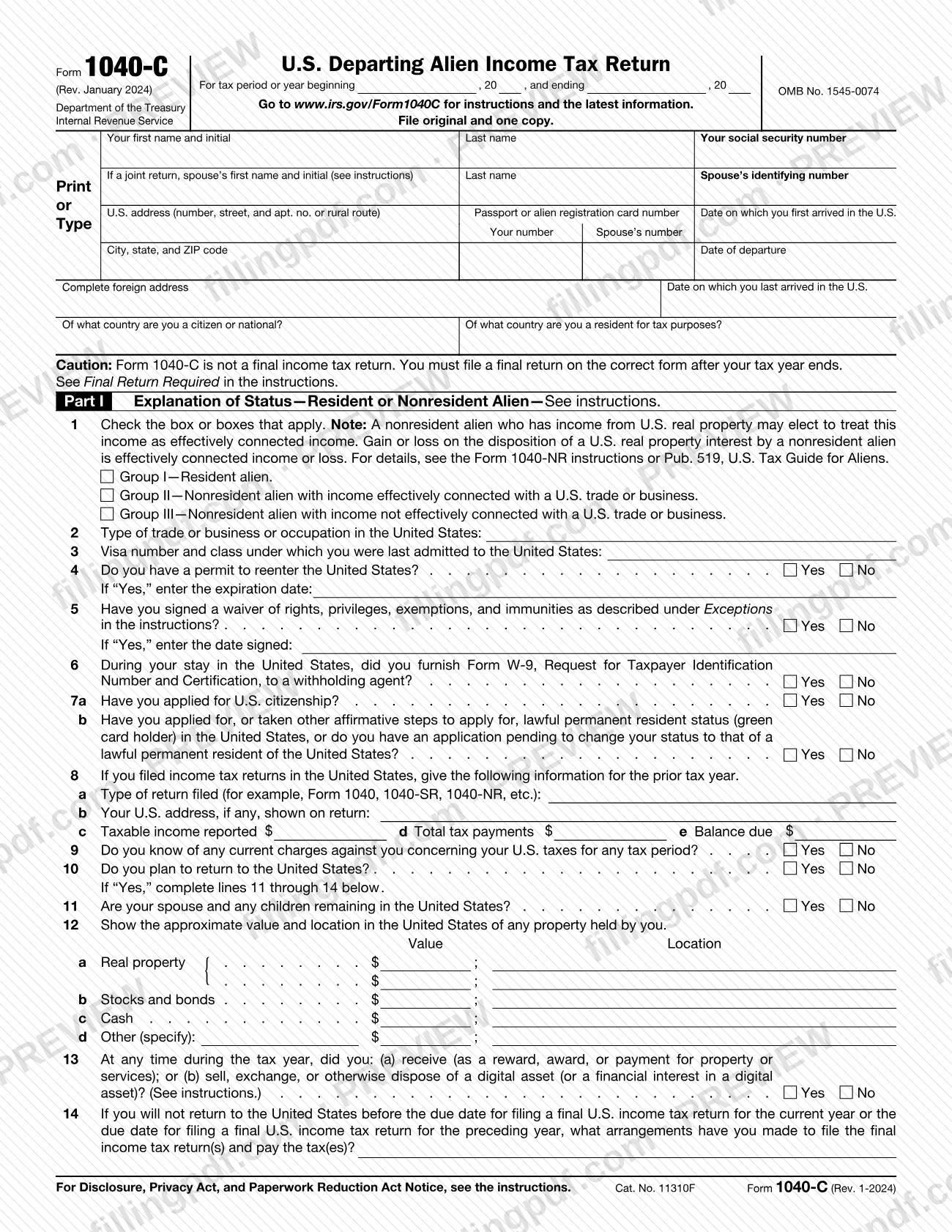
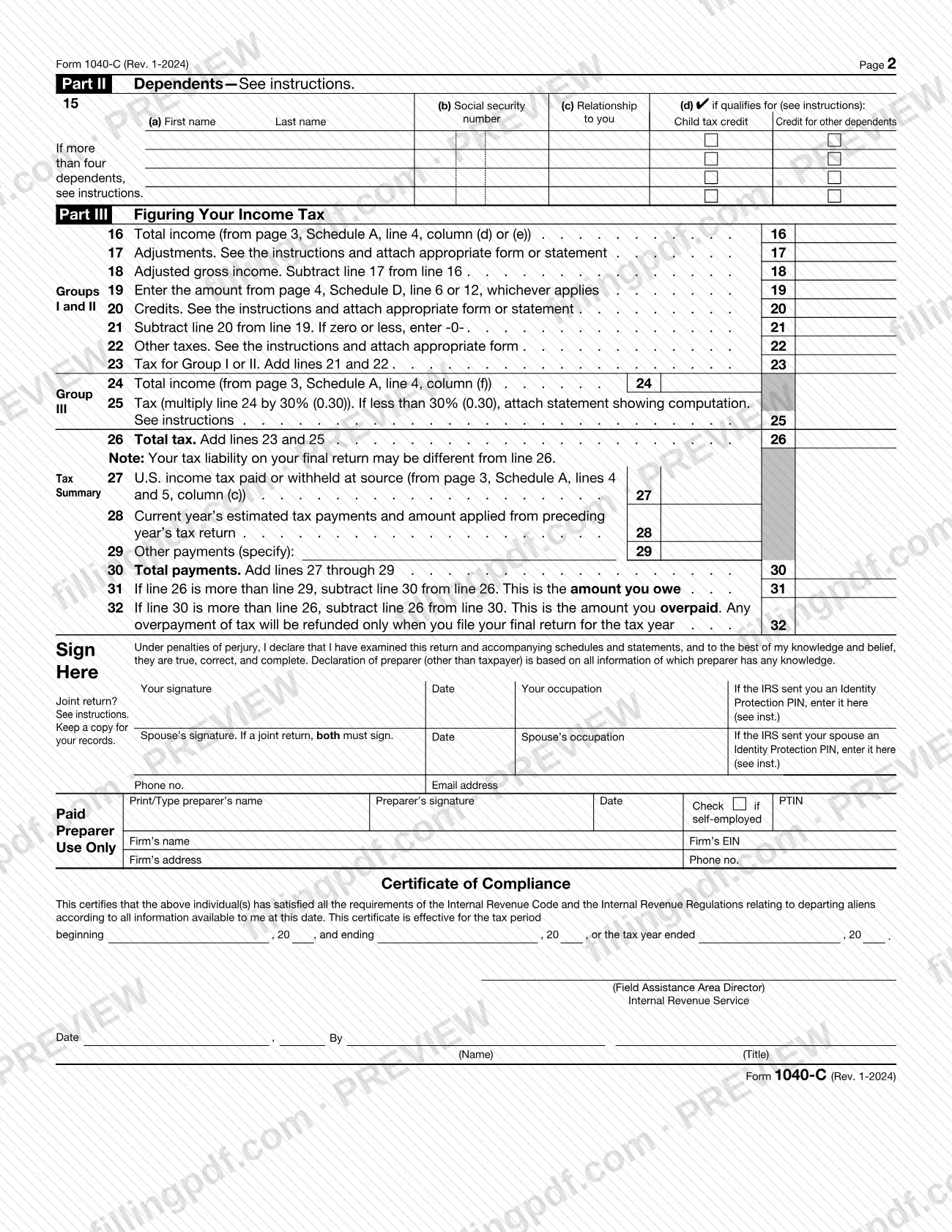
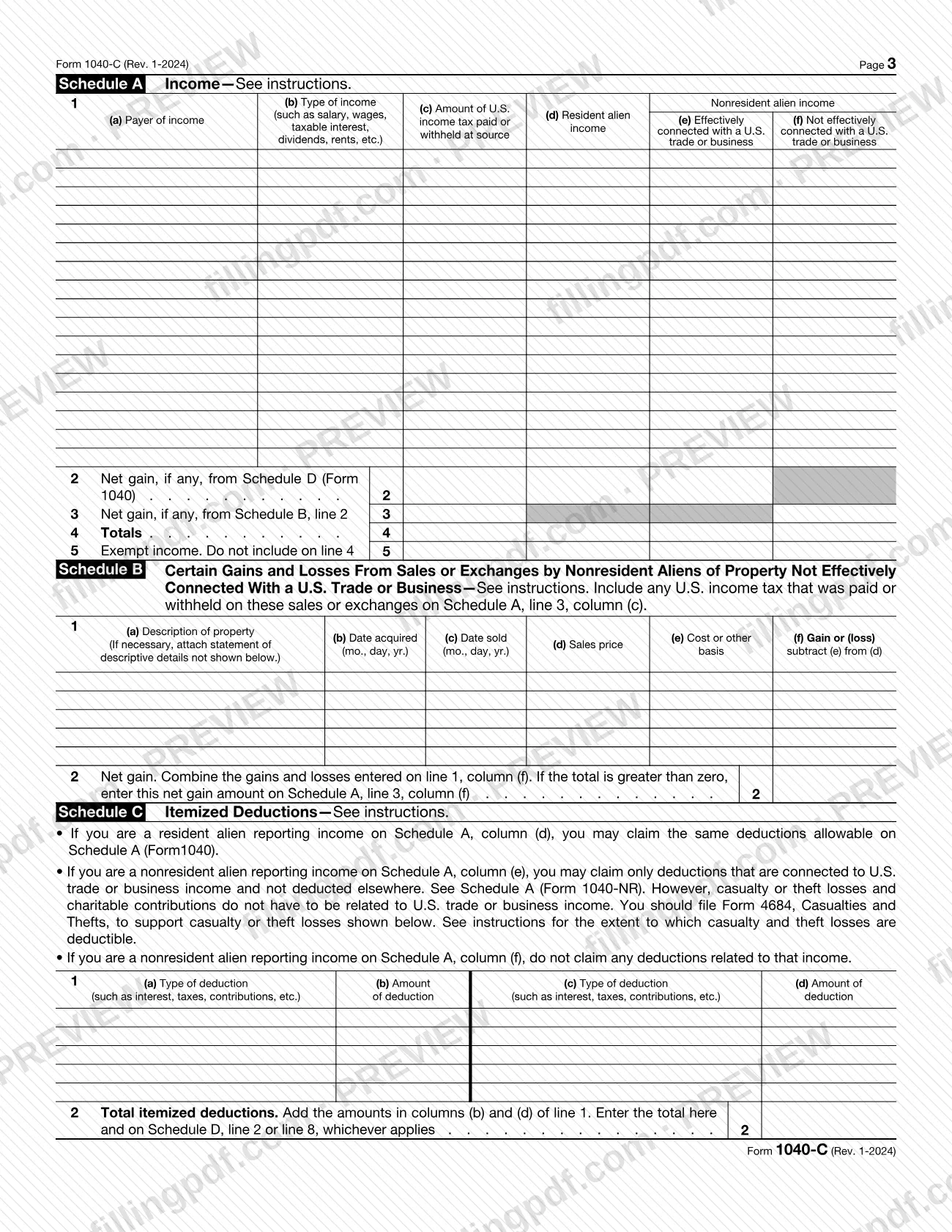
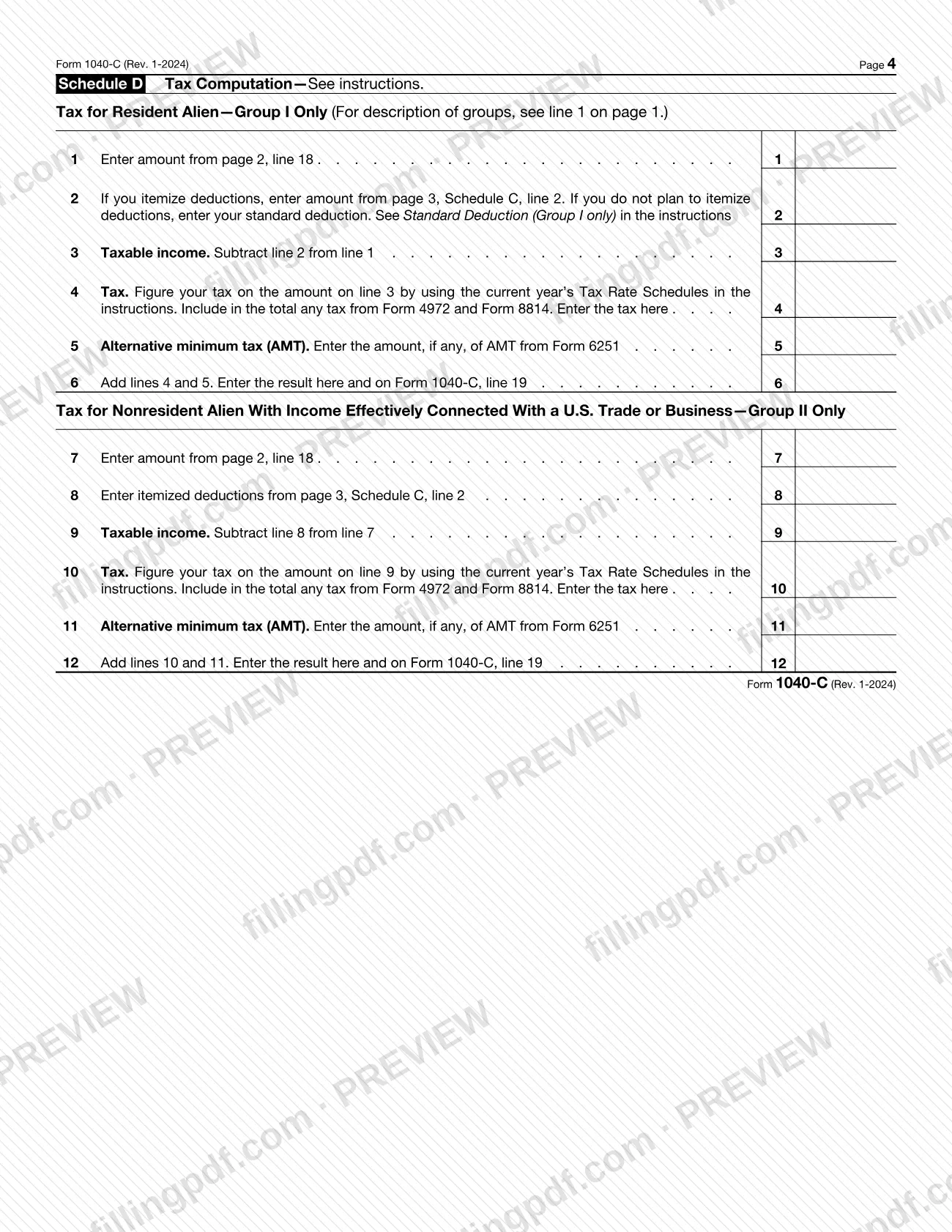
Form 1040-C (1040c), the U.S. Departing Alien Income Tax Return, is the Internal Revenue Service (IRS) form that aliens leaving the United States or its territories use to report income for the whole tax year and pay the expected tax on it. The signed certificate of compliance on the form works as your sailing or departure permit. On FillingPDF you can fill out Form 1040-C online and download or print the completed PDF; the IRS publishes the original form and its instructions at irs.gov, and filing happens at an IRS Taxpayer Assistance Center.
Last updated
What is 1040-C?
Form 1040-C, U.S. Departing Alien Income Tax Return, is the IRS form used by aliens who intend to leave the United States or any of its territories to report income received or expected for the entire tax year and to pay the expected tax on that income, if they must.
The form includes a Certificate of Compliance block. When an agent of the IRS Field Assistance Area Director signs it, it certifies that your U.S. tax obligations have been satisfied according to the information available. Your copy of the signed certificate is your sailing or departure permit. The certificate is not a final decision on your tax: if the IRS later finds you owe more, you must pay it.
Form 1040-C is not a final income tax return. You must still file Form 1040 (or 1040-SR) or Form 1040-NR after your tax year ends, and tax paid with Form 1040-C counts as a credit on that final return. Any overpayment shown on Form 1040-C is refunded only to the extent your final return shows one.
The form has Part I (status and background questions), Part II (dependents), Part III (figuring your income tax and a tax summary), and Schedules A (income), B (gains and losses of nonresident aliens), C (itemized deductions) and D (tax computation). It is a continuous-use form: you enter the tax year at the top. The shorter Form 2063, U.S. Departing Alien Income Tax Statement, is the alternative for departing aliens who qualify for it.
Who needs to file 1040-C?
If you are an alien and must get a sailing or departure permit before leaving the United States or any of its territories, you file Form 1040-C unless you qualify for the shorter Form 2063. Both resident and nonresident aliens can be in this position.
You do not need a certificate of compliance in these cases listed in the IRS instructions:
- diplomatic-passport holders and certain employees of foreign governments or international organizations, with their household members, under the conditions given (a signed waiver of nonimmigrant privileges removes the exception);
- students, industrial trainees and exchange visitors with F-1, F-2, H-3, H-4, J-1, J-2 or Q visas, and M-1 or M-2 students, whose U.S.-source income is limited to the items the instructions list;
- short-stay and transit visitors, such as B-2 pleasure travelers, B-1 or B-1/B-2 business travelers staying no more than 90 days in the tax year, people passing through, certain Canadian and Mexican commuters, and military trainees on official orders.
Exception 4 does not apply if the Area Director believes you had taxable income and your leaving would hinder collecting the tax.
Nonresident alien spouses cannot file jointly. If one spouse is a resident alien, a joint Form 1040-C is possible only if both can reasonably be expected to qualify for a joint return at the normal close of their tax years and both tax years end at the same time. A court-appointed conservator, guardian or other fiduciary signs for the individual and files Form 56.
When to file 1040-C
File Form 1040-C before you leave the United States or any of its territories. The IRS instructions say to get your sailing or departure permit at least 2 weeks before your planned departure, and you cannot apply earlier than 30 days before it. Do not wait until the last minute in case problems arise.
The certificate on Form 1040-C applies to all of your departures during the current tax year, but it can be revoked for a later departure if the Area Director believes your leaving would hinder collecting the tax. In some cases the certificate applies only to the departure for which it is issued, such as when you post a bond or the Area Director finds the collection of tax at risk.
Form 1040-C is filed for the tax year in which you plan to leave, and it must include all income received and reasonably expected to be received during the entire year of departure. The form is not your annual return, so the final return for the year is still due after the year ends. For a departure between January 1, 2026, and April 15, 2026, the instructions also tell you to file Form 1040-NR, 1040 or 1040-SR and pay any tax due.
Documents you need
- A valid passport with your alien registration card (green card) or visa, if they apply; bring it to your TAC appointment.
- Copies of your U.S. income tax returns filed for the past 2 years, or for the shorter period if you were in the United States less than 2 years.
- Receipts for income taxes paid on those returns.
- Receipts, bank records, canceled checks and other documents that prove your deductions, business expenses and dependents claimed on those returns.
- A statement from each employer you worked for this year showing wages paid and tax withheld; if self-employed, a statement of income and expenses up to your planned departure date.
- Proof of estimated tax payments for the past year and the current year.
- Documents showing any gain or loss from selling personal or real property, including capital assets and merchandise.
- For scholarship or fellowship grants: documents on the grantor, source and purpose, the application and approval, the amount paid and your obligations, and a list of previous grants.
- Documents showing qualification for special tax treaty benefits, if you claim any.
- A document verifying your date of departure, such as an airline ticket.
- A document verifying your taxpayer identification number (TIN), such as a social security card or an IRS Notice CP 565 showing your ITIN.
- If you are married and live in a community property state: the same documents for your spouse, whether or not your spouse needs a certificate.
- Form 4684 to support any casualty or theft loss claimed on Schedule C.
- A statement of your computation and the treaty article(s) if you claim a lower rate or exemption on line 25, or a treaty exemption on Schedule A, line 5.
- Approval from the IRS office where you file, if an agent signs for you because you are sick or unable to sign, with the agent's authorization attached.
How to fill out 1040-C
Enter the tax period and your identity
At the top, enter the tax period or year beginning and ending dates, your name and your Social Security number, or your ITIN if you have no SSN. For a joint return, add the spouse's name and identifying number.
Enter address, passport and travel dates
Give your U.S. address, complete foreign address, passport or alien registration card number, date you first arrived in the U.S., date you last arrived, and date of departure. Add your country of citizenship or nationality and country of tax residence.
Check your group on Part I, line 1
Check Group I (resident alien), Group II (nonresident alien with income effectively connected with a U.S. trade or business) or Group III (nonresident alien with income not effectively connected). More than one box may apply.
Answer Part I, lines 2 through 7
Enter your U.S. trade, business or occupation (line 2) and the visa number and class under which you were last admitted (line 3). Check Yes or No for the reentry permit, waiver of rights, Form W-9, U.S. citizenship application and green card questions on lines 4 to 7b, adding the dates where asked.
Complete Part I, lines 8 through 14
Line 8 asks for prior-year return details if you filed. Answer lines 9 to 11, list the value and location of U.S. property on line 12, and check Yes or No on line 13 for digital assets. On line 14, describe your arrangements to file the final return and pay tax if you will not return in time.
List dependents in Part II
On line 15, enter each dependent's first and last name, SSN or ITIN, and relationship, and check the Child tax credit or Credit for other dependents box that applies. If you have more than four dependents, see the instructions.
Report income on Schedule A
On line 1, list each payer, the type of income and the amount in column (d), (e) or (f) that matches your status, with any U.S. tax withheld in column (c). Complete lines 2 to 5, entering exempt income on line 5 only. Do this before Part III, since lines 16 and 24 pull from it.
Complete Schedules B and C if they apply
Nonresident aliens list sales of property not effectively connected with a U.S. trade or business on Schedule B and carry the net gain to Schedule A. Use Schedule C for itemized deductions and enter the total on line 2.
Figure tax on Schedule D
Group I uses lines 1 to 6, with the standard deduction or Schedule C total on line 2. Group II uses lines 7 to 12. Carry the result to Form 1040-C, line 19.
Figure your tax in Part III
Groups I and II complete lines 16 to 23 (total income, adjustments, adjusted gross income, credits and other taxes). Group III enters total income on line 24 and computes tax on line 25, attaching a statement if the tax is less than the rate printed there. Line 26 is your total tax.
Complete the tax summary
Enter tax paid or withheld (line 27), estimated tax payments (line 28), other payments (line 29) and total payments (line 30). Line 31 is the amount you owe; line 32 is any overpayment, refundable only when you file your final return.
Sign and add preparer details
Sign and date, and enter your occupation and any Identity Protection PIN. On a joint return both spouses must sign. A paid preparer must also sign and enter a PTIN. Leave the Certificate of Compliance block for the IRS.
Review and download the completed PDF
Check that all applicable lines are complete and the schedules agree with Part III. Download or print the completed PDF from FillingPDF, make one copy, and assemble the papers described under Required documents for your TAC appointment.
How to submit 1040-C
You file Form 1040-C in person at your local IRS Taxpayer Assistance Center (TAC) office before you leave the United States.
- Appointment: all TAC offices work by appointment. Call 844-545-5640 between 7 a.m. and 7 p.m. local time. Details on your local office are at IRS.gov/TAC. Services are limited and not every service is available at every office.
- What to file: an original and one copy of Form 1040-C for the tax year in which you plan to leave.
- Where: the instructions advise getting the permit from an IRS office in the area of your employment if you have been working in the United States, but you can also use an office in the area of your departure.
- Payment: you must pay all tax shown as due on Form 1040-C and any tax due for past years. Bring certified funds (cashier's check, certified bank or postal money order, or cash) and check your local TAC office for payment options. The IRS may accept a bond instead of payment in certain cases; ask your TAC office for the form of bond.
- Result: once the tax is paid and your returns are in order, you receive your signed certificate, which is your sailing or departure permit.
The instructions tell you not to send tax returns or payments to the IRS forms and publications address printed for comments. FillingPDF lets you fill out and download the PDF; submission follows the channels above.
Common mistakes to avoid
- Treating Form 1040-C as your final return; the instructions require a final return on the correct form after your tax year ends.
- Applying less than 2 weeks before leaving, or more than 30 days before your planned departure date.
- Filing only one copy; the instructions ask for an original and one copy of Form 1040-C.
- Leaving line 13 (digital assets) blank; you must check Yes or No.
- Expecting a refund when you leave; the IRS cannot refund an overpayment at departure, only on your final return.
- Filing a joint Form 1040-C when a spouse is a nonresident alien, or when the spouses' tax years do not end at the same time.
- Reporting only income received to date; the form must include all income received and reasonably expected for the entire tax year of departure.
- Including on lines 1 through 4 of Schedule A income that is reportable on line 5 as exempt.
- Entering the tax on line 25 without a statement of computation when a lower treaty rate or exemption applies.
- Sending the return or payment to the IRS forms and publications comment address instead of filing at a TAC office.
Frequently asked questions
What is Form 1040-C used for?
Form 1040-C is used by aliens who intend to leave the United States or its territories to report income received or expected for the whole tax year and pay the expected tax on it. The signed certificate of compliance on it serves as your sailing or departure permit.
Is Form 1040-C my final tax return?
No. The form says it is not a final income tax return. After your tax year ends you must file Form 1040 (or 1040-SR) or Form 1040-NR. Tax paid with Form 1040-C is credited against the tax on that final return.
When should I file Form 1040-C before leaving the U.S.?
Get your sailing or departure permit at least 2 weeks before you plan to leave, and not earlier than 30 days before your planned departure date. The IRS instructions advise against waiting until the last minute because of possible problems.
Where do I file the 1040c, and do I need an appointment?
File Form 1040-C (the 1040c) at your local IRS Taxpayer Assistance Center, by appointment only. Call 844-545-5640 from 7 a.m. to 7 p.m. local time. Bring an original and one copy of the form, plus the supporting records listed in the instructions.
What is the difference between Form 1040-C and Form 2063?
Form 2063 is a shorter form without a tax computation. Aliens with no taxable income for the year and preceding year, or resident aliens whose departure will not hinder collection, can use it. If you do not qualify for Form 2063 and need a permit, file Form 1040-C.
Do I have to pay tax when I file Form 1040-C?
Generally yes: you pay all tax shown as due on the form and any tax due for past years, in certified funds or cash. The IRS may accept a bond instead in certain cases, or may not require payment if you show you will return and your departure does not jeopardize collection.
Can a student or tourist skip the certificate of compliance?
Some can. The instructions exempt F-1, F-2, H-3, H-4, J-1, J-2, Q, M-1 and M-2 visa holders with limited U.S. income, and certain B-1, B-2 and transit travelers. Each exception has conditions, and the Area Director can override exception 4 if collection would be hindered.
Can I fill out Form 1040-C online?
You can fill out the PDF online on FillingPDF and download or print it. FillingPDF does not file the form or issue the certificate; you take the completed form to an IRS Taxpayer Assistance Center appointment.
Ready to fill out 1040-C?
Fill out 1040-C now