
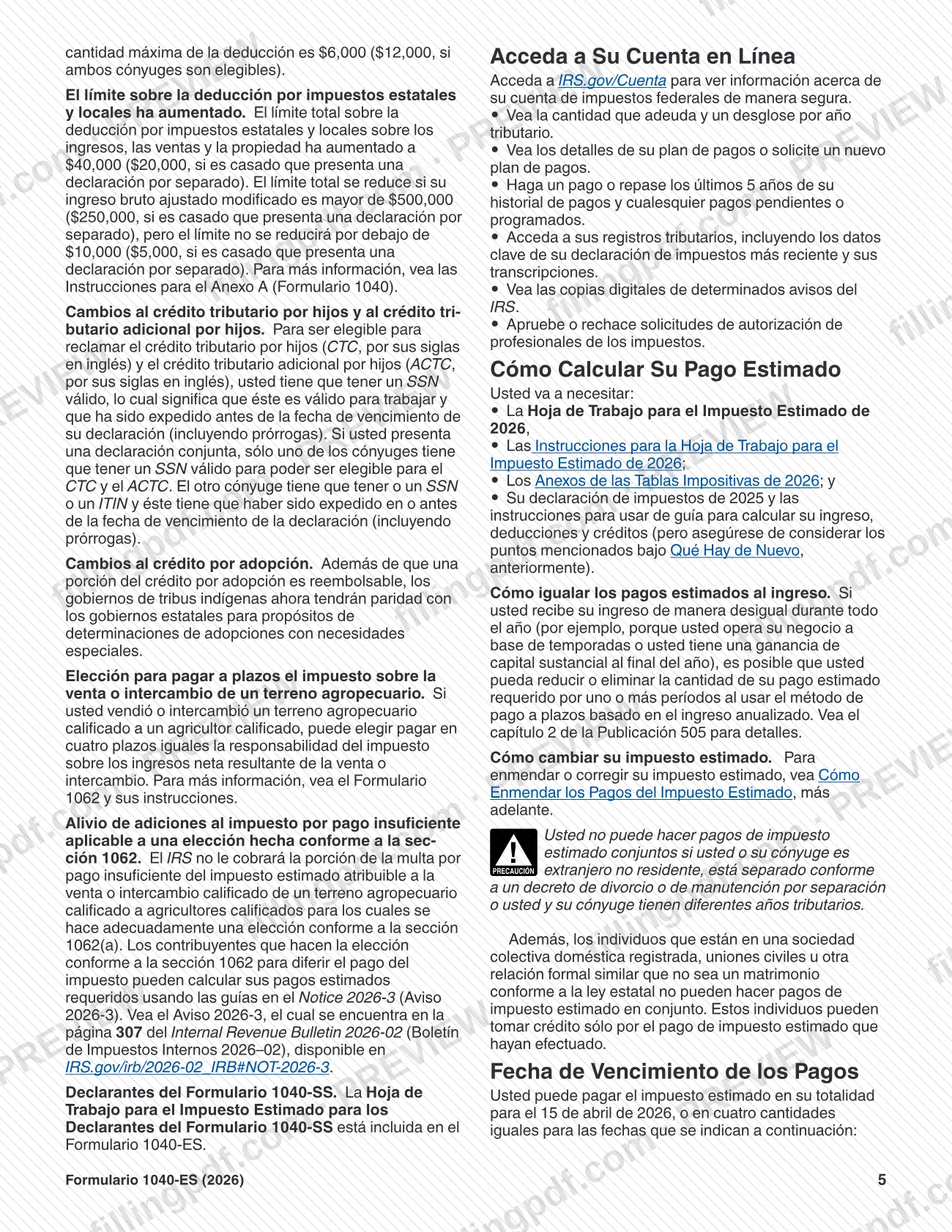
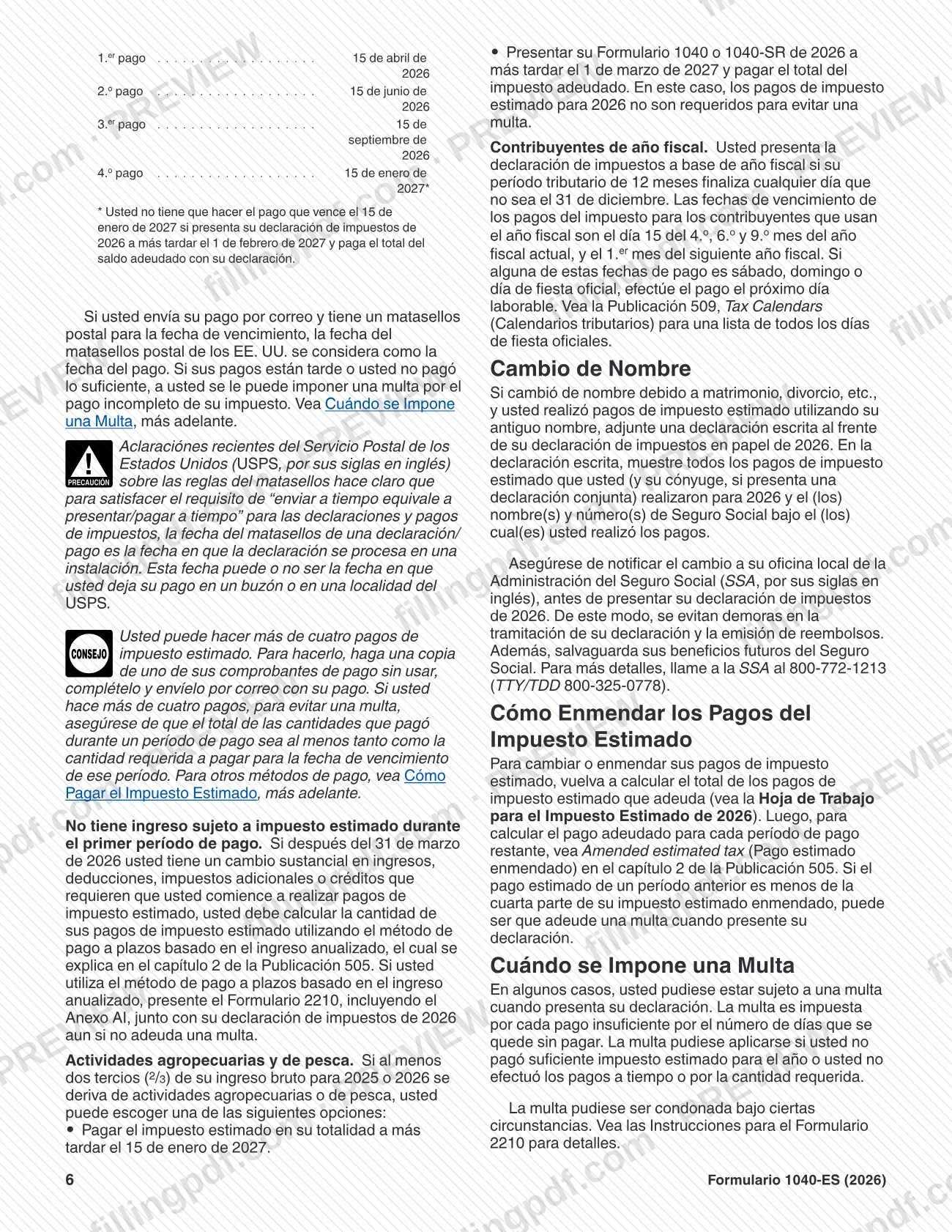
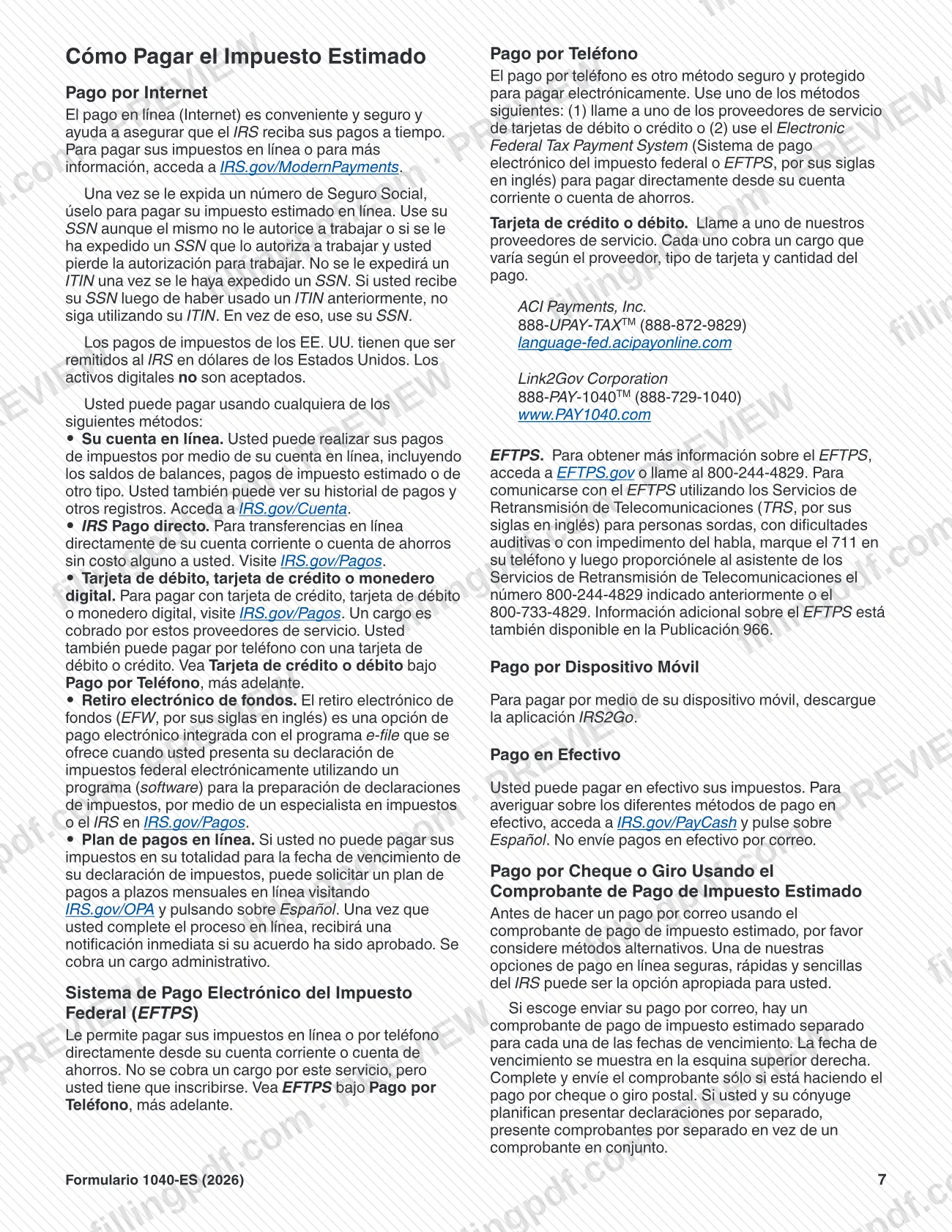
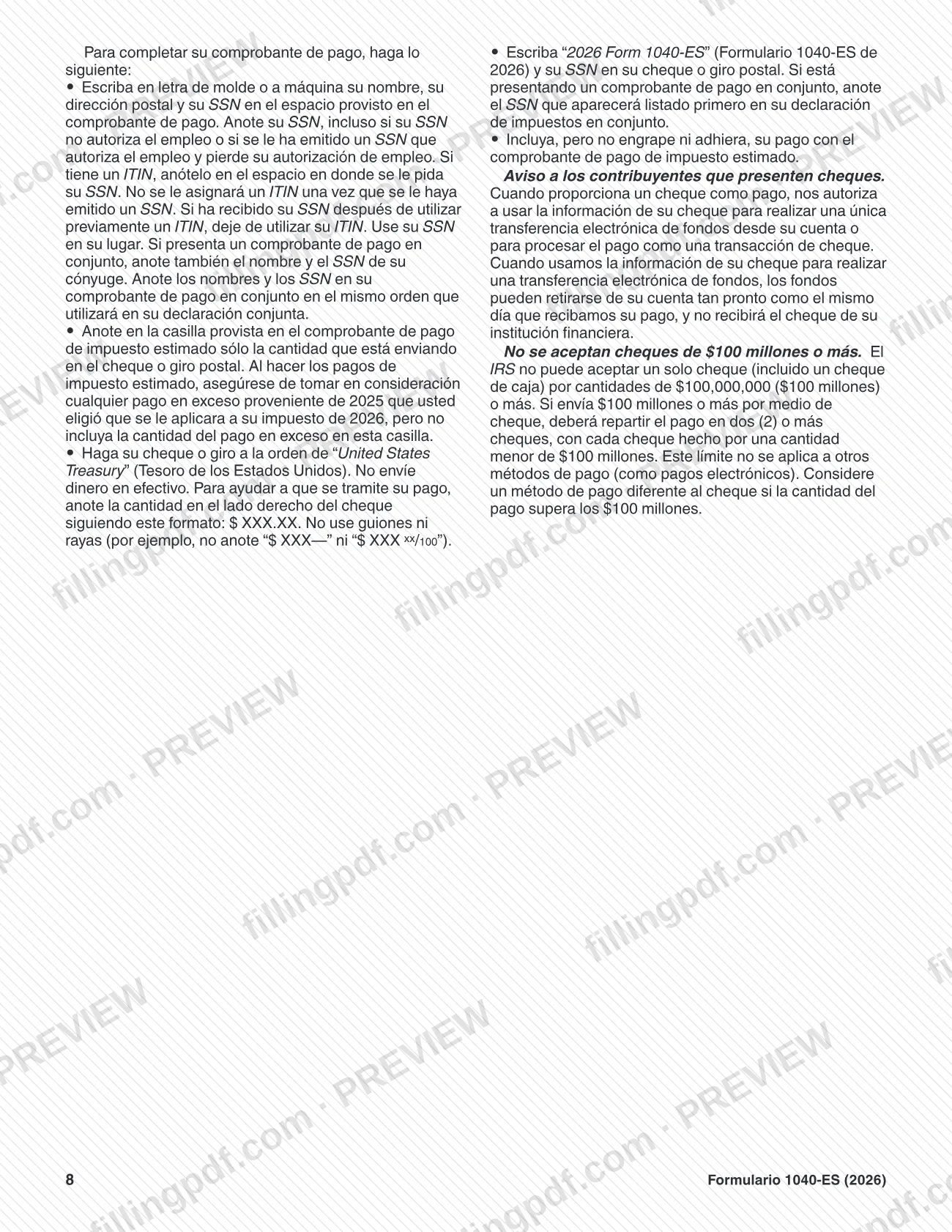




Form 1040-ES (sp), Estimated Tax For Individuals (Spanish Version), is the Spanish-language edition of the Internal Revenue Service (IRS) set of instructions, worksheets and payment vouchers for figuring and paying estimated tax for 2026. Estimated tax is how you pay tax on income that has no withholding, such as self-employment income, interest, dividends and rents. On FillingPDF you can fill out the form online and download or print the completed PDF; the form and its instructions are published by the IRS, and payments reach the IRS only through the channels described below.
Last updated
What is 1040-ES (sp)?
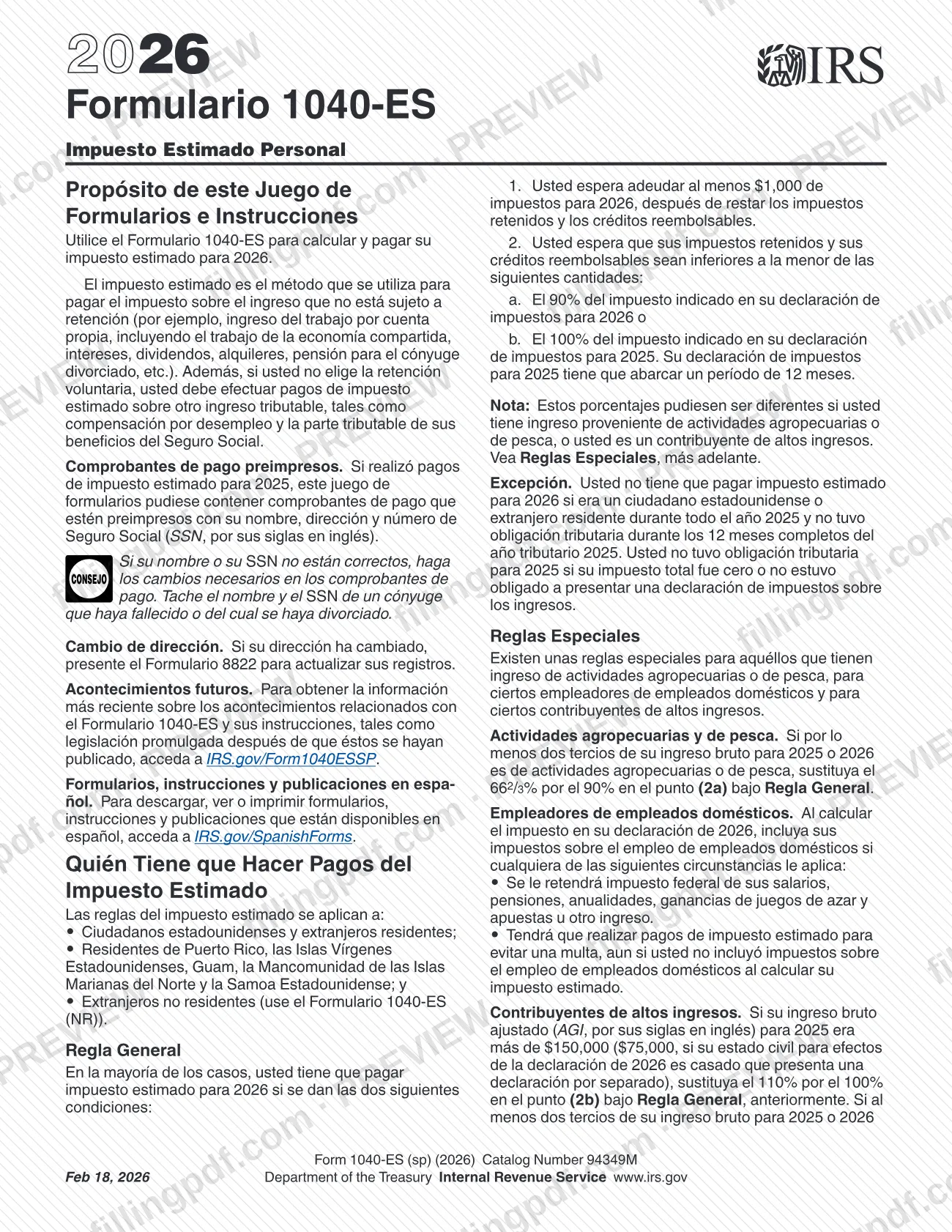
Form 1040-ES (sp), Estimated Tax For Individuals (Spanish Version), printed in Spanish as Formulario 1040-ES, Impuesto Estimado Personal, is the IRS form set used to figure and pay estimated tax for 2026 on income that is not subject to withholding.
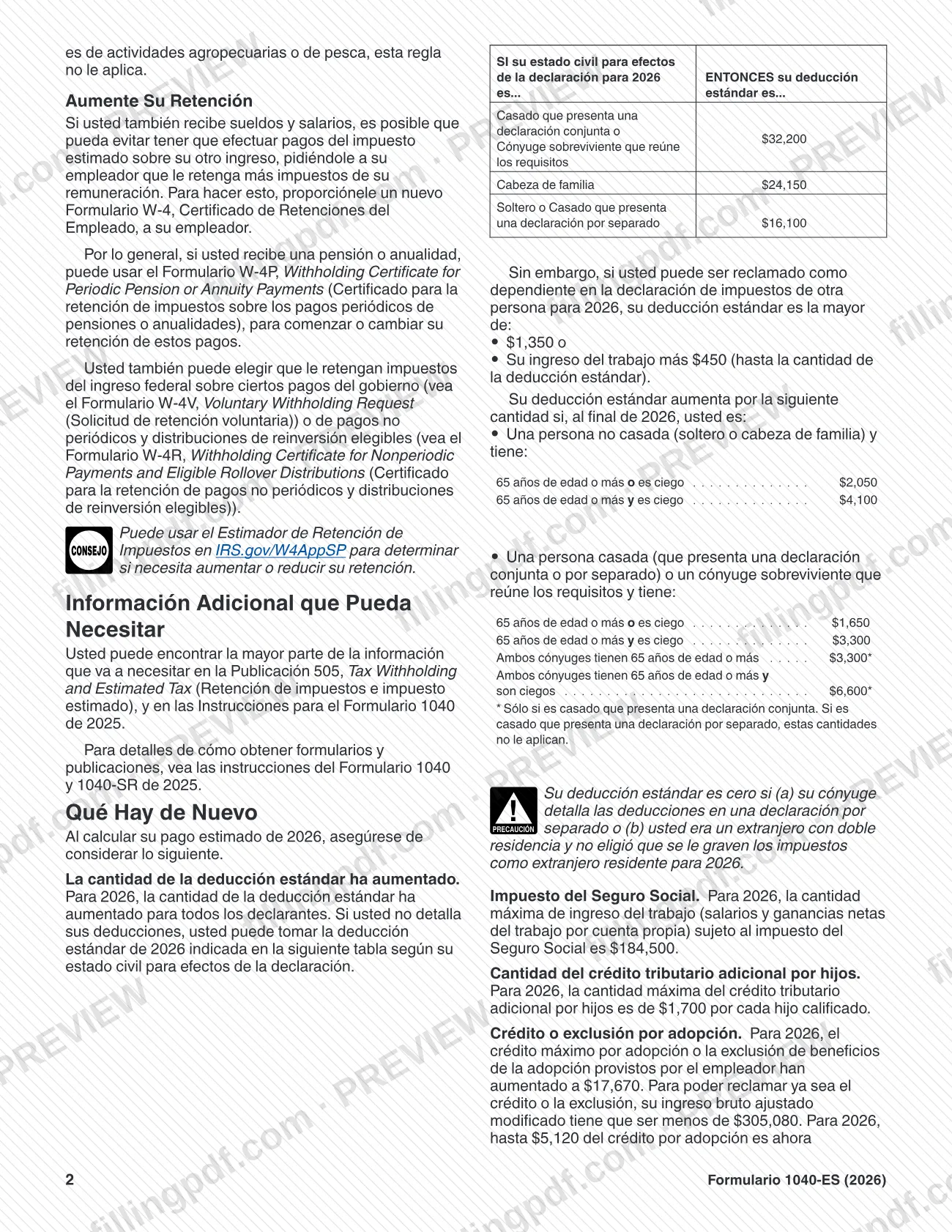
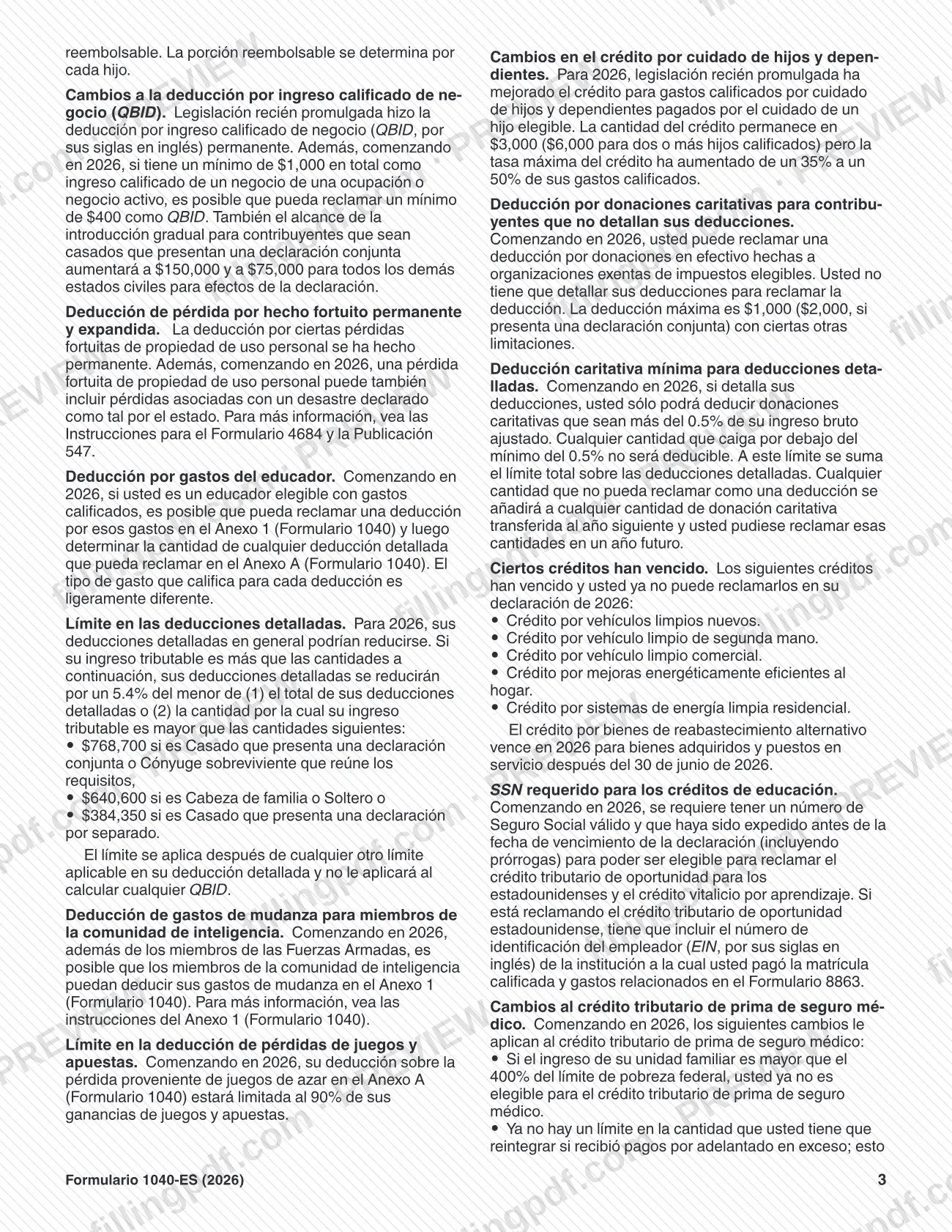
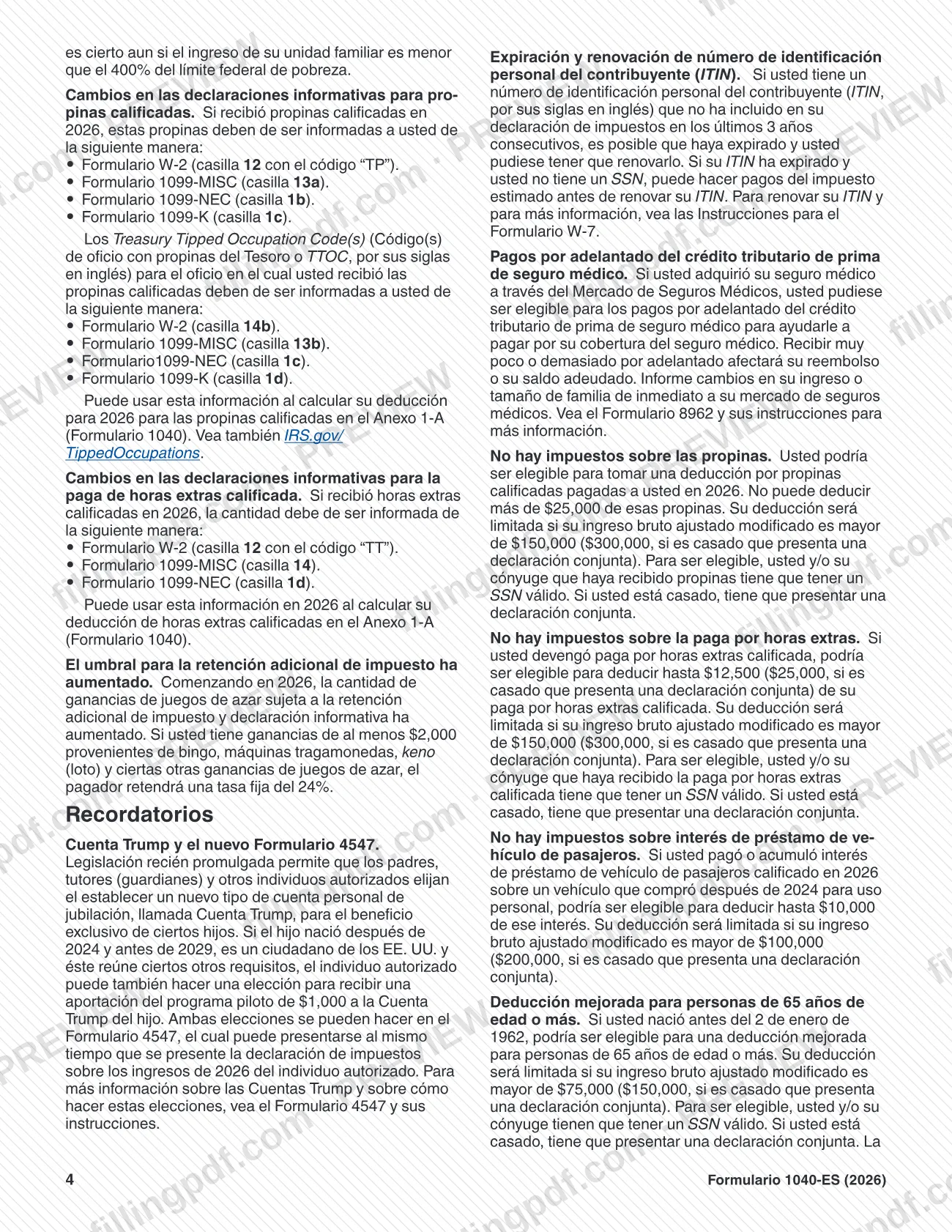
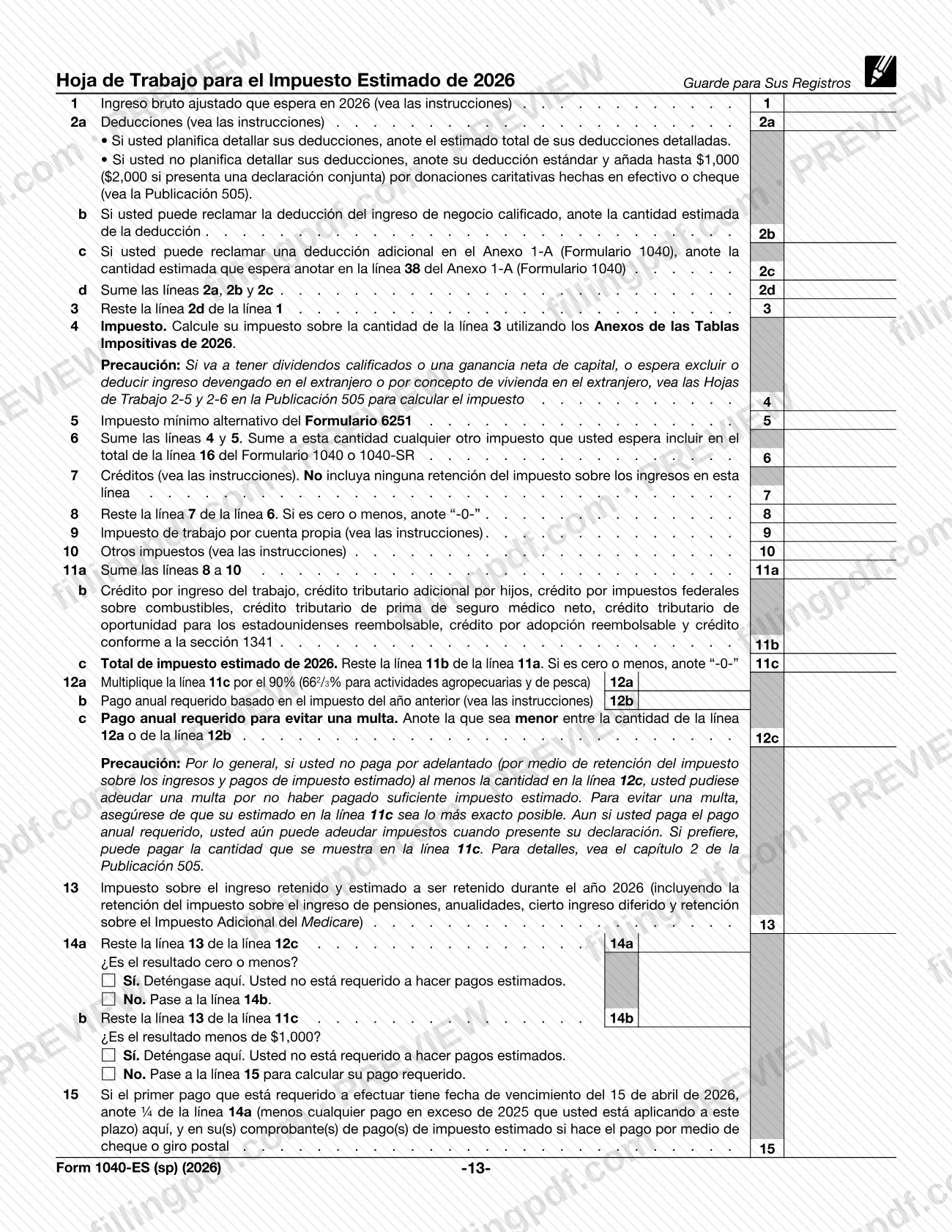
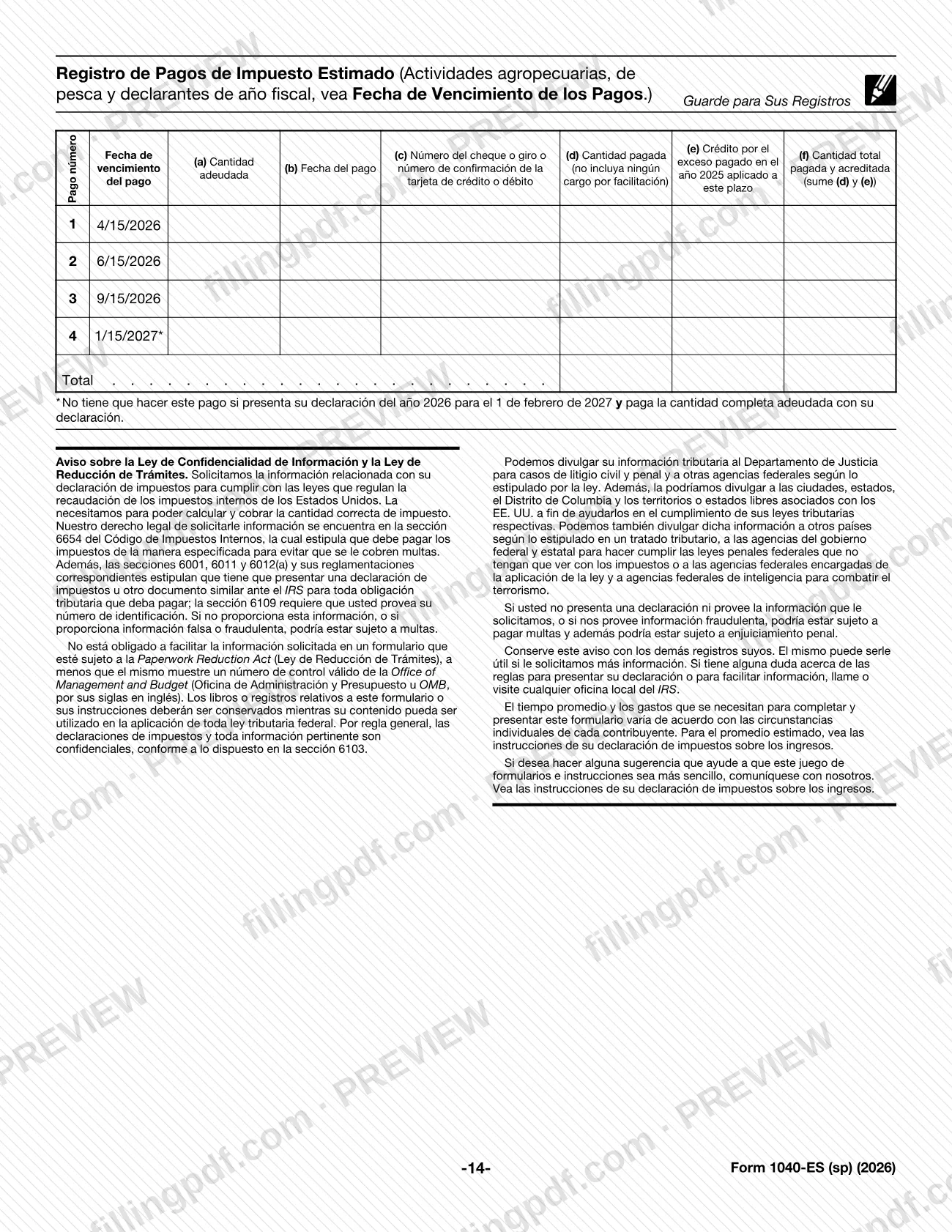
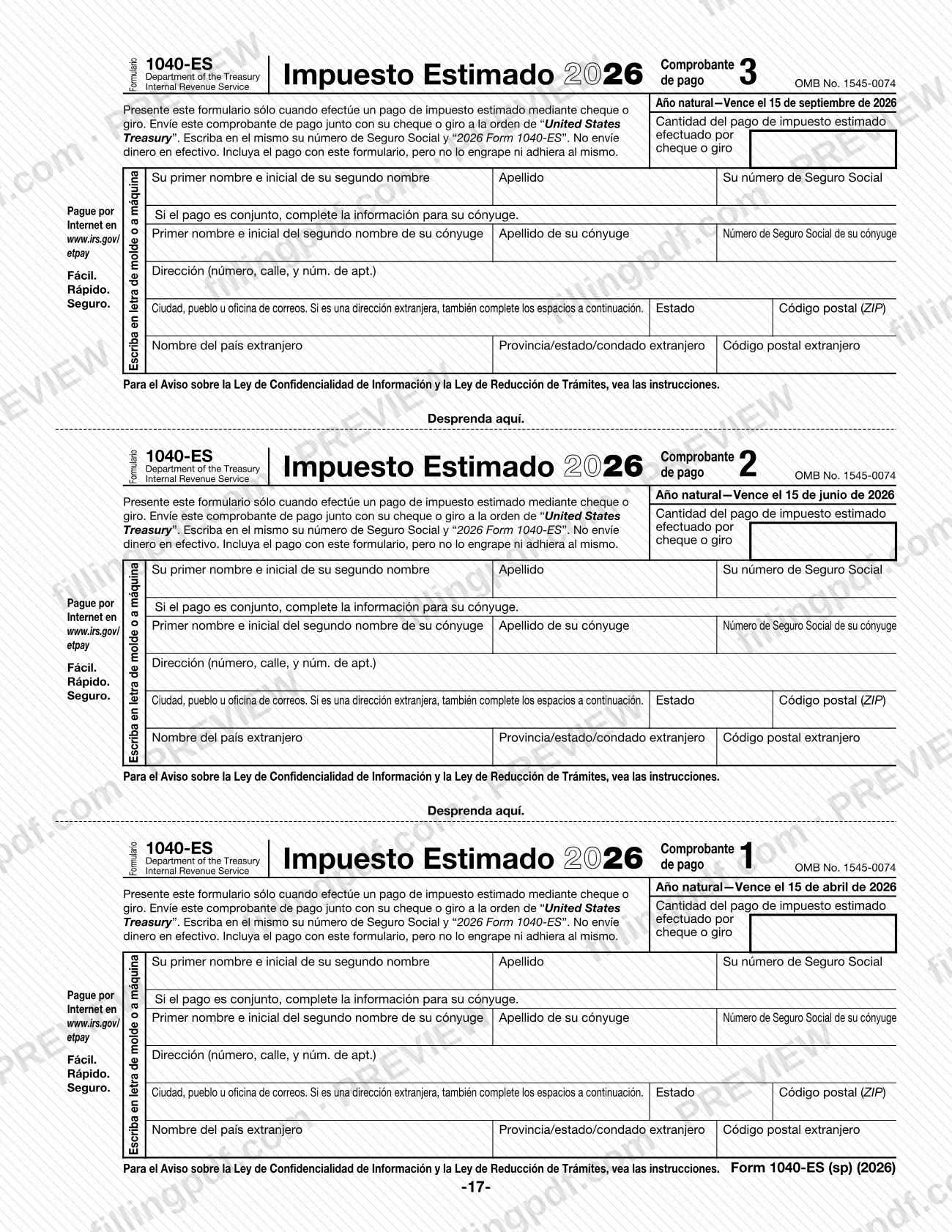
The set combines four things in one document: the instructions (who must pay, due dates, how to pay, where to mail), the 2026 Estimated Tax Worksheet with its instructions, the 2026 Tax Rate Schedules, and four payment vouchers, one for each due date. It also includes a payment record page for keeping track of what you paid, and a separate worksheet for people who file Form 1040-SS.
Estimated tax covers income such as self-employment earnings (including gig-economy work), interest, dividends, rents and alimony. If you do not choose voluntary withholding, it also covers other taxable income such as unemployment compensation and the taxable part of Social Security benefits.
The vouchers are used only when you pay by check or money order. Nonresident aliens use a different form, Form 1040-ES (NR). The IRS says you can find most of the information you need in Publication 505, Tax Withholding and Estimated Tax, and in the 2025 Instructions for Form 1040. The form is not a tax return and is not filed with one.
Who needs to file 1040-ES (sp)?
Most people who expect to owe tax for 2026 on income without enough withholding use this set. The estimated tax rules apply to:
- U.S. citizens and resident aliens;
- residents of Puerto Rico, the U.S. Virgin Islands, Guam, the Commonwealth of the Northern Mariana Islands and American Samoa.
Under the General Rule, you generally must pay estimated tax for 2026 if you expect to owe at least the minimum amount of tax stated in the instructions after subtracting withholding and refundable credits, and you expect withholding and refundable credits to be less than the smaller of 90% of the tax on your 2026 return or 100% of the tax on your 2025 return (which must cover 12 months). Special percentages apply to farmers and fishers, and to higher-income taxpayers.
You do not have to pay for 2026 if you were a U.S. citizen or resident alien for all of 2025 and had no tax liability for the full 12 months of 2025.
Do not use this form if you are a nonresident alien: use Form 1040-ES (NR). Joint estimated payments are not allowed if you or your spouse is a nonresident alien, you are separated under a divorce or separate maintenance decree, or you have different tax years. Registered domestic partners and people in civil unions that are not marriages under state law also cannot pay jointly.
When to file 1040-ES (sp)
Estimated tax for 2026 is due either in full by April 15, 2026, or in four equal amounts on these dates:
- 1st payment: April 15, 2026
- 2nd payment: June 15, 2026
- 3rd payment: September 15, 2026
- 4th payment: January 15, 2027
You do not have to make the January 15, 2027 payment if you file your 2026 return by February 1, 2027 and pay the full balance due with it. A mailed payment counts as made on the date of the U.S. postmark. Late or short payments can draw a penalty, charged for each underpayment for the number of days it stays unpaid.
If you have no income subject to estimated tax in the first period and your situation changes after March 31, 2026, the instructions point you to the annualized income installment method and Form 2210 with Schedule AI. Farmers and fishers with at least two-thirds of gross income from farming or fishing may pay everything by January 15, 2027, or file by March 1, 2027 and pay in full. Fiscal-year filers use the 15th day of the 4th, 6th and 9th months of the fiscal year and the 1st month of the next; weekend and holiday dates move to the next business day.
Documents you need
- Written statement attached to the front of your paper 2026 tax return, only if you changed your name and made estimated payments under your old name: list all 2026 estimated payments and the names and SSNs under which you made them.
- Form 2210 with Schedule AI, attached to your 2026 return, only if you use the annualized income installment method, even if you owe no penalty.
How to fill out 1040-ES (sp)
Decide whether you must pay
Read the General Rule and the Exception in the instructions. The 2026 Estimated Tax Worksheet also tells you to stop on line 14a or 14b if no payment is required.
Enter expected income and deductions
Worksheet line 1: your expected 2026 AGI. Line 2a: itemized deductions, or the standard deduction plus the charitable amount the worksheet allows; add lines 2b and 2c if they apply, total them on 2d and subtract from line 1 on line 3.
Figure tax and credits
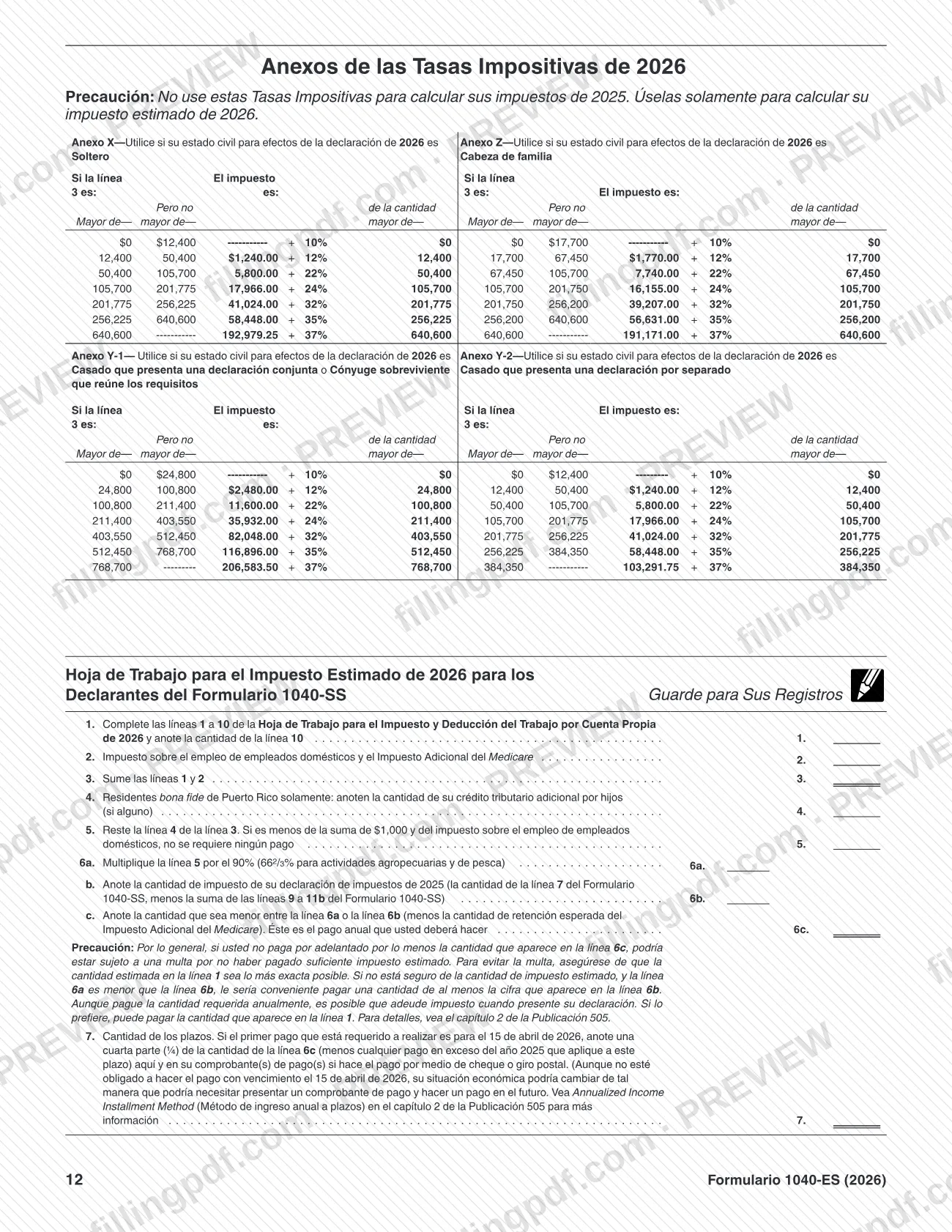
Line 4: tax on line 3 using the 2026 Tax Rate Schedules. Add the alternative minimum tax from Form 6251 on line 5, enter the total on line 6, subtract credits on line 7 and enter the result on line 8 ("-0-" if zero or less).
Add self-employment and other taxes
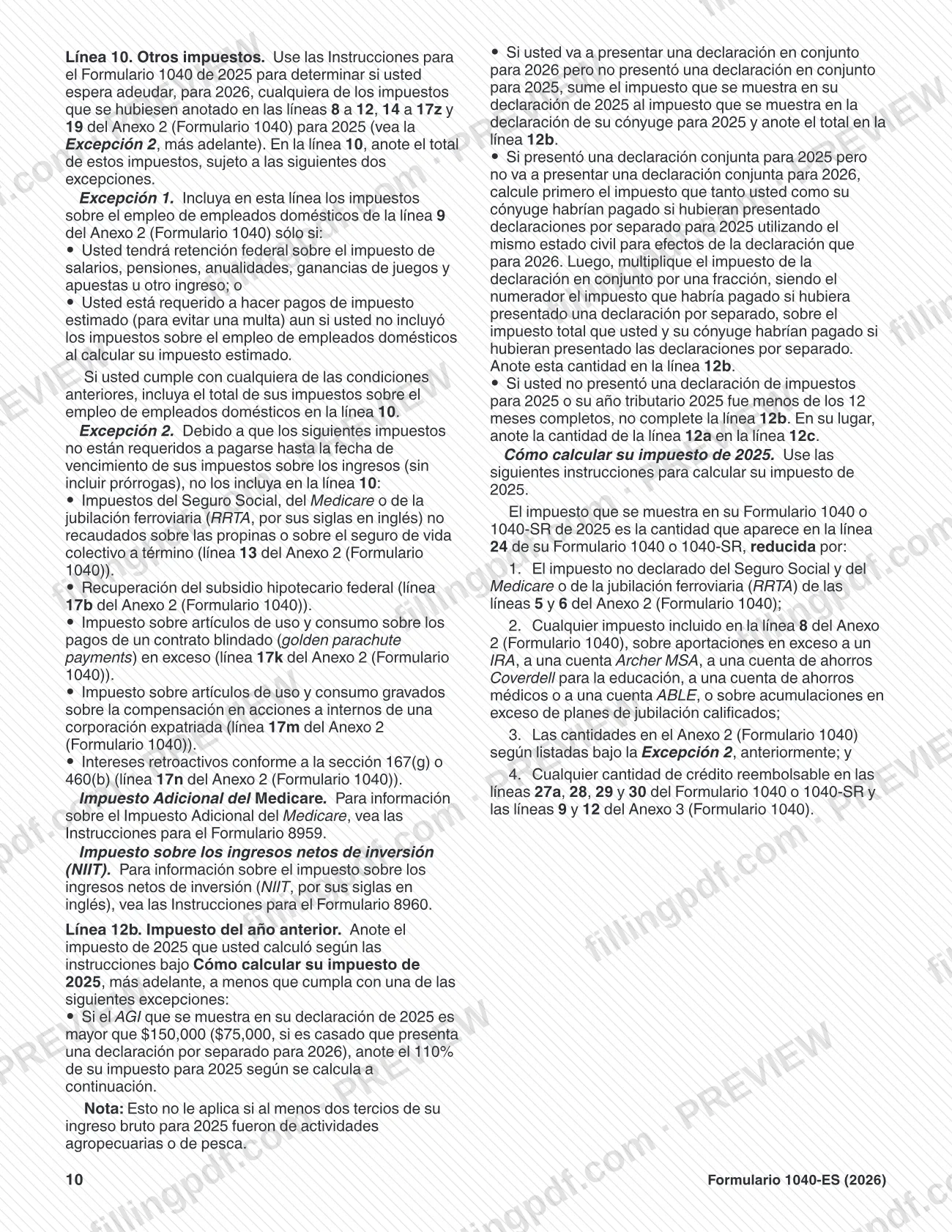
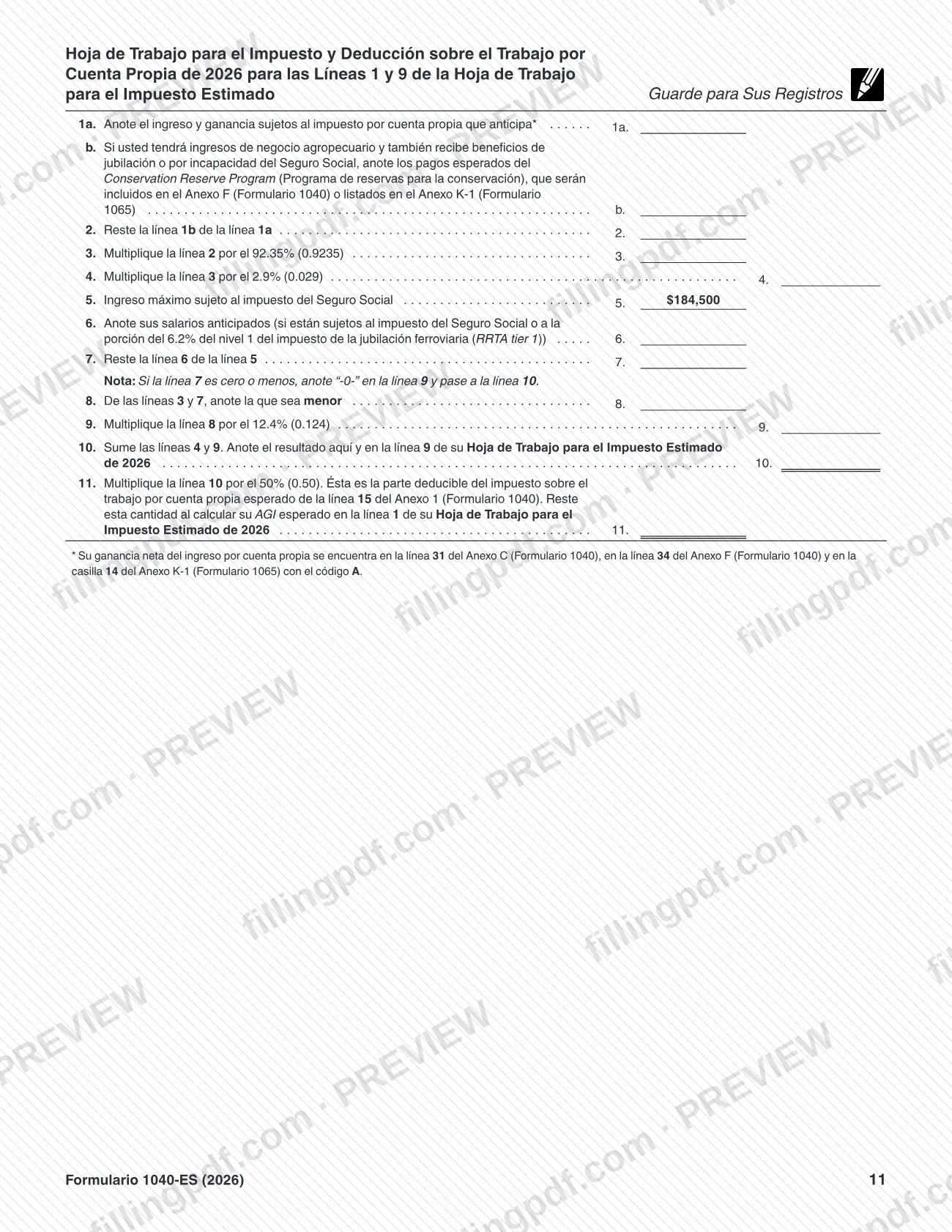
Line 9: self-employment tax, from the Self-Employment Tax and Deduction Worksheet if needed. Line 10: other taxes. Total lines 8 to 10 on 11a, subtract refundable credits on 11b and enter your total 2026 estimated tax on 11c.
Find the required annual payment
Line 12a: 90% of line 11c (the farming and fishing percentage if it applies). Line 12b: the required payment based on last year's tax. Line 12c: the smaller of 12a and 12b.
Subtract withholding and compute installments
Line 13: income tax withheld and expected to be withheld. Lines 14a and 14b show whether you are required to pay. On line 15, enter one-fourth of line 14a, less any 2025 overpayment applied to that installment.
Complete names and SSNs on the voucher
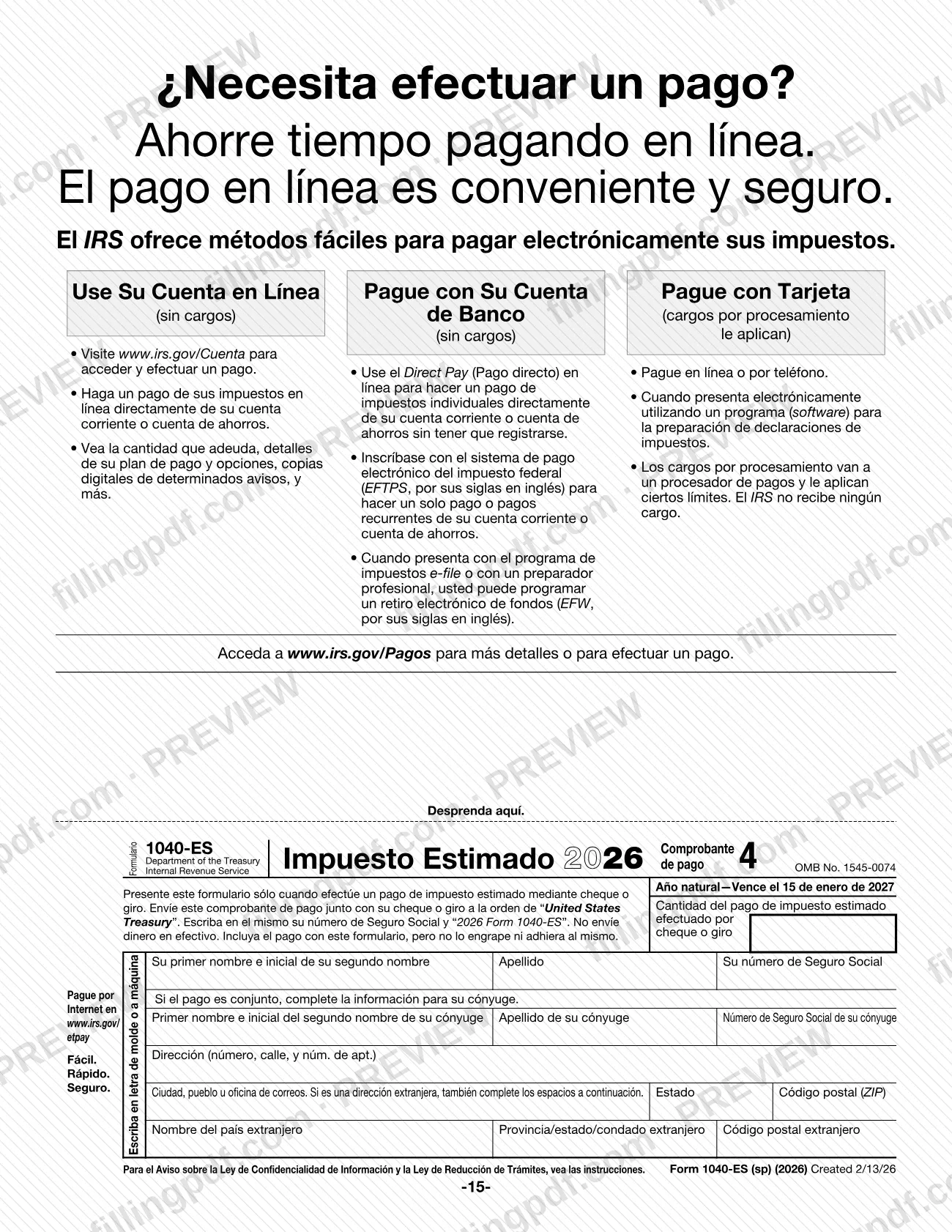
On each voucher, print or type your first name and middle initial, last name and SSN. For a joint payment, also enter your spouse's name and SSN in the same order as on your joint return.
Complete the voucher address
Enter your street address and apartment number, then city, state and ZIP code. For a foreign address, also fill in the foreign country, province or state, and foreign postal code spaces.
Enter the payment amount
In the payment box, enter only the amount you are sending by check or money order. Do not include a 2025 overpayment you chose to apply to 2026.
Record each payment
On the Registro de Pagos de Impuesto Estimado, record for each due date the amount due, payment date, check or confirmation number, amount paid and any 2025 credit applied.
Review and download the completed PDF
Check names, SSNs and amounts against your worksheet. Download or print the completed PDF from FillingPDF, keep the worksheets for your records and use the voucher only if you pay by check or money order.
How to submit 1040-ES (sp)
You do not file Form 1040-ES (sp) itself. You pay estimated tax online, by phone, with the IRS2Go app, in cash through a retail option, or by mailing a check or money order with a payment voucher.
- Online: your IRS online account (IRS.gov/Cuenta), IRS Direct Pay (IRS.gov/Pagos), debit or credit card or digital wallet, or electronic funds withdrawal when you e-file. See IRS.gov/ModernPayments.
- Phone: EFTPS (EFTPS.gov, 800-244-4829; enrollment required), or a card payment provider: ACI Payments, Inc., 888-UPAY-TAX (888-872-9829), or Link2Gov Corporation, 888-PAY-1040 (888-729-1040).
- Cash: see IRS.gov/PayCash. Never mail cash.
- By mail: send the voucher for the due date, with a check or money order payable to "United States Treasury", to the address for where you live. Write your SSN and "2026 Form 1040-ES" on the payment, and do not staple it to the voucher.
Mailing addresses:
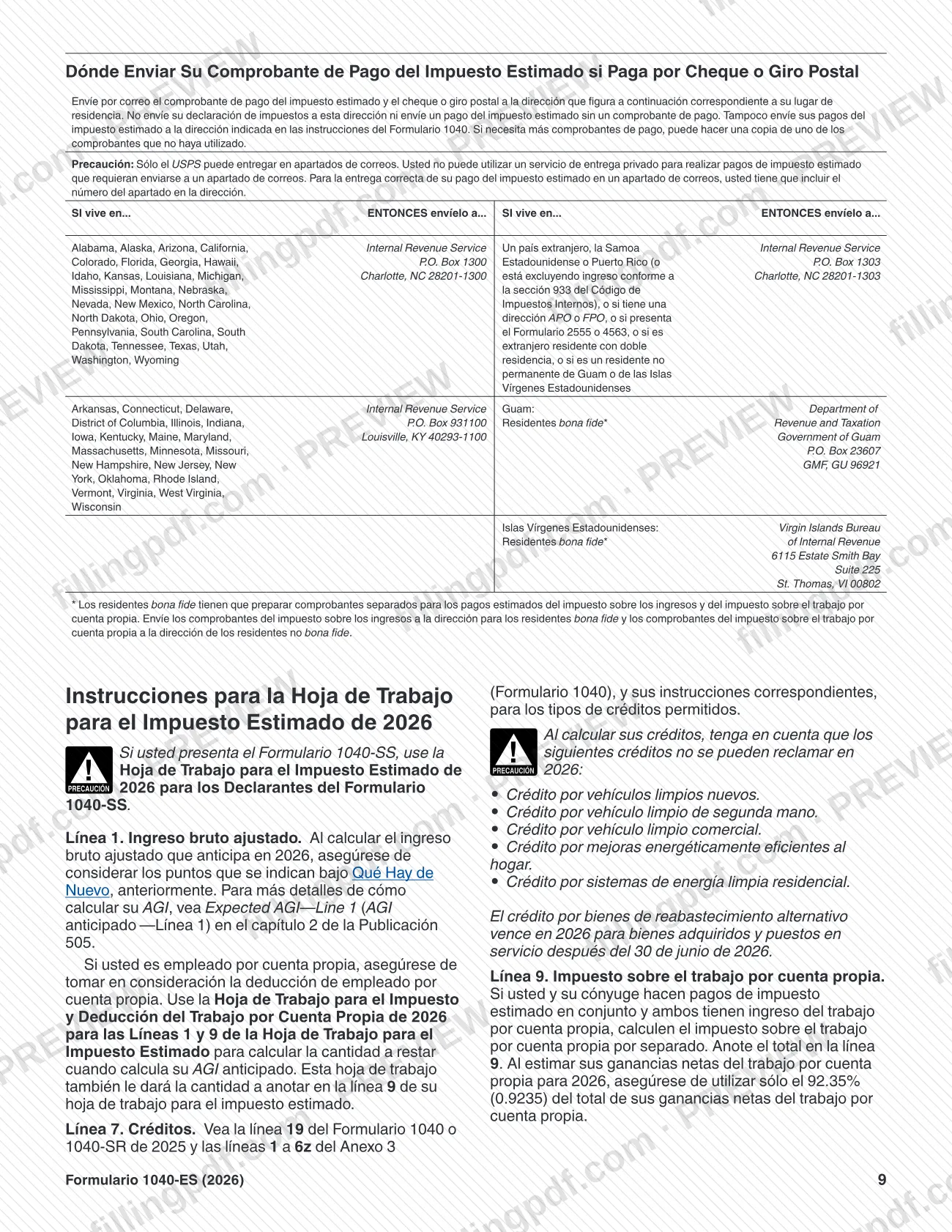
- Alabama, Alaska, Arizona, California, Colorado, Florida, Georgia, Hawaii, Idaho, Kansas, Louisiana, Michigan, Mississippi, Montana, Nebraska, Nevada, New Mexico, North Carolina, North Dakota, Ohio, Oregon, Pennsylvania, South Carolina, South Dakota, Tennessee, Texas, Utah, Washington, Wyoming: Internal Revenue Service, P.O. Box 1300, Charlotte, NC 28201-1300.
- Arkansas, Connecticut, Delaware, District of Columbia, Illinois, Indiana, Iowa, Kentucky, Maine, Maryland, Massachusetts, Minnesota, Missouri, New Hampshire, New Jersey, New York, Oklahoma, Rhode Island, Vermont, Virginia, West Virginia, Wisconsin: Internal Revenue Service, P.O. Box 931100, Louisville, KY 40293-1100.
- A foreign country, American Samoa, Puerto Rico (or excluding income under section 933), APO/FPO addresses, Form 2555 or 4563 filers, dual-status aliens, nonpermanent residents of Guam or the U.S. Virgin Islands: Internal Revenue Service, P.O. Box 1303, Charlotte, NC 28201-1303.
- Bona fide residents of Guam: Department of Revenue and Taxation, Government of Guam, P.O. Box 23607, GMF, GU 96921. Bona fide residents of the U.S. Virgin Islands: Virgin Islands Bureau of Internal Revenue, 6115 Estate Smith Bay, Suite 225, St. Thomas, VI 00802.
Only the USPS can deliver to P.O. boxes; private delivery services cannot be used for payments going to a P.O. box. Do not send a tax return or a payment without a voucher to these addresses. FillingPDF lets you fill out and download the PDF; submission follows the channels above.
Common mistakes to avoid
- Mailing a check or money order without the payment voucher; the instructions say not to send an estimated tax payment without one.
- Sending the payment to the address in the Form 1040 instructions or mailing your tax return to the estimated tax address; the form says to use neither.
- Using a private delivery service for a payment that must go to a P.O. box; only the USPS can deliver there.
- Mailing cash, or stapling or attaching the check to the voucher; the form says to include the payment but not staple it.
- Leaving off "2026 Form 1040-ES" and your SSN on the check or money order.
- Filing one joint voucher when you and your spouse plan to file separate returns; submit separate vouchers instead.
- Continuing to use an ITIN on the voucher after you have been issued an SSN; the instructions say to use the SSN.
- Making joint estimated payments when your spouse is a nonresident alien, you are separated under a decree, you have different tax years, or you are in a registered domestic partnership or civil union.
- Using the 2026 Tax Rate Schedules to figure your 2025 tax; the form says to use them only for 2026 estimated tax.
- Writing the check amount with dashes or "xx/100" instead of the format $ XXX.XX.
Frequently asked questions
What is Form 1040-ES (sp)?
Form 1040-ES (sp), Estimated Tax For Individuals (Spanish Version), is the IRS Spanish-language form set for 2026 used to figure and pay estimated tax. It includes instructions, a worksheet, tax rate schedules and four payment vouchers.
Who has to pay estimated tax for 2026?
Generally, U.S. citizens and resident aliens, and residents of Puerto Rico and other listed territories, who expect to owe tax after withholding and refundable credits. The amount of withholding must also fall below the lesser of 90% of 2026 tax or 100% of 2025 tax.
What are the 2026 estimated tax due dates?
April 15, 2026; June 15, 2026; September 15, 2026; and January 15, 2027. You may instead pay everything by April 15, 2026. You can skip the January payment if you file your 2026 return by February 1, 2027 and pay the full balance.
Do I have to mail the payment voucher?
No. The vouchers are for payments by check or money order only. You can pay online, by phone, with the IRS2Go app or in cash through a retail option, and the instructions encourage electronic methods. Use one voucher per due date when you mail.
Where do I mail my estimated tax payment?
It depends on where you live: P.O. Box 1300, Charlotte, NC 28201-1300; P.O. Box 931100, Louisville, KY 40293-1100; or P.O. Box 1303, Charlotte, NC 28201-1303 for foreign and certain other addresses. Guam and U.S. Virgin Islands bona fide residents use territory addresses.
Can I fill out Form 1040-ES (sp) online?
Yes. You can fill out the fillable PDF online on FillingPDF and download or print it. FillingPDF is an independent service and does not send payments or forms to the IRS; you pay through the IRS channels described on this page.
What happens if I pay late or too little?
The IRS may charge a penalty when you file your return, calculated for each underpayment and the number of days it remains unpaid. The penalty may be waived in certain circumstances; the instructions for Form 2210 give the details.
Should I use my ITIN or SSN on the voucher?
Use your SSN once you have been issued one, even if it does not authorize employment. If you only have an ITIN, enter it where the SSN is requested. The IRS does not issue an ITIN once an SSN has been issued.
Can I pay estimated tax if I am a nonresident alien?
Not with this form. The estimated tax rules also apply to nonresident aliens, but the instructions direct them to Form 1040-ES (NR). This Spanish-language set is for the other groups listed in the instructions.
Ready to fill out 1040-ES (sp)?
Fill out 1040-ES (sp) now