
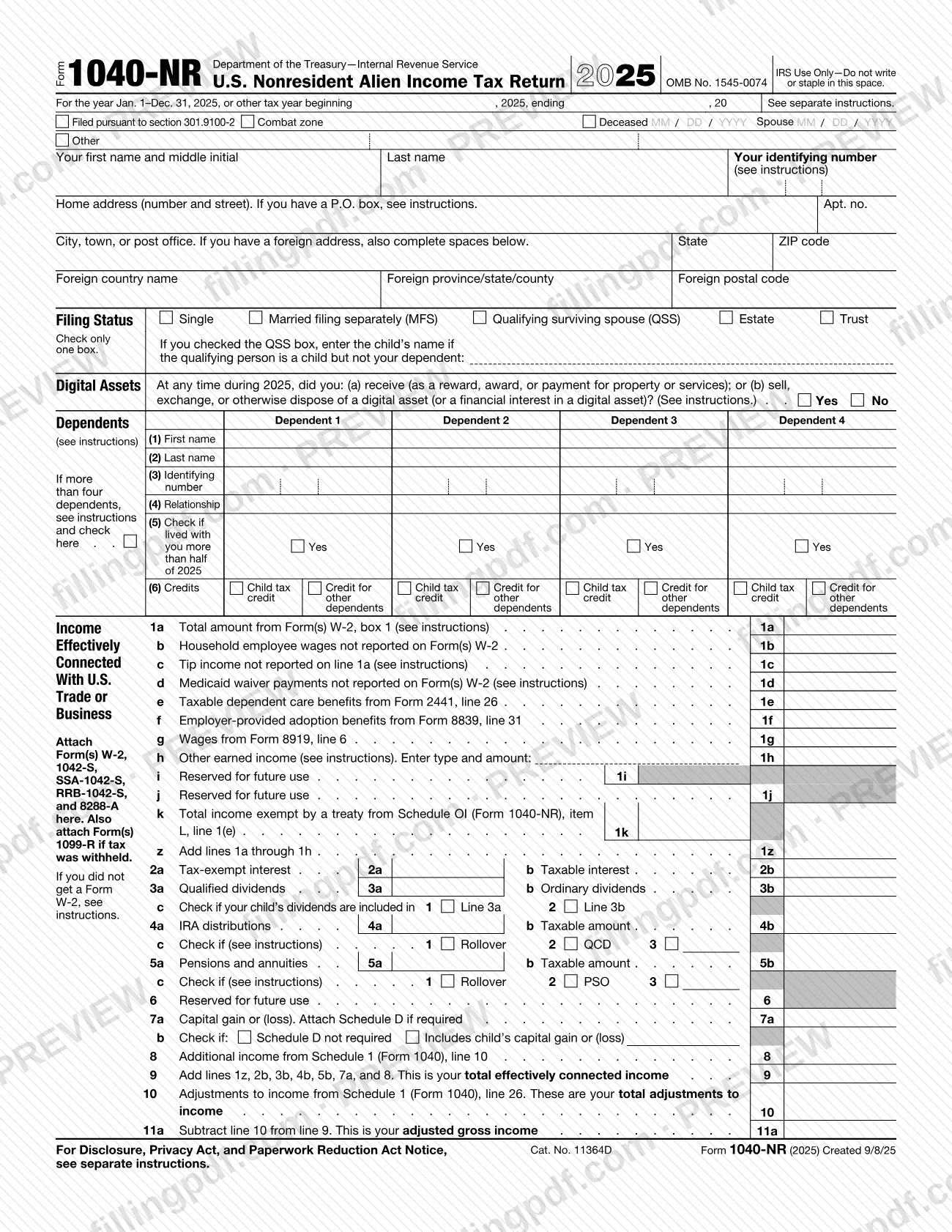
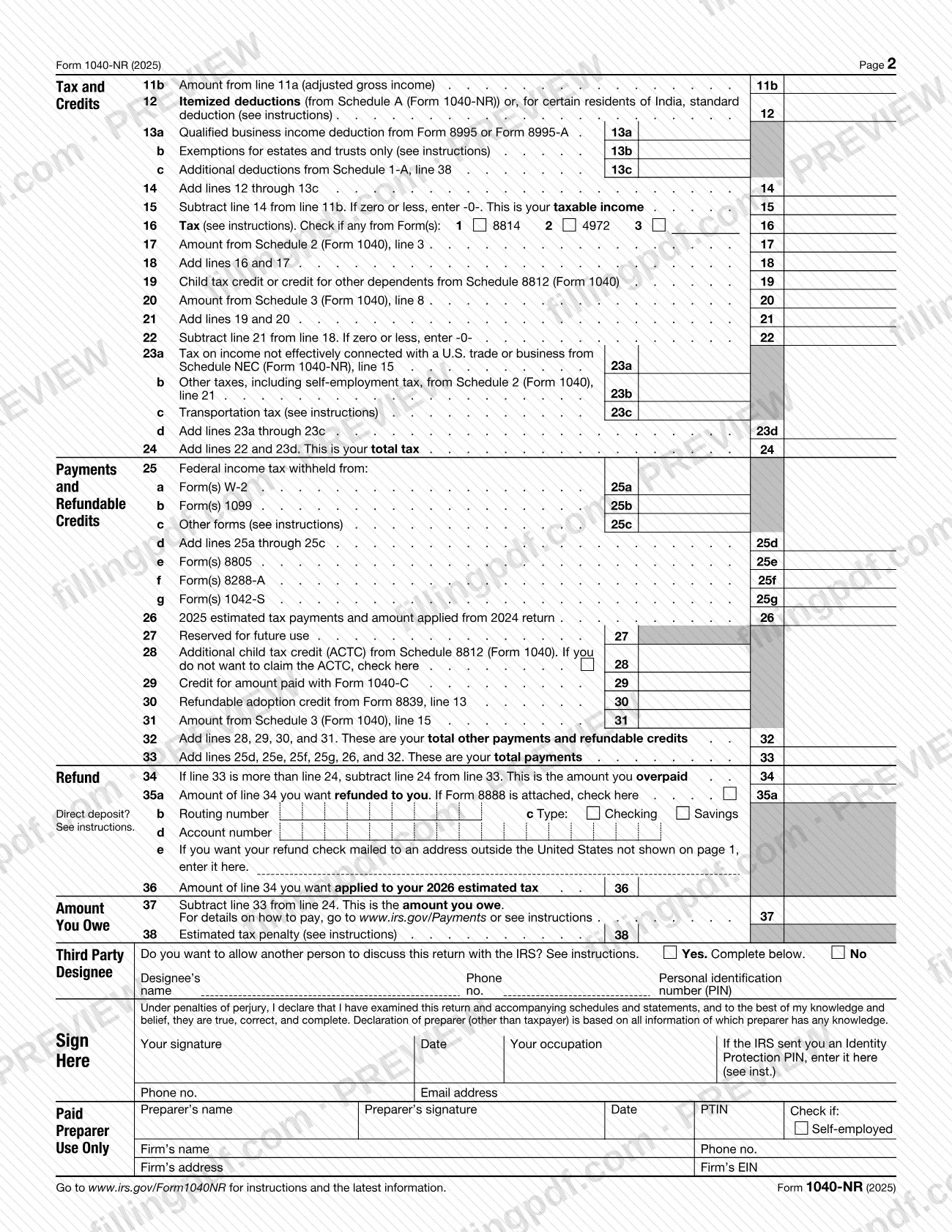
Form 1040-NR, U.S. Nonresident Alien Income Tax Return (often searched as 1040NR), is the Internal Revenue Service (IRS) return that nonresident aliens, and nonresident alien estates and trusts, use to report U.S. income and figure U.S. tax for 2025. Dual-status filers who were nonresidents on the last day of the tax year also use it. On FillingPDF you can fill out the form online and download or print the completed PDF; the IRS publishes the original PDF and the instructions at irs.gov, and the return reaches the IRS only through the channels described below.
Last updated
What is 1040-NR?
Form 1040-NR, U.S. Nonresident Alien Income Tax Return, is the Internal Revenue Service (IRS) form on which a nonresident alien, or the representative of a nonresident alien estate or trust, reports income effectively connected with a U.S. trade or business, figures tax and claims a refund or reports an amount owed for tax year 2025.
Its lines are arranged to match the same tax items as the 2025 Form 1040, U.S. Individual Income Tax Return, and Form 1040-SR, U.S. Income Tax Return for Seniors, but the rules differ: a nonresident alien cannot use the Married filing jointly or Head of household filing status, and many credits are limited or unavailable.
Page 1 covers effectively connected income, adjustments and adjusted gross income. Page 2 covers deductions, tax, payments, refund, amount you owe, third party designee and signature. Income that is not effectively connected with a U.S. trade or business is reported on Schedule NEC (Form 1040-NR), and the tax from it is entered on line 23a.
The form works with its own schedules: Schedule OI (Form 1040-NR), Other Information, which you include with the return; Schedule A (Form 1040-NR), Itemized Deductions; Schedule NEC; and Schedule P (Form 1040-NR). It can also use Schedules 1, 1-A, 2 and 3 of Form 1040. Schedule A (Form 1040-NR) is used only with Form 1040-NR, never with Form 1040 or 1040-SR.
Who needs to file 1040-NR?
You file Form 1040-NR if you were a nonresident alien engaged in a trade or business in the United States during 2025, even if you had no U.S. source income or your income is exempt under a tax treaty. You also file if you were a nonresident alien not engaged in a U.S. trade or business, received U.S. income reportable on Schedule NEC lines 1 through 12, and not all of the tax was withheld. Other triggers in Table A of the IRS instructions include owing alternative minimum tax or other special taxes, receiving HSA or Archer MSA distributions, advance payments of the premium tax credit, and holding a qualified opportunity fund investment.
- Representatives: a personal representative files for a deceased person who would have had to file; a representative files for a nonresident alien estate or trust.
- Dual-status filers: if you were a nonresident on the last day of the tax year, file Form 1040-NR and write "Dual-Status Return" across the top.
- Refund-only filers: you should file if you can get money back, such as withheld tax.
You do not need to file if you meet one of the exceptions in the instructions, such as a nonresident student, teacher or trainee on an F, J, M or Q visa with no income taxable under section 871. If you were a U.S. resident on the last day of the tax year, you file Form 1040 or 1040-SR instead. A joint return is not available unless you elect to be taxed as a resident alien, which uses Form 1040 or 1040-SR.
When to file 1040-NR
The due date depends on whether you were an employee who received wages subject to U.S. income tax withholding. If you were, file Form 1040-NR by the 15th day of the 4th month after your tax year ends: April 15, 2026 for the 2025 calendar year. If you did not receive such wages, file by the 15th day of the 6th month: June 15, 2026.
A nonresident alien estate or trust with an office in the United States files by the 15th day of the 4th month after its tax year ends. One without a U.S. office files by the 15th day of the 6th month. When a due date falls on a Saturday, Sunday or legal holiday, file by the next business day.
Filing after the due date may mean interest and penalties. For what to do if you cannot file on time, the instructions send you to the Instructions for Form 1040. Members of the U.S. Armed Forces in a designated combat zone or contingency operation may be able to file later; see Pub. 3.
Documents you need
- Schedule OI (Form 1040-NR), Other Information: included with every Form 1040-NR; you must answer all questions.
- Form(s) W-2, 1042-S, SSA-1042-S, RRB-1042-S and 8288-A, attached to the front of the return where they apply to your income or withholding.
- Form(s) 1099-R, attached to the front of the return if tax was withheld.
- Form(s) 8805, attached to the back of the return if you claim tax withheld by a partnership on line 25e.
- Form 1042-S or Form 1099 showing the income and the tax withheld, if you claim a refund of tax withheld at the source or backup withholding.
- Form 8833, Treaty-Based Return Position Disclosure, if required, for example when you claim treaty benefits or are a dual-resident taxpayer treated as a nonresident.
- Form 1040-V with a check or money order, if you pay a balance due by check or money order.
- Form 8958, if you or your spouse had community income and you must allocate it between spouses.
- Form 8997, if you held a qualified investment in a qualified opportunity fund at any time during the year.
- A statement with your name, address and identifying number, for items the instructions require in writing, such as a real property election or a dual-status statement.
How to fill out 1040-NR
Enter tax year, name, address and ID
At the top of page 1, enter the tax year (or the fiscal-year dates), your name, home address and your identifying number (SSN, ITIN, or EIN for an estate or trust). Check Deceased with the date when filing for someone who died, and complete the foreign address spaces if you have a foreign address.
Choose your filing status
Check only one box: Single, Married filing separately (MFS), Qualifying surviving spouse (QSS), Estate or Trust. Married filing jointly and Head of household are not available; if you check QSS and the qualifying person is a child who is not your dependent, enter the child's name.
Answer the digital assets question
Check Yes or No for whether you received a digital asset as a reward, award or payment, or sold, exchanged or otherwise disposed of one during 2025. The instructions require an answer.
List dependents if you qualify
Under Dependents, enter each dependent's first and last name, identifying number and relationship, then complete columns (5) and (6). Only U.S. nationals and residents of Canada and Mexico claim dependents on the same terms as U.S. citizens; residents of South Korea and certain India students have limited rules.
Report wages and earned income
On lines 1a through 1h, report only effectively connected income, such as W-2 box 1 wages from a U.S. trade or business. Enter income exempt under a treaty on line 1k, not line 1a, and total lines 1a through 1h on line 1z. Leave lines 1i and 1j blank.
Enter interest, dividends, pensions and gains
On lines 2a through 5b and 7a, report only amounts effectively connected with a U.S. trade or business; other U.S. source amounts go on Schedule NEC. Leave line 6 blank, then add lines 1z, 2b, 3b, 4b, 5b, 7a and 8 on line 9.
Figure adjusted gross income
Enter adjustments from Schedule 1 (Form 1040), line 26 on line 10. Subtract line 10 from line 9 on line 11a, and copy the result to line 11b on page 2.
Enter deductions and taxable income
On line 12, enter itemized deductions from Schedule A (Form 1040-NR). Complete lines 13a through 13c where they apply, add lines 12 through 13c on line 14, and subtract line 14 from line 11b on line 15, entering -0- if zero or less.
Calculate tax and credits
Enter tax on line 16, marking Form 8814 or 4972 if used, then complete lines 17 through 22. On line 23a enter tax from Schedule NEC, line 15; use line 23b for other taxes and 23c for transportation tax. Line 24 is your total tax.
Enter payments and refundable credits
On lines 25a through 25g, enter tax withheld from Forms W-2, 1099, 1042-S, 8805 and 8288-A. Add estimated tax on line 26, leave line 27 blank, complete lines 28 through 32, and total payments on line 33.
Complete refund or amount owed
If line 33 exceeds line 24, enter the overpayment on line 34, the refund on 35a (routing, type and account on 35b through 35d) and any amount applied to 2026 estimated tax on line 36. If you owe, enter it on line 37 and any estimated tax penalty on line 38.
Complete Schedule OI and other schedules
Answer every question on Schedule OI (Form 1040-NR) and include it with the return. Add Schedule A, NEC, P or Schedules 1, 1-A, 2 and 3 only where your situation requires them.
Review, sign and download the PDF
Complete the Third Party Designee section if you want the IRS to discuss the return with someone, then sign and date; a paid preparer fills in the preparer block. Check every line, then download or print the completed PDF from FillingPDF and attach the required forms.
How to submit 1040-NR
You can e-file Form 1040-NR or mail a paper return. If you e-file, there is no need to mail it; the IRS instructions point to IRS.gov for e-file details and note that tax software generally determines which schedules you need.
- By mail, individuals, no payment enclosed: Department of the Treasury, Internal Revenue Service, Austin, TX 73301-0215, USA.
- By mail, individuals, payment enclosed: Internal Revenue Service, P.O. Box 1303, Charlotte, NC 28201-1303, USA.
- By mail, estates and trusts, no payment: Department of the Treasury, Internal Revenue Service, Kansas City, MO 64999, USA. With a payment, use the Charlotte P.O. box above.
These addresses are for Forms 1040-NR filed in 2026; addresses for returns filed after 2026 may differ, so check IRS.gov/Form1040NR. Only the U.S. Postal Service can deliver to P.O. boxes, so you cannot use a private delivery service for a payment sent to one.
To pay, see IRS.gov/Payments. A check or money order must be drawn on a U.S. financial institution; write "2025 Form 1040-NR", your name, address, daytime phone number and SSN on it, and attach Form 1040-V. Refunds of tax shown on Forms 8805, 8288-A or 1042-S may take up to 6 months. FillingPDF lets you fill out and download the PDF; submission follows the channels above.
Common mistakes to avoid
- Choosing Married filing jointly or Head of household; a nonresident alien filing Form 1040-NR cannot use either status. A married person checks Married filing separately unless the exception for Single applies.
- Using Schedule A (Form 1040) with Form 1040-NR. Itemized deductions on line 12 come from Schedule A (Form 1040-NR), which is never used with Form 1040 or 1040-SR.
- Entering treaty-exempt wages on line 1a instead of line 1k, or skipping item L of Schedule OI (Form 1040-NR) when you claim a treaty exemption.
- Reporting income that is not effectively connected with a U.S. trade or business on page 1 instead of Schedule NEC (Form 1040-NR).
- Leaving the Digital Assets question unanswered; the instructions say you must answer it whether or not you received a Form 1099-DA.
- Claiming the earned income credit on line 27 or the American opportunity credit on line 29; Form 1040-NR filers cannot claim them, and line 27 is to be left blank.
- Claiming the child tax credit, credit for other dependents or a dependent when you are not a U.S. national or a resident of Canada or Mexico, or within the limited South Korea and India cases.
- Mailing a return with a payment to the Austin address, or sending a payment to the P.O. box by private delivery service; only the U.S. Postal Service delivers to P.O. boxes.
- Filing Form 1040-NR when you were a U.S. resident on the last day of the tax year; that dual-status case uses Form 1040 or 1040-SR.
- Not signing and dating the return; the instructions say you must sign and date it.
Frequently asked questions
What is Form 1040-NR (1040NR) used for?
Form 1040-NR is the IRS return for nonresident aliens, and for nonresident alien estates and trusts, to report U.S. income, figure tax and claim a refund or report an amount owed for tax year 2025. Dual-status filers who were nonresidents on the last day of the year also use it.
When is Form 1040-NR due for 2025?
April 15, 2026 if you were an employee with wages subject to U.S. income tax withholding. If you had no such wages, the due date is June 15, 2026. Weekend or holiday due dates move to the next business day, and late filing may bring interest and penalties.
Where do I mail Form 1040-NR?
Individuals without a payment mail it to Department of the Treasury, Internal Revenue Service, Austin, TX 73301-0215, USA. With a payment, mail it to Internal Revenue Service, P.O. Box 1303, Charlotte, NC 28201-1303, USA. Estates and trusts without a payment use Kansas City, MO 64999. E-filing needs no mailing.
Can a nonresident alien file a joint return or use Head of household?
No. A nonresident alien filing Form 1040-NR cannot use Married filing jointly or Head of household. The only way to file jointly is to elect to be taxed as a resident alien, which uses Form 1040 or 1040-SR, and the election has conditions listed in the instructions.
Do I have to file Form 1040-NR if my income is exempt under a tax treaty?
Yes, if you were a nonresident alien engaged in a U.S. trade or business, you must file even when your income is exempt under a treaty. Report treaty-exempt income on line 1k and complete item L of Schedule OI (Form 1040-NR); attach Form 8833 if required.
Do F-1 or J-1 students have to file Form 1040-NR?
Not always. A nonresident student, teacher or trainee temporarily in the United States on an F, J, M or Q visa does not need to file if they have no income taxable under section 871. If tax was withheld and refund is possible, the instructions say you should consider filing.
What is the difference between Form 1040-NR and Form 1040?
Form 1040-NR is for nonresident aliens and nonresident alien estates and trusts; Form 1040 and Form 1040-SR are for U.S. residents. Their lines match in most cases, but Form 1040-NR has its own schedules, limits on filing status and credits, and a Schedule OI that must be included.
Can I fill out Form 1040-NR online on FillingPDF?
Yes. You can fill out the fillable PDF online on FillingPDF and download or print it. FillingPDF is an independent service and does not file the return with the IRS; you e-file or mail it through the IRS channels.
What if I was a U.S. resident for part of 2025?
You have a dual-status year. If you were a resident on the last day of the tax year, file Form 1040 or 1040-SR with "Dual-Status Return" across the top. If you were a nonresident on the last day, file Form 1040-NR with that notation and a statement of income for the resident part.
Ready to fill out 1040-NR?
Fill out 1040-NR now