
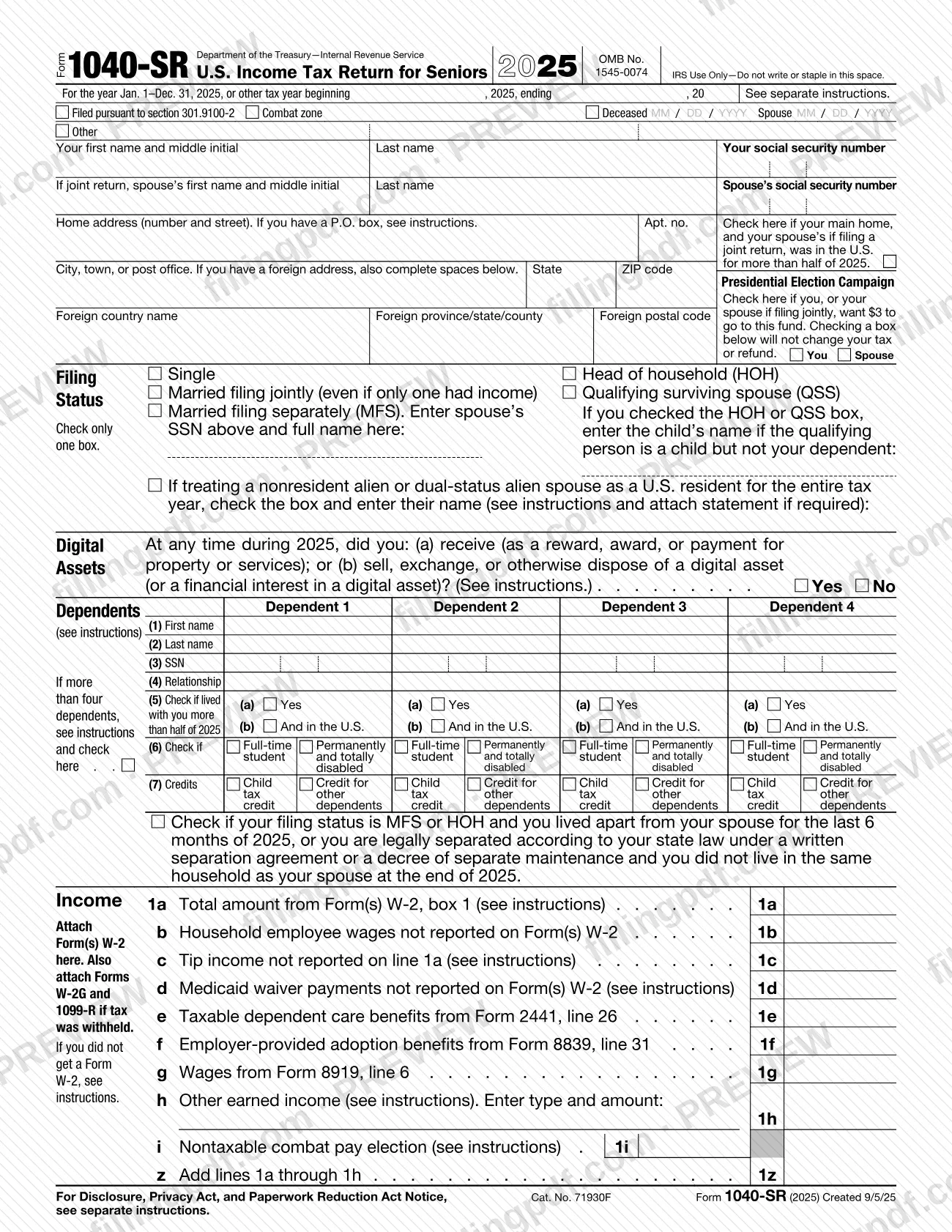
Form 1040-SR, U.S. Income Tax Return for Seniors, is the annual federal income tax return that the Internal Revenue Service (IRS) offers as an optional alternative to Form 1040 for taxpayers age 65 or older. It uses the same schedules and instructions as Form 1040, so the choice changes the form you file, not the rules behind it. This page lets you fill out the 1040-SR online on FillingPDF and download or print the completed PDF. The IRS publishes the form and its instructions at www.irs.gov/Form1040SR.
Last updated
What is 1040-SR?
Form 1040-SR, U.S. Income Tax Return for Seniors, is the Internal Revenue Service (IRS) form that taxpayers age 65 or older may use, as an optional alternative to Form 1040, to report income, claim deductions and credits, and figure a refund or the tax owed for the year.
The Department of the Treasury's IRS issues the form under OMB No. 1545-0074. The edition on this page is for the tax year printed as 2025 (January 1 to December 31, 2025, or another tax year entered at the top). The IRS says Form 1040-SR uses the same schedules and instructions as Form 1040.
The return follows a fixed order:
- Name, Social Security number, address and filing status.
- The digital assets question and the Dependents section.
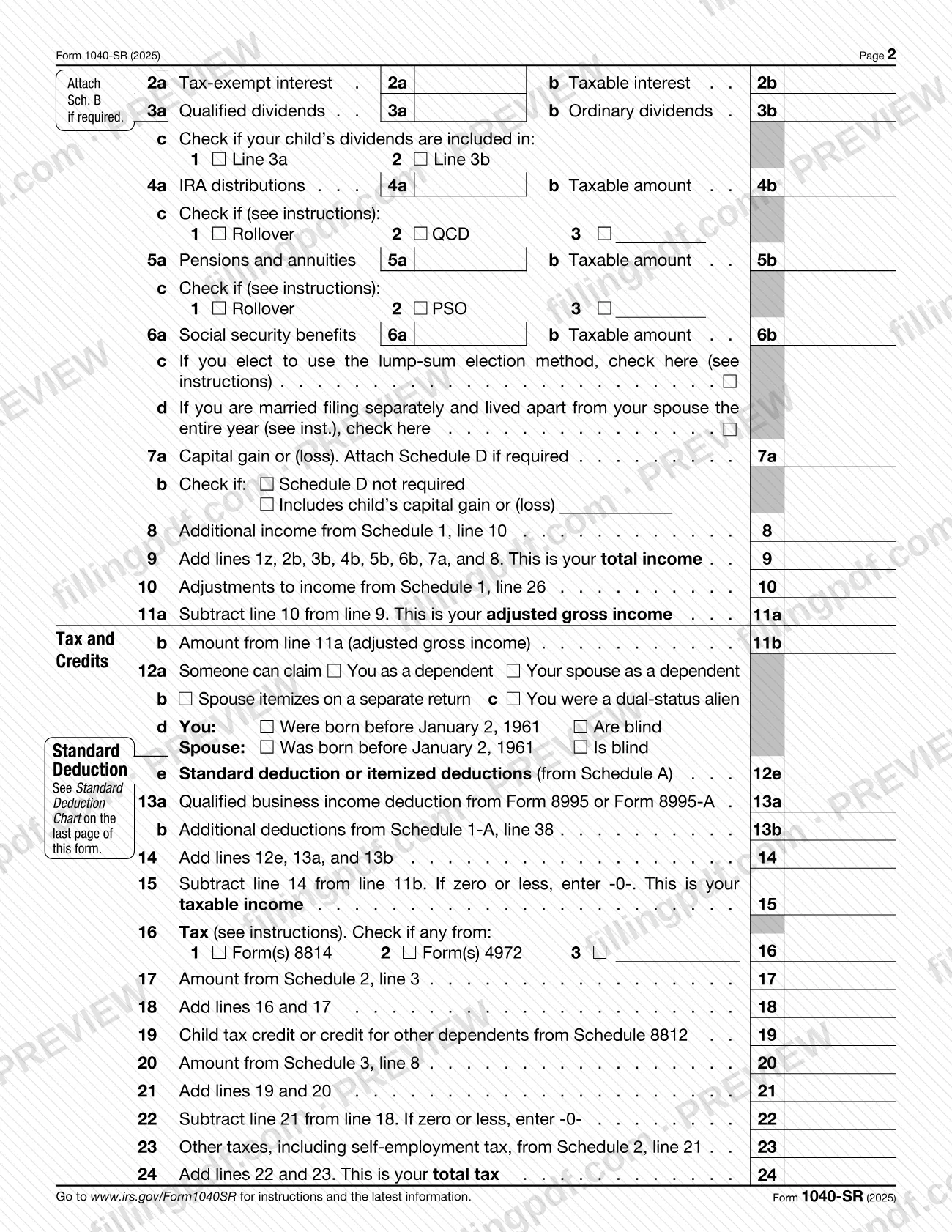
- Income (lines 1a to 9), adjustments and adjusted gross income (lines 10 to 11b).
- Deductions and taxable income (lines 12a to 15), tax and credits (lines 16 to 24).
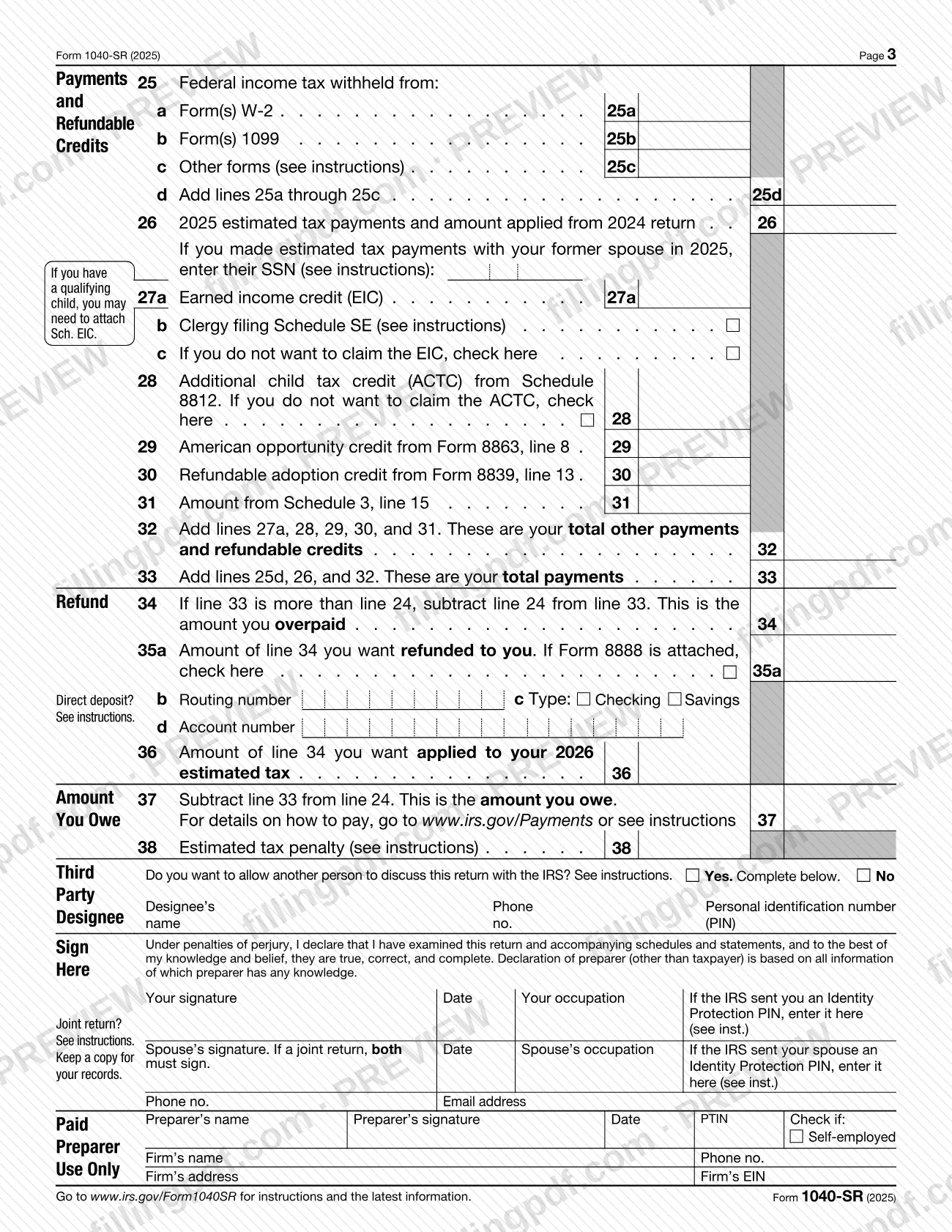
- Payments and refundable credits (lines 25 to 33), refund (lines 34 to 36) and amount you owe (lines 37 and 38).
- Third Party Designee, signature and Paid Preparer Use Only blocks.
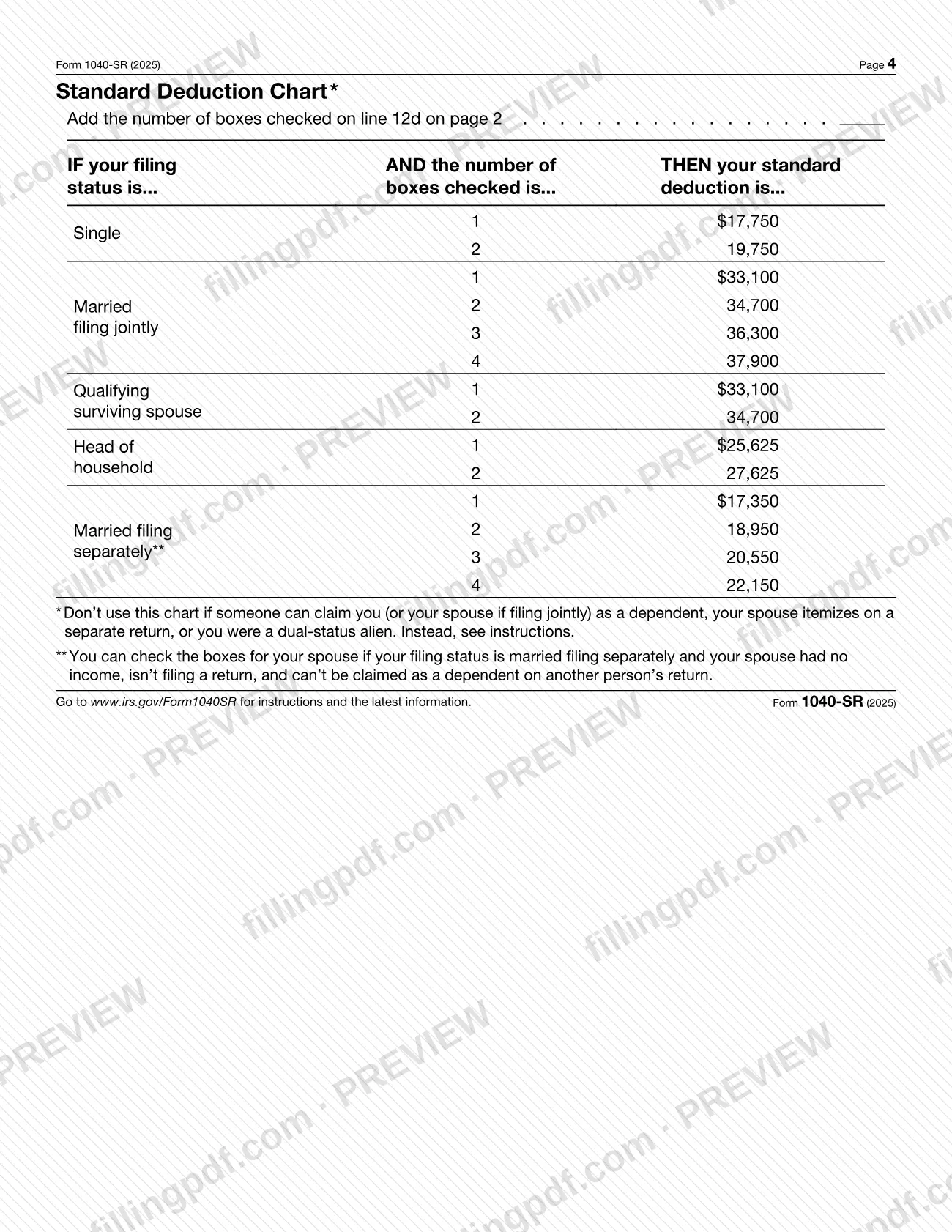
Page 4 holds a Standard Deduction Chart. Numbered schedules cover items the form itself does not: Schedule 1 for additional income and adjustments, Schedule 1-A for additional deductions, Schedule 2 for other taxes and Schedule 3 for additional credits and payments.
Who needs to file 1040-SR?
Taxpayers age 65 or older may use Form 1040-SR instead of Form 1040; the IRS describes it as optional. If you do not want it, Form 1040 remains available and follows the same schedules and instructions.
- Joint filers. On a joint return, both spouses are named on the form and both must sign.
- Dependents and filing status. Check only one filing status box. If you check Head of household or Qualifying surviving spouse and the qualifying person is a child who is not your dependent, enter the child's name.
- Taxpayers who died. Use the Deceased box and enter the date (MM/DD/YYYY) when the return is for a taxpayer who has died.
- Standard deduction. Line 12d asks whether you, and your spouse, were born before January 2, 1961 or are blind. The Standard Deduction Chart on page 4 must not be used if someone can claim you (or your spouse) as a dependent, your spouse itemizes on a separate return, or you were a dual-status alien; in those cases see the instructions.
A paid preparer completes the Paid Preparer Use Only block.
When to file 1040-SR
File Form 1040-SR for the tax year printed at the top of the form, January 1 to December 31, 2025, or for another tax year entered on the same line. The IRS Free File page refers to an April 15 filing deadline, and says that payment of any balance due is also owed by April 15 to avoid penalties.
If you cannot file by then, an extension request on Form 4868 gives you until October 15 to file your federal return. The extension is only for filing, not for paying.
IRS Free File can be used only for the current year's return; it cannot process a prior-year (past-due) return. Line 35a and the Where's My Refund tool relate to what happens next: the IRS says refund status appears about 24 hours after you e-file a current-year return and about 4 weeks after you file a paper return.
Documents you need
- Form(s) W-2: attach where the form shows, to report the total from box 1 on line 1a. If you did not get a Form W-2, see the instructions.
- Forms W-2G and 1099-R: attach only if federal income tax was withheld.
- Schedule B: attach if required, for interest and dividends reported on lines 2 and 3.
- Schedule D: attach if required, for the capital gain or (loss) on line 7a; otherwise check the box on line 7b that Schedule D is not required.
- Schedules 1, 1-A, 2, 3 and 8812: attach the ones your situation requires, since lines 8, 10, 13b, 17, 19, 20, 23 and 31 pull amounts from them.
- Form 8995 or Form 8995-A: attach for the qualified business income deduction entered on line 13a.
- Schedule A: attach if you enter itemized deductions on line 12e instead of the standard deduction.
- Schedule EIC: attach if you have a qualifying child and claim the earned income credit on line 27a.
- Form 8888: attach if you split your refund, and check the box on line 35a.
- Statement for a nonresident or dual-status alien spouse: attach if you treat that spouse as a U.S. resident for the entire tax year and the instructions require it.
How to fill out 1040-SR
Enter the tax year and header
At the top, use the pre-printed calendar year, or enter the beginning and ending dates of another tax year. Check the boxes for a deceased taxpayer (with MM/DD/YYYY), combat zone or section 301.9100-2 filing only if they apply.
Enter names, SSNs and address
Enter your first name and middle initial, last name and Social Security number, then the same for your spouse if you file jointly. Fill in the home address and, for a foreign address, the country, province/state/county and postal code; see the instructions if you use a P.O. box.
Check the residence and campaign boxes
Check the box if your main home (and your spouse's, on a joint return) was in the U.S. for more than half of 2025. In the Presidential Election Campaign box, check You, Spouse or both if you want to contribute; it does not change your tax or refund.
Choose your filing status
Check only one box: Single, Married filing jointly, Married filing separately (MFS), Head of household (HOH) or Qualifying surviving spouse (QSS). For MFS enter your spouse's SSN above and full name; for HOH or QSS with a qualifying child who is not your dependent, enter the child's name.
Answer the digital assets question
Check Yes or No for whether during 2025 you received a digital asset as a reward, award or payment, or sold, exchanged or otherwise disposed of one (or a financial interest in one).
List your dependents
For each of up to four dependents enter (1) first name, (2) last name, (3) SSN and (4) relationship, then (5) the lived-with-you and U.S. checks, (6) the student or disabled boxes and (7) Child tax credit or Credit for other dependents. If you have more than four, check the box and see the instructions.
Report your earned income
Enter the Form W-2 box 1 total on line 1a and other wages and pay on lines 1b to 1h, with the combat pay election on line 1i. Add lines 1a through 1h on line 1z.
Enter interest, dividends and retirement income
Complete lines 2a and 2b (interest), 3a to 3c (dividends), 4a to 4c (IRA distributions), 5a to 5c (pensions and annuities) and 6a to 6d (Social security benefits), using the check boxes where the form asks and the instructions for each.
Total your income and adjustments
Enter capital gain or (loss) on line 7a and check line 7b if it applies, then additional income from Schedule 1, line 10, on line 8. Add lines 1z, 2b, 3b, 4b, 5b, 6b, 7a and 8 on line 9, subtract Schedule 1, line 26 (line 10) on line 11a, and carry that amount to line 11b.
Figure deductions and taxable income
On line 12a to 12d check the boxes that apply, including birth before January 2, 1961 and blindness, then use the Standard Deduction Chart on page 4 or enter Schedule A itemized deductions on line 12e. Enter lines 13a and 13b, add lines 12e, 13a and 13b on line 14, and subtract it from line 11b on line 15, entering -0- if zero or less.
Calculate tax and credits
Enter the tax on line 16, marking Form(s) 8814 or 4972 if used, then Schedule 2, line 3 on line 17 and the total on line 18. Complete lines 19 to 22 for credits, add Schedule 2, line 21 on line 23, and enter your total tax on line 24.
Enter payments and refundable credits
Report tax withheld on lines 25a to 25c and total it on 25d, estimated payments on line 26, and the earned income credit, additional child tax credit, American opportunity credit, refundable adoption credit and Schedule 3 amount on lines 27a and 28 to 31. Add them on lines 32 and 33.
Complete the refund or amount owed
If line 33 is more than line 24, enter the overpayment on line 34, the amount refunded on line 35a and the amount applied to your 2026 estimated tax on line 36. For direct deposit enter the routing number, account type and account number on lines 35b to 35d. If you owe, enter the amount on line 37 and any estimated tax penalty on line 38.
Add designee, signature and preparer details
Check Yes or No under Third Party Designee and, if Yes, enter the designee's name, phone number and PIN. Sign and date, and have your spouse sign too on a joint return; add occupation and any Identity Protection PIN, and the paid preparer completes the preparer block.
Review and download the completed PDF
Check every line, the signature and the attachments listed in the form, then download or print the completed PDF from FillingPDF and keep a copy for your records.
How to submit 1040-SR
You can file Form 1040-SR electronically or on paper.
- Electronically. Start at IRS.gov/freefile and choose Guided tax software (limited by an adjusted gross income threshold and each partner's own eligibility criteria) or Free File Fillable Forms (any income level). You sign the e-filed return with last year's AGI or a five-digit self-select PIN, and the IRS confirms by email when the return is accepted.
- By mail. The IRS directs filers to its Where to file page for Form 1040, which lists the current mailing addresses. Attach Form(s) W-2 where the form shows, plus Forms W-2G and 1099-R if tax was withheld, and any schedules the return requires. Keep a copy for your records.
- Paying a balance. Go to www.irs.gov/Payments or see the instructions.
To check a refund, use Where's My Refund. Instructions and the latest information are at www.irs.gov/Form1040SR. FillingPDF lets you fill out and download the PDF; submission follows the channels above.
Common mistakes to avoid
- Leaving the digital assets question unanswered; the form asks you to check Yes or No.
- Checking more than one filing status box; the form says to check only one.
- Choosing Married filing separately without entering your spouse's SSN in the space at the top and the spouse's full name where the form asks.
- Using the Standard Deduction Chart when someone can claim you as a dependent, your spouse itemizes on a separate return, or you were a dual-status alien.
- Entering a negative amount on line 15 instead of -0- when line 14 is more than line 11b.
- Filing a joint return with only one signature; the form says both spouses must sign.
- Writing or stapling in the space marked IRS Use Only—Do not write or staple in this space.
- Leaving out Form(s) W-2, or Forms W-2G and 1099-R when tax was withheld.
- Treating a Form 4868 extension as extra time to pay; it extends only the time to file.
Frequently asked questions
What is Form 1040-SR?
Form 1040-SR, U.S. Income Tax Return for Seniors, is an IRS annual federal income tax return offered as an optional alternative to Form 1040 for taxpayers age 65 or older. It uses the same schedules and instructions as Form 1040.
Who can use Form 1040-SR?
Taxpayers who are age 65 or older can choose Form 1040-SR instead of Form 1040; the IRS calls it optional. Nothing on the form requires you to use it, and Form 1040 remains available with the same schedules and instructions.
What is the difference between Form 1040 and Form 1040-SR?
Form 1040-SR is an optional alternative for taxpayers age 65 or older, and the IRS says it uses the same schedules and instructions as Form 1040. The 1040-SR also prints a Standard Deduction Chart on its last page for use with the line 12d boxes.
Can I file Form 1040-SR electronically?
Yes. The IRS Free File page describes two e-file options: Guided tax software, which has an adjusted gross income threshold and partner eligibility criteria, and Free File Fillable Forms, available at any income level. Start at IRS.gov/freefile.
When is Form 1040-SR due, and can I get an extension?
The IRS Free File page refers to an April 15 deadline. Form 4868 gives you until October 15 to file your federal return, but it extends only the time to file, so pay any balance due by April 15 to avoid penalties.
What do I attach to Form 1040-SR?
Attach Form(s) W-2 where the form shows, plus Forms W-2G and 1099-R if tax was withheld. Add only the schedules and forms your return needs, such as Schedule B, Schedule D, Schedule EIC, or Form 8888 if you split your refund.
Do both spouses have to sign Form 1040-SR?
Yes, on a joint return. The signature block says that if it is a joint return, both spouses must sign. Each also has a line for occupation and any Identity Protection PIN the IRS sent.
Can I fill out Form 1040-SR online on FillingPDF?
Yes. You can fill out the fillable PDF online on FillingPDF and download or print it. FillingPDF is an independent service and does not file your return with the IRS; you submit it electronically or by mail through the IRS channels.
Ready to fill out 1040-SR?
Fill out 1040-SR now