
Form 1040-SS (sp), U.S. Self-Employment Tax Return (Including the Additional Child Tax Credit for Bona Fide Residents of Puerto Rico) (Spanish Version), is the Spanish-language edition of the form the Internal Revenue Service (IRS) publishes for tax year 2025. Bona fide residents of Guam, American Samoa, the U.S. Virgin Islands, the Northern Mariana Islands or Puerto Rico who do not have to file Form 1040 with the United States use it to report self-employment tax and certain related taxes. Puerto Rico residents also use Part II to claim the Additional Child Tax Credit (ACTC). On FillingPDF you can fill out the form online and download or print the completed PDF; the IRS publishes the original PDF and the Spanish instructions.
Last updated
What is 1040-SS (sp)?
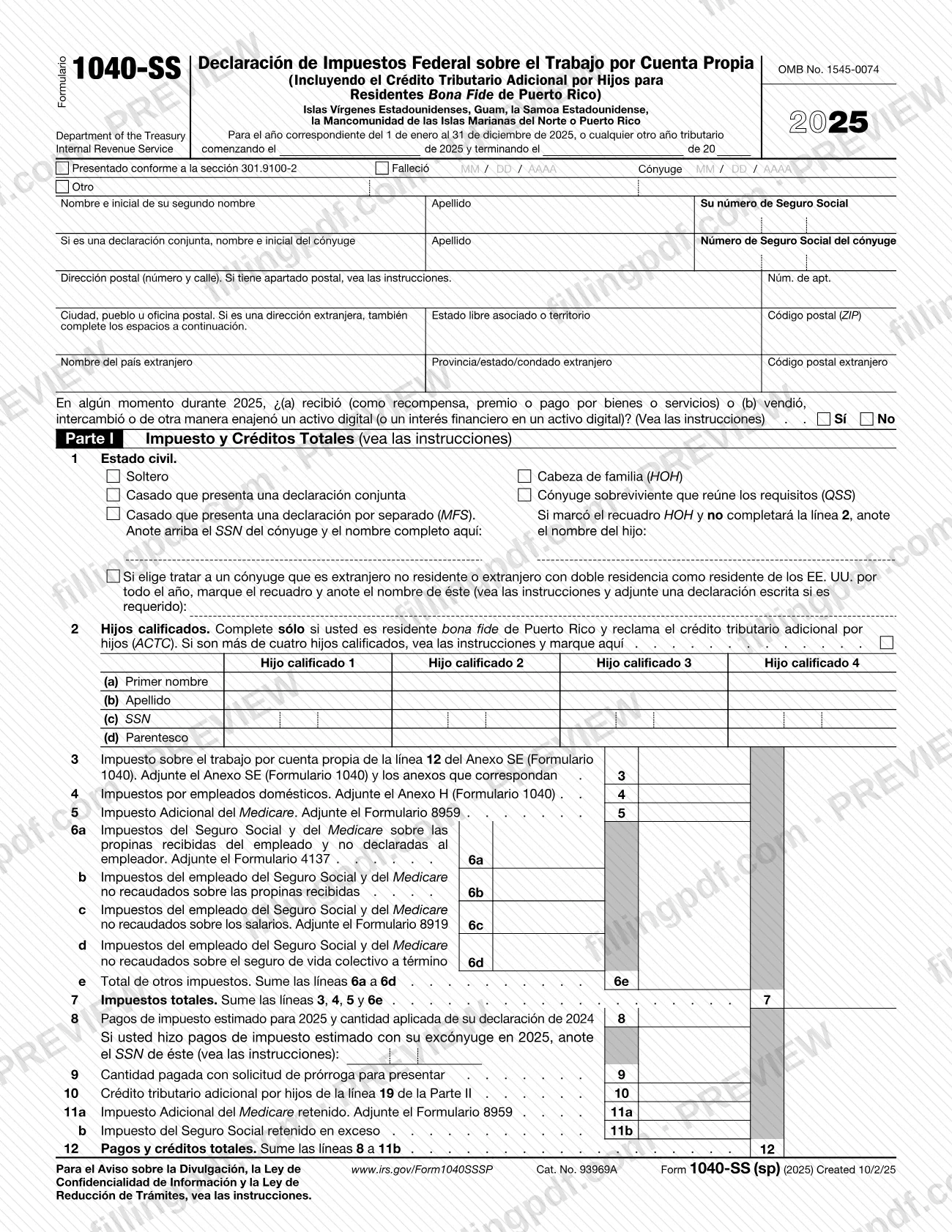
Form 1040-SS (sp), U.S. Self-Employment Tax Return (Including the Additional Child Tax Credit for Bona Fide Residents of Puerto Rico) (Spanish Version), is the Spanish-language IRS form for reporting self-employment tax by bona fide residents of U.S. territories.
The Internal Revenue Service (IRS) issues it under OMB No. 1545-0074. The form and its instructions are printed in Spanish, so the labels you see on it, such as Soltero or Cabeza de familia, are Spanish. The IRS instructions say the form is for residents of the U.S. Virgin Islands (USVI), Guam, American Samoa, the Commonwealth of the Northern Mariana Islands (CNMI) and Puerto Rico who are not required to file a U.S. income tax return but who have self-employment income or qualify to claim certain credits. The Social Security Administration (SSA) uses the self-employment information to figure Social Security benefits.
The form has two parts:
- Part I, Impuesto y Créditos Totales (total tax and credits): self-employment tax from line 12 of Schedule SE (Form 1040), household employee taxes, Additional Medicare Tax, unreported tip and uncollected tax lines, payments, refund or amount owed.
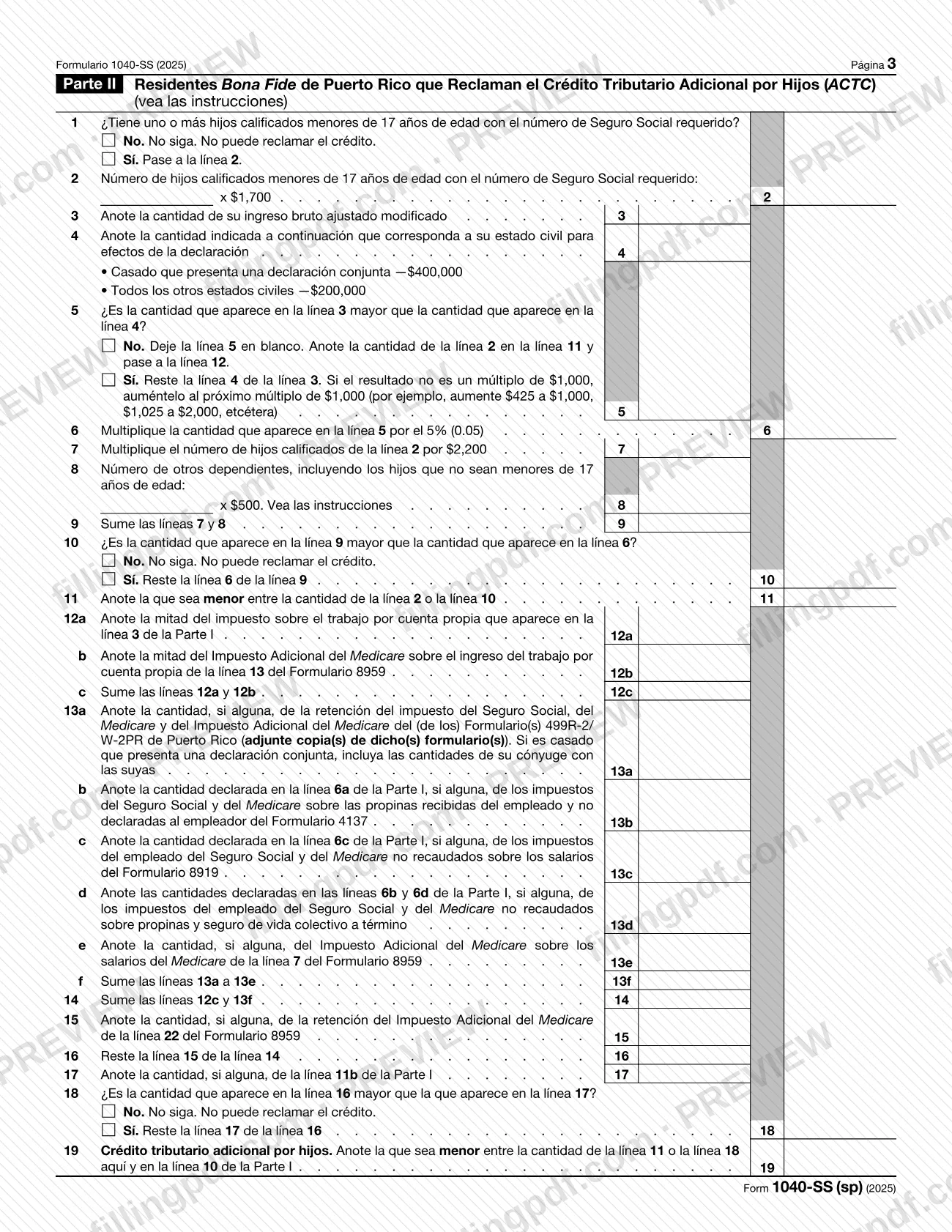
- Part II, for bona fide residents of Puerto Rico who claim the Additional Child Tax Credit (ACTC). The result carries to line 10 of Part I.
The instructions note that Form 1040 (PR) was discontinued and that, for 2023 and later years, you file Form 1040-SS. The form is not a substitute for a tax return filed with the territory's own tax office, which may also be required.
Who needs to file 1040-SS (sp)?
You must file Form 1040-SS (sp) if all three of these apply, according to the IRS instructions:
- You (or your spouse, on a joint return) had net self-employment earnings of $400 or more, or church employee income of $108.28 or more.
- You do not have to file Form 1040 with the United States.
- You are a bona fide resident of Guam, American Samoa, the USVI, the CNMI or Puerto Rico.
If items 2 and 3 apply but item 1 does not, you still file this form to report household employee taxes; Social Security and Medicare taxes on unreported tips, uncollected wages or group-term life insurance; Additional Medicare Tax; to claim a credit for excess Social Security tax withheld; or to claim the ACTC.
Bona fide residents of Puerto Rico with one or more qualifying children may claim the ACTC on Part II even when they owe no self-employment tax. Residents of the other four territories may be able to claim it on their territory return instead.
Do not use this form if you must file Form 1040 with the United States. Ministers and members of religious orders whose Form 4361 was approved, and members of certain religious sects whose Form 4029 was approved, are exempt from self-employment tax on those earnings and do not file for them. A surviving spouse or personal representative may file and sign for a taxpayer who died before filing.
When to file 1040-SS (sp)
For a calendar-year taxpayer, file Form 1040-SS (sp) by April 15, 2026. Fiscal-year filers file by the 15th day of the fourth month after the year ends. Filing later can mean interest and penalties.
Bona fide residents of Puerto Rico can get an automatic 6-month extension (to October 15, 2026 for calendar-year filers) by filing Form 4868 by the original due date. Bona fide residents of American Samoa, the CNMI, Guam or the USVI can take that extension, or an automatic 2 months if they are outside the United States and Puerto Rico on the due date. For the 2-month option, file by June 15, 2026 with a written statement explaining your residency. A further 4 months is available with Form 4868 filed by June 15, 2026.
No extension lengthens the time to pay: interest runs on unpaid tax from the original due date. If you expect to owe $1,000 or more of self-employment tax for 2026, the instructions say to make estimated tax payments with Form 1040-ES.
Documents you need
- Schedule SE (Form 1040): attach it for line 3 if you or your spouse had net self-employment earnings of $400 or more; each spouse with such earnings completes a separate one.
- Schedule C (Form 1040) or Schedule F (Form 1040): attach the one for your non-farm or farm business, with a separate schedule for each business.
- Schedule H (Form 1040): attach it to report household employee taxes on line 4.
- Form 8959: attach it if you report Additional Medicare Tax on line 5 or Additional Medicare Tax withheld on line 11a.
- Form 4137 for line 6a (unreported tips) and Form 8919 for line 6c (uncollected Social Security and Medicare tax on wages): attach whichever you completed.
- Form W-2AS, W-2CM, W-2GU, W-2VI or 499R-2/W-2PR: attach the ones that apply if you claim excess Social Security tax withheld on line 11b.
- Copies of Form(s) 499R-2/W-2PR from Puerto Rico: attach them if you enter withholding on Part II, line 13a.
- Form 8888: attach it and check the box on line 14a if you want your refund split among more than one account.
- Written statement for each person on Part II, line 8: name, taxpayer identification number (SSN, ITIN or ATIN) and relationship, for each qualifying person for the credit for other dependents.
- Birth certificate, death certificate or hospital records: attach them if you enter "Died" on line 2 for a qualifying child who was born and died in 2025 and has no SSN.
- Form 8862: attach it to claim the ACTC if the CTC or ACTC was previously denied or reduced for a reason other than a math or clerical error, unless an exception applies.
- Written statement signed by both spouses: attach it if you elect to treat a nonresident or dual-status alien spouse as a U.S. resident for 2025.
- Power of attorney, such as Form 2848: attach it if a representative signs the return for you.
How to fill out 1040-SS (sp)
Enter tax year, names and address
At the top, enter the fiscal-year months if you do not use the calendar year, then your name and SSN and your spouse's on a joint return, exactly as on your Social Security cards. Use a P.O. box only if your post office does not deliver to your home. For a foreign address, put only the city on the city line and complete the country, province and postal code spaces without abbreviating the country.
Check the Falleció box if needed
If you are filing for a taxpayer who died before filing, check Falleció and enter the date of death in the spaces provided (after Cónyuge for a deceased spouse).
Answer the digital assets question
Check Sí or No for whether you received, sold, exchanged or otherwise disposed of a digital asset or a financial interest in one during 2025. Do not leave it blank.
Choose your filing status on line 1
Check one box: Soltero, Casado que presenta una declaración conjunta, Casado que presenta una declaración por separado (MFS), Cabeza de familia (HOH) or Cónyuge sobreviviente que reúne los requisitos (QSS). Enter the spouse's SSN and full name for MFS, the child's name for HOH or QSS when the child is not your dependent, and check the election box with the spouse's name if you treat a nonresident or dual-status spouse as a U.S. resident.
List qualifying children on line 2
Complete line 2 only if you are a bona fide resident of Puerto Rico claiming the ACTC. For up to four children, enter first name, last name, SSN and relationship; check the box if you have more than four.
Enter self-employment and household taxes
Line 3: the amount from line 12 of Schedule SE (Form 1040), with the schedules attached. Line 4: household employee taxes from Schedule H (Form 1040).
Complete lines 5 through 7
Line 5: Additional Medicare Tax from Form 8959. Lines 6a to 6d: the tax amounts from Forms 4137 and 8919 and the uncollected amounts on tips and group-term life insurance; add them on line 6e. Line 7: add lines 3, 4, 5 and 6e.
Enter estimated tax and extension payments
Line 8: estimated tax payments for 2025 and any overpayment applied from your 2024 return, plus a former spouse's SSN if you paid jointly. Line 9: the amount you paid with your extension request, not counting any card convenience fee.
Enter credits and total payments
Line 10: the amount from line 19 of Part II. Line 11a: Additional Medicare Tax withheld, from Form 8959. Line 11b: excess Social Security tax withheld. Line 12: add lines 8 through 11b.
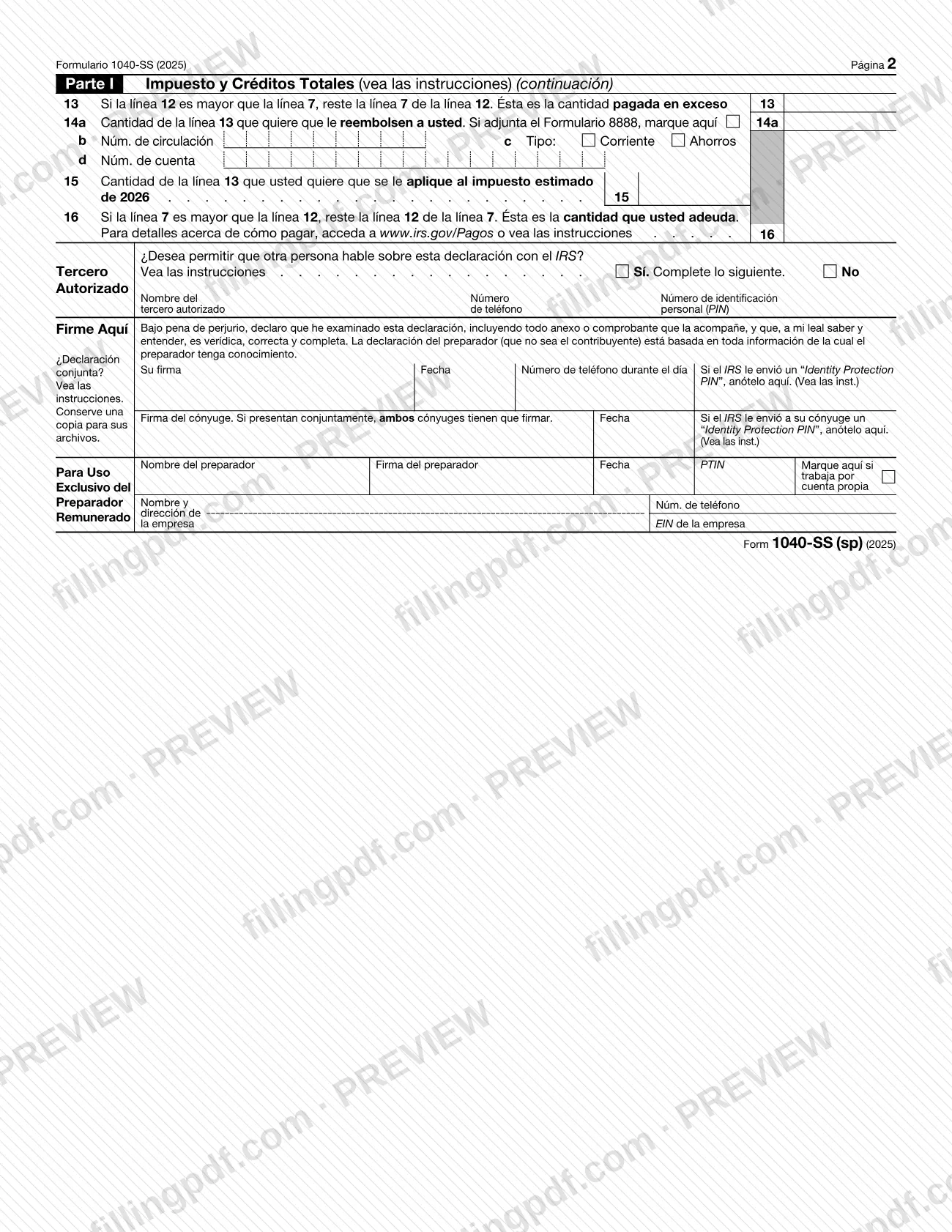
Figure your refund or amount owed
If line 12 is more than line 7, subtract to get the overpayment on line 13, then enter the refund on line 14a, direct deposit details on lines 14b to 14d, and any amount to apply to 2026 estimated tax on line 15. If line 7 is more than line 12, enter the difference on line 16 as the amount you owe.
Complete the Part II eligibility lines
Part II lines 1 to 11 apply only to bona fide residents of Puerto Rico claiming the ACTC. Answer line 1 (stop if No), enter the number of qualifying children on line 2, modified adjusted gross income on line 3 and the filing-status threshold on line 4, then work lines 5 to 11 as printed, with the line 8 statement for other dependents.
Complete the Part II credit lines
Lines 12a to 12c: half of the self-employment tax and half of the Additional Medicare Tax on self-employment income. Lines 13a to 13f: Puerto Rico and other withholding. Then follow lines 14 to 19; enter the smaller of line 11 or line 18 on line 19 and on line 10 of Part I.
Review, sign and download the PDF
Complete the Tercero Autorizado section if you want another person to speak with the IRS, then sign and date; both spouses sign a joint return and a paid preparer completes the preparer block. Check every entry, then download or print the completed PDF from FillingPDF, sign it by hand and keep a copy.
How to submit 1040-SS (sp)
You can file Form 1040-SS (sp) by mail or electronically, and you pay through separate channels.
- By mail with a payment: Internal Revenue Service, P.O. Box 1303, Charlotte, NC 28201-1303.
- By mail without a payment: Department of the Treasury, Internal Revenue Service, Austin, TX 73301-0215.
- Private delivery services: only certain IRS-designated DHL Express, UPS and FedEx services count for the timely-mailing rule. The list is at IRS.gov/PDS and street addresses are at IRS.gov/PDSStreetAddresses. Only the U.S. Postal Service can deliver to P.O. boxes, so a payment that must go to a P.O. box cannot use a private service.
- Electronically (e-file): the instructions say you may e-file Form 1040-SS; general information is at IRS.gov/Efile (click Español). Tax software normally determines which schedules you need.
- Payment: options are listed at IRS.gov/Pagos and include Direct Pay, debit or credit card, a digital wallet, your IRS online account and EFTPS. If you mail a check, attach Form 1040-V. Do not mail cash.
To check a refund, use the IRS2Go app or IRS.gov/Reembolsos. FillingPDF lets you fill out and download the PDF; submission follows the channels above.
Common mistakes to avoid
- Leaving the digital assets question blank. The instructions say you must check Sí or No, whether or not you received a Form 1099-DA.
- Entering a P.O. box in the address when your post office delivers mail to your home; the instructions allow a P.O. box only if it does not.
- Abbreviating the foreign country name or putting other information on the city line instead of the foreign address spaces.
- Using Form 1040-SS when you must file Form 1040 with the United States; the instructions say you cannot file this form in that case.
- Listing a child on line 2 who has no valid Social Security number issued by the due date (including extensions); that child cannot be used to claim the ACTC.
- Entering a person who qualifies for the credit for other dependents on line 2 of Part I; the instructions say this form does not claim that credit there.
- Mailing a payment that must go to a P.O. box through a private delivery service, which cannot deliver there.
- Assuming an extension gives more time to pay; interest runs on unpaid tax from the original due date.
- Signing a paper return with a typed, digital or electronic signature; the instructions require your own handwritten signature.
- Choosing to apply an overpayment to 2026 estimated tax on line 15 and expecting to change it later; the election cannot be changed.
Frequently asked questions
What is Form 1040-SS (sp)?
Form 1040-SS (sp) is the Spanish-language version of the IRS self-employment tax return for bona fide residents of Guam, American Samoa, the USVI, the CNMI and Puerto Rico. It reports self-employment tax and related taxes, and Part II lets Puerto Rico residents claim the Additional Child Tax Credit.
Who has to file Form 1040-SS (sp)?
You must file it if you had net self-employment earnings of $400 or more, you are not required to file Form 1040 with the United States, and you are a bona fide resident of one of the five territories. You can also file it to claim the ACTC or report certain other taxes even without self-employment tax.
When is Form 1040-SS (sp) due for 2025?
April 15, 2026 for calendar-year filers. Puerto Rico residents can extend the filing deadline 6 months with Form 4868, to October 15, 2026, but the extension does not extend the time to pay, so interest runs on unpaid tax from April 15.
Where do I mail Form 1040-SS (sp)?
With a payment, mail it to Internal Revenue Service, P.O. Box 1303, Charlotte, NC 28201-1303. Without a payment, mail it to Department of the Treasury, Internal Revenue Service, Austin, TX 73301-0215. You can also e-file; see IRS.gov/Efile.
Can I claim the Additional Child Tax Credit on Form 1040-SS (sp)?
Yes, if you are a bona fide resident of Puerto Rico with one or more qualifying children under 17 who each have a valid Social Security number issued by the due date. Complete line 2 of Part I and all of Part II. Residents of the other four territories claim it on their territory return.
Does a paper Form 1040-SS (sp) need a handwritten signature?
Yes. The IRS instructions require your own handwritten signature on a paper return; digital, electronic or typed signatures are not valid. On a joint return both spouses sign. E-filed returns are signed with a PIN instead.
What is the difference between Form 1040-SS (sp) and Form 1040 (PR)?
Form 1040 (PR) was discontinued. The IRS instructions say that for 2023 and later years you file Form 1040-SS, which was redesigned to include the Puerto Rico ACTC claim, and this page covers the Spanish-language Form 1040-SS (sp).
Can I fill out Form 1040-SS (sp) online on FillingPDF?
Yes. You can fill out the PDF online on FillingPDF and download or print it. FillingPDF is an independent service and does not file the return with the IRS; you submit it by mail or e-file through the IRS channels.
How do I correct a Form 1040-SS (sp) I already filed?
File a new Form 1040-SS and write "CORRECTED" in bold with the date at the top of page 1. The amended return generally must be filed within 3 years after the original was filed or 2 years after the tax was paid, whichever is later.
Ready to fill out 1040-SS (sp)?
Fill out 1040-SS (sp) now