
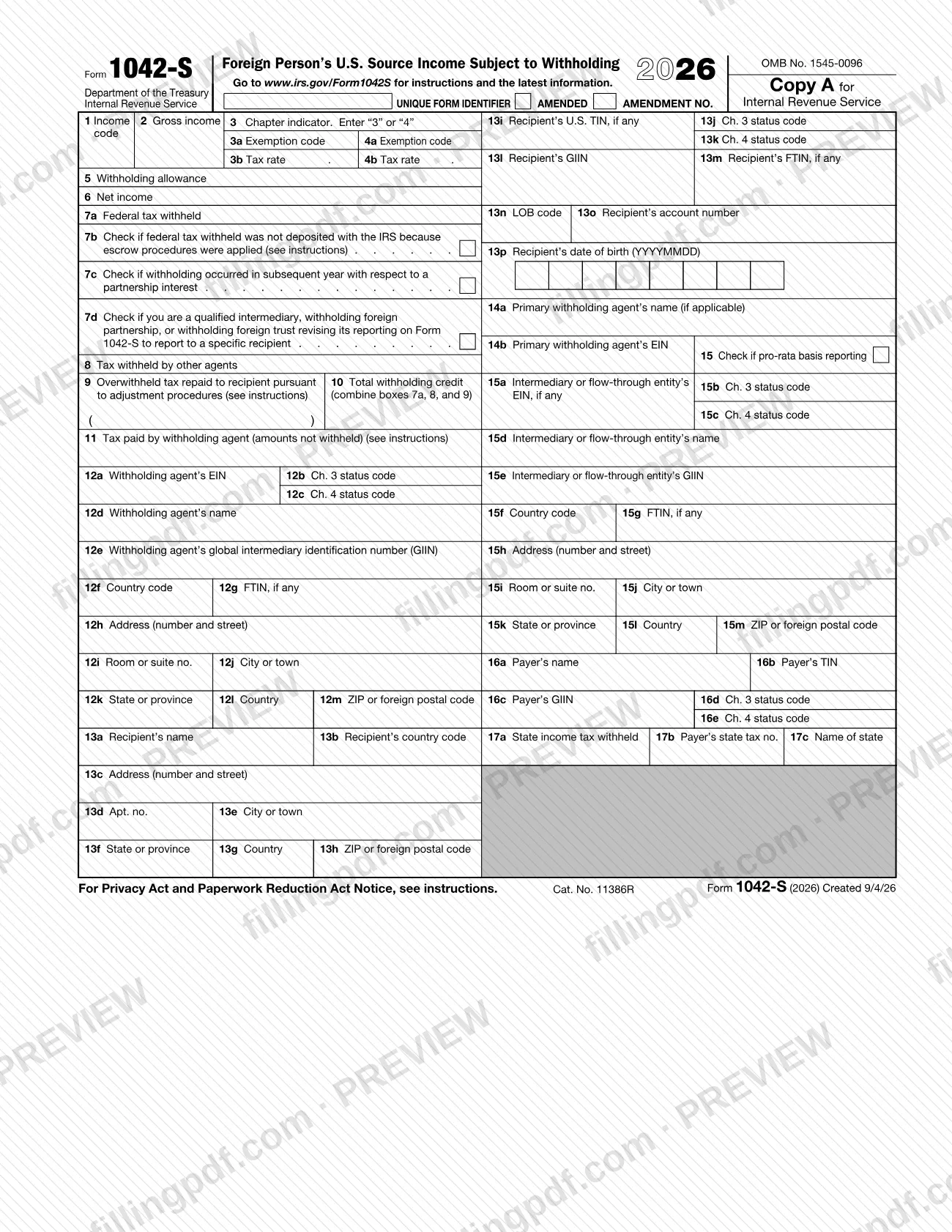
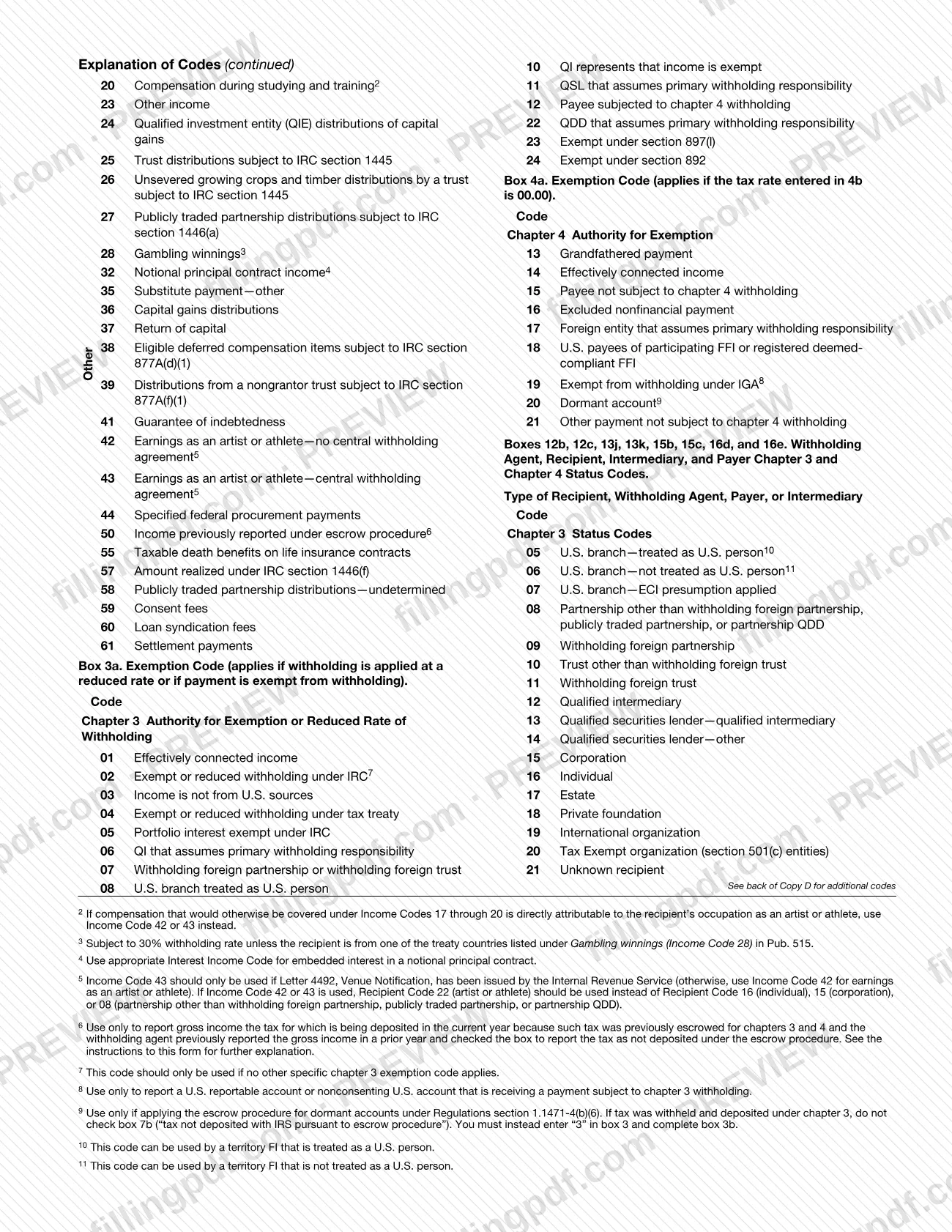
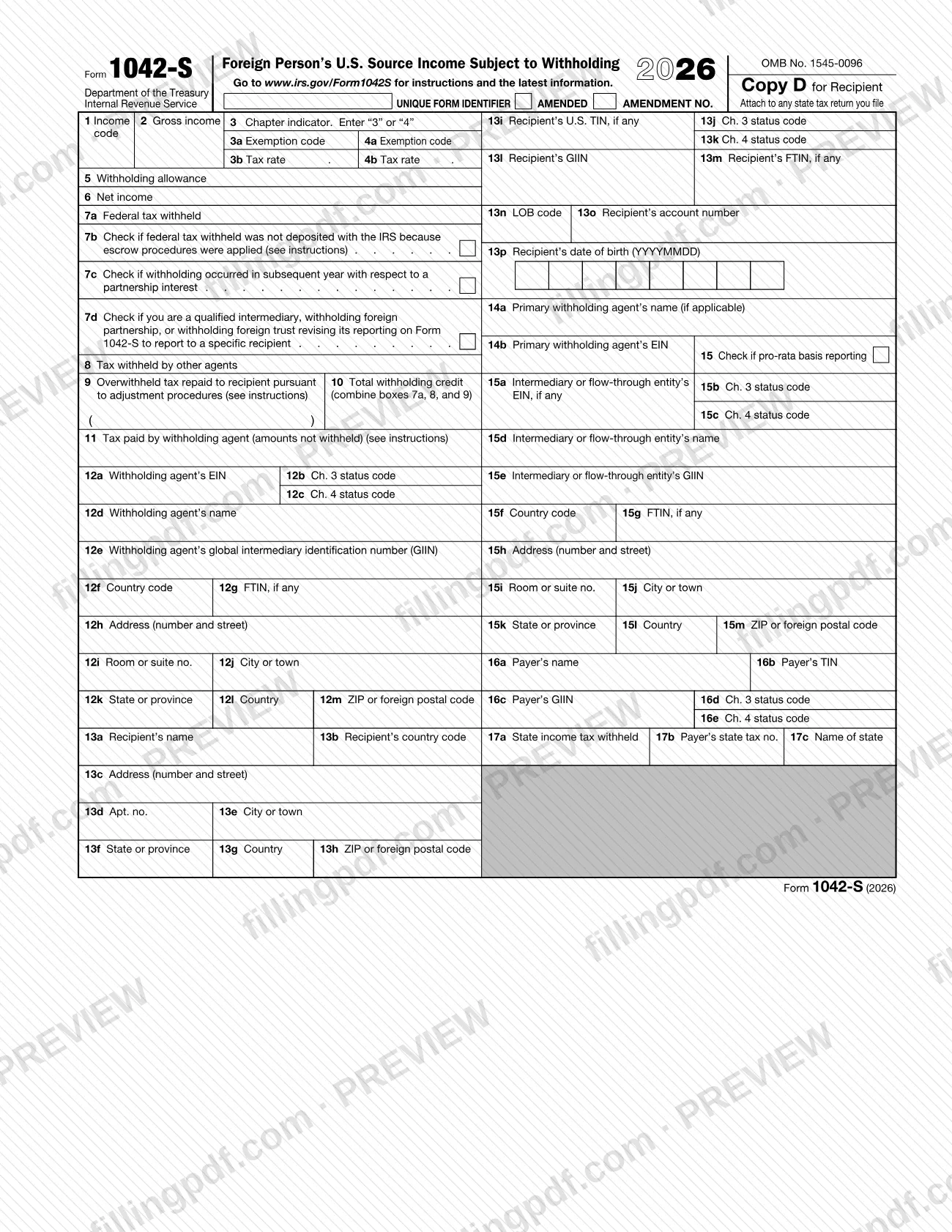
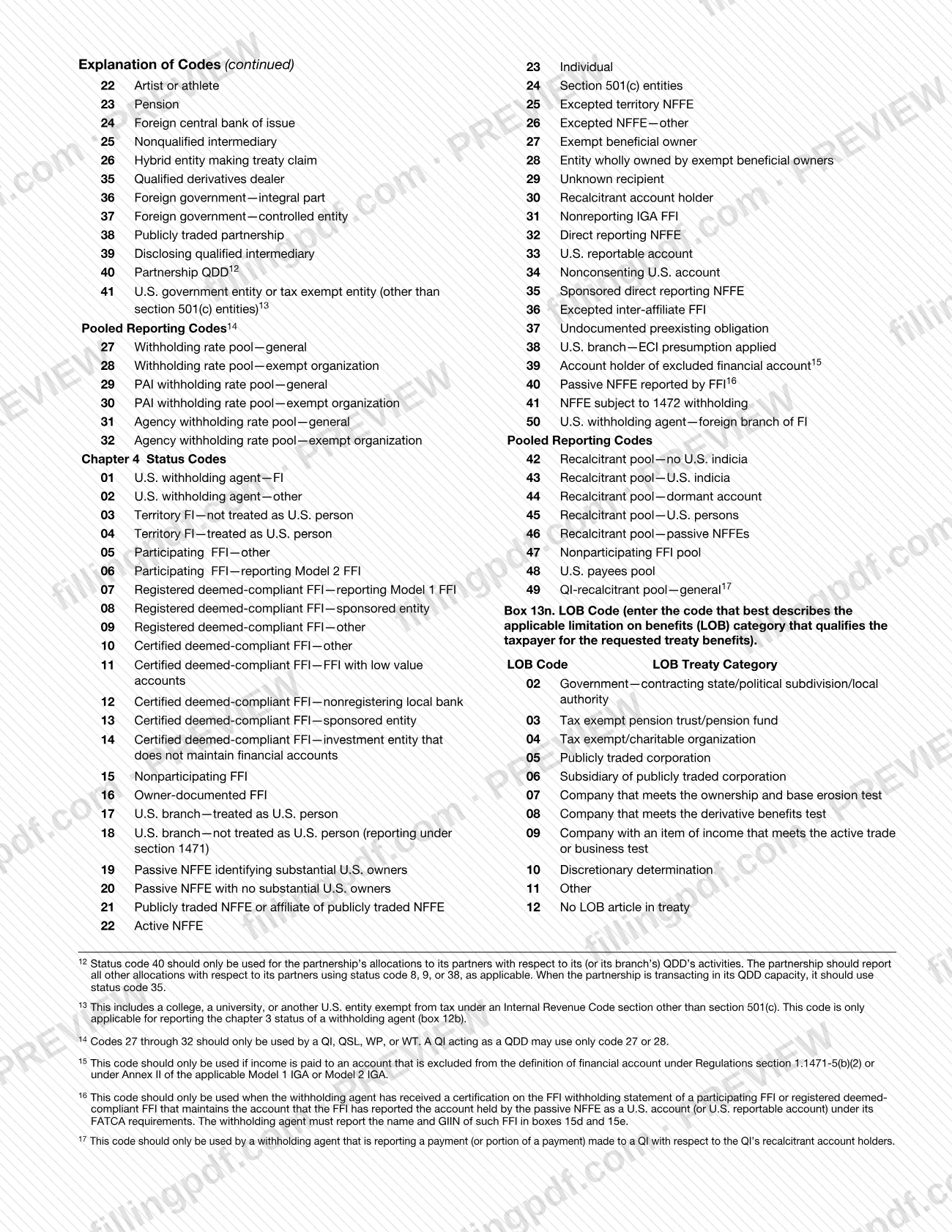
Form 1042-S, Foreign Person's U.S. Source Income Subject to Withholding, is the Internal Revenue Service (IRS) information return that withholding agents use to report U.S. source income paid to foreign persons and the tax withheld on it. A separate form is completed for each recipient, each income type and each tax rate applied. On FillingPDF you can fill out Form 1042-S online and download or print the completed PDF; the form and its instructions are published by the IRS at www.irs.gov/Form1042S.
Last updated
What is 1042-S?
Form 1042-S, Foreign Person's U.S. Source Income Subject to Withholding, is the IRS information return a withholding agent uses to report U.S. source income paid to a foreign person, and any tax withheld on it under chapter 3 or chapter 4.
Chapter 3 of the Internal Revenue Code covers withholding of tax on nonresident aliens and foreign corporations. Chapter 4 is the set of provisions commonly known as FATCA. One form reports both: it carries a chapter indicator in box 3, chapter 3 and chapter 4 exemption codes and rates, and status codes for the recipient, the withholding agent, the payer and any intermediary.
The IRS instructions also direct filers to use Form 1042-S for specified federal procurement payments subject to section 5000C, certain payments to covered expatriates under section 877A, certain distributions by publicly traded trusts and qualified investment entities, and effectively connected income distributed by publicly traded partnerships. A return is required even when no tax was withheld because a treaty or the Code exempted the income.
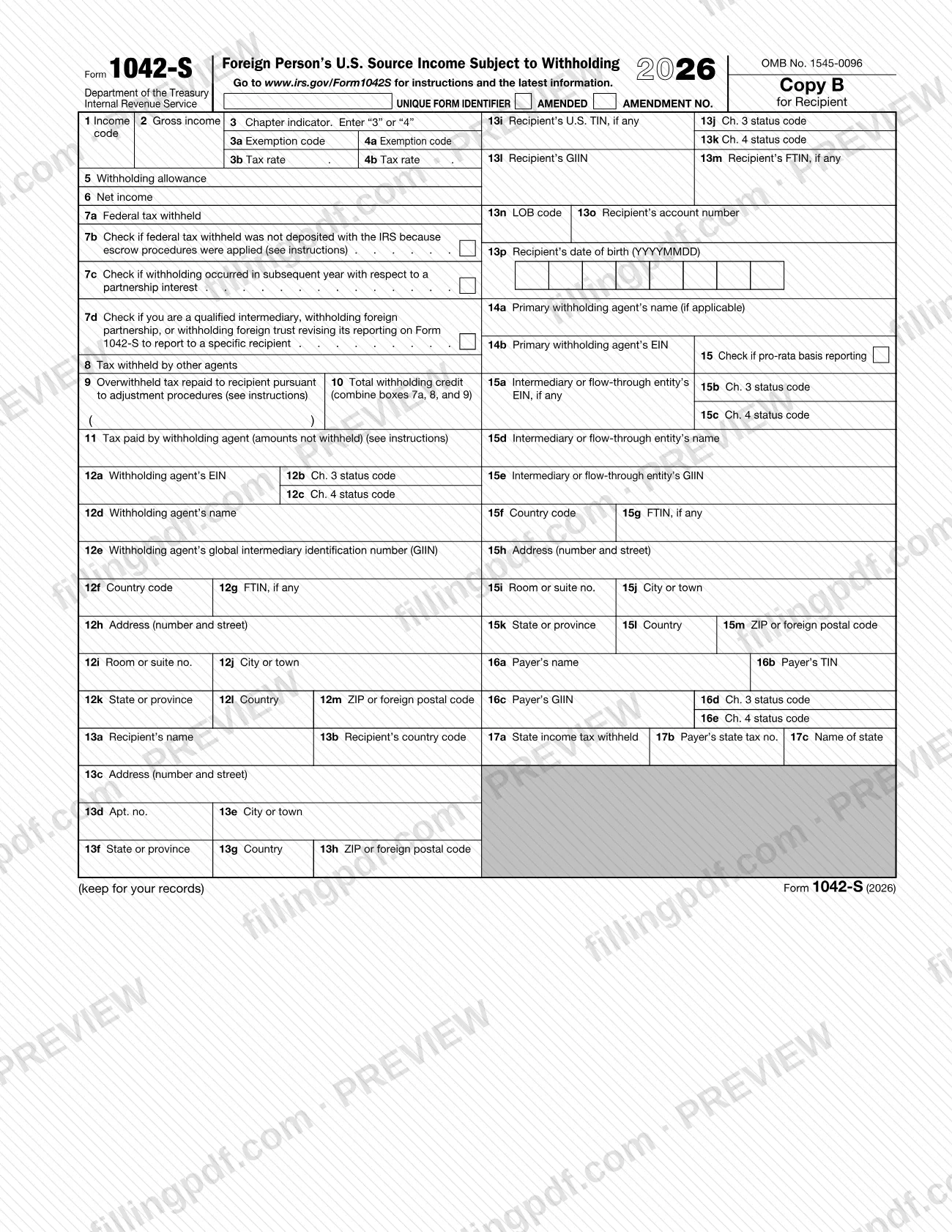
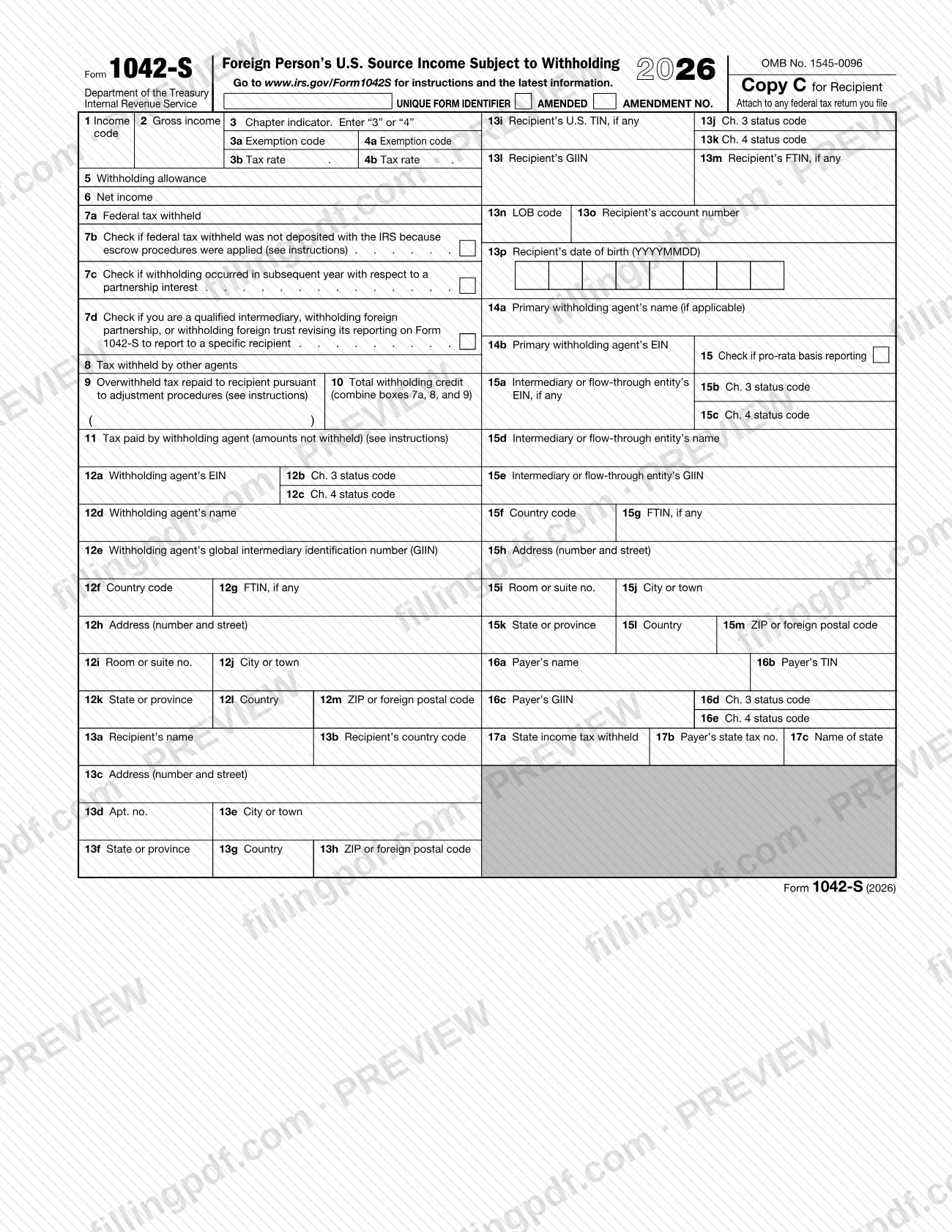
The form is printed in four copies: Copy A for the IRS, Copy B for the recipient (keep for your records), Copy C for the recipient to attach to any federal tax return, and Copy D for the recipient to attach to any state tax return. The printed form is dated 2026 and carries OMB No. 1545-0096.
Form 1042-S does not replace other returns. The instructions say not to use it for items reportable on Form W-2, Form 1099 (except where the instructions say otherwise), Form 8288-A, Form 8805 or Form 8966. A filer of Form 1042-S must also file Form 1042, Annual Withholding Tax Return for U.S. Source Income of Foreign Persons.
Who needs to file 1042-S?
Every withholding agent must file Form 1042-S to report amounts paid during the preceding calendar year that are subject to reporting. A withholding agent is any person, U.S. or foreign, that has control, receipt or custody of an amount subject to chapter 3 withholding, or that makes a withholdable payment under chapter 4. It can be an individual, corporation, partnership, trust, association or other entity, and includes qualified intermediaries, nonqualified intermediaries, withholding foreign partnerships and trusts, flow-through entities, territory FIs, section 1446 nominees and authorized agents.
Each of these filers must also file Form 1042-S:
- A withholding agent that paid income exempt from tax under a U.S. treaty or the Code, including effectively connected income.
- A withholding agent that released tax withheld back to the recipient.
Exclusions: a withholding agent who is an individual need not report a payment if the individual is not making it as part of a trade or business and no withholding is required on it. Amounts paid to a bona fide resident of a U.S. territory are not reportable on this form if the beneficial owner is a U.S. citizen, national or resident alien. Items belonging on Forms W-2, 1099, 8288-A, 8805 or 8966 are not reported here.
Recipients (foreign persons who received the income) do not complete the form. They receive Copies B, C and D from the withholding agent.
When to file 1042-S
File Form 1042-S, and furnish the recipient copies, by March 15 of the calendar year after the payments were made. If March 15 falls on a Saturday, Sunday or legal holiday in the District of Columbia or where the return is filed, the due date is the next business day.
To get more time to file, submit Form 8809, Application for Extension of Time To File Information Returns, as soon as you know you need it and no later than the due date. It gives an automatic 30-day extension, and you may submit a second Form 8809 before the initial extended period ends.
Recipient copies have their own request: you may ask for a one-time 30-day extension to furnish them using Form 15397, Application for Extension of Time to Furnish Recipient Statements. The request must be received no later than the date the forms are due to recipients, and approval generally grants a maximum of 30 extra days.
Documents you need
- Form 1042-T, Annual Summary and Transmittal of Forms 1042-S: required to transmit paper Copy A to the IRS; one Form 1042-T for each type of Form 1042-S.
- Form 1042, Annual Withholding Tax Return for U.S. Source Income of Foreign Persons: a filer of Form 1042-S must also file it.
- Form W-8 or Form W-9 withholding certificates from payees: the documentation the instructions rely on to treat a payment as made to a foreign person entitled to a reduced rate or exemption.
- Form 8809, Application for Extension of Time To File Information Returns: only if you need more time to file; request it by the due date.
- Form 15397, Application for Extension of Time to Furnish Recipient Statements: only if you need more time to furnish recipient copies.
- Form 8508, Application for a Waiver from Electronic Filing of Information Returns: only if you must file electronically and seek a hardship waiver.
How to fill out 1042-S
Enter the form identifier and amendment details
Enter your own 10-digit numeric number in UNIQUE FORM IDENTIFIER; it cannot be the recipient's TIN or FTIN. Check AMENDED and enter the AMENDMENT NO. only if you are correcting a form already filed.
Enter the income code and gross income
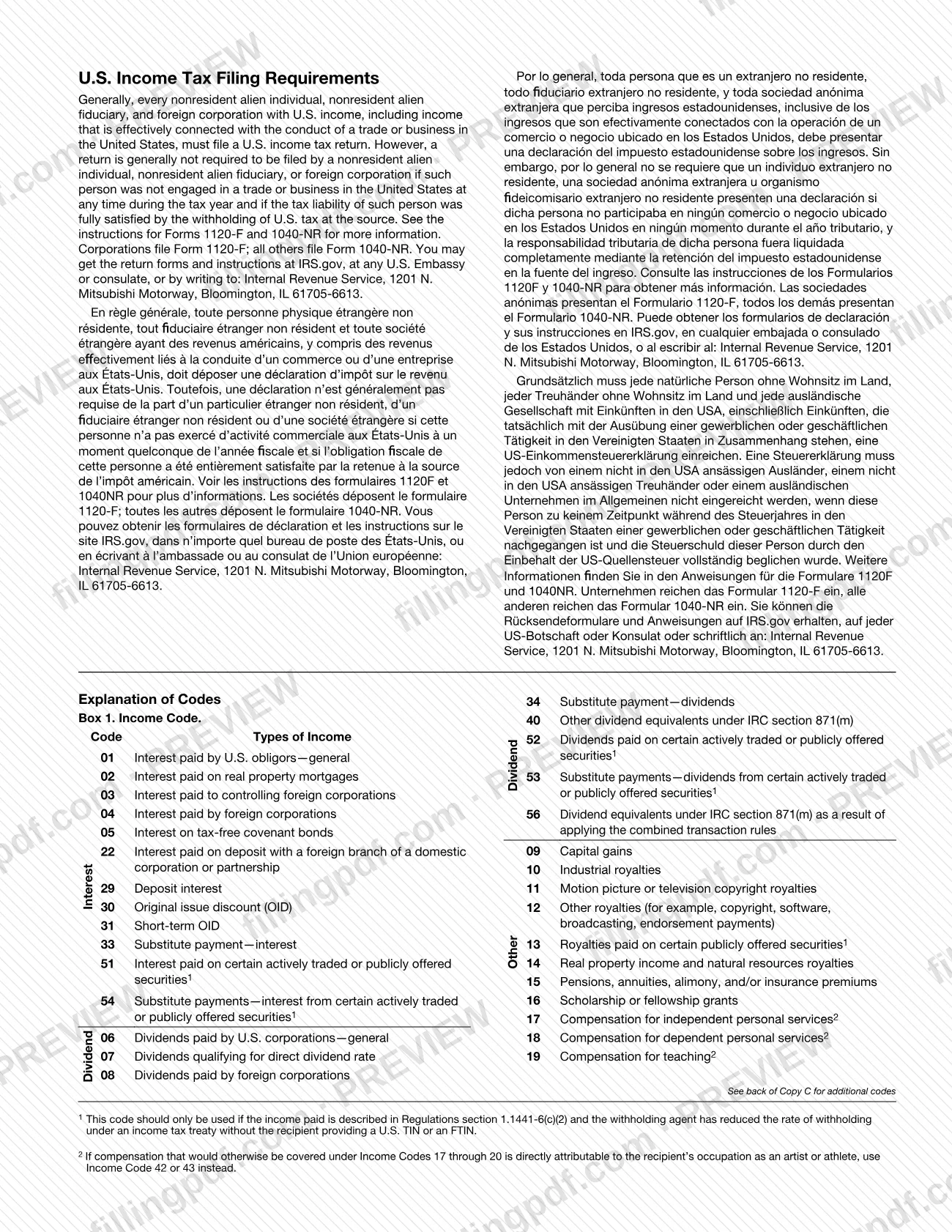
In box 1, enter the two-digit income code from the Explanation of Codes (for example 06 for dividends paid by U.S. corporations or 29 for deposit interest). In box 2, enter the gross income, in whole dollars.
Choose the chapter indicator
In box 3, enter "3" or "4" according to whether the amounts were withheld or paid under chapter 3 or chapter 4. If no withholding was required on the payment, enter "3".
Complete exemption codes and tax rates
Use boxes 3a and 3b for the chapter 3 exemption code and tax rate, and boxes 4a and 4b for the chapter 4 exemption code and rate. Boxes 4a and 4b must always be completed, and 4a applies when the rate in 4b is 00.00.
Enter withholding allowance and net income
Enter any withholding allowance in box 5 and the net income in box 6, following the instructions for those boxes.
Report federal tax withheld
Enter the tax withheld in box 7a. Check box 7b (escrow procedures), 7c (withholding in a subsequent year for a partnership interest) or 7d (QI, withholding foreign partnership or trust revising reporting to a specific recipient) only if it applies.
Complete the withholding credit boxes
Enter tax withheld by other agents in box 8, overwithheld tax repaid to the recipient in box 9, and the combined total of boxes 7a, 8 and 9 in box 10. Enter tax you paid without withholding it in box 11.
Enter the withholding agent's details
In boxes 12a through 12m, enter your EIN, chapter 3 and chapter 4 status codes, name, GIIN, country code, FTIN if any, and address. Use the country codes at IRS.gov/CountryCodes.
Enter the recipient's details
In boxes 13a through 13h, enter the recipient's name, country code and address. Then add the U.S. TIN (13i), status codes (13j, 13k), GIIN (13l), FTIN (13m), LOB code (13n), account number (13o) and date of birth as YYYYMMDD (13p), where they apply.
Complete the agent and intermediary boxes
Box 14a and 14b are for a primary withholding agent, if applicable. Check box 15 for pro-rata basis reporting and complete boxes 15a through 15m for an intermediary or flow-through entity. Leave boxes 15a through 15i blank when paying a beneficial owner directly.
Complete payer and state tax boxes
Complete boxes 16a through 16e only when a paying agent acts as an authorized agent for filing, or when the instructions otherwise call for payer information. Enter any state income tax withheld, the payer's state tax number and the state name in boxes 17a through 17c.
Review and download the completed PDF
Check that each form covers one recipient, one income type and one tax rate, and that every copy matches Copy A. Download or print the completed PDF from FillingPDF, then furnish and file it as described under How to submit.
How to submit 1042-S
You file Form 1042-S with the IRS electronically through the FIRE System or, where paper is permitted, on paper with Form 1042-T, and you furnish recipient copies to each recipient.
- Electronic filing: Submit through the Filing Information Returns Electronically (FIRE) System at FIRE.irs.gov, which operates 24 hours a day, 7 days a week. Electronic filing is required if you must file 10 or more information returns during the year, if you are a partnership with more than 100 partners, or if you are a financial institution (U.S. or foreign), whatever the number of returns. Check the status of your file within 5 business days; the IRS does not mail error reports for bad files. Pub. 1187 has the specifications.
- Paper filing: Attach only Copy A to Form 1042-T, Annual Summary and Transmittal of Forms 1042-S, and send it to the address in the Form 1042-T instructions. Use a separate Form 1042-T for each type of Form 1042-S.
- Recipient copies: Give Copies B, C and D to the recipient. They must match Copy A.
- Hardship waiver: To be excused from electronic filing, submit Form 8508, Application for a Waiver from Electronic Filing of Information Returns, at least 45 days before the due date.
Do not file the same returns on paper if you file electronically; duplicates may generate penalty notices. For electronic filing help, call the IRS Technical Services Operation at 866-455-7438 (toll free) or 304-263-8700. For tax law questions, call 267-941-1000 (not toll free). FillingPDF lets you fill out and download the PDF; submission follows the channels above.
Common mistakes to avoid
- Reporting more than one type of income on a single Form 1042-S; the instructions require a separate form for each recipient, each income type and each tax rate applied.
- Naming more than one joint owner as recipient in box 13a; the form can list only one owner.
- Not filing because no tax was withheld; a return is still required when a treaty or the Code exempted the income.
- Leaving boxes 4a and 4b blank when the chapter indicator in box 3 is "3"; the instructions say to complete them regardless of the chapter indicator.
- Truncating the recipient's U.S. TIN or FTIN on Copy A; truncation is allowed only on Copies B, C and D, and the withholding agent's EIN is never truncated.
- Using a unique form identifier that is not exactly 10 numeric digits, repeats one used on another original this year, or is the recipient's TIN or FTIN.
- Giving the recipient a copy that differs from the copy filed with the IRS, which delays the recipient's return and can lead to disallowed refund or credit claims.
- Filing the same Forms 1042-S both electronically and on paper; duplicates may generate penalty notices.
- Mailing paper Copy A without Form 1042-T, which the instructions require for transmitting paper forms.
Frequently asked questions
What is Form 1042-S used for?
Form 1042-S reports U.S. source income paid to foreign persons, such as interest, dividends, royalties and compensation, and any tax withheld under chapter 3 or chapter 4. The withholding agent files it with the IRS and gives copies to the recipient.
Who has to file Form 1042-S?
Every withholding agent that paid amounts subject to reporting during the prior calendar year must file it. An individual who is not paying as part of a trade or business and has no withholding to make is excused from reporting that payment.
Do I file Form 1042-S if no tax was withheld?
Yes. The IRS instructions say you must file even if no tax was withheld under chapter 3 because a U.S. tax treaty or the Internal Revenue Code exempts the income, including effectively connected income, or because you released the tax withheld to the recipient.
When is Form 1042-S due?
March 15 of the year after the payments, for both the IRS filing and the recipient copies. If that date is a weekend or legal holiday, it moves to the next business day. Form 8809 gives an automatic 30-day extension to file.
Do I have to file Form 1042-S electronically?
Yes, if you must file 10 or more information returns during the year, are a partnership with more than 100 partners, or are a financial institution. Electronic files go through the FIRE System. A hardship waiver request on Form 8508 is due 45 days before the due date.
Which copy of Form 1042-S goes to whom?
Copy A goes to the IRS, attached to Form 1042-T if filed on paper. Copies B, C and D go to the recipient: B is kept for records, C is attached to a federal return and D to a state return. All copies must match.
Can I fill out Form 1042-S online?
You can fill out the PDF online on FillingPDF and download or print it. FillingPDF is an independent service and does not file the form with the IRS; you file through FIRE or on paper with Form 1042-T, and furnish recipient copies yourself.
Can I use a separate Form 1042-S for each type of income?
You must. Complete a separate Form 1042-S for each recipient, each income type paid to the same recipient, and each amount taxed at a different rate. Multiple income types cannot go on one form or substitute form.
Ready to fill out 1042-S?
Fill out 1042-S now