
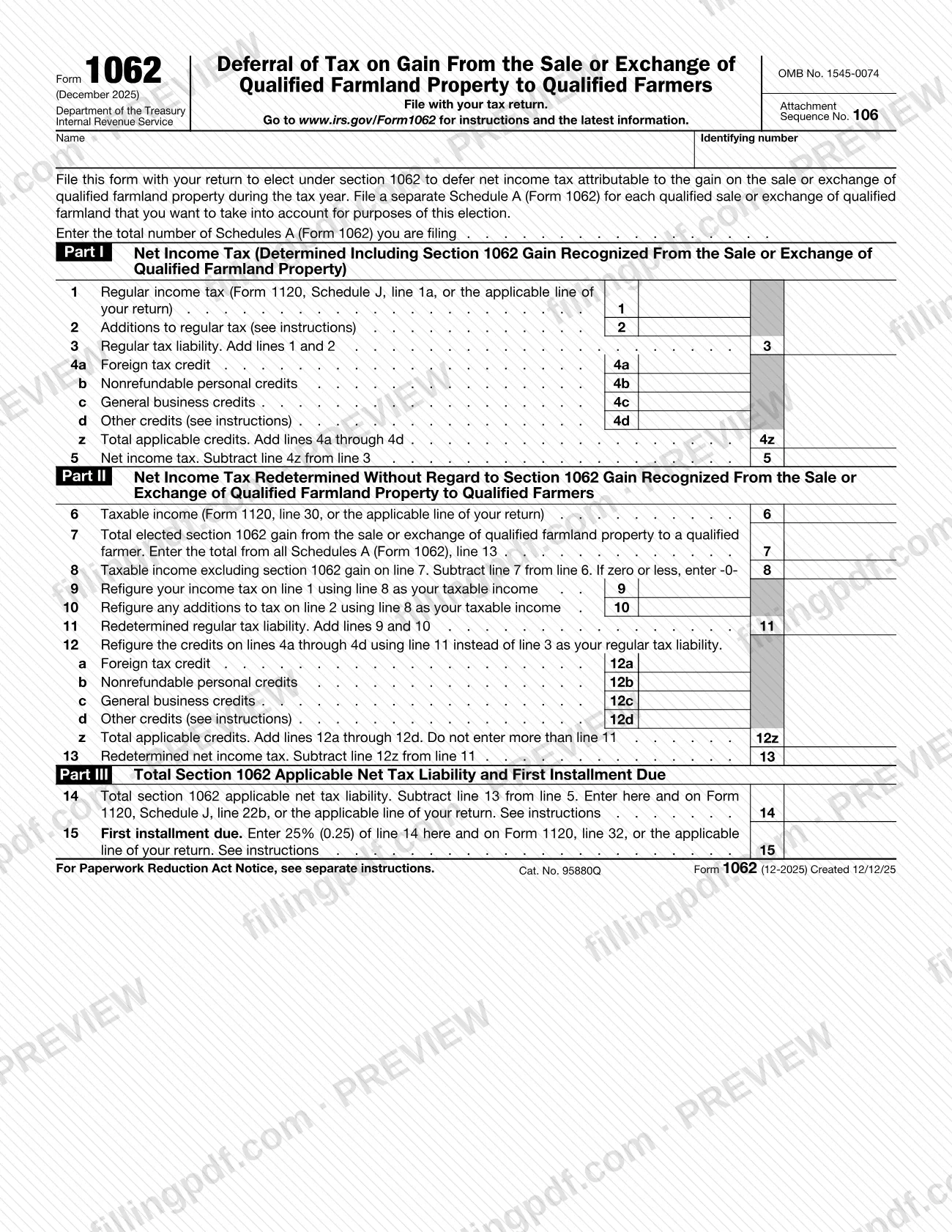
Form 1062 is the Internal Revenue Service (IRS) form that taxpayers file with their income tax return to elect under section 1062 to pay the net income tax on gain from selling or exchanging qualified farmland property to a qualified farmer. The tax is paid in four equal annual installments. Individuals and entities that make the election use it, together with a separate Schedule A (Form 1062) for each qualified sale. On this page you can fill out the form online on FillingPDF and download or print the completed PDF; the form and its instructions are published by the IRS at www.irs.gov/Form1062.
Last updated
What is 1062?
Form 1062 is the Internal Revenue Service (IRS) form used to elect under section 1062 to defer net income tax on gain from selling or exchanging qualified farmland property to a qualified farmer, paying it in four equal annual installments.
The election is new. The IRS instructions explain that, for tax years beginning after July 4, 2025, P.L. 119-21 (the One Big Beautiful Bill Act) created section 1062. It lets a taxpayer pay the net income tax attributable to the gain in four equal annual installments, beginning in the year of the qualified sale or exchange. The election is made by filing Form 1062, Schedule(s) A (Form 1062) and a section 1062 covenant.
The form has three parts:
- Part I figures net income tax including the section 1062 gain (lines 1 to 5).
- Part II redetermines net income tax without that gain (lines 6 to 13).
- Part III gives the total section 1062 applicable net tax liability (line 14) and the first installment due (line 15).
Schedule A (Form 1062) is a separate attachment. It describes the qualified farmland property, tests whether the sale qualifies and computes the recognized gain; its line 13 feeds line 7 of Form 1062. The instructions define a qualified farmer, qualified farmland property and a section 1062 covenant, a restriction limiting the land to farming for the 10-year period that begins the day after the sale or exchange.
Who needs to file 1062?
Individuals and entities that want to defer payment of the net income tax attributable to gain from a qualified sale or exchange file Form 1062 with the income tax return for the year of that sale or exchange. A qualified sale or exchange is a sale or exchange of qualified farmland property to a qualified farmer.
Special rules apply to pass-through entities:
- Partnerships and S corporations do not file Form 1062. The election is made at the partner or shareholder level. The entity files Schedule A (Form 1062) with its return and gives its partners or shareholders their share of the gain and a copy of Schedule A and of the section 1062 covenant.
- Partners and S corporation shareholders who decide to make the election file their own Form 1062 and their own Schedule A (Form 1062). They check the box on line A of Schedule A for the type of Schedule K-1 they received and leave lines 9 to 12 blank.
Do not include a disposition on Form 1062 if the answer to any of lines 4 through 8 of Schedule A is "No": the instructions say that sale does not qualify for the deferral, so Part II is not completed for it.
When to file 1062
File Form 1062 no later than the due date, including extensions, of the income tax return for the year of the qualified sale or exchange. You attach it to that return, so it has no separate due date.
Payment follows different timing. The first installment must be paid by the return due date without regard to any extension of time to file, for the tax year in which the qualified sale or exchange occurs. This applies even if the election is made on a return filed by the extended due date. Each of the next three installments is due by the return due date, again without extensions, for each of the 3 subsequent years.
The instructions also list events that accelerate the unpaid installments, such as an addition to tax for failing to pay an installment on time, the death of an individual taxpayer, or, for a C corporation, trust or estate, events like liquidation, sale of substantially all assets or cessation of business.
Documents you need
- Schedule A (Form 1062): one separate schedule for each qualified sale or exchange you want to include in the election; enter the total number of schedules at the top of Form 1062.
- A copy of the section 1062 covenant for each qualified sale or exchange covered by the election, attached to your income tax return.
- Your income tax return (for example Form 1120 or Form 1040), to which Form 1062 is attached and from which lines 1, 2, 6 and the carryover lines are taken.
- Partners and S corporation shareholders: the information from Form 1065, Schedule K-1, box 20, or Form 1120-S, Schedule K-1, box 17, code ZZ, used to complete line 13 of your Schedule A, plus a copy of the entity's Schedule A and covenant.
How to fill out 1062
Enter name and identifying number
At the top, enter your name and identifying number as shown on your return. Then enter the total number of Schedules A (Form 1062) you are filing, one per qualified sale or exchange.
Enter regular income tax and additions
Line 1: your regular income tax for the year from the applicable line of your return (for Form 1120, Schedule J, line 1a), including the gain from the qualified sale. Line 2: additional regular taxes, such as taxes from Schedule 2 if you file Form 1040. Line 3: add lines 1 and 2.
Report your credits on lines 4a to 4z
Enter the foreign tax credit on 4a, nonrefundable personal credits on 4b, general business credits (Form 3800) on 4c and other allowed credits on 4d. Add 4a through 4d on line 4z.
Figure net income tax on line 5
Subtract line 4z from line 3. This is your net income tax determined including the section 1062 gain.
Enter taxable income and 1062 gain
Line 6: taxable income from the applicable line of your return (Form 1120, line 30, or Form 1040, line 15). Line 7: the total of line 13 from all Schedules A (Form 1062). Line 8: subtract line 7 from line 6; if zero or less, enter -0-.
Refigure tax on lines 9 to 11
Line 9: refigure your income tax from line 1 using line 8 as taxable income. Line 10: refigure the additions to tax from line 2 the same way. Line 11: add lines 9 and 10.
Refigure credits and line 13
Lines 12a through 12d: recompute the credits from lines 4a through 4d using line 11 as the regular tax liability, then add them on line 12z without entering more than line 11. Line 13: subtract line 12z from line 11.
Compute the section 1062 liability
Line 14: subtract line 13 from line 5. Enter the result here and on Form 1120, Schedule J, line 22b, or the applicable line of your return; if zero or less, enter -0-.
Figure the first installment
Line 15: multiply line 14 by 25% (0.25). Enter it here and on Form 1120, line 32, or the applicable line of your return.
Complete Schedule A for each sale
Fill out one Schedule A (Form 1062) per qualified sale or exchange and gather a copy of each section 1062 covenant. Partners and shareholders check the box on line A and leave lines 9 to 12 blank.
Review, sign and download the PDF
Check that lines 7, 14 and 15 agree with your Schedules A and your return. Download or print the completed PDF from FillingPDF and attach it to your return as described under How to submit.
How to submit 1062
Form 1062 is filed with your income tax return; the form and instructions name no separate address, portal or office.
- With your return: attach Form 1062, Schedule(s) A (Form 1062) and a copy of each section 1062 covenant to your income tax return and file by the due date of that return, including extensions. Send the package the way you file the return itself; the instructions refer you to the instructions for that return.
- Partnerships and S corporations: file Schedule A (Form 1062) with the entity's return. They do not file Form 1062 or the covenant.
- Paying: the first installment, 25% of line 14, is entered on line 15 and on the applicable line of your return (Form 1120, line 32, or the applicable line of your return). Line 14 also goes on Form 1120, Schedule J, line 22b, or the applicable line of your return. The payment itself is due by the return due date without extensions.
FillingPDF lets you fill out and download the PDF; submission follows the channels above.
Common mistakes to avoid
- Using one Schedule A for several sales; the form requires a separate Schedule A, with a copy of the covenant, for each qualified sale or exchange.
- Leaving out the copy of the section 1062 covenant when attaching Form 1062 and Schedule A to the return.
- Filing Form 1062 as a partnership or S corporation; these entities file only Schedule A (Form 1062), and the election is made by each partner or shareholder.
- Assuming an extension delays the first installment; it is due by the return due date without regard to any extension.
- Entering a negative number on line 8 instead of -0- when line 7 is larger than line 6.
- Entering more than line 11 on line 12z, the total of the refigured credits.
- Entering only one Schedule A's gain on line 7 when you file several; line 7 is the total of line 13 from all Schedules A (Form 1062).
- Completing Part II of Schedule A for a sale with a "No" answer on lines 4 through 8; that sale does not qualify for deferral.
- Not carrying line 14 and line 15 to the applicable lines of your return as the form directs.
Frequently asked questions
What is Form 1062 used for?
Form 1062 is the IRS form used to elect under section 1062 to defer net income tax on gain from selling or exchanging qualified farmland property to a qualified farmer. The tax is paid in four equal annual installments, beginning in the year of the sale or exchange.
When is Form 1062 due?
Form 1062 is due by the due date of the income tax return for the year of the qualified sale or exchange, including extensions. The first installment, though, is due by the return due date without any extension, even if you file on extension.
Do partnerships and S corporations file Form 1062?
No. The election is made at the partner or shareholder level. The partnership or S corporation files only Schedule A (Form 1062) with its return and gives partners or shareholders their share of the gain; each one who elects files their own Form 1062 and Schedule A.
What do I attach to Form 1062?
Attach Form 1062, one Schedule A (Form 1062) for each qualified sale or exchange, and a copy of each section 1062 covenant to your income tax return. The Schedule A and covenant are required for every sale you include in the election.
How much of the tax do I pay with the first installment?
Line 15 of Form 1062 is 25% (0.25) of the total section 1062 applicable net tax liability on line 14. That amount is also entered on the applicable line of your return, and it must be paid by the return due date without extensions.
What counts as qualified farmland property?
Real property in the United States that you used as a farm for farming purposes, or leased to a qualified farmer for farming purposes, during substantially all of the 10-year period ending on the sale date, and that is subject to a section 1062 covenant.
What happens if I miss an installment or the taxpayer dies?
The instructions say that an addition to tax for failing to pay an installment on time makes the unpaid portion of all remaining installments due on the date of the failure. For an individual who dies, the remainder is due on the due date of the final individual return.
Can I fill out Form 1062 online on FillingPDF?
Yes. You can fill out the PDF online on FillingPDF and download or print it. FillingPDF is an independent service and does not file the form with the IRS; you submit it with your income tax return through the IRS channels.
Ready to fill out 1062?
Fill out 1062 now