
The 1099a, officially Form 1099-A, Acquisition or Abandonment of Secured Property, is the Internal Revenue Service (IRS) information return a lender completes when it acquires property that secured a loan or has reason to know the property was abandoned. The borrower receives a copy because the event may produce reportable income or loss. On FillingPDF you can fill out the form online and download or print the completed PDF. The IRS publishes the form at irs.gov, and its Copy A is for information only and is not to be printed and filed with the IRS.
Last updated
What is Form 1099-A?
Form 1099-A, Acquisition or Abandonment of Secured Property, is the IRS information return that a lender completes when, in full or partial satisfaction of a debt, it acquires an interest in property that secured the loan, or when it has reason to know the property has been abandoned.
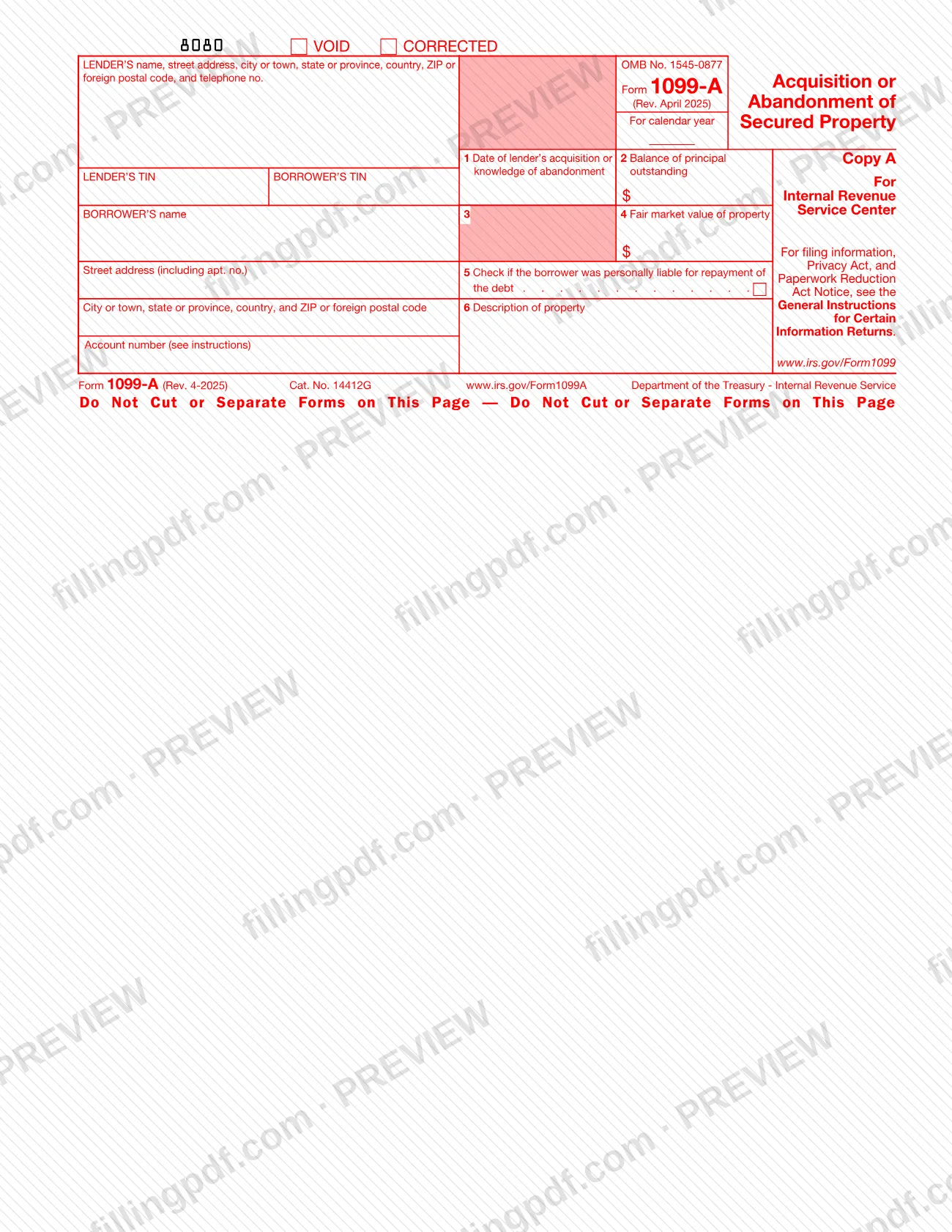
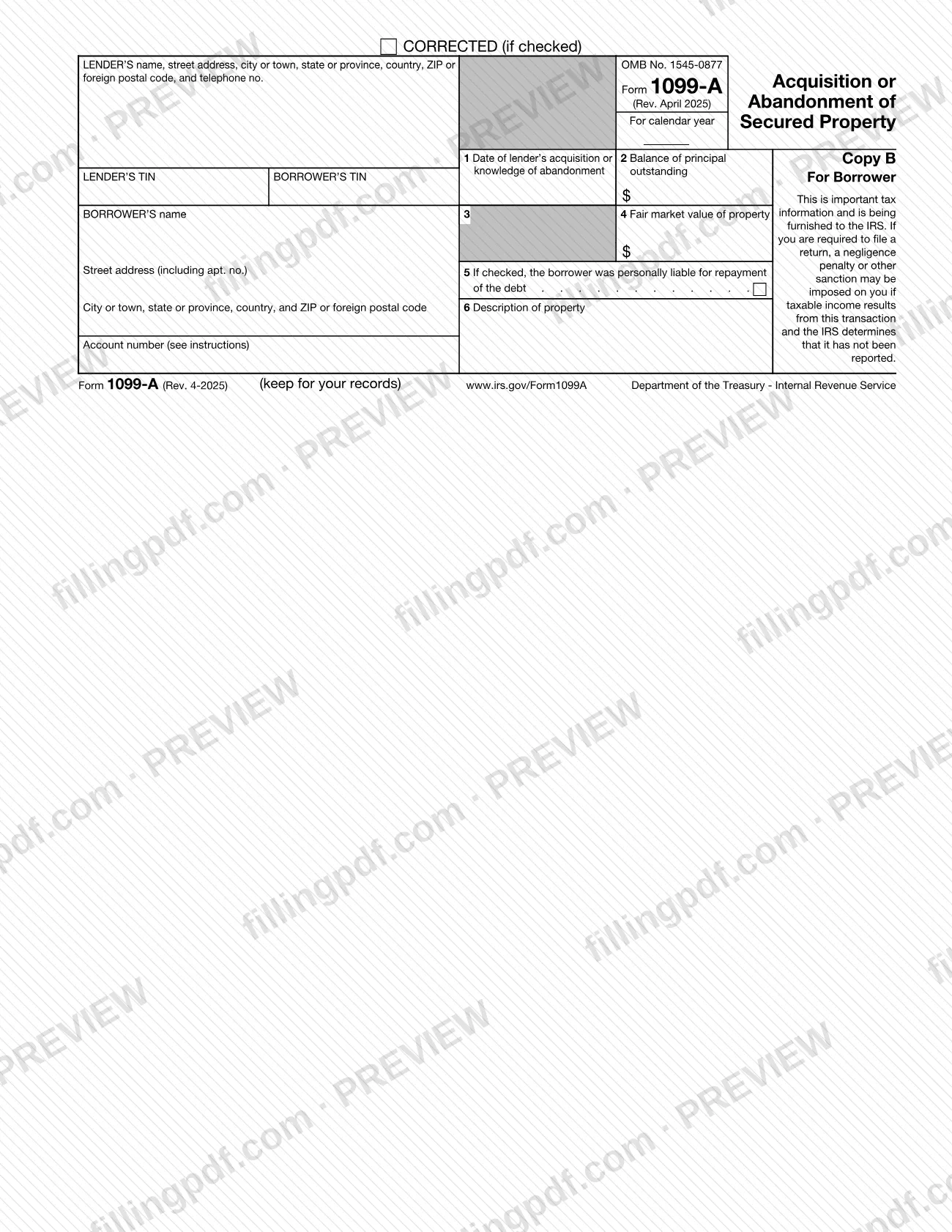
The form reports six items: the date of the lender's acquisition or knowledge of abandonment (box 1), the balance of principal outstanding (box 2), the fair market value of the property (box 4), whether the borrower was personally liable for repayment of the debt (box 5) and a description of the property (box 6). Box 3 is reserved for future use. The form also carries the lender's and borrower's names, addresses and taxpayer identification numbers (TINs), plus an optional account number.
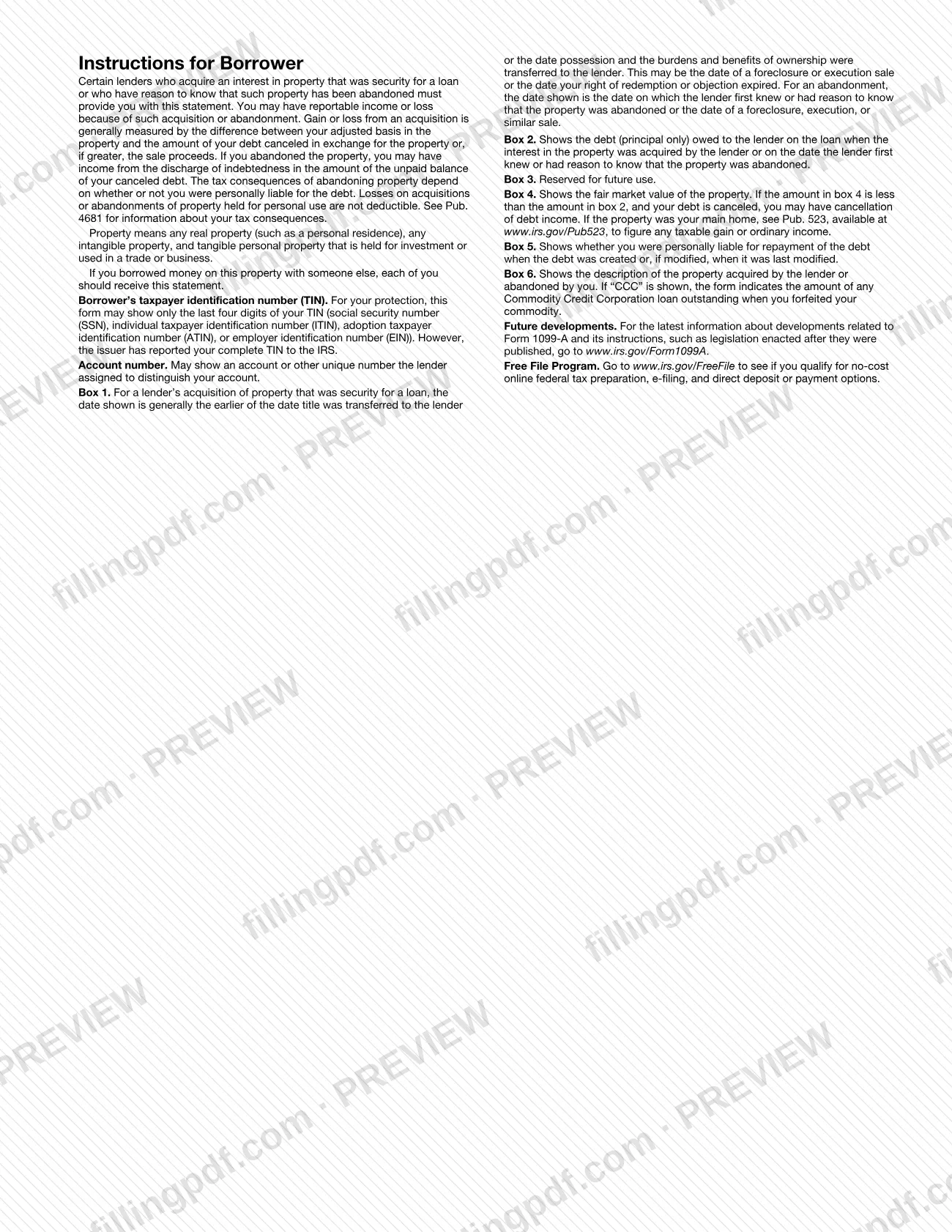
The borrower's copy explains why the form matters. Gain or loss from an acquisition is generally measured by the difference between the borrower's adjusted basis in the property and the amount of debt canceled in exchange for the property or, if greater, the sale proceeds. A borrower who abandoned property may have income from discharge of indebtedness. If box 4 is less than box 2 and the debt is canceled, the borrower may have cancellation of debt income. Losses on property held for personal use are not deductible. The borrower's instructions point to Pub. 4681, and to Pub. 523 when the property was the borrower's main home.
"Property" means real property such as a personal residence, intangible property, and tangible personal property held for investment or used in a trade or business. The copy published on this form's IRS page is marked "Info Copy Only": Copy A is for information and cannot be filed with the IRS.
Who needs to file Form 1099-A?
Lenders are the filers. The IRS says to file Form 1099-A for each borrower if you lend money in connection with your trade or business and, in full or partial satisfaction of the debt, you acquire an interest in property that is security for the debt, or you have reason to know that the property has been abandoned. You need not be in the business of lending money to be subject to this reporting requirement.
Borrowers receive the form. If you borrowed money on the property with someone else, each of you should receive a statement. The borrower's copy (Copy B) tells you to keep it for your records, and says the information is also being furnished to the IRS.
Borrowers should read the form because the acquisition or abandonment may create reportable income or loss. The tax consequences of abandoning property depend on whether you were personally liable for the debt, which is what box 5 shows.
Lenders with a different transaction, such as a canceled debt not tied to an acquisition or abandonment of secured property, are not described by this form's instructions.
When to file Form 1099-A
The triggering event is the lender's acquisition of an interest in the property that secured the loan, or the lender's knowledge, or reason to know, that the property was abandoned. Box 1 records that date. For an acquisition it is generally the earlier of the date title transferred to the lender or the date possession and the burdens and benefits of ownership transferred; it may be the date of a foreclosure or execution sale, or the date the right of redemption or objection expired.
The form carries "For calendar year" at the top, so each statement belongs to the year of the event. No due date for furnishing Copy B or filing with the IRS is printed on the form or on the IRS page for Form 1099-A. The form refers filers to the General Instructions for Certain Information Returns at IRS.gov/Form1099, including part O on penalties, so check those instructions for current deadlines.
How to fill out Form 1099-A
Enter the lender's information
In the LENDER'S box, enter the lender's name, street address, city or town, state or province, country, ZIP or foreign postal code, and telephone number. Enter the lender's TIN in the LENDER'S TIN box.
Mark VOID or CORRECTED if needed
Check CORRECTED only when the statement corrects one already furnished. The VOID box appears on Copy A only.
Enter the calendar year
Write the calendar year in the For calendar year space at the top of the form.
Enter the borrower's details
Enter the BORROWER'S TIN, the BORROWER'S name, street address (including apt. no.), and city or town, state or province, country, and ZIP or foreign postal code. Prepare a separate form for each borrower.
Add the account number
If the lender assigned an account or other unique number to distinguish the borrower's account, enter it in the Account number field.
Enter the date in box 1
Box 1, Date of lender's acquisition or knowledge of abandonment: enter the date of the acquisition or the date the lender knew or had reason to know of the abandonment.
Enter the principal balance in box 2
Box 2, Balance of principal outstanding: enter the debt, principal only, owed on the loan on the date shown in box 1.
Leave box 3 blank
Box 3 is reserved for future use, so make no entry there.
Enter the fair market value in box 4
Box 4, Fair market value of property: enter the property's fair market value.
Check box 5 if personally liable
Check box 5 if the borrower was personally liable for repayment of the debt when the debt was created or, if modified, when it was last modified.
Describe the property in box 6
Box 6, Description of property: describe the property acquired or abandoned. If the form shows "CCC", it indicates the amount of any Commodity Credit Corporation loan outstanding when the commodity was forfeited.
Review and download the PDF
Check each entry against your records. Download or print the completed PDF from FillingPDF, use the black copies to furnish the borrower's copy, and file with the IRS through the channels under How to submit; do not file the printed Copy A.
How to submit Form 1099-A
Filers have three routes: e-file through the IRS Information Returns Intake System (IRIS), order official paper forms from the IRS, or furnish the borrower's copy directly.
- E-file with the IRIS Taxpayer Portal. This free, web-based system lets you e-file up to 100 returns at a time, enter data manually or by .csv upload, and download payee copies. You need a 5-digit IRIS Transmitter Control Code (TCC). Form 1099-A is listed among the forms you can e-file with IRIS.
- E-file with software through IRIS Application to Application (A2A). Steps include applying for an IRIS A2A TCC, getting an API Client ID, getting a schema package and submitting IRIS Assurance Testing System transmissions. IRIS help desk: 866-937-4130, Monday-Friday, 7:30 a.m.-7 p.m. Eastern time.
- Paper filing. Do not print and file Copy A downloaded from the IRS website: it is not scannable, and a penalty may be imposed. Order official IRS information returns with a scannable Copy A at IRS.gov/EmployerForms.
- Borrower's copy. Copy B and the other black copies may be downloaded and printed to satisfy the requirement to provide the information to the recipient.
Starting tax year 2023, if you have 10 or more information returns, you must file them electronically. With fewer than 10, the IRS strongly encourages e-filing. FillingPDF lets you fill out and download the PDF; submission follows the IRS channels above.
Common mistakes to avoid
- Printing Copy A from the IRS website and filing it with the IRS; the online Copy A is not scannable and a penalty may be imposed. Order official forms at IRS.gov/EmployerForms or e-file.
- Filing 10 or more information returns on paper; starting tax year 2023 the IRS says they must be filed electronically.
- Entering an amount in box 3, which is reserved for future use.
- Reporting more than principal in box 2; it shows the debt owed to the lender, principal only, on the date of acquisition or knowledge of abandonment.
- Using the wrong date in box 1 for an abandonment; it is the date the lender first knew or had reason to know the property was abandoned, or the date of a foreclosure, execution or similar sale.
- Giving a statement to only one borrower when the loan was made to several people; each borrower should receive one.
- Leaving box 5 unchecked when the borrower was personally liable for repayment of the debt when it was created or last modified.
- Treating the borrower's copy as optional paperwork; the instructions tell borrowers it may affect reportable income or loss.
Frequently asked questions
What is Form 1099-A used for?
Form 1099-A is the IRS statement a lender provides when it acquires an interest in property that secured a loan, or has reason to know the property was abandoned. It reports the date, the principal balance, the property's fair market value and whether the borrower was personally liable.
Who has to file a 1099a?
Anyone who lends money in connection with a trade or business and, in full or partial satisfaction of the debt, acquires an interest in the property securing it, or has reason to know it was abandoned. You need not be in the business of lending money to be subject to this requirement.
Can I file the Copy A of Form 1099-A that I download?
No. Copy A on the IRS website is for information only and is not scannable; the IRS warns a penalty may be imposed for filing unscannable forms. Order official forms at IRS.gov/EmployerForms or e-file through IRIS.
Do I have to e-file Form 1099-A?
If you have 10 or more information returns, you must file them electronically starting tax year 2023. With fewer than 10, the IRS strongly encourages e-filing. The free IRIS Taxpayer Portal accepts Form 1099-A and requires a Transmitter Control Code.
What do the boxes on Form 1099-A mean for a borrower?
Box 1 is the date of acquisition or knowledge of abandonment. Box 2 is the principal owed then, box 4 the property's fair market value, box 5 whether you were personally liable, and box 6 the property description. Box 3 is reserved. If box 4 is below box 2 and the debt is canceled, you may have cancellation of debt income.
Do both borrowers get a Form 1099-A?
Yes. If you borrowed money on the property with someone else, each of you should receive a statement. The lender prepares the form for each borrower, and Copy B is the borrower's copy to keep for personal records.
Is there a deadline for Form 1099-A?
No due date is printed on the form or on the IRS page for Form 1099-A. The form points filers to the General Instructions for Certain Information Returns at IRS.gov/Form1099, where current deadlines and penalties are explained.
Can I fill out Form 1099-A online on FillingPDF?
You can fill out the PDF online on FillingPDF and download or print it. FillingPDF does not file the form with the IRS or send it to borrowers; filing follows IRS channels such as IRIS or official scannable paper forms.
Ready to fill out Form 1099-A?
Fill out Form 1099-A now