
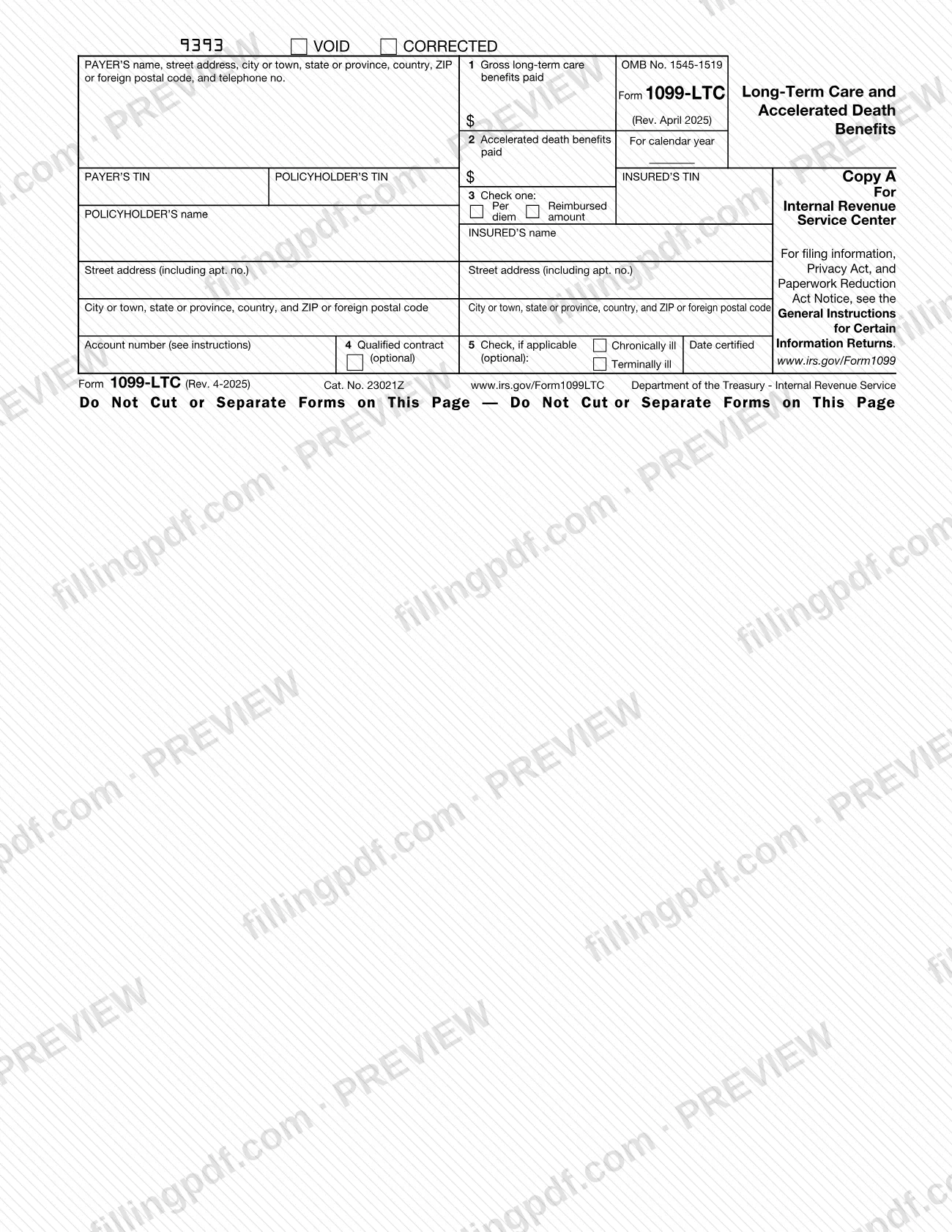
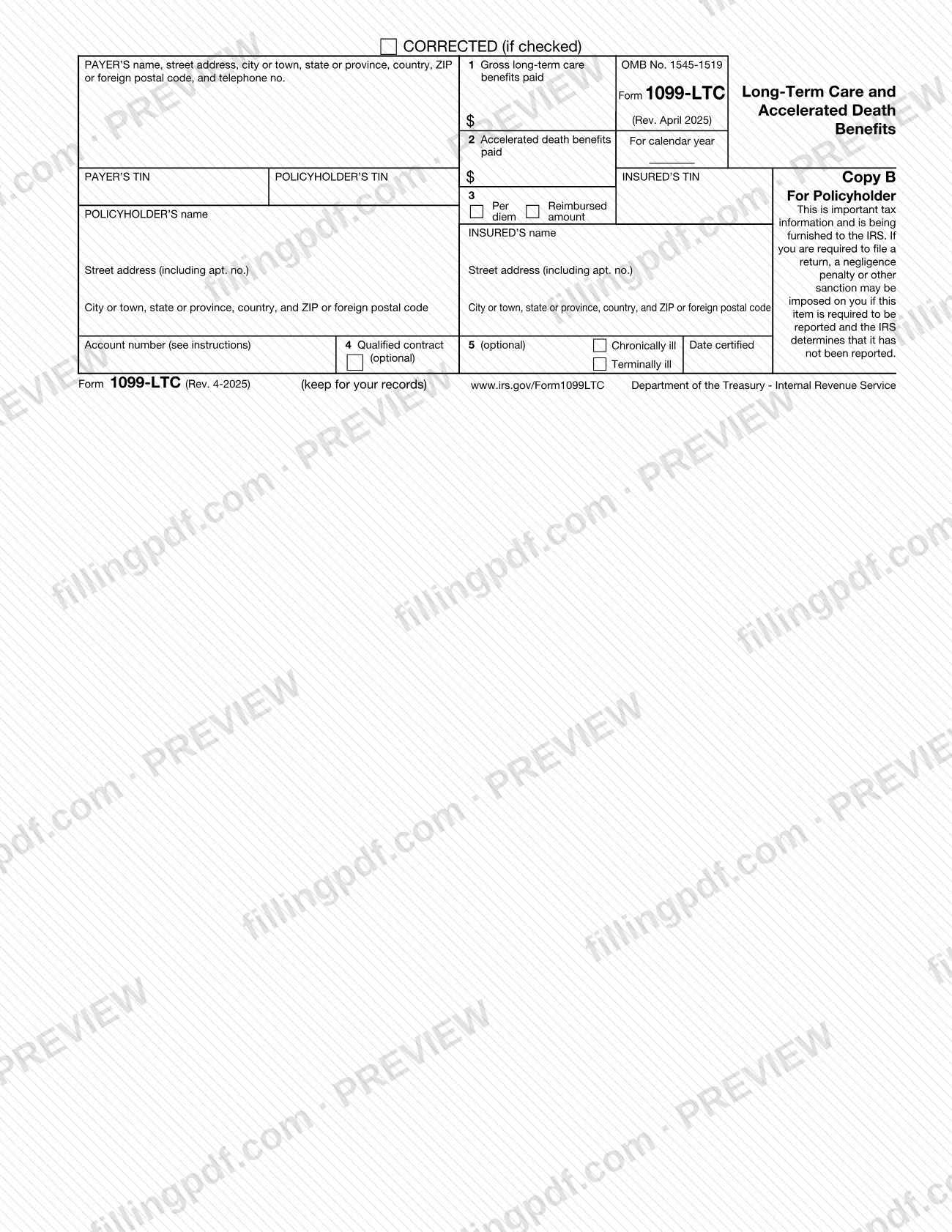

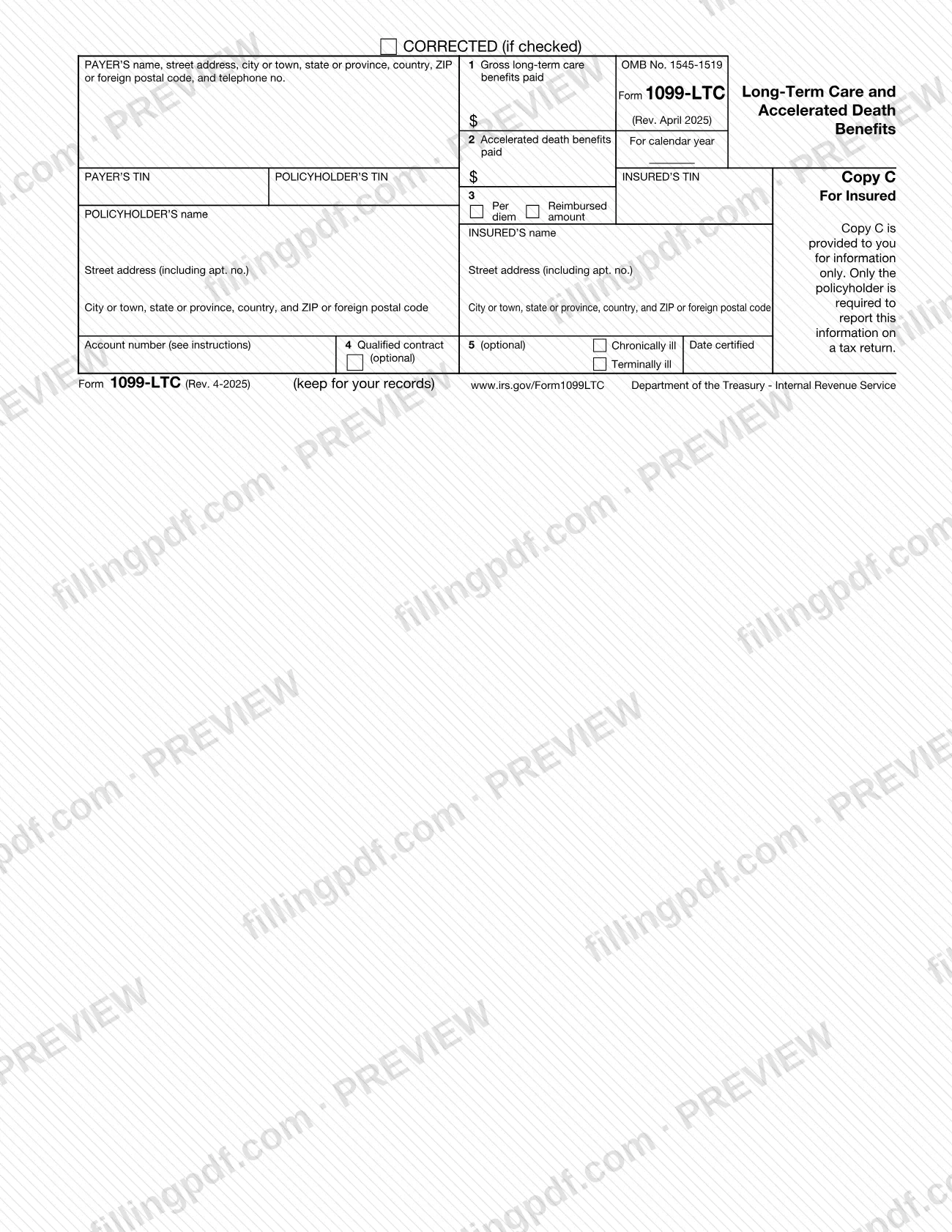

Form 1099-LTC is the Internal Revenue Service (IRS) information return on which a payer reports long-term care benefits and accelerated death benefits paid during the calendar year. Insurance companies, governmental units and viatical settlement providers file it, and the policyholder and the insured each receive a copy. On this page you can fill out the form online on FillingPDF and download or print the completed PDF. The official PDF, the instructions and the latest developments are published by the IRS at www.irs.gov/Form1099LTC.
Last updated
What is 1099-LTC?
Form 1099-LTC, Long-Term Care and Accelerated Death Benefits, is the IRS information return a payer files to report gross long-term care benefits and accelerated death benefits paid during the calendar year to or on behalf of an insured person.
The form carries five boxes: gross long-term care benefits paid (box 1), accelerated death benefits paid (box 2), whether the payment was per diem or reimbursed (box 3), whether the benefits came from a qualified contract (box 4) and whether the insured was certified chronically ill or terminally ill, with the latest date certified (box 5). Boxes 4 and 5 are optional. The payer is not required to decide whether any benefit is taxable or nontaxable.
"Long-term care benefits" covers payments under any product advertised, marketed or offered as long-term care insurance, qualified or not, and accelerated death benefits paid under a life insurance contract or by a viatical settlement provider. The form is issued as Copy A (for the IRS), Copy B (for the policyholder) and Copy C (for the insured). Copy C is for information only, because only the policyholder reports the information on a tax return. The IRS instructions say to use the form for tax year 2025 and later years until a new revision replaces it.
Who needs to file 1099-LTC?
Payers of long-term care benefits file Form 1099-LTC. The IRS instructions name insurance companies, governmental units and viatical settlement providers, and say to file if you paid any long-term care benefits, including accelerated death benefits.
- Report only individual policyholders. If the policyholder is not an individual, no reporting is required.
- Report payments to anyone. Reportable payments are those made to the policyholder, to the insured or to a third party such as a nursing home, caretaker or physician.
- Policyholder. The individual who owns the contract, including the owner of a contract sold or assigned to a viatical settlement provider. Under a group contract, the certificate holder or similar participant counts as the policyholder.
- Insured. The chronically or terminally ill person on whose behalf benefits are paid.
Recipients do not complete the form. They receive it: the policyholder gets Copy B and the insured gets Copy C. When the policyholder and the insured are the same person, that person gets Copy B and Copy C is optional. A payer can report the benefits of each contract on a separate form, or, at its option, combine contracts on one form if the same information is reportable for each contract other than the amount paid.
When to file 1099-LTC
File Form 1099-LTC when you have paid long-term care benefits or accelerated death benefits during the calendar year. The form itself carries no due date: the IRS instructions refer filers to the General Instructions for Certain Information Returns for when and where to file, for statements to recipients and for corrected and void returns. Those are available at IRS.gov/Form1099GeneralInstructions.
You must furnish a statement, or an acceptable substitute, to both the policyholder and the insured. The instructions point to part M of the General Instructions for the details. The instructions for this revision apply to tax year 2025 and subsequent years until the IRS issues a superseding revision.
Documents you need
- Form 1096, sent with the black-and-white Copy A printed from the IRS website, only if you are qualified to file this form on paper rather than electronically.
How to fill out 1099-LTC
Mark corrected and enter the year
Check the CORRECTED box only if this form corrects one filed earlier; see the General Instructions for corrected and void returns. Enter the calendar year next to For calendar year.
Enter the payer's details
In the PAYER'S name block, enter the payer's name, street address, city or town, state or province, country, ZIP or foreign postal code, and telephone number. Enter the full PAYER'S TIN, which may not be truncated.
Enter the policyholder's information
Enter the POLICYHOLDER'S name, street address and city, state and ZIP, and the POLICYHOLDER'S TIN. The policyholder is the individual who owns the contract.
Enter the insured's information
Enter the INSURED'S name, address and INSURED'S TIN. The insured is the chronically or terminally ill person on whose behalf benefits are paid.
Add an account number
In Account number (see instructions), enter the number that identifies the account. It is required if you file more than one Form 1099-LTC for the same recipient, and the IRS encourages it on all forms.
Enter long-term care benefits in box 1
Enter the gross long-term care benefits paid during the year, other than accelerated death benefits. Include amounts paid to the insured, the policyholder and third parties.
Enter accelerated death benefits in box 2
Enter the gross accelerated death benefits paid under a life insurance contract to or on behalf of an insured certified as terminally or chronically ill. Include amounts a viatical settlement provider paid for the sale or assignment of the death benefit.
Check per diem or reimbursed in box 3
Check Per diem for payments made on a periodic basis without regard to actual expenses, or Reimbursed amount for payments of actual expenses. Leave it unchecked for accelerated death benefits paid on behalf of a terminally ill person.
Complete the optional box 4
Check Qualified contract if the long-term care benefits were paid from a qualified long-term care insurance contract.
Complete the optional box 5
Check Chronically ill or Terminally ill, and enter the Date certified (the latest date). Leave the box blank if the insured was neither.
Review and download the completed PDF
Check names, TINs and amounts against your records, then download or print the completed PDF from FillingPDF. Use the correct copy for each recipient and follow the channels under How to submit.
How to submit 1099-LTC
Form 1099-LTC reaches the IRS through electronic filing or, for this form only and when you qualify to file on paper, on paper with Form 1096.
- Electronically through IRIS: The IRS Information Returns Intake System (IRIS) accepts Form 1099-LTC. You need an IRIS Transmitter Control Code (TCC). The IRIS Taxpayer Portal lets you e-file up to 100 returns at a time, entered manually or uploaded as a .csv file. Software and service providers can use IRIS Application to Application (A2A). The IRIS page says that, starting with tax year 2023, if you have 10 or more information returns you must file them electronically.
- On paper: If you qualify to file on paper, send the black-and-white Copy A that you print from the IRS website with Form 1096.
- To the recipients: Send Copy B to the policyholder and Copy C to the insured. The IRS says you may fill out the online fillable form at IRS.gov/Form1099LTC and send Copy B to the recipient.
IRIS help desk: 866-937-4130 (toll-free) or 470-769-5100 (international), Monday to Friday, 7:30 a.m. to 7 p.m. Eastern time. FillingPDF lets you fill out and download the PDF; submission follows the channels above.
Common mistakes to avoid
- Reporting payments when the policyholder is not an individual; the instructions say no reporting is required in that case.
- Truncating the payer's TIN. The payer's TIN may not be truncated on any form, and the policyholder's or insured's TIN may not be truncated on documents filed with the IRS.
- Checking a box 3 option for accelerated death benefits paid on behalf of a terminally ill person; the instructions say not to check a box in that case.
- Filling in box 5 when the insured was neither chronically ill nor terminally ill; the box is to be left blank.
- Furnishing a statement to only one party; a statement or acceptable substitute goes to both the policyholder and the insured.
- Giving the policyholder Copy C or the insured Copy B; the policyholder uses Copy B and the insured Copy C.
- Omitting the account number when you file more than one Form 1099-LTC for the same recipient; it is required in that case.
- Spending effort deciding whether benefits are taxable; the instructions say you are not required to determine that in box 1.
- Sending a paper filing without Form 1096 or on a form other than the black-and-white Copy A printed from the IRS website.
Frequently asked questions
What is Form 1099-LTC used for?
Form 1099-LTC is the IRS form a payer files to report long-term care benefits and accelerated death benefits paid during the calendar year. The policyholder and the insured each get a copy showing the gross benefits paid and whether they were per diem or reimbursed.
Who has to file Form 1099-LTC?
The payer of the benefits. The IRS instructions list insurance companies, governmental units and viatical settlement providers, and say to file if you paid any long-term care benefits, including accelerated death benefits. Recipients do not file it; they receive a copy.
I received a 1099-LTC. Which copy is mine?
The policyholder receives Copy B; the insured receives Copy C. Copy C is for information only, because only the policyholder is required to report the information on a tax return. If you are both, you should receive Copy B.
What is the difference between per diem and reimbursed in box 3?
Per diem means payments made on any periodic basis without regard to actual expenses. Reimbursed means payments made for actual expenses incurred. For accelerated death benefits paid on behalf of a terminally ill person, the instructions say not to check either box.
Can I fill out Form 1099-LTC online?
Yes. You can fill out the PDF online on FillingPDF and download or print it. FillingPDF is an independent service and does not file the form with the IRS. The IRS also offers an online fillable version at IRS.gov/Form1099LTC.
How do I file Form 1099-LTC with the IRS?
File it electronically through the IRS IRIS system, or, for this form only and if you qualify to file on paper, send the black-and-white Copy A printed from the IRS website with Form 1096. With 10 or more information returns, e-filing is required starting with tax year 2023.
Do I have to report whether the benefits are taxable on Form 1099-LTC?
No. The IRS instructions for box 1 say the payer is not required to determine whether any benefits are taxable or nontaxable. Box 1 shows the gross benefits paid under the long-term care insurance contract during the year.
Does a 1099-LTC apply when the policyholder is a business?
No. Report payments only if the policyholder is an individual. If the policyholder is not an individual, the IRS instructions say no reporting is required on Form 1099-LTC.
Ready to fill out 1099-LTC?
Fill out 1099-LTC now