
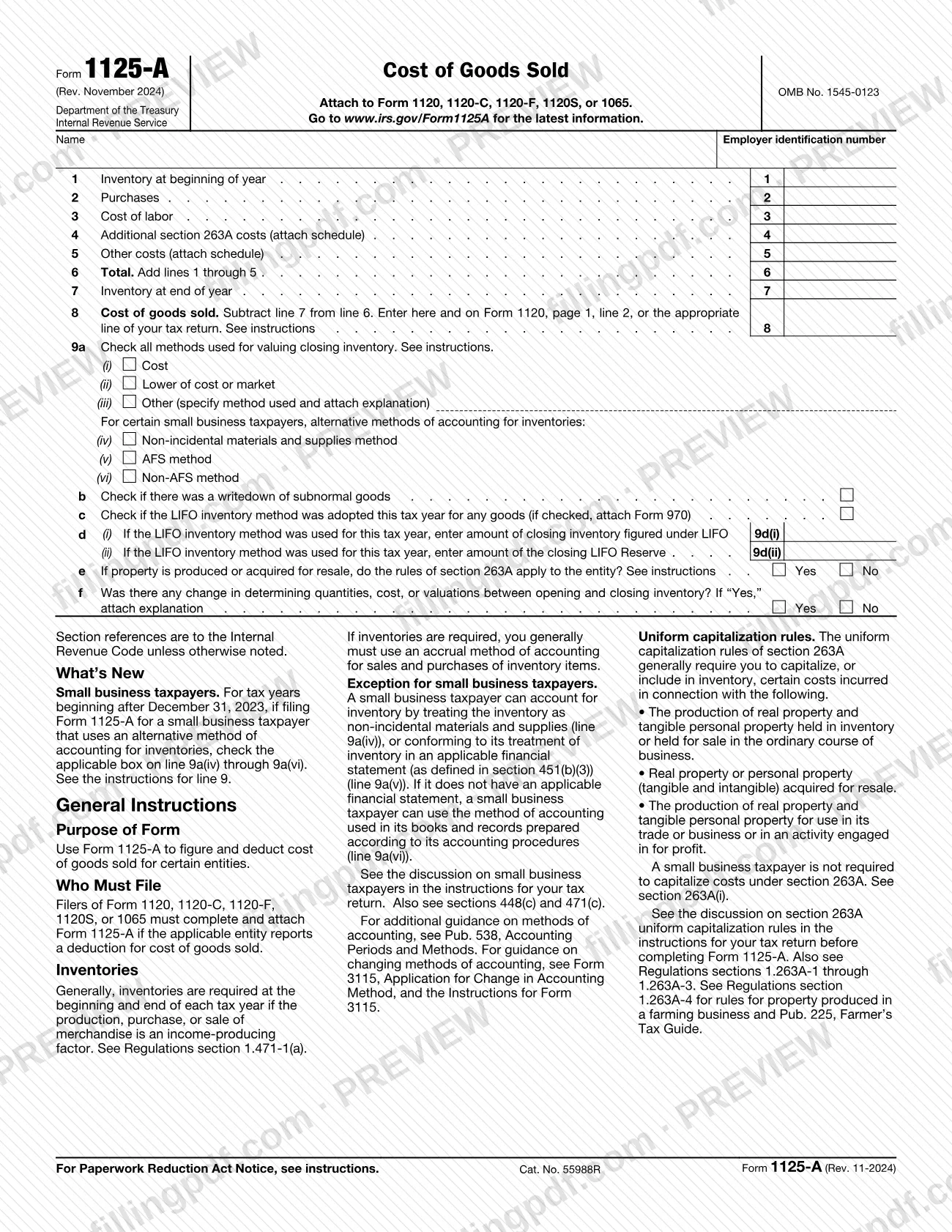
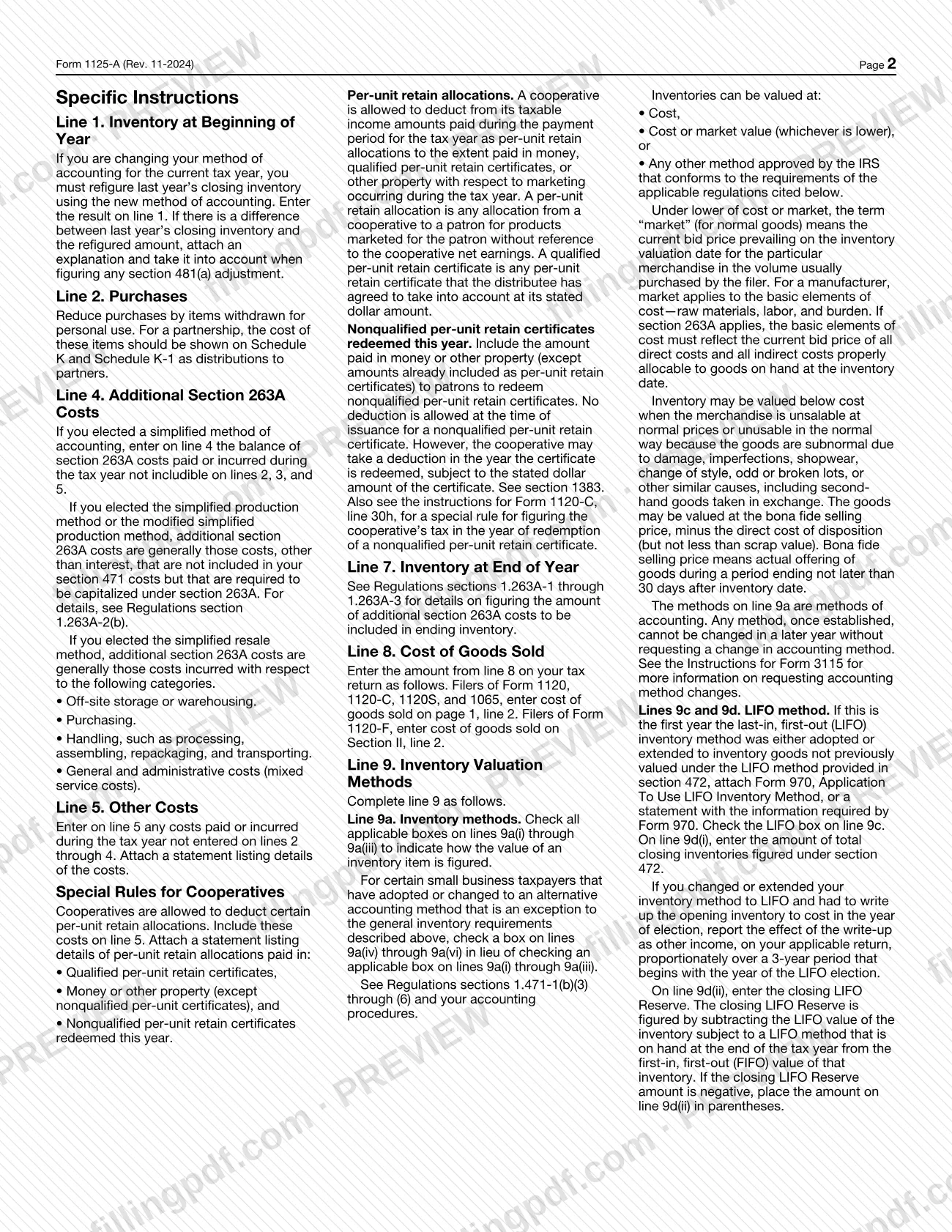

Form 1125-A, Cost of Goods Sold, is the Internal Revenue Service (IRS) form used to figure and deduct cost of goods sold for certain entities. Filers of Form 1120, 1120-C, 1120-F, 1120S or 1065 attach it to their return when they report that deduction. On this page you can fill out the form online on FillingPDF and download or print the completed PDF; the form and its latest information are published by the IRS at www.irs.gov/Form1125A.
Last updated
What is Form 1125-A?
Form 1125-A, Cost of Goods Sold, is the IRS schedule on which a business adds its beginning inventory, purchases, labor and other costs, subtracts its ending inventory, and arrives at the cost of goods sold it deducts on its income tax return.
The form works in two parts. Lines 1 through 8 are the calculation: inventory at beginning of year (line 1), purchases (line 2), cost of labor (line 3), additional section 263A costs (line 4), other costs (line 5), the total of lines 1 through 5 (line 6), inventory at end of year (line 7) and cost of goods sold, line 6 minus line 7 (line 8). Line 9 collects the inventory valuation details: the methods used to value closing inventory, any writedown of subnormal goods, LIFO information, whether the uniform capitalization rules of section 263A apply, and whether quantities, cost or valuations changed between opening and closing inventory.
The IRS states that the form is for certain entities and is attached to Form 1120, 1120-C, 1120-F, 1120S or 1065. The amount on line 8 is carried to the cost of goods sold line of that return. The form carries OMB No. 1545-0123 and the revision printed on it is Rev. November 2024. The IRS points to Pub. 538, Accounting Periods and Methods, for more on accounting methods, and to Form 3115, Application for Change in Accounting Method, for changing a method.
Who needs to file Form 1125-A?
Filers of Form 1120, 1120-C, 1120-F, 1120S or 1065 must complete and attach Form 1125-A if the applicable entity reports a deduction for cost of goods sold. The IRS page for the form also names Form 1065-B among the returns whose filers attach it.
Inventory rules shape who has meaningful entries. Generally, inventories are required at the beginning and end of each tax year if the production, purchase or sale of merchandise is an income-producing factor, and an entity that must keep inventories generally uses an accrual method of accounting for sales and purchases of inventory items.
Some groups have special lines:
- Cooperatives include certain per-unit retain allocations on line 5 and attach a statement listing their details.
- Entities that produce or acquire property for resale answer line 9e according to whether the section 263A uniform capitalization rules apply.
- Small business taxpayers for tax years beginning after December 31, 2023 that use an alternative method of accounting for inventories check a box on line 9a(iv) through 9a(vi). A small business taxpayer is not required to capitalize costs under section 263A.
- Entities using LIFO complete lines 9c and 9d.
An entity that reports no cost of goods sold deduction has no reason to attach the form.
When to file Form 1125-A
Form 1125-A is filed whenever your business return reports a deduction for cost of goods sold, so it is due with that return. The form prints no separate due date: it is a schedule that travels with Form 1120, 1120-C, 1120-F, 1120S or 1065 and follows the filing timing of that return.
Two timing points come from the instructions. If this is the first year you adopted the LIFO inventory method, or the first year you extended it to goods not previously valued under LIFO, attach Form 970 (or a statement with the information Form 970 requires) and check line 9c. If you change your method of accounting for the current tax year, you must refigure last year's closing inventory under the new method and enter the result on line 1. A method, once established, cannot be changed in a later year without requesting a change in accounting method.
Documents you need
- Form 1120, 1120-C, 1120-F, 1120S or 1065: the return to which Form 1125-A is attached and on which the line 8 result is entered.
- A schedule of additional section 263A costs, attached when you enter an amount on line 4.
- A statement listing the details of other costs, attached when you enter an amount on line 5. Cooperatives also list per-unit retain allocations in it.
- An explanation of the valuation method, attached when you check line 9a(iii), Other.
- Form 970, Application To Use LIFO Inventory Method, or a statement with the information Form 970 requires, when the LIFO method was adopted or extended this tax year and you check line 9c.
- An explanation of the change, attached when you answer Yes on line 9f because quantities, cost or valuations changed between opening and closing inventory.
- An explanation of any difference between last year's closing inventory and the refigured amount entered on line 1, when you are changing your method of accounting for the current year.
How to fill out Form 1125-A
Enter your name and EIN
At the top of the form, enter the name and employer identification number shown on the return to which you will attach Form 1125-A.
Enter beginning inventory on line 1
Enter inventory at beginning of year. If you are changing your method of accounting this year, refigure last year's closing inventory under the new method and enter that result, attaching an explanation of any difference.
Enter purchases on line 2
Enter purchases, reduced by any items withdrawn for personal use. For a partnership, show the cost of those items on Schedule K and Schedule K-1 as distributions to partners.
Enter cost of labor on line 3
Enter the cost of labor for the year as the line asks.
Enter section 263A costs on line 4
If you elected a simplified method of accounting, enter the balance of section 263A costs paid or incurred during the year that are not includible on lines 2, 3 and 5, and attach a schedule.
Enter other costs on line 5
Enter costs paid or incurred during the year that are not on lines 2 through 4, and attach a statement listing the details. Cooperatives include per-unit retain allocations here.
Total the costs and enter ending inventory
On line 6, add lines 1 through 5. On line 7, enter inventory at end of year, using the regulations cited in the line 7 instructions for the amount of additional section 263A costs to include.
Figure cost of goods sold on line 8
Subtract line 7 from line 6. Enter the result on page 1, line 2 of Form 1120, 1120-C, 1120S or 1065, or on Section II, line 2 of Form 1120-F.
Check the valuation methods on line 9a
Check all methods used to value closing inventory: cost, lower of cost or market, or other (attach an explanation). Eligible small business taxpayers using an alternative method check a box on lines 9a(iv) through 9a(vi) instead.
Mark writedowns on line 9b
Check line 9b if there was a writedown of subnormal goods.
Complete the LIFO lines 9c and 9d
Check line 9c if you adopted LIFO this tax year for any goods, and attach Form 970 or an equivalent statement. If you used LIFO this year, enter closing inventory under LIFO on line 9d(i) and the closing LIFO Reserve on line 9d(ii), in parentheses if negative.
Answer lines 9e and 9f
On line 9e, mark Yes or No for whether the section 263A rules apply to the entity. On line 9f, mark Yes or No for any change in determining quantities, cost or valuations between opening and closing inventory; if Yes, attach an explanation.
Review and download the completed PDF
Check each line and the attachments, then download or print the completed PDF from FillingPDF and attach it to your return as described under How to submit.
How to submit Form 1125-A
Form 1125-A has no filing channel or address of its own. You attach it to the Form 1120, 1120-C, 1120-F, 1120S or 1065 that reports your cost of goods sold deduction, and it is submitted by whatever method you use for that return. Check the instructions for your return for its filing options and addresses.
Before you attach it, assemble the supporting pieces the form calls for:
- A schedule for line 4 (additional section 263A costs) and a statement of details for line 5 (other costs).
- An explanation if you check line 9a(iii) (other method) or answer Yes on line 9f.
- Form 970, or a statement with the same information, if you check line 9c.
Enter the line 8 result on your return as the instructions direct: page 1, line 2 for filers of Form 1120, 1120-C, 1120S and 1065, and Section II, line 2 for filers of Form 1120-F. FillingPDF lets you fill out and download the PDF; submission follows the channels that apply to your return.
Common mistakes to avoid
- Not reducing purchases on line 2 by items withdrawn for personal use; for a partnership, those items belong on Schedule K and Schedule K-1 as distributions to partners.
- Carrying last year's closing inventory to line 1 unchanged when you are changing your accounting method, instead of refiguring it under the new method.
- Entering amounts on line 4 or line 5 without attaching the required schedule or statement listing the details.
- Entering the line 8 result on the wrong line of the return; Form 1120-F filers use Section II, line 2, while the other filers use page 1, line 2.
- Checking a box on lines 9a(iv) through 9a(vi) in addition to a box on 9a(i) through 9a(iii); the alternative methods are checked in lieu of those boxes.
- Checking line 9c for a LIFO adoption without attaching Form 970 or a statement with the required information.
- Leaving a negative closing LIFO Reserve on line 9d(ii) without parentheses.
- Answering Yes on line 9f without attaching an explanation of the change.
- Changing an established inventory method in a later year without requesting a change in accounting method on Form 3115.
Frequently asked questions
What is Form 1125-A used for?
Form 1125-A is the IRS schedule used to figure and deduct cost of goods sold. It adds beginning inventory, purchases, labor and other costs, subtracts ending inventory, and gives the line 8 amount that goes on the cost of goods sold line of the business return.
Who has to file Form 1125-A?
Filers of Form 1120, 1120-C, 1120-F, 1120S or 1065 must complete and attach it if the entity reports a deduction for cost of goods sold. The IRS page for the form also lists Form 1065-B filers. If you report no such deduction, you have nothing to attach.
Where does the line 8 amount go on my return?
Filers of Form 1120, 1120-C, 1120S and 1065 enter the amount from line 8 on page 1, line 2 of their return. Filers of Form 1120-F enter it on Section II, line 2. The form itself repeats this for Form 1120 as page 1, line 2.
Is there a due date for Form 1125-A?
It has no separate due date. The form says to attach it to Form 1120, 1120-C, 1120-F, 1120S or 1065, so it is filed with that return and follows that return's deadline and filing method.
Can I fill out Form 1125-A online?
Yes. You can fill out the PDF online on FillingPDF and download or print it. FillingPDF is an independent service and does not file the form with the IRS; you attach it to your return and file through the channels for that return.
What do I check on line 9a if I am a small business taxpayer?
For tax years beginning after December 31, 2023, a small business taxpayer using an alternative inventory method checks the applicable box on line 9a(iv), (v) or (vi) instead of a box on lines 9a(i) through 9a(iii). The three boxes cover non-incidental materials and supplies, the AFS method and the non-AFS method.
What do I attach if I adopted the LIFO method this year?
Attach Form 970, Application To Use LIFO Inventory Method, or a statement with the information Form 970 requires, and check line 9c. Also enter closing inventory under LIFO on line 9d(i) and the closing LIFO Reserve on line 9d(ii).
Can I change my inventory method just by checking a different box on line 9a?
No. The methods on line 9a are methods of accounting, and once established a method cannot be changed in a later year without requesting a change in accounting method. The instructions refer you to Form 3115 and its instructions.
Ready to fill out Form 1125-A?
Fill out Form 1125-A now