
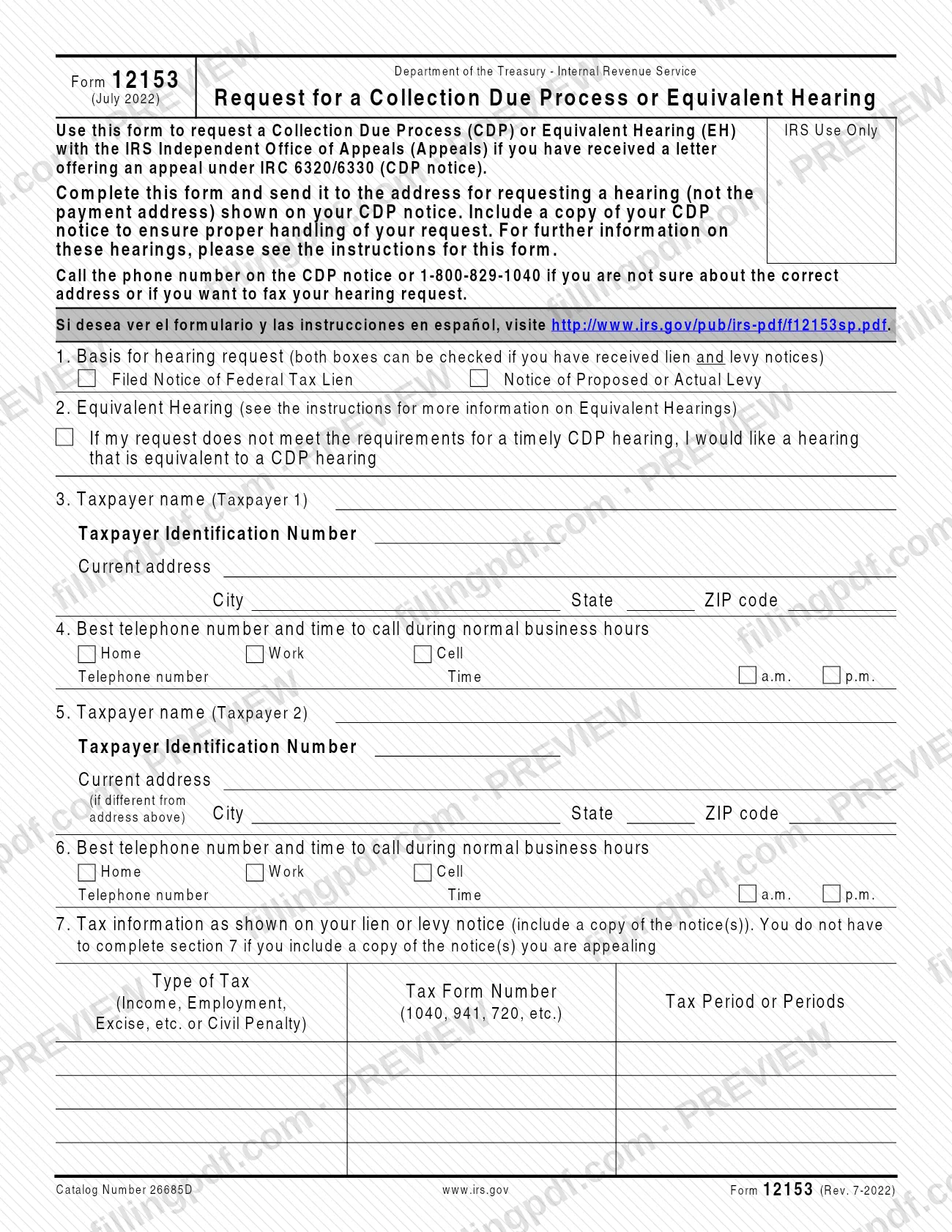
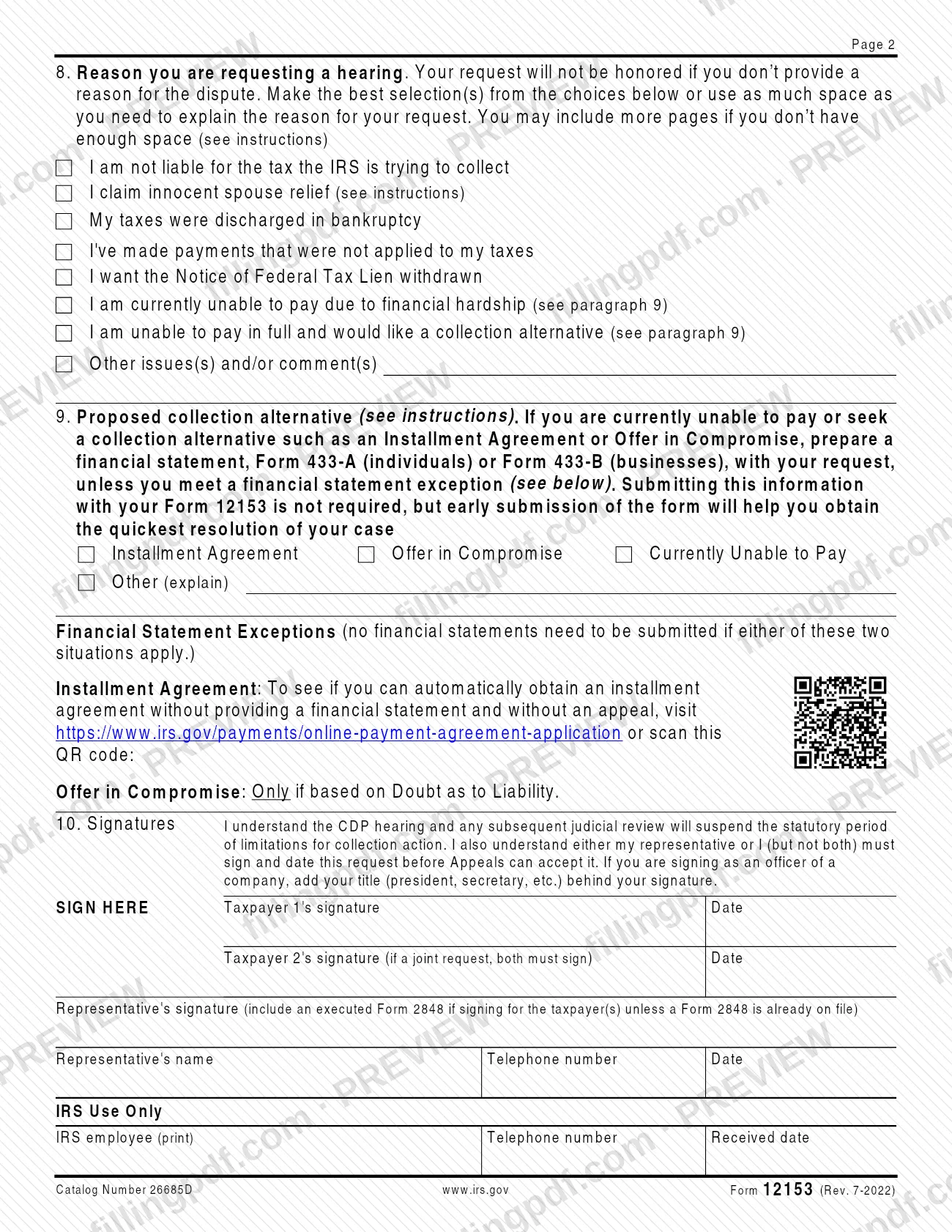
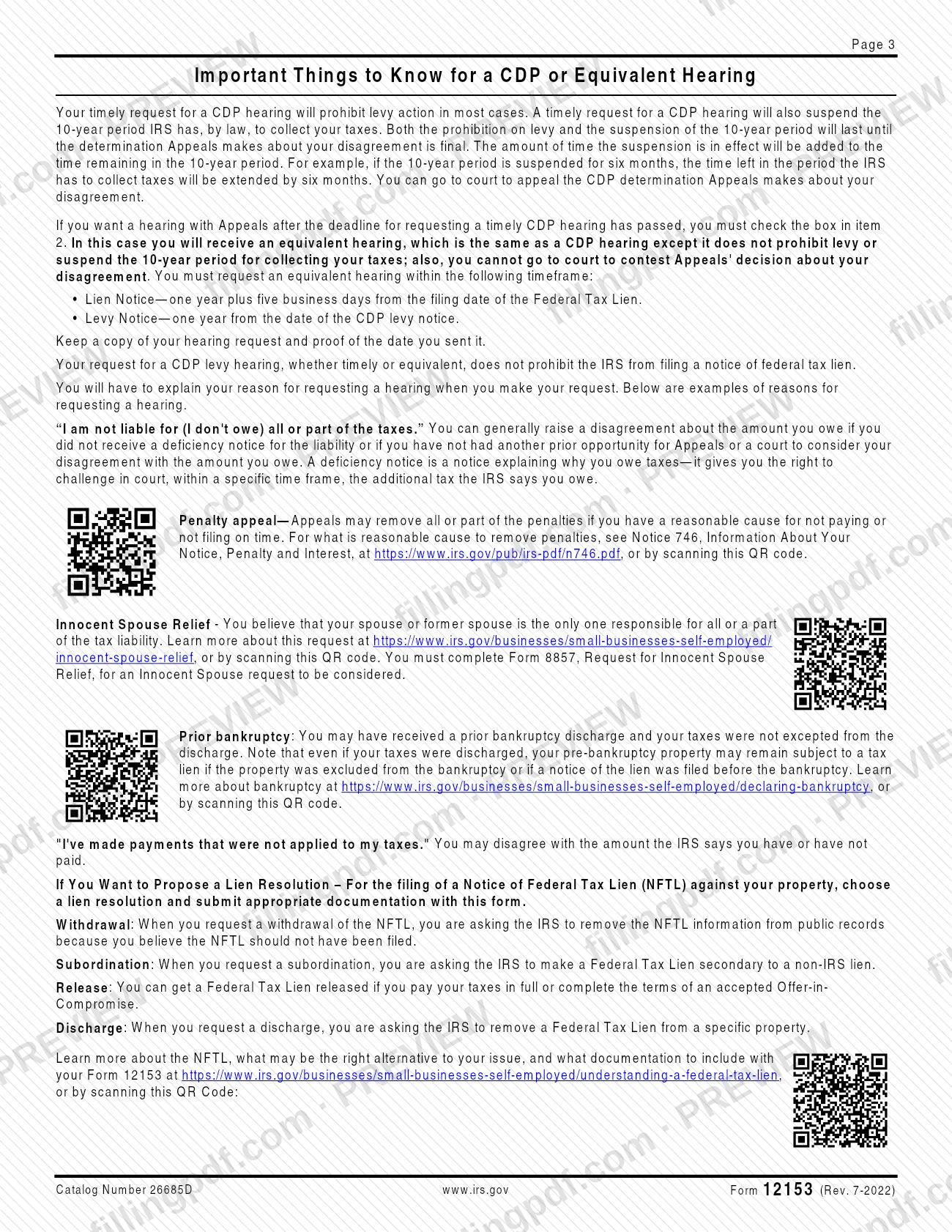
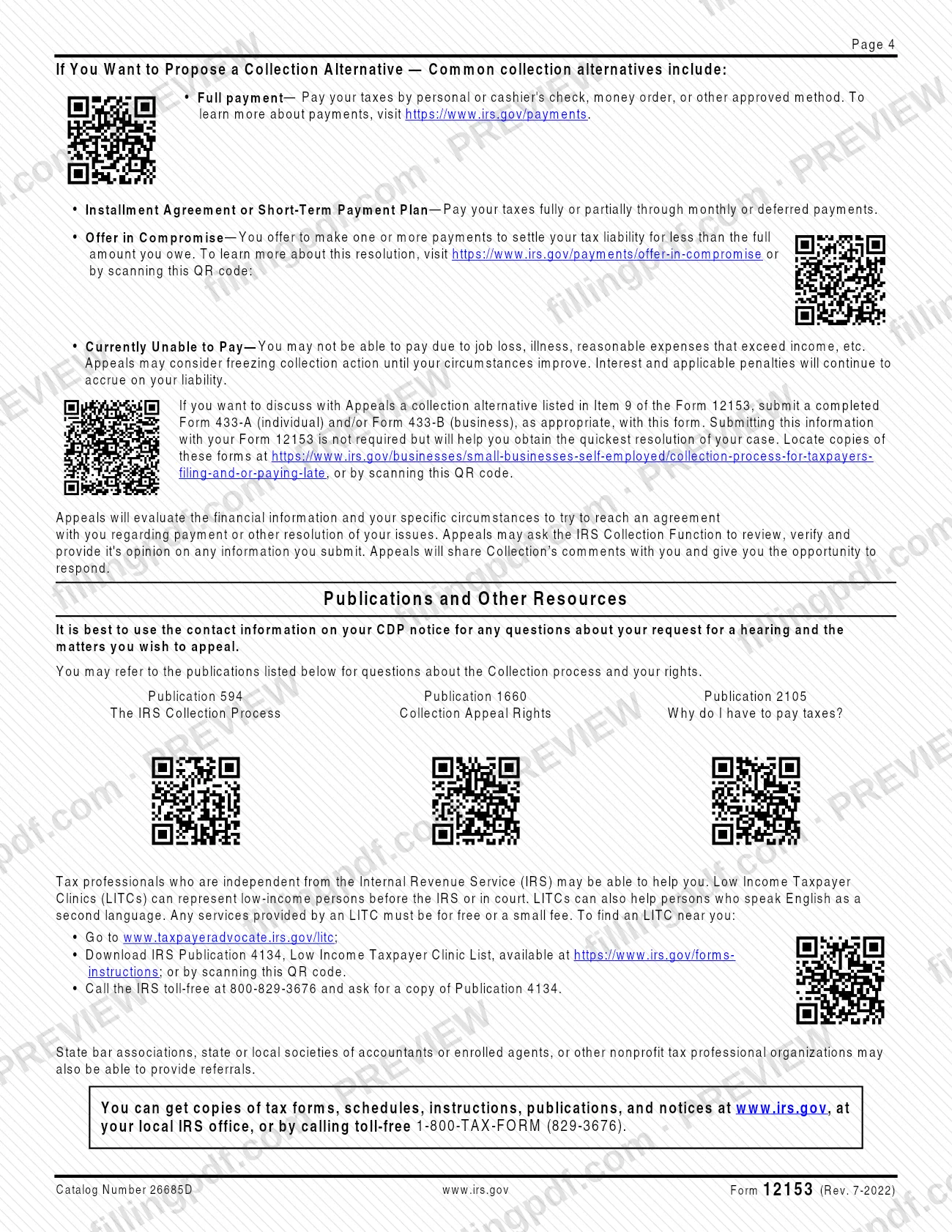
Form 12153 is the Internal Revenue Service (IRS) form you use to ask the IRS Independent Office of Appeals (Appeals) for a Collection Due Process (CDP) or Equivalent Hearing after you receive a letter offering an appeal under IRC 6320/6330 (a CDP notice). It applies to a filed Notice of Federal Tax Lien or a Notice of Proposed or Actual Levy. On this page you can fill out the form online on FillingPDF and download or print the completed PDF. The form is not sent to the payment address: you mail it to the hearing-request address printed on your CDP notice.
Last updated
What is Form 12153?
Form 12153, Request for a Collection Due Process or Equivalent Hearing, is the IRS form for asking Appeals to hear your disagreement with a lien or levy action, when you have received a CDP notice offering an appeal under IRC 6320/6330.
Completing it starts one of two kinds of hearing. A timely request produces a CDP hearing. In most cases it prohibits levy action and suspends the 10-year period the IRS has by law to collect your taxes, both until Appeals' determination is final, and you can go to court to appeal that determination. A late request, made by checking the box in item 2, produces an Equivalent Hearing (EH). An EH is the same as a CDP hearing except that it does not prohibit levy, does not suspend the 10-year period and cannot be taken to court.
On the form you state the basis for the hearing (a filed Notice of Federal Tax Lien, a Notice of Proposed or Actual Levy, or both), identify the taxpayer or taxpayers, give your reason for the dispute and, if you want one, propose a collection alternative such as an Installment Agreement or Offer in Compromise.
The IRS publishes a Spanish version of the form and instructions at http://www.irs.gov/pub/irs-pdf/f12153sp.pdf. A request for a CDP levy hearing, timely or equivalent, does not stop the IRS from filing a Notice of Federal Tax Lien.
Who needs to file Form 12153?
You use Form 12153 if you have received a letter offering an appeal under IRC 6320/6330 (a CDP notice) and want a hearing with Appeals. Check the box for the notice you received in item 1:
- Filed Notice of Federal Tax Lien, for a lien notice;
- Notice of Proposed or Actual Levy, for a levy notice;
- both boxes, if you received lien and levy notices.
If you filed your request too late for a timely CDP hearing, you can still ask for an Equivalent Hearing on the same form by checking the box in item 2.
The form has room for two taxpayers. On a joint request both taxpayers must sign. If you sign for a company, add your title (president, secretary, etc.) behind your signature.
A representative may sign instead of the taxpayer, but either the representative or the taxpayer signs, not both. A representative signing for the taxpayer or taxpayers must include an executed Form 2848, unless a Form 2848 is already on file.
The form's instructions also point to Low Income Taxpayer Clinics (LITCs) and other independent tax professionals for help.
When to file Form 12153
The trigger is receiving a CDP notice, the letter offering an appeal under IRC 6320/6330. A request made within the timely CDP period gets a CDP hearing; the form refers you to its instructions for the details of that period.
If the deadline for a timely CDP hearing has passed, check the box in item 2 to request an Equivalent Hearing. You must make that request within these timeframes:
- Lien notice: one year plus five business days from the filing date of the Federal Tax Lien.
- Levy notice: one year from the date of the CDP levy notice.
Keep a copy of your hearing request and proof of the date you sent it. The form sets no processing time.
Documents you need
- A copy of your CDP notice (the letter offering an appeal under IRC 6320/6330), included with the form to ensure proper handling of your request.
- Copies of the lien or levy notice(s) you are appealing; with them you do not have to complete section 7 (tax information).
- Form 2848, executed, when a representative signs for the taxpayer(s), unless a Form 2848 is already on file.
- Form 8857, Request for Innocent Spouse Relief, only if you claim innocent spouse relief; it must be completed for that request to be considered.
- Form 433-A (individuals) and/or Form 433-B (businesses), only if you are unable to pay or want a collection alternative such as an Installment Agreement or Offer in Compromise. Submitting it is not required but speeds resolution.
- Documentation for a lien resolution (withdrawal, subordination, release or discharge), if you propose one for a Notice of Federal Tax Lien.
- Additional pages explaining your reason for the hearing, if the space in item 8 is not enough.
How to fill out Form 12153
Choose the basis for the hearing
In item 1, check Filed Notice of Federal Tax Lien, Notice of Proposed or Actual Levy, or both if you received lien and levy notices.
Request an Equivalent Hearing if late
In item 2, check the box only if your request does not meet the requirements for a timely CDP hearing and you want a hearing equivalent to a CDP hearing.
Enter Taxpayer 1 details
In item 3, enter the taxpayer name, Taxpayer Identification Number and current address (city, state, ZIP code).
Add the best phone and time
In item 4, mark Home, Work or Cell, enter the telephone number and the best time to call during normal business hours, marking a.m. or p.m.
Enter Taxpayer 2 if joint
In items 5 and 6, repeat the name, Taxpayer Identification Number, address (if different from above) and best phone and time for the second taxpayer.
Fill in the tax information
In item 7, enter the type of tax, the tax form number (1040, 941, 720, etc.) and the tax period or periods shown on your notice. You can skip this item if you include a copy of the notice(s) you are appealing.
State the reason for your request
In item 8, check the choices that fit, such as not liable for the tax, innocent spouse relief, discharged in bankruptcy, unapplied payments, lien withdrawal, financial hardship or a collection alternative. Use Other issues(s) and/or comment(s) or extra pages to explain; a reason is required.
Propose a collection alternative
In item 9, mark Installment Agreement, Offer in Compromise, Currently Unable to Pay or Other (explain) if you want to discuss one. Prepare Form 433-A or 433-B unless you meet a financial statement exception.
Sign and date the request
In item 10, Taxpayer 1 signs and dates; Taxpayer 2 also signs on a joint request. Alternatively a representative signs, with the name, telephone number, date and an executed Form 2848, but not both the taxpayer and representative. Officers add their title.
Review, download and assemble
Check each item, then download or print the completed PDF from FillingPDF. Attach a copy of your CDP notice and any supporting forms, and mail it as described under How to submit.
How to submit Form 12153
You send Form 12153 by mail to the address for requesting a hearing shown on your CDP notice, or by fax where the IRS allows it.
- By mail: send the completed form to the address for requesting a hearing printed on your CDP notice. Do not use the payment address shown on the notice. Include a copy of your CDP notice so the request is handled properly.
- By fax: call the phone number on the CDP notice, or 1-800-829-1040, if you want to fax your hearing request.
- Not sure of the address: call the same numbers, the number on the CDP notice or 1-800-829-1040.
Before sending, make sure the form is signed and dated by either the taxpayer or the representative, not both, and that both taxpayers signed if the request is joint. Add the optional supporting forms if you want to propose a collection alternative. Keep a copy of the request and proof of the date you sent it. For questions about the request or the matters you are appealing, the form says it is best to use the contact information on your CDP notice. FillingPDF lets you fill out and download the PDF; submission follows the channels above.
Common mistakes to avoid
- Sending the form to the payment address on the CDP notice instead of the address for requesting a hearing.
- Leaving out the reason for the hearing in item 8: the form says your request will not be honored without a reason for the dispute.
- Submitting the request unsigned, or signed by both the taxpayer and a representative; one of them signs, and both taxpayers sign a joint request.
- Omitting an executed Form 2848 when a representative signs, unless one is already on file.
- Not including a copy of the CDP notice with the request.
- Filing after the timely period without checking the box in item 2, so the request is not treated as one for an Equivalent Hearing.
- Expecting an Equivalent Hearing to stop levy or the collection clock; it prohibits neither and cannot be taken to court.
- Claiming innocent spouse relief in item 8 without completing Form 8857.
- Failing to keep a copy of the request and proof of the date it was sent.
Frequently asked questions
What is Form 12153 used for?
Form 12153 is the IRS form for requesting a Collection Due Process (CDP) or Equivalent Hearing with the IRS Independent Office of Appeals. You use it after receiving a CDP notice offering an appeal under IRC 6320/6330 about a lien or levy.
Where do I send Form 12153?
Mail it to the address for requesting a hearing shown on your CDP notice, not the payment address, and include a copy of the notice. If you are unsure of the address, call the number on the notice or 1-800-829-1040.
Can I fax Form 12153?
The form says to call the phone number on your CDP notice or 1-800-829-1040 if you want to fax your hearing request. Use those numbers to get the right fax number rather than assuming one.
What is the difference between a CDP hearing and an Equivalent Hearing?
A timely CDP request generally prohibits levy, suspends the 10-year collection period and can be appealed in court. An Equivalent Hearing, requested by checking item 2 after the deadline, does none of these, though Appeals still hears your disagreement.
How long do I have to request an Equivalent Hearing?
For a lien notice, one year plus five business days from the filing date of the Federal Tax Lien. For a levy notice, one year from the date of the CDP levy notice. Check the box in item 2 when you file late.
Who can sign Form 12153?
The taxpayer or the taxpayer's representative signs, but not both. Both taxpayers sign a joint request, and an officer adds a title when signing for a company. A representative must include an executed Form 2848 unless one is already on file.
Do I have to include Form 433-A or 433-B?
No, it is not required, but early submission helps you get the quickest resolution. Prepare Form 433-A (individuals) or 433-B (businesses) if you are unable to pay or want a collection alternative, unless a financial statement exception applies.
Can I fill out Form 12153 online?
Yes. You can fill out the PDF online on FillingPDF and download or print it. FillingPDF is independent of the IRS and does not file the form; you send it to the IRS yourself through the channels on your CDP notice.
Ready to fill out Form 12153?
Fill out Form 12153 now