
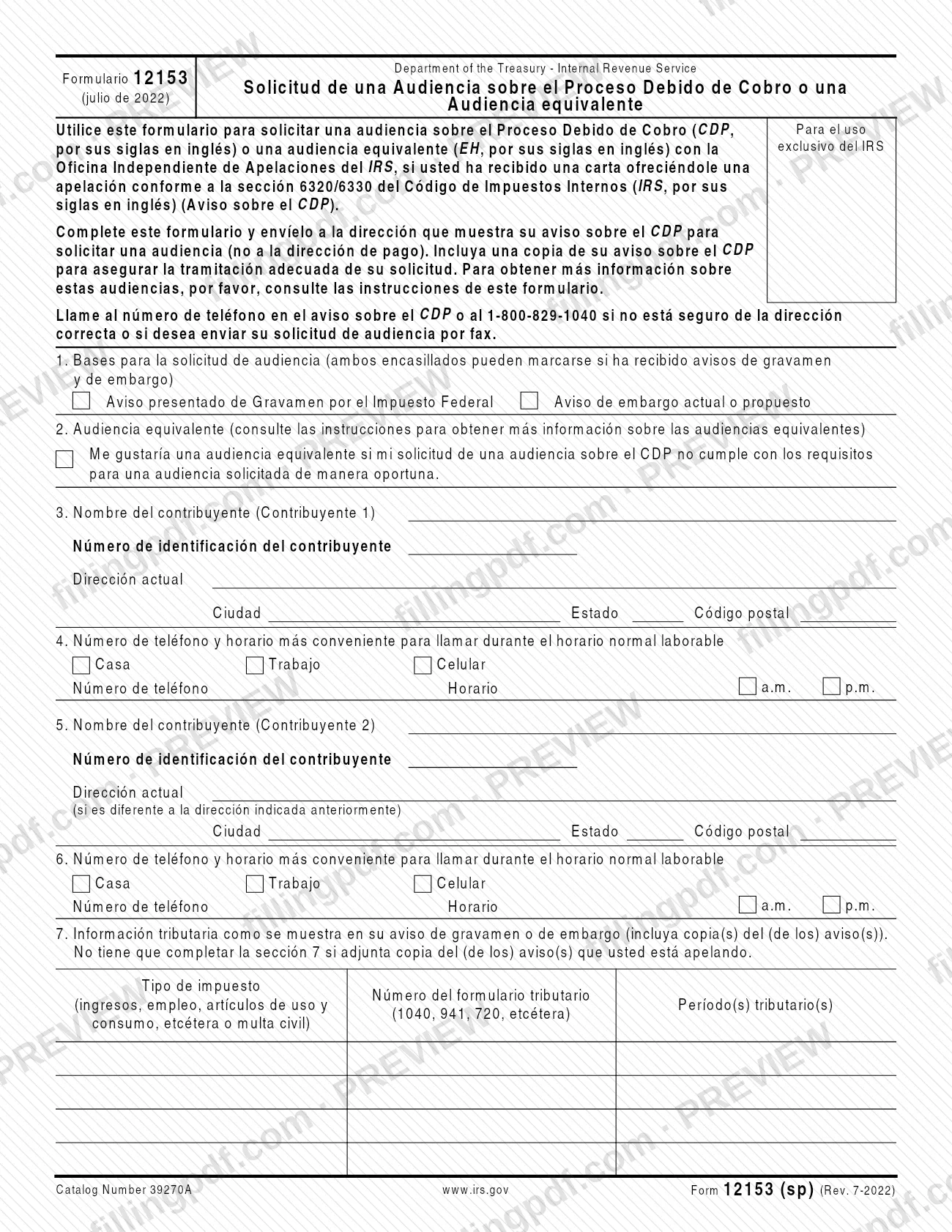
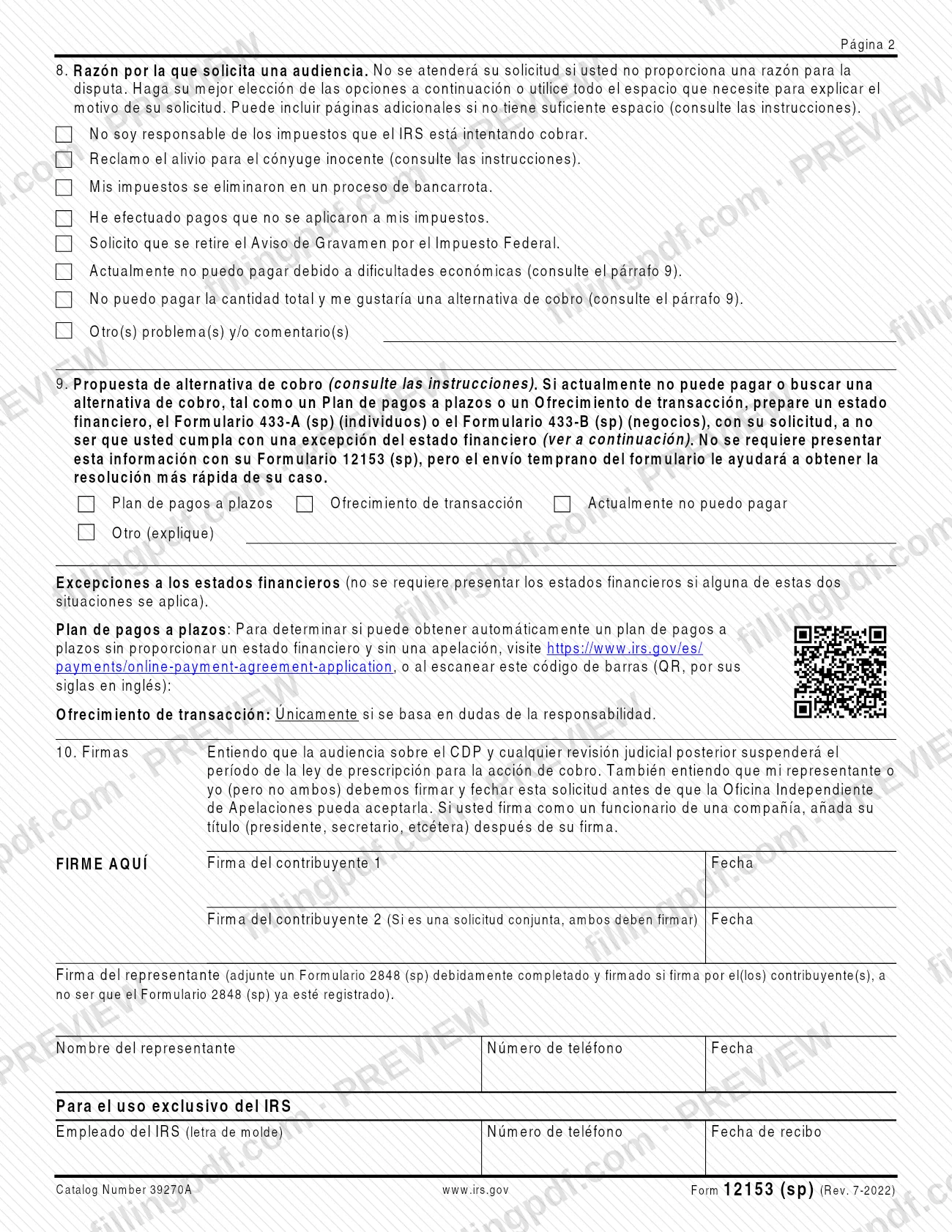
Form 12153 (sp), Request for a Collection Due Process or Equivalent Hearing (Spanish Version), is the Internal Revenue Service (IRS) form you use to ask the IRS Independent Office of Appeals for a hearing after you receive a letter offering an appeal under section 6320/6330 of the Internal Revenue Code (a CDP Notice). It applies to a filed Notice of Federal Tax Lien, a current or proposed levy, or both. On this page you can fill out the form online on FillingPDF and download or print the completed PDF; the original form is published by the IRS, and the request goes to the address shown on your CDP Notice.
Last updated
What is 12153 (sp)?
Form 12153 (sp) is the Spanish-language IRS form for asking the IRS Independent Office of Appeals for a Collection Due Process (CDP) or equivalent (EH) hearing after you receive a CDP Notice offering an appeal under Internal Revenue Code section 6320/6330.
The form is printed in Spanish as Formulario 12153 and carries the revision date July 2022 (Rev. 7-2022). It has ten numbered sections: the basis for the request, the equivalent-hearing box, taxpayer and phone details for one or two taxpayers, the tax information from the lien or levy notice, your reason for the hearing, a proposed collection alternative, and signatures.
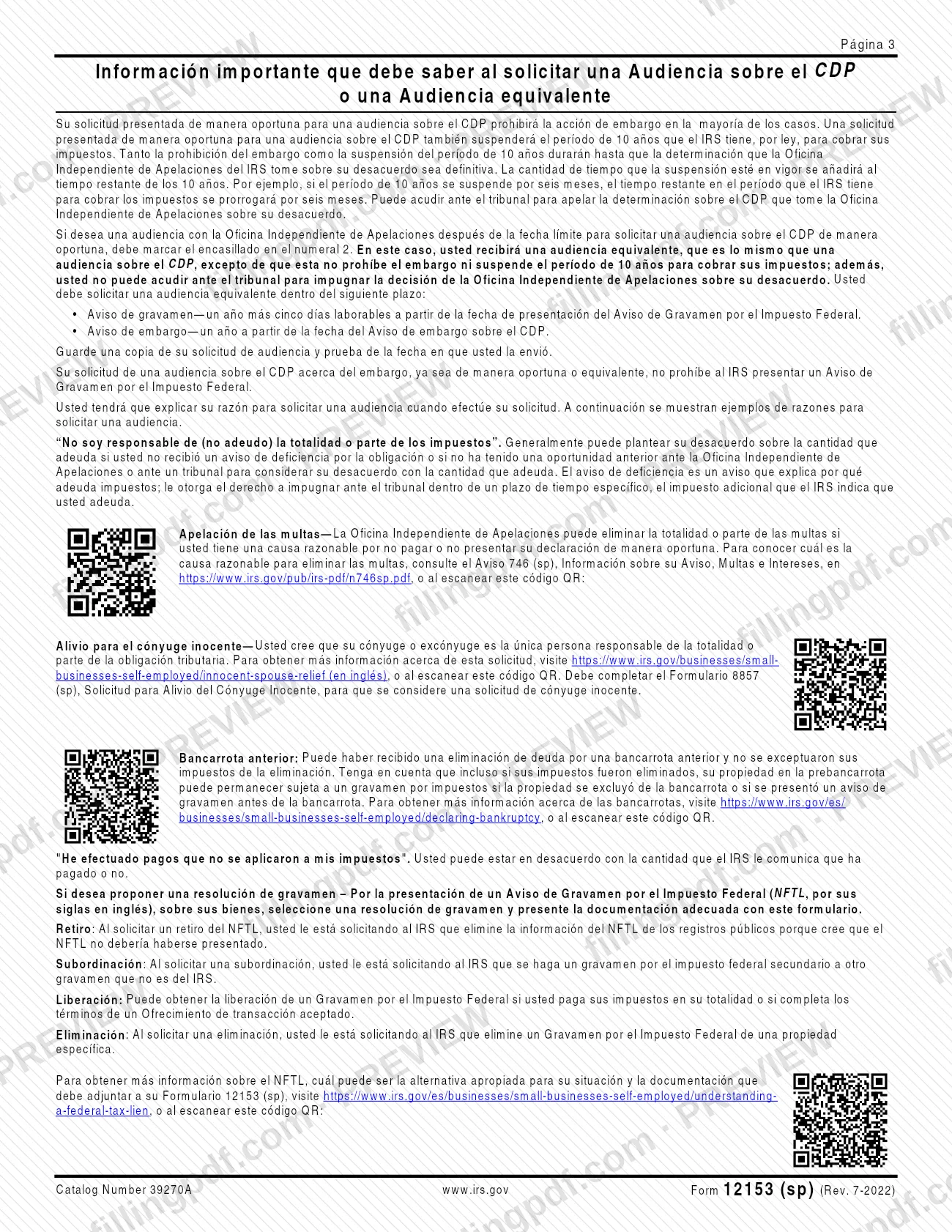
A timely CDP hearing request generally bars levy action and suspends the 10-year period the IRS has by law to collect the tax, until the Appeals determination is final. You can go to court to appeal that determination. An equivalent hearing is the same hearing for people who miss the timely deadline, except that it does not bar levy, does not suspend the 10-year period and gives no right to go to court.
The form does not stop the IRS from filing a Notice of Federal Tax Lien. Related forms the instructions name include Form 433-A (sp) and Form 433-B (sp) for financial statements, Form 2848 (sp) for a representative, and Form 8857 (sp) for innocent spouse relief.
Who needs to file 12153 (sp)?
You use Form 12153 (sp) if you received a CDP Notice offering an appeal under section 6320/6330 and want a hearing with the IRS Independent Office of Appeals. Section 1 lets you mark the filed Notice of Federal Tax Lien, the current or proposed levy notice, or both when you received both.
- Taxpayers who miss the timely deadline: mark the equivalent-hearing box in section 2 if your request does not meet the requirements for a timely CDP hearing.
- Joint requests: two taxpayers can request together; both must sign.
- Businesses: an officer signs and adds a title, such as president or secretary, after the signature.
- Representatives: your representative may sign instead of you, but the form says you and your representative may not both sign. A representative who signs for the taxpayer attaches a completed and signed Form 2848 (sp), unless it is already on file.
The form does not name other eligibility conditions. Contact information on the CDP Notice is the best place for questions about your own case.
When to file 12153 (sp)
File Form 12153 (sp) after you receive a CDP Notice, within the time allowed to request a CDP hearing. The form does not print the timely deadline, so use your CDP Notice for it. A timely request is what bars levy action in most cases and suspends the 10-year collection period.
If you want a hearing after the timely deadline has passed, check the box in section 2 to ask for an equivalent hearing. You must request it within these windows:
- Lien notice: one year plus five business days from the date the Notice of Federal Tax Lien was filed.
- Levy notice: one year from the date of the CDP levy notice.
The form tells you to keep a copy of your request and proof of the date you sent it. Sending the form early with any financial statement also helps the IRS resolve the case faster.
Documents you need
- A copy of your CDP Notice, for proper processing of the request. If you attach the notice(s) you are appealing, you do not have to complete section 7.
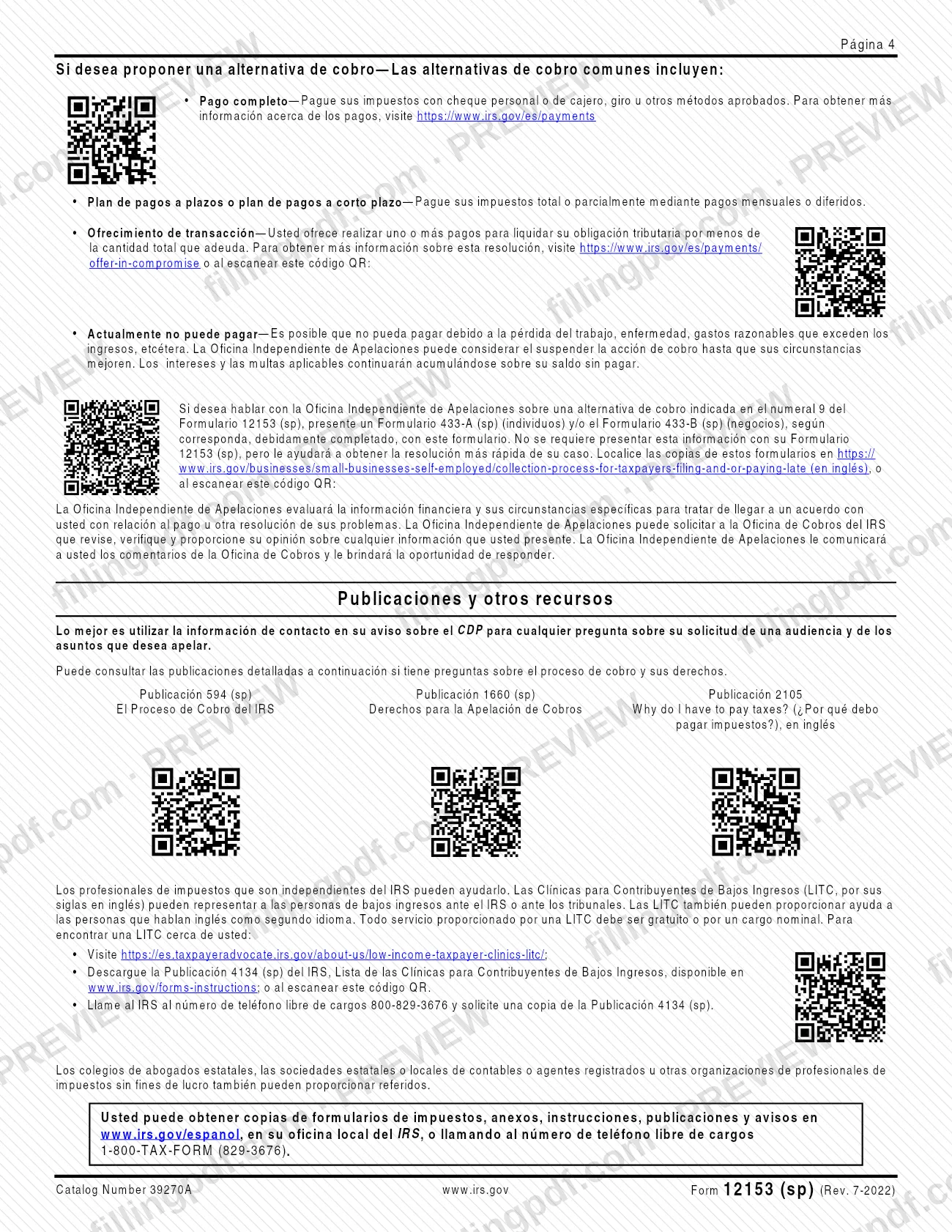
- Form 433-A (sp) (individuals) or Form 433-B (sp) (businesses), if you cannot pay now or want a collection alternative. Not required with the form, but it speeds resolution; exceptions apply (see below).
- No financial statement is needed for an installment agreement you can get automatically without one and without an appeal, or for an offer in compromise based only on doubt as to liability.
- A properly completed and signed Form 2848 (sp), if a representative signs for you, unless it is already on file.
- Form 8857 (sp), Request for Innocent Spouse Relief, if you want an innocent spouse request considered.
- Appropriate documentation for a lien resolution (withdrawal, subordination, discharge or release) if you propose one for a Notice of Federal Tax Lien.
- Additional pages with your explanation, if section 8 does not leave enough room.
How to fill out 12153 (sp)
Mark the basis for your request
In section 1, check Aviso presentado de Gravamen por el Impuesto Federal (filed Notice of Federal Tax Lien), Aviso de embargo actual o propuesto (current or proposed levy notice), or both if you received both.
Decide on an equivalent hearing
In section 2, check the box only if you want an equivalent hearing because your request does not meet the requirements for a timely CDP hearing.
Enter taxpayer 1 details
In section 3, enter the taxpayer's name, taxpayer identification number, current address, city, state and ZIP code. In section 4, give a phone number, mark Home, Work or Cell, and enter the best time to call.
Add taxpayer 2 if joint
In section 5, enter the second taxpayer's name, identification number and address, the address only if different from section 3. In section 6, give that taxpayer's phone number and best time to call.
Enter the tax information
In section 7, enter the type of tax, the tax form number (1040, 941, 720, etc.) and the tax period(s) from your notice. Skip section 7 if you attach copies of the notices you are appealing.
State your reason for the hearing
In section 8, check the options that fit, such as not being responsible for the tax, innocent spouse relief, payments not applied, withdrawal of the lien, or inability to pay. Use Otro(s) problema(s) y/o comentario(s) or extra pages for more detail.
Propose a collection alternative
In section 9, check Plan de pagos a plazos, Ofrecimiento de transacción, Actualmente no puedo pagar or Otro (explique). Prepare Form 433-A (sp) or 433-B (sp) unless an exception applies.
Sign and date the request
In section 10, the taxpayer signs and dates; for a joint request both sign. If a representative signs instead, enter the representative's name, phone and date and attach Form 2848 (sp) unless on file. Corporate officers add their title.
Review, download and assemble
Check every section, then download or print the completed PDF from FillingPDF. Add a copy of your CDP Notice and any attachments, keep a copy, and send the package through the channels under How to submit.
How to submit 12153 (sp)
You send Form 12153 (sp) to the address shown on your CDP Notice, or fax it after calling the IRS.
- By mail: Use the address shown on your CDP Notice, not the payment address. Include a copy of the CDP Notice so the request is processed properly.
- By fax: Call the telephone number on your CDP Notice, or 1-800-829-1040, if you want to fax the request or are unsure of the right address.
Keep a copy of the signed request and proof of the date you sent it. Financial statements (Form 433-A (sp) or Form 433-B (sp)) may go with the request but are not required with it. Questions about your hearing go to the contact information on the CDP Notice. The form prints no fee. FillingPDF lets you fill out and download the PDF; submission follows the channels above.
Common mistakes to avoid
- Mailing the request to the payment address instead of the address shown on the CDP Notice.
- Leaving section 8 without a reason; the form says the request will not be handled without a reason for the dispute.
- Having both the taxpayer and the representative sign; the form says one or the other, not both.
- Signing a joint request with only one taxpayer's signature; both must sign.
- A representative signing without a completed Form 2848 (sp), unless one is already on file.
- Missing the box in section 2 when you ask for a hearing after the timely deadline, so the request is not treated as an equivalent hearing.
- Leaving section 7 blank without attaching a copy of the lien or levy notice you are appealing.
- Sending a request for innocent spouse relief without Form 8857 (sp).
- Assuming the request stops the IRS from filing a Notice of Federal Tax Lien; the form says it does not.
- Not keeping a copy of the request and proof of the date it was sent.
Frequently asked questions
What is Form 12153 (sp)?
Form 12153 (sp) is the Spanish version of the IRS form used to request a Collection Due Process (CDP) or equivalent hearing with the IRS Independent Office of Appeals. You use it after receiving a CDP Notice about a Notice of Federal Tax Lien, a levy, or both.
Where do I send Form 12153 (sp)?
Send it to the address shown on your CDP Notice, not to the payment address, and include a copy of the notice. If you are unsure of the address or want to fax the request, call the number on the notice or 1-800-829-1040.
What is the difference between a CDP hearing and an equivalent hearing?
An equivalent hearing is the same as a CDP hearing except that it does not bar levy, does not suspend the 10-year collection period, and gives no right to go to court. You mark the box in section 2 to ask for it after the timely deadline.
What is the deadline for an equivalent hearing?
For a lien notice, one year plus five business days from the date the Notice of Federal Tax Lien was filed. For a levy notice, one year from the date of the CDP levy notice. The form does not print the timely CDP deadline; check your CDP Notice.
Do I have to attach financial statements to Form 12153 (sp)?
No. Form 433-A (sp) or 433-B (sp) is not required with the form, but sending one helps resolve your case faster if you propose a collection alternative. You need none for an automatic installment agreement or an offer in compromise based only on doubt as to liability.
Who can sign Form 12153 (sp)?
You or your representative may sign, but not both. On a joint request both taxpayers sign. A representative signing for you attaches a completed Form 2848 (sp) unless it is already on file. A company officer adds a title after the signature.
Does requesting a hearing stop the IRS from filing a tax lien?
No. The form says a CDP hearing request about a levy, timely or equivalent, does not prohibit the IRS from filing a Notice of Federal Tax Lien. A timely CDP request does bar levy action in most cases and suspends the 10-year collection period.
Can I fill out Form 12153 (sp) online on FillingPDF?
Yes. You can fill out the fillable PDF online on FillingPDF and download or print it. FillingPDF is an independent service and does not submit the request to the IRS; you send it yourself through the channels on your CDP Notice.
Ready to fill out 12153 (sp)?
Fill out 12153 (sp) now