
Form 12277 is the Internal Revenue Service (IRS) application a taxpayer, or a representative, files to ask the IRS to withdraw a Notice of Federal Tax Lien (NFTL) that was filed on Form 668(Y). You list the taxpayer, identify the lien, mark its current status, check the reason for withdrawal and explain the basis for the request. On this page you can fill out Form 12277 online on FillingPDF and download or print the completed PDF; the IRS publishes the original form and the application is mailed to the IRS as described below.
Last updated
What is 12277?
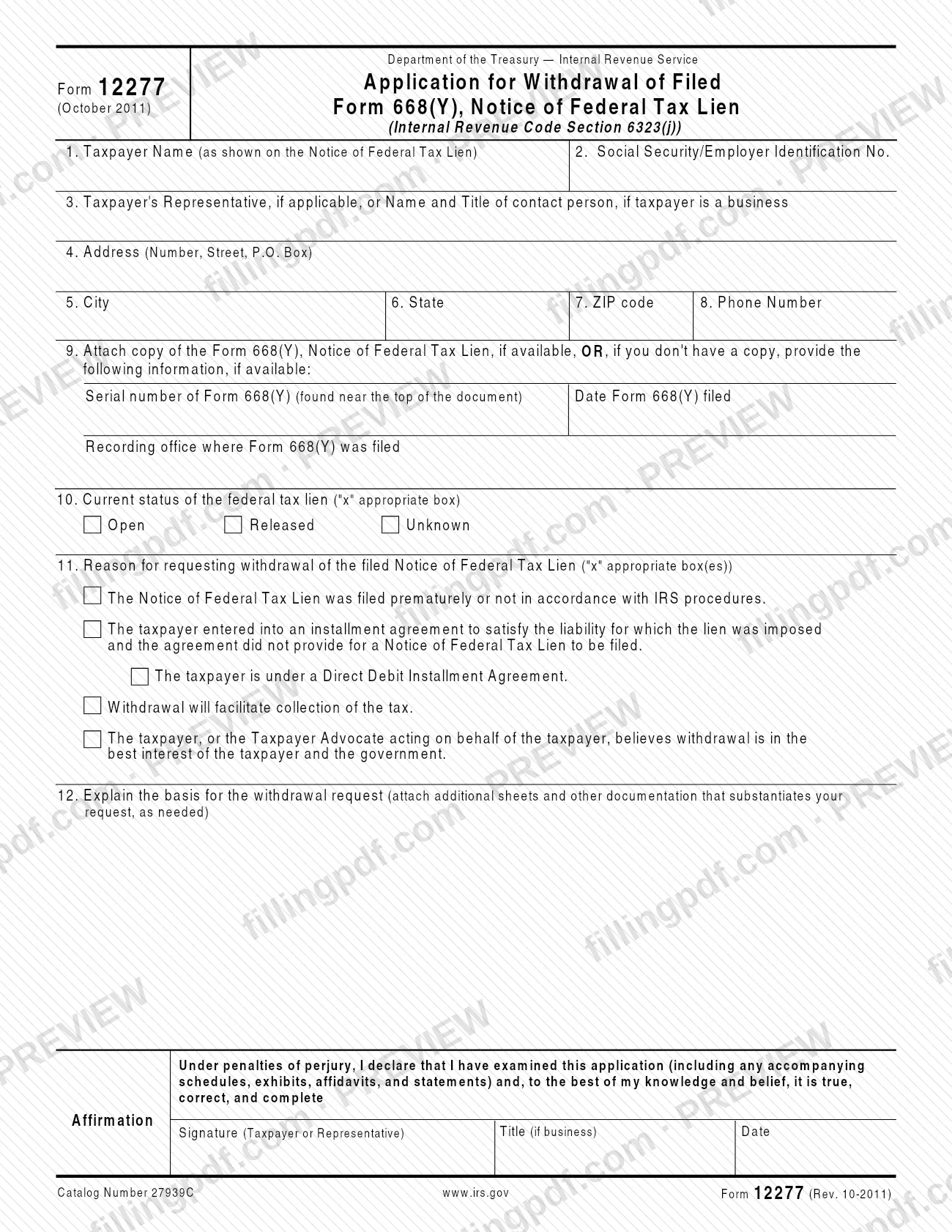
Form 12277, Application for Withdrawal of Filed Form 668(Y), Notice of Federal Tax Lien (Internal Revenue Code Section 6323(j)), is the IRS form used to request the withdrawal of a filed Notice of Federal Tax Lien (NFTL).
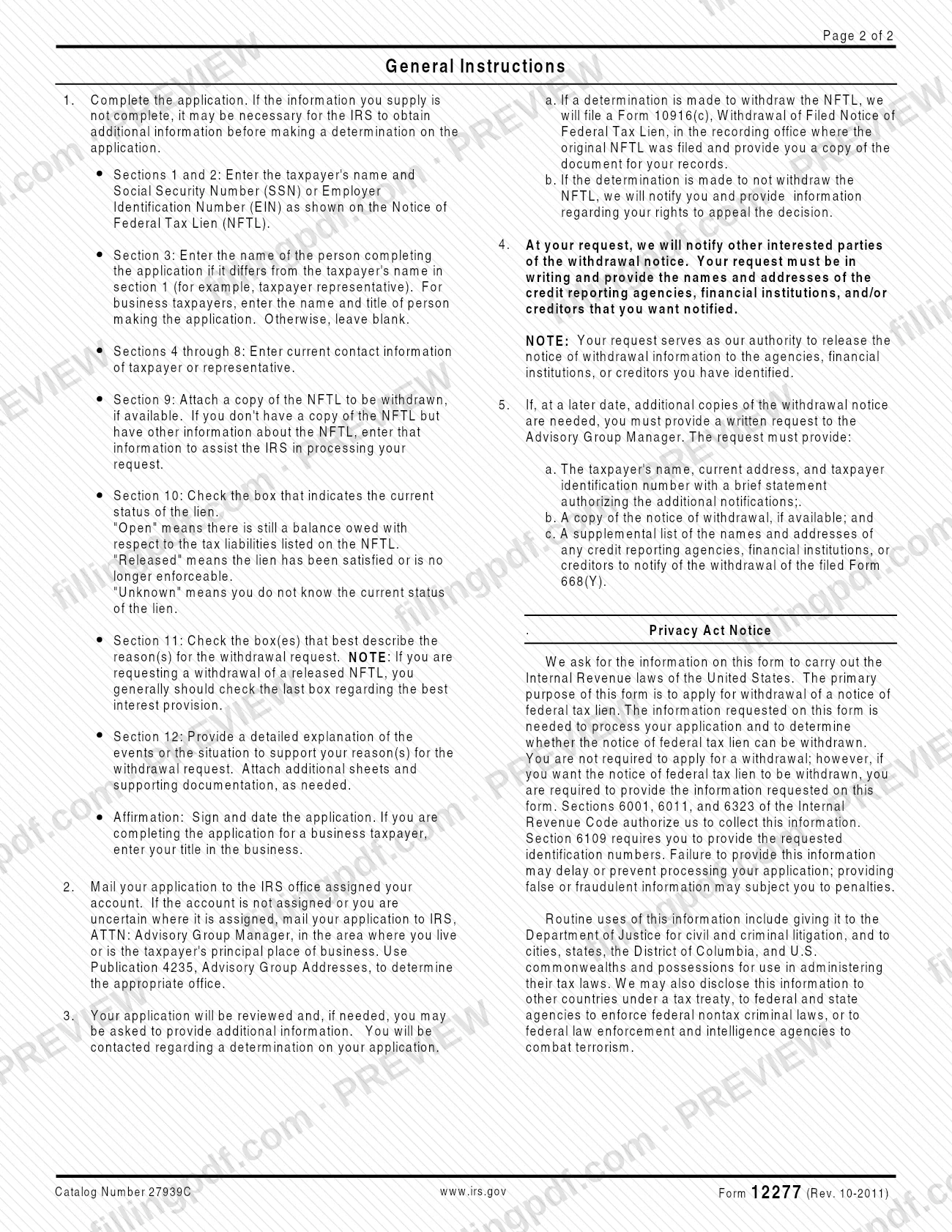
The form is a two-page document. Page 1 collects the taxpayer's name and Social Security Number (SSN) or Employer Identification Number (EIN) as shown on the NFTL, contact details, identifying information about the lien, its current status (open, released or unknown), the reason for the request and a written explanation. It ends with an affirmation signed under penalties of perjury. Page 2 holds the general instructions and the Privacy Act Notice.
The IRS reviews the application and may ask for more information. If it decides to withdraw the NFTL, it files a Form 10916(c), Withdrawal of Filed Notice of Federal Tax Lien, in the recording office where the original NFTL was filed and gives you a copy. If it decides not to withdraw, it notifies you and explains your rights to appeal the decision.
In the IRS's wording, "Open" means a balance is still owed on the liabilities listed on the NFTL, and "Released" means the lien has been satisfied or is no longer enforceable.
Who needs to file 12277?
Form 12277 is for a taxpayer who wants the IRS to withdraw a Notice of Federal Tax Lien that has been filed against them. A taxpayer's representative may complete it, and for a business taxpayer the person making the application enters their name and title in section 3.
The form lists the reasons you can give, and you check each box that applies:
- The NFTL was filed prematurely or not in accordance with IRS procedures.
- The taxpayer entered into an installment agreement to satisfy the liability, and the agreement did not provide for an NFTL to be filed.
- The taxpayer is under a Direct Debit Installment Agreement.
- Withdrawal will facilitate collection of the tax.
- The taxpayer, or the Taxpayer Advocate acting for the taxpayer, believes withdrawal is in the best interest of the taxpayer and the government.
A lien that has already been released can still be the subject of the request: the instructions say that if you request withdrawal of a released NFTL, you generally should check the last box, the best interest reason.
Applying is optional. The Privacy Act Notice says you are not required to apply, but if you want the NFTL withdrawn you must provide the information the form requests.
When to file 12277
You file Form 12277 when you want the IRS to consider withdrawing a Notice of Federal Tax Lien that has already been filed. The form prints no filing deadline, and the Privacy Act Notice says applying is not required.
The lien's status does not bar the request. Section 10 lets you mark the lien as open, released or unknown, and the instructions give guidance for a released NFTL.
After you mail the application, the IRS reviews it, may contact you for additional information and will contact you about its determination. The form gives no processing time.
Documents you need
- A copy of the Form 668(Y), Notice of Federal Tax Lien to be withdrawn, if you have one; if you do not, enter the lien's serial number, filing date and recording office in section 9 instead.
- Additional sheets and other documentation that substantiates your request, as needed, to support the explanation in section 12.
- A written request listing names and addresses of credit reporting agencies, financial institutions or creditors, only if you want the IRS to notify them of the withdrawal.
How to fill out 12277
Enter the taxpayer's name and number
Fields 1 and 2: write the taxpayer name and the SSN or EIN exactly as shown on the Notice of Federal Tax Lien.
Add the representative or contact person
Field 3: enter the taxpayer's representative, or for a business the name and title of the contact person, if it differs from field 1. Otherwise leave it blank.
Enter current contact information
Fields 4 through 8: give the current street address or P.O. box, city, state, ZIP code and phone number of the taxpayer or the representative.
Identify the lien in section 9
Attach a copy of Form 668(Y) if available. If not, enter the serial number found near the top of the document, the date it was filed and the recording office where it was filed.
Mark the current lien status
Section 10: mark Open, Released or Unknown. Open means a balance is still owed; Released means the lien is satisfied or no longer enforceable.
Check the reasons for withdrawal
Section 11: check each box that applies. For a released NFTL, the instructions say to generally check the best interest box.
Explain the basis for the request
Section 12: describe in detail the events or situation supporting your reasons. Attach additional sheets and supporting documents as needed.
Sign and date the affirmation
Sign and date under penalties of perjury as taxpayer or representative. For a business taxpayer, also enter your title in the business.
Review and download the completed PDF
Check that every entry matches the NFTL and that you attached the lien copy and supporting pages. Download or print the PDF from FillingPDF and mail it as described under How to submit.
How to submit 12277
You submit Form 12277 by mail to the IRS. The form names no online or in-person channel.
- Mail to your assigned office: send the application to the IRS office assigned your account.
- If the account is not assigned, or you are unsure: mail it to IRS, ATTN: Advisory Group Manager, in the area where you live or where the taxpayer's principal place of business is located. Use Publication 4235, Advisory Group Addresses, to find the right office.
Attach a copy of Form 668(Y) if you have one, and any additional sheets or documents that support your explanation in section 12.
To have other parties told about a withdrawal, send a written request with their names and addresses: credit reporting agencies, financial institutions or creditors. If you later need more copies of the withdrawal notice, send a written request to the Advisory Group Manager with the taxpayer's name, current address and taxpayer identification number, a brief statement authorizing the notifications, a copy of the notice of withdrawal if available, and a supplemental list of names and addresses.
FillingPDF lets you fill out and download the PDF; submission follows the channels above.
Common mistakes to avoid
- Entering the taxpayer's name or SSN/EIN differently from how they appear on the Notice of Federal Tax Lien; sections 1 and 2 must match the NFTL.
- Leaving out both the copy of Form 668(Y) and the serial number, filing date and recording office, when the form asks for one or the other in section 9.
- Checking only the first reasons when withdrawing a released NFTL; the instructions say you generally should check the last box, the best interest provision.
- Filling in section 3 with the taxpayer's own name when no representative or contact person applies; the instructions say to leave it blank in that case.
- Giving a thin explanation in section 12 instead of a detailed account of the events, with additional sheets and supporting documents attached.
- Omitting the signature and date, or, for a business taxpayer, the title in the business.
- Mailing the application to a general IRS address instead of the assigned office or the Advisory Group Manager listed in Publication 4235.
- Expecting other agencies or creditors to be notified without a written request naming them and giving their addresses.
Frequently asked questions
What is Form 12277 used for?
Form 12277 is the IRS Application for Withdrawal of Filed Form 668(Y), Notice of Federal Tax Lien. You use it to ask the IRS to withdraw a Notice of Federal Tax Lien that has already been filed, giving a reason and an explanation.
Can I fill out Form 12277 online?
You can fill out the PDF online on FillingPDF and download or print it. FillingPDF is an independent service and does not send the application to the IRS; you mail it through the channels the IRS instructions describe.
Where do I mail Form 12277?
Mail it to the IRS office assigned your account. If the account is not assigned or you are unsure, mail it to IRS, ATTN: Advisory Group Manager, in the area where you live or where the taxpayer's business is based, using Publication 4235, Advisory Group Addresses.
Can I use Form 12277 if the lien is already released?
Yes. Section 10 includes a Released option. The instructions say that when you request withdrawal of a released NFTL, you generally should check the last reason box, the best interest provision in section 11.
What happens after the IRS approves a withdrawal?
The IRS files a Form 10916(c), Withdrawal of Filed Notice of Federal Tax Lien, in the recording office where the original NFTL was filed and gives you a copy. If it denies the request, it notifies you and explains your appeal rights.
What if I do not have a copy of Form 668(Y)?
Complete section 9 with what you know: the serial number near the top of the document, the date the Form 668(Y) was filed and the recording office. Provide it if available; incomplete information may lead the IRS to ask for more.
Can the IRS tell credit agencies or lenders about the withdrawal?
Yes, at your request. Send a written request giving the names and addresses of the credit reporting agencies, financial institutions or creditors to notify. The IRS treats your request as its authority to release the withdrawal information to them.
Ready to fill out 12277?
Fill out 12277 now