
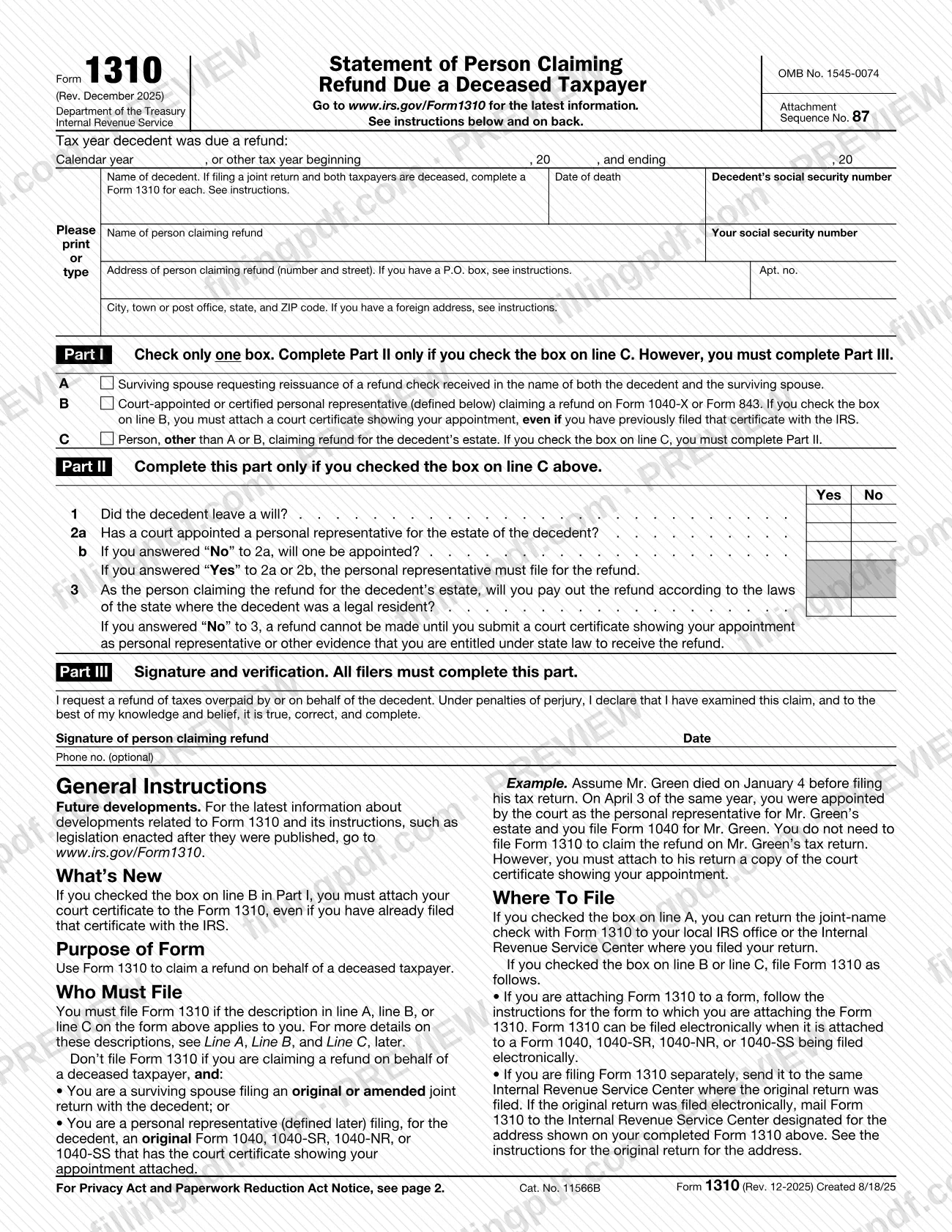
Form 1310 is the Internal Revenue Service (IRS) statement that a person files to claim a refund on behalf of a deceased taxpayer. It is used by a surviving spouse asking for a joint-name refund check to be reissued, by a court-appointed or certified personal representative filing Form 1040-X or Form 843, and by other persons claiming the refund for the decedent's estate. On this page you can fill out Form 1310 online on FillingPDF and download or print the completed PDF; the IRS publishes the original form and its instructions at irs.gov/Form1310.
Last updated
What is Form 1310?
Form 1310, Statement of Person Claiming Refund Due a Deceased Taxpayer, is the Internal Revenue Service (IRS) form used to claim a refund on behalf of a taxpayer who has died, by identifying who you are in relation to the decedent and verifying the claim under penalties of perjury.
The form is issued by the IRS under OMB No. 1545-0074 and has three parts. In Part I you check only one box: line A (surviving spouse asking for reissuance of a refund check received in both names), line B (court-appointed or certified personal representative claiming a refund on Form 1040-X or Form 843) or line C (any other person claiming the refund for the decedent's estate). Part II applies only to line C and asks whether there was a will, whether a personal representative has been or will be appointed, and whether you will pay out the refund under the laws of the decedent's state of legal residence. Part III, the signature and verification, is completed by all filers.
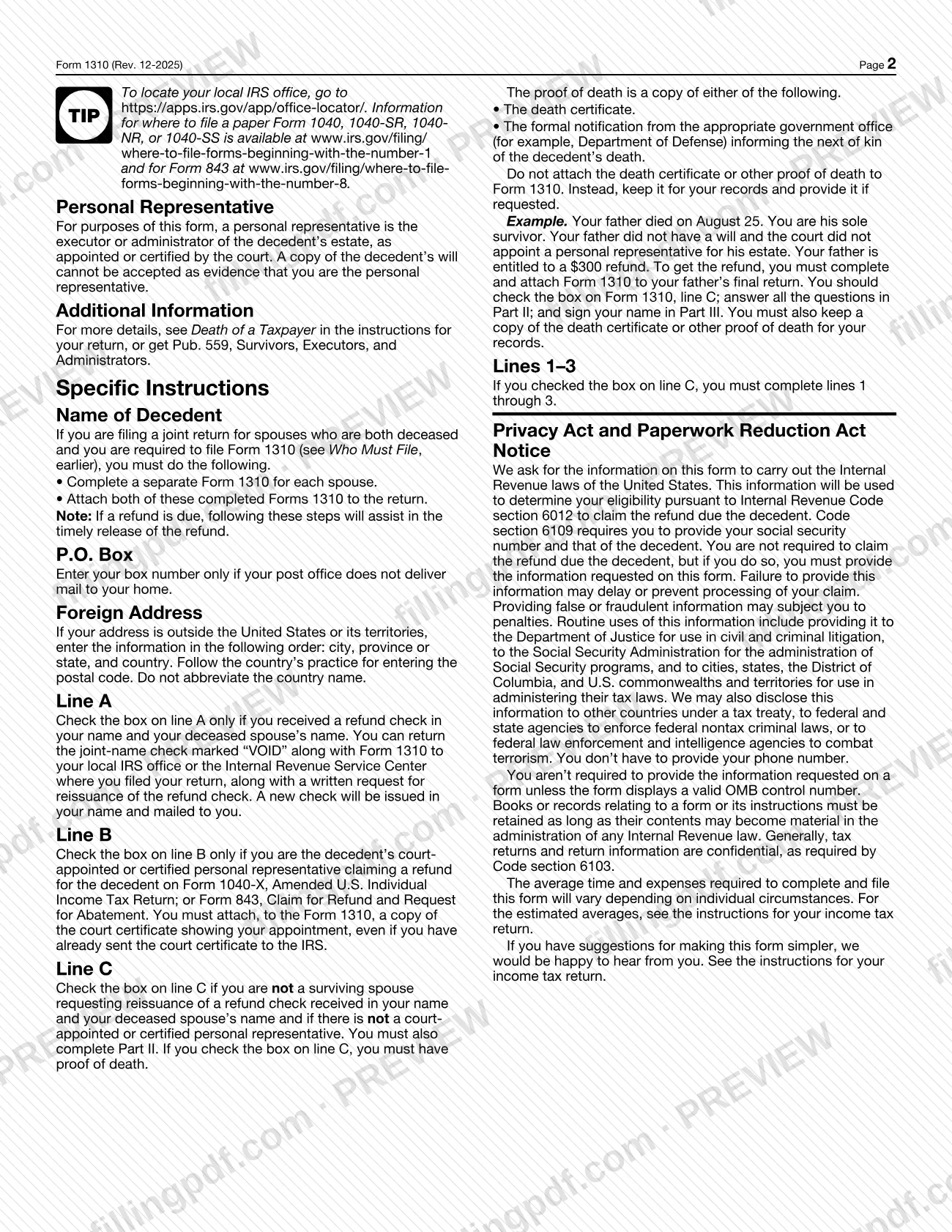
The IRS instructions define a personal representative, for this form, as the executor or administrator of the estate as appointed or certified by the court; a copy of the will is not accepted as evidence. Related IRS resources named on the IRS page for the form include Publication 559, Survivors, Executors, and Administrators, Form 1040-X, Form 843, Form 1040 and Form 1040-NR.
Who needs to file Form 1310?
You must file Form 1310 if the description on line A, line B or line C of Part I applies to you:
- Line A: you are a surviving spouse and received a refund check in your name and your deceased spouse's name, and you want it reissued in your name.
- Line B: you are the court-appointed or certified personal representative and are claiming the refund on Form 1040-X or Form 843.
- Line C: you are neither of the above and there is no court-appointed or certified personal representative, but you are claiming the refund for the decedent's estate. You must also complete Part II and have proof of death.
Do not file Form 1310 if you are a surviving spouse filing an original or amended joint return with the decedent. Do not file it either if you are a personal representative filing, for the decedent, an original Form 1040, 1040-SR, 1040-NR or 1040-SS with the court certificate showing your appointment attached to the return.
If a joint return is filed for spouses who are both deceased and you are required to file Form 1310, complete a separate Form 1310 for each spouse and attach both to the return.
When to file Form 1310
File Form 1310 when you are claiming the refund and one of the three Part I descriptions applies to you. The form prints no separate due date: its timing follows the document it travels with.
If you are a surviving spouse on line A, you return the joint-name check marked "VOID" with Form 1310 once you have received that check. If you check line B or line C, you attach Form 1310 to the return or claim form you are filing, such as Form 1040-X, Form 843 or the decedent's final return, so it is submitted when that form is submitted. You may also file Form 1310 separately, as described under How to submit. For any deadline that applies to the return or claim itself, follow the instructions for that form.
Documents you need
- A copy of the court certificate showing your appointment as personal representative: required with Form 1310 if you check line B, even if you already filed that certificate with the IRS.
- Form 1040-X or Form 843: the claim you are filing as personal representative on line B; Form 1310 is attached to it following that form's instructions.
- The joint-name refund check marked "VOID", with a written request for reissuance: returned with Form 1310 if you check line A.
- Proof of death, either the death certificate or formal notification from a government office (for example, Department of Defense) to the next of kin: you must have it if you check line C, but keep it and do not attach it to Form 1310.
- A court certificate of your appointment as personal representative or other evidence that you are entitled under state law to receive the refund: needed before a refund can be made if you answer "No" to line 3 of Part II.
How to fill out Form 1310
Enter the tax year of the refund
At the top, enter the tax year the decedent was due a refund: check the calendar year, or enter the beginning and ending dates of another tax year.
Enter the decedent's information
Enter the name of the decedent, the date of death and the decedent's social security number. If both spouses on a joint return are deceased, complete a separate Form 1310 for each.
Enter your own information
Enter your name, your social security number and your address. Enter a P.O. box only if your post office does not deliver mail to your home.
Enter a foreign address correctly
If your address is outside the United States or its territories, enter city, province or state, and country, in that order. Follow the country's practice for the postal code and do not abbreviate the country name.
Check one box in Part I
Check only one: line A for a surviving spouse requesting reissuance of a joint-name refund check, line B for a court-appointed or certified personal representative claiming a refund on Form 1040-X or Form 843, or line C for any other person claiming the refund for the estate.
Answer Part II if you checked line C
Answer Yes or No to line 1 (will), line 2a (court-appointed personal representative), line 2b (will one be appointed, if 2a is No) and line 3 (will you pay out the refund under the laws of the decedent's state of legal residence). Skip Part II if you checked line A or B.
Check the effect of your Part II answers
If you answered Yes to line 2a or 2b, the personal representative must file for the refund. If you answered No to line 3, no refund is made until you submit a court certificate of appointment or other evidence that state law entitles you to it.
Sign and date Part III
Sign and date the verification, which states under penalties of perjury that you examined the claim and that it is true, correct and complete. The phone number is optional.
Gather the attachments you need
For line B, attach the court certificate. For line A, prepare the VOID check and a written request for reissuance. For line C, keep proof of death for your records rather than attaching it.
Review and download the completed PDF
Check names, social security numbers, the single Part I box and the signature, then download or print the completed PDF from FillingPDF and submit it through the channels described under How to submit.
How to submit Form 1310
Form 1310 is submitted attached to another form, mailed on its own, or, for line A, returned with the check to an IRS office.
- Line A: return the joint-name check marked "VOID" with Form 1310 and a written request for reissuance to your local IRS office or the Internal Revenue Service Center where you filed your return. A new check is issued in your name and mailed to you. Find your local office at https://apps.irs.gov/app/office-locator/.
- Lines B and C, attached: follow the instructions for the form you are attaching it to. Form 1310 can be filed electronically when it is attached to a Form 1040, 1040-SR, 1040-NR or 1040-SS that is filed electronically.
- Lines B and C, separately: send it to the same Internal Revenue Service Center where the original return was filed. If the original return was filed electronically, mail Form 1310 to the Service Center designated for the address shown on your completed Form 1310. The IRS lists paper-filing addresses at www.irs.gov/filing/where-to-file-forms-beginning-with-the-number-1 and, for Form 843, at www.irs.gov/filing/where-to-file-forms-beginning-with-the-number-8.
Line B filers must attach the court certificate. Do not attach the death certificate or other proof of death; keep it and provide it if requested. FillingPDF lets you fill out and download the PDF; submission follows the channels above.
Common mistakes to avoid
- Checking more than one box in Part I; the form says to check only one.
- Filing Form 1310 as a surviving spouse who is also filing an original or amended joint return with the decedent; the instructions say not to file it in that case.
- Filing Form 1310 when you are a personal representative filing an original Form 1040, 1040-SR, 1040-NR or 1040-SS with the court certificate already attached to the return.
- Checking line B without attaching the court certificate, or leaving it off because you already filed it with the IRS; the certificate must be attached either way.
- Submitting a copy of the decedent's will as proof that you are the personal representative; the IRS does not accept it as evidence.
- Checking line C and skipping Part II; lines 1 through 3 must be completed if you check line C.
- Attaching the death certificate or other proof of death to Form 1310 instead of keeping it for your records.
- Filing one Form 1310 for a joint return when both spouses are deceased; a separate form is needed for each, and both are attached to the return.
- Leaving Part III unsigned; all filers must complete it, and the claim is made under penalties of perjury.
Frequently asked questions
What is Form 1310 used for?
Form 1310 is used to claim a refund on behalf of a deceased taxpayer. It identifies whether you are a surviving spouse requesting a reissued joint-name check, a court-appointed or certified personal representative, or another person claiming the refund for the decedent's estate.
Who has to file Form 1310?
You must file it if the description on line A, B or C of Part I applies to you. You do not file it if you are a surviving spouse filing a joint return with the decedent, or a personal representative filing an original Form 1040, 1040-SR, 1040-NR or 1040-SS with the court certificate attached.
Can I fill out Form 1310 online?
You can fill out the Form 1310 PDF online on FillingPDF and download or print it. FillingPDF is an independent service and does not file the form with the IRS; you submit it through the IRS channels, such as attached to a return or by mail.
Where do I send Form 1310?
If attached to another form, follow that form's instructions. If filed separately, send it to the Internal Revenue Service Center where the original return was filed. A line A filer returns the VOID check with the form to a local IRS office or that Service Center.
Do I attach the death certificate to Form 1310?
No. The instructions say not to attach the death certificate or other proof of death. Keep it for your records and provide it if the IRS requests it. Line C filers must have proof of death; line B filers attach a court certificate instead.
What do I attach to Form 1310 as a personal representative?
If you check line B, attach a copy of the court certificate showing your appointment, even if you already filed it with the IRS. A copy of the decedent's will cannot be accepted as evidence that you are the personal representative.
Can Form 1310 be filed electronically?
Yes, in one case. The IRS says Form 1310 can be filed electronically when it is attached to a Form 1040, 1040-SR, 1040-NR or 1040-SS that is being filed electronically. For other forms, follow the instructions for the form you are attaching it to.
What if both spouses on a joint return have died?
Complete a separate Form 1310 for each spouse and attach both completed forms to the return. The IRS notes that following these steps helps the refund be released in a timely way.
Ready to fill out Form 1310?
Fill out Form 1310 now