
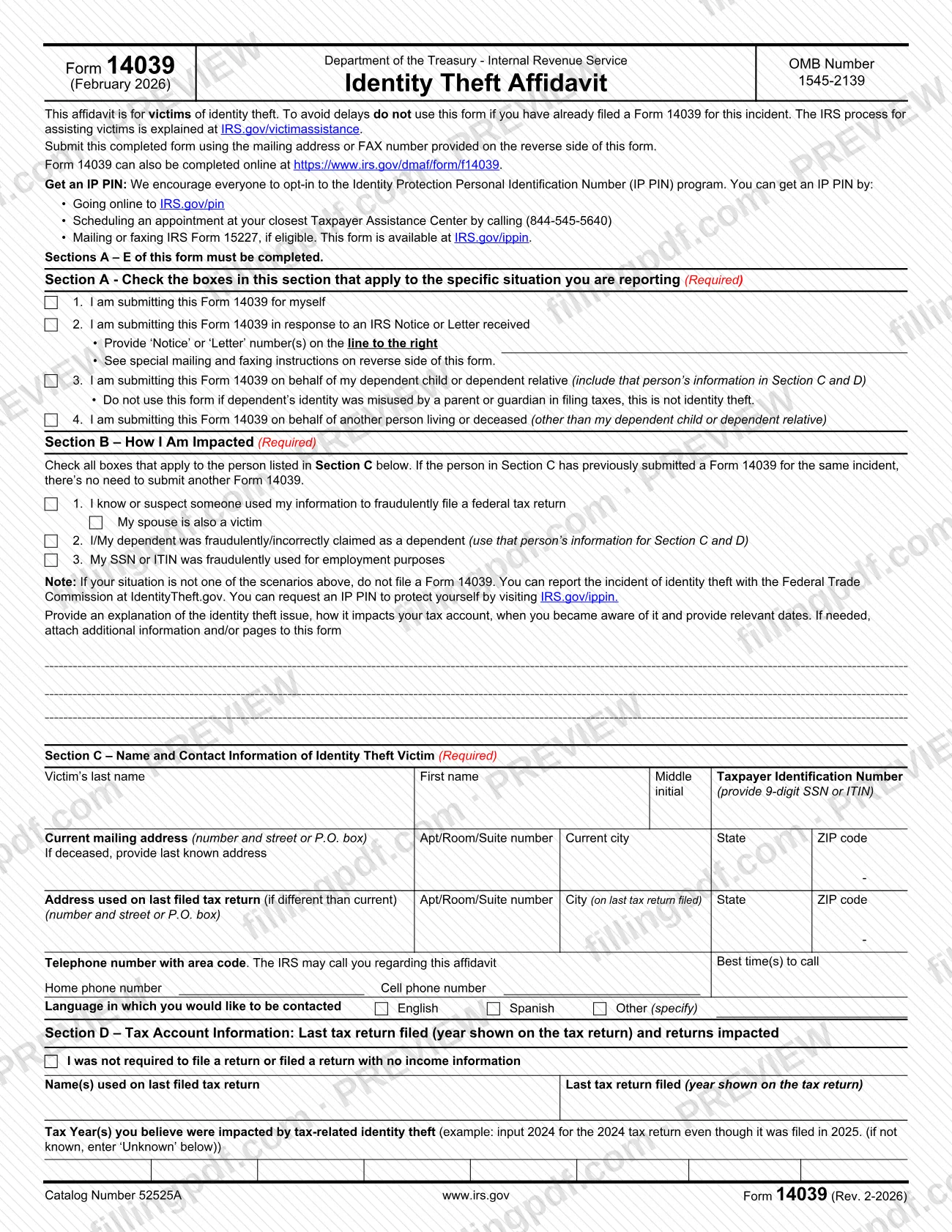
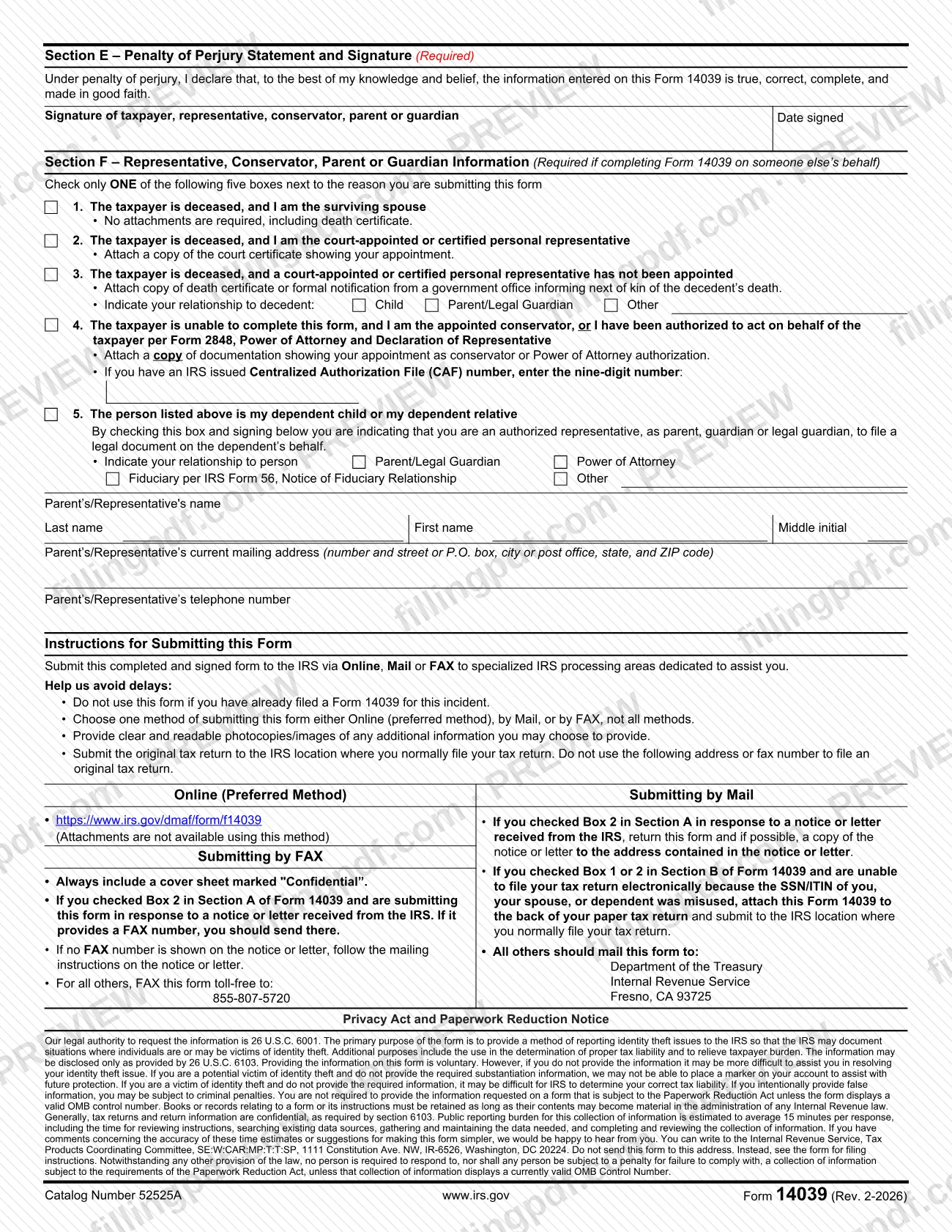
Form 14039, Identity Theft Affidavit, is the Internal Revenue Service (IRS) form that victims of tax-related identity theft use to report the problem and ask the IRS to document it on their account. You can file it for yourself, in response to an IRS notice or letter, or on behalf of a dependent or another person. On FillingPDF you can fill out form 14039 online and download or print the completed PDF; the IRS publishes the original at irs.gov and receives the form only through the channels listed under How to submit.
Last updated
What is 14039?
Form 14039, Identity Theft Affidavit, is the Internal Revenue Service (IRS) form for victims of identity theft to report that someone used their information in a way that affects their federal tax account, under a signed penalty of perjury statement.
The IRS explains its process for assisting victims at IRS.gov/victimassistance. According to the form's Privacy Act notice, its primary purpose is to give taxpayers a way to report identity theft so the IRS can document situations where individuals are or may be victims. The information also helps determine the proper tax liability. If you do not give the required substantiation, the IRS says it may not be able to place a marker on your account to help protect you in the future.
The form has six lettered sections. Section A says who is submitting it and why, Section B how you are affected, Section C the victim's name and contact information, Section D the tax account information, Section E the signature, and Section F the representative's details when someone else completes it. Sections A to E must be completed.
The form is not an application for an Identity Protection Personal Identification Number (IP PIN). The form encourages everyone to opt in to that program at IRS.gov/pin, and mentions Form 15227 for those who are eligible. It is also not a report to other agencies: the form points to the Federal Trade Commission at IdentityTheft.gov for situations it does not cover.
Who needs to file 14039?
You file Form 14039 if you are a victim of identity theft and your situation matches at least one box in Section B of the form:
- you know or suspect someone used your information to fraudulently file a federal tax return (you can also check that your spouse is a victim);
- you or your dependent was fraudulently or incorrectly claimed as a dependent;
- your SSN or ITIN was fraudulently used for employment purposes.
You can also file for someone else, as Section A and Section F describe:
- a dependent child or dependent relative, as parent, guardian or legal guardian;
- a deceased person, as the surviving spouse, as a court-appointed or certified personal representative, or, when none has been appointed, as a next of kin who attaches proof of death;
- a taxpayer who cannot complete the form, as appointed conservator or as someone authorized under Form 2848, Power of Attorney and Declaration of Representative.
Do not use the form in these cases:
- you already filed a Form 14039 for the same incident;
- your situation is not one of the three in Section B (report it to the Federal Trade Commission at IdentityTheft.gov instead);
- a dependent's identity was misused by a parent or guardian in filing taxes, which the form says is not identity theft.
When to file 14039
File Form 14039 when you learn, or suspect, that someone used your tax identity in one of the three ways listed in Section B, or when an IRS notice or letter prompts you to respond. The form prints no filing deadline. In Section B you explain when you became aware of the problem, with relevant dates.
If you received an IRS notice or letter about the problem, check Box 2 in Section A and enter the notice or letter number. Return the form according to the instructions in that notice or letter.
Send only one Form 14039 per incident. The IRS asks you not to file again if you or the person in Section C already submitted a Form 14039 for the same incident, because a duplicate can cause delays. The form does not state a processing time.
Documents you need
- A copy of the IRS notice or letter, if possible, when you check Box 2 in Section A and return the form by mail in response to it.
- A copy of the court certificate showing your appointment, when you check Section F, Box 2 as the court-appointed or certified personal representative of a deceased taxpayer.
- A copy of the death certificate or formal notification from a government office informing next of kin of the death, when you check Section F, Box 3 because no personal representative has been appointed.
- Documentation of your appointment as conservator, or the Power of Attorney authorization (Form 2848), when you check Section F, Box 4 for a taxpayer unable to complete the form.
- Your paper tax return, with Form 14039 attached to the back, when you checked Box 1 or 2 in Section B and cannot file electronically because an SSN or ITIN was misused.
- Additional pages with your explanation of the identity theft, if the space in Section B is not enough. Submitting online does not allow attachments.
How to fill out 14039
Check who is submitting in Section A
Section A is required. Check Box 1 if you file for yourself, Box 2 if you respond to an IRS notice or letter (enter the notice or letter number), Box 3 for your dependent child or dependent relative, or Box 4 for another person, living or deceased.
Mark how you are impacted in Section B
Check every box that applies to the person in Section C: a fraudulent federal tax return, a fraudulent or incorrect dependent claim, or SSN/ITIN misuse for employment. Check My spouse is also a victim if it applies.
Explain the identity theft issue
In the space under Section B, describe the issue, how it affects your tax account, when you became aware of it and the relevant dates. Attach additional pages if you need them.
Enter the victim's information in Section C
Enter the victim's last name, first name, middle initial and 9-digit SSN or ITIN, then the current mailing address. If the person is deceased, give the last known address, and add the address from the last filed return if it is different.
Add phone numbers and language
Enter home and cell numbers with area code, the best time to call, and the language for contact: English, Spanish or Other (specify). The IRS may call you about this affidavit.
Complete the tax account details in Section D
Check the box if you were not required to file or filed a return with no income information. Otherwise enter the name(s) on your last filed return and its year, then the tax year(s) impacted, or Unknown if not known.
Sign the penalty of perjury statement
In Section E, the taxpayer, representative, conservator, parent or guardian signs and enters the date signed. The statement says the information is true, correct, complete and made in good faith.
Complete Section F for someone else
If you complete the form for another person, check only ONE of the five boxes: surviving spouse, personal representative, no representative appointed, conservator or Form 2848 authorization, or dependent. Then enter the representative's name, mailing address and telephone number, and the relationship or CAF number where the box asks for it.
Review, download and prepare to submit
Check every section against your records, then download or print the completed PDF from FillingPDF. Gather any attachments and submit through one channel described under How to submit.
How to submit 14039
You can submit Form 14039 online, by mail or by fax. The form tells you to choose one method only, not all of them.
- Online (preferred method): complete and submit the form at https://www.irs.gov/dmaf/form/f14039. Attachments are not available with this method.
- By mail: if you checked Box 2 in Section A in response to an IRS notice or letter, return the form, and a copy of the notice or letter if possible, to the address in that notice or letter. If you checked Box 1 or 2 in Section B and cannot e-file because an SSN or ITIN was misused, attach the form to the back of your paper tax return and send it to the IRS location where you normally file. All others mail it to: Department of the Treasury, Internal Revenue Service, Fresno, CA 93725.
- By fax: always include a cover sheet marked "Confidential". If you are answering a notice or letter and it gives a fax number, use that number. If it shows none, follow its mailing instructions. All others fax the form toll-free to 855-807-5720.
Do not use these addresses or this fax number to file an original tax return. Send copies that are clear and readable. FillingPDF lets you fill out and download the PDF; submission follows the channels above.
Common mistakes to avoid
- Filing Form 14039 again for an incident you already reported; the form says this causes delays.
- Using more than one submission method. The form says to choose one: online, mail or fax, not all.
- Using the form when your situation matches none of the Section B boxes; the form directs those cases to the Federal Trade Commission at IdentityTheft.gov.
- Filing for a dependent whose identity was misused by a parent or guardian in filing taxes. The form says this is not identity theft.
- Sending a fax without a cover sheet marked "Confidential".
- Faxing or mailing an original tax return to the Form 14039 address or fax number; the form says to file the original return where you normally file it.
- Entering the filing year instead of the tax year in Section D; the example is 2024 for the 2024 return, even though it was filed in 2025.
- Leaving Section F incomplete or checking more than one box when filing for someone else. The form allows only ONE of the five boxes.
- Leaving out the required attachment for the Section F box you checked, such as the court certificate or death certificate.
- Sending the form unsigned. Section E requires a signature and date under the penalty of perjury statement.
Frequently asked questions
What is Form 14039 used for?
Form 14039, Identity Theft Affidavit, is the IRS form for reporting that someone used your information in a way that affects your federal tax account. It covers a fraudulent return, a fraudulent dependent claim, or SSN/ITIN misuse for employment, and it is signed under penalty of perjury.
Can I fill out Form 14039 online?
Yes, two ways. The IRS provides an online version at https://www.irs.gov/dmaf/form/f14039, which it calls the preferred method. You can also fill out the PDF on FillingPDF and download it, but FillingPDF does not file it with the IRS; you then send it by mail or fax.
Where do I mail or fax Form 14039?
If you are responding to an IRS notice or letter, use the address or fax number in it. Otherwise mail to Department of the Treasury, Internal Revenue Service, Fresno, CA 93725, or fax toll-free to 855-807-5720 with a cover sheet marked "Confidential". Pick only one method.
Can I file Form 14039 for my child or a deceased relative?
Yes. Check Box 3 in Section A for a dependent child or relative, or Box 4 for another person, living or deceased. Then complete Section F. The form does not accept it if a parent or guardian misused a dependent's identity in filing taxes.
What do I attach if the taxpayer has died?
It depends on the Section F box. A surviving spouse attaches nothing, not even a death certificate. A court-appointed or certified personal representative attaches the court certificate. If none has been appointed, attach a death certificate or formal government notification of death.
Do I need to file Form 14039 if I already filed one?
No. The form says not to file again for the same incident, because that causes delays. If the person in Section C already submitted a Form 14039 for the same incident, there is no need for another one.
What if my situation is not one of the Section B boxes?
Do not file Form 14039. The form says to report the identity theft to the Federal Trade Commission at IdentityTheft.gov, and to request an IP PIN at IRS.gov/ippin to protect yourself.
What tax year do I enter in Section D?
Enter the year shown on the affected tax return, not the year you filed it. The form's example is 2024 for the 2024 return even though it was filed in 2025. If you do not know which years were impacted, enter "Unknown".
Ready to fill out 14039?
Fill out 14039 now