
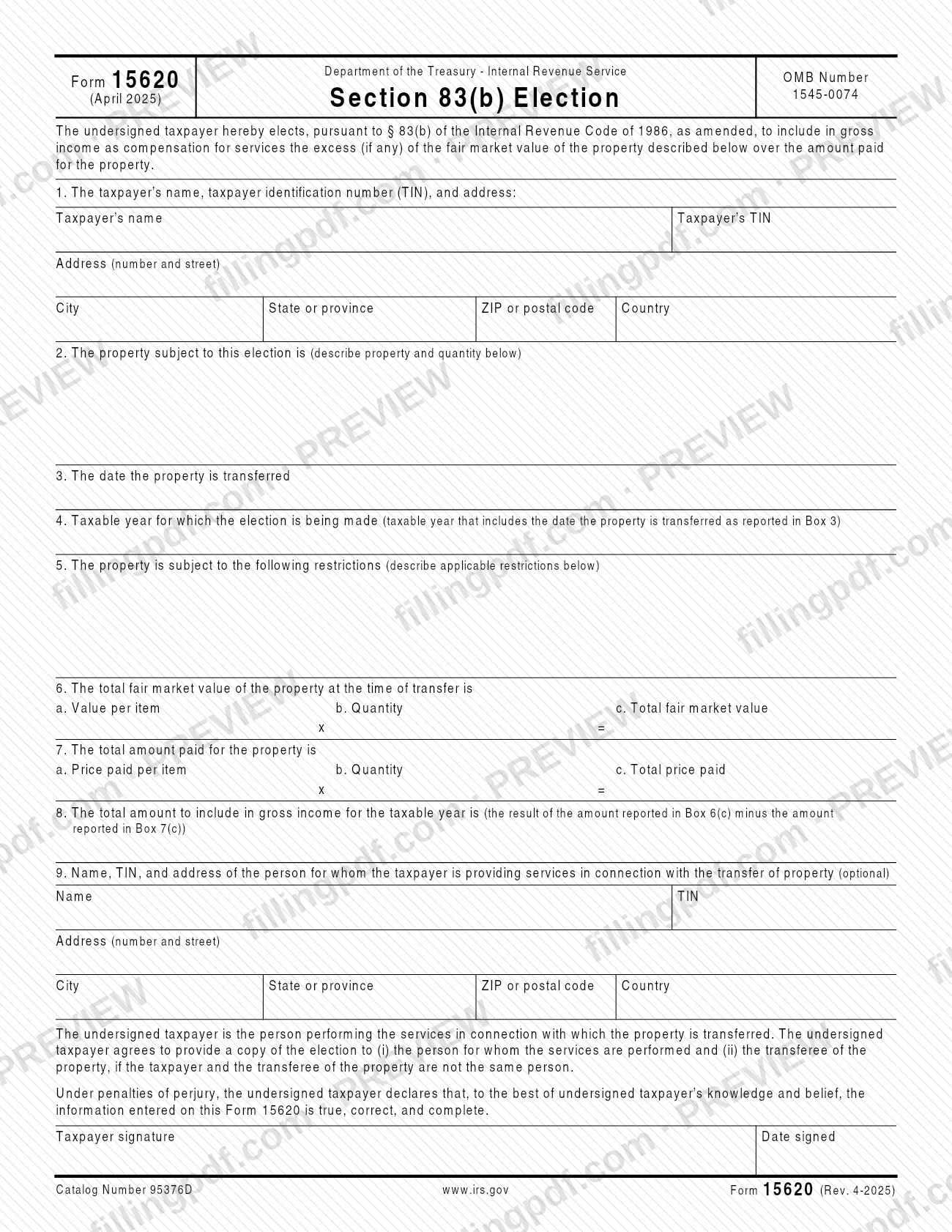
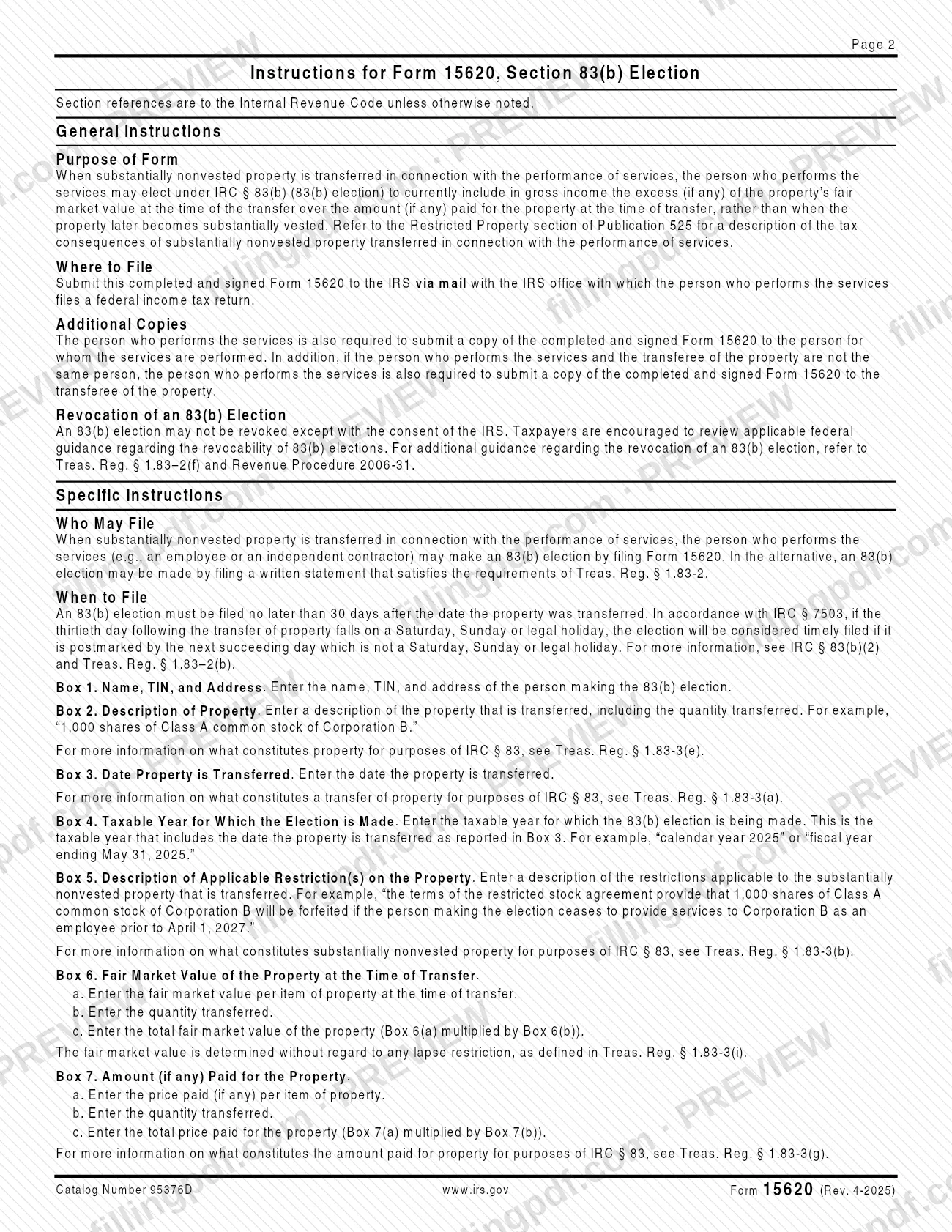

Form 15620, Section 83(b) Election, is the Internal Revenue Service (IRS) form for making an election under § 83(b) of the Internal Revenue Code when property is transferred to you for services. It is used by the person who performs the services, such as an employee or an independent contractor, who wants to be taxed on the property at transfer instead of when it later vests. On this page you can fill out the form online on FillingPDF and download or print the completed PDF; the original form and its instructions are published by the IRS.
Last updated
What is Form 15620?
Form 15620, Section 83(b) Election, is the IRS form for making an election under § 83(b) of the Internal Revenue Code. It lets the person who performs services include the property's value, minus any amount paid, in gross income at transfer.
The election applies when substantially nonvested property is transferred in connection with the performance of services. Without it, the income is taxed later, when the property becomes substantially vested. With it, the person who performs the services currently includes in gross income the excess (if any) of the property's fair market value at the time of transfer over the amount (if any) paid for it. The IRS instructions point to the Restricted Property section of Publication 525 for the tax consequences.
The form has nine numbered boxes: the taxpayer's name, TIN and address; the property; the transfer date; the taxable year; the restrictions; the fair market value; the amount paid; the amount to include in gross income; and, optionally, the service recipient. The taxpayer then signs under penalties of perjury.
Using Form 15620 is voluntary, and you are not required to make a section 83(b) election. The instructions also allow the election to be made with a written statement that satisfies Treas. Reg. § 1.83-2. The form is not a way to cancel an election: an 83(b) election may not be revoked except with the consent of the IRS.
Who needs to file Form 15620?
The person who performs the services may use Form 15620 when substantially nonvested property is transferred in connection with those services. The IRS instructions give an employee and an independent contractor as examples.
- Employees and independent contractors who receive substantially nonvested property for their services and choose to be taxed at transfer.
- Taxpayers who are not the transferee. If the person who performs the services and the transferee of the property are different people, the person performing the services still makes the election and must give a copy to the transferee.
You are not required to make an 83(b) election at all, and use of this form is voluntary. If you prefer, the instructions allow a written statement that meets the requirements of Treas. Reg. § 1.83-2 in place of the form.
The form is for making the election. It does not revoke one, and the instructions refer to Treas. Reg. § 1.83-2(f) and Revenue Procedure 2006-31 for the revocation rules.
When to file Form 15620
An 83(b) election must be filed no later than 30 days after the date the property was transferred. That date is the one you enter in Box 3.
If the thirtieth day falls on a Saturday, Sunday or legal holiday, the election is considered timely filed if it is postmarked by the next day that is not a Saturday, Sunday or legal holiday, under IRC § 7503. The instructions refer to IRC § 83(b)(2) and Treas. Reg. § 1.83-2(b) for more detail.
The form prints no later deadline and no extension. Count the 30 days from the transfer date, not from the date the property vests or the date you sign.
Documents you need
- A copy of the completed and signed Form 15620 for the person for whom the services are performed; the person who performs the services must provide it.
- A copy of the completed and signed Form 15620 for the transferee of the property, only if the person who performs the services and the transferee are not the same person.
How to fill out Form 15620
Enter taxpayer name, TIN and address
Box 1: enter the name, taxpayer identification number (TIN) and address of the person making the 83(b) election, including city, state or province, ZIP or postal code and country.
Describe the property
Box 2: describe the property transferred and the quantity, for example "1,000 shares of Class A common stock of Corporation B."
Enter the transfer date
Box 3: enter the date the property is transferred. The 30-day filing period runs from this date.
Enter the taxable year
Box 4: enter the taxable year that includes the transfer date from Box 3, such as "calendar year 2025" or "fiscal year ending May 31, 2025."
Describe the restrictions
Box 5: describe the restrictions that make the property substantially nonvested, such as a forfeiture if you stop providing services before a stated date.
Enter the fair market value
Box 6: enter the value per item in 6(a), the quantity in 6(b) and the total in 6(c), which is 6(a) multiplied by 6(b). Determine value without regard to any lapse restriction.
Enter the amount paid
Box 7: enter the price paid per item, if any, in 7(a), the quantity in 7(b) and the total price in 7(c), which is 7(a) multiplied by 7(b).
Calculate the amount to include
Box 8: subtract the total amount paid in Box 7(c) from the total fair market value in Box 6(c). The result is the amount included in gross income for the year in Box 4.
Add the service recipient if you wish
Box 9: enter the name, TIN and address of the person for whom you provide services in connection with the transfer. This box is optional and not required for a valid election.
Sign and date the election
Sign and enter the date signed. The signature is made under penalties of perjury and confirms that you will provide copies to the service recipient and, if different from you, the transferee.
Review and download the completed PDF
Check that Boxes 3, 4, 6, 7 and 8 agree with each other, then download or print the completed PDF from FillingPDF. Submit it and give the required copies as described under How to submit.
How to submit Form 15620
Form 15620 is submitted to the IRS by mail; the instructions name no other channel. In addition, copies go to other people.
- Mail to the IRS. Send the completed and signed form to the IRS office with which the person who performs the services files a federal income tax return. The form and instructions print no separate address, so use the one that applies to your own return.
- Copy to the service recipient. The person who performs the services must also give a copy of the completed and signed form to the person for whom the services are performed.
- Copy to the transferee. If the person who performs the services and the transferee of the property are not the same person, a copy must also go to the transferee.
The 30-day deadline is measured by postmark, so keep proof of the mailing date. FillingPDF lets you fill out and download the PDF; submission follows the channels above.
Common mistakes to avoid
- Filing more than 30 days after the date the property was transferred; the election must be filed no later than 30 days after transfer, or postmarked by the next business day if day 30 is a weekend or holiday.
- Sending the election to an IRS office other than the one with which you file your federal income tax return.
- Not giving a copy of the signed form to the person for whom the services are performed, or to the transferee when that person is not you.
- Entering a taxable year in Box 4 that does not include the transfer date reported in Box 3.
- Figuring Box 8 by any method other than Box 6(c) minus Box 7(c).
- Determining fair market value in Box 6 with regard to a lapse restriction; the instructions say it is determined without regard to any lapse restriction.
- Describing the property in Box 2 without the quantity transferred.
- Leaving the form unsigned; the taxpayer declares the entries true, correct and complete under penalties of perjury.
- Assuming a filed 83(b) election can simply be withdrawn; it may not be revoked except with the consent of the IRS.
Frequently asked questions
What is Form 15620 used for?
Form 15620 is the IRS Section 83(b) Election. The person who performs services uses it to include in gross income, at the time of transfer, the excess of the property's fair market value over the amount paid, instead of waiting until the property becomes substantially vested.
What is the deadline to file Form 15620?
No later than 30 days after the date the property was transferred. If the thirtieth day is a Saturday, Sunday or legal holiday, the election is timely if postmarked by the next day that is not one of those, under IRC § 7503.
Where do I send Form 15620?
Mail it to the IRS office with which you file your federal income tax return. The form prints no separate address. You must also give copies to the person for whom you perform the services and, if it is someone else, to the transferee of the property.
Do I have to use Form 15620 to make an 83(b) election?
No. The IRS instructions say use of the form is voluntary and allow a written statement that satisfies Treas. Reg. § 1.83-2 instead. Making a section 83(b) election at all is also not required.
Can I revoke an 83(b) election?
Not on your own. The instructions say an 83(b) election may not be revoked except with the consent of the IRS, and they point to Treas. Reg. § 1.83-2(f) and Revenue Procedure 2006-31 for guidance on revocation.
Is Box 9 on Form 15620 required?
No. Box 9, the name, TIN and address of the person for whom you provide services, is optional, and the instructions say a response is not required to make a valid 83(b) election.
How do I figure the amount in Box 8?
Subtract the total amount paid in Box 7(c) from the total fair market value in Box 6(c). The result is the amount you include in gross income for the taxable year shown in Box 4.
Can I fill out Form 15620 online on FillingPDF?
Yes. You can fill out the PDF online on FillingPDF and download or print it. FillingPDF is an independent service and does not file the election with the IRS; you mail it and provide the required copies yourself.
Ready to fill out Form 15620?
Fill out Form 15620 now