
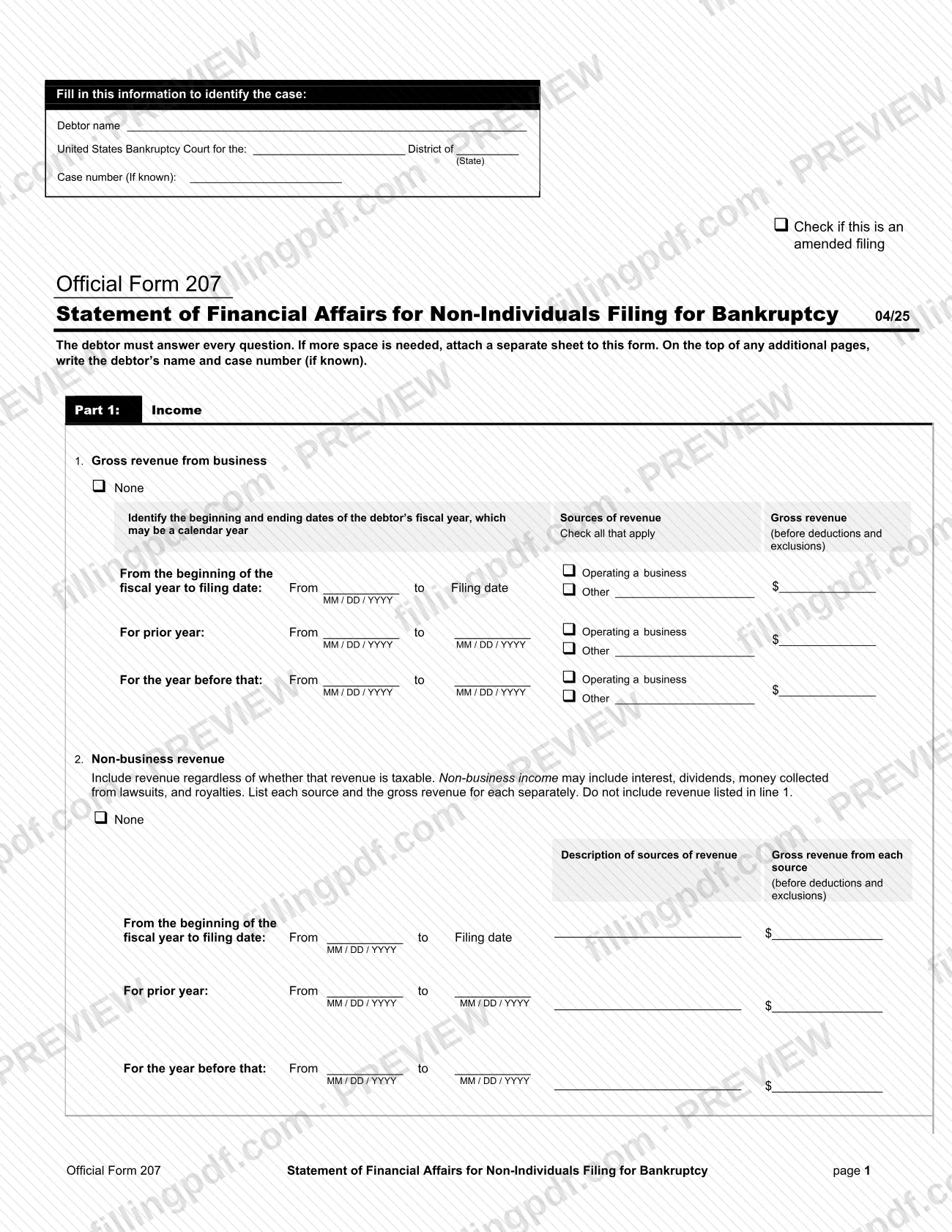
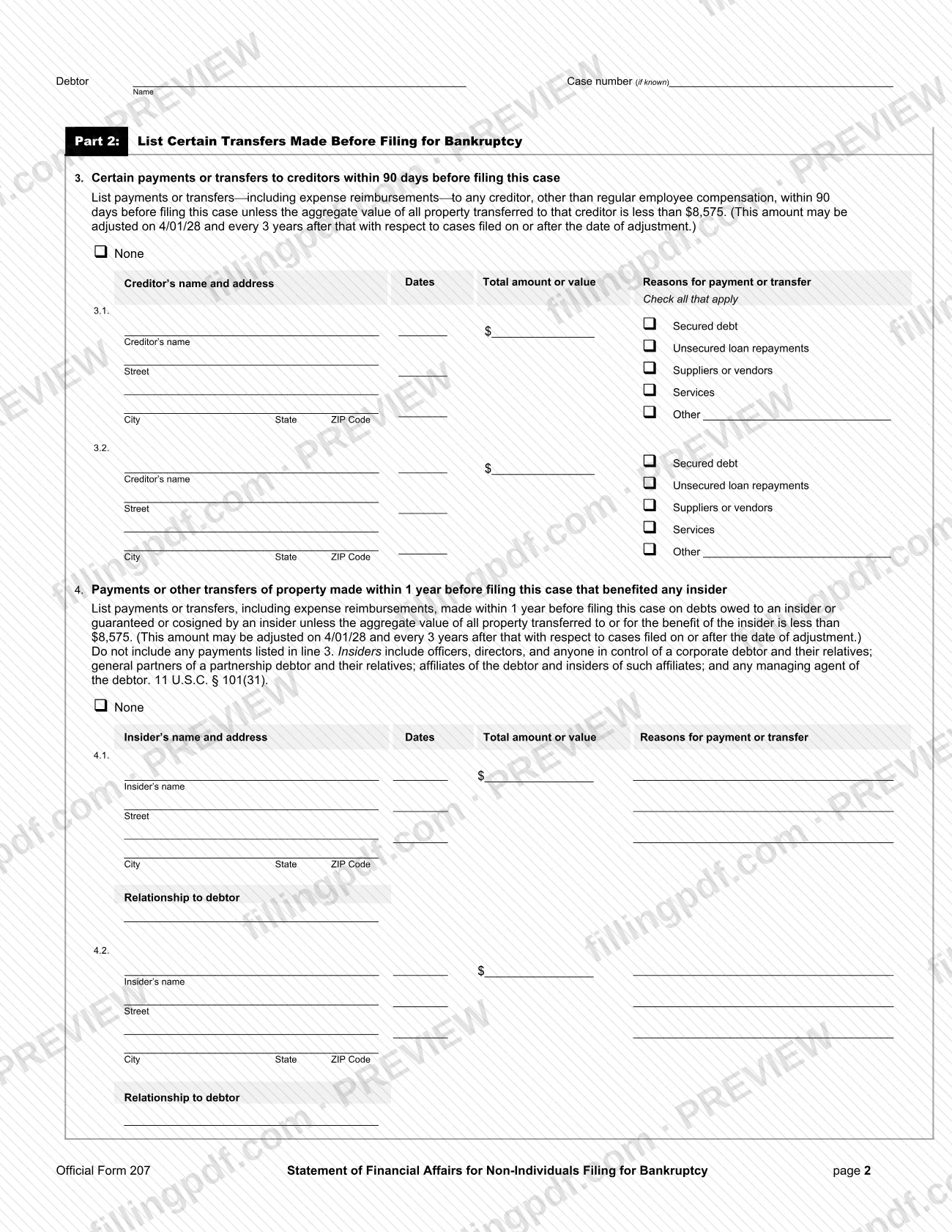
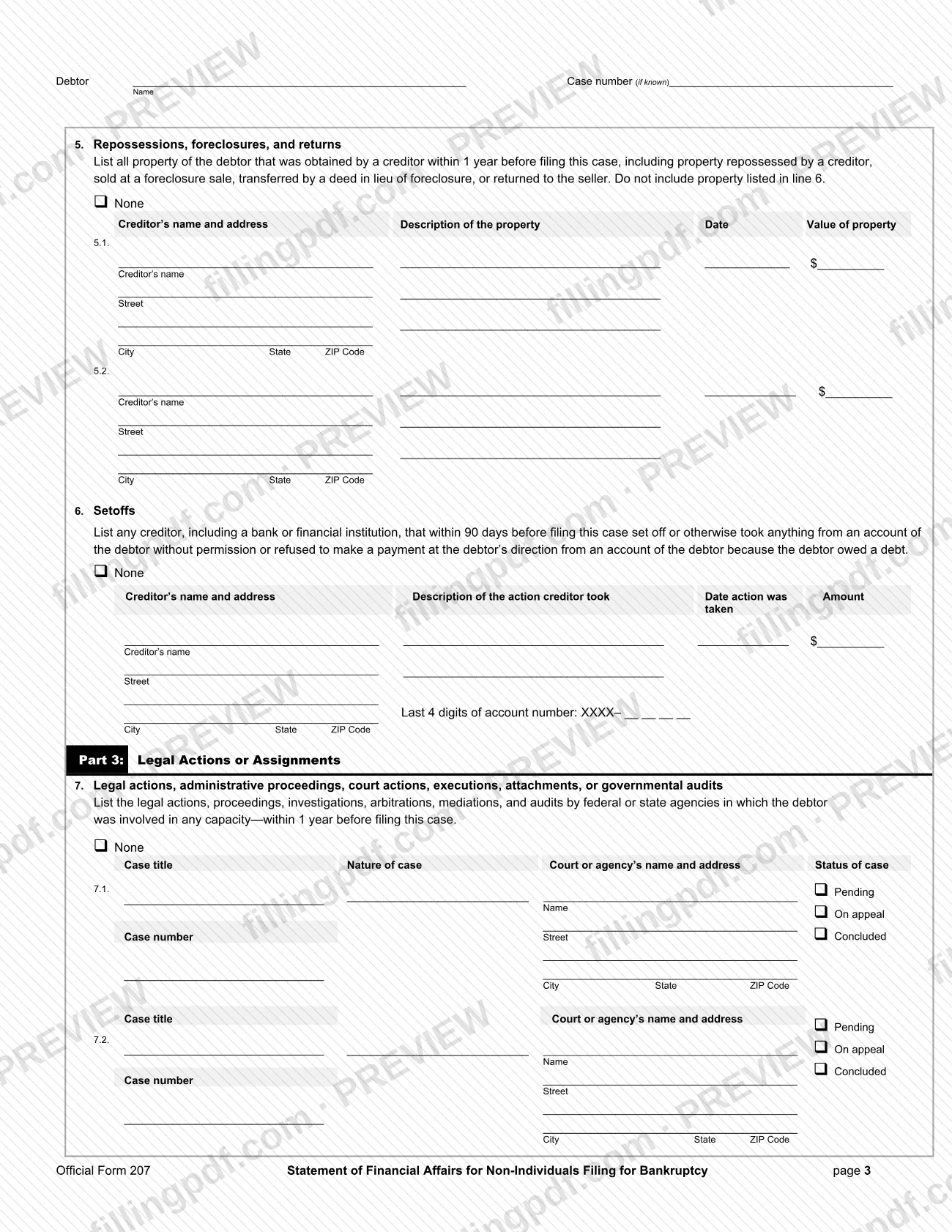
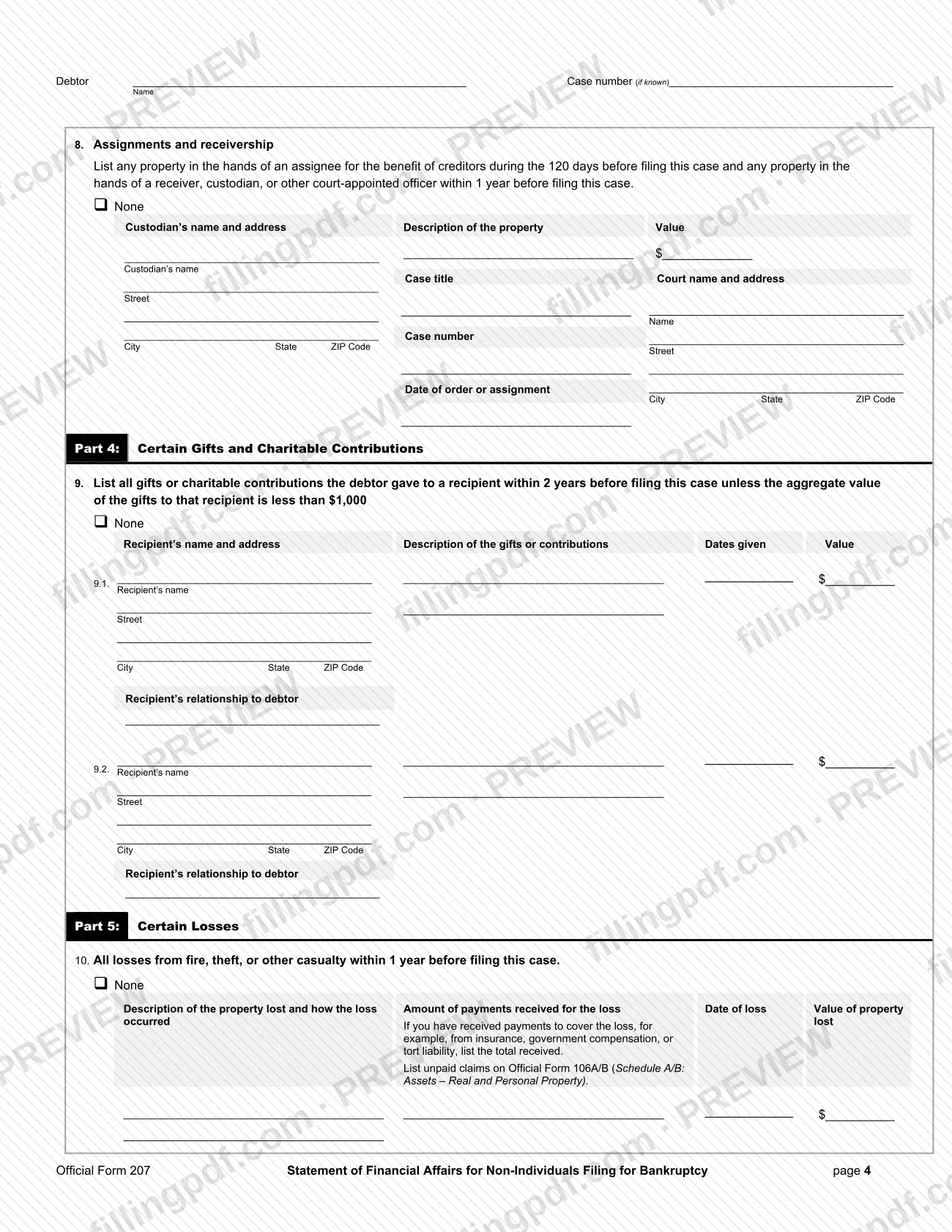
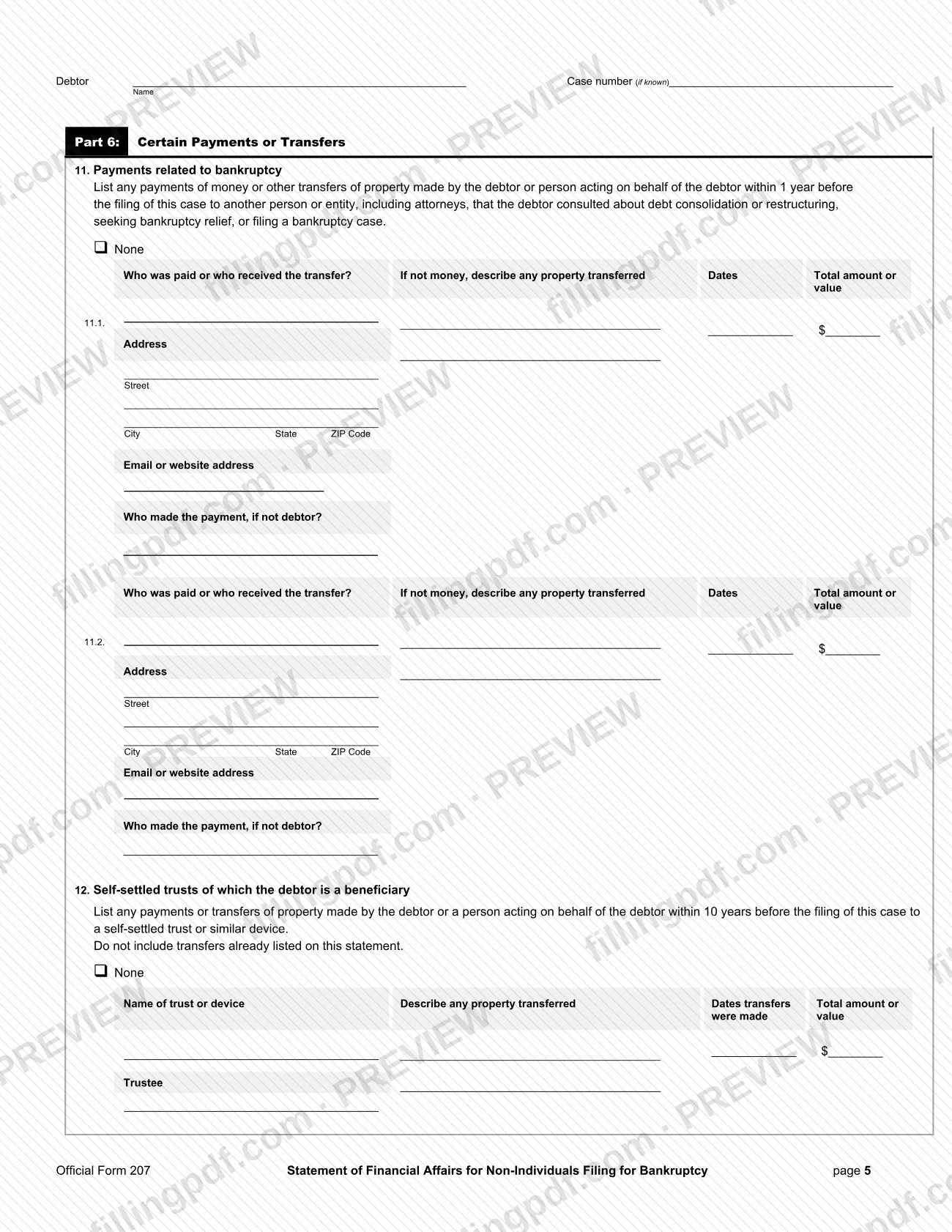
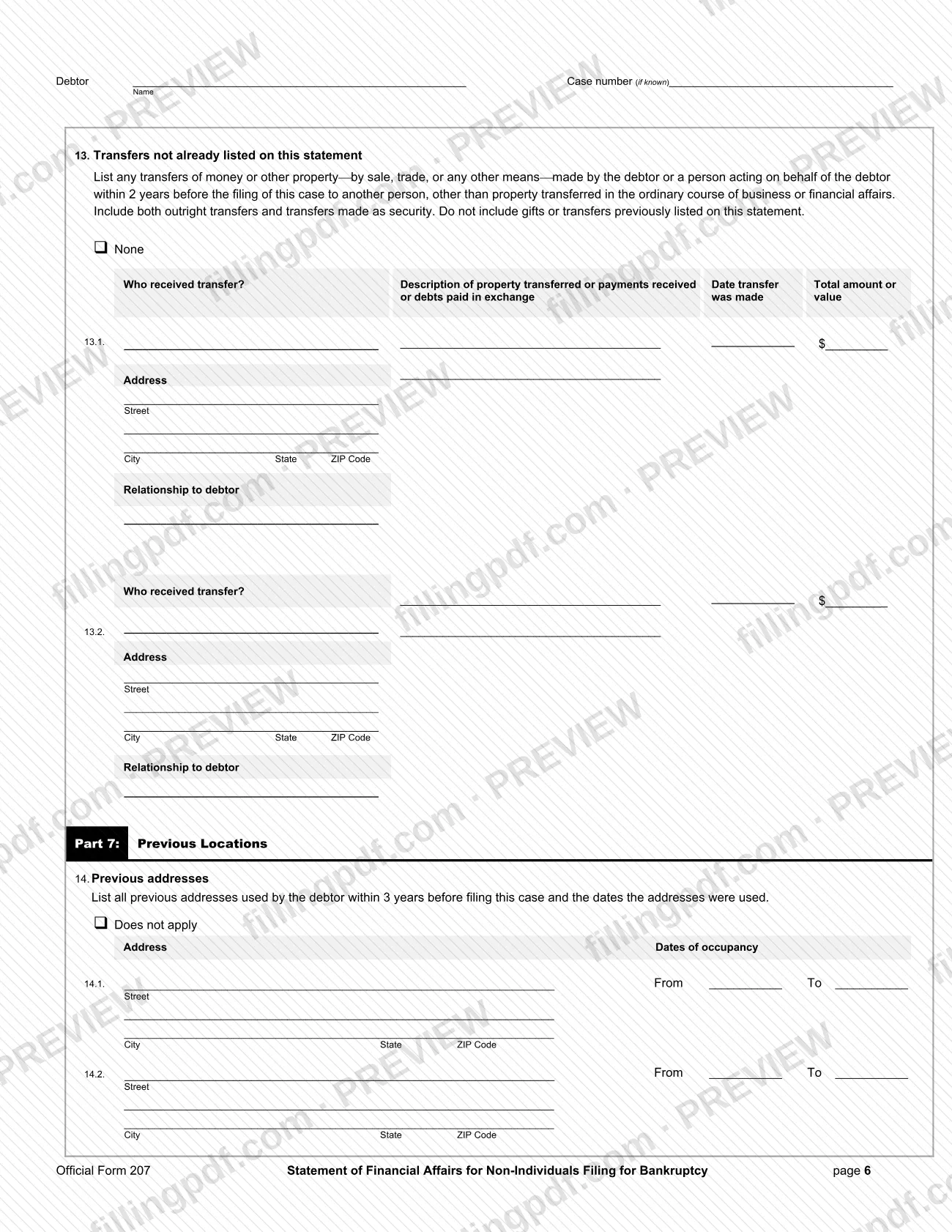
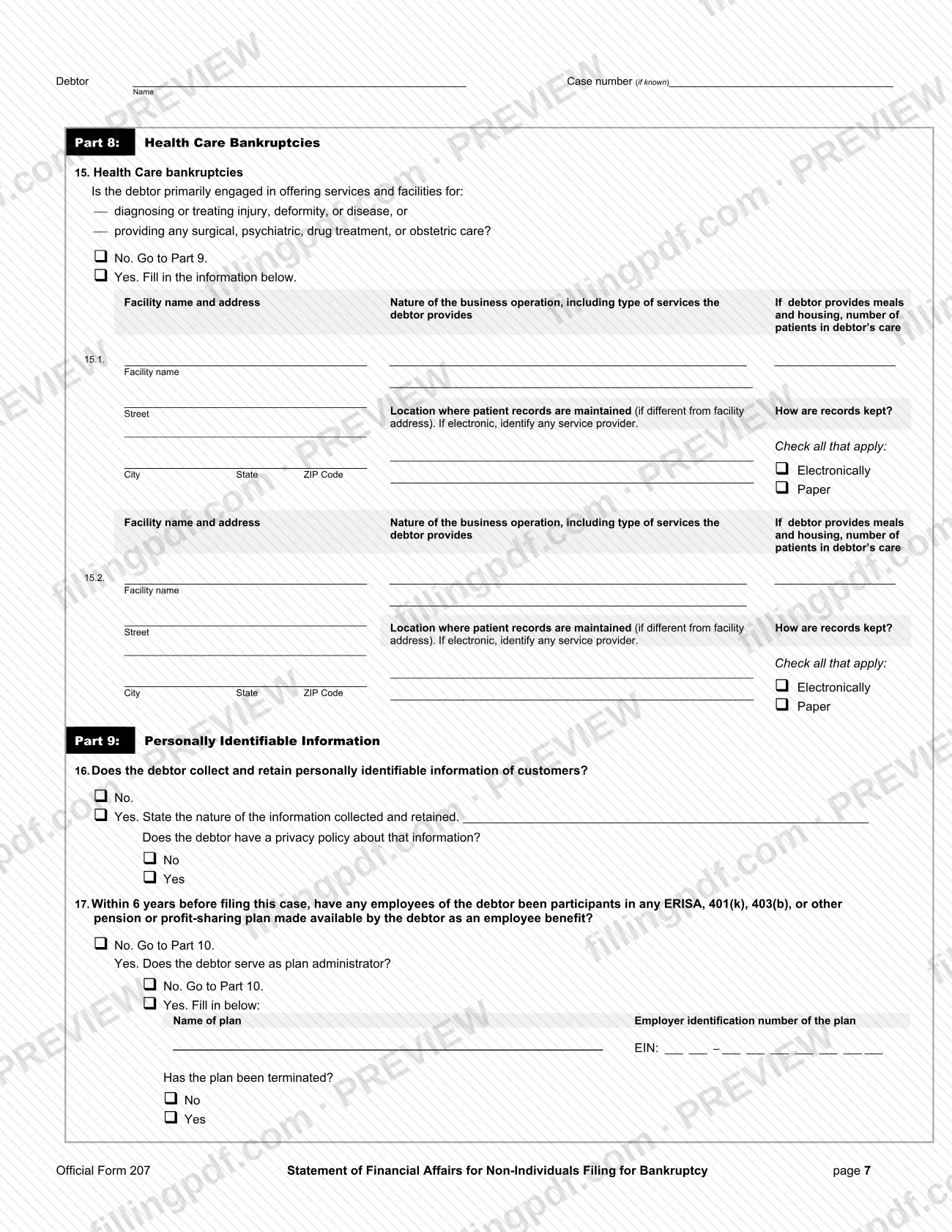
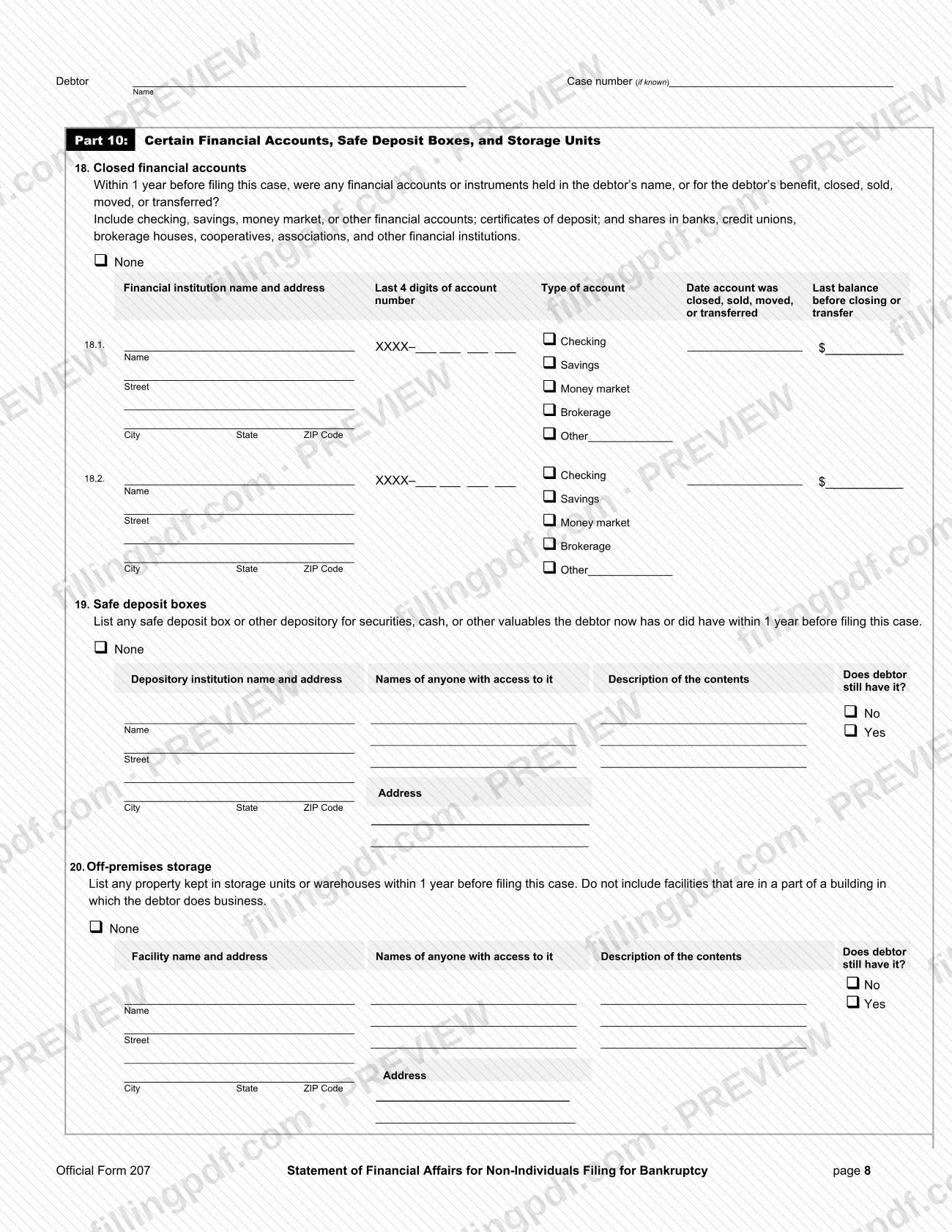
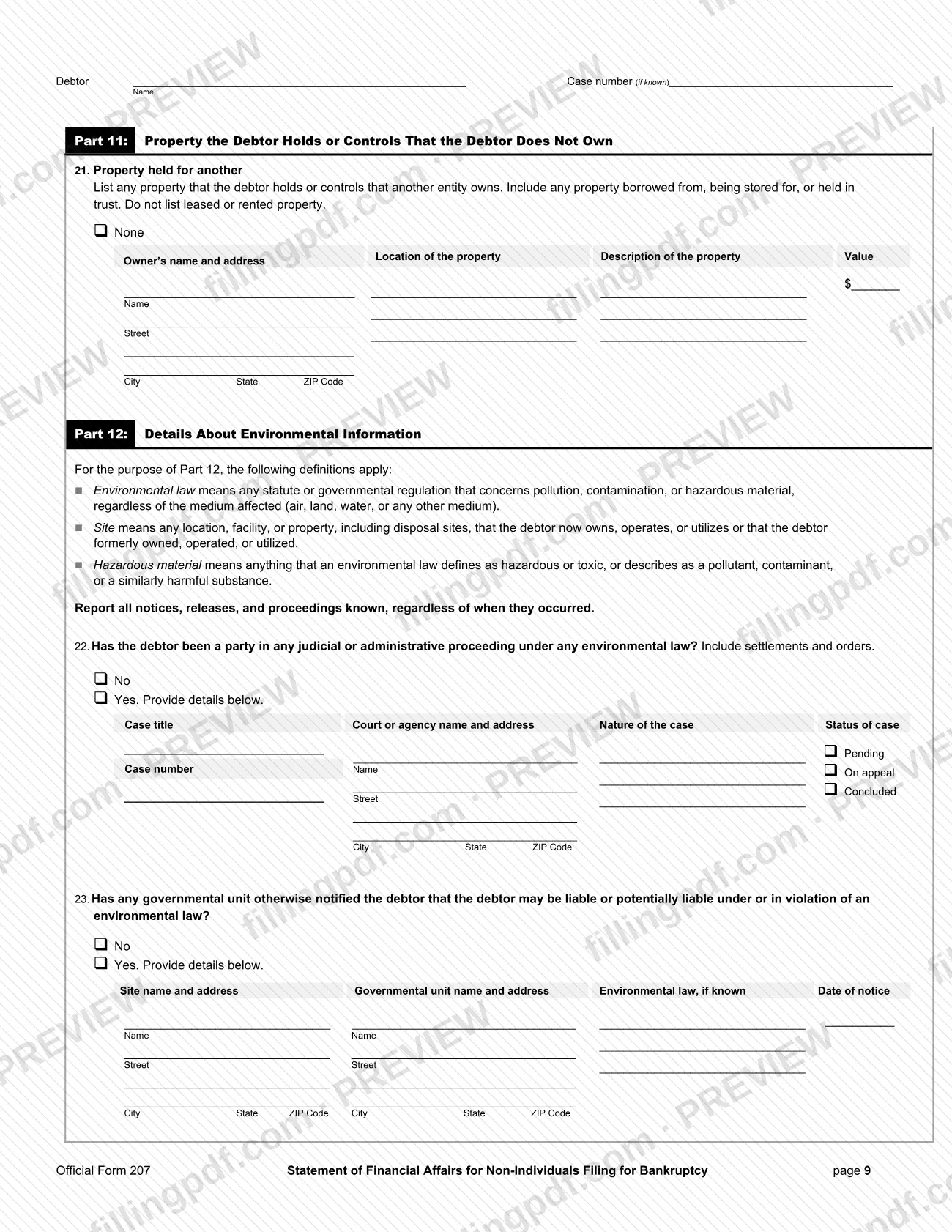
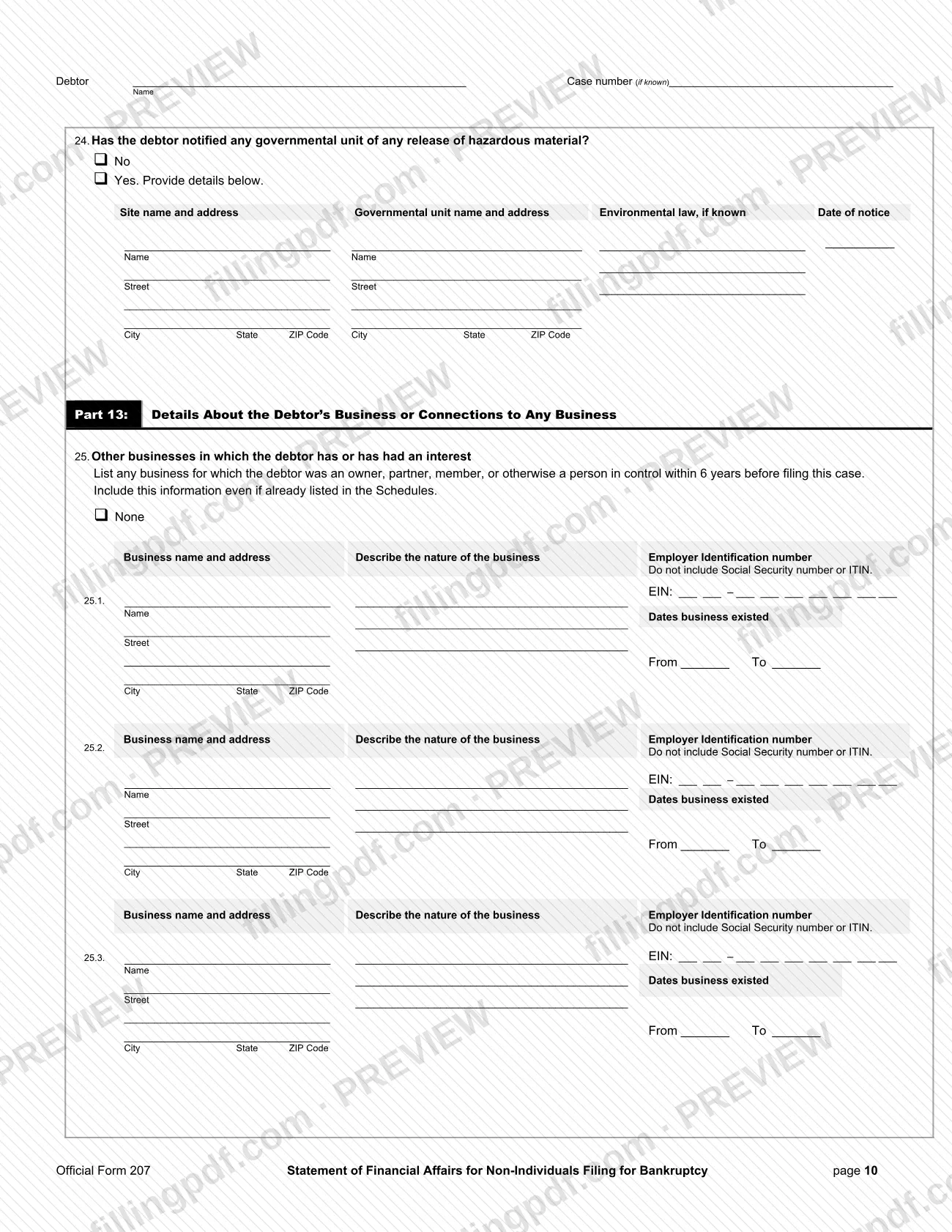
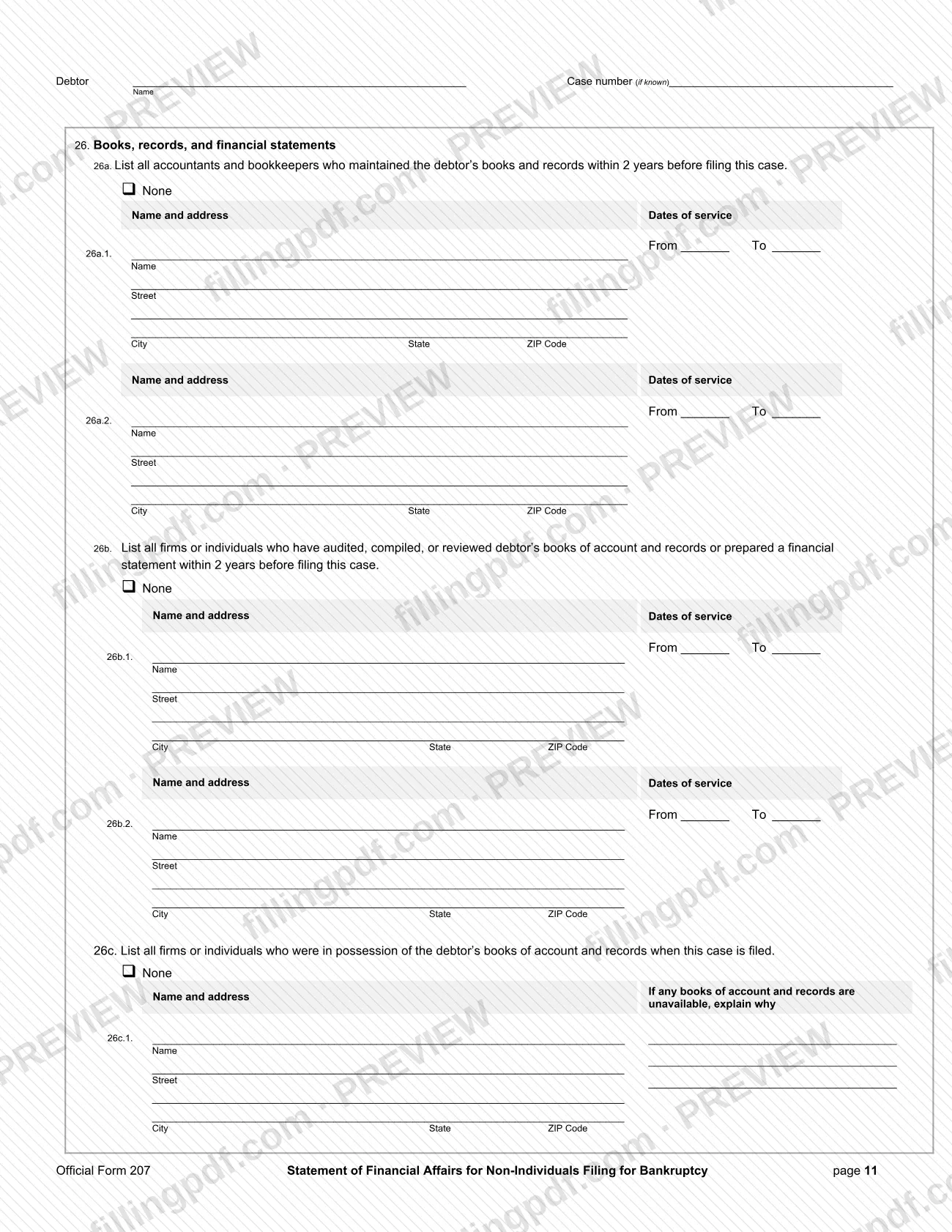
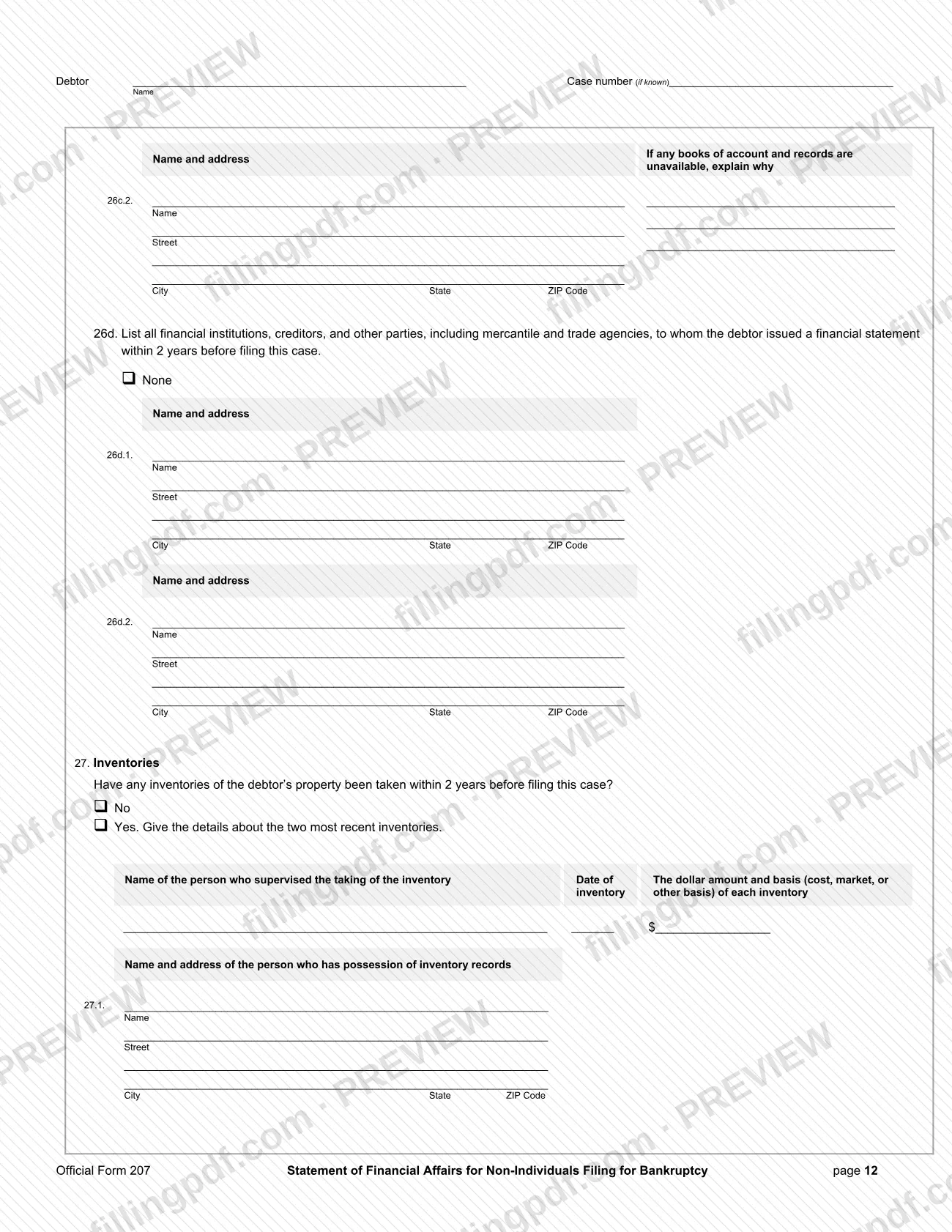
B207 is the number the Administrative Office of the U.S. Courts gives to Official Form 207, Statement of Financial Affairs for Non-Individuals Filing for Bankruptcy. On it, a debtor that is not an individual answers questions about its income, payments and transfers, legal actions, accounts, businesses and insiders; the form says the debtor must answer every question. On this page you can fill out the form online on FillingPDF and download or print the completed PDF; the official PDF (revision 04/25) is published by the U.S. Courts at uscourts.gov.
Last updated
What is B 207?
Official Form 207, Statement of Financial Affairs for Non-Individuals Filing for Bankruptcy, is the Official Bankruptcy Form on which a debtor that is not an individual reports its income, certain transfers, legal actions, financial accounts, business connections and insiders.
The U.S. Courts list it as Form Number B 207 and describe it as an Official Bankruptcy Form: it is approved by the Judicial Conference and must be used under Bankruptcy Rule 9009. The revision printed on the PDF is 04/25.
The form is organized in 14 parts:
- Part 1, Income (lines 1-2).
- Part 2, certain transfers made before filing (lines 3-6).
- Part 3, legal actions or assignments (lines 7-8).
- Part 4, gifts and charitable contributions (line 9), and Part 5, losses (line 10).
- Part 6, certain payments or transfers (lines 11-13), and Part 7, previous locations (line 14).
- Part 8, health care bankruptcies (line 15), and Part 9, personally identifiable information (lines 16-17).
- Part 10, financial accounts, safe deposit boxes and storage units (lines 18-20), and Part 11, property the debtor holds but does not own (line 21).
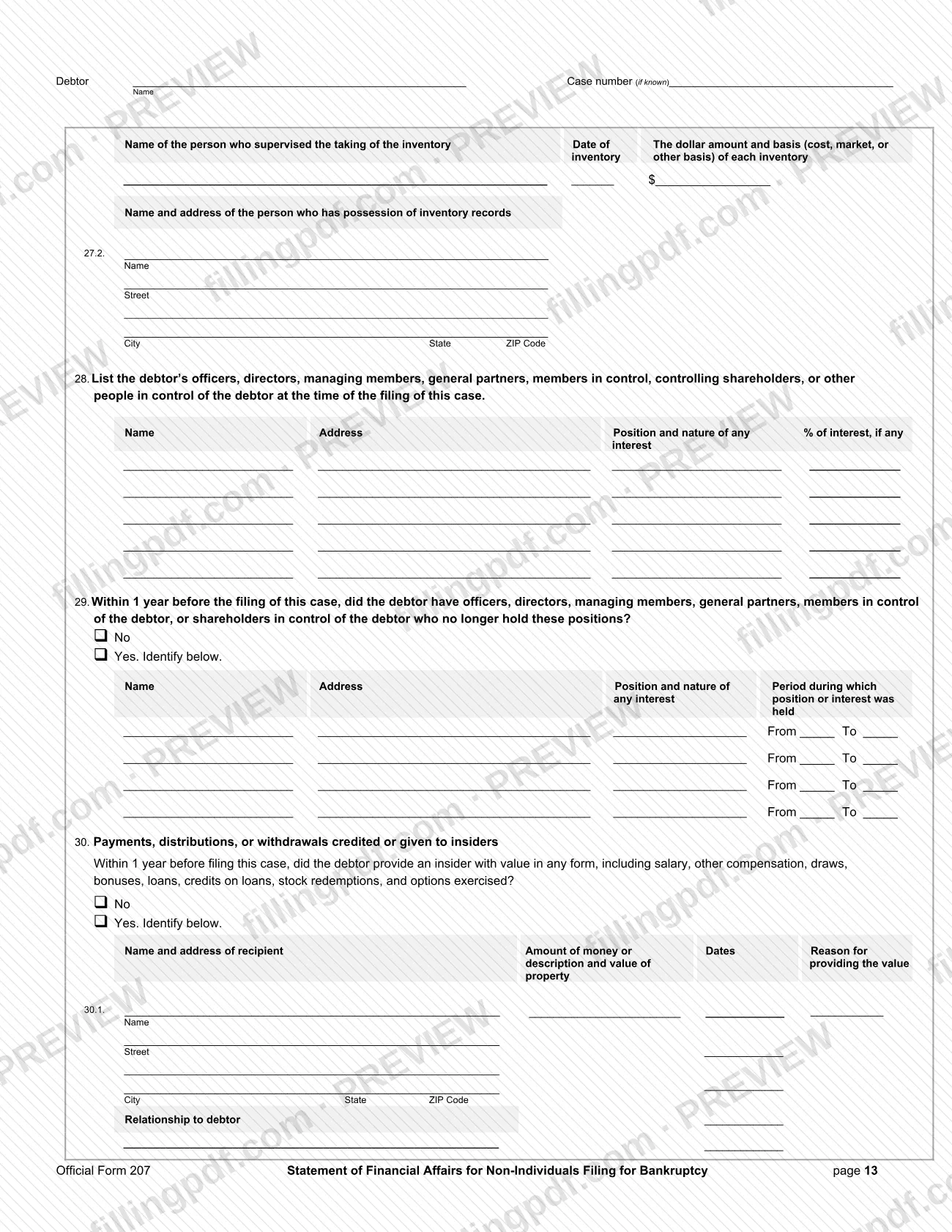
- Part 12, environmental information (lines 22-24), and Part 13, the debtor's business or connections to any business (lines 25-32).
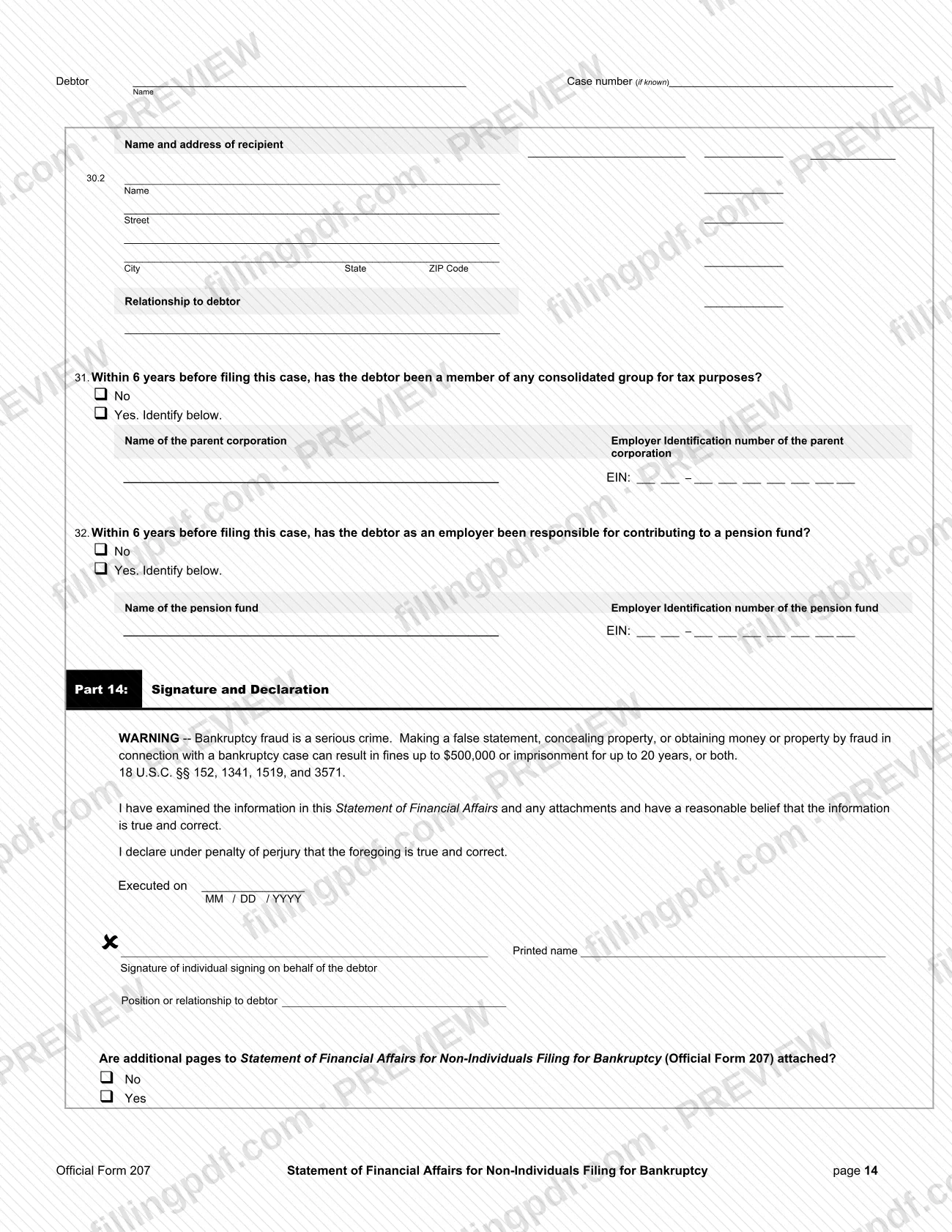
- Part 14, Signature and Declaration.
Part 12 defines "environmental law," "site" and "hazardous material" for its own lines, and the warning in Part 14 states that bankruptcy fraud is a serious crime.
Who needs to file B 207?
The debtor in a bankruptcy case that is not an individual completes this form; the title limits it to non-individuals, and the form states that the debtor must answer every question. Line 4 refers to corporate debtors and partnership debtors, and line 28 asks for officers, directors, managing members, general partners, members in control and controlling shareholders, which shows the kinds of entities the form has in mind.
Some parts apply only in certain situations:
- Part 8 (line 15): answer in detail only if the debtor is primarily engaged in offering services and facilities for diagnosing or treating injury, deformity or disease, or providing surgical, psychiatric, drug treatment or obstetric care; otherwise check No and go to Part 9.
- Line 17: the plan-administrator questions apply only if employees participated in a pension or profit-sharing plan the debtor offered within 6 years before filing.
- Lines 22-24: answer Yes only for the environmental proceedings, notices or releases described there.
The form is signed by an individual signing on behalf of the debtor, who gives a printed name and a position or relationship to the debtor. Any debtor that has an earlier version on file and wants to correct it checks the box at the top for an amended filing.
When to file B 207
The form is completed for a debtor's bankruptcy case, and almost every question looks back from the date the case is filed. No separate due date is printed on it.
The look-back periods printed on the form are:
- 90 days for payments to creditors (line 3) and setoffs (line 6).
- 120 days for property in the hands of an assignee for the benefit of creditors (line 8).
- 1 year for insider payments (line 4), repossessions (line 5), legal actions (line 7), losses (line 10), bankruptcy-related payments (line 11) and closed accounts (line 18).
- 2 years for gifts (line 9), other transfers (line 13), books and records (line 26) and inventories (line 27).
- 3 years for previous addresses (line 14), 6 years for businesses, plans and consolidated groups, and 10 years for self-settled trusts (line 12).
Line 1 uses the current fiscal year up to the filing date plus the two prior years. Part 12 asks you to report all known notices, releases and proceedings regardless of when they occurred. If the statement must be corrected later, check Check if this is an amended filing at the top of page 1.
Documents you need
- Separate sheet(s), only if more space is needed: attach them to the form and write the debtor's name and case number (if known) at the top of each additional page.
- Official Form 106A/B (Schedule A/B: Assets – Real and Personal Property): unpaid claims for casualty losses are listed there, not on line 10 of this form.
How to fill out B 207
Identify the debtor and the case
At the top, enter the debtor name, the district of the United States Bankruptcy Court, the state and the case number (if known). Check the box if this is an amended filing.
Report income on lines 1 and 2
Line 1: enter the fiscal year dates in MM / DD / YYYY, check the sources of revenue and enter gross revenue before deductions and exclusions. Line 2: list non-business revenue by source, without repeating line 1, or check None.
List transfers on lines 3 to 6
Line 3: payments to creditors within 90 days. Line 4: insider payments within 1 year, with the relationship to the debtor. Line 5: repossessions, foreclosures and returns within 1 year. Line 6: setoffs within 90 days, with the last 4 digits of the account number.
Describe legal actions and assignments
Line 7: for each proceeding within 1 year, enter the case title, case number, nature, court or agency name and address, and check Pending, On appeal or Concluded. Line 8: list property held by an assignee, receiver or custodian, with the value.
Enter gifts and losses on lines 9 and 10
Line 9: list gifts and charitable contributions within 2 years above the threshold printed on the line, with the recipient's relationship to the debtor. Line 10: describe each fire, theft or casualty loss within 1 year and any payments received for it.
Complete lines 11 to 13
Line 11: payments related to bankruptcy within 1 year, including who made the payment if not the debtor. Line 12: transfers to self-settled trusts within 10 years. Line 13: other transfers within 2 years, leaving out anything already listed.
Add previous addresses and health care details
Line 14: list addresses used within 3 years with dates of occupancy, or check Does not apply. Line 15: check No and go to Part 9, or check Yes and give each facility, its services and how patient records are kept.
Answer lines 16 and 17
Line 16: say whether the debtor collects and retains personally identifiable information and whether it has a privacy policy. Line 17: answer the pension or profit-sharing plan questions, and if the debtor is plan administrator give the plan name and its EIN.
List accounts, boxes, storage and held property
Line 18: closed or transferred financial accounts, with the last 4 digits only. Line 19: safe deposit boxes. Line 20: off-premises storage. Line 21: property held for another, excluding leased or rented property.
Answer the environmental questions
Lines 22 to 24: check No or Yes for each. If Yes, give the case, site, governmental unit, environmental law (if known), status or date of notice, using the Part 12 definitions.
Complete the business questions
Line 25: businesses in which the debtor held an interest within 6 years, with the EIN, never a Social Security number or ITIN. Line 26: accountants, auditors, record holders and parties given financial statements. Line 27: inventories.
Fill in insiders, groups and pension funds
Line 28: current officers, directors and others in control. Line 29: those who left within 1 year. Line 30: value given to insiders within 1 year. Lines 31 and 32: consolidated tax group parent and pension fund, each with an EIN if Yes.
Review, sign and download the PDF
In Part 14, enter the execution date as MM / DD / YYYY, the signature, printed name and position or relationship of the person signing for the debtor, and answer whether additional pages are attached. Download or print the completed PDF from FillingPDF.
How to submit B 207
The form itself names no mailing address, online portal or appointment rule. It is headed with the United States Bankruptcy Court district and the case number, so it belongs to the case in that court; follow that court's instructions for how and where to deliver it.
What the form does require from the person assembling it:
- Additional pages: if more space is needed, attach a separate sheet, with the debtor's name and case number (if known) written at the top of each added page. At the end of Part 14, answer the question whether additional pages are attached (No or Yes).
- Signature: the individual signing on behalf of the debtor signs, prints a name, gives a position or relationship to the debtor and enters the execution date in MM / DD / YYYY format.
- Amendments: check the amended-filing box at the top of page 1.
FillingPDF lets you fill out and download the PDF; submission follows the channels above.
Common mistakes to avoid
- Leaving a question unanswered. The form says the debtor must answer every question, so check None, No or Does not apply where the line allows it.
- Adding extra pages without the debtor's name and case number at the top of each page.
- Listing on line 4 a payment already listed on line 3; the instructions on line 4 say not to include payments listed in line 3.
- Repeating on line 2 revenue already reported on line 1; line 2 is for non-business revenue only.
- Listing leased or rented property on line 21, which covers property the debtor holds that another entity owns and says not to list leased or rented property.
- Entering a Social Security number or ITIN as a business's identification number on line 25; the form says not to include them.
- Writing the full account number on lines 6 or 18, where the form asks only for the last 4 digits.
- Signing the declaration without having examined the statement and its attachments, which the signer certifies under penalty of perjury.
- Filing a corrected version without checking the amended-filing box at the top of page 1.
Frequently asked questions
What is b207 in bankruptcy?
B207 is the form number the U.S. Courts use for Official Form 207, Statement of Financial Affairs for Non-Individuals Filing for Bankruptcy. A debtor that is not an individual uses it to report income, transfers, legal actions, accounts, businesses and insiders for periods before the case was filed.
Who has to complete Official Form 207?
The debtor in a bankruptcy case that is not an individual, through an individual who signs on its behalf. The title limits the form to non-individuals, and it states that the debtor must answer every question. Part 8 applies in detail only to health care debtors.
Do I have to answer every question on Form 207?
Yes. The form states that the debtor must answer every question. Most lines have a None box and Parts 8, 9 and 12 use No or Yes boxes, so check the one that applies instead of leaving a line blank.
How far back does Form 207 ask about?
It varies by line: 90 days for creditor payments and setoffs, 1 year for insider payments, repossessions and legal actions, 2 years for gifts and other transfers, 3 years for previous addresses, 6 years for businesses and 10 years for self-settled trusts.
What if I need more space on Form 207?
Attach a separate sheet. The form says to write the debtor's name and case number (if known) at the top of any additional pages. Then answer the question at the end of Part 14 asking whether additional pages are attached.
Who signs Form 207 for a company?
An individual signing on behalf of the debtor. That person signs, prints a name and gives a position or relationship to the debtor, and enters the date in MM / DD / YYYY format. The signer declares under penalty of perjury that the statement is true and correct.
How do I amend a Form 207 I already filed?
Complete the form with the corrected information and check the box Check if this is an amended filing at the top of page 1. The form prints no separate procedure for delivering an amendment, so follow the instructions of the bankruptcy court that has the case.
What happens if I make a false statement on Form 207?
The form warns that bankruptcy fraud is a serious crime. Making a false statement, concealing property or obtaining money or property by fraud in a bankruptcy case can result in fines or imprisonment, or both, under 18 U.S.C. §§ 152, 1341, 1519, and 3571.
Can I fill out Form 207 online on FillingPDF?
Yes. You can fill out the fillable PDF online on FillingPDF and download or print it. FillingPDF is an independent service, not affiliated with the U.S. Courts, and it does not file the form with any bankruptcy court; delivery follows the court's own channels.
Ready to fill out B 207?
Fill out B 207 now