
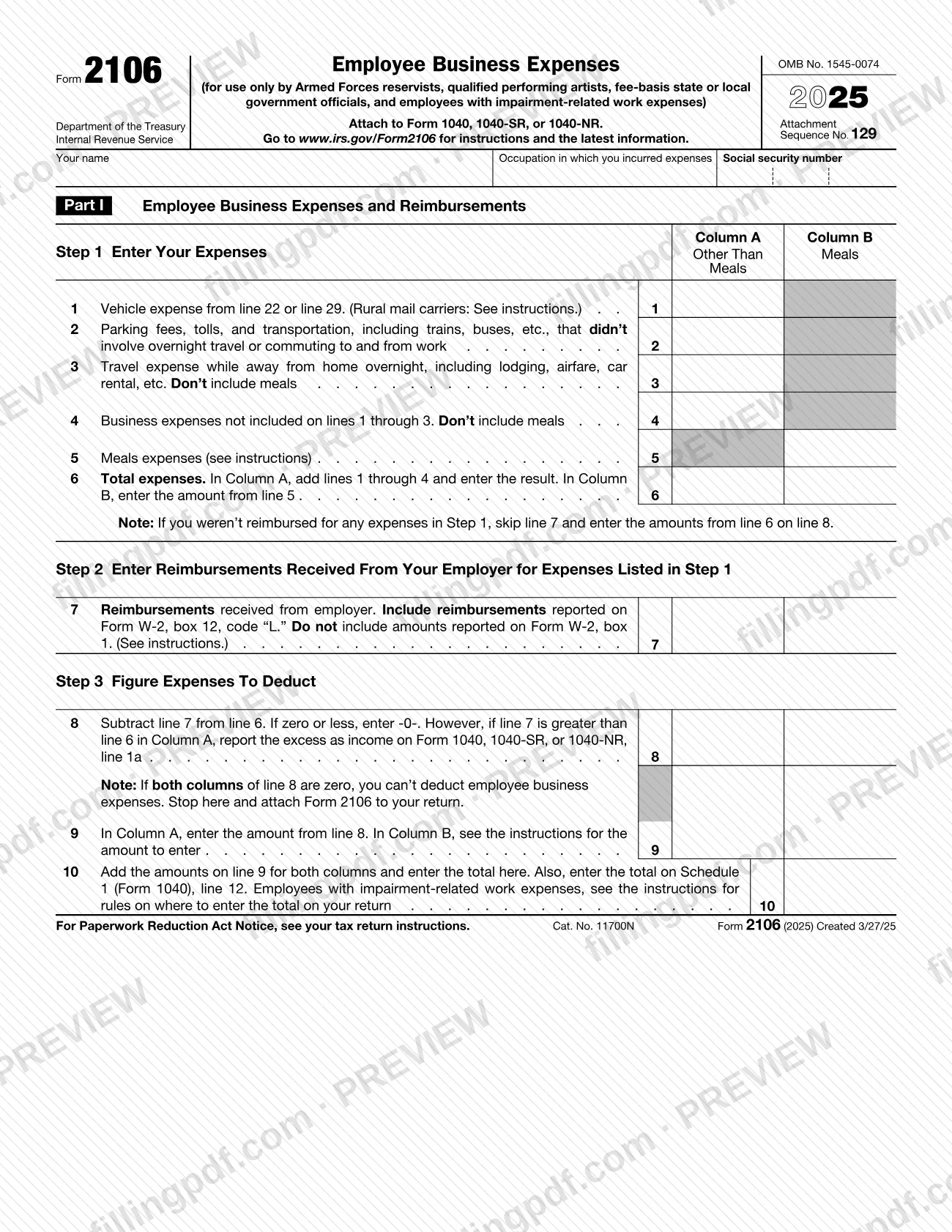
Form 2106, Employee Business Expenses, is the Internal Revenue Service (IRS) form that qualifying employees attach to Form 1040, 1040-SR, or 1040-NR to figure the job expenses they can deduct after employer reimbursements. The form is printed for use only by Armed Forces reservists, qualified performing artists, fee-basis state or local government officials, and employees with impairment-related work expenses. On this page you can fill out the form online on FillingPDF and download or print the completed PDF; the form and its instructions are published by the IRS at www.irs.gov/Form2106.
Last updated
What is 2106?
Form 2106, Employee Business Expenses, is the IRS form that Armed Forces reservists, qualified performing artists, fee-basis state or local government officials and employees with impairment-related work expenses use to list job-related expenses, subtract reimbursements and arrive at the amount they can deduct.
The IRS describes the expenses as ordinary and necessary: an ordinary expense is common and accepted in your field, and a necessary expense is helpful and appropriate for your business, even if it is not required.
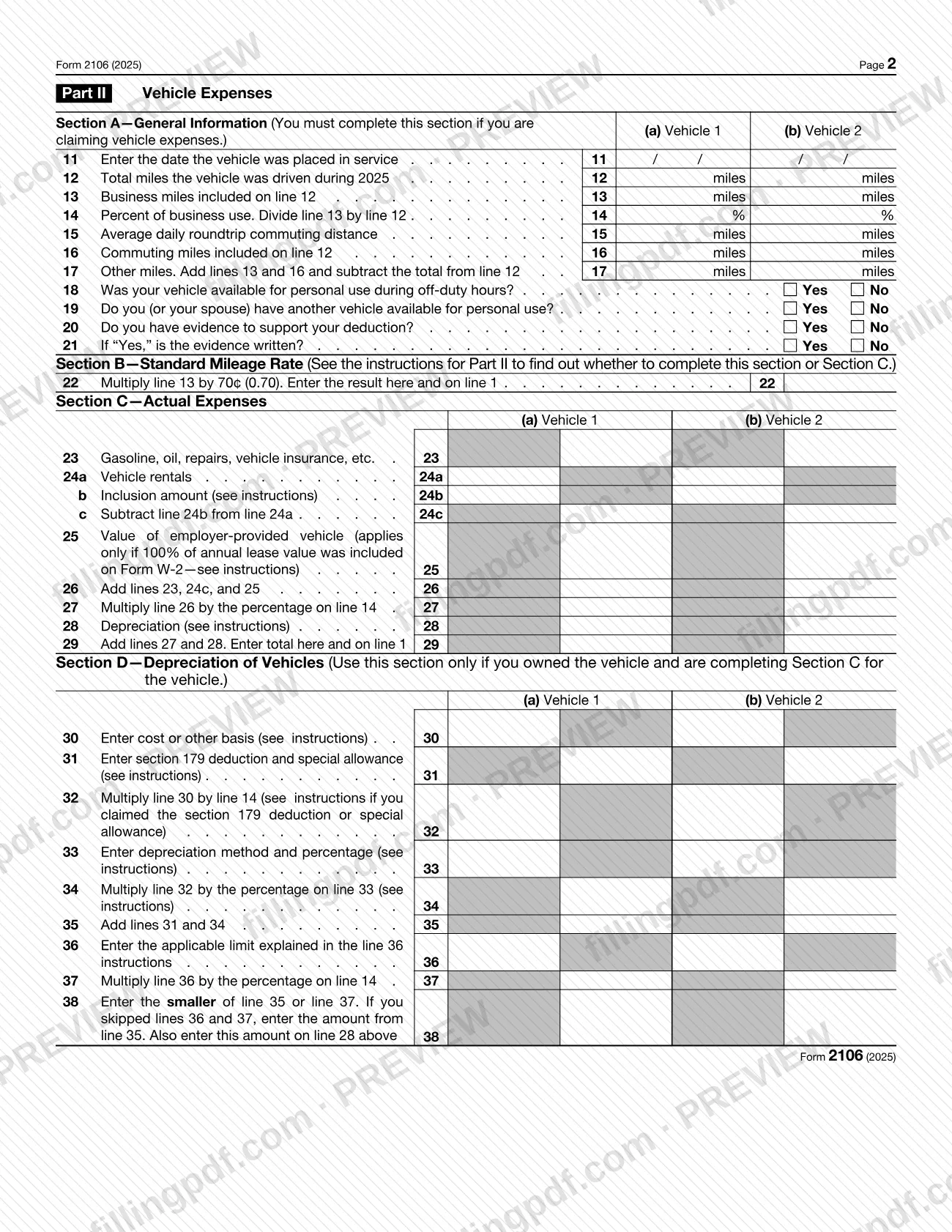
The form has two pages. Part I takes your expenses (vehicle, parking and tolls, overnight travel, other expenses, meals) in Column A and Column B for meals, then your employer reimbursements, then the expenses to deduct. Part II covers vehicle expenses in four sections: general information, standard mileage rate, actual expenses and depreciation of vehicles. The total on line 10 is carried to your return.
This is the 2025 edition (OMB No. 1545-0074, Attachment Sequence No. 129), attached to Form 1040, 1040-SR, or 1040-NR. The IRS instructions explain that employees outside the four groups generally cannot use it, because section 67(h) eliminated miscellaneous itemized deductions subject to the 2% floor for tax years after 2017.
Who needs to file 2106?
The main group is employees who, during the tax year, were one of the following, according to the IRS instructions for Form 2106:
- Armed Forces reservists: members of a reserve component, meaning the Army, Navy, Marine Corps, Air Force or Coast Guard Reserve; the Army National Guard of the United States; the Air National Guard of the United States; or the Reserve Corps of the Public Health Service.
- Qualified performing artists: employees who worked in the performing arts for at least two employers, received wages from at least two of them at or above the per-employer minimum in the instructions, had performing-arts expenses of more than 10% of their performing-arts gross income, and had adjusted gross income at or below the limit in the instructions before deducting those expenses. Married artists must file jointly unless they lived apart from their spouse all year.
- Fee-basis state or local government officials: employees of a state or political subdivision paid, in whole or in part, on a fee basis.
- Employees with impairment-related work expenses: people with physical or mental disabilities who have attendant care costs at work or other workplace expenses that enable them to work.
Other employees may not use the form. The instructions say rural mail carriers should not use Form 2106. Employees outside the four groups who receive reimbursements above their expenses from an employer's nonaccountable plan should have the excess included as wages on Form W-2 and on their return.
When to file 2106
Complete Form 2106 when you prepare the federal income tax return for the year it covers, because it is an attachment to Form 1040, 1040-SR, or 1040-NR. The form has no due date of its own, so it follows the due date of that return. This edition is for 2025: line 12 asks for the miles each vehicle was driven during 2025.
One timing rule is stated for this form. If you choose not to claim the special depreciation allowance for a vehicle, the instructions say to attach a statement to your timely filed return, including extensions, naming the election and the class of property. The election covers all property in the same class placed in service that year.
Documents you need
- A second Form 2106, page 2, when you used more than two vehicles for business; include the line 22 amounts from both pages in the total on line 1.
- A statement attached to your timely filed return (including extensions), only if you elect not to claim the special depreciation allowance; it names the election and the class of property.
- Form 4562, Depreciation and Amortization, as a source of figures, when you use it to work out depreciation or the section 179 deduction that goes on lines 28 and 31.
How to fill out 2106
Enter your name, occupation and SSN
At the top of page 1, enter your name, the occupation in which you incurred the expenses and your social security number.
List expenses in Step 1
Enter vehicle expense from line 22 or 29 on line 1, parking, tolls and local transportation on line 2, overnight travel on line 3 and other business expenses on line 4, none of them including meals. Enter meal expenses on line 5, Column B; the standard meal allowance uses the federal rates at GSA.gov/perdiem.
Total your expenses on line 6
In Column A, add lines 1 through 4 and enter the result. In Column B, enter the amount from line 5.
Enter employer reimbursements
If you were reimbursed, enter on line 7 the reimbursements not reported in Form W-2, box 1, including box 12, code "L". If one payment covers meals and other expenses, use the Reimbursement Allocation Worksheet to split Column A and Column B; if you were not reimbursed, skip line 7.
Figure the expenses to deduct
On line 8, subtract line 7 from line 6 and enter -0- if zero or less; if line 7 exceeds line 6 in Column A, report the excess as income on line 1a of your return. Enter the Column A amount on line 9 and follow the line 9 instructions for Column B, then add both columns on line 10.
Carry the line 10 total to your return
Reservists, fee-basis officials and qualified performing artists enter the total on Schedule 1 (Form 1040), line 12. Employees with impairment-related work expenses use Schedule A (Form 1040), line 16, or Schedule A (Form 1040-NR), line 7.
Complete Part II, Section A
Only if you claim vehicle expenses, give the date placed in service (line 11), total miles (line 12), business miles (line 13), business-use percentage (line 14), commuting figures (lines 15 and 16) and other miles (line 17) for each vehicle. Answer Yes or No on lines 18 through 21.
Use Section B for standard mileage
If you qualify for the standard mileage rate, multiply line 13 by the rate printed on line 22 and enter the result there and on line 1. Fill in only the section for the method you choose.
Use Section C for actual expenses
Enter vehicle operating costs on line 23, rentals on line 24a with any inclusion amount on 24b, and employer-provided vehicle value on line 25 only if 100% of the annual lease value was in Form W-2. Add lines 23, 24c and 25 on line 26, multiply by the line 14 percentage on line 27, add depreciation from line 28 and enter the total on line 29 and line 1.
Complete Section D for owned vehicles
If you owned the vehicle and used Section C, enter cost or other basis (line 30), section 179 deduction and special allowance (line 31), the depreciation method and percentage (line 33) and the line 36 limit if it applies. Enter the smaller of line 35 or line 37 on line 38 and on line 28.
Review, download and attach
Check that every line matches your records and that columns and vehicles are not mixed up. Download or print the completed PDF from FillingPDF and attach it to your Form 1040, 1040-SR, or 1040-NR as described under How to submit.
How to submit 2106
Form 2106 is not sent on its own. It is attached to your Form 1040, 1040-SR, or 1040-NR and goes to the IRS with that return.
- With your return: the form prints no address, portal or appointment rule of its own. Submit it through the channel you use for the return, following the filing instructions for that return.
- If you owe nothing to deduct: the form says that if both columns of line 8 are zero you cannot deduct employee business expenses, and you should stop and attach Form 2106 to your return.
- If you used more than two vehicles: complete and attach a second Form 2106, page 2, and include line 22 from both pages in the total on line 1.
Where the line 10 total goes depends on your category. Reservists, fee-basis officials and qualified performing artists enter it on Schedule 1 (Form 1040), line 12. Employees with impairment-related work expenses enter it on Schedule A (Form 1040), line 16, or Schedule A (Form 1040-NR), line 7. If line 7 is greater than line 6 in Column A, report the excess as income on line 1a of your return.
FillingPDF lets you fill out and download the PDF; submission follows the channels above.
Common mistakes to avoid
- Filing Form 2106 as an employee who is not an Armed Forces reservist, qualified performing artist, fee-basis state or local government official or employee with impairment-related work expenses.
- Using Form 2106 as a rural mail carrier; the instructions say rural mail carriers should not use it.
- Including meal costs on lines 3 or 4, which both say not to include meals; meals belong on line 5 and Column B.
- Counting commuting miles on line 13 or deducting commuting on line 2; commuting is not deductible and not a business mile.
- Entering on line 7 reimbursements already reported in Form W-2, box 1; only reimbursements not in box 1 (plus box 12, code "L") belong there.
- Deducting the full cost of business meals in Column B instead of following the line 9 instructions, which say generally only 50% is deductible.
- Using the standard mileage rate for a leased vehicle for only part of the lease period, or for five or more vehicles used at the same time.
- Putting state or local personal property taxes or vehicle loan interest on line 23; the instructions send those to Schedule A or Schedule 1-A.
- Completing Section D for a vehicle you did not own, or when you are not using the actual expense method in Section C.
Frequently asked questions
What is Form 2106 used for?
Form 2106 is the IRS form for figuring deductible employee business expenses after employer reimbursements. The form is printed for use only by Armed Forces reservists, qualified performing artists, fee-basis state or local government officials and employees with impairment-related work expenses.
Can I use Form 2106 to deduct my unreimbursed job expenses?
Only if you are in one of the four groups. The IRS instructions say employees outside those groups may not use Form 2106, because section 67(h) eliminated miscellaneous itemized deductions subject to the 2% floor for tax years after 2017.
Where does the line 10 total of Form 2106 go?
Reservists, fee-basis officials and qualified performing artists enter it on Schedule 1 (Form 1040), line 12; those deductions apply whether or not you itemize. Employees with impairment-related work expenses enter it on Schedule A (Form 1040), line 16, or Schedule A (Form 1040-NR), line 7.
How do I submit Form 2106?
Attach it to your Form 1040, 1040-SR, or 1040-NR; it is not filed alone and prints no address of its own. It goes to the IRS through whatever channel you use for the return. If you used more than two vehicles, attach a second Form 2106, page 2.
Should I use the standard mileage rate or actual expenses?
It depends on your vehicle. The instructions say that if you can use either, you should figure both ways and choose the more beneficial, then complete only the section for that method. You cannot use actual expenses for a leased vehicle if you previously used the standard mileage rate for it.
Who is a qualified performing artist for Form 2106?
An employee who worked for at least two employers in the performing arts, earned wages from at least two of them above the per-employer minimum, had performing-arts expenses over 10% of performing-arts gross income, and had adjusted gross income within the instructions' limit. Married artists generally file jointly.
What if my reimbursements are more than my expenses?
If line 7 is greater than line 6 in Column A, line 8 tells you to report the excess as income on line 1a of Form 1040, 1040-SR, or 1040-NR. If both columns of line 8 are zero, you cannot deduct employee business expenses.
Can I fill out Form 2106 online?
Yes. You can fill out the PDF online on FillingPDF and download or print it. FillingPDF is an independent service and does not file the form with the IRS; you attach it to your return and submit it through the IRS channels for that return.
Ready to fill out 2106?
Fill out 2106 now