
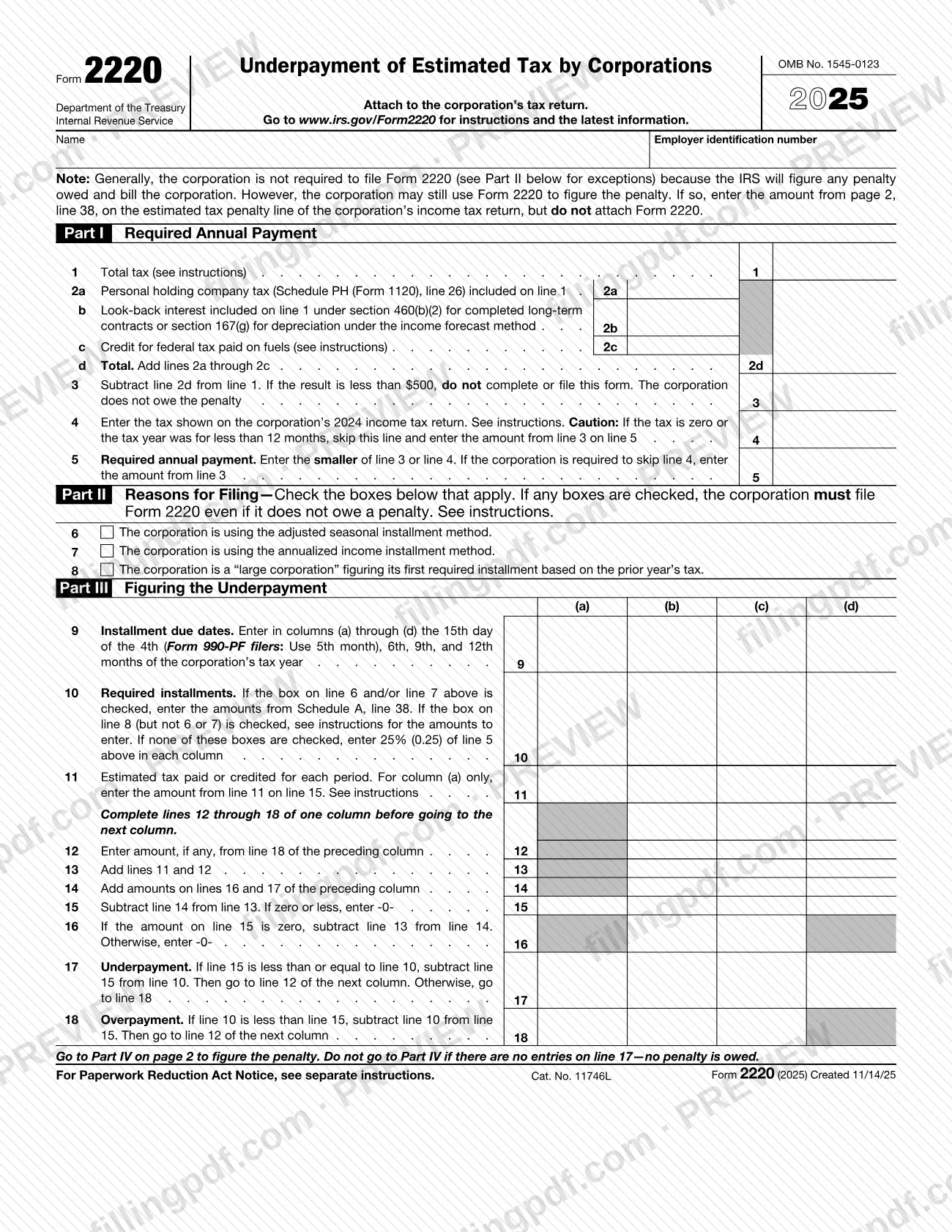
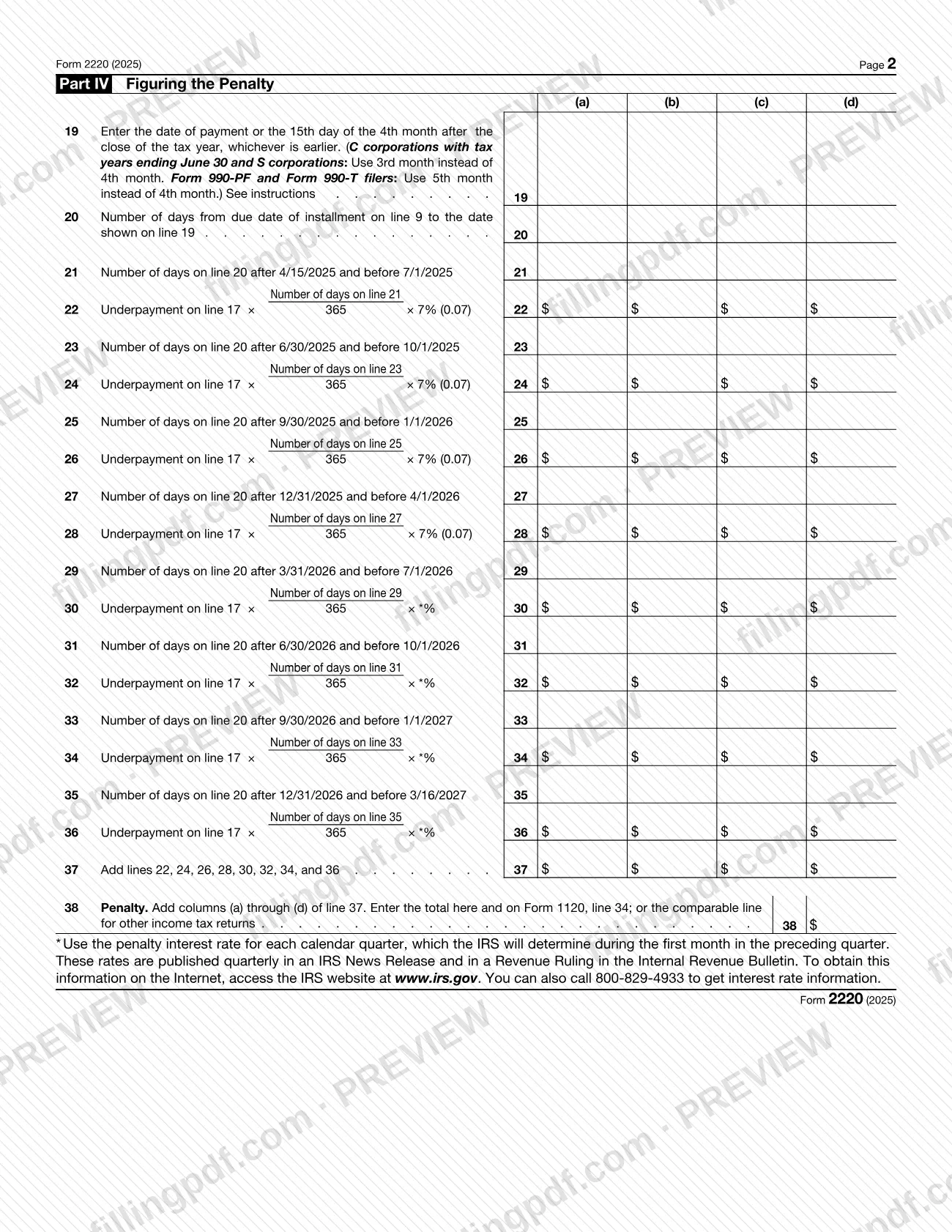
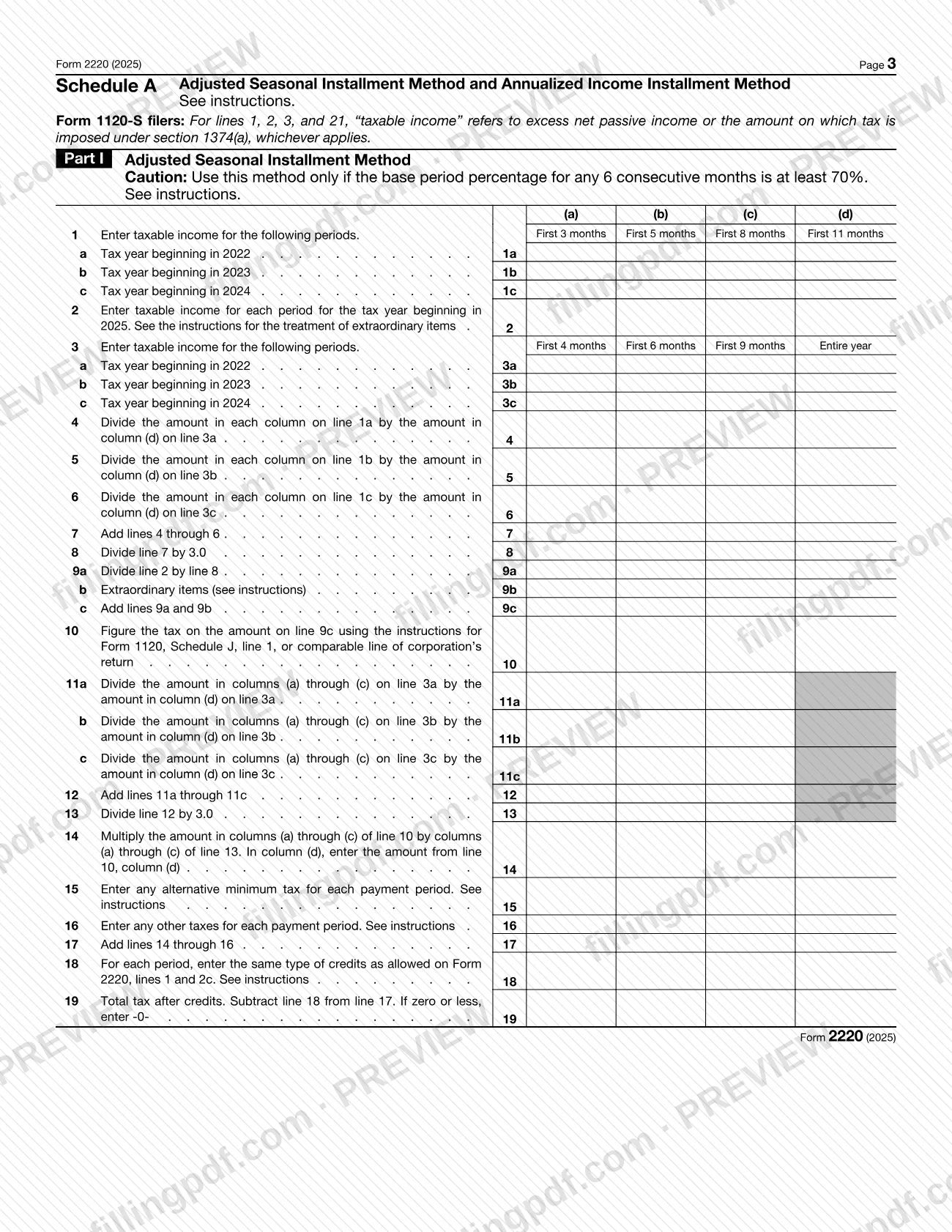
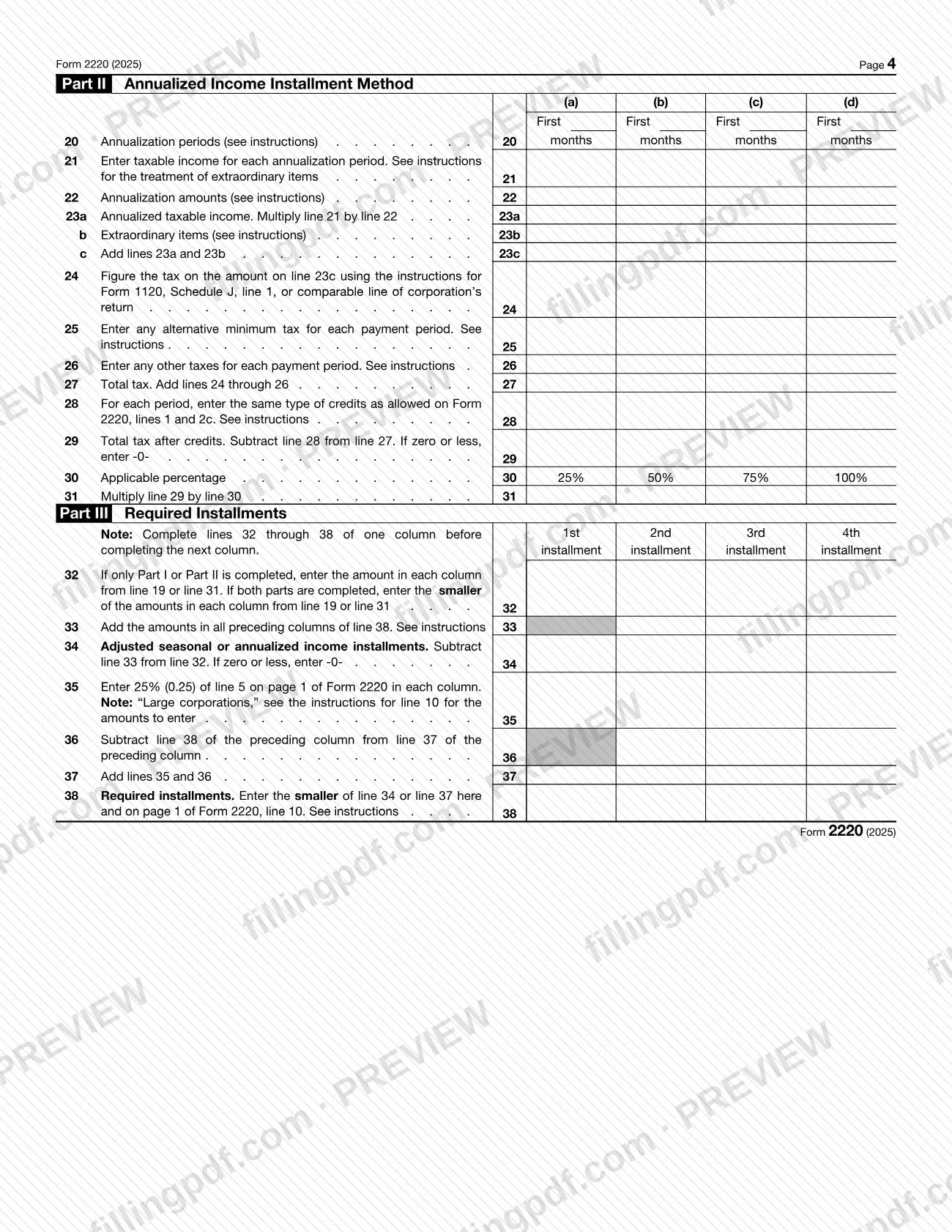
Form 2220, Underpayment of Estimated Tax by Corporations, is the Internal Revenue Service (IRS) form that shows whether a corporation is subject to the penalty for underpaying its estimated tax and, if so, how much the penalty is. Most corporations do not have to file it, because the IRS figures any penalty and bills the corporation; it must be attached to the return only in the cases listed in Part II. On this page you can fill out the form online on FillingPDF and download or print the completed PDF. The form and its instructions are published by the IRS at www.irs.gov/Form2220.
Last updated
What is Form 2220?
Form 2220, Underpayment of Estimated Tax by Corporations, is the IRS form that corporations, including S corporations, tax-exempt organizations subject to the unrelated business income tax, and private foundations use to determine whether they owe the estimated tax underpayment penalty and the amount of that penalty for the period that applies.
The form has four parts and a two-part schedule:
- Part I, Required Annual Payment (lines 1 to 5): starts from total tax and arrives at the smaller of the current-year tax or the prior-year tax.
- Part II, Reasons for Filing (lines 6 to 8): boxes for the adjusted seasonal installment method, the annualized income installment method, and a large corporation figuring its first installment on the prior year's tax.
- Part III, Figuring the Underpayment (lines 9 to 18): works through the four installments and shows any underpayment on line 17.
- Part IV, Figuring the Penalty (lines 19 to 38): counts the days of underpayment by period and totals the penalty on line 38.
- Schedule A (pages 3 and 4): the adjusted seasonal and annualized income methods, which can lower or eliminate the required installments.
The penalty is figured separately for each installment due date, so a corporation can owe it for an earlier date even if it paid enough later. The form is OMB No. 1545-0123 and is attached to the corporation's tax return, for example Form 1120, when it has to be filed. Form 8842 is a separate election form that the instructions name for the optional annualization periods.
Who needs to file Form 2220?
Corporations (including S corporations), tax-exempt organizations subject to the unrelated business income tax, and private foundations use Form 2220 to determine whether they are subject to the underpayment penalty and how much it is.
Generally, the corporation does not have to file the form, because the IRS figures the penalty and notifies it of any amount due. The corporation may still use the form to figure the penalty itself; in that case it enters the amount from line 38 on the estimated tax penalty line of its return and does not attach the form.
You must complete and attach Form 2220 to the return, even if no penalty is owed, when the Part I, line 3 amount is at or above the minimum printed on the form and any of these applies:
- the adjusted seasonal installment method is used (box on line 6);
- the annualized income installment method is used (box on line 7);
- the corporation is a "large corporation" figuring its first required installment on the prior year's tax (box on line 8). The instructions for line 8 define this as a corporation other than an S corporation whose taxable income reached the stated threshold in any of the 3 preceding tax years.
Do not complete or file the form if line 3 is below that minimum: the corporation does not owe the penalty. For tax year 2025, corporations affected by the corporate alternative minimum tax (CAMT) relief must still file Form 2220 even if they owe no penalty.
When to file Form 2220
Form 2220 has no due date of its own: when it must be filed, it goes with the corporation's tax return and is due when that return is due. The 2025 instructions say that if a box in Part II is checked, the form is attached to the income tax return, and that you also check the box on Form 1120, page 1, line 34 (or the comparable line of the other income tax return).
The installments themselves are due on the 15th day of the 4th, 6th, 9th and 12th months of the tax year (Form 990-PF filers use the 5th month for the first). The period of underpayment generally runs from the installment due date to the earlier of the payment date or the 15th day of the 4th month after the close of the tax year. C corporations with tax years ending June 30 and S corporations use the 3rd month; Form 990-PF and 990-T filers use the 5th. If you elect Option 1 or Option 2 annualization periods, Form 8842 must be filed by the due date of the first required installment.
Documents you need
- Form 2220 itself is attached to the corporation's income tax return when any Part II box is checked or the instructions otherwise require it; if not required, enter the line 38 penalty on the return and do not attach it.
- Schedule A (Form 2220, pages 3 and 4), only if the corporation uses the adjusted seasonal installment method, the annualized income installment method, or both.
- A separate computation for each payment, only if the corporation made more than one payment for a required installment.
- A computation of the penalty for the extra period, only if a fiscal-year corporation has an underpayment period that extends beyond the latest date in Part IV, line 35.
- Form 8842, Election To Use Different Annualization Periods for Corporate Estimated Tax, filed by the due date of the first required installment, only if Option 1 or Option 2 annualization periods are used.
How to fill out Form 2220
Enter name and EIN
At the top, enter the corporation's name and employer identification number. The form is attached to the corporation's tax return when required.
Figure total tax on lines 1 to 3
Line 1: generally the tax from Form 1120, line 31, or the applicable line of another return. On lines 2a to 2c enter personal holding company tax, look-back interest and the fuels credit, total them on 2d, and subtract 2d from line 1 on line 3.
Find the required annual payment
Line 4: the tax shown on the 2024 return, unless you must skip it (no 2024 return showing tax, or a tax year under 12 months). Line 5: the smaller of line 3 or line 4, or line 3 if line 4 is skipped.
Check the Part II reason boxes
Check line 6 for the adjusted seasonal installment method, line 7 for the annualized income installment method, and line 8 for a large corporation figuring its first installment on prior-year tax. Any checked box means the form must be filed.
Complete Schedule A if used
For line 6 only, complete Schedule A, Parts I and III. For line 7 only, complete Parts II and III. For both methods, complete all three parts. Then use the Schedule A, line 38 amounts on Form 2220, line 10.
Enter due dates and required installments
Line 9: the installment due dates in columns (a) to (d). Line 10: the Schedule A line 38 amounts if line 6 or 7 is checked; the large-corporation amounts from the instructions if only line 8 is checked; otherwise 25% (0.25) of line 5 in each column.
Enter estimated tax payments
Line 11: estimated tax paid or credited for each period, including any 2024 overpayment credited to 2025. Payments apply to unpaid installments in the order installments are due.
Work through lines 12 to 18
Complete lines 12 to 18 of one column before the next. Line 17 shows the underpayment and line 18 any overpayment carried to line 12 of the next column.
Figure the penalty in Part IV
Go to Part IV only if line 17 has an entry. On line 19 enter the payment date or the 15th day of the 4th month after year end, whichever is earlier (3rd month for June 30 C corporations and S corporations; 5th for Forms 990-PF and 990-T), then count days on lines 20 to 36 and total on line 37.
Enter the total penalty
Line 38: add columns (a) to (d) of line 37. Enter the total on Form 1120, line 34, or the comparable line of the return.
Review and download the PDF
Check the Part II boxes, any Schedule A parts and the attachments required for multiple payments. Download or print the completed PDF from FillingPDF and attach it to the return only if the instructions require.
How to submit Form 2220
Form 2220 is submitted as an attachment to the corporation's income tax return; it has no address, portal or appointment process of its own.
- Attached to the return: if you checked any box in Part II, or the instructions otherwise require the form, attach it to the corporation's return (Form 1120, or for example Form 1120-C, 1120-L or 1120-S) and file the return as you normally would. Check the box on Form 1120, page 1, line 34, or the comparable line of another return.
- Not attached: if you use the form only to figure the penalty and no Part II box applies, enter the line 38 amount on the estimated tax penalty line of the return and do not attach the form.
- Extra computations: if you made more than one payment toward a required installment, attach a separate computation for each payment. If a fiscal-year corporation has an underpayment period that runs past the latest date in Part IV, line 35, attach a computation of the penalty for that period and include it in line 38.
For quarterly penalty interest rates, see the IRS website at www.irs.gov or call 800-829-4933. FillingPDF lets you fill out and download the PDF; submission follows the channels that apply to the return it is attached to.
Common mistakes to avoid
- Attaching Form 2220 when no Part II box applies and the form is only used to figure the penalty; in that case enter line 38 on the return and do not attach it.
- Completing or filing the form when line 3 is below the minimum printed on it; the corporation does not owe the penalty.
- Not checking the box on Form 1120, page 1, line 34 (or the comparable line of another return) when a Part II box is checked.
- Using Schedule A for some payment due dates but not others; if Schedule A is used for any due date, it must be used for all of them.
- Using the adjusted seasonal installment method without a base period percentage of at least 70% for some 6 consecutive months.
- Entering a line 4 amount when the corporation filed no 2024 return showing tax or had a tax year under 12 months; skip line 4 and carry line 3 to line 5.
- Including CAMT or section 338(a)(1) sale tax in line 1 instead of writing "CAMT" or "Sec. 338 gain" and the bracketed amount on the dotted line.
- Using Option 1 or Option 2 annualization periods without filing Form 8842 by the due date of the first required installment.
- Assuming a later catch-up payment cancels the penalty for an earlier installment; it is figured separately for each due date.
Frequently asked questions
What is Form 2220 used for?
Form 2220 is used by corporations, S corporations, tax-exempt organizations subject to the unrelated business income tax, and private foundations to determine whether they owe the estimated tax underpayment penalty and to figure its amount for the period that applies.
Do I have to file Form 2220 with my corporate return?
Generally no, because the IRS figures the penalty and bills the corporation. You must attach it if line 3 is at or above the printed minimum and you use the adjusted seasonal method, the annualized income method, or are a large corporation using prior-year tax for the first installment.
Where do I enter the Form 2220 penalty on my return?
Enter the line 38 total on Form 1120, line 34, or the comparable line of the corporation's other income tax return. If no Part II box is checked and you only used the form to figure the penalty, do not attach it.
Can I fill out Form 2220 online?
Yes. You can fill out the PDF online on FillingPDF and download or print it. FillingPDF is independent of the IRS and does not file the form; you submit it by attaching it to the corporation's return.
What are the Form 2220 due dates?
The form has no separate due date; it is filed with the return. Installments are due on the 15th day of the 4th, 6th, 9th and 12th months of the tax year, with Form 990-PF filers using the 5th month for the first.
What is the difference between the annualized income and adjusted seasonal methods?
Both are on Schedule A and can lower or eliminate required installments for corporations whose income varies. The seasonal method needs a base period percentage of at least 70% for 6 consecutive months; the annualized method annualizes income for set periods.
Do I still file Form 2220 if I owe no penalty?
Only in certain cases: if a Part II box is checked and line 3 is at or above the printed minimum, you must attach it even with no penalty. For 2025, corporations using the CAMT relief must also file it and show a penalty amount on Form 1120, line 34, even if zero.
Does a late payment erase the penalty for an earlier installment?
No. The penalty is figured separately for each installment due date, so a corporation can owe it for an earlier date even if it later paid enough, or is due a refund. The Schedule A methods may reduce or eliminate it.
Ready to fill out Form 2220?
Fill out Form 2220 now