



Form 2290 (sp), Heavy Highway Vehicle Use Tax Return (Spanish Version), is the Spanish-language edition of Form 2290 that the Internal Revenue Service (IRS) publishes for the tax period July 1, 2026 to June 30, 2027. Owners of registered vehicles with a taxable gross weight of 55,000 pounds or more use it to figure and pay the heavy highway vehicle use tax (HVUT) or to report a tax suspension. On FillingPDF you can fill out the form online and download or print the completed PDF; the IRS publishes the original PDF and the Spanish instructions at www.irs.gov/Form2290SP.
Last updated
What is 2290 (sp)?
Form 2290 (sp), Heavy Highway Vehicle Use Tax Return (Spanish Version), is the Spanish-language edition of the IRS return used to figure and pay the federal tax on motor vehicles with a taxable gross weight of 55,000 pounds or more operated on public highways, or to claim a tax suspension.
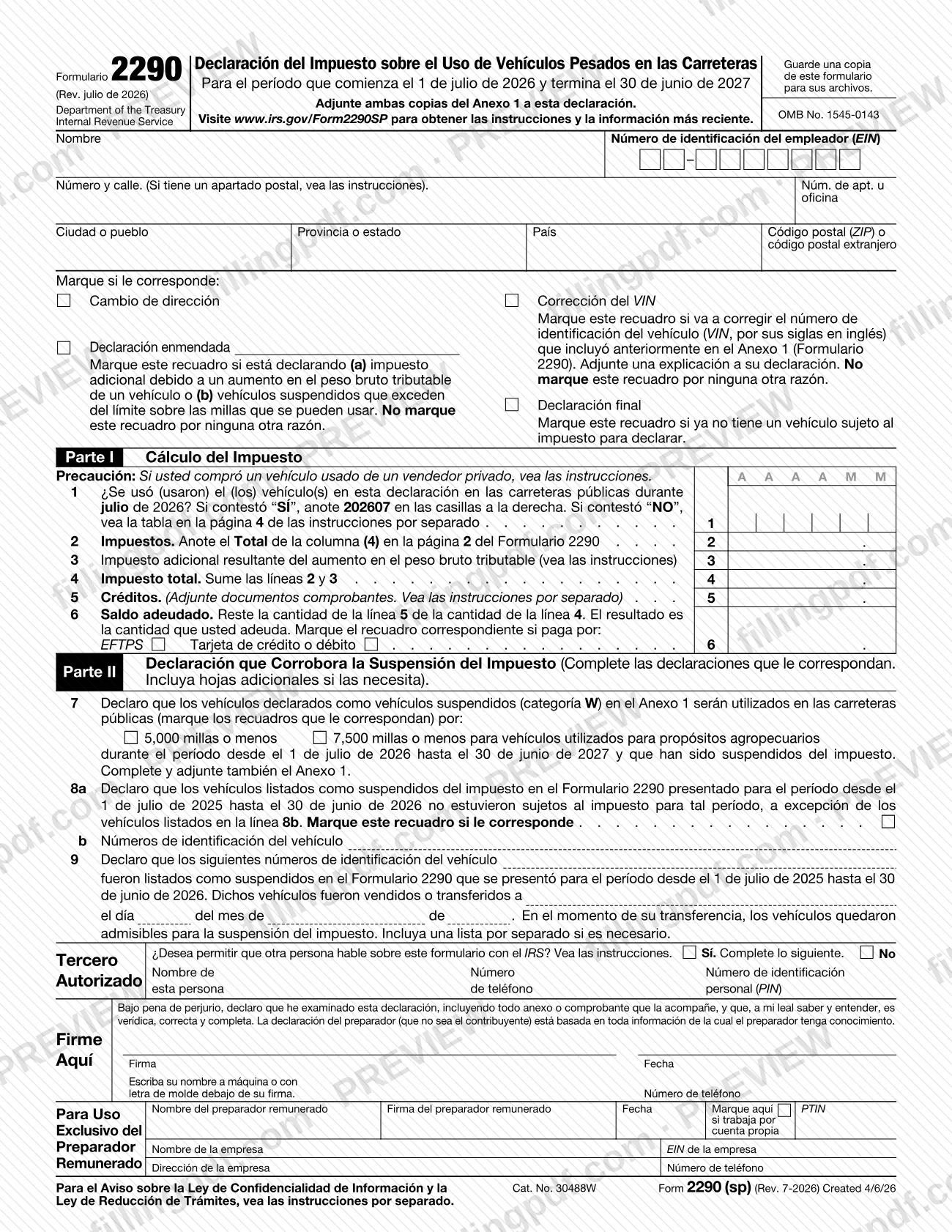
The printed form is titled Formulario 2290, Declaración del Impuesto sobre el Uso de Vehículos Pesados en las Carreteras, carries OMB No. 1545-0143 and covers the period beginning July 1, 2026 and ending June 30, 2027. The IRS warns on its cover sheet not to use this revision for a period that began on or before June 30, 2026.
According to the IRS instructions, the return is used to:
- figure and pay the tax on vehicles used on public highways during the period;
- pay additional tax when a vehicle's taxable gross weight increases and it moves to a different category;
- claim a suspension of the tax for vehicles expected to be used 5,000 miles or less (7,500 miles or less for agricultural vehicles);
- claim a credit for tax paid on vehicles that were destroyed, stolen, sold or used 5,000 miles or less (7,500 for agricultural vehicles).
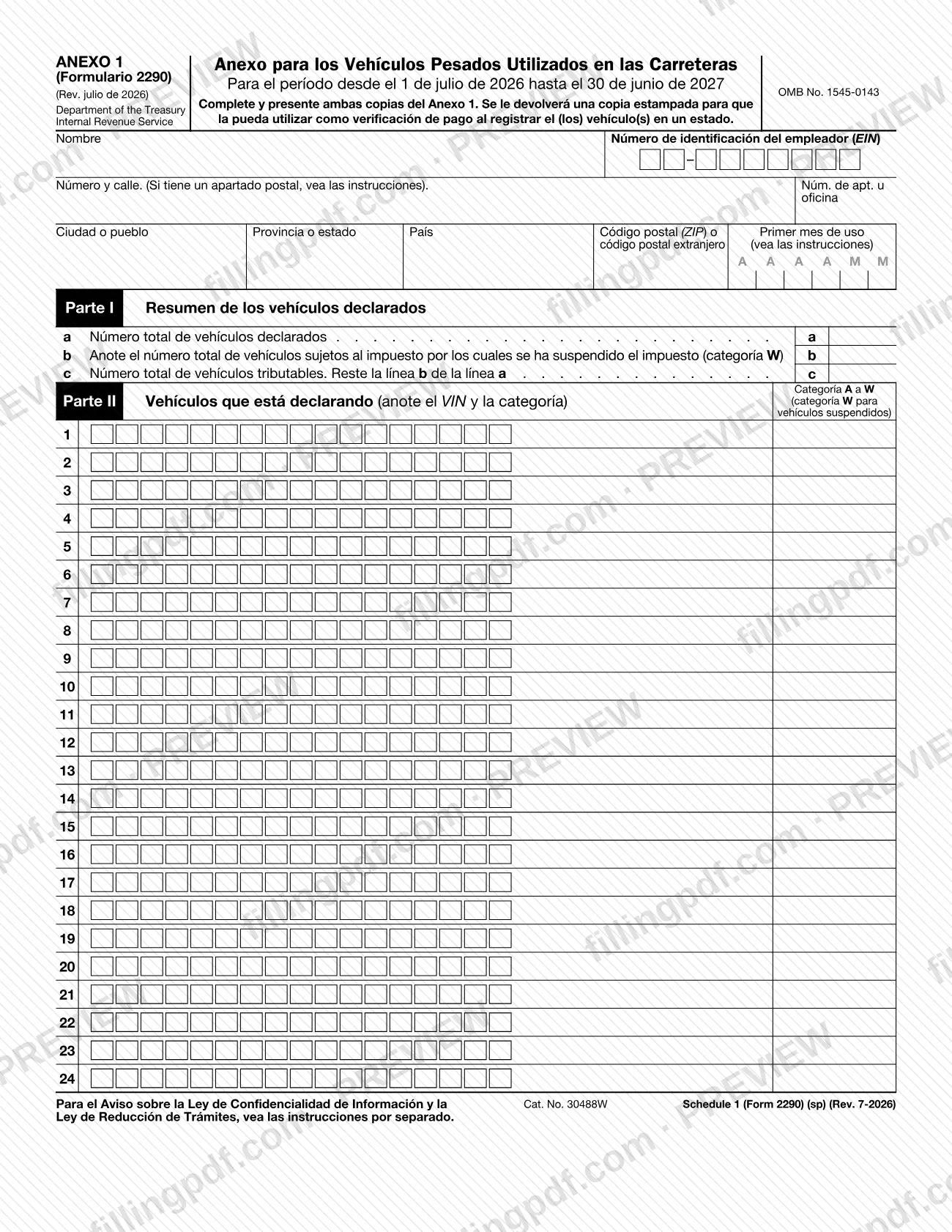
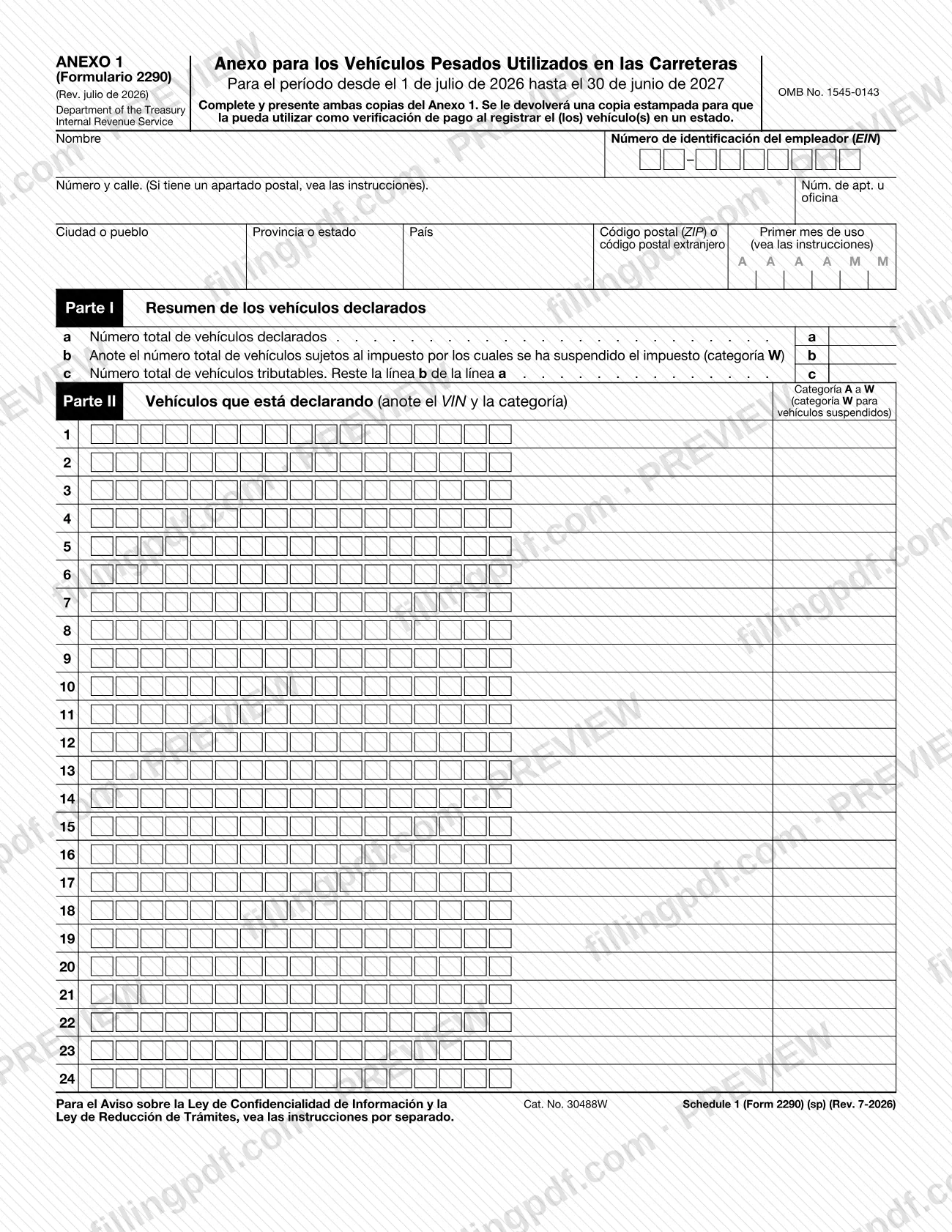
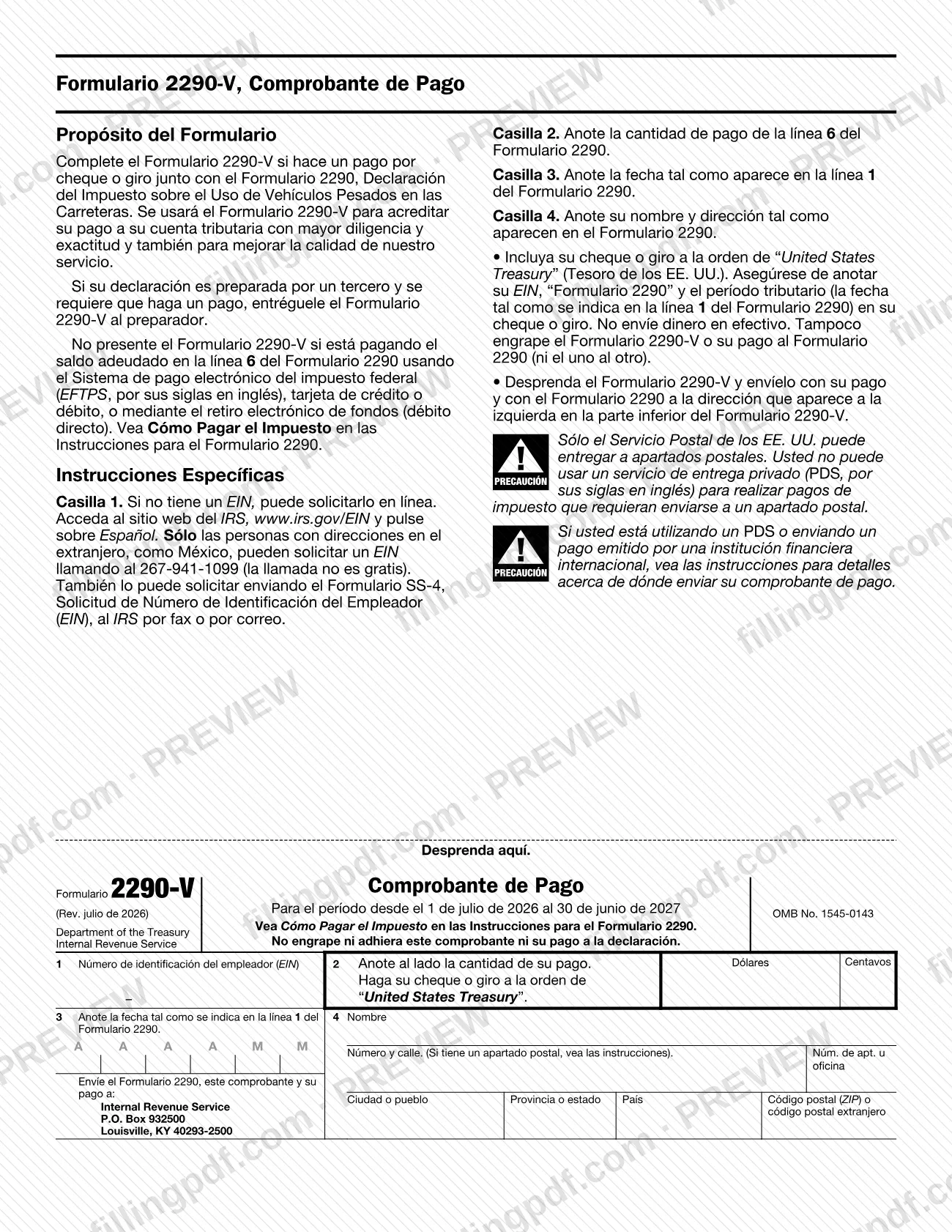
The package has companion pieces. Schedule 1 (Form 2290) lists every vehicle by VIN and category, and its stamped copy serves as proof of payment for state registration. Form 2290-V, Comprobante de Pago, is the payment voucher for checks and money orders. The Spanish version differs from the English Form 2290 in one practical way: the IRS instructions say that currently only the English Form 2290 can be filed electronically.
Who needs to file 2290 (sp)?
You file Form 2290 (sp), with Schedule 1, if a taxable motor vehicle with a taxable gross weight of 55,000 pounds or more is registered, or required to be registered, in your name under the law of a state, the District of Columbia, Canada or Mexico when it is first used on public highways during the tax period. The instructions say you may be an individual, LLC, corporation, partnership or other entity, including a nonprofit. You must have an employer identification number (EIN); a Social Security number cannot be used.
Other conditions from the instructions:
- If a vehicle is registered in the names of the owner and another person, the owner pays the tax. The same applies to a leased vehicle registered in two names.
- Qualified subchapter S subsidiaries and single-owner disregarded entities file and pay under the entity's own EIN.
- Logging vehicles use reduced tax rates; agricultural vehicles have a 7,500-mile suspension limit.
- File a final return if you no longer have a vehicle to report.
Use of a vehicle directly by the following is exempt and is not reported: the federal government, the District of Columbia, state or local governments, the American National Red Cross, nonprofit volunteer fire departments, ambulance associations and rescue squads, certain Native American tribal governments, and qualifying public transit authorities. Qualified blood-collection vehicles and certain mobile machinery are also excluded. Taxpayers who pay tax on 25 or more vehicles must file electronically, which currently means the English Form 2290.
When to file 2290 (sp)
File Form 2290 (sp) for each month in which a taxable vehicle is first used on public highways during the period, no later than the last day of the month after that first-use month. This revision covers July 1, 2026 to June 30, 2027. If the due date falls on a Saturday, Sunday or legal holiday, file on the next business day.
If you first use vehicles in more than one month, file a separate Form 2290 for each month. The due date is not tied to your state registration renewal date. The IRS instructions (Rev. July 2025) give the due-date table for the 2025–2026 period; for the 2026–2027 period, check the current instructions at www.irs.gov/Form2290SP.
Before the due date you can request an extension of time to file by writing to the Internal Revenue Service, 7940 Kentucky Drive, Florence, KY 41042-2915, explaining the cause of the delay. Except for taxpayers abroad, it cannot exceed 6 months, and it does not extend the time to pay. For an increase in taxable gross weight, file the amended return by the last day of the month after the increase. For a suspended vehicle that exceeds the mileage limit, the same deadline applies.
Documents you need
- Schedule 1 (Form 2290), both copies, listing each vehicle's full VIN and category; the IRS returns a stamped copy as proof of payment, and the return can be rejected without Schedule 1.
- Form 2290-V, Comprobante de Pago, only if you pay by check or money order; not needed when you pay by EFTPS, credit or debit card, or electronic funds withdrawal.
- Check or money order payable to "United States Treasury" with your EIN, "Formulario 2290" and the period date from line 1, when paying by check; do not staple it.
- For credits on line 5: a separate sheet explaining the facts, with VIN, weight category, date of the accident, theft or sale, a copy of the credit worksheet, and the buyer's name and address for sales on or after July 1, 2015.
- For a weight increase on line 3: a copy of the worksheet in the instructions, one for each vehicle, with the amended return box checked.
- For a VIN correction: an explanation attached to the return, with the correct VIN written on Schedule 1.
- For a vehicle bought from a seller who suspended its tax (line 9): the seller's written statement with name, address, EIN, VIN, sale date and odometer readings.
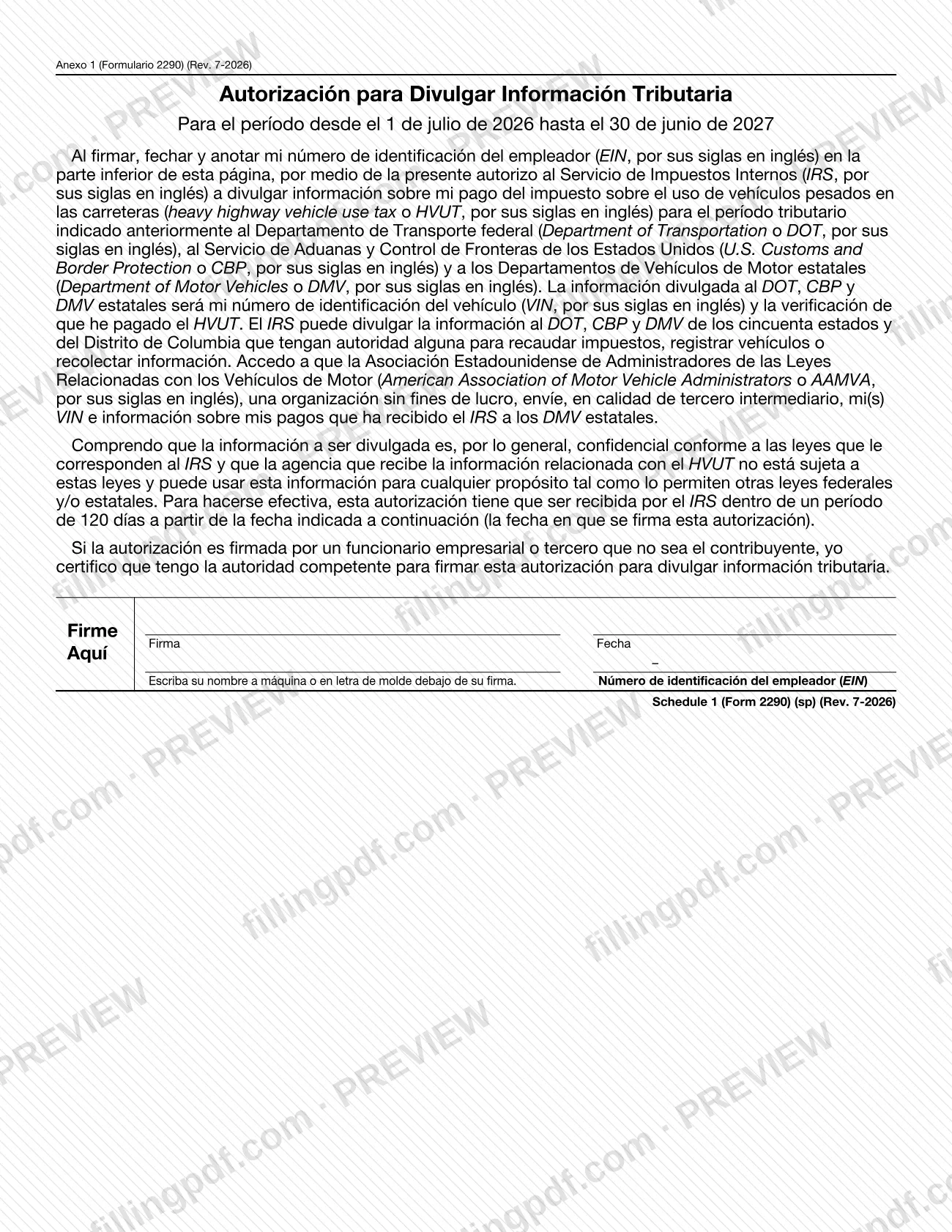
- Signed Autorización para Divulgar Información Tributaria (Schedule 1), only if you agree to let the IRS share your VINs and payment verification with the DOT, CBP and state DMVs.
How to fill out 2290 (sp)
Confirm the revision and tax period
This form is for the period from July 1, 2026 to June 30, 2027. Do not use it for a period that began on or before June 30, 2026; get the earlier revision at www.irs.gov/Form2290SP.
Enter name, EIN and address
Fill in Nombre, Número de identificación del empleador (EIN), and your full physical address. Use a P.O. box number only if the post office does not deliver mail to your address; for Mexico or Canada, use their postal codes and do not abbreviate the country.
Mark the special-case boxes
Check only what applies: Cambio de dirección, Corrección del VIN (attach an explanation), Declaración enmendada (only for added tax from a weight increase or suspended vehicles over the mileage limit) or Declaración final.
Enter the first month of use on line 1
If the vehicles were used on public highways during July 2026, enter 202607 in the YYYYMM boxes. If not, use the table on page 4 of the separate instructions to find the code.
Complete the tax computation on page 2
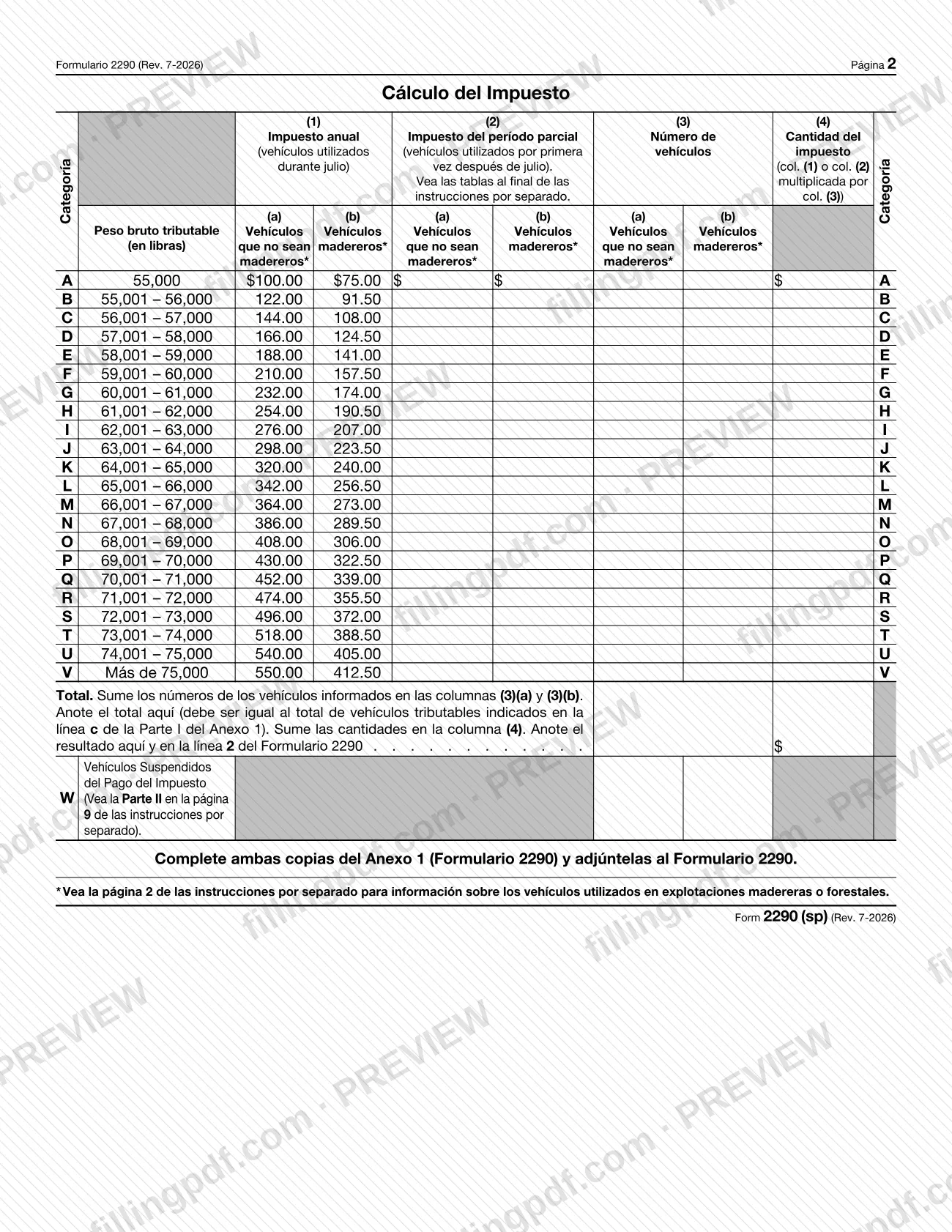
For each category A to V, enter the number of vehicles in column (3)(a) or (b) and multiply by the rate in column (1) or (2); logging vehicles use the (b) columns. Enter suspended vehicles under category W. The total vehicle count must equal line c of Part I of Schedule 1.
Fill in lines 2 through 4
Line 2: the column (4) total from page 2. Line 3: additional tax from a gross-weight increase only, using the instructions' worksheet. Line 4: add lines 2 and 3.
Claim credits on line 5
Complete line 5 only for a vehicle sold, destroyed or stolen before June 1 and not used for the rest of the period, or used 5,000 miles or less (7,500 for agricultural vehicles). The credit cannot exceed line 4; attach supporting documents.
Figure the balance due on line 6
Subtract line 5 from line 4. Check EFTPS or Tarjeta de crédito o débito if you pay that way; if paying by check or money order, complete Form 2290-V.
Complete Part II for suspended vehicles
Line 7: check 5,000 miles or less, or 7,500 or less for agricultural use, for category W vehicles listed on Schedule 1. Line 8a: check if the prior-period suspended vehicles did not exceed the limit, listing exceptions on line 8b. Line 9: list VINs sold or transferred, with the date.
Designate a third party if wanted
In the Tercero Autorizado section, check Sí and enter the person's name, phone number and five-digit PIN if you want the IRS to discuss this return with them. The authorization applies only to this return.
Sign the return
Sign and date under penalties of perjury and give a phone number. A paid preparer also completes the preparer section, including PTIN, and signs.
Complete both copies of Schedule 1
Enter name, address, EIN and Primer mes de uso exactly as on Form 2290. In Part I give totals on lines a, b and c; in Part II list each full VIN and its category A to W. Sign and date the Autorización para Divulgar Información Tributaria if you agree.
Review and download the completed PDF
Check that names, EIN, first month of use and VINs match on every page. Download or print the completed PDF from FillingPDF, keep a copy, and assemble the package described under How to submit.
How to submit 2290 (sp)
A paper Form 2290 (sp) goes by mail to the IRS; you can also hand it to a participating state DMV. The IRS instructions (Rev. July 2025) say only the English Form 2290 can currently be e-filed, through IRS e-file providers for excise taxes.
- Mail, with a check or money order: Internal Revenue Service, P.O. Box 932500, Louisville, KY 40293-2500. Include Form 2290-V, both copies of Schedule 1 and your payment.
- Mail, without payment or paid by EFTPS or credit/debit card: Department of the Treasury, Internal Revenue Service, Ogden, UT 84201-0031.
- Check from an international financial institution: Internal Revenue Service, International Accounts, 1973 Rulon White Blvd., Ogden, UT 84201-0038.
- Private delivery service: certain IRS-designated services count as timely filing. Use the Ogden Processing Center street address listed at IRS.gov/PDSstreetAddresses. Private services cannot deliver to a P.O. box; only the U.S. Postal Service can.
- State DMV: in states that participate in the alternate proof-of-payment program, you can give the DMV the return, payment and voucher. The return is not filed until the IRS receives it.
Payment options are EFTPS, credit or debit card at IRS.gov/PagueConTarjeta (the card processors charge a service fee), or check or money order payable to "United States Treasury". Do not staple the voucher or payment to the return. For questions, call the Form 2290 phone center at 866-699-4096 (toll-free) Monday to Friday, 8:00 a.m. to 6:00 p.m. Eastern. FillingPDF lets you fill out and download the PDF; submission follows the channels above.
Common mistakes to avoid
- Filing without Schedule 1 or with only one copy; the instructions require both copies and say the return may be rejected if Schedule 1 is missing.
- Using a Social Security number instead of an EIN; the instructions say you must have an EIN to file.
- Entering an incomplete VIN on Schedule 1, or the trailer's VIN instead of the vehicle's; a partial VIN can prevent state registration.
- Checking the Declaración enmendada box for any reason other than added tax from a gross-weight increase or suspended vehicles over the mileage limit.
- Reporting added tax from a weight increase on line 2 instead of line 3.
- Sending Form 2290-V when paying by EFTPS, card or electronic withdrawal, or stapling the voucher or check to the return.
- Using a private delivery service for a P.O. box address; only the U.S. Postal Service delivers there.
- Assuming the due date follows your state registration renewal; the return is due the last day of the month after first use.
- Mailing an unsigned return, which is not considered properly filed and is sent back for signature.
- Using this July 2026 revision for a period that began on or before June 30, 2026.
Frequently asked questions
What is the difference between Form 2290 and Form 2290 (sp)?
Form 2290 (sp) is the IRS Spanish-language edition of Form 2290, the Heavy Highway Vehicle Use Tax Return. The instructions say that currently only the English Form 2290 can be filed electronically, so the Spanish version is a paper return.
Who has to file Form 2290 (sp)?
Anyone in whose name a taxable vehicle with a taxable gross weight of 55,000 pounds or more is registered, or required to be registered, when it is first used on public highways in the period. Exempt users, such as state or local governments, do not report that use.
When is Form 2290 (sp) due?
By the last day of the month after the month the vehicle was first used on public highways during the period, or the next business day if that date is a weekend or holiday. File a separate return for each first-use month. The date is not tied to state registration.
Where do I mail Form 2290 (sp)?
With a check or money order, mail it to Internal Revenue Service, P.O. Box 932500, Louisville, KY 40293-2500. Without payment, or if you pay by EFTPS or card, mail it to Department of the Treasury, Internal Revenue Service, Ogden, UT 84201-0031.
Do I need an EIN to file Form 2290 (sp)?
Yes. The instructions say you must have an employer identification number and cannot use a Social Security number. You can apply online at IRS.gov/EIN, or by mail or fax with Form SS-4. Only applicants with foreign addresses can apply by phone.
Do I have to attach Schedule 1 to Form 2290 (sp)?
Yes. Complete and file both copies of Schedule 1 (Form 2290) with the return. The IRS stamps the second copy and returns it as proof of payment for state registration. The return may be rejected if Schedule 1 is not attached.
Can I fill out Form 2290 (sp) online on FillingPDF?
Yes. You can fill out the fillable PDF online on FillingPDF and download or print it. FillingPDF is an independent service and does not file the return or accept payment; you mail it to the IRS or submit it through the channels the IRS lists.
What happens if I file or pay late?
The IRS may assess penalties for late filing or late payment. If you believe you had reasonable cause, send the IRS a letter explaining why, or visit IRS.gov/PenaltyRelief. Do not attach that explanation when you file Form 2290.
Ready to fill out 2290 (sp)?
Fill out 2290 (sp) now