

Form 2350 (sp), Application for Extension of Time to File U.S. Income Tax Return (Spanish Version), is the Spanish-language edition of the form the Internal Revenue Service (IRS) publishes for 2025 so that U.S. citizens and resident aliens living abroad can ask for more time to file their income tax return. It is meant for people who expect to qualify for special tax treatment, such as the foreign earned income exclusion, only after the return's due date. On this page you can fill out the form online on FillingPDF and download or print the completed PDF; the original PDF and the latest information are published by the IRS at www.irs.gov/Form2350SP.
Last updated
What is 2350 (sp)?
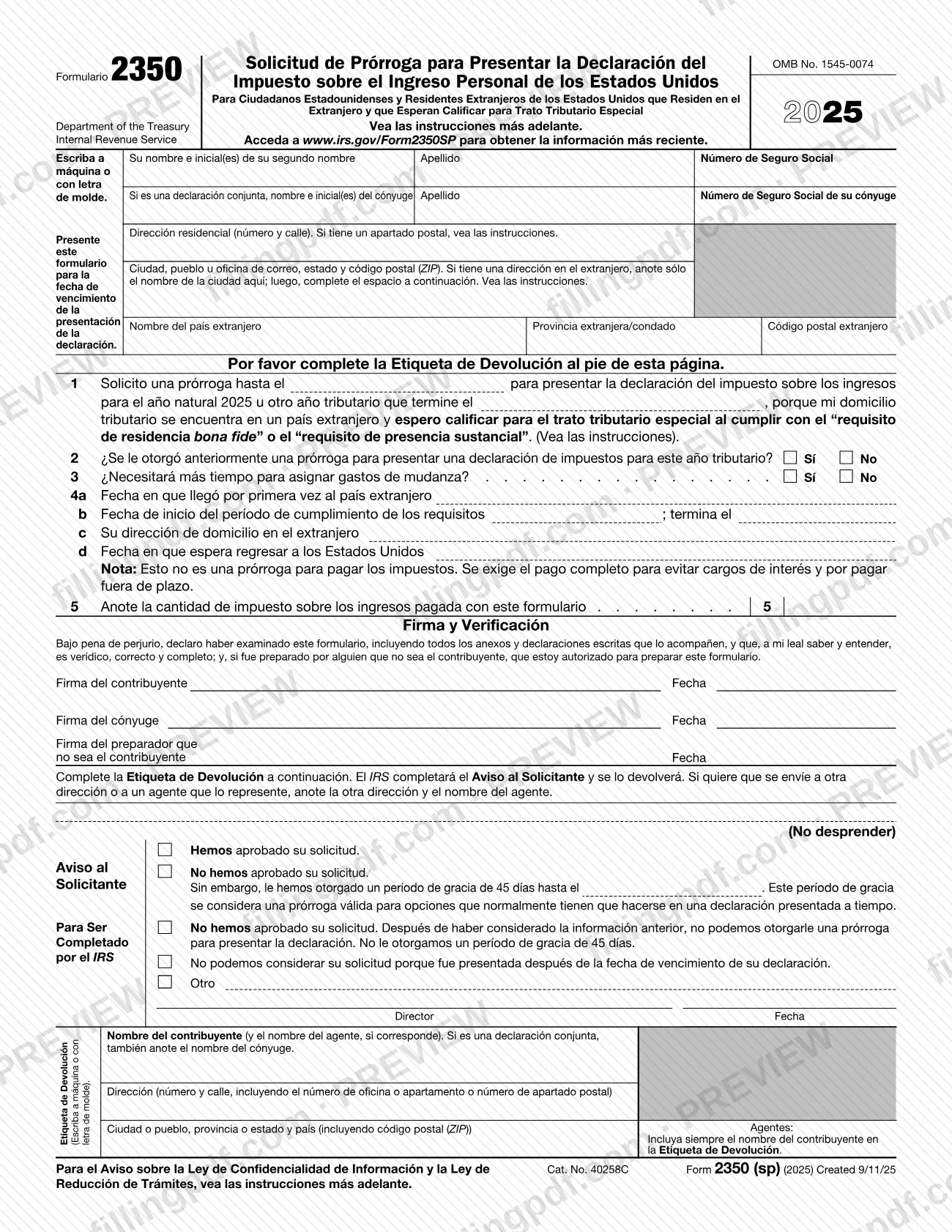
Form 2350 (sp) is the Spanish-language IRS form that U.S. citizens and resident aliens living abroad use to request extra time to file their income tax return while they work toward the bona fide residence test or the physical presence test.
The form is the Spanish version of Form 2350. Its printed text and its instructions are in Spanish, it carries OMB No. 1545-0074, and the edition on this page is marked 2025. The IRS instructions say to use it only if you believe you will file Form 2555 and need time to meet one of those two tests, so you can claim the foreign earned income exclusion and/or the foreign housing exclusion or deduction.
The form does not extend the time to pay tax. The IRS fills in a Notice to Applicant at the bottom of the page and returns it to you through the Return Label you complete. The notice says one of four things: the request is approved; it is not approved but a 45-day grace period is granted; it is not approved and no grace period is given; or it cannot be considered because it was filed after the return's due date.
Everyone else who needs more time files Form 4868, Application for Automatic Extension of Time To File U.S. Individual Income Tax Return, according to the instructions. The IRS also publishes the form's information at www.irs.gov/Form2350SP.
Who needs to file 2350 (sp)?
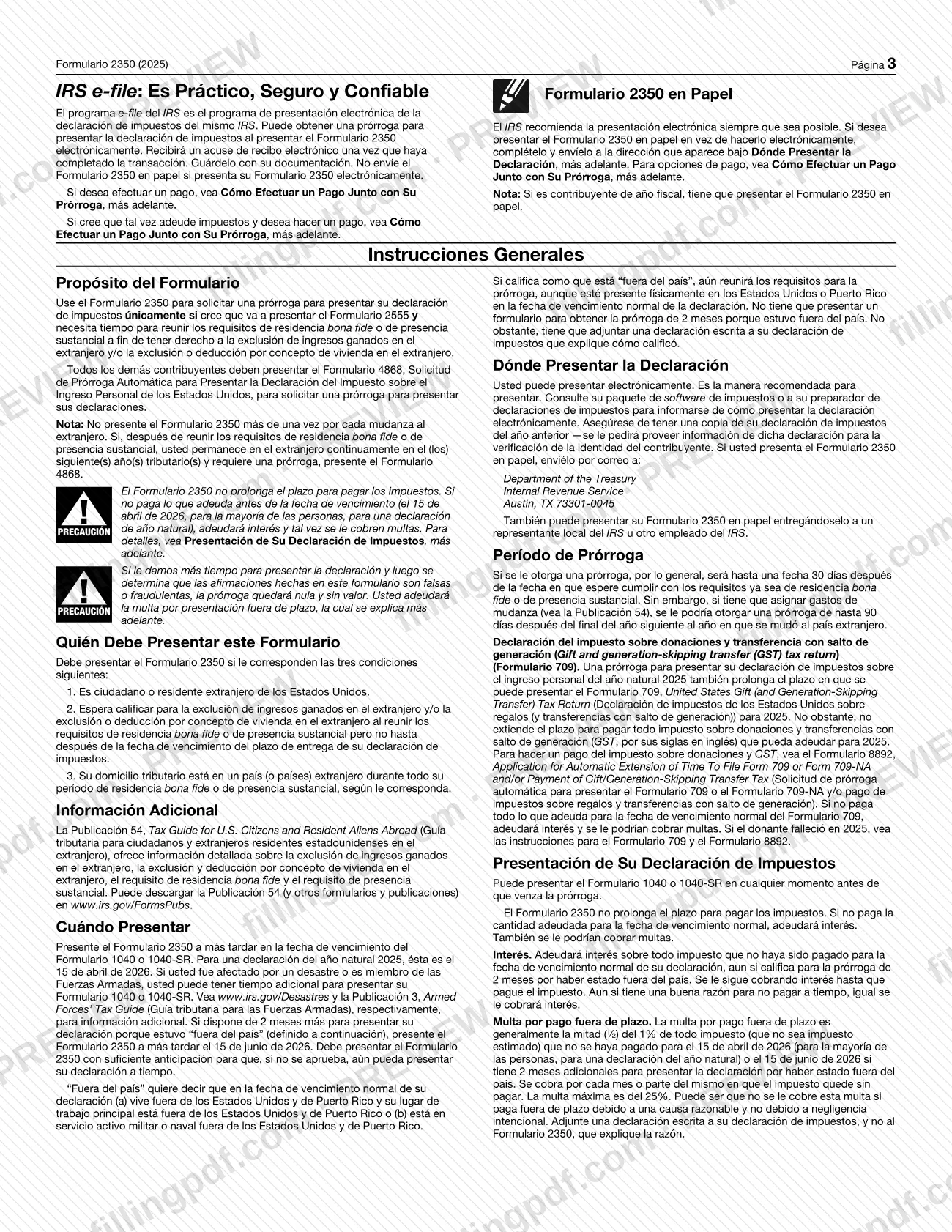
You must file Form 2350 (sp) if all three conditions in the IRS instructions apply to you:
- You are a U.S. citizen or resident alien.
- You expect to qualify for the foreign earned income exclusion and/or the foreign housing exclusion or deduction by meeting the bona fide residence test or the physical presence test, but not until after the due date for filing your return.
- Your tax home is in a foreign country (or countries) throughout your period of bona fide residence or physical presence, as applicable.
Do not use this form if you do not expect to file Form 2555 and need the time to meet those tests. All other taxpayers file Form 4868. Do not file Form 2350 more than once for each move abroad: if you stay abroad continuously in later tax years after meeting a test and need more time, file Form 4868.
If you are "out of the country" on the regular due date, you get an automatic 2-month extension without filing any form, but you must attach a written statement to your return explaining how you qualified. Fiscal-year taxpayers must file Form 2350 on paper.
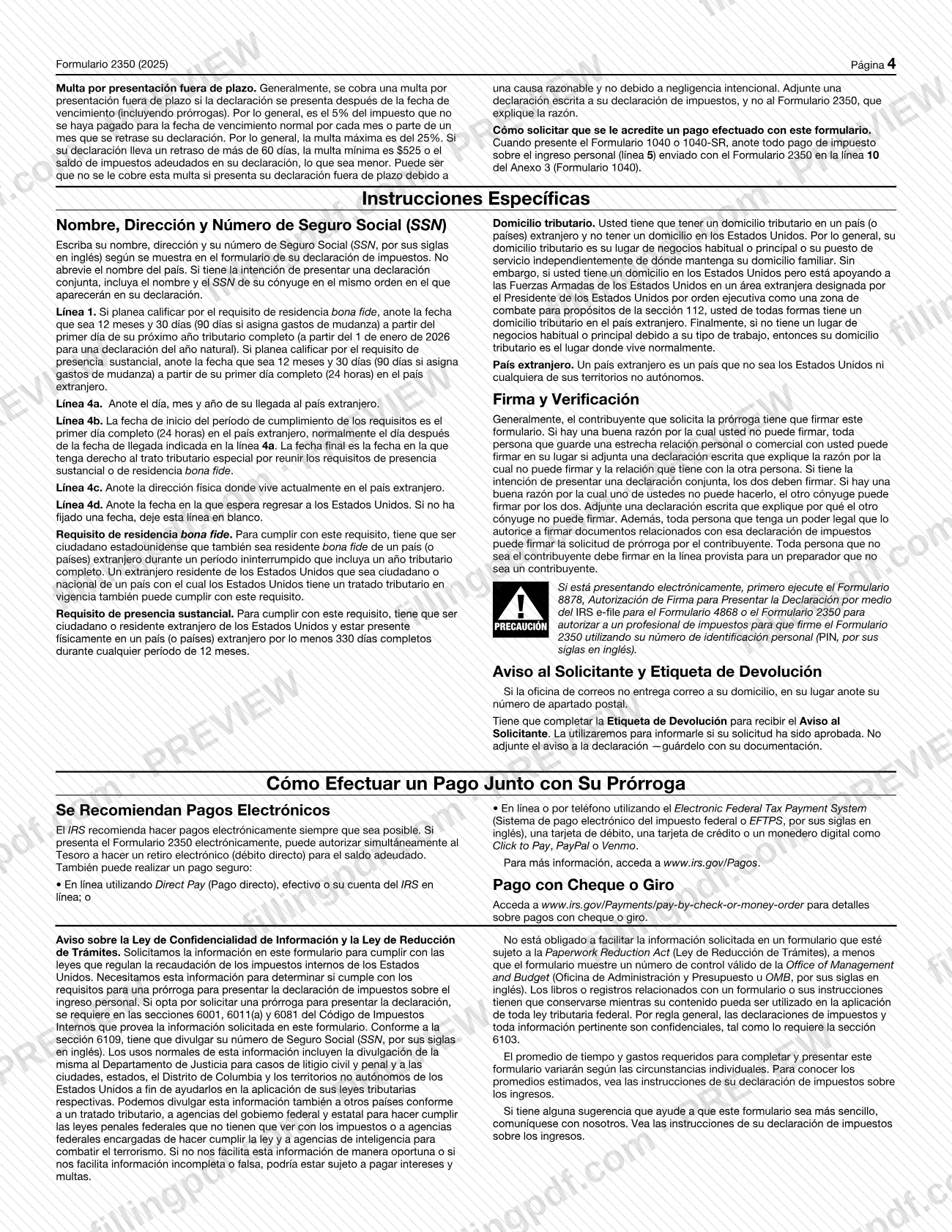
Signing: the taxpayer generally signs, and both spouses sign a joint request. Someone with a close personal or business relationship may sign if the taxpayer cannot, with an attached written statement giving the reason and the relationship. A person holding a power of attorney for the return may also sign, on the preparer line.
When to file 2350 (sp)
File Form 2350 (sp) no later than the due date of Form 1040 or 1040-SR. For a 2025 calendar-year return, that date is April 15, 2026. If you get the 2 extra months because you are "out of the country", file the form by June 15, 2026. File early enough that, if the request is denied, you can still file your return on time.
If you are granted an extension, it generally runs until 30 days after the date you expect to meet the bona fide residence or physical presence test. If you must allocate moving expenses, you may be granted up to 90 days after the end of the year following the year you moved abroad. You can file Form 1040 or 1040-SR any time before the extension ends.
Taxpayers affected by a disaster or serving in the Armed Forces may have additional time; the instructions refer to www.irs.gov/Desastres and Publication 3. An extension of the 2025 income tax return also extends the time to file Form 709 for 2025, but not the time to pay any gift or generation-skipping transfer tax.
Documents you need
- Written statement explaining why you cannot sign and your relationship to the person signing for you, only if someone with a close personal or business relationship signs the form in your place.
- Written statement explaining why your spouse cannot sign, only if one spouse signs for both on an intended joint return.
- Form 8878, only if you file electronically and authorize a tax professional to sign Form 2350 with a PIN.
- Copy of your prior-year tax return, to have on hand when you e-file; the IRS asks for information from it to verify your identity.
How to fill out 2350 (sp)
Enter names and Social Security numbers
Type or print your name and Social Security number (SSN) as shown on your tax return. For a joint return, add your spouse's name and SSN in the same order they will appear on the return.
Enter your residence address
Write your street address and city, state and ZIP code. If your post office does not deliver to your home, enter a P.O. box. For a foreign address, enter only the city on the first line, then complete the foreign country, province or county, and postal code spaces; do not abbreviate the country.
Complete line 1, extension date
Enter the date you request and the tax year (calendar year 2025 or the year ending on the date you write). For bona fide residence, use the date 12 months and 30 days after the first day of your next full tax year; for physical presence, 12 months and 30 days after your first full 24-hour day abroad. Use 90 days instead of 30 if you allocate moving expenses.
Answer lines 2 and 3
Line 2: check Yes or No for whether you were previously granted an extension for this tax year. Line 3: check Yes or No for whether you will need more time to allocate moving expenses.
Enter arrival and qualifying dates
Line 4a: the day, month and year you first arrived in the foreign country. Line 4b: the first full 24-hour day abroad, usually the day after 4a, and the date you expect to qualify under either test.
Enter foreign address and return date
Line 4c: the physical address where you now live in the foreign country. Line 4d: the date you expect to return to the United States; leave it blank if you have not set one.
Enter any payment on line 5
On line 5, enter the amount of income tax you are paying with this form. The form is not an extension to pay, and later you report this payment on Schedule 3 (Form 1040), line 10.
Sign and date the form
Sign under the perjury statement; both spouses sign a joint request. If someone else signs for you, attach the required written statement, and a non-taxpayer signs on the paid-preparer line.
Complete the Return Label
Type or print the taxpayer's name (and the agent's name, if any), the street address or P.O. box, and the city, province or state and country with the postal code. The IRS completes the Notice to Applicant and returns it to this address.
Review and download the completed PDF
Check the dates on lines 1 and 4, the signatures and the Return Label. Download or print the completed PDF from FillingPDF and submit it through the channels described under How to submit.
How to submit 2350 (sp)
You can submit Form 2350 (sp) electronically, which the IRS recommends, or on paper by mail or by hand to an IRS representative.
- Electronically: use your tax software or tax preparer. Have a copy of your prior-year return, because you are asked for information from it to verify your identity. You get an electronic acknowledgment; keep it, and do not also mail a paper form. If a tax professional signs for you with a PIN, first complete Form 8878.
- By mail (paper): send it to Department of the Treasury, Internal Revenue Service, Austin, TX 73301-0045. Fiscal-year taxpayers must use paper.
- In person: you can hand the paper form to a local IRS representative or other IRS employee.
Complete the Return Label at the bottom of the form so the IRS can send back the Notice to Applicant; if it should go to another address or to an agent, enter that address and the agent's name. Keep the notice with your records and do not attach it to your return.
If you owe tax, a payment is not part of the extension itself, but the IRS recommends paying electronically: Direct Pay, cash, your IRS online account, EFTPS, a debit or credit card, or a digital wallet such as Click to Pay, PayPal or Venmo (www.irs.gov/Pagos). Check and money order details are at www.irs.gov/Payments/pay-by-check-or-money-order.
FillingPDF lets you fill out and download the PDF; submission follows the channels above.
Common mistakes to avoid
- Filing Form 2350 when you do not expect to file Form 2555 and need time to meet the bona fide residence or physical presence test; those taxpayers file Form 4868.
- Filing Form 2350 more than once for the same move abroad; for later years of continuous stay abroad, the instructions say to file Form 4868.
- Treating the extension as time to pay: the form does not extend the payment deadline, and interest runs on unpaid tax from the regular due date.
- Filing after the return's due date; the Notice to Applicant states that the IRS cannot consider a request filed late.
- Mailing a paper Form 2350 after filing it electronically, or e-filing as a fiscal-year taxpayer, who must file on paper.
- Leaving the Return Label blank, so the IRS cannot return the Notice to Applicant; agents must always include the taxpayer's name on it.
- Attaching the Notice to Applicant to your tax return instead of keeping it with your records.
- Abbreviating the foreign country name in the address, or entering a street address when the post office does not deliver mail to your home and a P.O. box is required.
- Putting a reasonable-cause explanation for late payment on Form 2350; the instructions say to attach it to the tax return.
- Signing a joint request with only one signature when there is no attached statement explaining why the other spouse cannot sign.
Frequently asked questions
What is Form 2350 (sp) used for?
Form 2350 (sp) is the Spanish version of the IRS application for extra time to file a U.S. income tax return. It is for citizens and resident aliens living abroad who expect to meet the bona fide residence or physical presence test after the regular due date and plan to file Form 2555.
Who must file Form 2350?
You must file it if you are a U.S. citizen or resident alien, you expect to qualify for the foreign earned income exclusion and/or foreign housing exclusion or deduction only after the return's due date, and your tax home is in a foreign country throughout your qualifying period.
When is Form 2350 (sp) due for 2025?
File it no later than the due date of Form 1040 or 1040-SR, which is April 15, 2026, for a 2025 calendar-year return. If you have the 2 extra months for being out of the country, file it by June 15, 2026.
Does Form 2350 give me more time to pay my taxes?
No. The form extends only the time to file. If you do not pay what you owe by the regular due date, you owe interest and may be charged penalties. Any payment you send with the form goes on line 5 and is credited later on Schedule 3 (Form 1040), line 10.
What is the difference between Form 2350 and Form 4868?
Form 2350 is only for people abroad who need time to meet the bona fide residence or physical presence test and expect to file Form 2555. All other taxpayers use Form 4868. Do not file Form 2350 more than once per move abroad; use Form 4868 afterward.
Can I fill out Form 2350 (sp) online on FillingPDF?
Yes. You can fill out the fillable PDF online on FillingPDF and download or print it. FillingPDF is an independent service and does not file the form for you; you submit it to the IRS by e-file, mail or in person with an IRS representative.
Where do I mail Form 2350 on paper?
Mail it to Department of the Treasury, Internal Revenue Service, Austin, TX 73301-0045, or hand it to a local IRS representative. The IRS recommends e-filing, and you should not mail a paper copy if you filed electronically. Fiscal-year taxpayers must file on paper.
How long is the extension if the IRS approves Form 2350?
Generally until 30 days after the date you expect to meet the bona fide residence or physical presence test. If you must allocate moving expenses, it can be up to 90 days after the end of the year following the year you moved abroad.
What happens if the IRS denies my Form 2350 request?
The Notice to Applicant tells you whether you were denied with or without a 45-day grace period. File your return on time anyway: the instructions say to submit the form early enough that you can still file on time if it is not approved.
Ready to fill out 2350 (sp)?
Fill out 2350 (sp) now