
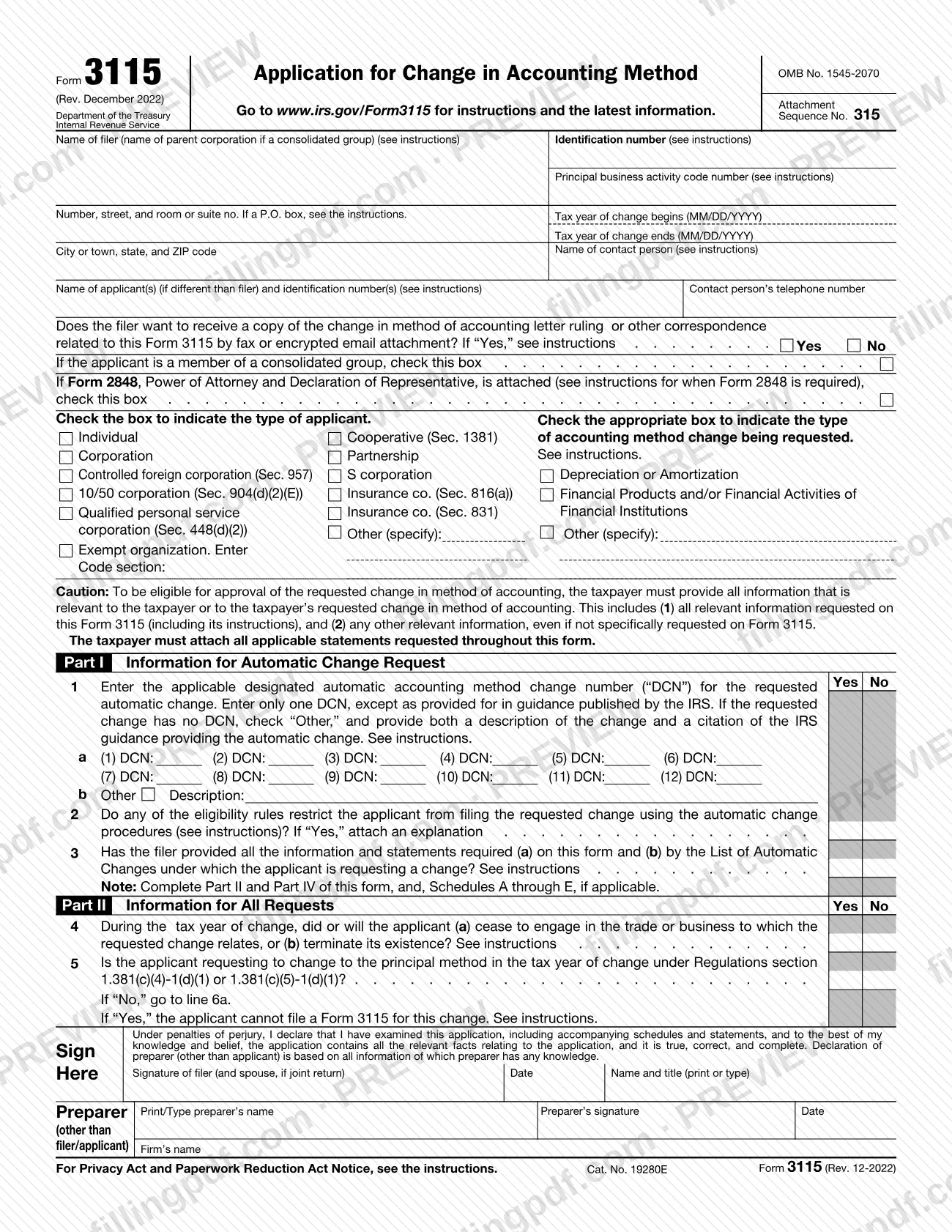
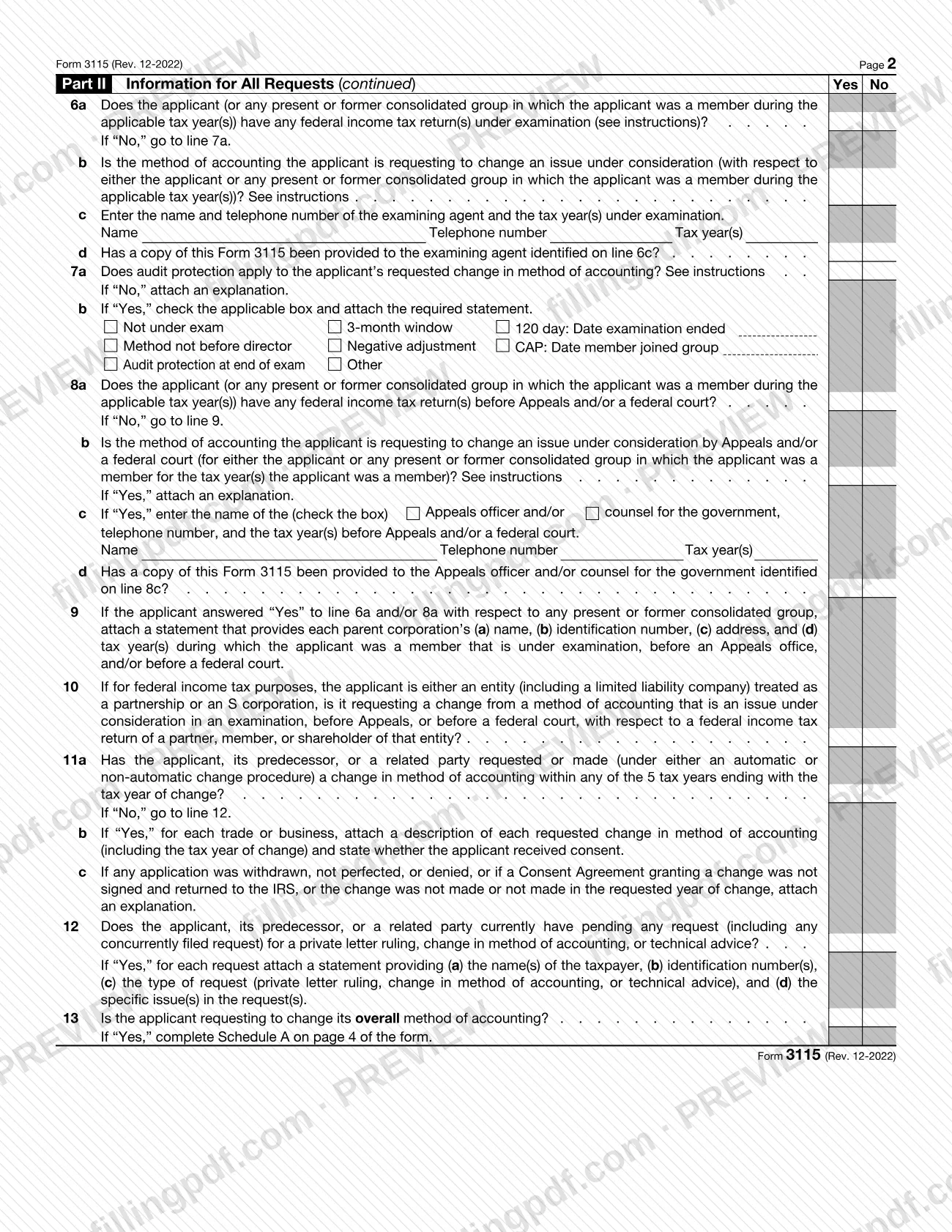
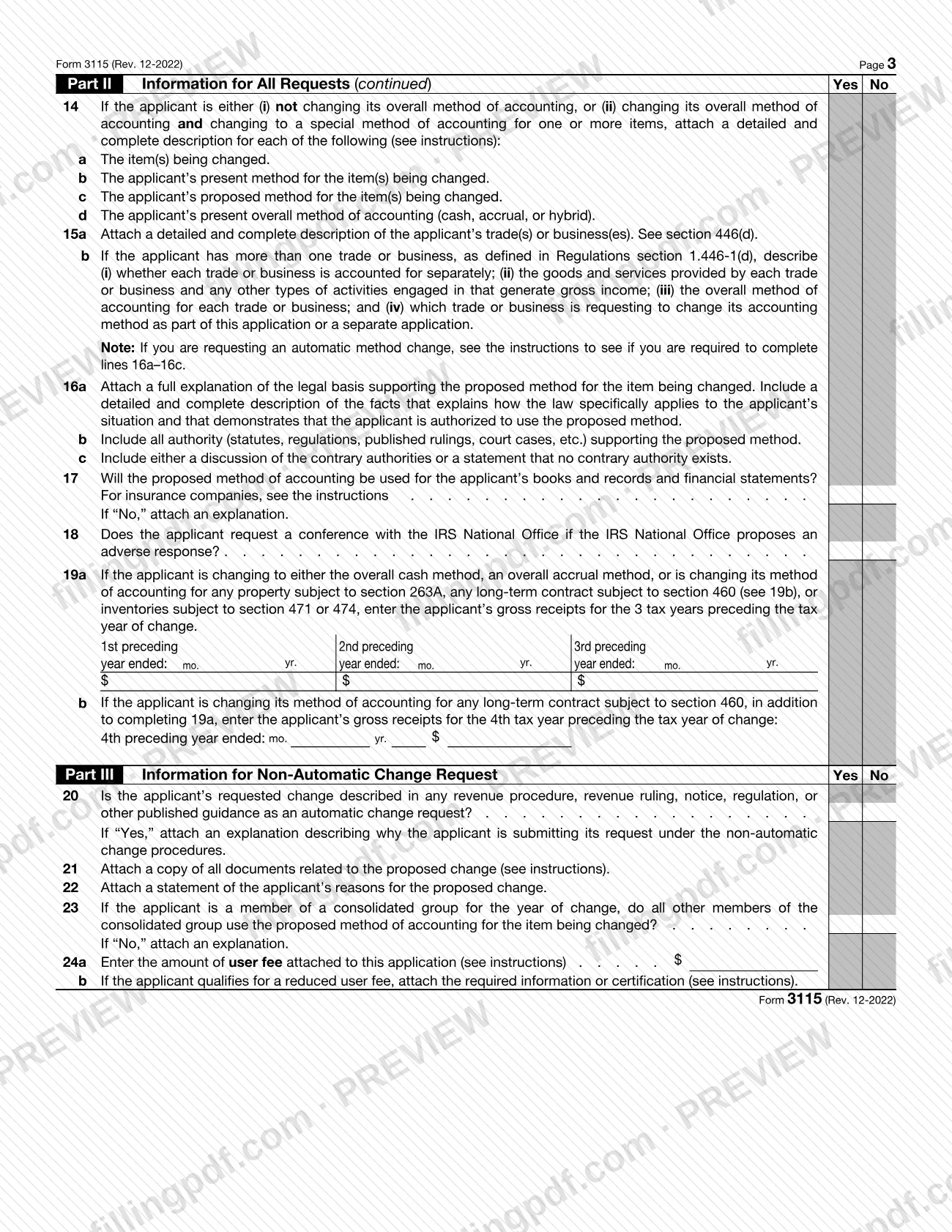
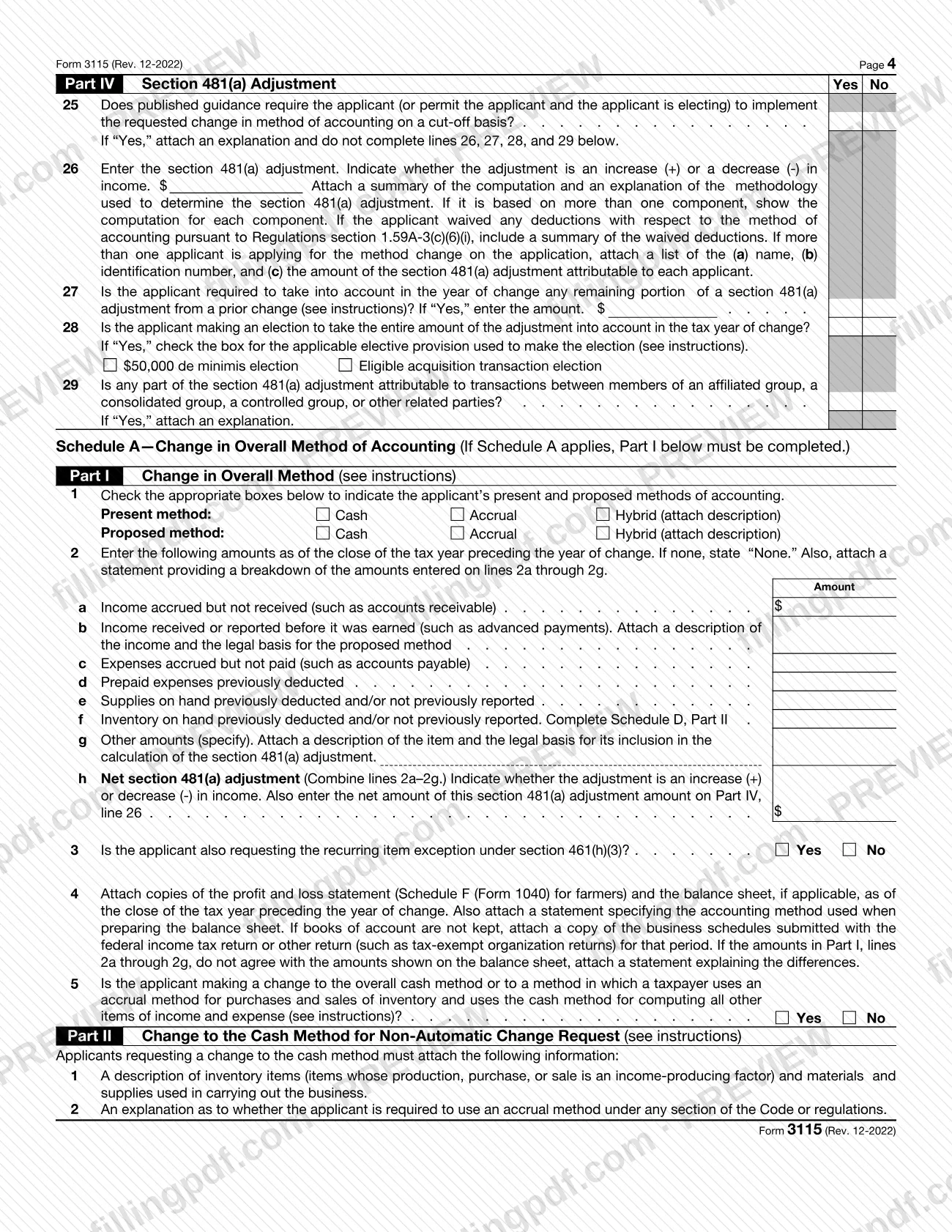
Form 3115 is the Internal Revenue Service (IRS) application for changing an accounting method, whether the change affects your overall method or the treatment of a single item. A business, individual, estate, trust or exempt organization uses it under either the automatic or the non-automatic change procedures, and the form is built around that choice. On this page you can fill out Form 3115 online on FillingPDF and download or print the completed PDF; the IRS publishes the form and its instructions at www.irs.gov/Form3115.
Last updated
What is Form 3115?
Form 3115, Application for Change in Accounting Method, is the IRS form used to request a change in either an overall accounting method or the accounting treatment of any item, under the automatic or the non-automatic change procedures.
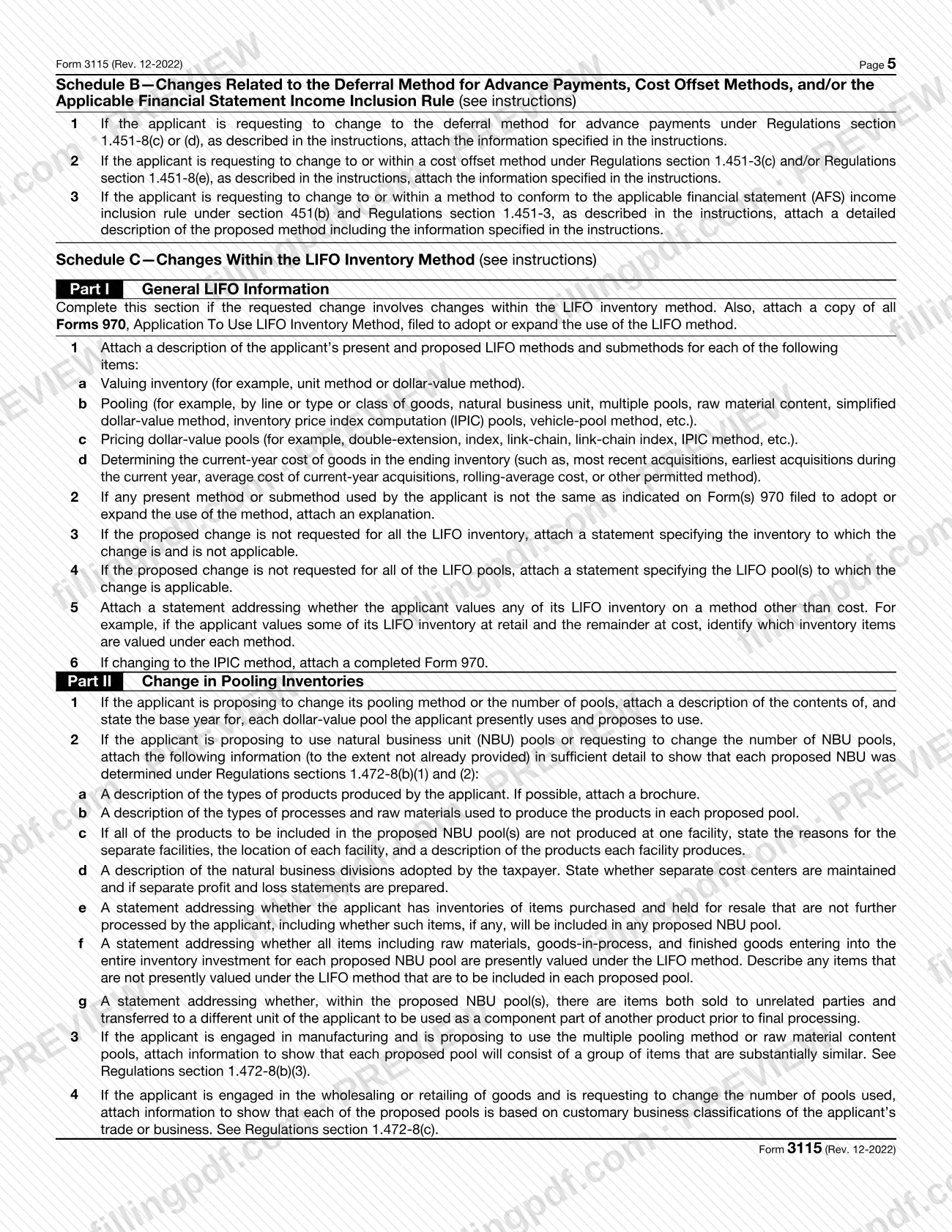
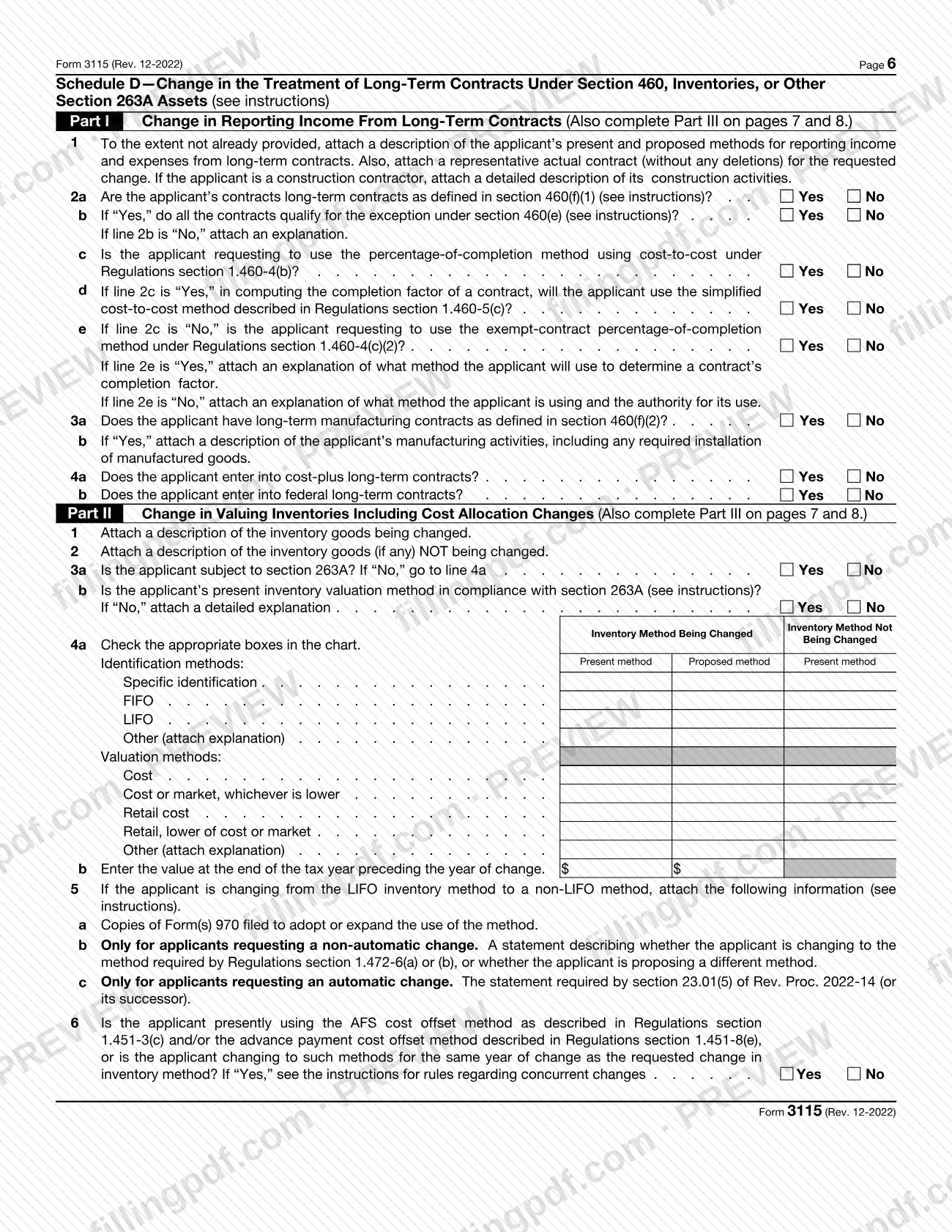
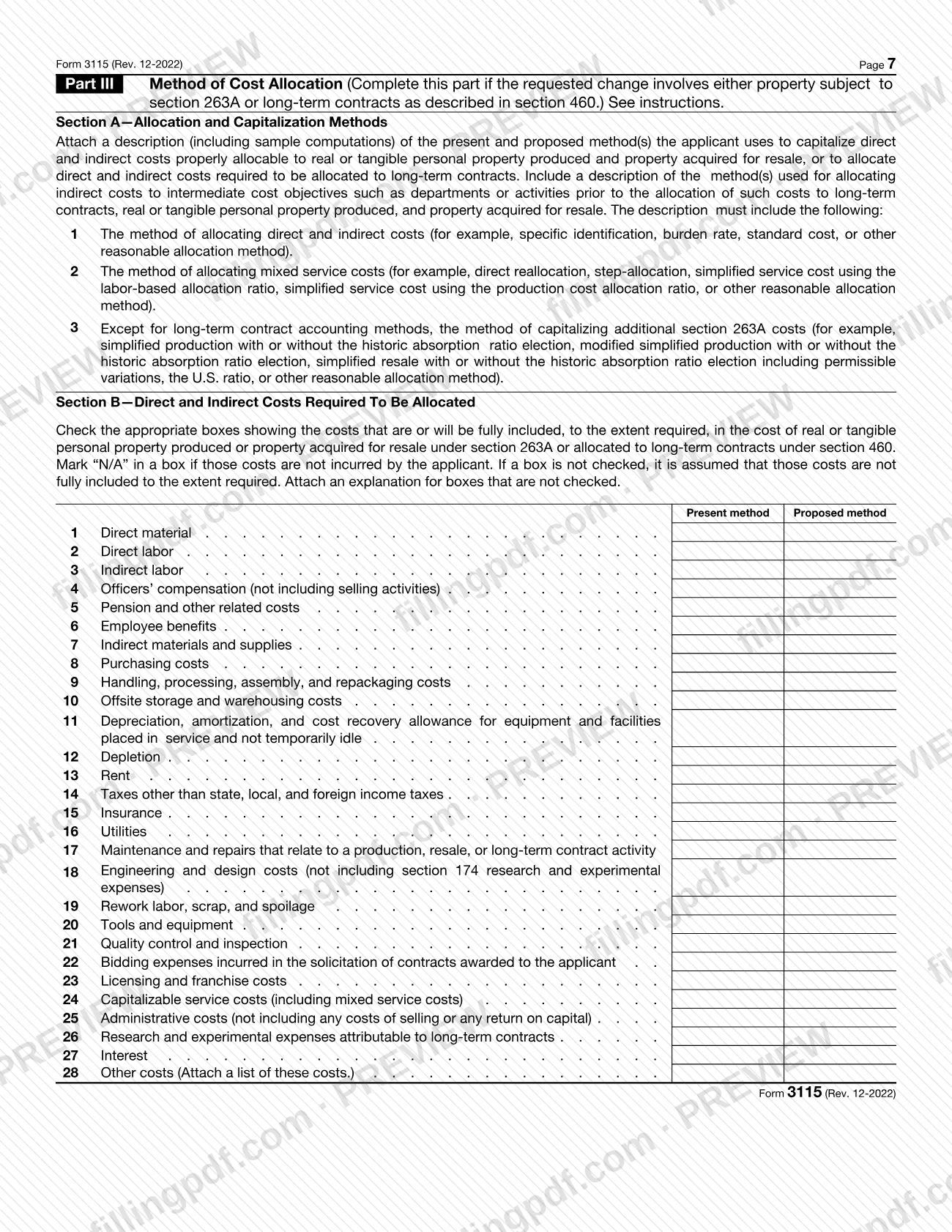
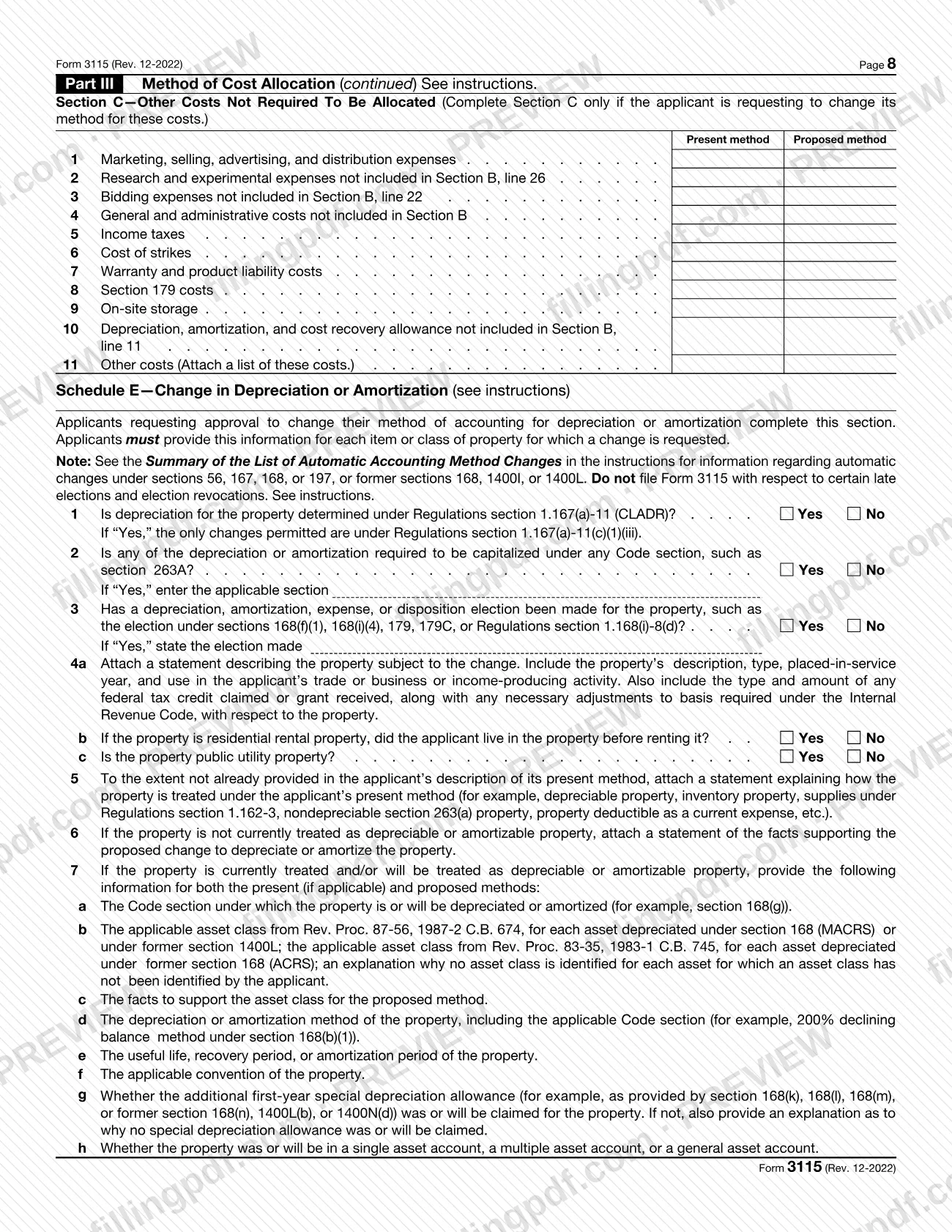
The form is divided by purpose. Part I applies only to automatic change requests and asks for the designated automatic accounting method change number (DCN). Part II applies to all requests and covers examinations, Appeals, prior changes, pending rulings, and the description and legal basis of the change. Part III applies to non-automatic requests. Part IV reports the section 481(a) adjustment. Schedules A through E collect extra information for specific changes: overall method, advance payments and cost offset methods, LIFO, long-term contracts and inventories, and depreciation or amortization.
An automatic change that is timely filed and follows the automatic procedures is granted consent, subject to IRS review. A non-automatic change that the IRS National Office approves results in a letter ruling. The form carries OMB No. 1545-2070 and is accompanied by the Instructions for Form 3115, which list the DCNs and refer to Rev. Proc. 2015-13, Rev. Proc. 2022-14 and Rev. Proc. 2023-1 for the underlying procedures.
The form states that the taxpayer must supply all relevant information and all applicable statements, even those not specifically requested.
Who needs to file Form 3115?
The filer is the entity or person required to file Form 3115, on its own behalf or for another entity. The applicant is the entity, person, or separate and distinct trade or business whose accounting method is being changed. You use the form if you want consent to change an overall method or the treatment of any item.
- Consolidated groups: the common parent corporation files for itself and for any member.
- Separate Forms: generally, each applicant and each separate trade or business needs its own Form 3115 (with a user fee for non-automatic requests). Identical changes for certain related entities, group members, or separate trades or businesses may be combined on one form, as the instructions list.
- Automatic changes: the instructions say you must use the automatic procedures if you are eligible for them for the requested year of change.
- Non-automatic changes: not available if the change must be made under a published automatic procedure, or, with exceptions, if the year of change is the final year of the trade or business.
You cannot file Form 3115 if you answer "Yes" on line 5 (changing to the principal method under Regulations section 1.381(c)(4)-1(d)(1) or 1.381(c)(5)-1(d)(1)).
The signer depends on the filer: both spouses on a joint return, an officer for a corporation, a general partner or LLC member for a partnership, a fiduciary for an estate or trust. A preparer who is not the filer also signs. Your representative needs Form 2848 attached for the IRS to discuss the form with them.
When to file Form 3115
The deadline depends on the procedure.
Automatic change: attach the original to the filer's timely filed federal income tax return (including extensions) for the year of change. File the signed duplicate copy with the IRS National Office no earlier than the first day of the year of change and no later than the date the original is filed with the return.
Non-automatic change: file during the tax year for which the change is requested, unless published guidance says otherwise. The instructions advise filing as early as possible in the year of change so the IRS can respond before the return due date.
Late filing: the IRS generally does not extend the time to file except in unusual and compelling circumstances, under Regulations section 301.9100-3. An automatic 6-month extension from the return due date (excluding extensions) may be available for automatic change requests.
The IRS normally sends an acknowledgment within 60 days for a non-automatic request. It sends none for automatic requests.
Documents you need
- Form 2848, Power of Attorney and Declaration of Representative, if the contact person is not authorized to sign or if your representative will discuss the form with the IRS or receive correspondence.
- A statement requesting correspondence by fax with the contact person's fax number, if you answer "Yes" to the fax or encrypted email question on page 1.
- A statement requesting encrypted email correspondence naming the encryption method, with any needed memorandums of understanding, if you want that service.
- A schedule listing each applicant and its identification number, if one Form 3115 covers multiple applicants; a "SIGNATURE ATTACHMENT" if several signatures are required.
- An explanation for "Yes" answers where the form asks for one, such as line 2 (eligibility restrictions), line 7a "No" and lines 8b and 12.
- A statement for the section 481(a) adjustment on line 26: a summary of the computation and methodology, and a list per applicant if more than one applies.
- For non-automatic changes: a legal-basis explanation with supporting and contrary authorities (lines 16a–c), copies of related documents (line 21) and a statement of reasons (line 22).
- For non-automatic changes: the user fee (line 24a) and any information or certification for a reduced fee (line 24b).
- Profit and loss statement, balance sheet and accounting-method statement for the preceding year, if you complete Schedule A, Part I (line 4).
- Copies of Form(s) 970, Application To Use LIFO Inventory Method, if you complete Schedule C, or a LIFO-to-non-LIFO change on Schedule D, Part II, line 5.
How to fill out Form 3115
Enter filer and applicant details
At the top of page 1, enter the name of the filer (parent corporation for a consolidated group), identification number, principal business activity code, address, tax year of change begins and ends (MM/DD/YYYY), and the contact person and telephone number. If the applicant differs from the filer, enter the applicant name and identification number on the fourth line.
Answer the page 1 checkbox questions
Check Yes or No on whether the filer wants correspondence by fax or encrypted email. Check the consolidated group box if the applicant is a member, and the Form 2848 box if it is attached.
Select applicant and method change type
Check the box for the type of applicant, such as Individual, Corporation, Partnership or S corporation. Then check the type of accounting method change: Depreciation or Amortization, Financial Products and/or Financial Activities of Financial Institutions, or Other with a short description.
Complete Part I for automatic changes
On line 1a enter the DCN, normally only one. If the change has no DCN, check Other on line 1b and give a description and the IRS guidance citation. Answer lines 2 and 3, attaching an explanation to line 2 if a "Yes" applies.
Answer Part II lines 4 through 13
Answer the cessation, principal-method, examination (6a–6d), audit protection (7a–7b), Appeals (8a–8d), prior-change (11a–c), pending-request (12) and overall-method (13) questions. Attach each statement the form requests.
Describe the change on lines 14 through 19
Attach the item, present method, proposed method and overall method description (line 14) and the business description (15a–b). For non-automatic changes attach the legal basis (16a–c). Answer lines 17 and 18, and enter gross receipts for the preceding years on line 19 where it applies.
Complete Part III for non-automatic changes
Answer line 20, attach related documents (21) and the reasons (22), answer line 23 for consolidated groups, and enter the user fee on line 24a. Attach reduced-fee information on line 24b if it applies.
Report the section 481(a) adjustment
In Part IV, answer line 25 first. If it is not a cut-off change, enter the adjustment on line 26 as an increase (+) or decrease (-) and attach the computation. Complete lines 27 through 29 as they apply.
Complete the schedules that apply
Schedule A covers an overall method change; B advance payments, cost offset and AFS rules; C LIFO changes; D long-term contracts and inventories, with cost allocation in Part III; E depreciation or amortization. Complete only those the instructions require for your change.
Sign and date the declaration
The filer signs and dates under the penalties of perjury declaration, with name and title. A preparer who is not the filer completes the preparer block. The original attached to a return under the automatic procedures does not need to be signed; the duplicate copy must be.
Review, download and assemble
Check every Yes/No answer against the required attachments. Download or print the completed PDF from FillingPDF and assemble the package described under How to submit.
How to submit Form 3115
You can submit Form 3115 by mail, by private delivery service, by secure fax, or (non-automatic requests only) by encrypted email. Where it goes depends on the procedure.
- Automatic change: attach the original to your timely filed federal income tax return. Send the signed duplicate copy to the Internal Revenue Service, Ogden, UT 84201, M/S 6111. By private delivery service use Internal Revenue Service, 1973 N. Rulon White Blvd., M/S 6111, Ogden, UT 84201. Fax: 844-249-8134.
- Non-automatic change: mail to Internal Revenue Service, Attn: CC:PA:LPD:TSS, P.O. Box 7604, Benjamin Franklin Station, Washington, DC 20044. By private delivery service use Internal Revenue Service, Attn: CC:PA:LPD:TSS, Room 5336, 1111 Constitution Ave. NW, Washington, DC 20224. Fax: 877-773-4950 (Secure). Encrypted email: [email protected].
A user fee applies to non-automatic requests and is paid through PAY.gov; no user fee is required for automatic requests. Ask the IRS or see Rev. Proc. 2023-1 for the amount.
If you are under examination, before Appeals or a federal court, or are certain foreign entities, you must send additional copies as the instructions describe. If no acknowledgment arrives within 60 days on a non-automatic request, write to Internal Revenue Service, Control Clerk, CC:IT&A, Room 4512, 1111 Constitution Ave. NW, Washington, DC 20224. FillingPDF lets you fill out and download the PDF; submission follows the channels above.
Common mistakes to avoid
- Filing under the non-automatic procedures when the change must be made under a published automatic change procedure; the instructions bar that.
- Entering more than one DCN on line 1a when published guidance does not permit a single Form 3115 for those concurrent changes.
- Omitting the copy of the signed Form 3115 to the examining agent (line 6d) or Appeals officer or counsel (line 8d) by the date the filer timely files.
- Combining unrelated changes or applicants on one form; each applicant and each unrelated item or submethod generally needs its own Form 3115.
- Sending a non-automatic request to the automatic copy address in Ogden, or the reverse; the Address Chart lists separate addresses.
- Omitting Form 2848 when a representative who is not authorized to sign is the contact person or will discuss the form with the IRS.
- Completing lines 26 through 29 after answering "Yes" on line 25 (cut-off basis), when the form says not to.
- Leaving out the schedule or statement a "Yes" answer requires, such as the explanation for lines 2, 7a, 12 or 29.
- Omitting the user fee on a non-automatic request, or expecting an acknowledgment for an automatic request when the IRS sends none.
Frequently asked questions
What is Form 3115 used for?
Form 3115 is the IRS Application for Change in Accounting Method. You file it to request a change in your overall accounting method or in the accounting treatment of any item, under either the automatic or the non-automatic change procedures.
What is the difference between an automatic and a non-automatic change on Form 3115?
An automatic change is on the IRS List of Automatic Changes, uses Part I, and needs no user fee. A non-automatic change uses Part III, requires a user fee, and results in a letter ruling if the IRS National Office approves. You must use the automatic procedures if you are eligible.
Where do I send Form 3115?
For an automatic change, attach the original to your timely filed return and send a signed copy to the IRS in Ogden, UT 84201, M/S 6111, or by fax. For a non-automatic change, send it to Attn: CC:PA:LPD:TSS, P.O. Box 7604, Benjamin Franklin Station, Washington, DC 20044.
When is Form 3115 due?
For an automatic change, file the original with your timely filed return for the year of change, and the signed copy between the first day of that year and the date the return is filed. For a non-automatic change, file during the tax year of the requested change.
Is there a user fee for Form 3115?
A user fee is required for non-automatic requests, paid through PAY.gov, and none for automatic requests. The instructions point to Rev. Proc. 2023-1, Appendix A for the amounts, including reduced fees; check there or with the IRS.
Can one Form 3115 cover more than one accounting method change?
Usually no: you file a separate form for each applicant and each unrelated change. Exceptions exist where published guidance permits concurrent changes, such as listing two DCNs on line 1a, and for identical changes by certain related entities.
Do I need Form 2848 with Form 3115?
Yes, if you want the IRS to discuss the form with your representative, even if that person prepared or signed it. It is also required if the contact person is not an individual authorized to sign the form.
Can I fill out Form 3115 online?
You can fill out the PDF online on FillingPDF and download or print it. FillingPDF is an independent service and does not file the form with the IRS; you submit it through the IRS channels described above.
Ready to fill out Form 3115?
Fill out Form 3115 now