
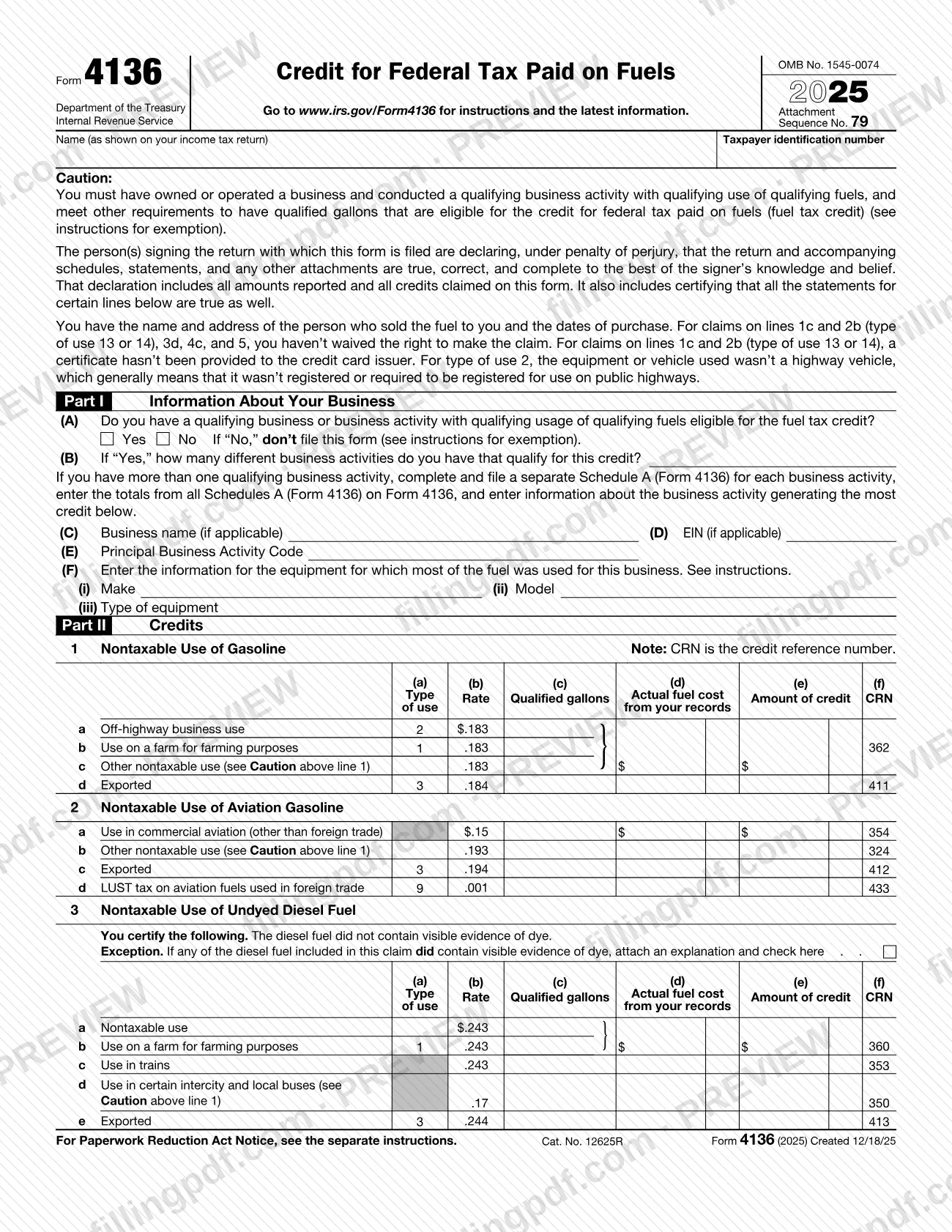
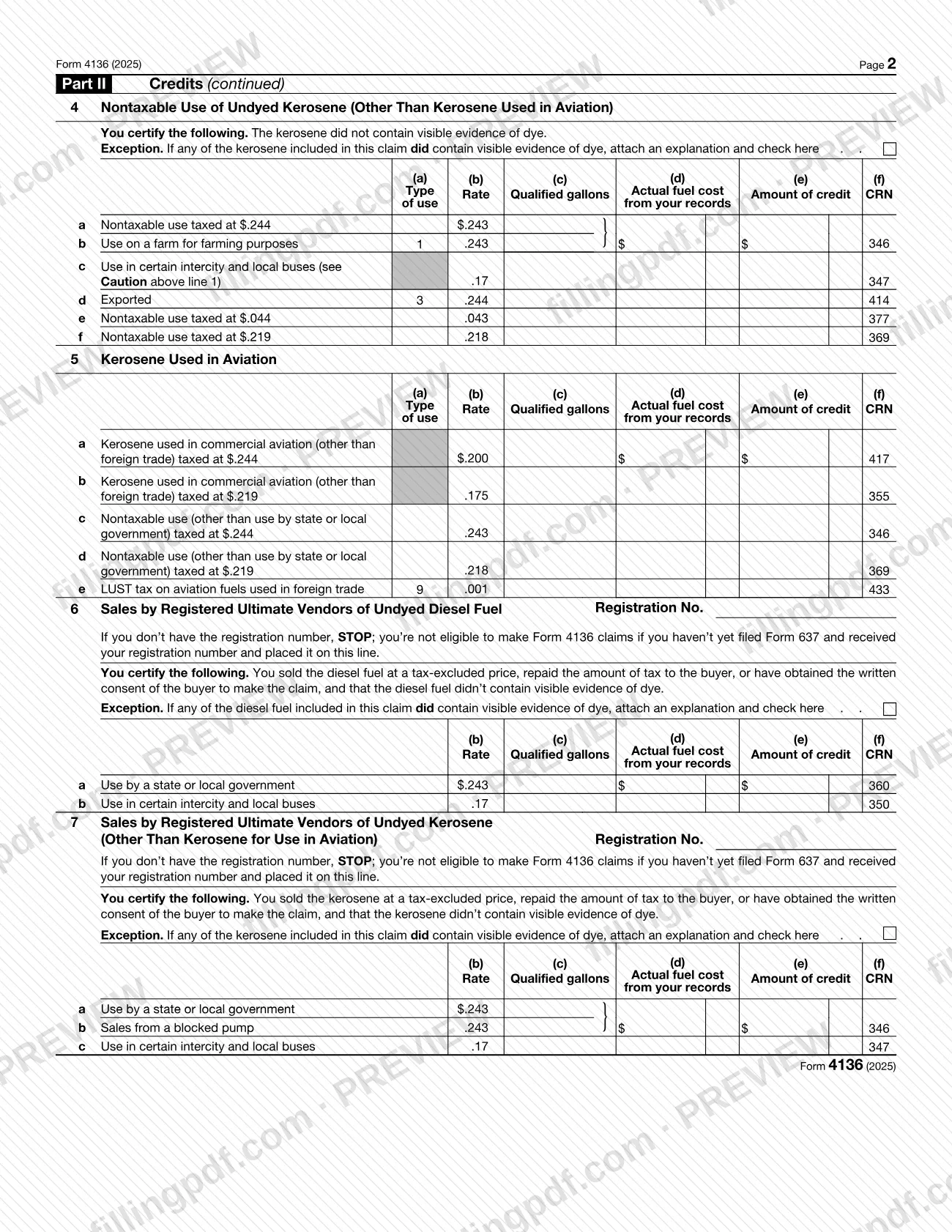
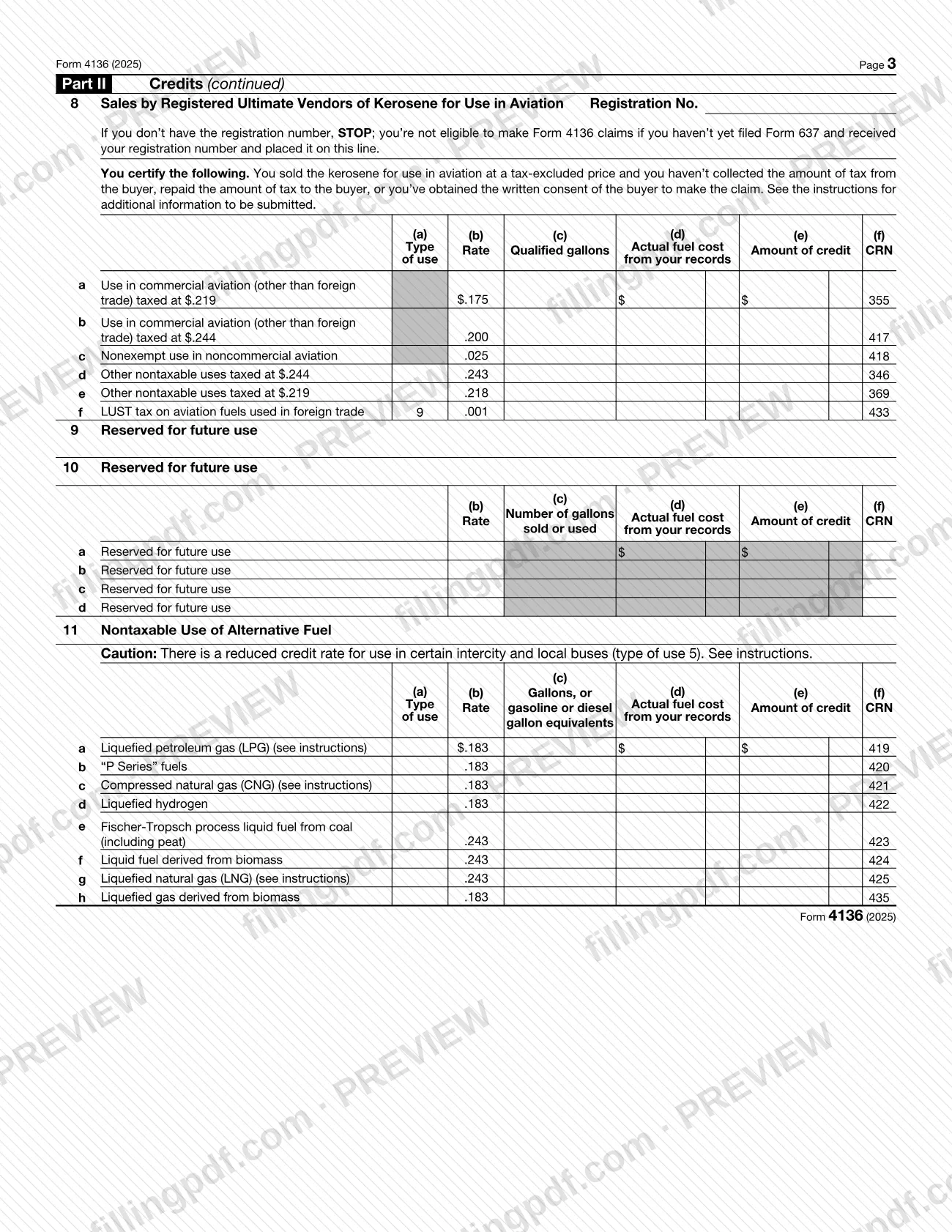
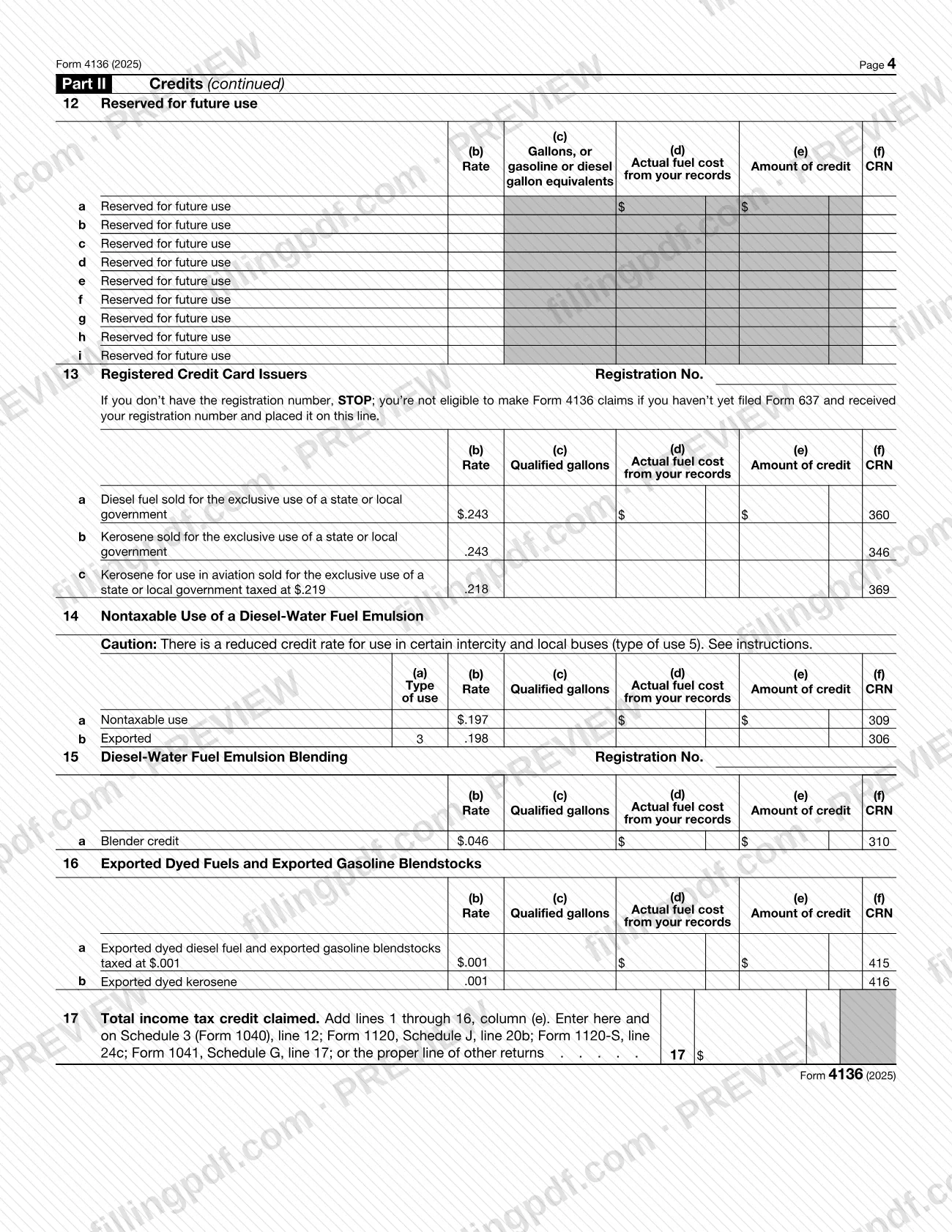
Form 4136, Credit for Federal Tax Paid on Fuels, is the Internal Revenue Service (IRS) form for claiming the fuel tax credit (FTC) on your income tax return. It covers credits for certain nontaxable uses or sales of fuel, the alternative fuel credit, a credit for blending a diesel-water fuel emulsion, and a credit for exporting dyed fuels or gasoline blendstocks. On this page you can fill out the form online on FillingPDF and download or print the completed PDF; the form and its instructions are published by the IRS at www.irs.gov/Form4136.
Last updated
What is Form 4136?
Form 4136, Credit for Federal Tax Paid on Fuels, is the IRS form on which a taxpayer claims the fuel tax credit (FTC) for fuel used or sold in certain nontaxable ways during the income tax year, and for related blending and export credits.
The form has two parts. Part I, Information About Your Business, asks whether you have a qualifying business activity with qualifying use of qualifying fuels, and describes the business and the equipment that used most of the fuel. Part II, Credits, is organized by fuel: gasoline (line 1), aviation gasoline (line 2), undyed diesel fuel (line 3), undyed kerosene (line 4), kerosene used in aviation (line 5), sales by registered ultimate vendors (lines 6 to 8), alternative fuel (line 11), registered credit card issuers (line 13), diesel-water fuel emulsion (lines 14 and 15) and exported dyed fuels and gasoline blendstocks (line 16). Line 17 totals the credit.
The total is carried to the income tax return the form is filed with, such as Schedule 3 (Form 1040), line 12. Form 4136 is printed as OMB No. 1545-0074, Attachment Sequence No. 79.
If you have more than one qualifying business activity, you file a separate Schedule A (Form 4136) for each one and enter the totals on Form 4136. Instead of waiting for an annual credit, the IRS instructions say you may be able to claim a periodic refund on Form 8849, Claim for Refund of Excise Taxes, or a credit against your excise tax liability on Form 720, Quarterly Federal Excise Tax Return.
Who needs to file Form 4136?
You use Form 4136 if you owned or operated a business and conducted a qualifying business activity with qualifying use of qualifying fuels, and you meet the other requirements for qualified gallons. If you answer "No" on line A of Part I, do not file the form.
The claimant depends on the line:
- Ultimate purchasers make the claims for gasoline, aviation gasoline, undyed diesel fuel, undyed kerosene, kerosene used in aviation, alternative fuel and diesel-water fuel emulsion.
- Registered ultimate vendors use lines 6 to 8, and only with the registration number issued by the IRS after filing Form 637.
- Registered credit card issuers use line 13, with their registration number.
- Blenders of a diesel-water fuel emulsion use line 15.
- Exporters of dyed diesel fuel or dyed kerosene use line 16.
One exemption applies: if you are claiming the tax on undyed kerosene you bought (other than from a blocked pump) and used in your home for heating, lighting or cooking, answer "Yes" on line A, skip lines B through F and go to Part II.
Who cannot use it: the credit does not apply to gasoline used in vehicles for personal use, commuting or driving for ride sharing services, to non-business off-highway use (minibikes, snowmobiles, lawn mowers, chain saws), or to vehicles registered or required to be registered for highway use. Partnerships (other than electing large partnerships) cannot file this form; they report each partner's share on Schedule K-1 (Form 1065). Ultimate vendors cannot use it for gasoline claims.
When to file Form 4136
File Form 4136 with the income tax return for the year in which the fuel was used or sold: the credits are for nontaxable uses or sales during your income tax year, and the form prints no separate due date, so it follows the due date of the return it accompanies.
If you prefer not to wait for the annual claim, the IRS instructions point to Form 8849 for a periodic refund or Form 720 for a credit against excise tax liability. You cannot claim on Form 4136 any amount you already claimed on Form 8849, Form 8864 or Form 720, Schedule C.
Keep the records that support the credits for at least 3 years from the date the return is due or filed, whichever is later. If you deducted the full cost of the fuel, including excise taxes, as an expense that reduced your income tax, include the credit in gross income (see Pub. 510).
Documents you need
- The income tax return the form is filed with (for example Form 1040, 1120, 1120-S or 1041); the line 17 total is carried to it.
- Schedule A (Form 4136), one for each business activity, when you have more than one qualifying business activity.
- A written explanation, if any of the diesel fuel or kerosene in the claim contained visible evidence of dye, with the exception box checked on lines 3, 4, 6 or 7.
- A separate statement with the name and taxpayer identification number of each governmental unit and the gallons sold to each, for claims on lines 6a and 7a.
- A certifying statement for line 15 (diesel-water fuel emulsion blending): at least 14% water, EPA-registered additive, undyed diesel fuel as the base, and use or sale in the blender's trade or business.
- A separate statement in the same format as the line, if you need more space for any line, such as additional types of use.
- Your IRS-issued Form 637 registration number, entered on the line, for claims on lines 6 through 8, 13 and 15.
How to fill out Form 4136
Enter your name and taxpayer ID
At the top of page 1, enter your name as shown on your income tax return and your taxpayer identification number.
Answer Part I, line A
Check Yes or No for whether you have a qualifying business activity with qualifying usage of qualifying fuels. If you check No, do not file the form; for home-use kerosene, answer Yes, skip lines B through F and go to Part II.
Report your business activities on line B
Enter how many different business activities qualify for the credit. If more than one, complete a separate Schedule A (Form 4136) for each and enter the totals from all Schedules A on Form 4136.
Describe the business on lines C to F
Enter the business name (C), your EIN (D, never your SSN), the six-digit principal business activity code (E), and the make, model and type of equipment that used most of the fuel (F). Use the activity that generates the most credit.
Enter type of use, gallons and cost
In Part II, enter the number from the Type of Use Table where a Type of use column is shown, the qualified gallons in column (c), and the actual fuel cost from your records in column (d). Multiply the rate by the gallons for the amount of credit in column (e); the CRN in column (f) is already printed.
Complete lines 1 through 5 for your fuels
Use line 1 for gasoline, line 2 for aviation gasoline, line 3 for undyed diesel fuel, line 4 for undyed kerosene and line 5 for kerosene used in aviation. For lines 3, 4 and 6 to 8, check the exception box and attach an explanation if any fuel contained visible dye.
Claim home-use kerosene correctly
On line 4a, enter 8 in column (a) and the gallons of undyed kerosene in column (c), then figure the credit using the line's rate. If this is your only fuel tax credit, the amount goes on line 17 and Schedule 3 (Form 1040) or (1040-SR), line 12.
Fill lines 6 through 8 if you are a vendor
Registered ultimate vendors enter their registration number, including the prefix, and complete the applicable line. Attach the statement of governmental units and gallons for lines 6a and 7a.
Complete line 11 and the bus rates
Enter alternative fuel gallons, or gasoline or diesel gallon equivalents for LPG, CNG and LNG, on line 11. For type of use 5, write "Bus" to the left of column (a) and enter the correct claim rate in column (b).
Complete lines 13 through 16 if they apply
Use line 13 for registered credit card issuers, lines 14 and 15 for diesel-water fuel emulsion use and blending, and line 16 for exported dyed fuels and gasoline blendstocks. Lines 9, 10 and 12 are marked reserved for future use.
Total the credit on line 17
Add lines 1 through 16, column (e), including any amounts from separate statements and Schedules A. Enter the total on line 17 and on the matching line of your return, such as Schedule 3 (Form 1040), line 12.
Review, sign with your return, and download
Check that gallons, type-of-use numbers and the line 17 total are correct, and keep records supporting each claim. Download or print the completed PDF from FillingPDF and attach it to the income tax return, which carries the signature declaration.
How to submit Form 4136
Form 4136 has no filing address of its own: it is filed with your income tax return, and the person signing that return signs for everything on this form too.
- With your return: attach Form 4136 to the return you file for the year. The line 17 total goes on Schedule 3 (Form 1040), line 12; Form 1120, Schedule J, line 20b; Form 1120-S, line 24c; Form 1041, Schedule G, line 17; or the proper line of another return. Follow the return's instructions for where and how to file it.
- Electronic filing: the IRS Form 4136 page lists a notice about e-filing tax year 2025 returns that include Form 4136; check it at https://www.irs.gov/forms-pubs/about-form-4136.
- Attachments: include Schedule A (Form 4136) for each business activity when you have more than one, and the statements the instructions require for specific lines. Do not include fuel receipts or explanations of actual fuel cost with your return; keep them with your books and records.
FillingPDF lets you fill out and download the PDF; submission follows the channels above.
Common mistakes to avoid
- Filing Form 4136 after answering "No" on line A of Part I; the instructions say you are not eligible and should not complete the form.
- Claiming gasoline used for personal use, commuting, ride sharing services such as Uber or Lyft, or non-business off-highway equipment.
- Completing lines 6 through 8, 13 or 15 without a registration number issued after filing Form 637.
- Claiming amounts on Form 4136 that you already claimed on Form 8849, Form 8864 or Form 720, Schedule C.
- Filing the form as a partnership (other than an electing large partnership) instead of allocating gallons to partners on Schedule K-1 (Form 1065).
- Entering your SSN or another taxpayer's EIN on line D; enter only the EIN issued to you on Form SS-4, or leave it blank if you have none.
- Attaching fuel receipts to the return for column (d), Actual fuel cost from your records; keep them with your records instead.
- Using the bus claim lines without writing "Bus" next to column (a) and entering the correct claim rate in column (b).
- Filing one Form 4136 for several business activities without a separate Schedule A (Form 4136) for each.
- Not keeping proof of exportation, such as a bill of lading or foreign consignee statement, for exported taxable fuel claims.
Frequently asked questions
What is Form 4136 used for?
Form 4136 is the IRS form for claiming the fuel tax credit on your income tax return. It covers certain nontaxable uses or sales of fuel, the alternative fuel credit, a diesel-water fuel emulsion blending credit, and a credit for exporting dyed fuels or gasoline blendstocks.
Who can claim the fuel tax credit on Form 4136?
Generally the ultimate purchaser of the fuel, if you owned or operated a business with a qualifying use of qualifying fuels. Registered ultimate vendors, credit card issuers, blenders and exporters claim on specific lines. If you answer "No" on line A, do not file the form.
Can I claim the credit for gas used in my car for commuting or Uber and Lyft?
No. The instructions say a taxpayer who uses gasoline for personal use, commuting to work or driving for ride sharing services such as Uber or Lyft does not qualify for the fuel tax credit. Highway vehicles registered for highway use also do not qualify for off-highway business use.
Where do I file Form 4136?
You file it with your income tax return, not separately. The line 17 total goes on Schedule 3 (Form 1040), line 12; Form 1120, Schedule J, line 20b; Form 1120-S, line 24c; Form 1041, Schedule G, line 17; or the proper line of another return.
What is the difference between Form 4136, Form 8849 and Form 720?
Form 4136 claims the credit once a year on your income tax return. Instead, you may be able to file Form 8849 for a periodic refund or use Form 720 to take a credit against your excise tax liability. You cannot claim on Form 4136 amounts you claimed on those forms.
Do I need Schedule A (Form 4136)?
Yes, if you have more than one qualifying business or business activity. File a separate Schedule A (Form 4136) for each, combine the totals on Form 4136, Part II, and describe the activity generating the most qualifying fuel use in Part I, lines C through F.
Can I claim the credit for kerosene used to heat my home?
Yes, under the exemption in the instructions: for undyed kerosene bought other than from a blocked pump and used at home for heating, lighting or cooking, answer Yes on line A, skip lines B through F, and claim it on line 4a with type of use 8.
What records do I need to keep for Form 4136?
Keep records supporting the credits for at least 3 years from the return's due date or filing date, whichever is later. Keep fuel receipts for column (d) with your books rather than attaching them, and keep proof of exportation for exported fuel claims.
Can a partnership file Form 4136?
No. Partnerships other than electing large partnerships cannot file it. They include a statement on Schedule K-1 (Form 1065) showing each partner's gallons of each fuel, the credit per gallon, the nontaxable use or sale and any other required information.
Can I fill out Form 4136 online on FillingPDF?
Yes. You can fill out the PDF online on FillingPDF and download or print it. FillingPDF is an independent service and does not file Form 4136 or your return with the IRS; you submit it with your income tax return.
Ready to fill out Form 4136?
Fill out Form 4136 now