
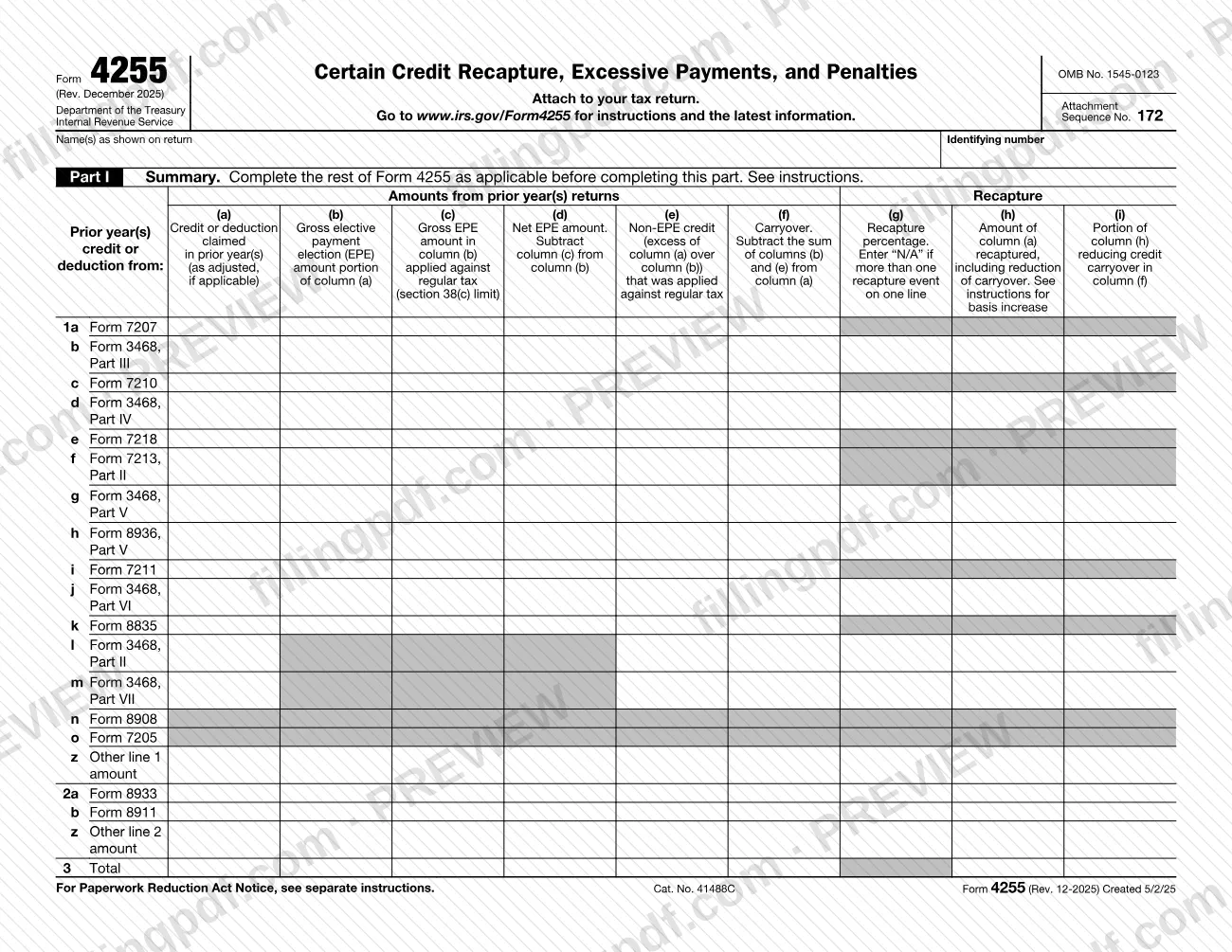

Form 4255 is the Internal Revenue Service (IRS) form you attach to your tax return to figure the increase in tax from investment credit recapture, excessive payments (EPs), excessive credit transfers and penalty amounts for failing prevailing wage and apprenticeship (PWA) requirements. It applies when a credit you claimed earlier must be refigured or when the IRS determines an excessive payment. On this page you can fill out the form online on FillingPDF and download or print the completed PDF. The form and its instructions are published by the IRS at www.irs.gov/Form4255.
Last updated
What is 4255?
Form 4255, Certain Credit Recapture, Excessive Payments, and Penalties, is the IRS form, attached to a tax return, that figures the increase in tax from certain credit recaptures, excessive payments, excessive credit transfers, and prevailing wage and apprenticeship penalty amounts.
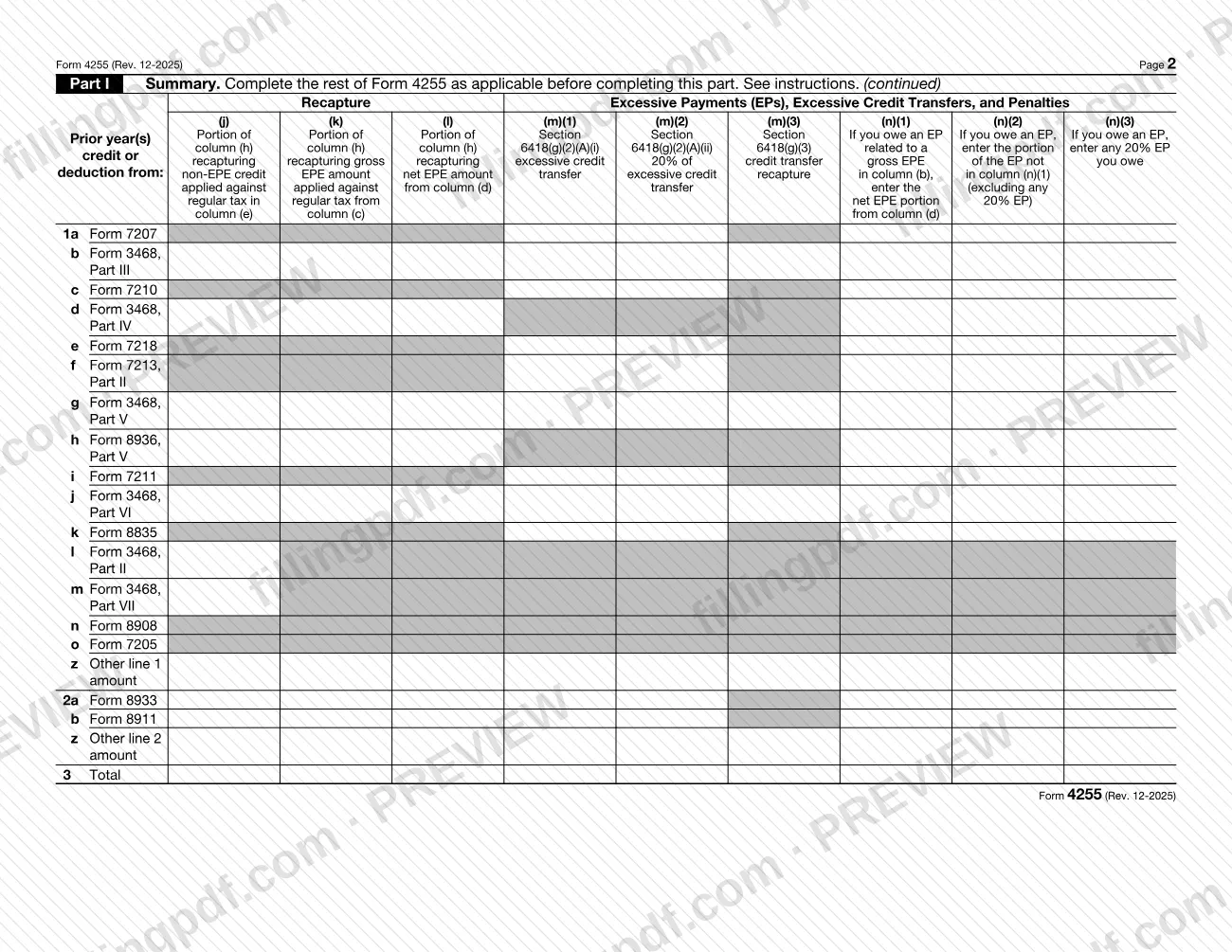
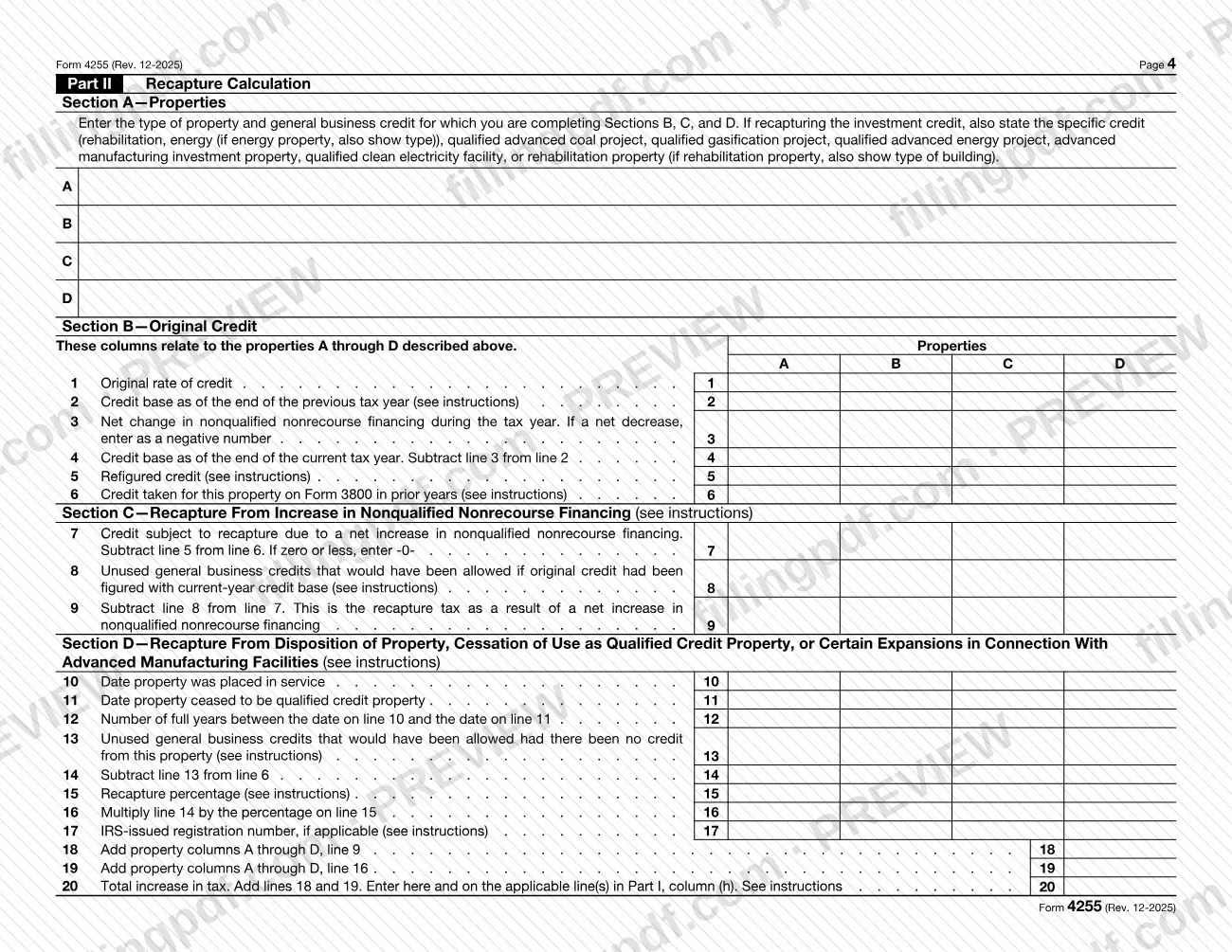
The form has three parts. Part I, Summary, lists each credit or deduction by the form it came from (for example Form 7207, Form 3468, Form 8936, Form 8835, Form 8908, Form 8933 or Form 8911) and carries the recapture, excessive payment and penalty amounts across columns (a) through (t). Part II, Recapture Calculation, refigures the original credit for up to four properties and computes the recapture tax from an increase in nonqualified nonrecourse financing (Section C) or from disposition or cessation of use of the property (Section D). Part III figures emissions tier recapture for property that is part of a specified clean hydrogen production facility.
The IRS instructions say to complete Parts II and III before Part I. Amounts of excessive payments and excessive credit transfers include a 20% amount when there is no reasonable cause, and PWA penalty amounts come from Form 7220, Prevailing Wage and Apprenticeship (PWA) Verification and Corrections.
Form 4255 does not claim a credit. The credit itself is figured on forms such as Form 3468, Investment Credit, and carried to Form 3800, General Business Credit. Form 4255 is used later, when part of that credit must be given back or a penalty or excessive amount is owed. The printed form shows OMB No. 1545-0123 and Attachment Sequence No. 172.
Who needs to file 4255?
Taxpayers who must refigure an investment credit and may have to recapture all or part of it use Form 4255. The IRS instructions list the triggering situations, including:
- disposing of investment credit property before the end of 5 full years after it was placed in service (the recapture period);
- changing the use of the property, or decreasing its business use, so it no longer qualifies in whole or in part;
- reducing your proportionate interest by more than one-third in a partnership, S corporation, estate or trust that allocated basis to you;
- returning leased property to the lessor before the recapture period ends;
- a net increase in nonqualified nonrecourse financing for property to which section 49(a)(1) applied;
- failing prevailing wage requirements for alteration or repair during the 5-year period after the project is placed in service;
- an emissions tier recapture event for a specified clean hydrogen production facility.
You also use it to report excessive payments, excessive credit transfers and PWA penalty payments (columns (m) through (p)). If you made a section 6418 transfer election, you must notify the transferee taxpayer of a recapture event.
Recapture does not apply to a transfer because of death, a transfer between spouses or incident to divorce under section 1041, a transaction under section 381(a), or a mere change in the form of conducting a trade or business that meets the instructions' two conditions. Partners, shareholders and beneficiaries whose Schedule K-1 shows recapture need their copy of the original Form 3468.
When to file 4255
Form 4255 is filed with the tax return for the year in which the recapture event or determination occurs, so it has no due date of its own. For disposition or cessation of use, the instructions' examples show a June 2025 disposition increasing the 2025 tax. For an excessive payment or excessive credit transfer, the increase applies to the tax year in which the IRS makes its determination.
Recapture generally applies when the event happens before the end of 5 full years after the property was placed in service; the line 15 table sets the percentage by full years held. For emissions tier recapture, an event includes failing to obtain an annual verification report by the deadline for filing the return, including extensions, for a year in which one is required. A PWA penalty payment may be reported for a credit or deduction claimed in the current tax year.
Documents you need
- Your original Form 3468, Investment Credit, if you are a partner, shareholder or beneficiary whose Schedule K-1 shows recapture of investment credit claimed in an earlier year.
- The Form 3468 you filed for the property: Part II, Section B, line 1 takes the original credit rate from it and line 2 the credit base you used.
- Records of credits taken for the property on Form 3800, General Business Credit, in prior years, needed for line 6 (excluding any credit already recaptured for nonqualified nonrecourse financing).
- Form 7220 figures for PWA penalties: column (o) amounts come from Form 7220, Part IV, column (f), and column (p) amounts from Part III, column (i).
- Additional Forms 4255, if you must list more properties than Section A allows.
- Notice of the recapture event from the eligible taxpayer, if you are a transferee taxpayer under a section 6418 transfer election; you calculate recapture on the transferred credit.
How to fill out 4255
Enter name and identifying number
At the top, enter the name(s) as shown on your return and your identifying number. Form 4255 is attached to that return.
Describe the properties in Part II, Section A
Use lines A through D to enter the type of property and general business credit for each property you must refigure. For investment credit recapture, also state the specific credit, such as rehabilitation or energy (and the energy type).
Refigure the original credit in Section B
Enter the original rate (line 1), credit base at the end of the prior year (line 2) and net change in nonqualified nonrecourse financing (line 3). Then subtract line 3 from line 2 for line 4, enter the refigured credit on line 5 and credits taken on Form 3800 in prior years on line 6.
Complete Section C if financing increased
On line 7, subtract line 5 from line 6, entering -0- if zero or less. Enter unused general business credits that would have been allowed on line 8 (see Worksheet 1) and subtract line 8 from line 7 for line 9.
Complete Section D for disposition or cessation
Enter the placed-in-service date (line 10) and the date the property ceased to be qualified credit property (line 11). Enter full years on line 12, unused credits on line 13, the result of line 6 minus line 13 on line 14, the recapture percentage on line 15, line 14 times line 15 on line 16, and any IRS-issued registration number on line 17.
Total the Part II increase in tax
Add property columns A through D for line 9 (line 18) and line 16 (line 19). Add lines 18 and 19 on line 20 and enter the result on the applicable line(s) in Part I, column (h).
Complete Part III for hydrogen facilities
Only if an emissions tier recapture event occurred, complete lines 1 through 9 using the Form 3468, Part I and Part VI figures the lines name. Enter line 9 in Part I, line 1j, column (h).
Fill in prior-year amounts in Part I
On lines 1a–1o, 1z, 2a, 2b and 2z, enter the credit or deduction claimed in prior years in column (a), gross EPE in (b), the amount applied against regular tax in (c), net EPE in (d), non-EPE credit in (e) and carryover in (f).
Enter recapture in columns (g) through (l)
Enter the recapture percentage in column (g), or "N/A" if there is more than one recapture event on a line. Enter the amount recaptured in column (h), then split it among columns (i) through (l) as the instructions describe.
Report excessive payments and credit transfers
In columns (m)(1) through (m)(3), enter section 6418 excessive credit transfer, 20% excessive credit transfer and credit transfer recapture amounts. In columns (n)(1) through (n)(3), enter any EP related to net EPE, the rest of the EP, and any 20% EP.
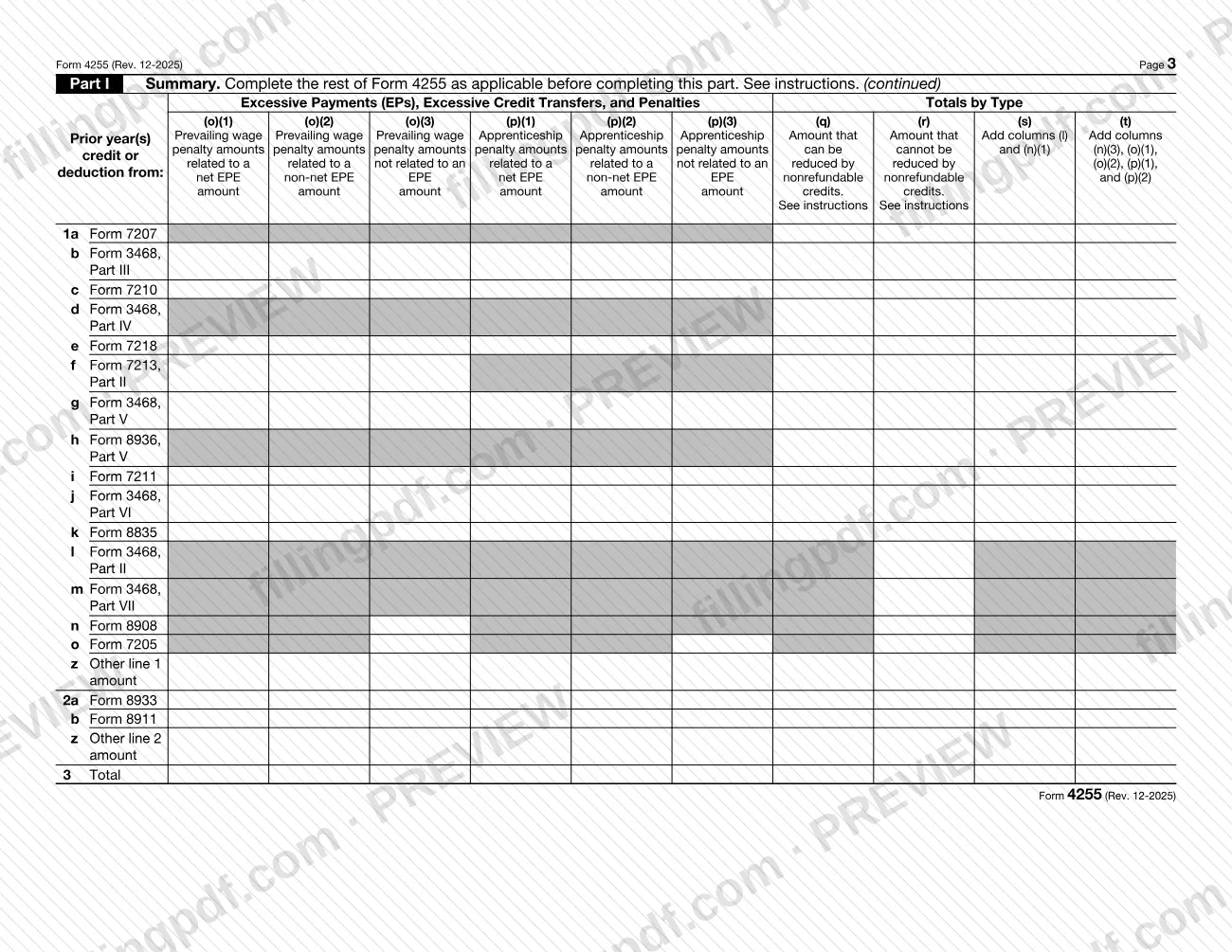
Enter PWA penalty amounts
Enter prevailing wage penalties in columns (o)(1) to (o)(3) and apprenticeship penalties in columns (p)(1) to (p)(3). Apportion by the instructions' ratios if you have EPE amounts; otherwise enter the full amount in (o)(3) or (p)(3).
Complete totals by type and line 3
Fill in columns (q) through (t) using the additions the instructions give, then complete line 3, Total. Carry the column (q) and (r) totals to your return, or to the partnership or S corporation return where the instructions say so.
Review and download the completed PDF
Check that Part II totals match Part I, column (h), and that line 3 totals agree across columns. Download or print the completed PDF from FillingPDF and attach it to your tax return as described under How to submit.
How to submit 4255
Form 4255 is not filed on its own: you attach it to your tax return and submit it through whatever channel that return uses. The form itself prints no separate address or portal, and the IRS instructions refer you to the instructions for the return with which it is filed.
- Attach to your return: Include the completed Form 4255 with the income tax return for the year of the recapture event or determination. If you list more properties than Part II, Section A allows, complete and attach additional Forms 4255.
- Carry totals to the return: Enter Part I, line 3, column (q) on the appropriate line of your return (for Form 1120, Schedule J, line 1g) and column (r) likewise (for Form 1120, Schedule J, line 9a).
- Partnerships and S corporations: Certain line 3 amounts, in columns (m)(1), (m)(2), (n)(1) through (n)(3), (o)(1) through (o)(3) and (p)(1) through (p)(3), are reported directly on the entity return: Form 1065, line 27, Other taxes, or Form 1120-S, line 23c. Do not report those same amounts on Schedule K-1.
FillingPDF lets you fill out and download the PDF; submission follows the channels above.
Common mistakes to avoid
- Completing Part I first. The instructions say to complete Parts II and III as applicable before Part I, because their totals feed column (h).
- Entering the exact placed-in-service date on line 10 instead of the first day of that month in MM/DD/YYYY, such as 02/01/2023 for February 20, 2023.
- Entering a partial year on line 12. If the property was held less than 12 months, enter -0-.
- Entering more on line 5 than the applicable dollar limit, such as the kilowatt limit in section 48(c)(1)(B), when the credit was limited.
- Including a previously recaptured credit in line 6; the instructions say not to include credit recaptured for increased nonqualified nonrecourse financing.
- Completing Part III after recapturing the entire credit because the property was disposed of or ceased to be investment credit property; the form says not to.
- Not apportioning PWA penalties in columns (o)(1)–(o)(3) and (p)(1)–(p)(3) by the EPE ratios when you have EPE amounts; with no EPE, enter the full amount in (o)(3) or (p)(3).
- Reporting partnership or S corporation line 3 amounts on Schedule K-1 instead of directly on Form 1065 or Form 1120-S.
- Entering a percentage in column (g) when there is more than one recapture event on one line; enter "N/A".
Frequently asked questions
What is Form 4255 used for?
Form 4255 figures the increase in tax from certain credit recaptures, excessive payments, excessive credit transfers and penalty amounts for failing prevailing wage and apprenticeship requirements. You attach it to your tax return; it does not claim a credit.
Who has to file Form 4255?
Taxpayers who must refigure and recapture an investment credit, who owe an excessive payment or excessive credit transfer, or who make PWA penalty payments. Triggers include disposing of property within 5 full years of placing it in service. Transfers at death or between spouses are exceptions.
Where do I send Form 4255?
You do not send it separately. Attach it to the tax return for the year of the recapture event; the form prints no address of its own. Partnerships and S corporations report certain line 3 amounts on Form 1065, line 27, or Form 1120-S, line 23c.
What recapture percentage do I use on line 15?
It depends on the full years on line 12: 0 years is 100, 1 is 80, 2 is 60, 3 is 40, 4 is 20, and 5 or more is 0. For certain expansions in connection with advanced manufacturing facilities, enter 100.
What date do I enter on line 10 of Form 4255?
Enter the first day of the month in which the property was placed in service, in MM/DD/YYYY format. A property placed in service on February 20, 2023 is entered as 02/01/2023, as the IRS instructions illustrate.
Do I fill out Part III of Form 4255?
Only for an emissions tier recapture event involving property that is part of a specified clean hydrogen production facility. Do not complete it if you already recaptured the entire credit through disposal or cessation of investment credit property.
Can I fill out Form 4255 online?
Yes. You can fill out the fillable PDF online on FillingPDF and download or print it. FillingPDF is an independent service and does not file the form with the IRS; you attach it to your tax return and submit that return through the IRS channels.
What are columns (o) and (p) on Form 4255?
Columns (o)(1) through (o)(3) report penalty amounts for failing prevailing wage requirements, and columns (p)(1) through (p)(3) report apprenticeship requirement penalties. The amounts come from Form 7220 and are apportioned by EPE ratios if you have EPE amounts.
Ready to fill out 4255?
Fill out 4255 now