
Form 433-A (OIC) is the Collection Information Statement that the Internal Revenue Service (IRS) uses to evaluate an individual's offer in compromise. It lists your household, assets, income and expenses, then calculates the minimum offer amount to place on Form 656. The form says it should only be used with Form 656, Offer in Compromise. On this page you can fill out the form online on FillingPDF and download or print the completed PDF; the official PDF is published by the IRS.
Last updated
What is Form 433-A (OIC)?
Form 433-A (OIC), Collection Information Statement for Wage Earners and Self-Employed Individuals, is the IRS financial statement an individual completes to support an offer in compromise, showing available assets, monthly income and expenses, and the resulting minimum offer amount.
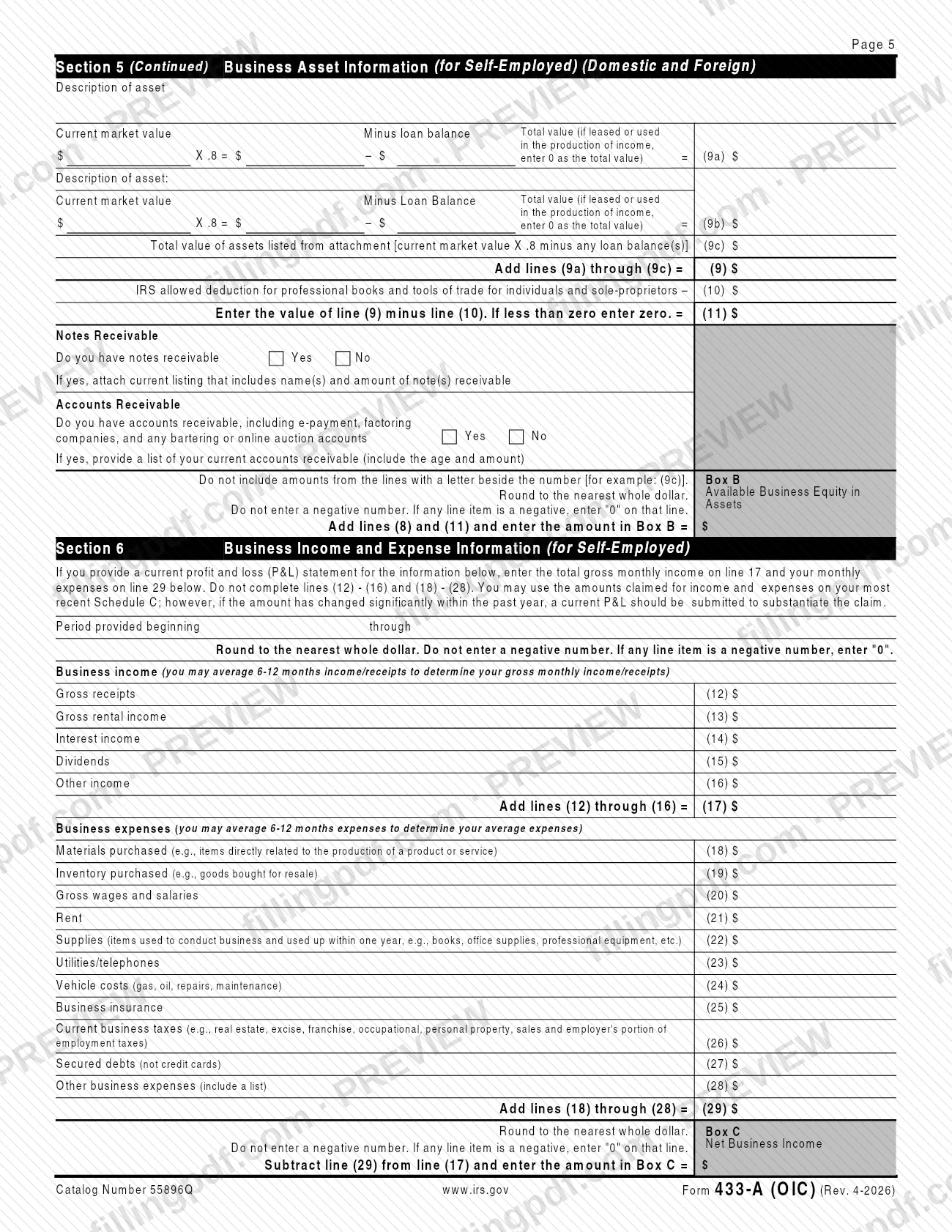
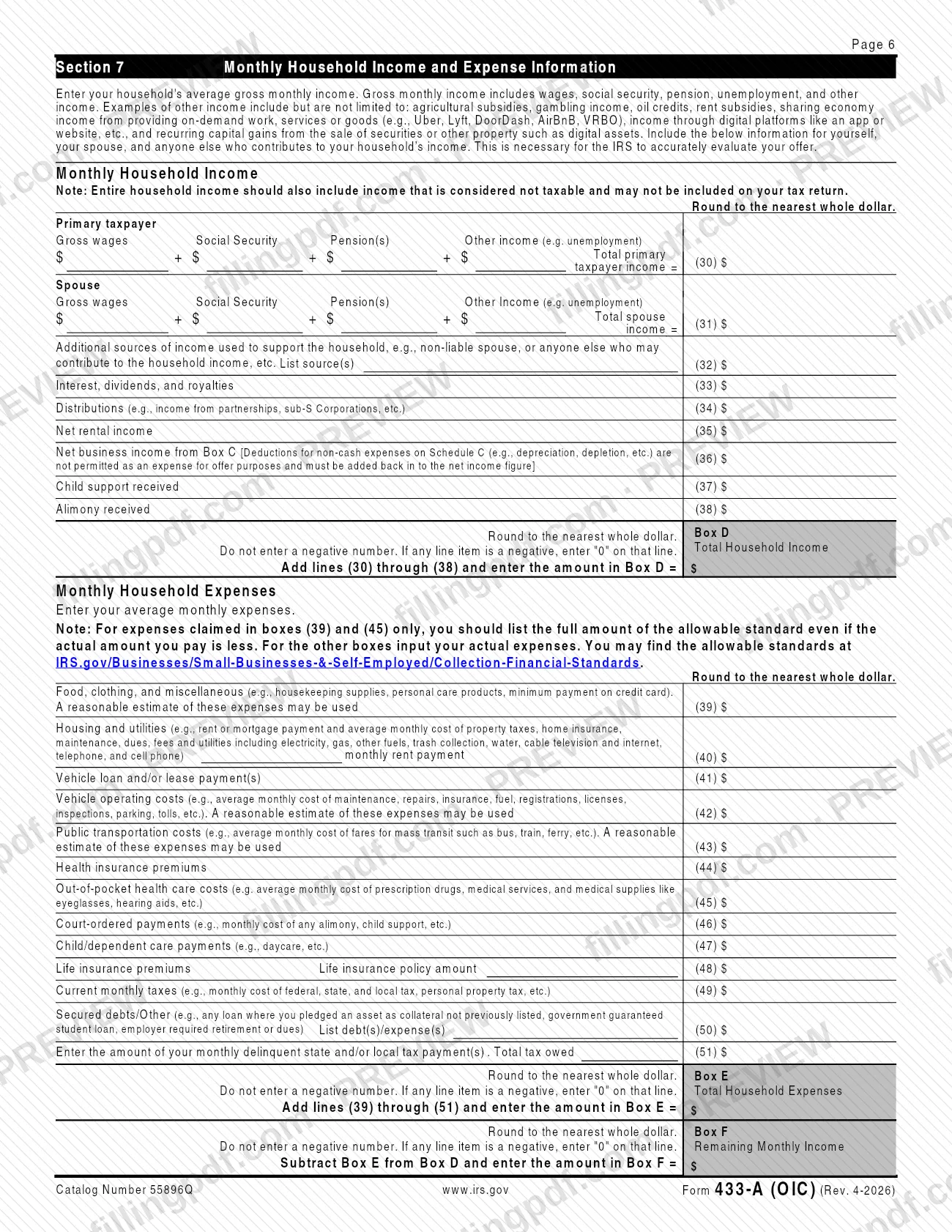
The form is built in ten sections: personal and household information (Section 1), employment for wage earners (Section 2), personal assets, domestic and foreign (Section 3), self-employed information, business assets and business income and expenses (Sections 4, 5 and 6), monthly household income and expenses (Section 7), the minimum offer calculation (Section 8), other information such as litigation, bankruptcy and trusts (Section 9), and signatures (Section 10).
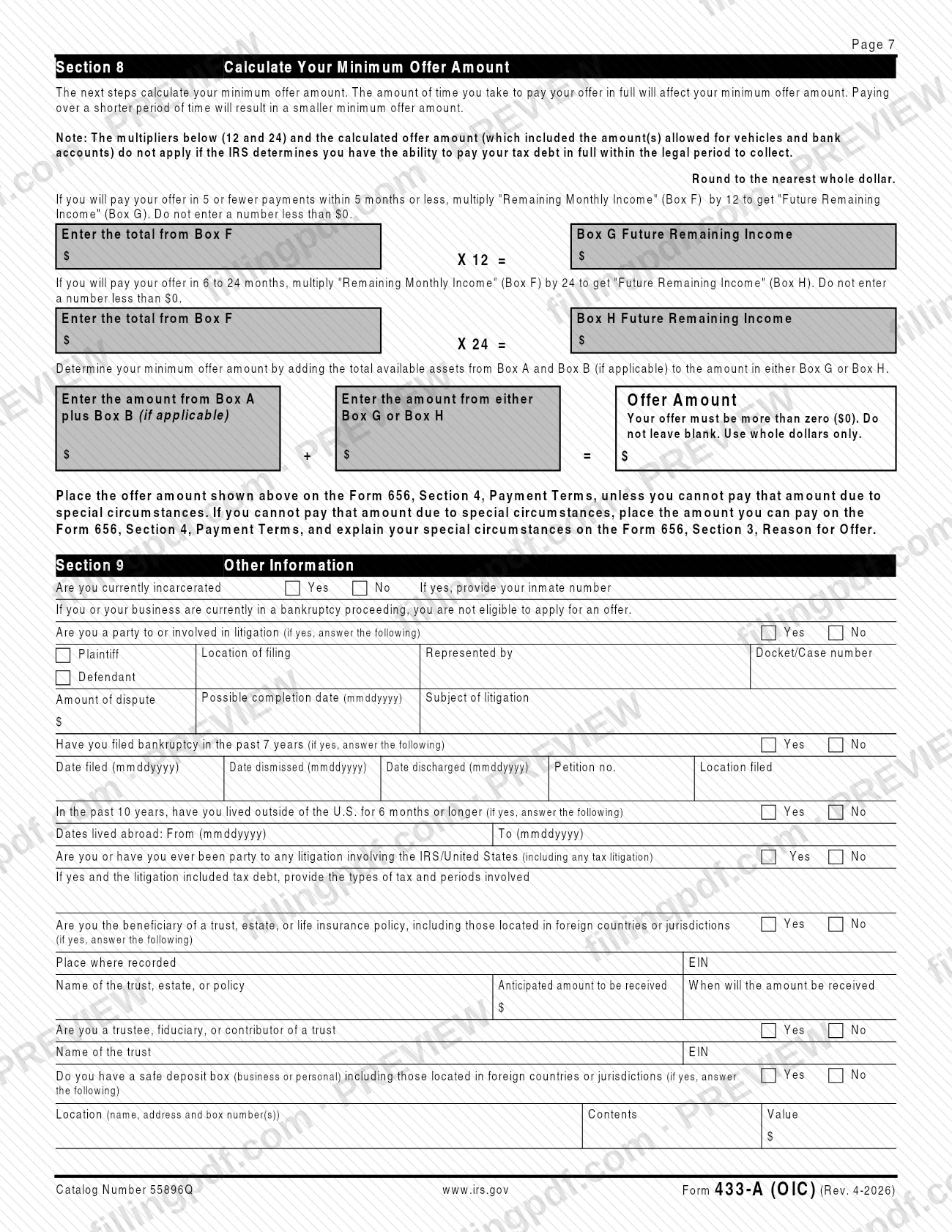
Section 8 turns the totals into an offer amount. Available assets from Box A and, if applicable, Box B are added to Remaining Monthly Income multiplied by 12 (five or fewer payments within five months or less) or by 24 (payments over 6 to 24 months). The result goes on Form 656, Section 4, Payment Terms, unless special circumstances prevent you from paying that amount; then you enter what you can pay and explain on Form 656, Section 3, Reason for Offer.
The form says it should only be used with Form 656. If you or your spouse have an interest in a business entity other than a sole proprietorship, Form 433-B, Collection Information Statement for Businesses, is also needed.
Who needs to file Form 433-A (OIC)?
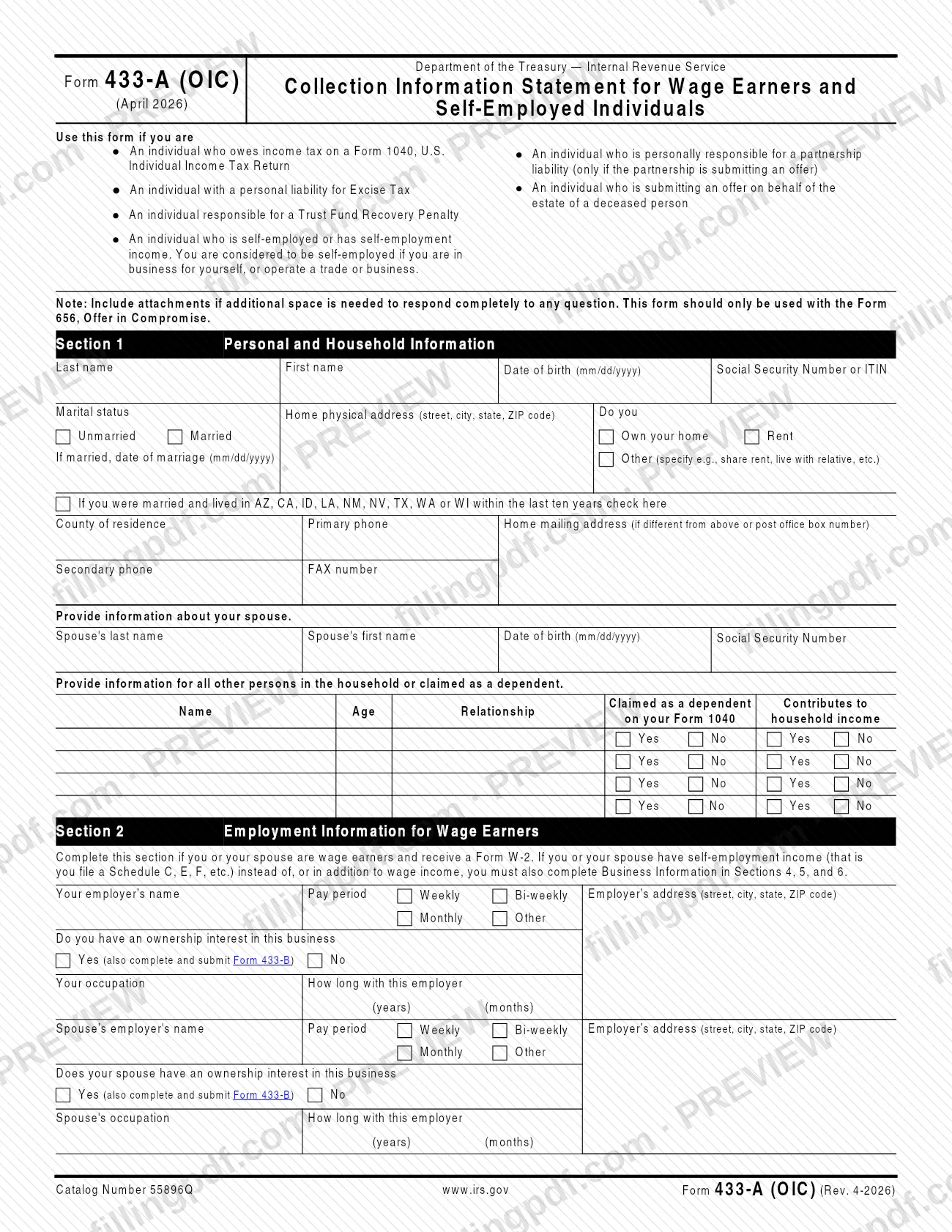
Use Form 433-A (OIC) if you are submitting an offer in compromise and you are one of the following:
- an individual who owes income tax on a Form 1040, U.S. Individual Income Tax Return;
- an individual with a personal liability for Excise Tax;
- an individual responsible for a Trust Fund Recovery Penalty;
- an individual who is self-employed or has self-employment income, meaning you are in business for yourself or operate a trade or business;
- an individual personally responsible for a partnership liability, only if the partnership is submitting an offer;
- an individual submitting an offer on behalf of the estate of a deceased person.
If you or your spouse file a Schedule C, E or F, you must also complete the business sections (4, 5 and 6) in addition to any wage information. If you or your spouse have an ownership interest in an employer's business, the form asks you to complete and submit Form 433-B as well.
The form states that if you or your business are currently in a bankruptcy proceeding, you are not eligible to apply for an offer. If you want an attorney, CPA or enrolled agent to represent you and no current form is on file with the IRS, attach Form 2848, Power of Attorney and Declaration of Representative.
When to file Form 433-A (OIC)
Complete Form 433-A (OIC) when you submit an offer in compromise, because it travels with Form 656, Offer in Compromise, and is not meant to be used on its own. The form prints no separate due date.
Have your most recent statements ready before you start. The attachments list asks for the most recent pay stubs, investment and retirement account statements, and complete bank statements for the three most recent months (six months for each business bank account if you operate a business). If you or your spouse are self-employed, complete Sections 4, 5 and 6 before Sections 7 and 8, since the totals from those sections feed the offer calculation.
The time you take to pay the offer affects the minimum amount: paying over a shorter period results in a smaller minimum offer amount.
Documents you need
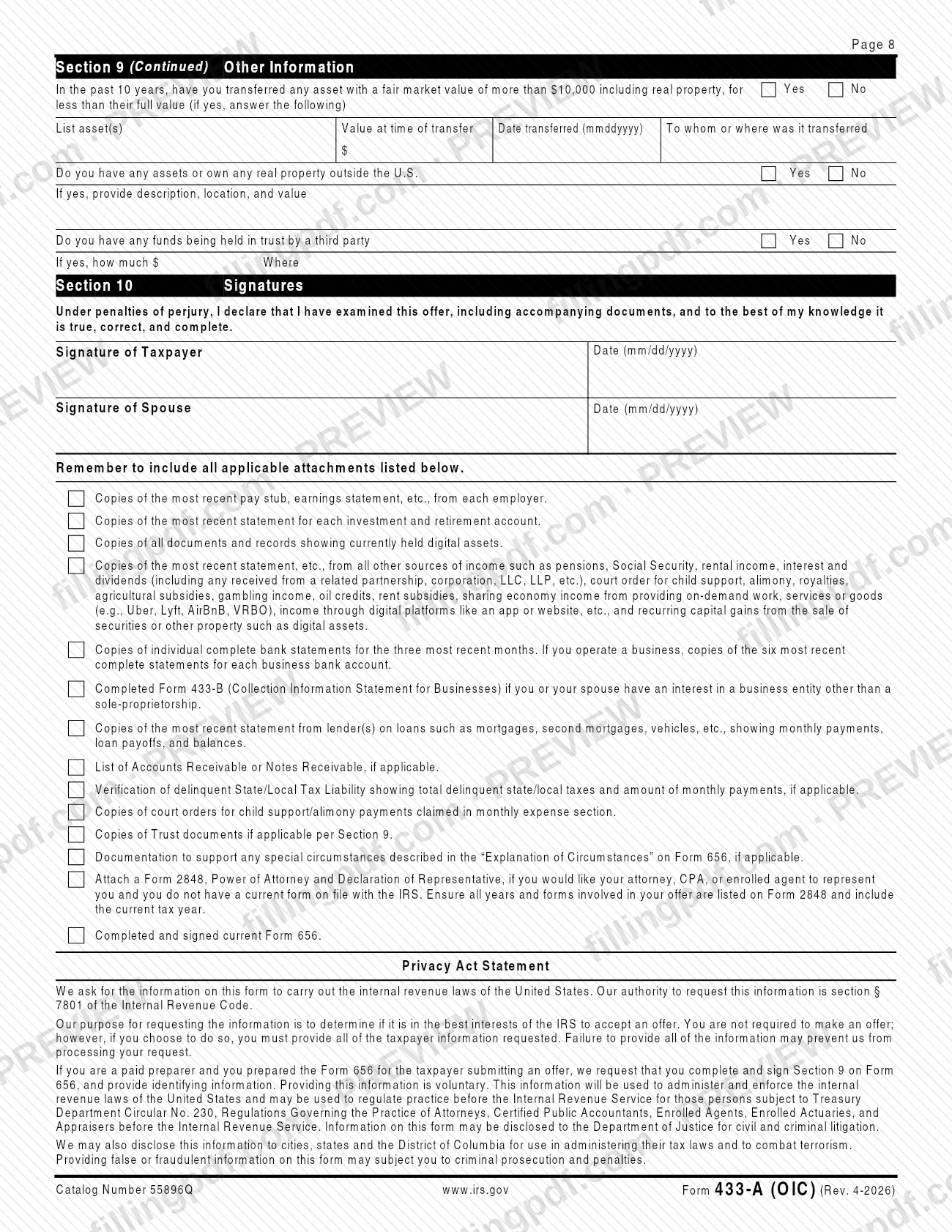
- Completed and signed current Form 656, Offer in Compromise, which this statement accompanies.
- Copies of the most recent pay stub, earnings statement or similar record from each employer.
- Copies of the most recent statement for each investment and retirement account.
- Copies of all documents and records showing currently held digital assets.
- Copies of the most recent statement from all other sources of income, such as pensions, Social Security, rental income, interest and dividends, child support or alimony court orders, royalties, and sharing economy or digital platform income.
- Copies of individual complete bank statements for the three most recent months; if you operate a business, the six most recent complete statements for each business bank account.
- Completed Form 433-B, Collection Information Statement for Businesses, if you or your spouse have an interest in a business entity other than a sole proprietorship.
- Copies of the most recent lender statements on loans such as mortgages, second mortgages and vehicles, showing monthly payments, loan payoffs and balances.
- List of Accounts Receivable or Notes Receivable, if applicable.
- Verification of delinquent state/local tax liability showing total delinquent taxes and monthly payments, if applicable.
- Copies of court orders for child support or alimony payments claimed in the monthly expense section.
- Copies of trust documents if applicable per Section 9.
- Documentation supporting any special circumstances described in the Explanation of Circumstances on Form 656, if applicable.
- Form 2848, Power of Attorney and Declaration of Representative, if you want an attorney, CPA or enrolled agent to represent you and no current form is on file; list all years and forms in the offer and include the current tax year.
How to fill out Form 433-A (OIC)
Enter personal and household information
In Section 1, enter your name, date of birth (mm/dd/yyyy), Social Security Number or ITIN, marital status, home address, whether you own or rent, and county of residence. Add your spouse's details, and list every other person in the household or claimed as a dependent with age, relationship and whether they contribute to household income.
Complete employment details for wage earners
In Section 2, enter your employer's name and address, pay period, occupation and time with the employer, and the same for your spouse. Answer the ownership interest question; Yes means also completing and submitting Form 433-B.
Report cash, investments and insurance
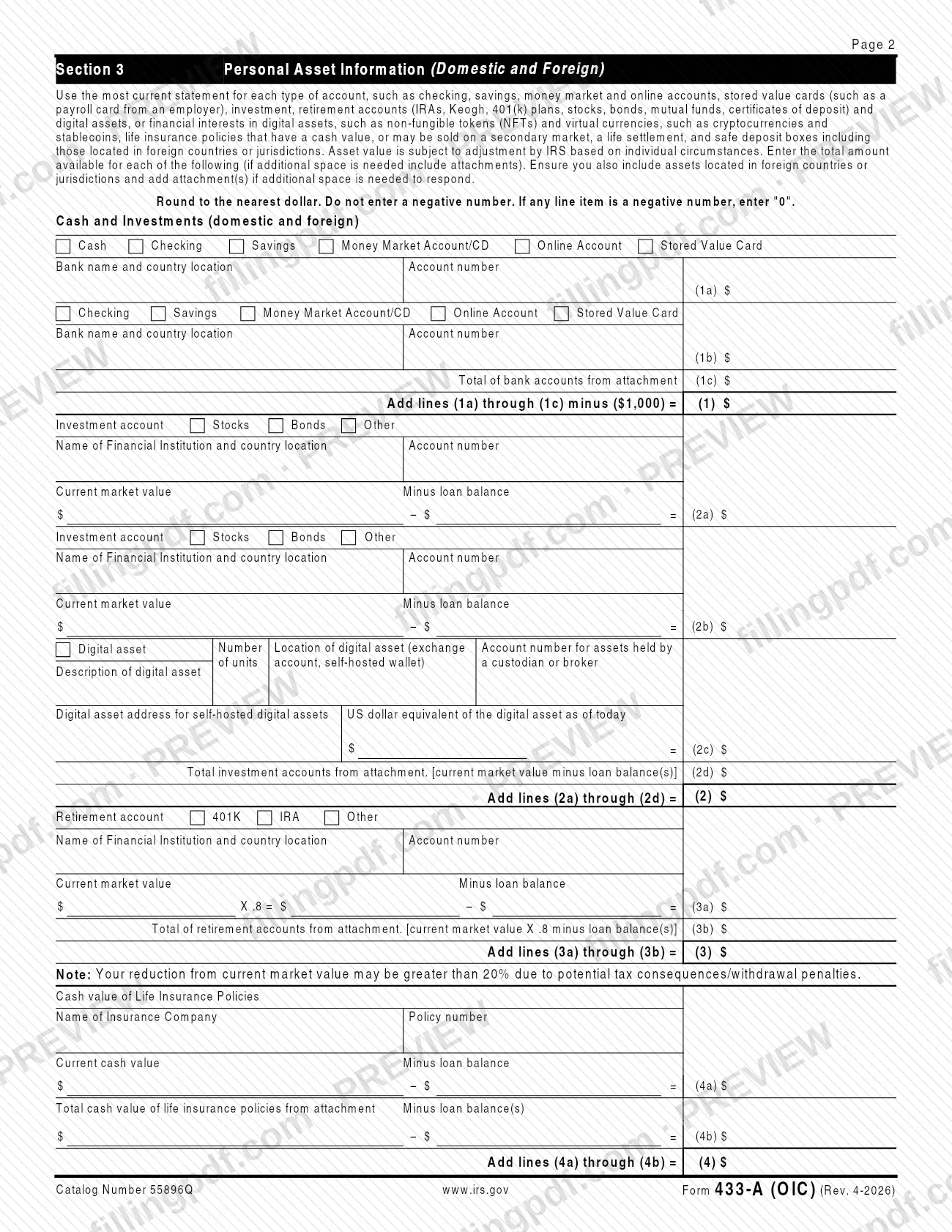
In Section 3, lines (1) to (4), list bank accounts, investment accounts, digital assets, retirement accounts and the cash value of life insurance. Follow the multipliers and loan deductions printed on each line, and attach extra pages if you need more space.
Report property, vehicles and other items
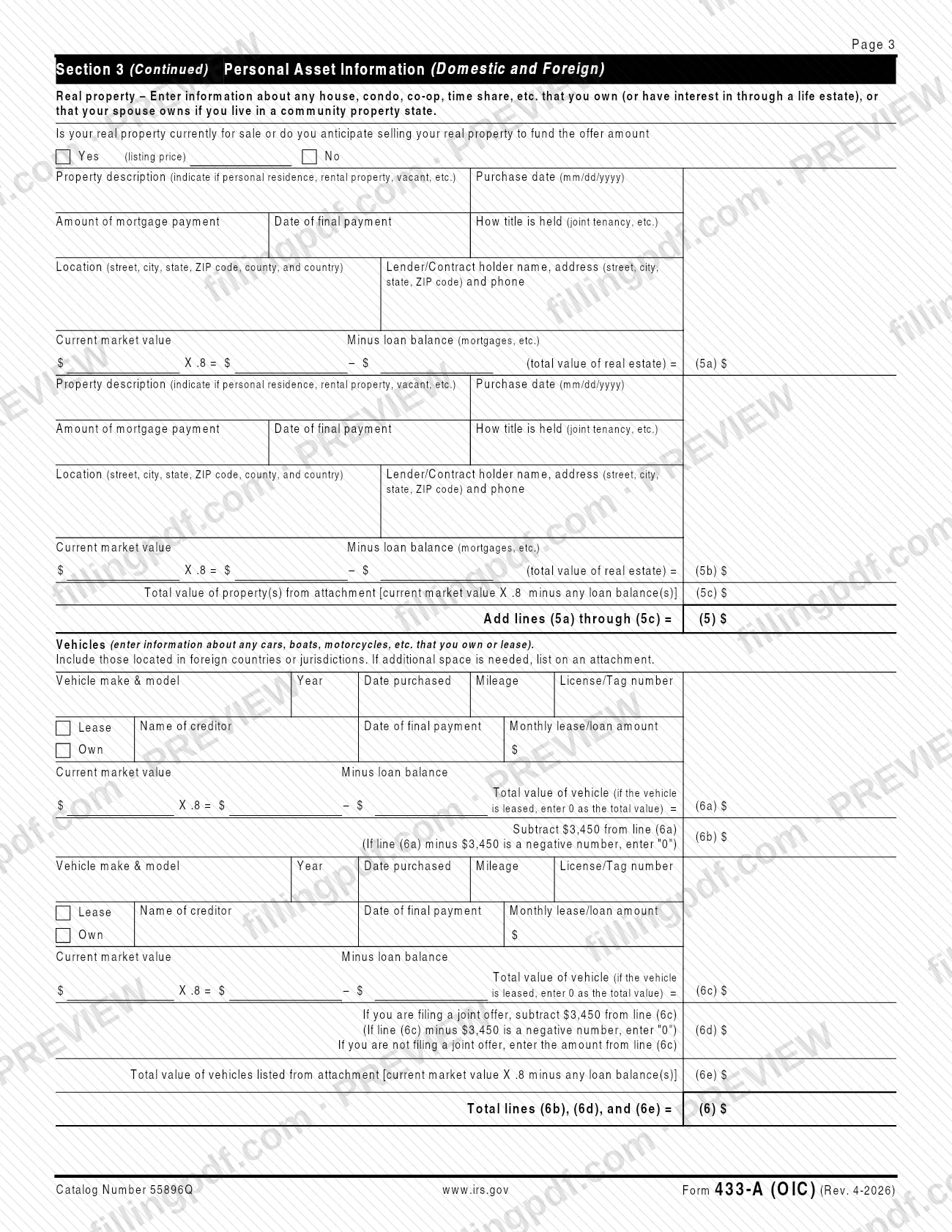
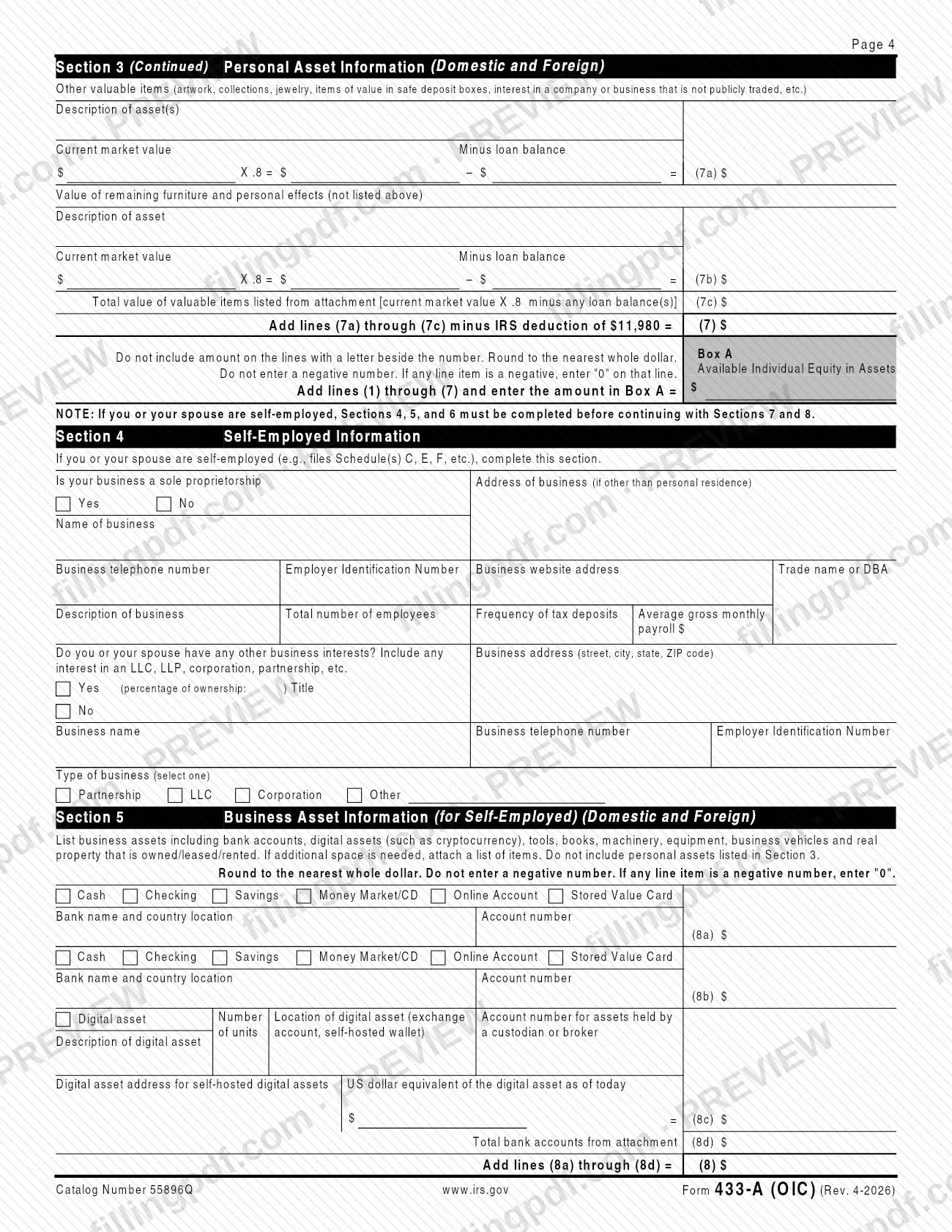
Complete lines (5), (6) and (7) for real property, vehicles you own or lease, valuable items and furniture. Add lines (1) through (7), without the lettered lines, and enter the total in Box A, Available Individual Equity in Assets.
Complete Sections 4 and 5 if self-employed
Describe the business in Section 4, then list business bank accounts, digital assets and other business assets in Section 5, lines (8) to (11). Answer the notes receivable and accounts receivable questions and enter the total in Box B.
Enter business income and expenses
In Section 6, enter gross monthly income on lines (12) to (17) and expenses on lines (18) to (29), or enter line 17 and line 29 from a current profit and loss statement. Subtract line (29) from line (17) and enter the result in Box C.
Enter monthly household income
In Section 7, enter gross monthly income for the primary taxpayer (30), spouse (31) and the other income sources on lines (32) to (38), including income that is not taxable. Add lines (30) through (38) and enter the total in Box D.
Enter monthly household expenses
Enter average monthly expenses on lines (39) to (51), using the allowable standards for boxes (39) and (45) as the form directs and actual amounts for the others. Enter the total in Box E, then subtract Box E from Box D for Box F, Remaining Monthly Income.
Calculate your minimum offer amount
In Section 8, multiply Box F by 12 for Box G or by 24 for Box H, depending on how quickly you will pay. Add Box A, Box B if applicable, and Box G or H to get the offer amount, which must be more than $0, in whole dollars.
Answer the Other Information questions
In Section 9, answer each Yes/No question on incarceration, litigation, bankruptcy in the past 7 years, time lived abroad, trusts, safe deposit boxes, asset transfers, foreign assets and funds held in trust. Where you answer Yes, fill in the follow-up details.
Review, sign and download the PDF
Sign and date Section 10 under penalties of perjury, with your spouse's signature line if applicable, and check the attachments list. Download or print the completed PDF from FillingPDF and assemble it with Form 656 as described under How to submit.
How to submit Form 433-A (OIC)
Form 433-A (OIC) is not filed alone: it goes to the IRS together with a completed and signed current Form 656, Offer in Compromise. The form itself prints no mailing address, portal or appointment rule, so follow the submission instructions that come with Form 656.
What the package must contain, according to the attachments checklist on the form:
- Form 656: completed and signed, with the offer amount from Section 8 of this form placed in Section 4, Payment Terms.
- Supporting records: pay stubs, account and loan statements, bank statements, trust documents and the other items listed under Section 10 where they apply to you.
- Form 433-B and Form 2848: when applicable, as described under who needs the form.
Sign and date Section 10 under penalties of perjury; the spouse signature line is on the same section. If you are a paid preparer's client, the preparer completes Section 9 on Form 656, not on this form.
FillingPDF lets you fill out and download the PDF; submission follows the IRS channels that apply to Form 656.
Common mistakes to avoid
- Using Form 433-A (OIC) without Form 656; the form says it should only be used with Form 656, Offer in Compromise.
- Entering a negative number on any line; the form says to enter "0" on any line item that is negative and to round to the nearest dollar.
- Skipping Sections 4, 5 and 6 when you or your spouse file a Schedule C, E or F, even though Sections 7 and 8 depend on them.
- Leaving the offer amount blank or entering zero; the form says the offer must be more than zero ($0) and in whole dollars.
- Putting the 12 multiplier on a payment plan that runs 6 to 24 months; 12 applies only to five or fewer payments within five months or less, and 24 to 6 to 24 months.
- Entering your actual cost on lines (39) and (45) when the allowable standard is higher; the form says to list the full allowable standard on those boxes even if you pay less.
- Leaving out foreign accounts, foreign real property or digital assets; Section 3 says to include assets located in foreign countries or jurisdictions.
- Claiming depreciation or other non-cash business deductions on line (36); the form says they are not permitted for offer purposes and must be added back.
- Submitting while in a bankruptcy proceeding; the form states you are not eligible to apply for an offer.
Frequently asked questions
What is Form 433-A (OIC) used for?
Form 433-A (OIC) is the IRS financial statement that supports an individual's offer in compromise. It reports assets, monthly income and expenses, and calculates the minimum offer amount that you place on Form 656, Section 4, Payment Terms.
Can I use Form 433-A (OIC) without Form 656?
No. The form states that it should only be used with Form 656, Offer in Compromise. The offer amount calculated in Section 8 is entered on Form 656, and a completed and signed current Form 656 is on the attachments checklist.
Can I fill out Form 433-A (OIC) online?
Yes, you can fill out the PDF online on FillingPDF and download or print it. FillingPDF is an independent service and does not submit the form to the IRS; the package goes to the IRS through the channels that apply to Form 656.
How is the minimum offer amount figured on Form 433-A (OIC)?
Section 8 multiplies Remaining Monthly Income (Box F) by 12 if you pay in five or fewer payments within five months or less, or by 24 if you pay over 6 to 24 months. You add that to the available assets from Box A and Box B.
What if I cannot pay the calculated offer amount?
Put the amount you can pay on Form 656, Section 4, Payment Terms, and explain your special circumstances on Form 656, Section 3, Reason for Offer. Attach documentation that supports those circumstances, if applicable.
What should I attach to Form 433-A (OIC)?
The checklist in Section 10 includes recent pay stubs, investment and retirement statements, three months of bank statements, lender statements, and a signed Form 656. Other items, such as Form 433-B or trust documents, apply only in the situations the form describes.
Do I need to complete the business sections?
Yes, if you or your spouse are self-employed or file a Schedule C, E or F. Sections 4, 5 and 6 must be completed before Sections 7 and 8. If you have an interest in a business entity other than a sole proprietorship, Form 433-B is also required.
Can I apply for an offer while in bankruptcy?
No. The form states that if you or your business are currently in a bankruptcy proceeding, you are not eligible to apply for an offer. Section 9 also asks whether you filed bankruptcy in the past 7 years.
Ready to fill out Form 433-A (OIC)?
Fill out Form 433-A (OIC) now