
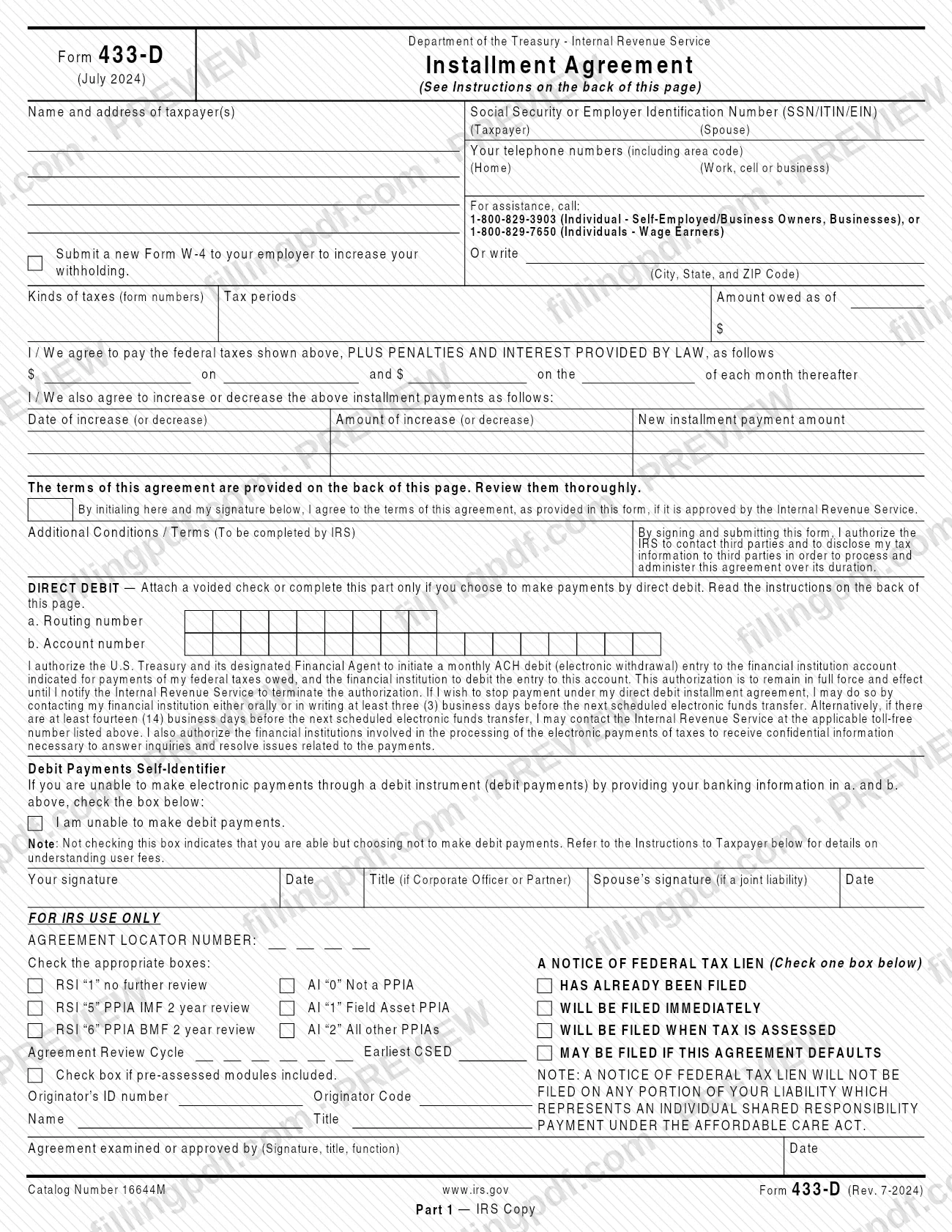

Form 433-D, Installment Agreement, often searched as 433d, is the Internal Revenue Service (IRS) form in which you agree to pay federal taxes you owe, plus penalties and interest, in monthly installments. It records the taxes and periods covered, the amount owed, the payment amount, the monthly due day and, if you choose, a direct debit from your bank account. On this page you can fill out the form online on FillingPDF and download or print the completed PDF. The agreement takes effect only if the IRS approves it, and the original form is published by the IRS at irs.gov.
Last updated
What is 433-D?
Form 433-D, Installment Agreement, is the Internal Revenue Service (IRS) form on which a taxpayer agrees to pay federal taxes shown on the form, plus penalties and interest provided by law, through monthly installment payments. The agreement binds you if the IRS approves it.
The front of the form collects your name and address, Social Security number, ITIN or Employer Identification Number (SSN/ITIN/EIN), telephone numbers, the kinds of taxes (form numbers) and tax periods, and the amount owed as of a date. You then enter the installment amount and the day of the month you will pay. A separate table lets you agree to increase or decrease the payment on later dates. An optional DIRECT DEBIT section authorizes a monthly ACH withdrawal from your account.
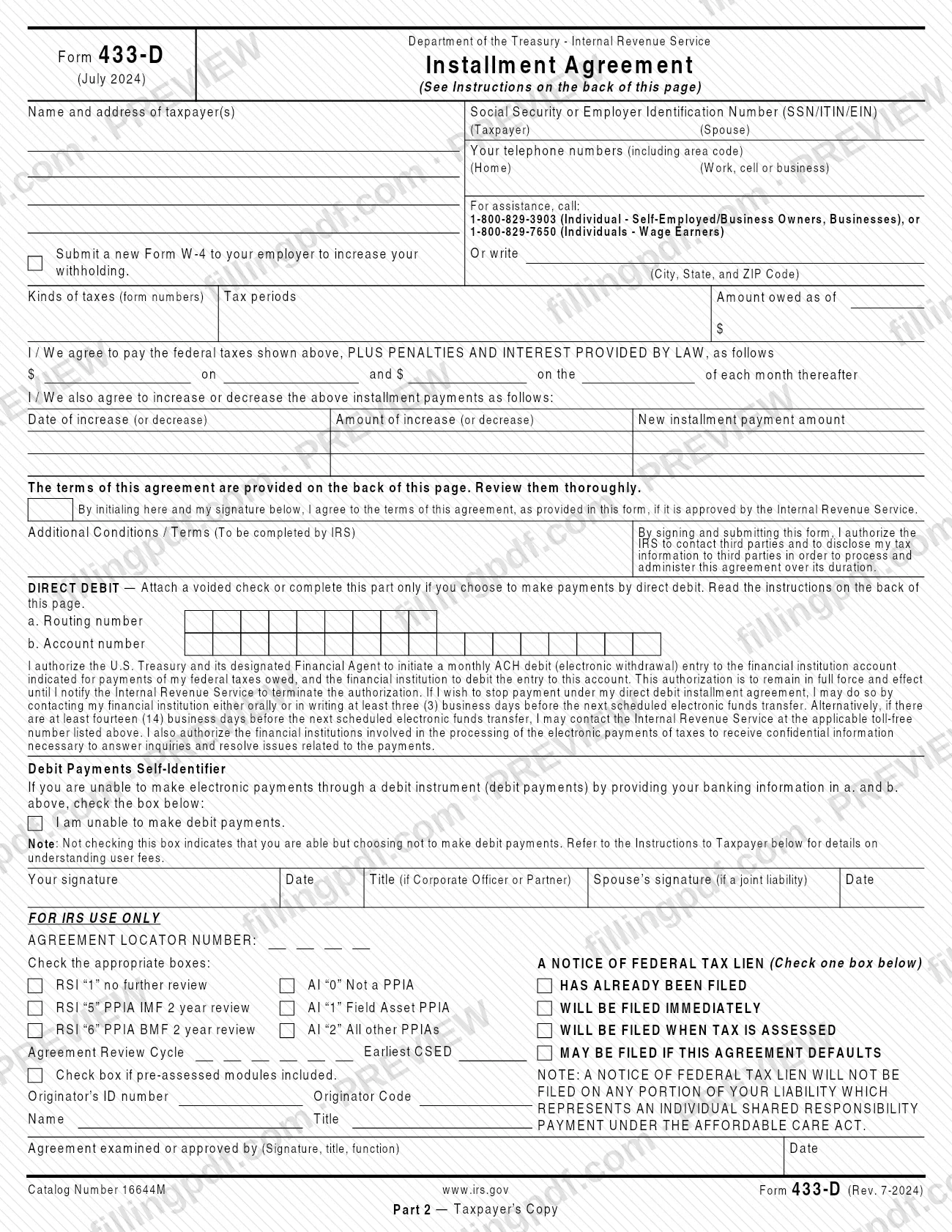
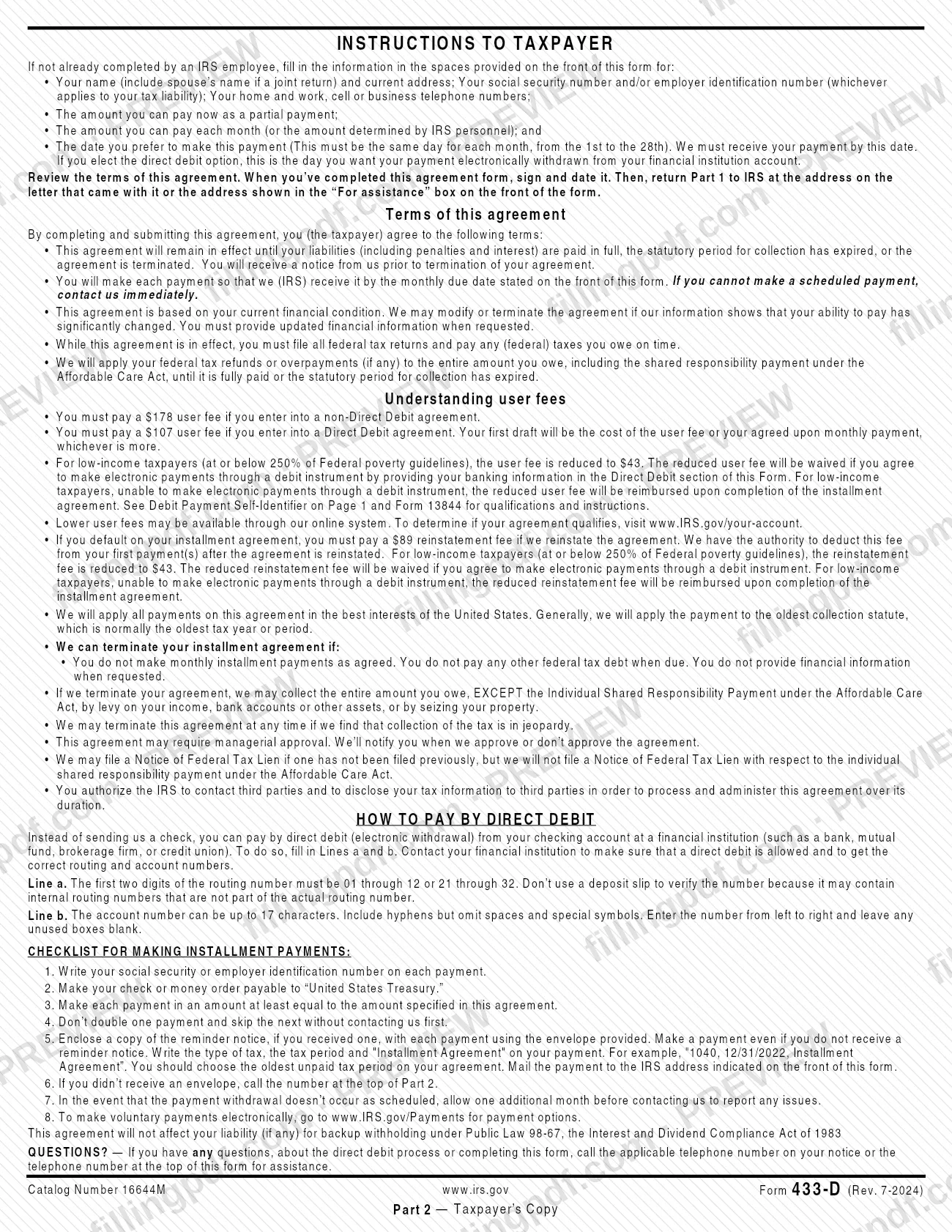
The form is printed twice in the PDF as Part 1, the IRS copy, and Part 2, the Taxpayer's Copy, which carries the instructions and the terms. Under those terms the agreement stays in effect until the liability is paid in full, the statutory period for collection expires, or the IRS terminates it. The block marked FOR IRS USE ONLY, and the Additional Conditions / Terms box, are completed by the IRS, not by you.
The form states that it does not affect any liability you may have for backup withholding under Public Law 98-67.
Who needs to file 433-D?
Taxpayers who owe federal taxes and want to pay them over time in fixed monthly installments use Form 433-D. It covers individuals, including self-employed people and wage earners, and businesses; the form lists separate IRS assistance numbers for each group: 1-800-829-3903 for individuals who are self-employed or business owners, and for businesses, and 1-800-829-7650 for individuals who are wage earners.
- Joint liability: where the liability is joint, both spouses are named on the form, and the form has a line for the spouse's signature if a joint liability.
- Corporate officers and partners: if you sign for a business, enter your title in the Title (if Corporate Officer or Partner) box.
- Direct debit users: you complete lines a and b only if you choose to pay by direct debit from a checking account at a financial institution.
- Taxpayers unable to make debit payments: you may check the I am unable to make debit payments box. Low-income taxpayers should see Form 13844 for the qualifications.
Do not complete the FOR IRS USE ONLY section. If an IRS employee has already filled in part of the front of the form, you complete only what is missing.
When to file 433-D
The form sets no filing deadline of its own: you complete it when you owe federal tax you cannot pay at once and want to propose monthly payments, usually after the IRS sends it to you with a letter. Once an agreement is approved, each payment must reach the IRS by the monthly due day you chose, which must be the same day every month, from the 1st to the 28th.
The agreement may require managerial approval, and the IRS notifies you when it approves or does not approve it. While it is in effect you must file all federal tax returns and pay any federal taxes you owe on time. If you cannot make a scheduled payment, contact the IRS immediately. The IRS can modify or terminate the agreement if your ability to pay changes significantly, and will send notice before terminating.
Documents you need
- A voided check, only if you choose to pay by direct debit and do not complete lines a and b of the Direct Debit section; the form allows either.
- A copy of the reminder notice with each mailed payment, if you received one; payments are mailed after the agreement is in place, not with the form.
- Updated financial information, only when the IRS requests it while the agreement is in effect.
How to fill out 433-D
Enter taxpayer name and address
In Name and address of taxpayer(s), enter your name and current address, and your spouse's name if the liability is joint. Skip anything an IRS employee has already completed.
Enter tax ID and phone numbers
Enter your SSN, ITIN or EIN, whichever applies to your tax liability, for the taxpayer and spouse. Add your home telephone number and your work, cell or business number, with area code.
List the taxes and amount owed
Under Kinds of taxes (form numbers) and Tax periods, list each tax and period covered, and enter the Amount owed as of date and total.
Set the installment amount and day
In the "I / We agree to pay" lines, enter the partial payment you can make now, the monthly amount, and the day of the month. Choose the same day each month, from the 1st to the 28th.
Add any scheduled payment changes
If you agree to raise or lower payments later, enter the date of increase (or decrease), the amount of the change and the new installment payment amount.
Review terms and initial
Read the terms on Part 2, then initial where the form says that by initialing and signing you agree to its terms if the IRS approves it.
Complete direct debit lines if used
To pay by direct debit, enter the routing number on line a and the account number on line b, or attach a voided check. If you cannot make debit payments, check I am unable to make debit payments.
Sign and date the form
Sign and date. Enter your title if you are a corporate officer or partner, and have your spouse sign if the liability is joint.
Leave IRS-use sections blank
Do not complete FOR IRS USE ONLY or Additional Conditions / Terms; the IRS fills those in when it reviews the agreement.
Review and download the completed PDF
Check names, numbers, the payment day and the signatures. Download or print the completed PDF from FillingPDF, then send Part 1 as described under How to submit and keep Part 2.
How to submit 433-D
Return Part 1 of Form 433-D to the IRS by mail; the form names no other channel.
- By mail: after completing, signing and dating the form, send Part 1 to the address on the letter that came with it, or to the address shown in the For assistance box on the front of the form. Keep Part 2, the Taxpayer's Copy.
- Phone assistance: call 1-800-829-3903 (individuals who are self-employed or business owners, and businesses) or 1-800-829-7650 (individuals who are wage earners). For direct debit or form questions you may also use the number on your notice.
- Direct debit: attach a voided check or complete lines a and b of the Direct Debit section.
- Monthly payments by check or money order: make them payable to "United States Treasury", write your SSN or EIN on each payment, and mail them to the IRS address on the front of the form. Voluntary electronic payments are available through www.IRS.gov/Payments.
- User fees: a user fee applies, and its amount depends on the kind of agreement. See the form's Understanding user fees section, or call the IRS, for current amounts. Lower fees may be available online at www.IRS.gov/your-account.
FillingPDF lets you fill out and download the PDF; submission follows the IRS channels above.
Common mistakes to avoid
- Choosing a monthly due day outside the 1st to the 28th, or a day that changes from month to month; the form requires the same day each month and the IRS must receive payment by it.
- Entering a routing number whose first two digits are not 01 through 12 or 21 through 32, or copying the number from a deposit slip, which may show internal routing numbers.
- Putting spaces or special symbols in the account number on line b; it can be up to 17 characters, with hyphens included, and spaces and special symbols omitted.
- Signing without initialing the agreement statement, or leaving out the spouse's signature when the liability is joint.
- Filling in the FOR IRS USE ONLY block or the Additional Conditions / Terms box, which the IRS completes.
- Mailing Part 1 to an address other than the one on the IRS letter or in the For assistance box.
- Doubling one payment and skipping the next without contacting the IRS, or paying less than the amount in the agreement.
- Leaving your SSN or EIN off a check or money order, or making it payable to anyone other than "United States Treasury".
- Contacting the IRS about a missed direct debit before allowing one additional month after the scheduled withdrawal.
Frequently asked questions
What is Form 433-D used for?
Form 433-D is the IRS Installment Agreement. You use it to agree to pay federal taxes you owe, plus penalties and interest, in monthly installments. It takes effect only if the IRS approves it, and you must keep the terms printed on the form.
Is 433d the same as Form 433-D?
Yes. People type the form number as 433d, 433-d or form 433d, but the IRS prints it as Form 433-D, Installment Agreement. This page covers that form, revision July 2024 (Rev. 7-2024).
Where do I send Form 433-D?
Mail Part 1 to the address on the letter that came with the form, or to the address in the For assistance box on its front. The form lists no other submission channel. Keep Part 2, the Taxpayer's Copy, for your records.
Do I have to pay by direct debit?
No. Direct debit is optional: complete lines a and b only if you choose it. You can instead pay by check or money order payable to United States Treasury. Not checking the unable-to-make-debit-payments box tells the IRS you are able but choosing not to pay that way.
Is there a fee for a Form 433-D installment agreement?
Yes, a user fee applies, and it differs for direct debit and non-direct debit agreements. A reinstatement fee applies if a defaulted agreement is reinstated. Reduced fees exist for low-income taxpayers (see Form 13844). Check the form's Understanding user fees section for current amounts.
What day of the month can I choose for payments?
Any single day from the 1st to the 28th, the same each month. The IRS must receive your payment by that date. With direct debit, it is the day the payment is electronically withdrawn from your account.
What happens if I miss payments on my installment agreement?
The IRS can terminate the agreement if you miss monthly payments, owe other federal tax debt when due, or do not provide requested financial information. It will send a notice first, and may then collect the full amount by levy or seizure.
Can I fill out Form 433-D online?
Yes. You can fill out the PDF online on FillingPDF and download or print it. FillingPDF is an independent service and does not submit it to the IRS; you send Part 1 to the IRS yourself, by mail to the address given on the form or letter.
Ready to fill out 433-D?
Fill out 433-D now