
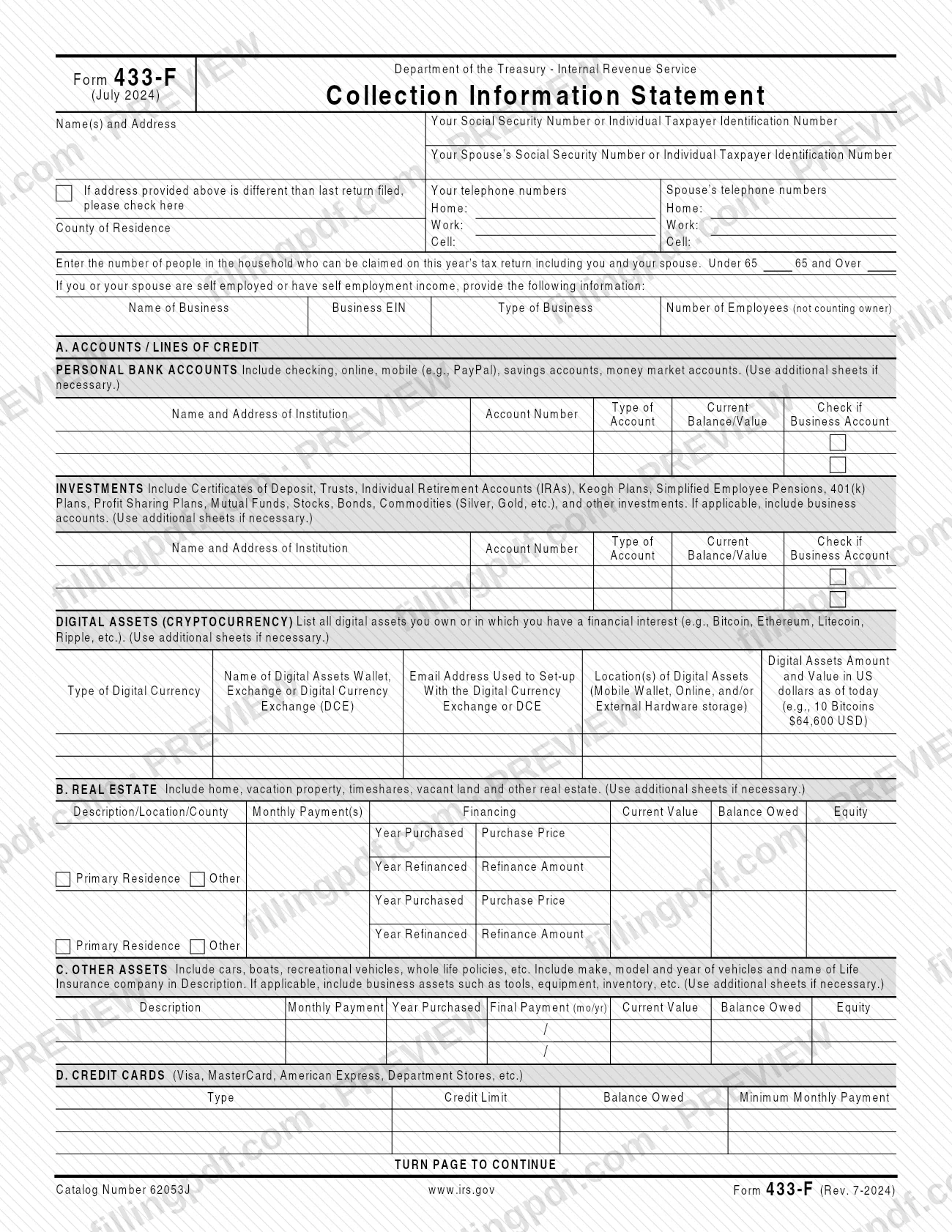
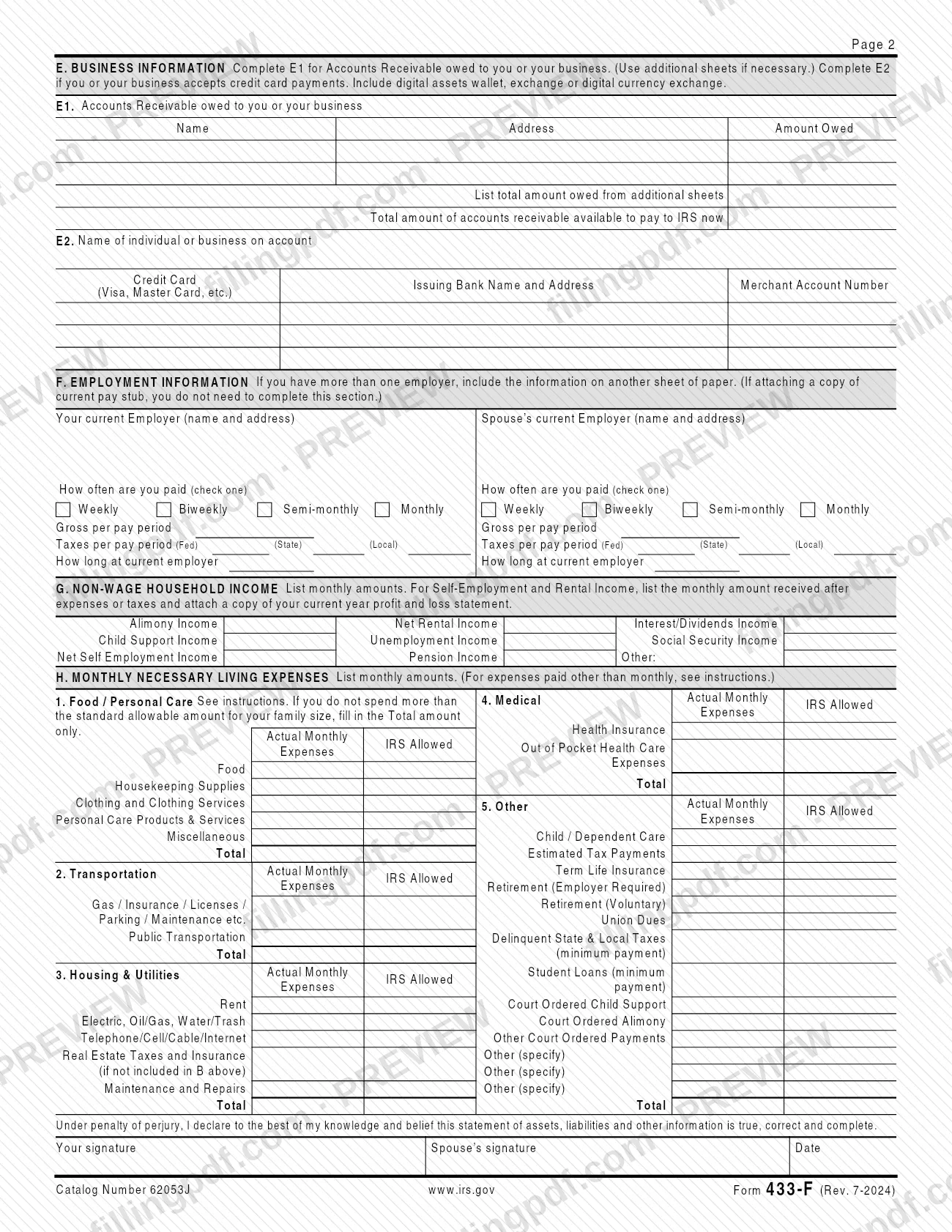
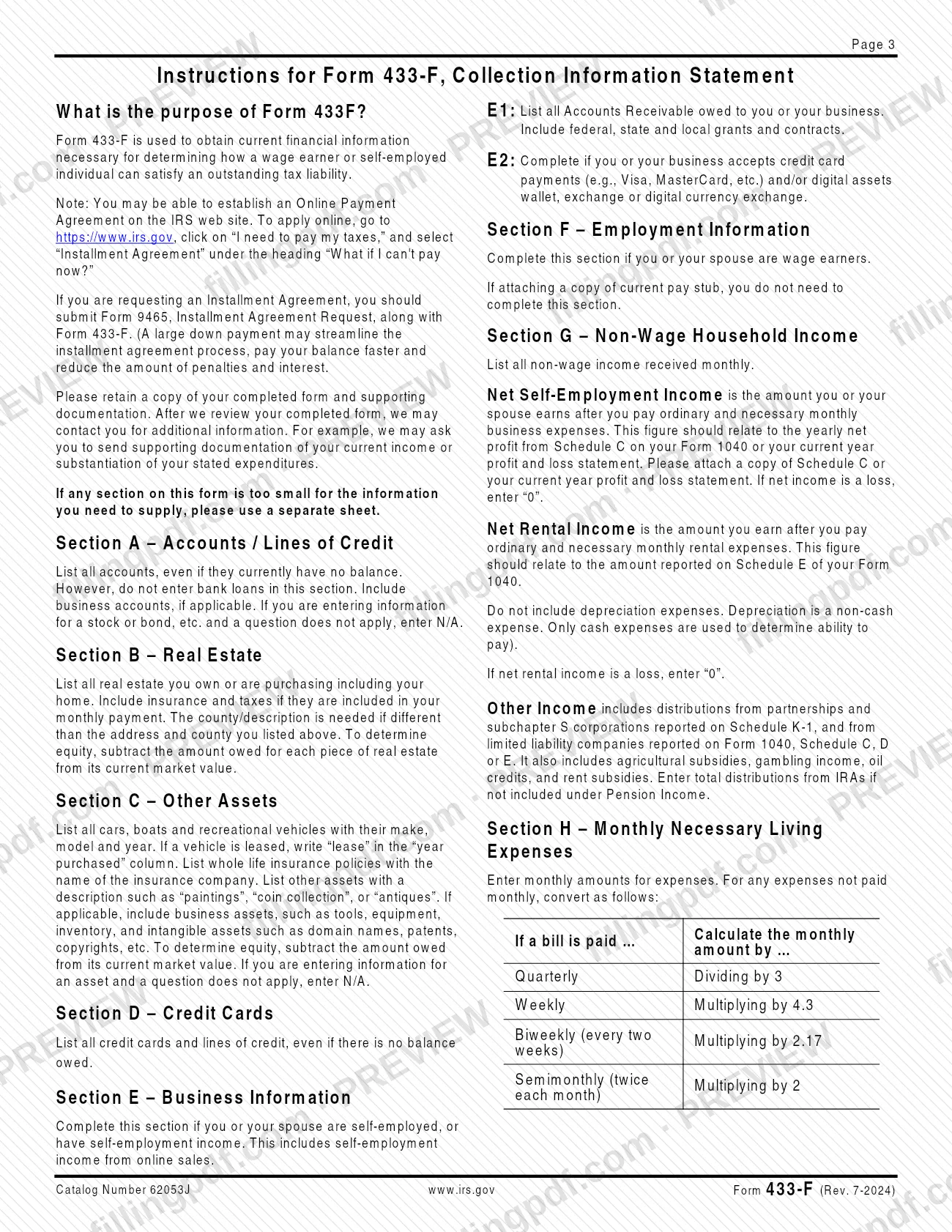
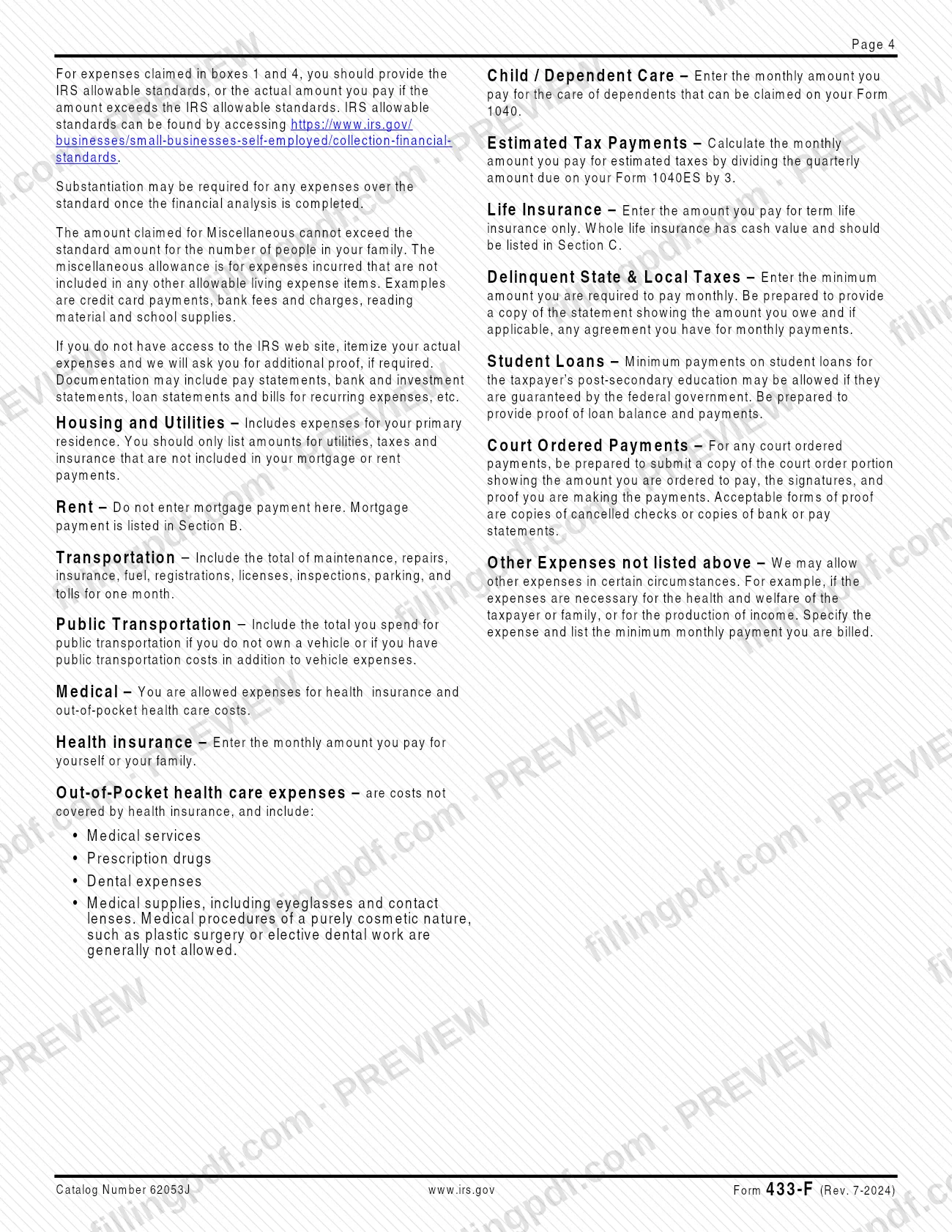
Form 433-F is the Collection Information Statement of the Internal Revenue Service (IRS), the form on which a wage earner or self-employed individual reports assets, debts, income and living expenses so the IRS can decide how an outstanding tax liability can be paid. It is a three-section financial worksheet, Sections A through H, signed under penalty of perjury. On this page you can fill out the form online on FillingPDF and download or print the completed PDF; the form and its instructions are published by the IRS at irs.gov.
Last updated
What is 433-F?
Form 433-F, Collection Information Statement, is the IRS form used to obtain the current financial information needed to determine how a wage earner or self-employed individual can satisfy an outstanding tax liability.
The form is organized in lettered sections:
- A. Accounts / Lines of Credit: personal bank accounts, investments and digital assets (cryptocurrency).
- B. Real Estate and C. Other Assets: property, vehicles, boats, whole life policies and, where applicable, business assets.
- D. Credit Cards, with credit limit, balance owed and minimum monthly payment.
- E. Business Information: accounts receivable (E1) and credit card or digital asset merchant accounts (E2).
- F. Employment Information and G. Non-Wage Household Income.
- H. Monthly Necessary Living Expenses, grouped as food and personal care, transportation, housing and utilities, medical, and other expenses.
It ends with a declaration, under penalty of perjury, that the statement of assets, liabilities and other information is true, correct and complete, with signature lines for you and your spouse.
The IRS instructions printed on pages 3 and 4 of the form say the IRS may contact you for additional information after it reviews the completed statement, for example to ask for supporting documentation of your income or substantiation of your stated expenses. Keep a copy of the completed form and your supporting documents.
Who needs to file 433-F?
Form 433-F is for wage earners and self-employed individuals who have an outstanding tax liability and need to give the IRS their current financial information so it can determine how the liability can be satisfied.
Sections apply according to your situation:
- Wage earners: you or your spouse complete Section F, unless you attach a copy of a current pay stub.
- Self-employed individuals: if you or your spouse are self-employed or have self-employment income, including income from online sales, you complete the business line on page 1 and Section E.
- Married filers: the form has spaces for your spouse's Social Security number or Individual Taxpayer Identification Number, telephone numbers, employer and signature.
If you are requesting an Installment Agreement, the IRS instructions say you should not submit Form 9465, Installment Agreement Request, along with Form 433-F. The instructions also say you may be able to establish an Online Payment Agreement on the IRS website instead of completing this form.
When to file 433-F
The form prints no due date. You complete Form 433-F when the IRS needs current financial information to decide how an outstanding tax liability can be satisfied, for example when you are requesting an Installment Agreement.
Because the form asks for current figures, fill it out with up-to-date information: the current balance of each account, digital asset values in U.S. dollars as of today, a current pay stub if you attach one in place of Section F, and a current year profit and loss statement for self-employment or rental income. After the IRS reviews your completed form, it may contact you for additional information or for substantiation of your stated expenses.
Documents you need
- A copy of your current pay stub, if you want to skip Section F, Employment Information; with it you do not need to complete that section.
- A copy of Schedule C from Form 1040 or your current year profit and loss statement, to support the net self-employment income entered in Section G.
- A current year profit and loss statement for net rental income in Section G; the figure should relate to the amount reported on Schedule E of your Form 1040.
- Additional sheets of paper whenever a section is too small, or when you have more than one employer.
- For court ordered payments in Section H, be prepared to provide a copy of the court order portion showing the amount, the signatures and proof of payment, such as cancelled checks or bank or pay statements.
- For delinquent state and local taxes, be prepared to provide a copy of the statement showing the amount owed and any monthly payment agreement.
- For student loans, be prepared to provide proof of the loan balance and payments; minimum payments may be allowed if the loans are guaranteed by the federal government.
- Pay statements, bank and investment statements, loan statements and bills for recurring expenses, if the IRS asks you to substantiate your stated expenses.
How to fill out 433-F
Enter your personal details
At the top of page 1, enter your name(s) and address, your Social Security Number or Individual Taxpayer Identification Number, your spouse's number, county of residence and telephone numbers. Check the box if the address differs from the one on the last return filed.
Enter household size
Enter the number of people in the household who can be claimed on this year's tax return, including you and your spouse, in the Under 65 and 65 and Over boxes.
Add self-employment information
If you or your spouse are self employed or have self employment income, enter the name of business, business EIN, type of business and number of employees, not counting the owner.
Complete Section A accounts
List personal bank accounts, investments and digital assets (cryptocurrency), even if they have no balance, with institution, account number and current balance or value. Do not enter bank loans; enter N/A for a stock or bond question that does not apply.
List real estate in Section B
List all real estate you own or are purchasing, including your home, with monthly payment, financing details, current value, balance owed and equity (value minus amount owed). Include insurance and taxes if they are in your monthly payment.
List other assets in Section C
Enter cars, boats, recreational vehicles with make, model and year, whole life policies with the insurance company, and other assets, plus business assets if applicable. Write "lease" under year purchased for a leased vehicle.
Enter credit cards in Section D
List every credit card and line of credit, even with no balance owed, with the type, credit limit, balance owed and minimum monthly payment.
Complete Section E if self-employed
In E1, list accounts receivable owed to you or your business, including federal, state and local grants and contracts, and the total available to pay the IRS now. In E2, enter credit card or digital asset merchant accounts.
Fill in Section F employment
Enter your employer and your spouse's employer, how often you are paid, gross and taxes per pay period, and time at the job. Skip this section if you attach a copy of a current pay stub.
Enter Section G non-wage income
List monthly amounts for alimony, child support, net self employment, net rental, unemployment, pension, interest and dividends, Social Security and other income. Enter "0" for a net loss and attach Schedule C or a profit and loss statement where required.
Complete Section H living expenses
Enter monthly amounts for food and personal care, transportation, housing and utilities, medical and other expenses, converting non-monthly bills with the instructions' table. Use the IRS standard amount or your actual amount if it is higher.
Sign, review and download the PDF
Check every section for blanks, then sign and date the declaration; your spouse signs too if applicable. Download or print the completed PDF from FillingPDF and assemble any attachments described under How to submit.
How to submit 433-F
The form itself prints no mailing address, fax number or portal for sending it, so follow the delivery instructions the IRS gave you for your balance or request. The one alternative the IRS instructions describe is online: you may be able to establish an Online Payment Agreement at https://www.irs.gov by clicking "I need to pay my taxes" and selecting "Installment Agreement" under "What if I can't pay now?"
When you send the completed form:
- Sign and date it. The declaration under penalty of perjury has lines for your signature, your spouse's signature and the date.
- Include supporting pages. Attach a current pay stub if you skip Section F, a copy of Schedule C or a current year profit and loss statement for net self-employment income, and additional sheets where a section is too small.
- Do not add Form 9465. If you are requesting an Installment Agreement, the instructions say not to submit it along with Form 433-F.
- Keep a copy. Retain a copy of the completed form and your supporting documentation.
FillingPDF lets you fill out and download the PDF; submission follows the channels above.
Common mistakes to avoid
- Entering bank loans in Section A; the instructions say not to enter them there, although accounts with no balance should still be listed.
- Leaving out accounts, credit cards or lines of credit that currently have no balance; Sections A and D ask for all of them.
- Writing the mortgage payment on the Rent line in Section H; the mortgage payment is listed in Section B.
- Entering a loss for Net Self Employment Income or Net Rental Income instead of "0"; the instructions say to enter "0" when the net amount is a loss.
- Including depreciation in net rental income; it is a non-cash expense, and only cash expenses are used to determine ability to pay.
- Not converting expenses paid other than monthly: weekly bills are multiplied by 4.3, biweekly by 2.17, semimonthly by 2, and quarterly bills divided by 3.
- Claiming a Miscellaneous amount above the standard for your family size; the instructions say it cannot exceed the standard amount.
- Listing whole life insurance as an expense in Section H; the Life Insurance line is for term life insurance only, and whole life policies go in Section C.
- Sending Form 9465 together with Form 433-F when requesting an Installment Agreement, which the instructions say is not needed.
- Leaving the declaration unsigned or undated; it is made under penalty of perjury, with lines for your signature, your spouse's signature and the date.
Frequently asked questions
What is Form 433-F used for?
Form 433-F is the IRS Collection Information Statement. It collects current financial information so the IRS can determine how a wage earner or self-employed individual can satisfy an outstanding tax liability. It covers assets, debts, income and monthly living expenses.
Who has to fill out Form 433-F?
It is for wage earners and self-employed individuals with an outstanding tax liability. Wage earners complete Section F, unless they attach a current pay stub, and self-employed people complete Section E. Spouses add their own information where the form provides space.
Can I fill out Form 433-F online?
You can complete the fillable PDF online on FillingPDF and download or print it. The IRS does not receive it through this site, so deliver it as the IRS directed you. You may also be able to set up an Online Payment Agreement at irs.gov.
Do I send Form 9465 with Form 433-F?
No. The IRS instructions say that if you are requesting an Installment Agreement, you should not submit Form 9465, Installment Agreement Request, along with Form 433-F.
Do I list accounts and credit cards with a zero balance?
Yes. Section A says to list all accounts even if they currently have no balance, and Section D says to list all credit cards and lines of credit even if no balance is owed. Do not list bank loans in Section A.
How do I convert weekly or quarterly bills to monthly amounts?
Section H asks for monthly amounts. Multiply weekly bills by 4.3, biweekly (every two weeks) by 2.17 and semimonthly (twice a month) by 2. Divide quarterly bills by 3. Estimated tax payments are the quarterly Form 1040ES amount divided by 3.
What do I attach to Form 433-F?
Attach a current pay stub if you skip Section F, and Schedule C or a current year profit and loss statement for self-employment or rental income. Use extra sheets if a section is too small. The IRS may later ask for statements or bills to support your expenses.
What happens after the IRS receives my Form 433-F?
After the IRS reviews your completed form, it may contact you for additional information, such as supporting documentation of your current income or substantiation of your stated expenses. Keep a copy of the form and your documents.
Does my spouse have to sign Form 433-F?
The declaration under penalty of perjury has separate lines for your signature and your spouse's signature, plus a date. The form does not say more about when a spouse must sign, so follow the IRS instructions you received.
Ready to fill out 433-F?
Fill out 433-F now