
Form 4669, Statement of Payments Received, is an Internal Revenue Service (IRS) form that a payor uses to show it may be entitled to relief when it withheld less tax than required. The payor fills in Part 1 about the payments; the payee completes Parts 2 and 3 to confirm the payments were reported and the tax was paid. On this page you can fill out Form 4669 online on FillingPDF and download or print the completed PDF. The IRS publishes the original form at irs.gov.
Last updated
What is Form 4669?
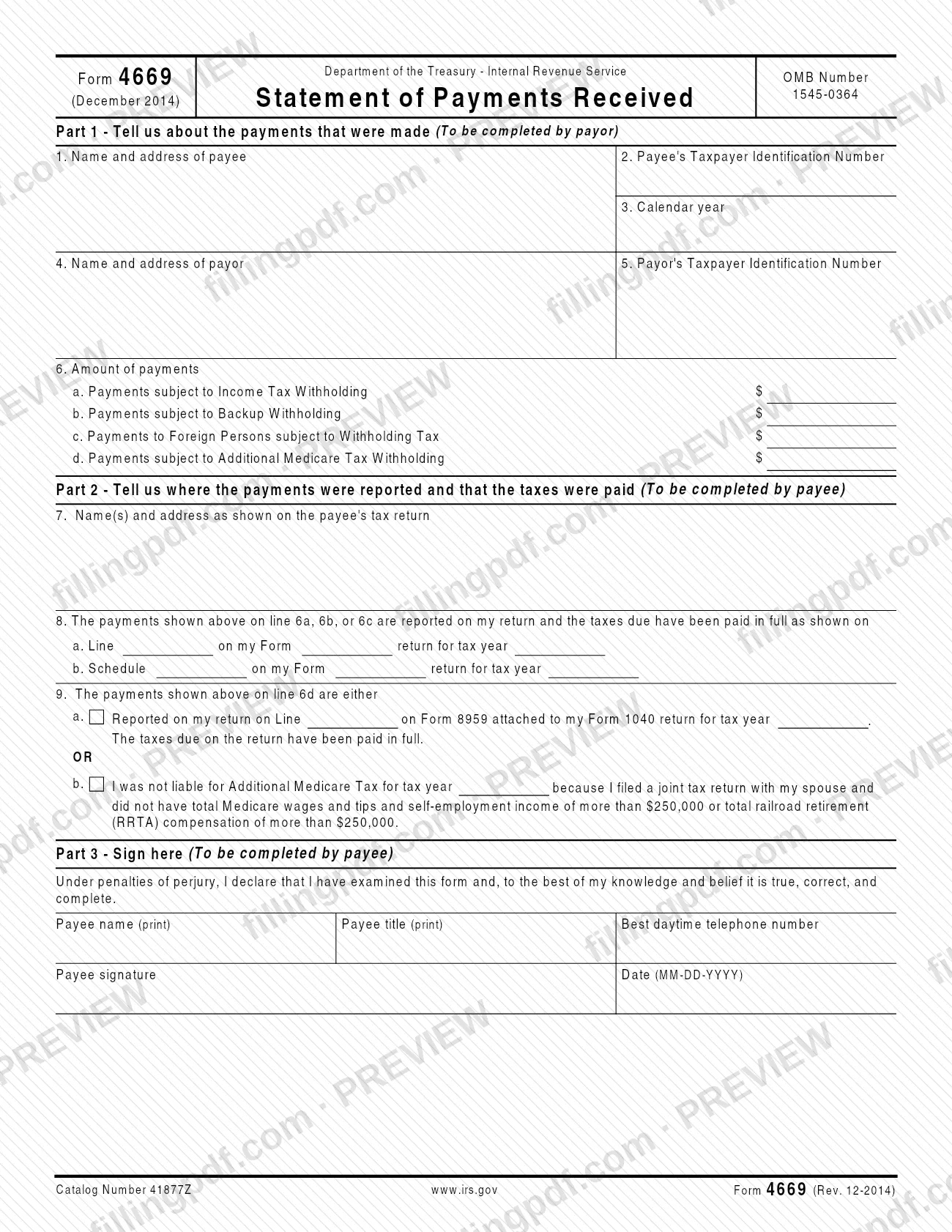
Form 4669, Statement of Payments Received, is the IRS form a payor uses to show that it is entitled to relief when it failed to withhold the required tax from payments made to a payee, because the payee reported the payments and paid the corresponding tax.
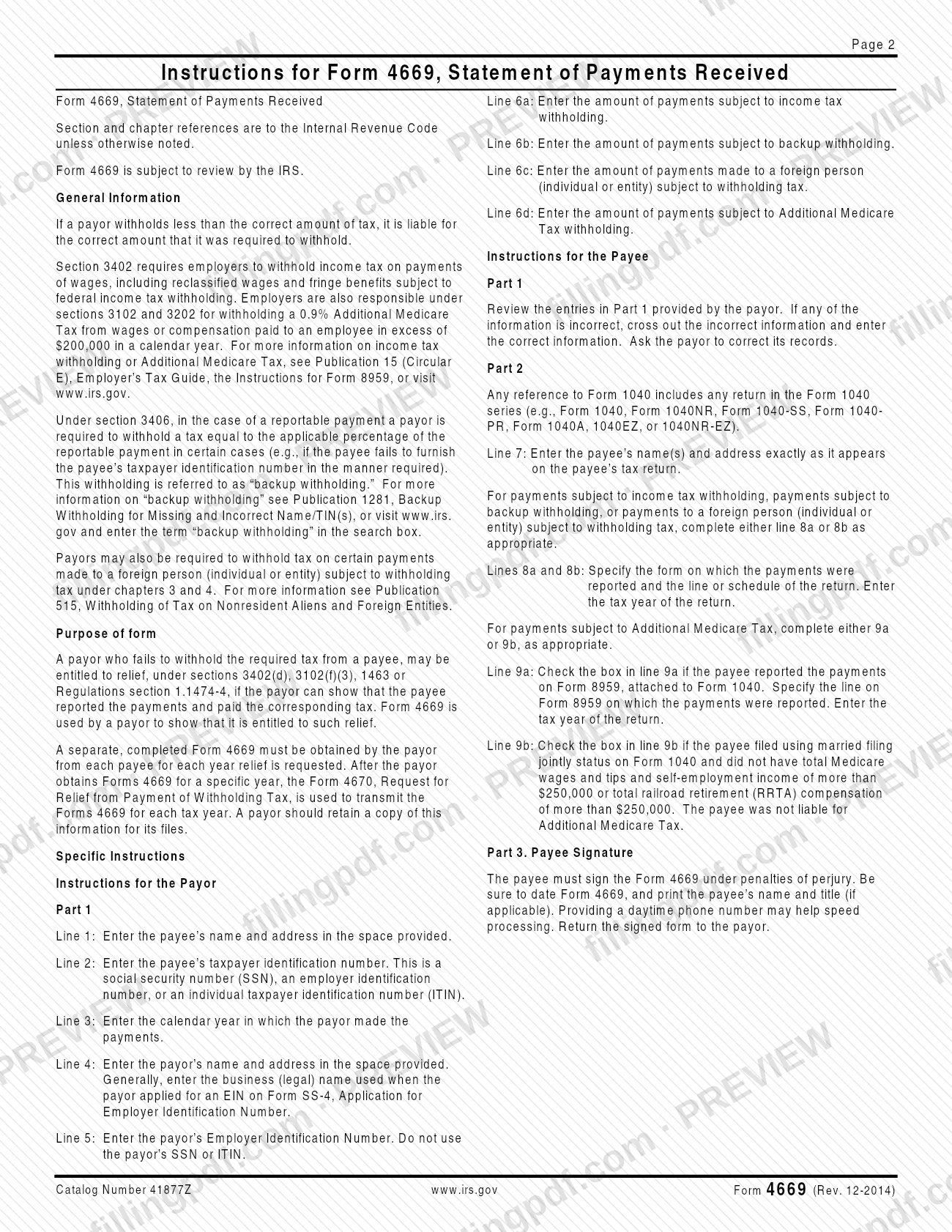
If a payor withholds less than the correct amount, it is liable for the amount it was required to withhold. The IRS instructions say a payor may be entitled to relief under sections 3402(d), 3102(f)(3) or 1463 of the Internal Revenue Code, or Regulations section 1.1474-4, if it can show the payee reported the payments and paid the tax. Form 4669 is the document that shows this.
The form has three parts:
- Part 1, completed by the payor: payee and payor identification, the calendar year, and the amounts of payments subject to income tax withholding, backup withholding, withholding tax on foreign persons, and Additional Medicare Tax withholding.
- Part 2, completed by the payee: where the payments were reported on the payee's return and that the taxes due were paid in full.
- Part 3, completed by the payee: a signature under penalties of perjury.
A separate Form 4669 is obtained from each payee for each year relief is requested. Once the payor has the forms for a tax year, Form 4670, Request for Relief from Payment of Withholding Tax, is used to transmit them. The form is OMB No. 1545-0364, revision December 2014.
Who needs to file Form 4669?
Payors that did not withhold the required tax and want relief use Form 4669. The IRS instructions describe the payor's role: it completes Part 1 and must obtain a separate completed form from each payee for each year relief is requested.
Payees complete Parts 2 and 3 when a payor asks them to. They review Part 1, correct anything that is wrong, state where the payments were reported on their return, and sign. The payee's name and title are printed if applicable.
The payments covered are those subject to income tax withholding, backup withholding, withholding tax on payments to foreign persons (individuals or entities), and Additional Medicare Tax withholding.
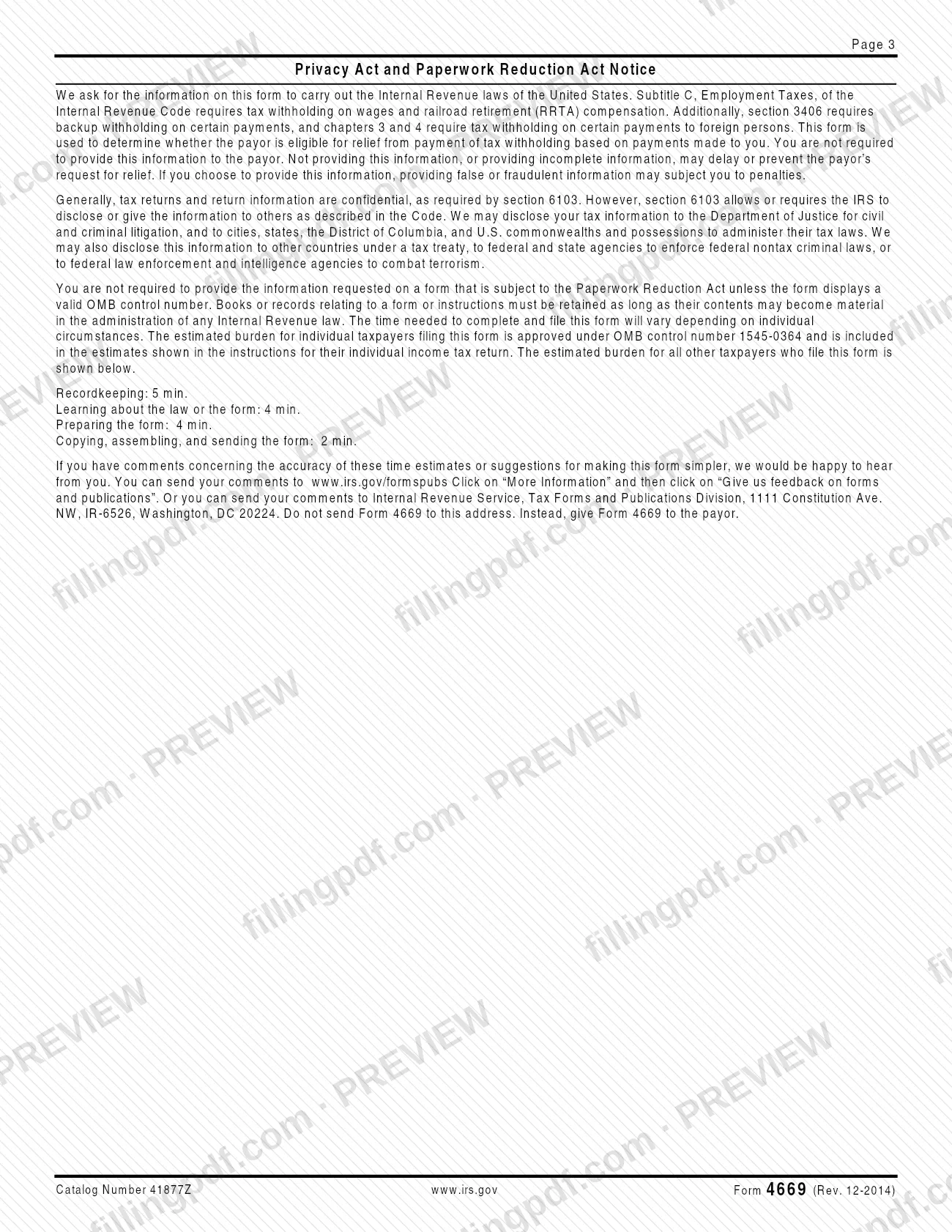
Payees are not required to provide this information to the payor. The IRS privacy notice says that not providing it, or providing incomplete information, may delay or prevent the payor's request for relief. The form is not for individuals who simply want to report income on their own return; it is exchanged between payor and payee.
When to file Form 4669
The triggering event is a payor's request for relief after it failed to withhold the required tax from payments to a payee. The form prints no separate due date. The payor obtains one completed Form 4669 from each payee for each year relief is requested. The payee's Part 2 can only be completed once the payee has reported the payments on a return and paid the taxes due in full, so the form follows the payee's filing for the tax year shown on line 3 or in Part 2. After the payor has Forms 4669 for a specific year, it uses Form 4670 to transmit them for that tax year and keeps a copy for its files. Form 4669 is subject to review by the IRS.
How to fill out Form 4669
Identify the payee on lines 1 and 2
Payor: on line 1 enter the payee's name and address. On line 2 enter the payee's taxpayer identification number, which is an SSN, an employer identification number or an ITIN.
Enter the calendar year on line 3
Payor: enter the calendar year in which the payments were made.
Identify the payor on lines 4 and 5
Payor: on line 4 enter the payor's name and address, generally the business (legal) name used on Form SS-4. On line 5 enter the payor's Employer Identification Number, not an SSN or ITIN.
Enter payment amounts on line 6
Payor: complete line 6a (income tax withholding), 6b (backup withholding), 6c (payments to foreign persons subject to withholding tax) and 6d (Additional Medicare Tax withholding) as they apply.
Review Part 1 as the payee
Payee: check the payor's entries. If anything is incorrect, cross it out, enter the correct information and ask the payor to correct its records.
Enter your return name on line 7
Payee: enter your name(s) and address exactly as they appear on your tax return.
Complete line 8a or 8b
Payee, for payments on lines 6a, 6b or 6c: give the line or schedule of the return on which the payments were reported, the form, and the tax year of the return.
Complete line 9a or 9b
Payee, for payments on line 6d: check 9a if you reported them on Form 8959 attached to Form 1040, giving the line and tax year. Check 9b if you filed jointly and did not exceed the Medicare wage and RRTA limits printed there.
Sign and date Part 3
Payee: print your name, title (if applicable) and daytime telephone number, sign under penalties of perjury, and enter the date as MM-DD-YYYY.
Review and download the completed PDF
Check each part against its instructions, then download or print the completed PDF from FillingPDF. Return it to the payor as described under How to submit.
How to submit Form 4669
Form 4669 is handed between payor and payee and then sent on by the payor with Form 4670; the payee does not send it to the IRS.
- Payor to payee: the payor completes Part 1 and gives the form to the payee.
- Payee to payor: the payee completes and signs Parts 2 and 3 and returns the signed form to the payor. A daytime phone number may help speed processing.
- Payor to the IRS: after the payor has Forms 4669 for a specific year, Form 4670, Request for Relief from Payment of Withholding Tax, is used to transmit them for each tax year. The payor should retain a copy for its files. See the Form 4670 instructions for how to submit it.
Do not send Form 4669 to the Tax Forms and Publications Division address printed in the IRS notice; the form says to give it to the payor. FillingPDF lets you fill out and download the PDF; submission follows the channels above.
Common mistakes to avoid
- Having the payee complete Part 1; the instructions say Part 1 is completed by the payor and Parts 2 and 3 by the payee.
- Using one Form 4669 for several payees or several years; a separate completed form is needed from each payee for each year relief is requested.
- Entering the payor's SSN or ITIN on line 5; the instructions say to use the payor's Employer Identification Number.
- Entering a name and address on line 7 that differ from those on the payee's tax return; it must appear exactly as on the return.
- Leaving incorrect Part 1 entries uncorrected; the payee should cross out wrong information, enter the correct information and ask the payor to fix its records.
- Completing neither line 9a nor 9b when payments appear on line 6d, or completing lines 8a and 8b without specifying the tax year of the return.
- Submitting the form unsigned, undated or without the payee's printed name; the payee must sign under penalties of perjury.
- Sending Form 4669 to the IRS Tax Forms and Publications Division address; the form says to give it to the payor.
Frequently asked questions
What is Form 4669 used for?
Form 4669 is used by a payor to show it is entitled to relief when it did not withhold the required tax. The payee confirms on the form that the payments were reported on a return and the taxes due were paid in full.
Who fills out Form 4669, the payor or the payee?
Both. The payor completes Part 1 (payee, payor, calendar year and payment amounts). The payee completes Part 2 (where the payments were reported) and Part 3 (signature under penalties of perjury), then returns the form to the payor.
Where do I send Form 4669?
The payee returns it to the payor, not to the IRS; the form says to give it to the payor. The payor then uses Form 4670, Request for Relief from Payment of Withholding Tax, to transmit the Forms 4669 for each tax year.
Do I need a separate Form 4669 for each payee and year?
Yes. The instructions say a separate, completed Form 4669 must be obtained by the payor from each payee for each year relief is requested. The payor should keep a copy for its files.
Does a payee have to complete Form 4669?
No. The IRS privacy notice says you are not required to provide this information to the payor. However, not providing it, or giving incomplete information, may delay or prevent the payor's request for relief.
What is the difference between lines 9a and 9b?
Line 9a is checked if you reported the line 6d payments on Form 8959 attached to Form 1040. Line 9b is checked if you filed married filing jointly and did not exceed the Medicare wage and RRTA limits printed on the form, so you owed no Additional Medicare Tax.
Can I fill out Form 4669 online?
Yes. You can fill out the fillable PDF online on FillingPDF and download or print it. FillingPDF is an independent service and does not send the form to the payor or the IRS; you hand it over yourself.
Ready to fill out Form 4669?
Fill out Form 4669 now