
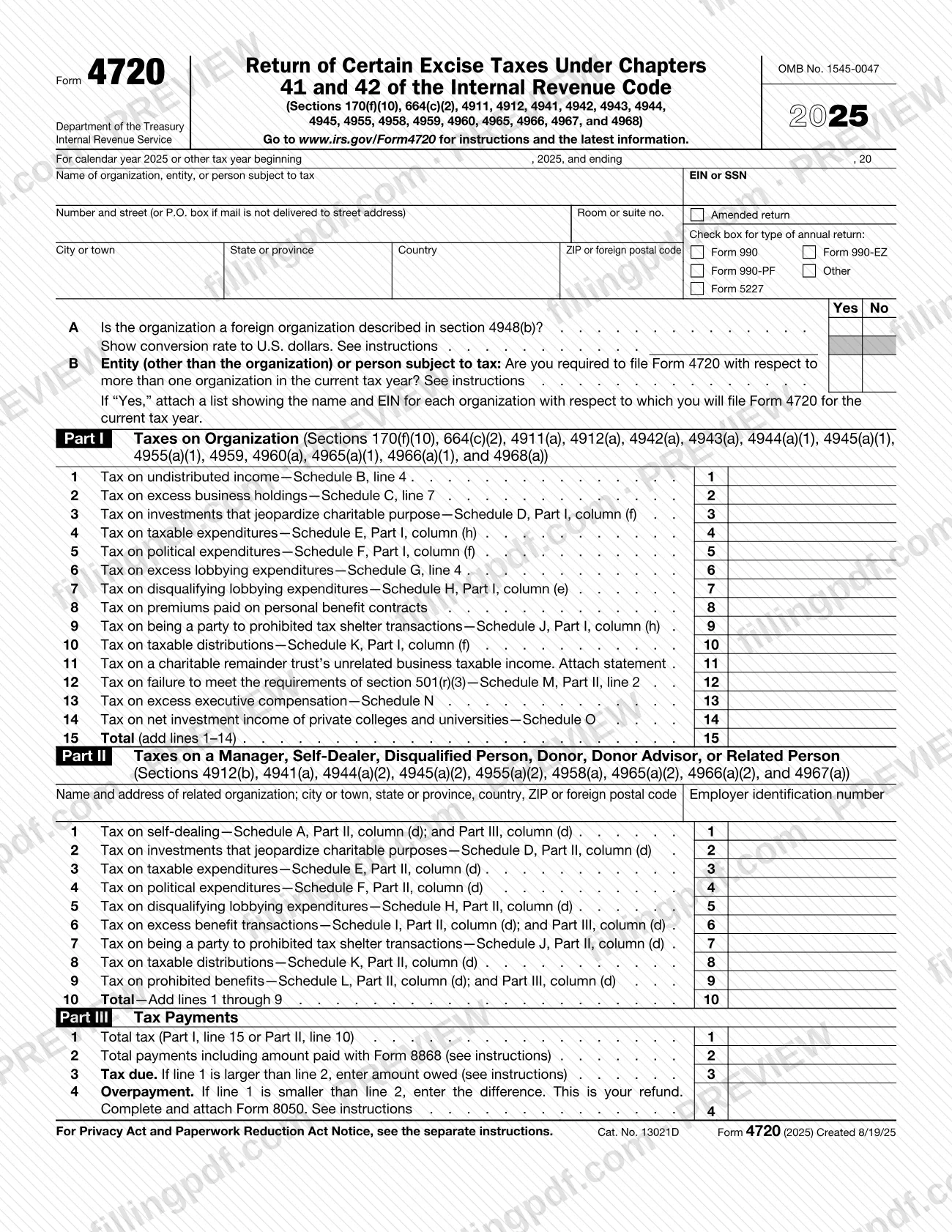
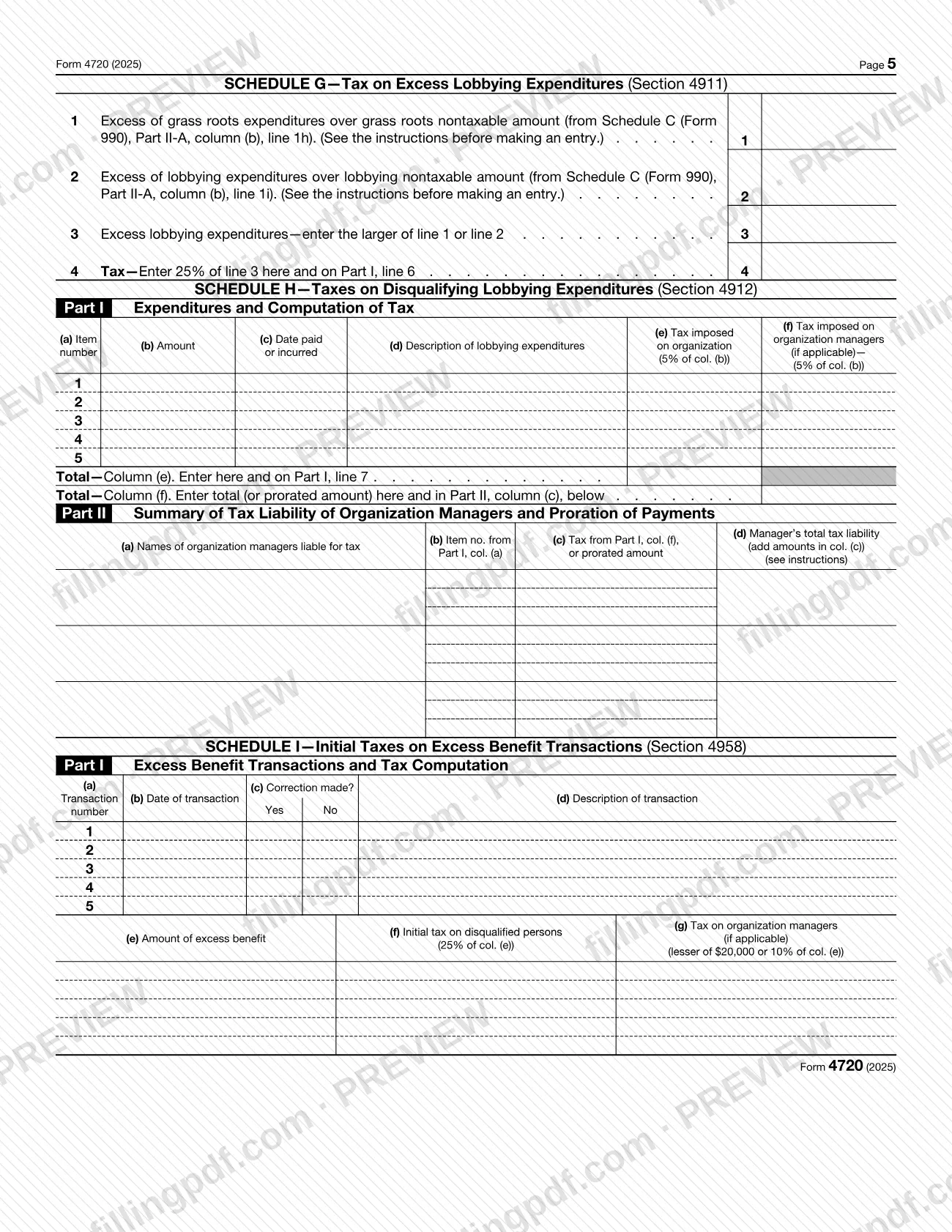
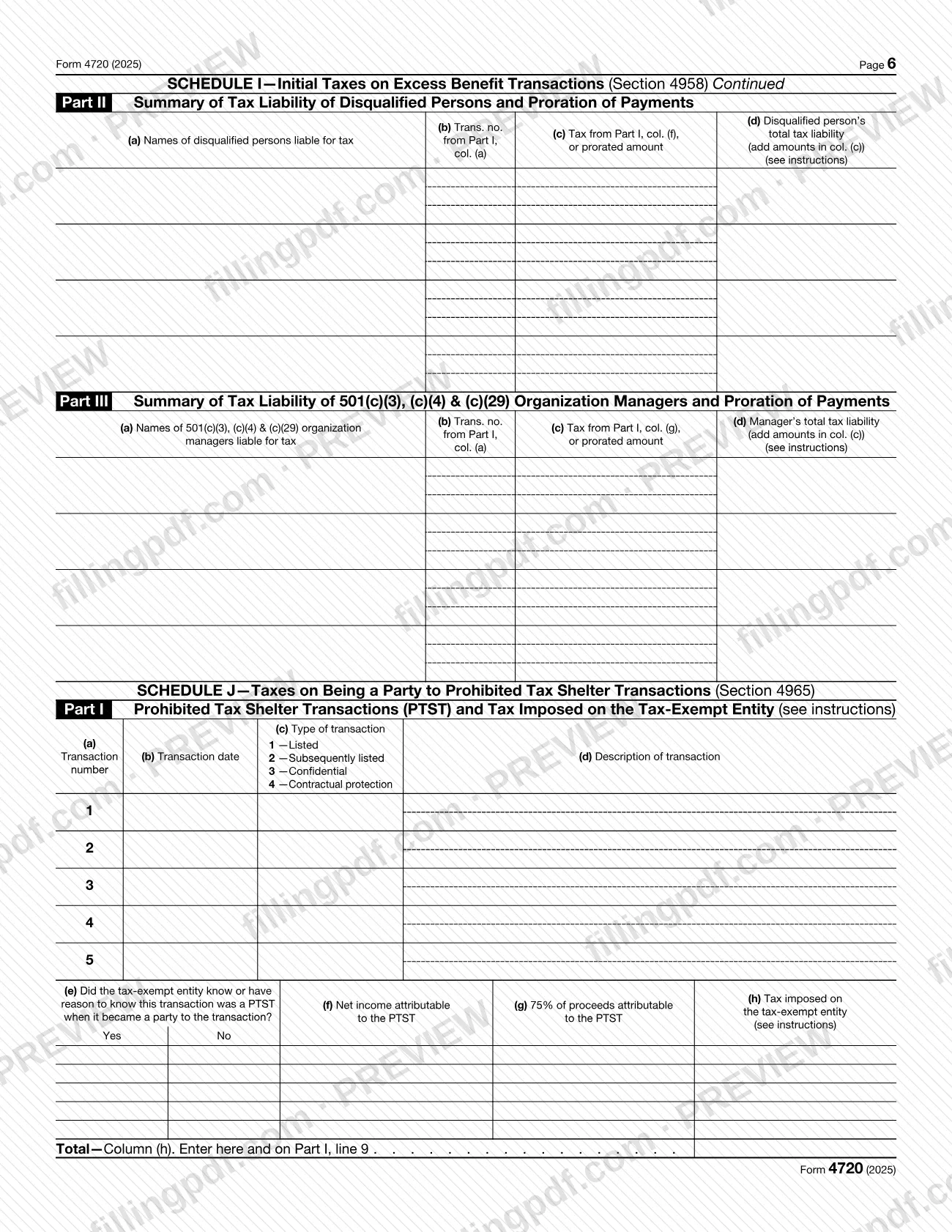
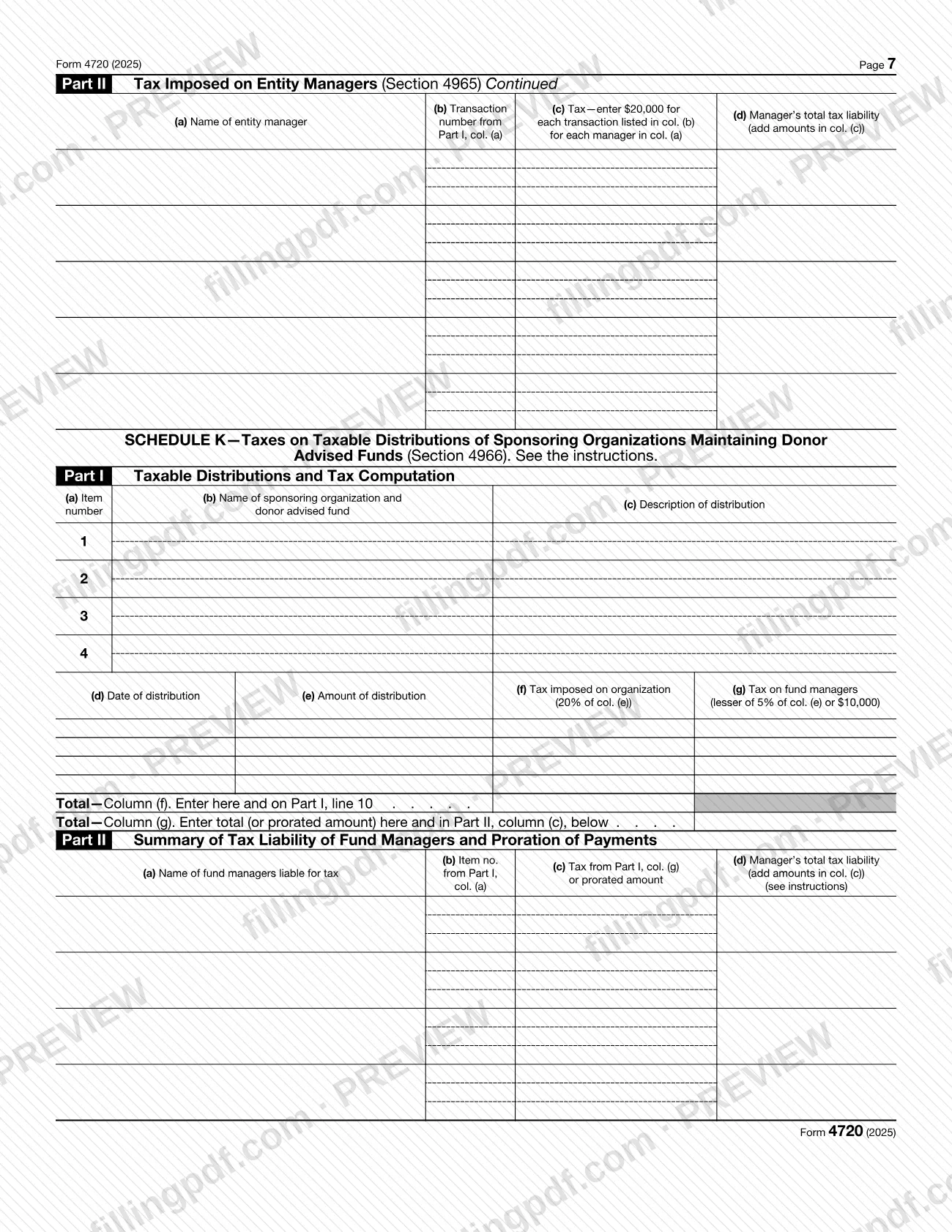
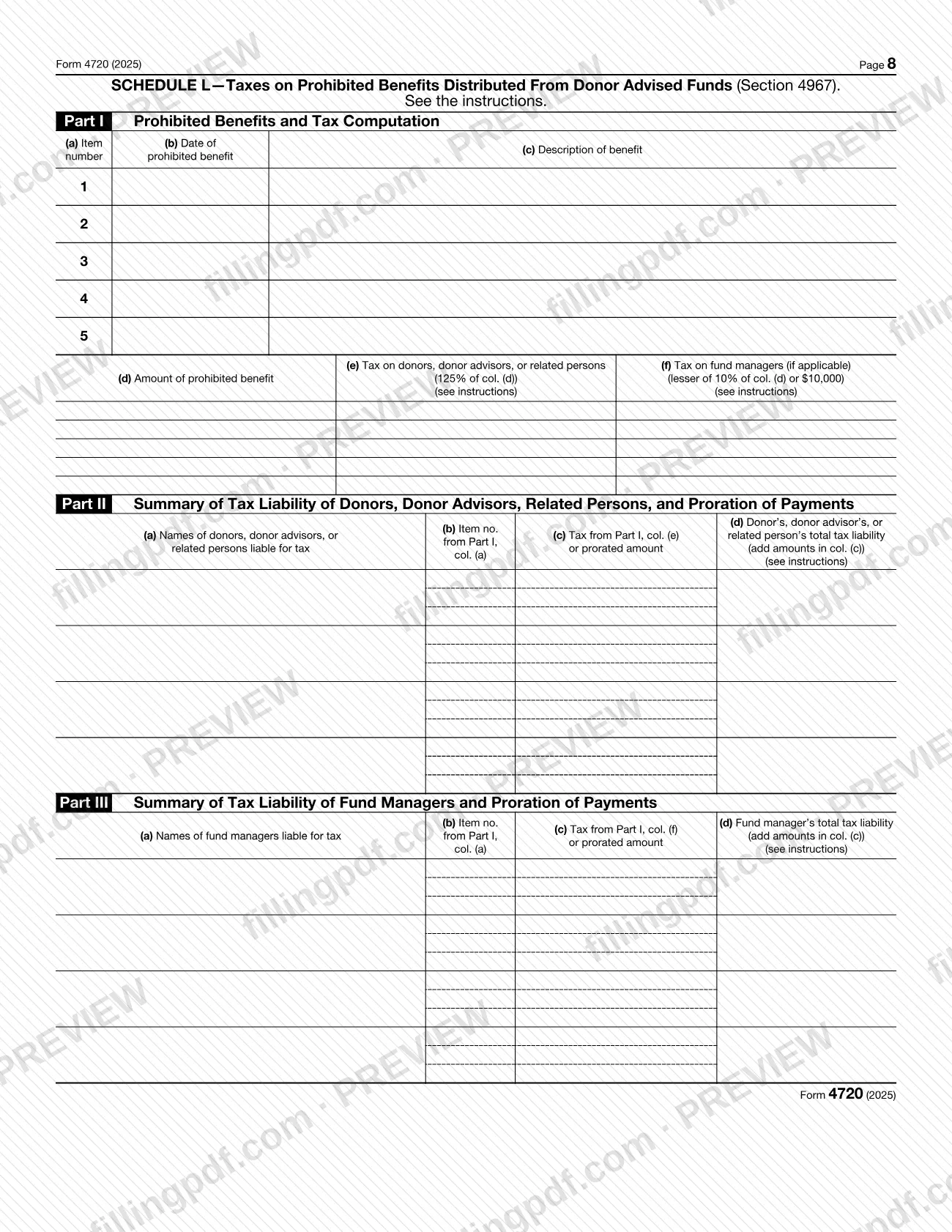
Form 4720 is the Internal Revenue Service (IRS) return on which tax-exempt organizations, and the managers, self-dealers, disqualified persons, donors and donor advisors tied to them, report and pay certain Chapter 41 and Chapter 42 excise taxes. Organizations use Part I, individuals and other entities use Part II, and each taxpayer files its own return. On this page you can fill out the form online on FillingPDF and download or print the completed PDF; the form and the 2025 instructions are published by the IRS at www.irs.gov/Form4720.
Last updated
What is 4720?
Form 4720, Return of Certain Excise Taxes Under Chapters 41 and 42 of the Internal Revenue Code, is the IRS form used to figure and pay excise taxes on private foundations, public charities, other tax-exempt entities and the people connected with them, including managers, self-dealers, disqualified persons, donors and donor advisors.
The 2025 form and its instructions cover taxes under sections 170(f)(10), 664(c)(2), 4911, 4912, 4941, 4942, 4943, 4944, 4945, 4955, 4958, 4959, 4960, 4965, 4966, 4967 and 4968. Each tax has its own schedule:
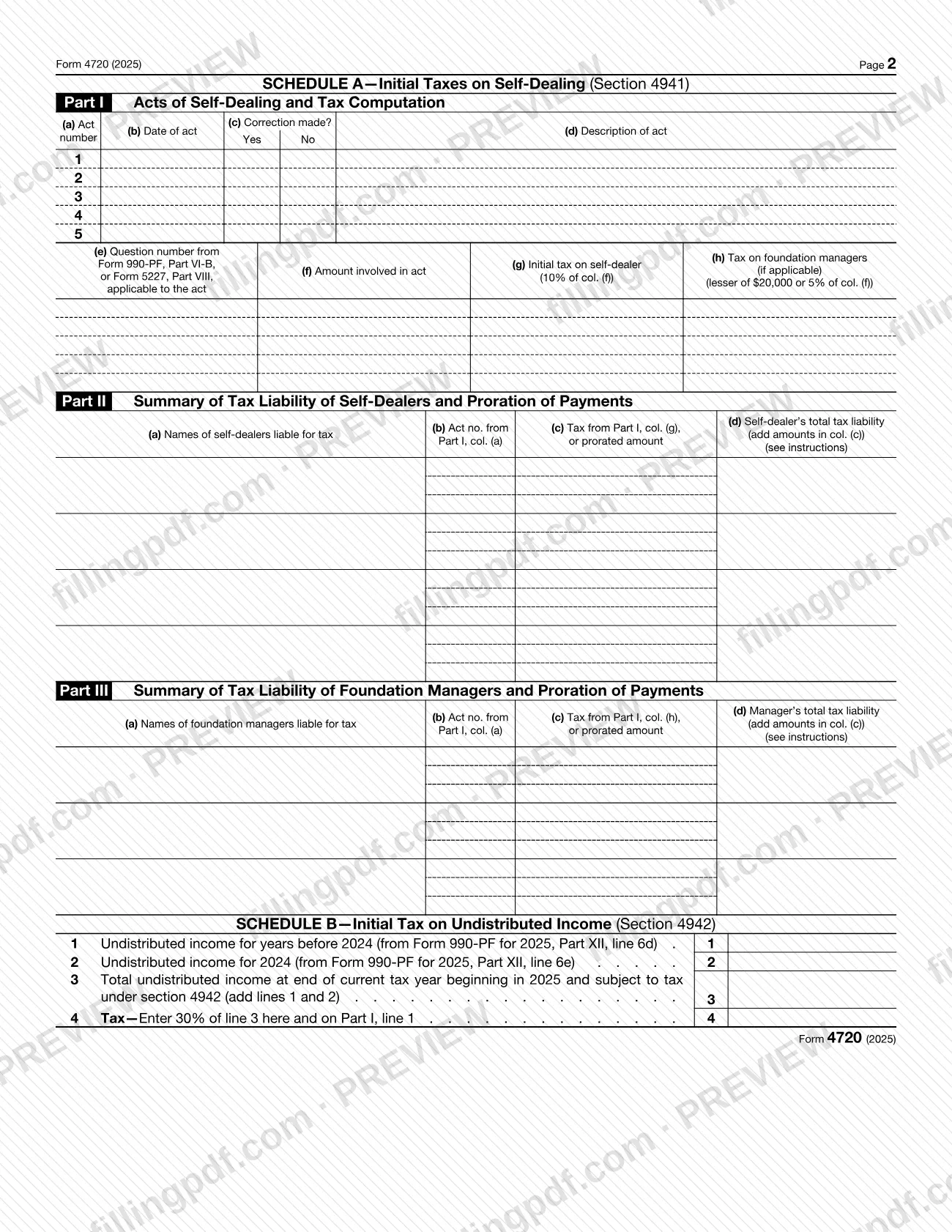
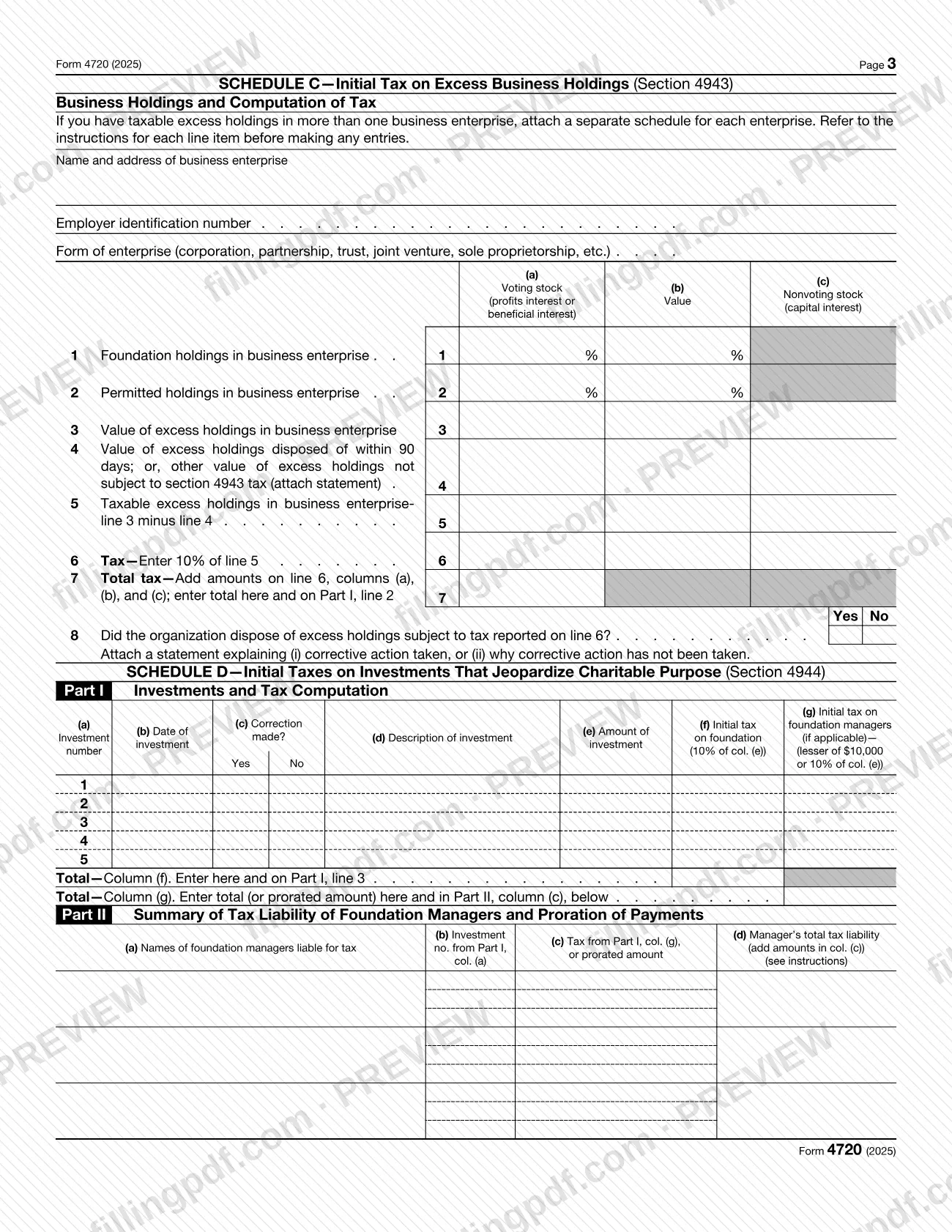
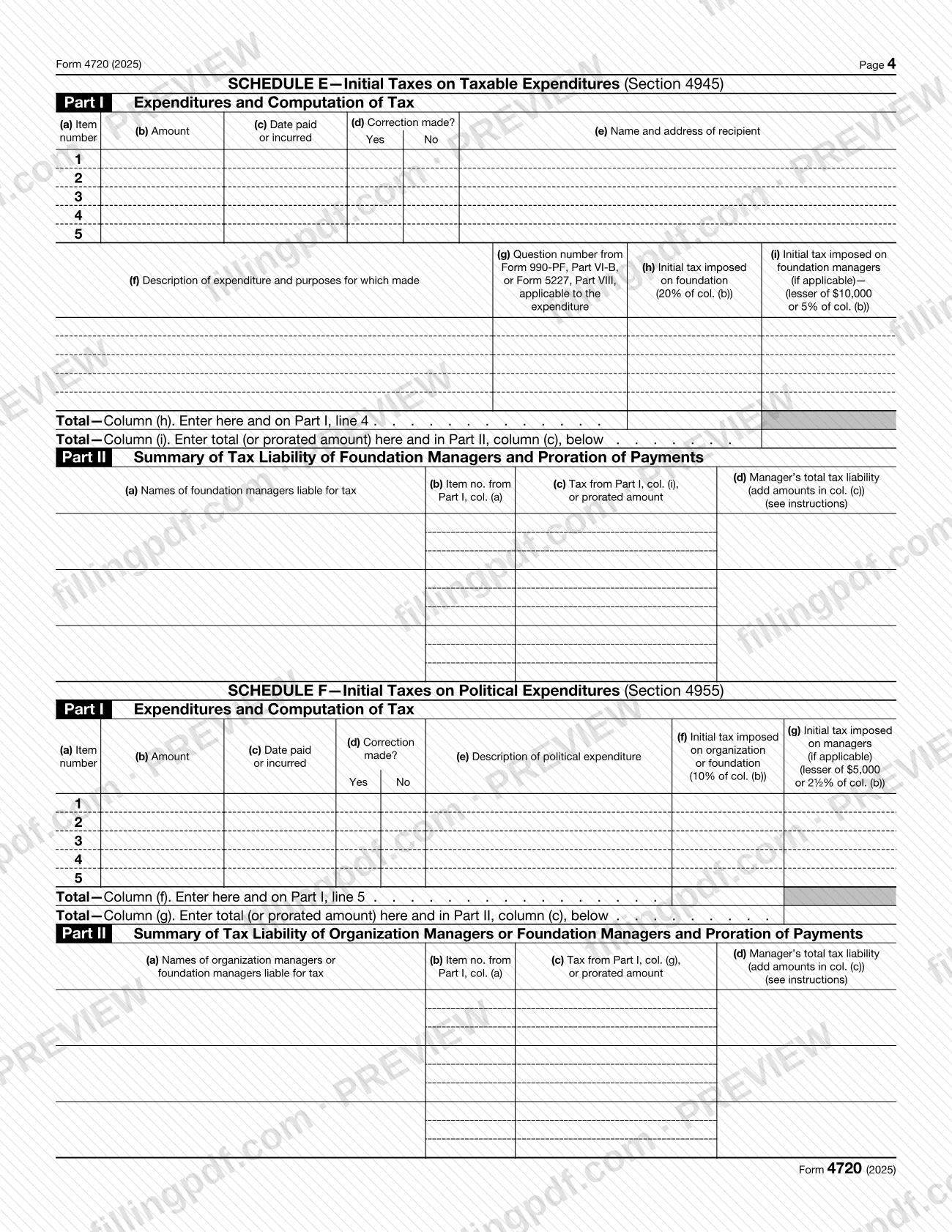
- Schedules A to E: self-dealing, undistributed income, excess business holdings, jeopardizing investments and taxable expenditures.
- Schedules F to H: political expenditures, excess lobbying expenditures and disqualifying lobbying expenditures.
- Schedule I: excess benefit transactions.
- Schedule J: prohibited tax shelter transactions.
- Schedules K and L: taxable distributions and prohibited benefits involving donor advised funds.
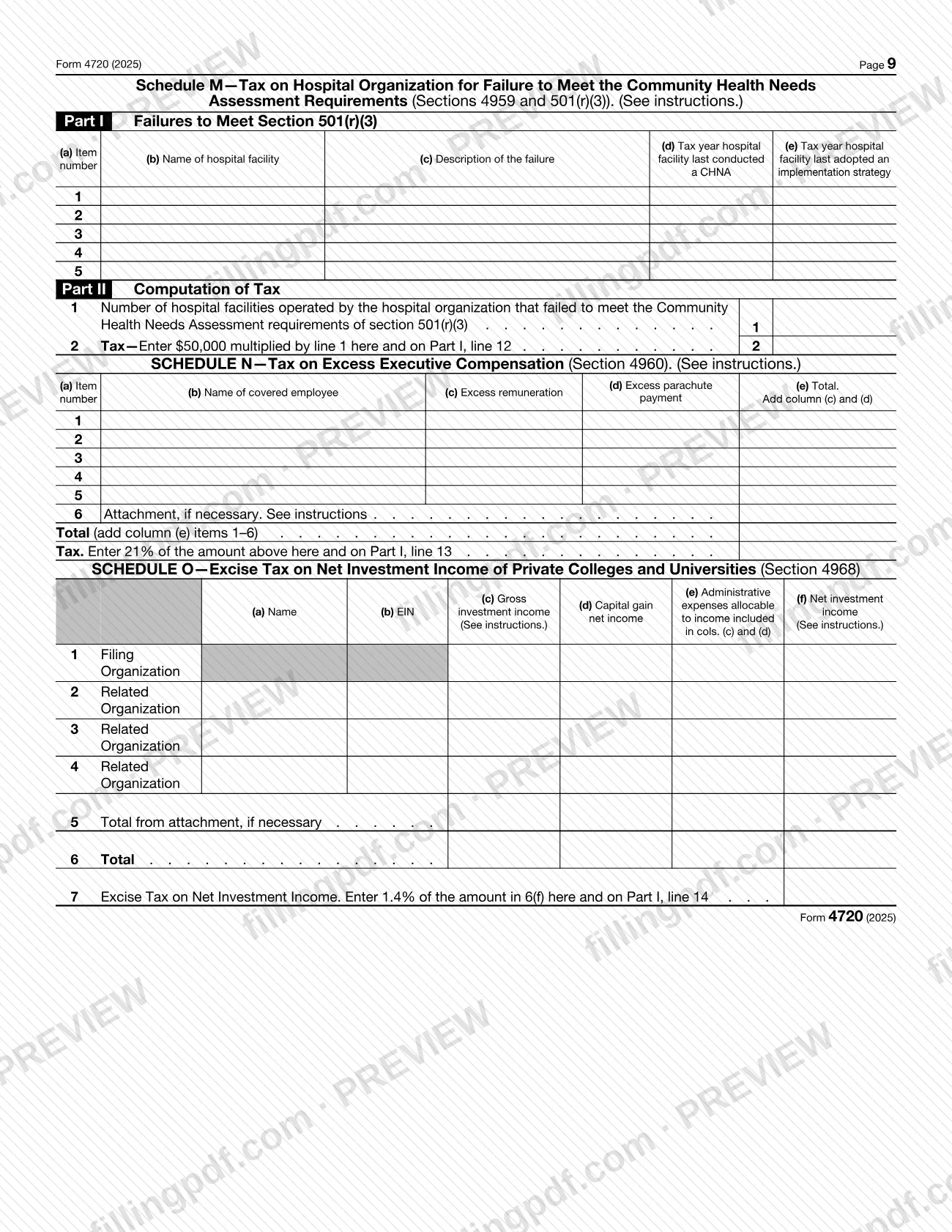
- Schedule M: a hospital organization's failure to meet the community health needs assessment requirements.
- Schedules N and O: excess executive compensation and net investment income of private colleges and universities.
Part I reports taxes on the organization, Part II reports taxes on a manager, self-dealer, disqualified person, donor, donor advisor or related person, and Part III totals the tax, payments, balance due or overpayment. The instructions say that amounts from Part I and Part II cannot be combined in Part III.
Who needs to file 4720?
Organizations liable for a Chapter 41 or 42 excise tax file Form 4720 and report their own tax in Part I only. The instructions name these groups:
- Private foundations and section 4947(a) trusts that answered "Yes" to the listed questions in Part VI-B of Form 990-PF or Part VIII of Form 5227 (Schedules A through E).
- Supporting organizations and donor advised funds that owe tax on excess business holdings (Schedule C).
- Section 501(c)(3) organizations that make a political expenditure (Schedule F) and public charities with excess lobbying expenditures under a section 501(h) election (Schedule G).
- Organizations involved in excess benefit transactions, personal benefit contract premiums, prohibited tax shelter transactions, donor advised fund distributions, hospital CHNA failures, excess executive compensation, or net investment income of certain private colleges and universities.
- Charitable remainder trusts with unrelated business taxable income (Part I, line 11).
A manager, self-dealer, disqualified person, donor, donor advisor or related person who owes tax must file a separate Form 4720 and use Part II. The organization must not enter amounts in Part II, and should not pay these persons' tax. Managers of the tax-favored retirement plans and savings arrangements listed in the instructions report section 4965(a)(2) tax on Form 5330 instead. A nonelecting member of an affiliated group does not file Form 4720.
When to file 4720
For Part I taxes on the organization, file Form 4720 by the due date, not counting extensions, of the organization's Form 990-PF, Form 990, Form 990-EZ or Form 5227. If the organization is not required to file any of those forms, file by the 15th day of the 5th month after its accounting period ends.
For Part II taxes, each manager, self-dealer, disqualified person, donor, donor advisor or related person files by the 15th day of the 5th month after the end of their tax year. If the due date falls on a Saturday, Sunday or legal holiday, file by the next business day.
Use Form 8868 to request an automatic extension of time to file. It is granted if Form 8868 is properly completed and filed, and any balance due on Form 4720 is paid, by the due date of Form 4720. For taxes that continue year after year, such as those for self-dealing or excess business holdings, the instructions say paying the tax and filing Form 4720 is required for each year or part of a year in the taxable period.
Documents you need
- A list showing the name and EIN of each organization, if you answer "Yes" to question B because you file Form 4720 for more than one organization in the current tax year.
- A separate Schedule C for each business enterprise in which the foundation has excess business holdings.
- A statement describing qualifying distributions made to correct undistributed income (or explaining why none were made), attached for Schedule B, line 3.
- A statement explaining corrective action taken, or why it has not been taken, for Schedule C, line 8, and the correction details the Schedule A, D, E and F instructions require.
- A statement for Part I, line 11, with a copy of the completed Form 990-T, for a charitable remainder trust with unrelated business taxable income.
- Form 8050, Direct Deposit of Tax Exempt or Government Entity Tax Refund, if Part III, line 4 shows an overpayment you are entitled to claim.
- A copy of the power of attorney, if a person with a valid power of attorney signs for the taxpayer.
- For an amended return: a statement identifying the lines and amounts changed and the reason for each change.
- Additional sheets showing the same information in the same order, if a paper filer needs more space; put the organization's name and EIN on each sheet.
How to fill out 4720
Enter the tax year and taxpayer identity
At the top, enter the calendar year or tax-year dates, then the name, address and EIN or SSN of the organization or person subject to tax. An organization uses the name and EIN shown on its Form 990-PF, 990, 990-EZ or Form 5227. A manager, self-dealer, donor or similar person enters their own name, address and taxpayer identification number.
Check the annual return type
Check the box for the annual return the organization files: Form 990, 990-EZ, 990-PF, 5227 or Other. A person or taxable entity whose return is not listed checks Other. Check Amended return when correcting a filed Form 4720.
Answer questions A and B
Question A asks whether the organization is a foreign organization described in section 4948(b); if Yes, show the conversion rate to U.S. dollars. Question B is for an entity or person other than the organization filing for more than one organization; answering Yes means attaching a list of names and EINs.
Complete the schedules that apply
Read each schedule's instructions first, then complete only those for taxes you owe or must report (A through O). The organization completes all parts of a schedule, including tax on other persons; other filers complete the parts that give rise to their own liability.
Record corrections in the Yes/No columns
In Schedules A, D, E, F and I, answer Yes if a correction has been made in whole or in part, and No only if there is none. Schedule C, line 8 asks whether excess holdings were disposed of. Attach the correction details the instructions require.
Report organization taxes in Part I
Carry totals from the schedules to Part I, lines 1 through 14, using the schedule references printed on each line. Line 8 is premiums paid on personal benefit contracts, and line 11 is a charitable remainder trust's unrelated business taxable income. Add lines 1–14 on line 15.
Report taxes on other persons in Part II
A manager, self-dealer, disqualified person, donor, donor advisor or related person enters the related organization's name, address and EIN, then carries each amount from the schedule shown on lines 1 through 9. Add lines 1 through 9 on line 10. An organization leaves Part II blank.
Figure tax payments in Part III
Line 1 is the total tax from Part I, line 15 or Part II, line 10, never both. Line 2 is total payments, including any amount paid with Form 8868. Enter tax due on line 3, or an overpayment on line 4 with Form 8050 attached.
Handle filers reporting only certain schedules
An organization filing only for Schedule A, Schedule I or Schedule L leaves Part I, lines 1 through 14 blank and enters zero on line 15. If it also owes tax from other schedules, it completes all applicable schedules and reports only its own tax in Part I.
Review, sign and download the PDF
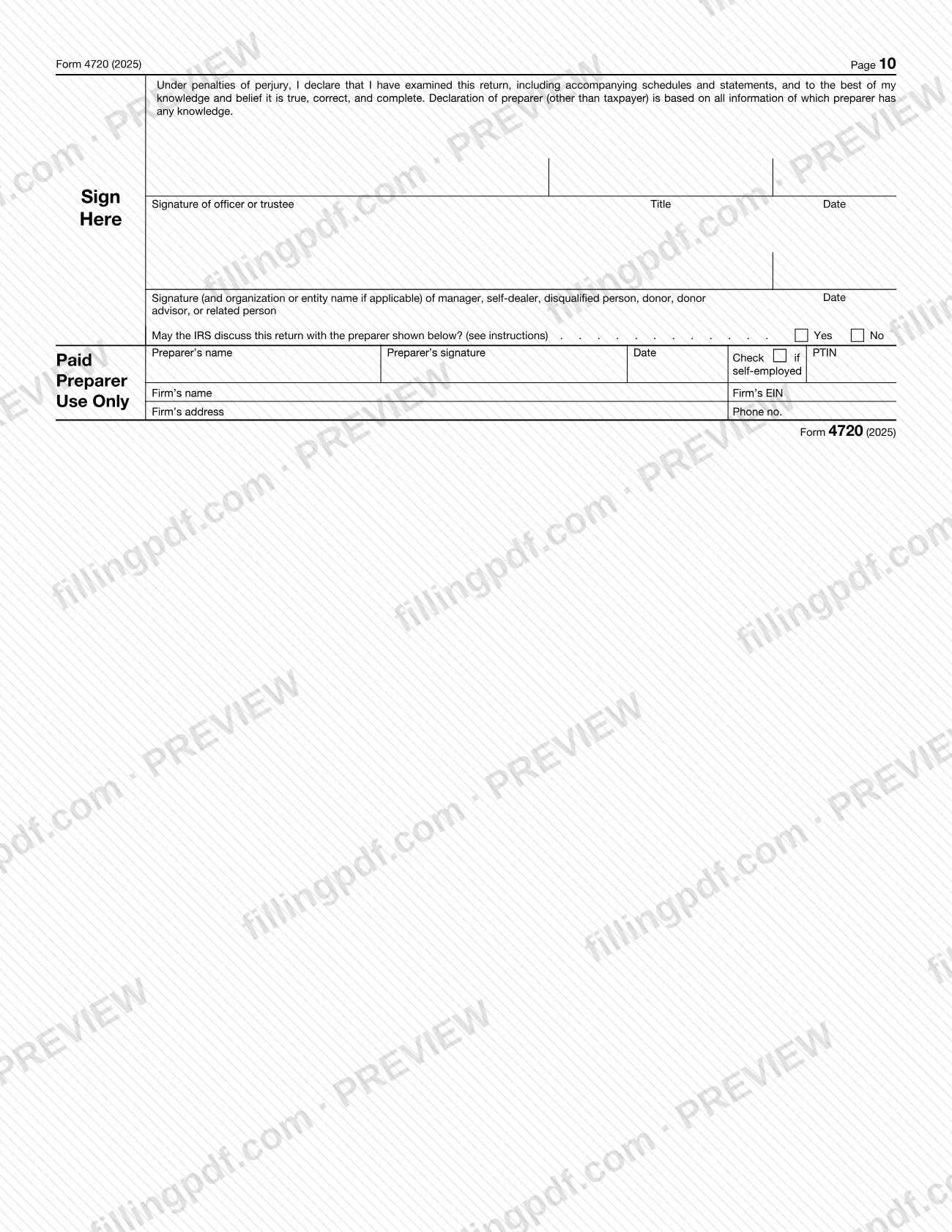
Sign under penalties of perjury on page 10: an officer or trustee for the organization, or the individual or entity representative. Complete the paid preparer block and the preparer discussion question if applicable. Download or print the completed PDF from FillingPDF and file it through the channels described under How to submit.
How to submit 4720
You can file Form 4720 electronically or on paper, but some filers must file electronically.
- Electronic filing: open to all filers; see IRS.gov/Efile. Private foundations reporting Chapter 42 liability on Schedules A–F, J or N must e-file, and paper returns from them are not accepted or processed. Filers that are not private foundations must e-file if they file at least 10 returns of any type during the calendar year ending with or within the tax year. The IRS may waive the requirement for undue hardship.
- Paper, from the United States: Department of the Treasury, Internal Revenue Service Center, Ogden, UT 84201-0027.
- Paper, from a foreign country or U.S. territory: Internal Revenue Service Center, P.O. Box 409101, Ogden, UT 84409.
- Private delivery services: designated services listed at IRS.gov/PDS deliver to Internal Revenue Service, 1973 Rulon White Blvd., Ogden, UT 84201. They cannot deliver to P.O. boxes; use the U.S. Postal Service for those.
Pay tax due through EFTPS, electronic funds withdrawal (for e-filers) or by check or money order payable to "United States Treasury", with SSN (or TIN, if applicable) and "Form 4720" written on the check. For refunds, attach Form 8050. Form 843 requests abatement; see its instructions for where to send it. FillingPDF lets you fill out and download the PDF; submission follows the channels above.
Common mistakes to avoid
- Entering amounts in Part II on the organization's own return; Part II is for managers, self-dealers, disqualified persons, donors, donor advisors and related persons.
- Listing a manager's or self-dealer's tax on the organization's return; the instructions say each taxpayer must file a separate Form 4720.
- Combining Part I and Part II amounts in Part III; these need separate returns.
- Mailing a paper Form 4720 when a private foundation must file electronically; paper returns from those filers are not accepted or processed.
- Sending a private delivery service package to a P.O. box; private delivery services cannot deliver there, so use the U.S. Postal Service.
- Skipping the Yes/No correction column in Schedules A, D, E, F or I, or answering "No" when a transaction was corrected in part.
- Having a foundation, organization or fund pay a manager's, self-dealer's or disqualified person's tax; those persons should pay it from their own funds.
- Filing an amended return that shows only the changed lines instead of the entire return, with the "Amended Return" box checked.
- Using Form 843 to claim a refund of an overpayment figured on Part III, line 4; the instructions say not to.
- Leaving off "Form 4720" and the SSN or TIN on a check payment, which helps the IRS post it to the right account.
Frequently asked questions
What is Form 4720 used for?
Form 4720 is the IRS return used to figure and pay certain Chapter 41 and 42 excise taxes, such as those for self-dealing, excess business holdings, taxable expenditures, excess benefit transactions, excess lobbying and donor advised fund violations. Organizations report in Part I and other taxpayers in Part II.
Who has to file Form 4720?
Organizations liable for a covered excise tax, such as private foundations, certain public charities and supporting organizations, and the managers, self-dealers, disqualified persons, donors, donor advisors and related persons who owe tax. Each taxpayer files its own Form 4720; they cannot report on the organization's return.
When is Form 4720 due?
For the organization, by the due date of its Form 990-PF, 990, 990-EZ or Form 5227, not counting extensions; without one of those, the 15th day of the 5th month after the accounting period ends. Part II filers file by the 15th day of the 5th month after their tax year ends.
Can I get an extension to file Form 4720?
Yes. File Form 8868 to request an automatic extension of time to file. It is granted if the form is properly completed and filed and any balance due on Form 4720 is paid by the Form 4720 due date. Count the payment on Part III, line 2.
Do I have to file Form 4720 electronically?
Private foundations reporting liability on Schedules A–F, J or N must file electronically, and their paper returns are not accepted. Other filers must e-file if they file at least 10 returns of any type during the calendar year ending with or within the tax year; hardship waivers are possible.
Where do I mail a paper Form 4720?
From the United States, mail it to Department of the Treasury, Internal Revenue Service Center, Ogden, UT 84201-0027. From a foreign country or U.S. territory, use Internal Revenue Service Center, P.O. Box 409101, Ogden, UT 84409. Private delivery services use 1973 Rulon White Blvd., Ogden, UT 84201.
How do I amend Form 4720?
Use the same-year form, check the Amended Return box, and complete the entire return, not only the changed lines. Include a statement identifying the lines and amounts changed and the reason for each change. Show any overpayment on Part III, line 4.
Can I fill out Form 4720 online on FillingPDF?
You can fill out the Form 4720 PDF online on FillingPDF and download or print it. FillingPDF is an independent service and does not file or submit the return to the IRS; you file it electronically or by mail through the IRS channels.
Ready to fill out 4720?
Fill out 4720 now