
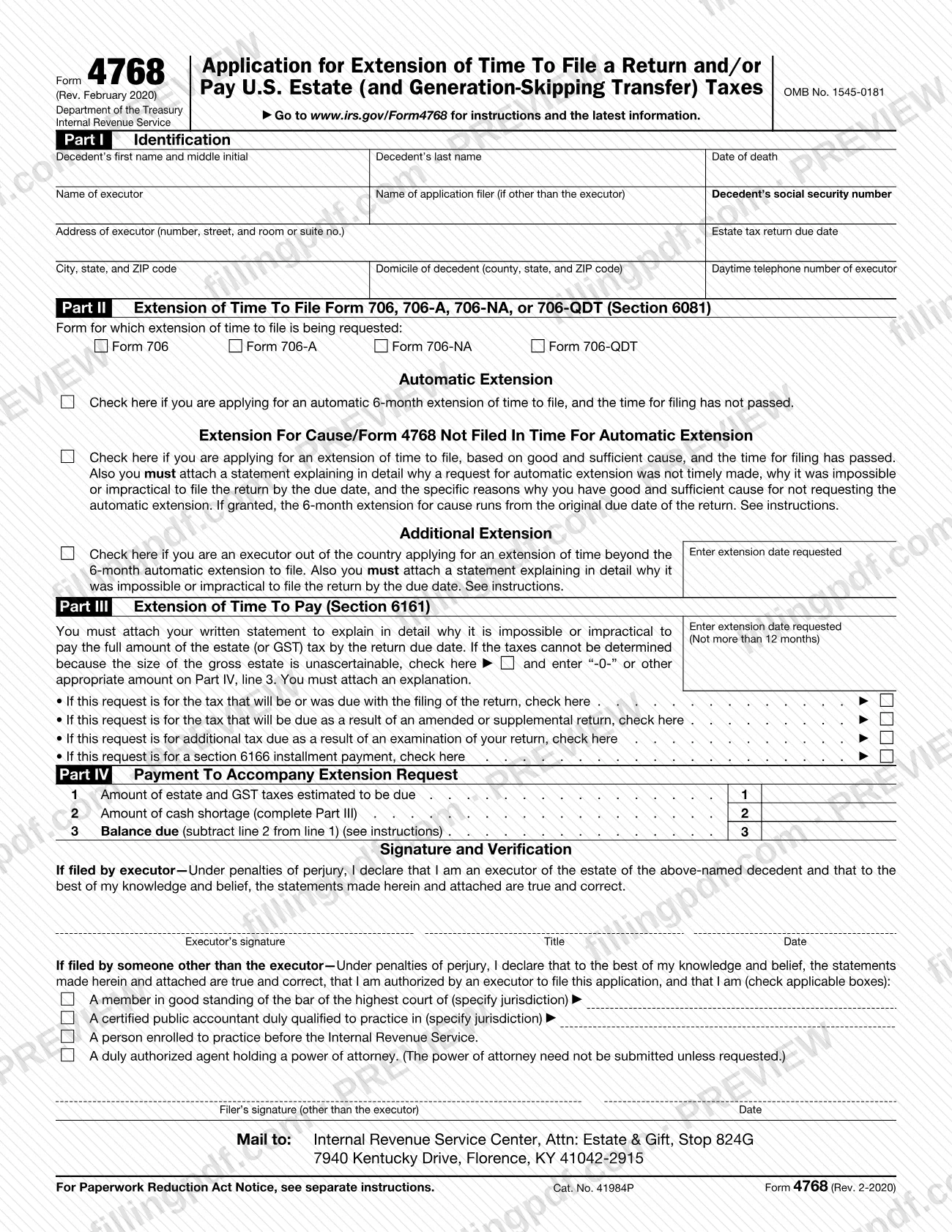
Form 4768, Application for Extension of Time To File a Return and/or Pay U.S. Estate (and Generation-Skipping Transfer) Taxes, is the Internal Revenue Service (IRS) form that executors use to ask for more time to file an estate tax return or to pay estate and generation-skipping transfer (GST) tax. An authorized attorney, certified public accountant, enrolled agent or agent with a power of attorney may file it for the executor. On FillingPDF you can fill out Form 4768 online and download or print the completed PDF; the IRS publishes the original form and its instructions at irs.gov/Form4768.
Last updated
What is 4768?
Form 4768, Application for Extension of Time To File a Return and/or Pay U.S. Estate (and Generation-Skipping Transfer) Taxes, is the Internal Revenue Service (IRS) form for asking more time to file or pay estate or generation-skipping transfer (GST) tax.
The form has two main requests. Part II asks for more time to file Form 706, 706-A, 706-NA or 706-QDT under section 6081. It offers three kinds of extension: an automatic 6-month extension, an extension for cause when the automatic extension was not requested in time, and an additional extension for an executor who is out of the country. Part III asks for more time to pay estate or GST tax under section 6161. Part IV records the payment that goes with the request.
An extension of time to file does not extend the time to pay, and an extension of time to pay does not extend the time to file. Interest is due on any estate and GST tax not paid in full by the original due date of the return, whether or not an extension was granted.
This revision has no second page to copy. When you request more time to pay, the IRS answers on Form 4768-A, Reply to Request for Extension of Time to Pay U.S. Estate Taxes (Section 6161).
Form 4768 is not for Form 706-GS(T), Generation-Skipping Transfer Tax Return For Terminations, or Form 706-GS(D), Generation-Skipping Transfer Tax Return For Distributions. For those, the instructions point to Form 7004.
Who needs to file 4768?
An executor filing Form 706 or Form 706-NA for a decedent's estate files Form 4768 to extend the time to file under section 6081(a), the time to pay estate tax under section 6161(a)(2), or both. If there is more than one executor, only one has to sign.
Others who may file:
- An authorized attorney, certified public accountant, enrolled agent, or agent holding a power of attorney, on behalf of the executor. This filer checks the matching box in the signature section.
- A qualified heir filing Form 706-A, or a trustee/designated filer filing Form 706-QDT, to request more time to file the return and/or pay the additional tax. For these forms, the instructions substitute "qualified heir" or "trustee/designated filer" for "executor."
An additional extension of time to file, beyond the automatic 6-month extension or the extension for cause, is available only to an executor who is out of the country.
Do not use Form 4768 to request an extension for Form 706-GS(T) or Form 706-GS(D). The instructions direct those filers to Form 7004.
When to file 4768
For an automatic 6-month extension of time to file, file Form 4768 by the original due date of the return. Form 706 and Form 706-NA are due 9 months after the date of death. Form 706-A is due 6 months after the taxable disposition or cessation of qualified use. Form 706-QDT has its own due dates, set out in the instructions. A due date on a weekend or legal holiday moves to the next business day.
An extension for cause must be filed no later than 6 months after the original due date. If granted, it runs 6 months from the original due date, not from the filing date. File an additional extension early enough for the IRS to consider it before the extended due date.
Apply for an extension of time to pay on or before the estate tax due date; the instructions say a request made after that date will generally not be considered. The request cannot exceed 12 months. The IRS contacts you about a time-to-file request only if it is denied.
Documents you need
- For an extension for cause: a statement explaining in detail why an automatic extension was not timely requested, why it was impossible or impractical to file by the due date, and the specific reasons for good and sufficient cause.
- For an additional extension (executor out of the country): a statement explaining in detail why it was impossible or impractical to file the return by the due date.
- For an additional extension after a granted extension: an explanation of why a reasonably complete return cannot be filed by the due date.
- For an additional extension on Form 706-A or 706-QDT: the date and a description of the taxable event.
- For an extension of time to pay: a written statement explaining in detail why it is impossible or impractical to pay the full estate (or GST) tax by the return due date.
- If the gross estate is unascertainable: an explanation, with "-0-" or another appropriate amount entered on Part IV, line 3.
- A copy of the return, if it has already been filed, to support the tax amount on Part IV, line 1; otherwise estimate the tax.
- A statement of the cash shortage on Part IV, line 2, including the current assets already distributed and, if applicable, the plan for partial payments.
- When paying under an approved extension: a copy of the approved application and/or Form 4768-A.
- A power of attorney for an agent filer, only if the IRS requests it; it need not be submitted otherwise.
How to fill out 4768
Enter the decedent's details
In Part I, enter the decedent's first name and middle initial, last name, date of death and social security number.
Enter the executor and filer details
Give the name of the executor, the name of the application filer if different, the executor's address, city, state and ZIP code, the decedent's domicile (county, state and ZIP code), the executor's daytime telephone number and the estate tax return due date.
Check the return to be extended
In Part II, check Form 706, Form 706-A, Form 706-NA or Form 706-QDT. File a separate Form 4768 for each return.
Choose the type of extension to file
Check Automatic Extension if the filing time has not passed, Extension For Cause/Form 4768 Not Filed In Time For Automatic Extension if it has, or Additional Extension if you are an executor out of the country. Do not combine an additional extension with the others on one form.
Attach the required statements
An extension for cause or additional extension needs a written statement explaining in detail why the request was late or why filing by the due date was impossible or impractical. For an additional extension, also enter the extension date requested.
Request more time to pay
In Part III, enter the extension date requested (not more than 12 months) and attach your written statement. If the gross estate is unascertainable, check the box, enter "-0-" or another appropriate amount on Part IV, line 3, and attach an explanation.
Check the type of tax in Part III
Check one box: tax due with the return, tax due from an amended or supplemental return, additional tax from an examination, or a section 6166 installment payment. Each kind needs its own Form 4768.
Complete the payment lines
On Part IV, line 1, enter the estate and GST taxes estimated to be due (attach the return if already filed). On line 2, enter the cash shortage with the supporting statement. On line 3, subtract line 2 from line 1.
Sign as executor
If you are the executor, sign, enter your title and date the declaration under penalties of perjury. Only one executor needs to sign.
Sign as another filer
If someone other than the executor files, check the box for member of the bar, certified public accountant, person enrolled to practice before the IRS, or agent holding a power of attorney. Specify the jurisdiction where requested, then sign and date.
Review and download the completed PDF
Check the dates, the box selections and the amounts, then download or print the completed PDF from FillingPDF. Assemble any statements and mail the package as described under How to submit.
How to submit 4768
Form 4768 is filed by mail or by a private delivery service (PDS) to the same IRS address. The instructions describe no other channel.
- By mail: Internal Revenue Service Center, Attn: Estate & Gift, Stop 824G, 7940 Kentucky Drive, Florence, KY 41042-2915.
- By private delivery service: use the same address. The IRS designates certain services for the timely-mailing rule; see IRS.gov/PDS for the current list, and ask the service how to get written proof of the mailing date.
File a separate Form 4768 for each return for which you want more time to file. A request for more time to pay must go in its own envelope to this address, not with Form 706. A separate Form 4768 is needed for each kind of tax: the tax due on Form 706, an amended or supplemental return, an examination, or a section 6166 installment.
Any payment goes with the form: make the check or money order payable to "United States Treasury" and write the decedent's (or qualified heir's) social security number and the type of return, such as "Form 706". If the IRS approves a pay extension, it sends Form 4768-A to the executor; attach a copy when you pay. Keep a copy of Form 4768 for your records. FillingPDF lets you fill out and download the PDF; submission follows the channels above.
Common mistakes to avoid
- Filing for an automatic 6-month extension after the original due date of the return; the automatic extension must be requested by that date.
- Assuming an extension of time to file also extends the time to pay; Part III is a separate request, and interest runs from the original due date.
- Mailing a request for an extension of time to pay in the same envelope as Form 706; it must go in a separate envelope.
- Combining an automatic extension (or extension for cause) and an additional extension on one Form 4768; the instructions say they cannot be combined.
- Using one Form 4768 for several returns or several kinds of tax; a separate form is required for each return and each type of payment extension.
- Leaving out the required written statement for an extension for cause, an additional extension, or an extension of time to pay.
- Requesting an extension of time to pay for more than 12 months, or after the estate tax due date, when the IRS will generally not consider it.
- Using Form 4768 for Form 706-GS(T) or Form 706-GS(D), which call for Form 7004.
- Signing as a non-executor without checking the box for attorney, certified public accountant, enrolled person or agent with a power of attorney.
- Filing an appeal of a denied pay extension later than the 10-day period beginning the day after the date on Form 4768-A.
Frequently asked questions
What is Form 4768 used for?
Form 4768 asks the IRS for more time to file Form 706, 706-A, 706-NA or 706-QDT, and/or more time to pay estate or generation-skipping transfer tax under section 6161. Part II covers time to file, Part III time to pay, and Part IV the payment sent with the request.
When do I file Form 4768 for the automatic extension?
File it by the original due date of the return. Form 706 and Form 706-NA are due 9 months after the date of death. The automatic extension is 6 months from that original due date, and you do not have to explain why you are asking.
Does Form 4768 extend the time to pay estate tax?
Only if you complete Part III. An extension of time to file does not extend the time to pay, and interest must be paid on any tax not paid in full by the original due date, whether or not an extension was granted.
Where do I mail Form 4768?
Mail it to Internal Revenue Service Center, Attn: Estate & Gift, Stop 824G, 7940 Kentucky Drive, Florence, KY 41042-2915. Designated private delivery services use the same address. A request for more time to pay must go in a separate envelope from Form 706.
Can I fill out Form 4768 online?
You can fill out the Form 4768 PDF online on FillingPDF and download or print it. FillingPDF is independent of the IRS and does not file the form; you mail it to the IRS Service Center in Florence, KY yourself.
Can my attorney or CPA sign Form 4768 for me?
Yes. An authorized attorney, certified public accountant, enrolled agent or agent holding a power of attorney may file for the executor and checks the matching box in the signature section. The power of attorney need not be submitted unless the IRS requests it.
How long can an extension of time to pay last?
The request on Form 4768 cannot exceed 12 months. The instructions add that reasonable-cause extensions may be granted 1 year at a time, up to 10 years, and up to 4 years for a deficiency. Section 6163 and 6166 elections may have different periods.
What if I missed the deadline for the automatic extension?
You can still request an extension for cause if you show good and sufficient cause. File Form 4768 no later than 6 months after the original due date, and attach a statement explaining why the automatic extension was not requested and why the return could not be filed on time.
Can I appeal if my request for more time to pay is denied?
Yes. Send a written appeal to the address on Form 4768-A within the 10-day period beginning the day after the date on that form. Include the signature, a detailed statement of disagreement, a copy of Form 4768-A and supporting documentation.
Ready to fill out 4768?
Fill out 4768 now