
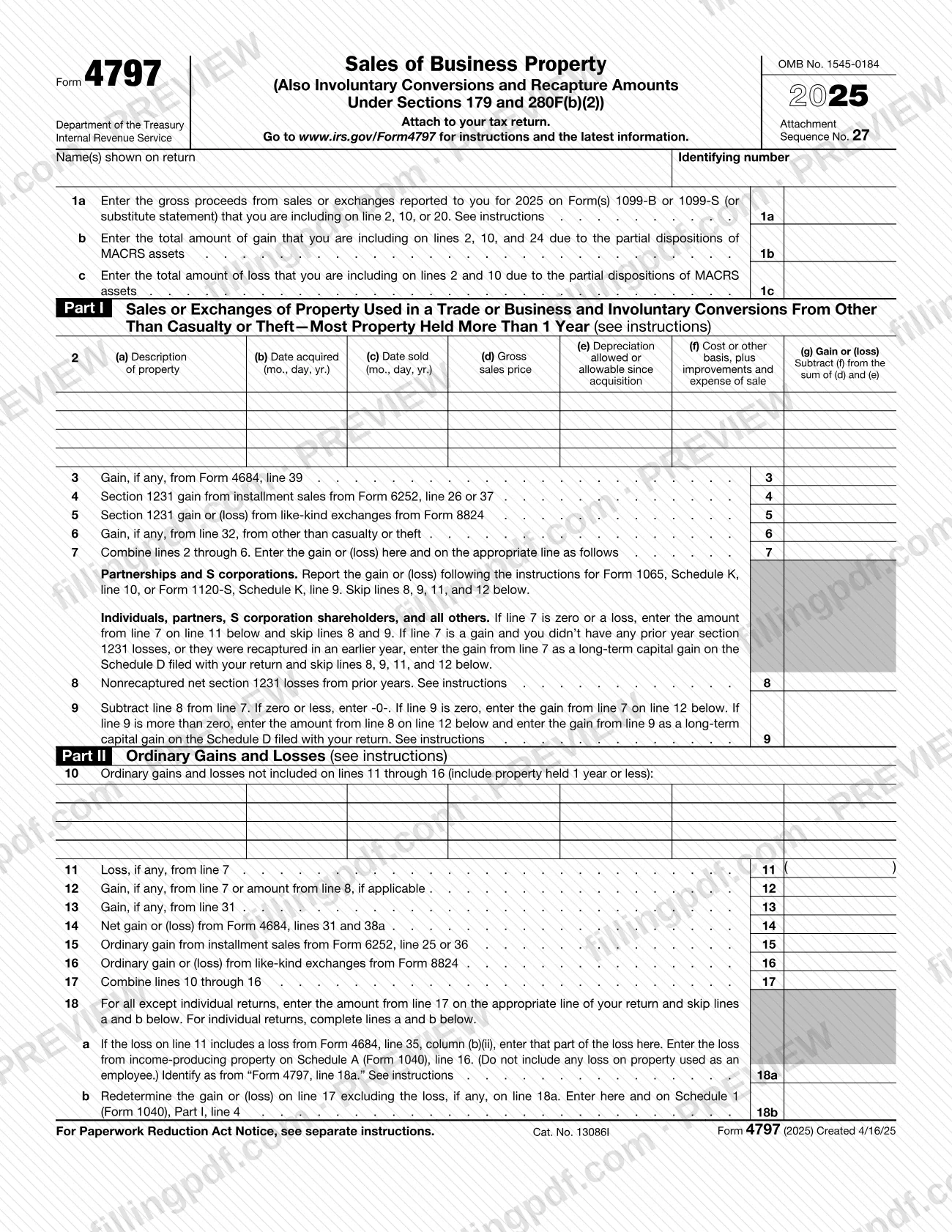
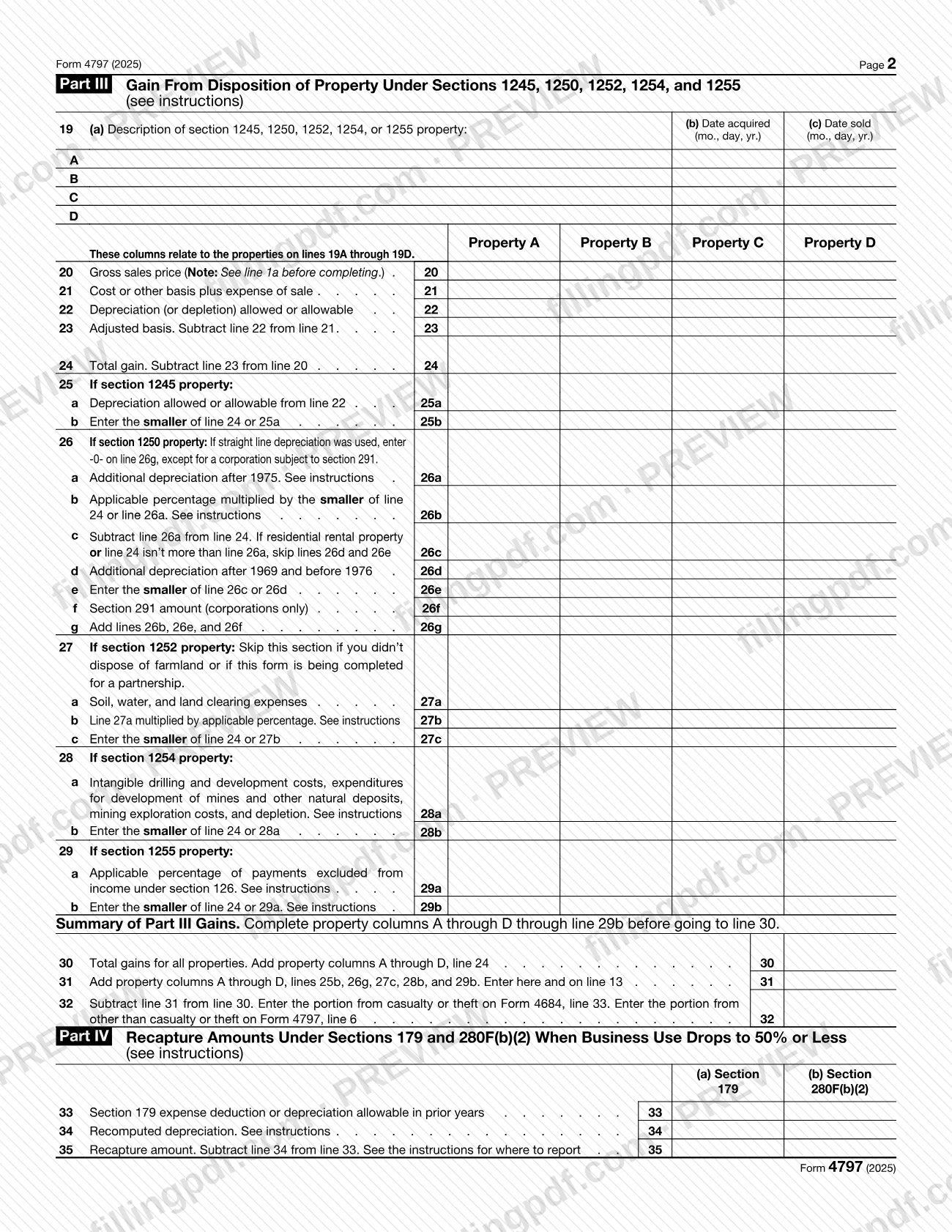
Form 4797, Sales of Business Property, is the Internal Revenue Service (IRS) form you attach to your tax return to report the sale or exchange of business property, involuntary conversions other than casualty or theft, and the recapture of section 179 and listed-property deductions. It is used by individuals, partners, S corporation shareholders and other taxpayers who dispose of property used in a trade or business. On this page you can fill out the form online on FillingPDF and download or print the completed PDF; the form and its instructions are published by the IRS at www.irs.gov/Form4797.
Last updated
What is 4797?
Form 4797, Sales of Business Property (Also Involuntary Conversions and Recapture Amounts Under Sections 179 and 280F(b)(2)), is the Internal Revenue Service (IRS) form attached to a tax return to report sales or exchanges of business property, involuntary conversions and section 179 recapture.
The IRS instructions list what it reports: sales or exchanges of real property used in a trade or business, of depreciable and amortizable tangible property used in a trade or business, of oil, gas, geothermal or other mineral properties, and of certain cost-sharing payment property under section 126. It also covers the disposition of noncapital assets other than inventory, the disposition of capital assets not reported on Schedule D, and gains or losses treated as ordinary by traders who made a section 475(f) mark-to-market election.
The form has four parts:
- Part I: section 1231 transactions, mostly property held more than 1 year (lines 2 through 9).
- Part II: ordinary gains and losses (lines 10 through 18).
- Part III: gain from disposition of property under sections 1245, 1250, 1252, 1254 and 1255 (lines 19 through 32).
- Part IV: recapture amounts under sections 179 and 280F(b)(2) when business use drops to 50% or less (lines 33 through 35).
Other events use their own forms, which feed into this one: Form 4684 for casualties and thefts, Form 6252 for installment sales, Form 8824 for like-kind exchanges and Form 8949 for capital assets not reported elsewhere.
Who needs to file 4797?
Taxpayers who dispose of property used in a trade or business, or who have the other transactions the IRS instructions list, file Form 4797 with their return.
- Individuals, partners, S corporation shareholders and others who sold or exchanged real or depreciable business property, or had an involuntary conversion of business property other than from casualty or theft.
- Taxpayers who sold property that was their home and was also used for business, for the part used for business (or the entire property if used entirely for business).
- Partners and S corporation shareholders who received a Schedule K-1 reporting the disposition of property on which a section 179 deduction was passed through. They report their share on Form 4797, 4684, 6252 or 8824.
- Traders in securities or commodities with a section 475(f) mark-to-market election, who report gains and losses on line 10.
- Anyone whose business use of section 179 or listed property dropped to 50% or less and who must figure recapture in Part IV.
Partnerships and S corporations do not report section 179 property dispositions on Forms 4797, 4684, 6252 or 8824; they give partners and shareholders the information on Schedule K-1. Gain on depreciable property held for investment rather than business generally goes on Form 8949 and Schedule D, although part may still need recapture on Form 4797.
When to file 4797
Form 4797 has no due date of its own: you file it with the tax return it is attached to, for the year in which the property was disposed of. The form says "Attach to your tax return," so the return's due date, including extensions, governs.
Some elections tie to a timely filed return. An election to recognize a partial disposition of a MACRS asset is made on a timely filed federal return, including extensions, for the year of the disposition. To elect out of the installment method, report the full gain on a timely filed return, including extensions; if you filed on time without electing, the instructions allow an amended return within 6 months of the return's due date, excluding extensions. A gain invested in a qualified opportunity fund must be invested within 180 days beginning on the date the gain is realized to be eligible for deferral.
Documents you need
- Your tax return: Form 4797 is attached to it and is not filed alone.
- A statement, in the same format as line 10, showing each transaction, if you are a trader with a section 475(f) mark-to-market election; enter "Trader—see attached" in column (a).
- A computation of the loss, if you report a loss on section 1244 (small business) stock on line 10.
- A statement with the name and address of the small business investment company and, if applicable, why and when the stock became worthless, if you report a loss on its stock on line 10.
- A separate statement of the recapture calculation for each property, if more than one property is subject to Part IV recapture.
- Form 8997, if you held a qualified investment in a qualified opportunity fund (QOF) at any time during the year.
- Additional Forms 4797, if you have more than four properties to report in Part III.
How to fill out 4797
Enter your name and identifying number
At the top, write the name(s) shown on your return and your identifying number.
Complete lines 1a, 1b and 1c
On line 1a enter gross proceeds reported to you for 2025 on Form(s) 1099-B or 1099-S (or substitute statements) that you include on line 2, 10 or 20. On lines 1b and 1c enter the total gain and loss from partial dispositions of MACRS assets.
List Part I sales on line 2
For each sale, give (a) description, (b) date acquired, (c) date sold, (d) gross sales price, (e) depreciation allowed or allowable, (f) cost or other basis, and (g) gain or (loss). Enter "INHERITED" in column (b) for inherited property.
Carry in lines 3 through 7
Enter gain from Form 4684, line 39 (line 3), Form 6252, line 26 or 37 (line 4), Form 8824 (line 5) and Form 4797, line 32 (line 6). Combine lines 2 through 6 on line 7 and follow the printed directions for your filer type.
Handle prior-year losses on lines 8 and 9
On line 8 enter nonrecaptured net section 1231 losses from prior years. On line 9 subtract line 8 from line 7, entering -0- if zero or less, and follow the directions printed under line 9.
Report ordinary items in Part II
Enter ordinary gains and losses, including property held 1 year or less, on line 10. Complete lines 11 through 16 from line 7, line 8, line 31, Form 4684, Form 6252 and Form 8824 as printed, then combine lines 10 through 16 on line 17.
Finish line 18 for individual returns
Skip lines 18a and 18b unless you file an individual return. On line 18a enter the loss part described on the form, and on line 18b redetermine the line 17 gain or loss without it and enter it on Schedule 1 (Form 1040), Part I, line 4.
Describe properties in Part III
On line 19, list up to four properties as A through D with description, date acquired and date sold. Enter columns for each on line 20 (gross sales price), line 21 (cost or other basis plus expense of sale), line 22 (depreciation allowed or allowable), line 23 (line 21 minus line 22) and line 24 (total gain).
Figure recapture on lines 25 through 29
Complete only the section matching each property: line 25 for section 1245, line 26 for section 1250, line 27 for section 1252 farmland, line 28 for section 1254 and line 29 for section 1255. Enter the smaller-of amounts as the lines direct.
Summarize Part III gains
Add the property columns on line 30 (line 24) and line 31 (lines 25b, 26g, 27c, 28b and 29b), entering line 31 also on line 13. Subtract line 31 from line 30 on line 32 and send the portion to Form 4684, line 33 or Form 4797, line 6 as printed.
Figure Part IV recapture
If business use of section 179 or listed property dropped to 50% or less, use column (a) for section 179 and column (b) for section 280F(b)(2). Enter the prior deduction or depreciation on line 33, recomputed depreciation on line 34 and the difference on line 35.
Review, download and attach
Check every line, parentheses on losses and the carried amounts between parts. Download or print the completed PDF from FillingPDF and attach it, with any required statements, to your tax return as described under How to submit.
How to submit 4797
Form 4797 is not filed on its own. You attach it to your tax return and submit it through the channel that return uses.
- With your tax return: the form is marked "Attach to your tax return," and it prints no separate mailing address, portal or appointment rule. For where and how to send the return, see the instructions for that return.
- Partnerships and S corporations: report the Part I gain or loss as directed on the form, following the instructions for Form 1065, Schedule K, line 10, or Form 1120-S, Schedule K, line 9, and give partners and shareholders their information on Schedule K-1.
- Extra pages and statements: if you have more than four properties in Part III, use additional forms. Attach any statements the instructions require, such as the trader statement for line 10.
The IRS publishes the form, instructions and latest information at www.irs.gov/Form4797. FillingPDF lets you fill out and download the PDF; submission follows the channels that apply to the tax return the form is attached to.
Common mistakes to avoid
- Having a partnership or S corporation report a section 179 property disposition on Form 4797, 4684, 6252 or 8824; they give partners and shareholders the information on Schedule K-1 instead.
- Reporting a building and its land together when sold in the same transaction; for property held more than 1 year, the building goes in Part III and the land in Part I, with the amount realized allocated by fair market value.
- Writing an acquisition date for inherited property in column (b) instead of entering "INHERITED."
- Showing losses without enclosing the figures in parentheses.
- Completing Part III for property held 1 year or less when the chart "Where To Make First Entry" sends it to Part II.
- Omitting the words "Partial Disposition Election" in the description of an elective partial disposition of a MACRS asset.
- Reporting a loss on Form 6252; the worksheet instructions say to report the loss on the Form 4797 lines instead.
- Leaving out the trader statement when line 10 shows "Trader—see attached."
- Forgetting to increase your basis in the property by the Part IV recapture amount.
Frequently asked questions
What is Form 4797 used for?
Form 4797 reports sales or exchanges of business property, involuntary conversions other than casualty or theft, and the disposition of noncapital assets. It also computes recapture under sections 179 and 280F(b)(2) when business use falls to 50% or less. You attach it to your tax return.
Do I file Form 4797 by itself?
No. The form says to attach it to your tax return, and it prints no separate address or due date. You submit it with the return it belongs to, through that return's filing channel.
Where do I report a loss from Form 4797 line 18a?
On Schedule A (Form 1040), line 16, for the loss from income-producing property, identified as from "Form 4797, line 18a." Line 18a applies to individual returns only and excludes losses on property used as an employee.
Which part of Form 4797 do I use for a property sale?
It depends on the property and holding period. For example, depreciable property sold at a gain after more than 1 year starts in Part III, while one sold at a loss starts in Part I. Property held 1 year or less generally starts in Part II, per the chart in the instructions.
Can I fill out Form 4797 online?
Yes. You can fill out the Form 4797 PDF online on FillingPDF and download or print it. FillingPDF is an independent service and does not file the form; you submit it with your tax return through the IRS channels.
How do I report the sale of a home used for business?
Use Form 4797 for the part used for business, or the whole property if used entirely for business. The personal part's gain is a capital gain, and a loss on it is not deductible. A principal-residence exclusion may apply under section 121; see Pub. 523.
Do partnerships and S corporations file Form 4797?
For ordinary Part I gains or losses they follow the Schedule K instructions printed on the form. For section 179 property dispositions they do not report on Form 4797; they give partners and shareholders the information on Schedule K-1.
What if I have more than four properties in Part III?
Use additional Forms 4797. Part III has columns for four properties, A through D, and the instructions say to use additional forms for more. Line 30 and line 31 total the property columns on each form.
Ready to fill out 4797?
Fill out 4797 now