
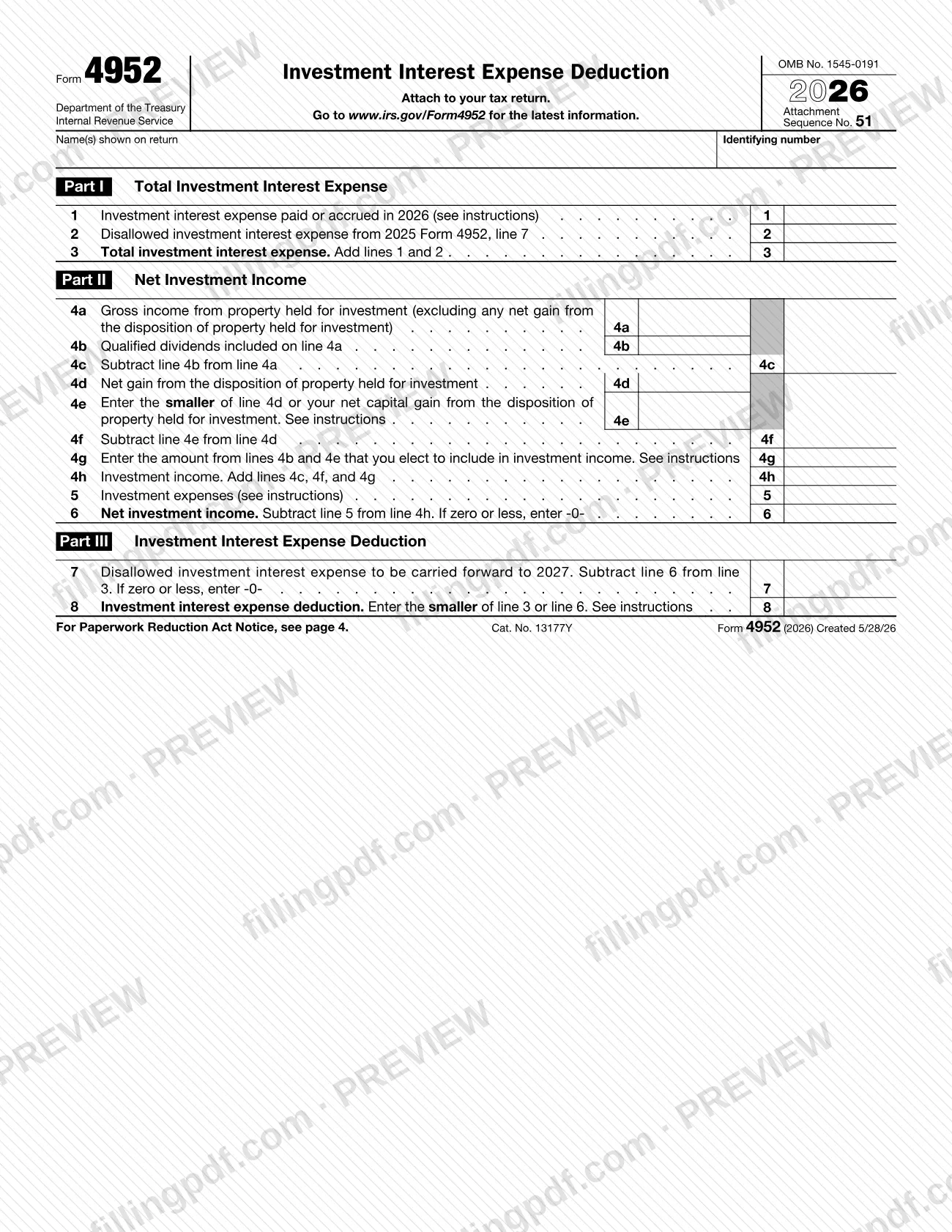

Form 4952 is the Internal Revenue Service (IRS) form for figuring how much investment interest expense you can deduct for 2025 and how much you carry forward to later years. Individuals, estates and trusts attach it to their tax return when they claim the deduction, which is limited to net investment income. On this page you can fill out the form online on FillingPDF and download or print the completed PDF; the official PDF and the latest information are published by the IRS at www.irs.gov/Form4952.
Last updated
What is 4952?
Form 4952, Investment Interest Expense Deduction, is the IRS form used to figure the amount of investment interest expense you can deduct for 2025 and the amount you can carry forward to future years. Your deduction is limited to your net investment income.
The form has three parts. Part I (lines 1 to 3) totals your investment interest expense: interest paid or accrued in 2025 plus any disallowed expense carried from line 7 of the 2024 Form 4952. Part II (lines 4a to 6) works out net investment income: gross income from property held for investment, net gain from disposing of such property, the election to include qualified dividends and net capital gain, and minus investment expenses. Part III (lines 7 and 8) gives the amount carried forward to 2026 and the deduction itself, which is the smaller of line 3 or line 6.
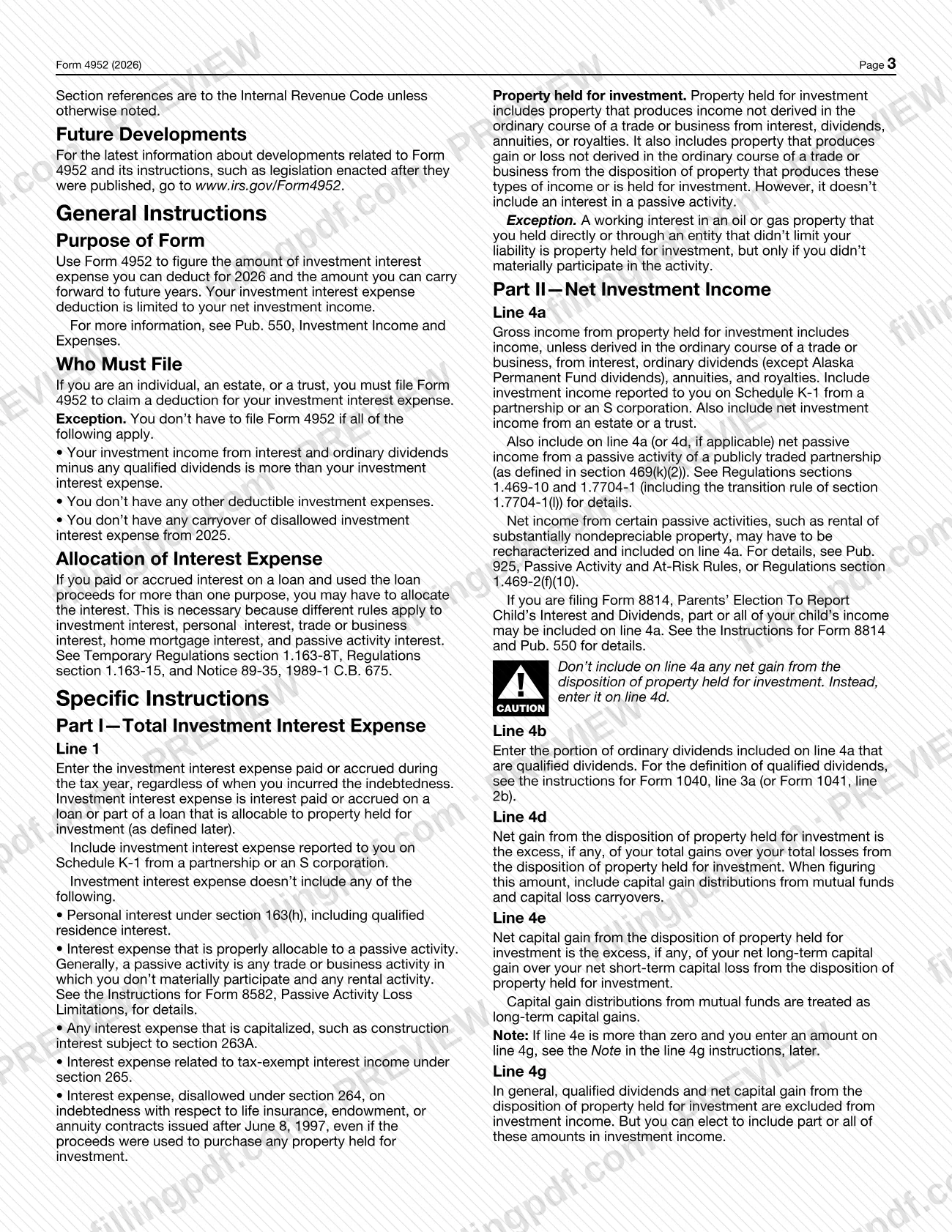
Investment interest expense is interest on a loan, or part of a loan, allocable to property held for investment. The instructions exclude personal interest, interest allocable to a passive activity, capitalized interest, interest tied to tax-exempt income under section 265 and certain life insurance, endowment or annuity interest under section 264.
The form is issued under OMB No. 1545-0191, Attachment Sequence No. 51, and is attached to your tax return. The IRS points to Pub. 550, Investment Income and Expenses, for more information.
Who needs to file 4952?
If you are an individual, an estate or a trust, you must file Form 4952 to claim a deduction for your investment interest expense.
You do not have to file it if all three of the following apply:
- Your investment income from interest and ordinary dividends, minus any qualified dividends, is more than your investment interest expense.
- You have no other deductible investment expenses.
- You have no carryover of disallowed investment interest expense from 2024.
Filers also use the form when part of the expense comes through a partnership or an S corporation: investment interest expense and investment income reported to you on Schedule K-1 are included on lines 1 and 4a. If you report your child's income on your return with Form 8814, part or all of it may belong on line 4a.
If any deductible investment interest is attributable to an activity for which you are not at risk, you must also use Form 6198, At-Risk Limitations.
When to file 4952
Form 4952 has no due date of its own: you attach it to your tax return, so it is due when that return is due, including extensions. If you have a disallowed amount on line 7, it carries forward to the 2026 Form 4952 as line 2.
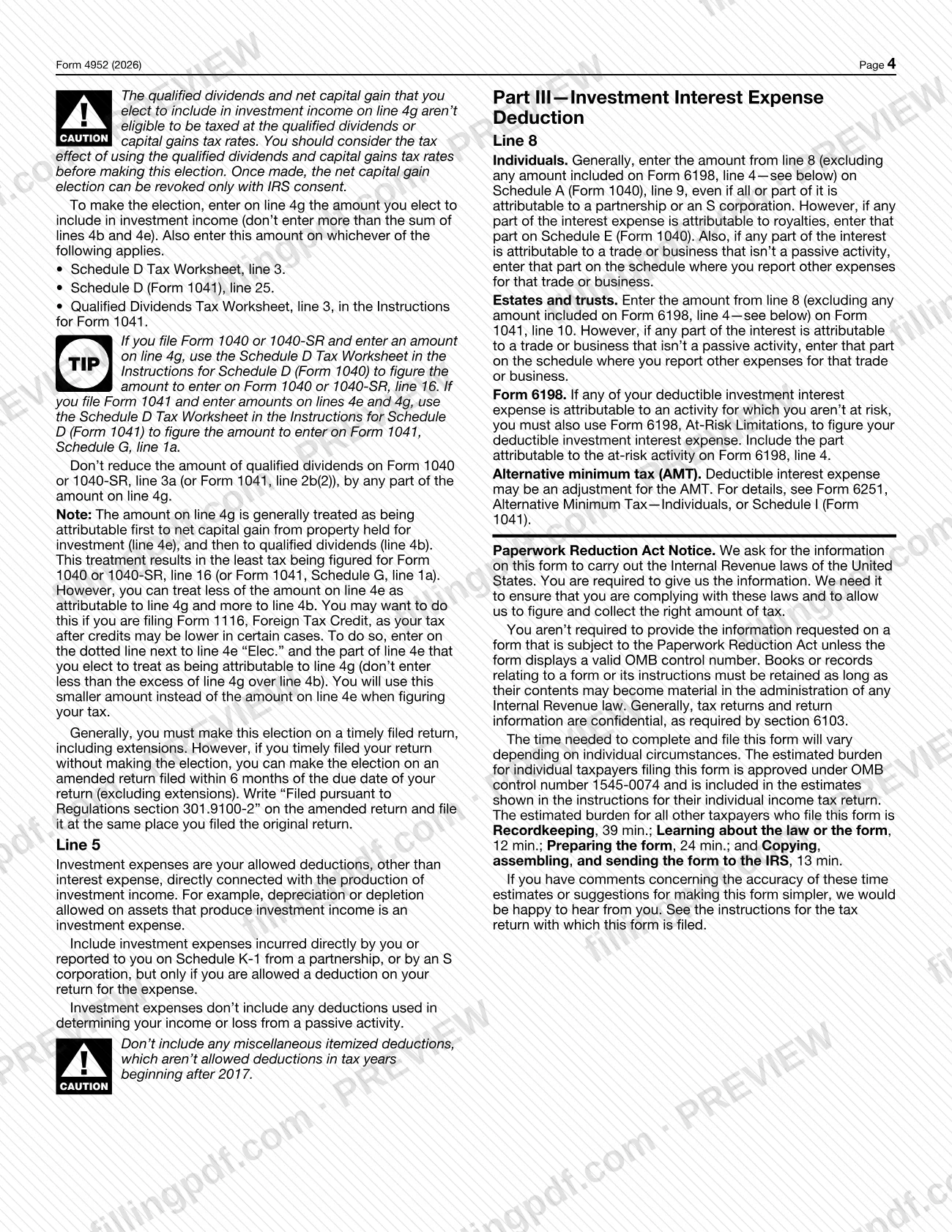
One timing rule applies to the election on line 4g, which includes qualified dividends and net capital gain in investment income. Generally you must make it on a timely filed return, including extensions. If you timely filed without making the election, you can make it on an amended return filed within 6 months of the due date of the return (excluding extensions). Write "Filed pursuant to section 301.9100-2" on the amended return and file it at the same place you filed the original return. Once made, the election can be revoked only with IRS consent.
Documents you need
- Your tax return (for example Form 1040 or Form 1041): Form 4952 is attached to it.
- Schedule K-1 from a partnership or S corporation: use it only if it reports investment interest expense, investment income or investment expenses to you.
- Your 2024 Form 4952: only if line 7 shows disallowed investment interest expense, which you enter on line 2 of the 2025 form.
- Form 6198, At-Risk Limitations: only if some deductible investment interest is attributable to an activity for which you are not at risk.
- Schedule A (Form 1040) or Form 1041: where the line 8 deduction is entered, as the instructions direct.
How to fill out 4952
Enter your name and identifying number
At the top, write the name(s) shown on your return and your identifying number.
Enter investment interest paid or accrued
Line 1: enter the investment interest expense paid or accrued in 2025, regardless of when you incurred the debt. Include amounts reported on Schedule K-1 from a partnership or an S corporation.
Carry in last year's disallowed amount
Line 2: enter the disallowed investment interest expense from line 7 of your 2024 Form 4952. Then add lines 1 and 2 and enter the total on line 3.
Report gross investment income
Line 4a: enter gross income from property held for investment, excluding any net gain from its disposition. Line 4b: enter the qualified dividends included on line 4a, then subtract 4b from 4a on line 4c.
Report gains on investment property
Line 4d: enter net gain from the disposition of property held for investment. Line 4e: enter the smaller of line 4d or your net capital gain from that disposition, then subtract 4e from 4d on line 4f.
Decide on the line 4g election
Line 4g: enter the amount of lines 4b and 4e you elect to include in investment income, no more than the sum of those two lines. Also enter it on the Schedule D Tax Worksheet, line 3, Schedule D (Form 1041), line 25, or the Qualified Dividends Tax Worksheet, line 3, as applicable.
Total your investment income
Line 4h: add lines 4c, 4f and 4g.
Enter investment expenses
Line 5: enter your allowed deductions, other than interest, directly connected with producing investment income. Do not include miscellaneous itemized deductions.
Figure net investment income
Line 6: subtract line 5 from line 4h. If zero or less, enter -0-.
Calculate the carryforward
Line 7: subtract line 6 from line 3 to get the disallowed amount carried forward to 2026. If zero or less, enter -0-.
Enter your deduction
Line 8: enter the smaller of line 3 or line 6. Individuals generally carry it to Schedule A (Form 1040), line 9; estates and trusts use Form 1041, line 10.
Review, download and attach
Check each line against the instructions, then download or print the completed PDF from FillingPDF and attach it to your tax return.
How to submit 4952
Form 4952 is not filed on its own: the form says to attach it to your tax return, and it goes to the IRS through whichever channel you use for that return. It prints no separate address, portal or fee.
- With your return: attach the completed form to the return that claims the deduction.
- Where line 8 goes (individuals): generally on Schedule A (Form 1040), line 9. Any part attributable to royalties goes on Schedule E (Form 1040), and any part attributable to a trade or business that is not a passive activity goes on the schedule where you report other expenses for that business.
- Where line 8 goes (estates and trusts): on Form 1041, line 10, with the same exception for a non-passive trade or business.
- Form 6198: include any amount attributable to an at-risk activity on Form 6198, line 4, and exclude it from the amount you carry to your return.
The IRS publishes the latest information at www.irs.gov/Form4952. FillingPDF lets you fill out and download the PDF; submission follows the channels used for your tax return.
Common mistakes to avoid
- Including net gain from disposing of investment property on line 4a; the instructions say to enter it on line 4d instead.
- Counting personal interest, interest allocable to a passive activity or capitalized interest as investment interest expense on line 1.
- Entering more on line 4g than the sum of lines 4b and 4e when electing to include qualified dividends and net capital gain.
- Including miscellaneous itemized deductions on line 5; they are not allowed deductions for tax years beginning after December 31, 2017, and before January 1, 2026.
- Reducing qualified dividends on Form 1040 or 1040-SR, line 3a (or Form 1041, line 2b(2)), by any part of the line 4g amount.
- Leaving out the 2024 carryover on line 2 when the 2024 Form 4952, line 7, shows a disallowed amount.
- Making the line 4g election after the return was filed without following the amended-return rule and the "Filed pursuant to section 301.9100-2" notation.
- Omitting Form 6198 when part of the deductible interest comes from an activity for which you are not at risk.
Frequently asked questions
What is Form 4952 used for?
Form 4952 is the IRS form for figuring the investment interest expense you can deduct for 2025 and the amount you can carry forward. The deduction is limited to your net investment income, and the form is attached to your tax return.
Who has to file Form 4952?
Individuals, estates and trusts must file it to claim a deduction for investment interest expense. You can skip it if your interest and ordinary dividend income minus qualified dividends exceeds your investment interest expense, you have no other deductible investment expenses and no 2024 carryover.
Where do I enter the Form 4952 line 8 deduction?
Individuals generally enter line 8 on Schedule A (Form 1040), line 9. Estates and trusts enter it on Form 1041, line 10. Royalty-related interest goes on Schedule E (Form 1040), and non-passive business interest goes on that business's schedule.
What happens to interest I cannot deduct this year?
It is carried forward. Line 7 shows the disallowed investment interest expense to be carried forward to 2026, and it becomes line 2 on the next year's Form 4952. Line 7 is the amount by which line 3 exceeds line 6, or -0-.
What is the line 4g election on Form 4952?
It lets you include part or all of your qualified dividends and net capital gain from investment property in investment income. Those amounts are then not eligible for the qualified dividend or capital gain tax rates, and the election can be revoked only with IRS consent.
Can I fill out Form 4952 online?
Yes. You can fill out the form 4952 PDF online on FillingPDF and download or print it. FillingPDF is an independent service and does not file the form with the IRS; you attach it to your tax return and submit that return through the IRS channels.
Is there a deadline for Form 4952?
It has no separate deadline; it is due with the tax return it is attached to. The line 4g election generally must be made on a timely filed return, including extensions, or on an amended return filed within 6 months of the due date excluding extensions.
Where can I find the Form 4952 instructions?
The instructions are printed on pages 3 and 4 of the IRS form, and the IRS publishes the latest information at www.irs.gov/Form4952. For more background it refers to Pub. 550, Investment Income and Expenses.
Ready to fill out 4952?
Fill out 4952 now