
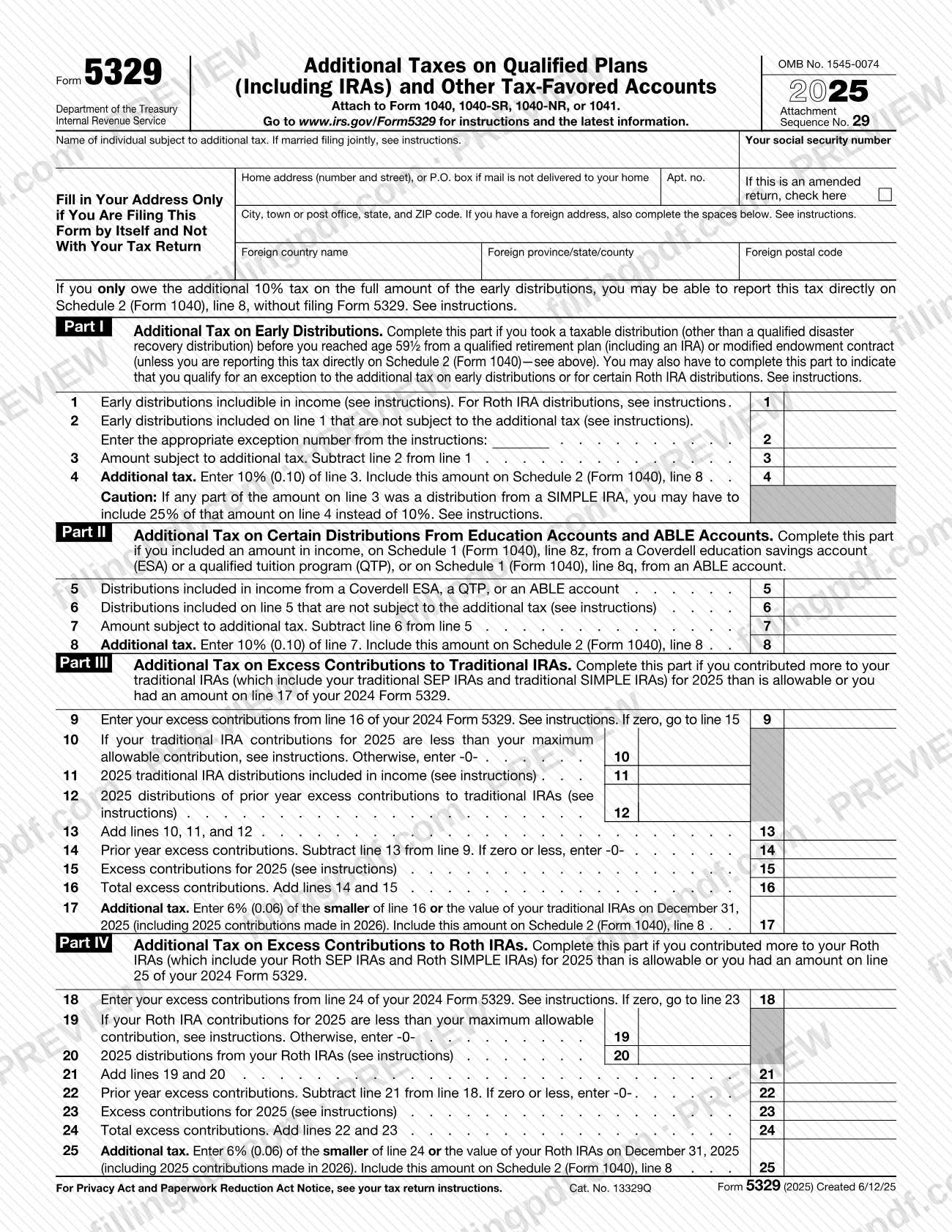
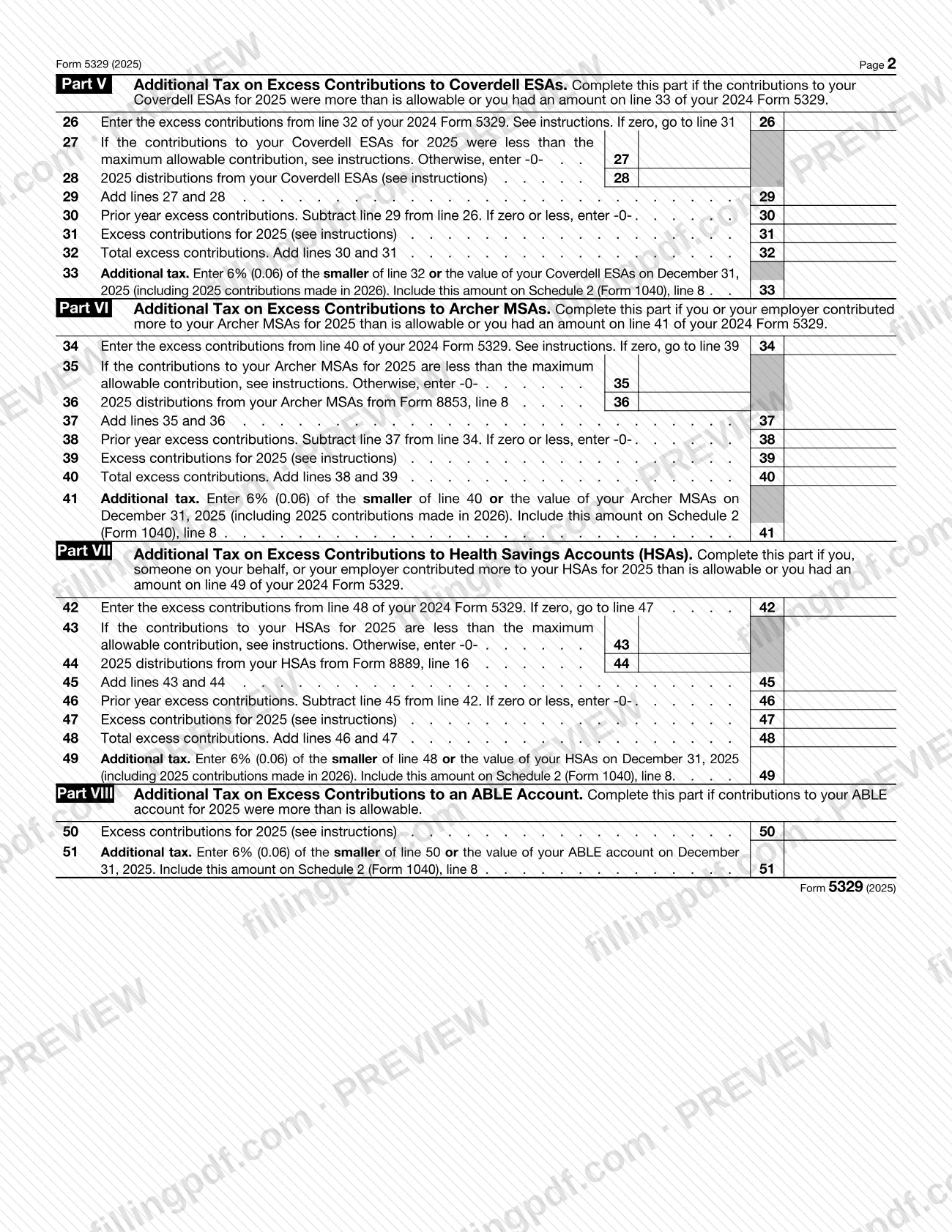
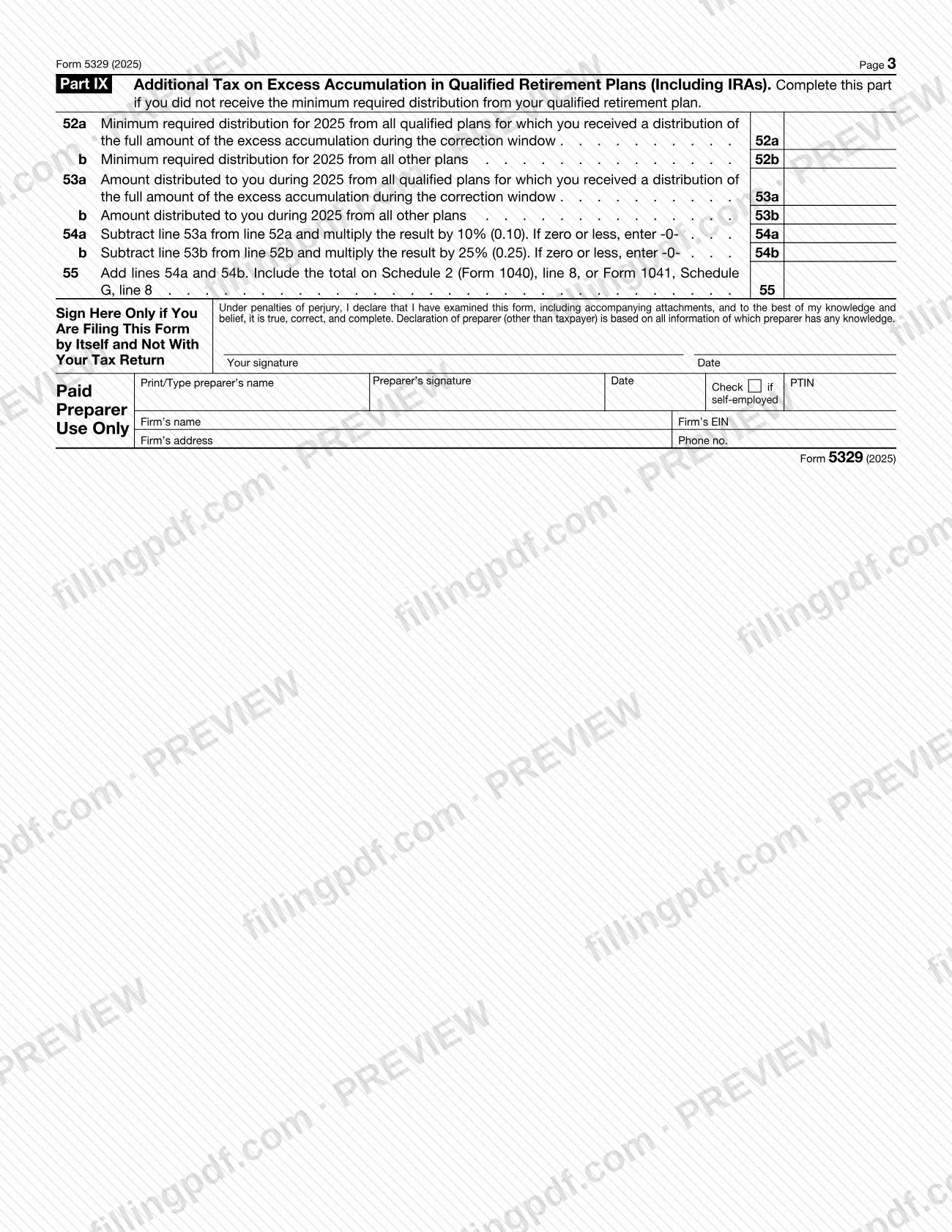
Form 5329, Additional Taxes on Qualified Plans (Including IRAs) and Other Tax-Favored Accounts, is the Internal Revenue Service (IRS) form for reporting additional taxes on IRAs, other qualified retirement plans, modified endowment contracts, Coverdell ESAs, QTPs, Archer MSAs, HSAs and ABLE accounts. You use it when you took an early distribution, contributed more than the limit, or did not take a required minimum distribution, and also to show that an exception to the early-distribution tax applies. On FillingPDF you can fill out the form online and download or print the completed PDF; the IRS publishes the form and its instructions at www.irs.gov/Form5329.
Last updated
What is 5329?
Form 5329, Additional Taxes on Qualified Plans (Including IRAs) and Other Tax-Favored Accounts, is the IRS form used to report additional taxes on early distributions, excess contributions and missed minimum required distributions for IRAs, other qualified plans, and other tax-favored accounts.
The form is an attachment to Form 1040, 1040-SR, 1040-NR or 1041 (OMB No. 1545-0074, Attachment Sequence No. 29). The 2025 edition has nine parts:
- Part I: early distributions from qualified retirement plans, IRAs and modified endowment contracts, including the exception number that shows why part of a distribution is not taxed.
- Part II: certain distributions from Coverdell education savings accounts (ESAs), qualified tuition programs (QTPs) and ABLE accounts.
- Parts III to VIII: excess contributions to traditional IRAs, Roth IRAs, Coverdell ESAs, Archer MSAs, health savings accounts (HSAs) and ABLE accounts.
- Part IX: excess accumulation, which applies when you did not receive the minimum required distribution from a qualified retirement plan.
Each part ends with the additional tax, which the form carries to Schedule 2 (Form 1040), line 8. Part IX can alternatively go to Form 1041, Schedule G, line 8. Qualified disaster recovery distributions are not reported on this form, and the instructions point to Form 8915-F for them. The IRS instructions for Form 5329 also describe the waiver of tax for reasonable cause on a missed minimum distribution.
Who needs to file 5329?
You file Form 5329 if one of the situations in the IRS instructions applies to you:
- You received a Roth IRA distribution and the amount on line 25c of Form 8606 is more than zero, the distribution includes a recapture amount, or it is a qualified first-time homebuyer distribution.
- You received an early distribution from a qualified retirement plan (other than a Roth IRA) and you meet an exception, but box 7 of Form 1099-R does not show it or the exception does not cover the whole distribution.
- You received taxable distributions from Coverdell ESAs, QTPs or ABLE accounts.
- Your 2025 contributions to traditional IRAs, Roth IRAs, Coverdell ESAs, Archer MSAs, HSAs or ABLE accounts exceed the limit, or you had tax due from an excess contribution on line 17, 25, 33, 41 or 49 of your 2024 Form 5329.
- You did not receive the minimum required distribution from your qualified retirement plan. Trusts and estates in that position also file.
You do not have to file if distribution code 1 is correctly shown in box 7 of all your Forms 1099-R and you owe the additional tax on the full amount shown on each; report it directly on Schedule 2 (Form 1040), line 8. The part of a distribution you rolled over is not subject to the early-distribution tax. If both spouses must file, each completes a separate form.
When to file 5329
File Form 5329 with your 2025 Form 1040, 1040-SR, 1040-NR or 1041 by the due date of that return, including extensions. If you do not have to file a 2025 income tax return, complete and file Form 5329 by itself at the time and place you would be required to file Form 1040, 1040-SR or 1040-NR.
For a prior year, use that year's version of the form. If you have no other changes and have not filed a federal income tax return for that year, file the prior-year form by itself; if you have other changes, file it with Form 1040-X, Amended U.S. Individual Income Tax Return.
Some corrections have their own timing. You can withdraw excess IRA, Archer MSA or HSA contributions by the due date of the 2025 return, including extensions, for them to be treated as not contributed. After a timely filed return, the instructions allow the withdrawal up to 6 months after the due date, excluding extensions, with an amended return marked "Filed pursuant to section 301.9100-2". For Coverdell ESAs the withdrawal must be made before June 1, 2026.
Documents you need
- Statement of explanation for a waiver of the tax on a missed minimum required distribution: attach it if you believe the shortfall was due to reasonable error and you are taking reasonable steps to remedy it.
- Statement with the name, age and TIN of the child or eligible adoptee, for a qualified birth or adoption distribution (exception number 19).
- If the child died before a TIN was obtained: a statement saying so, plus a copy of the child's birth certificate, death certificate or hospital records, for exception number 19.
- Explanation of the withdrawal on an amended return, when you withdraw excess contributions after a timely filed return; the instructions say to enter "Filed pursuant to section 301.9100-2" at the top of the amended return.
- Form 1040-X, Amended U.S. Individual Income Tax Return: file it with a prior-year Form 5329 only if you have other changes to that year's return.
How to fill out 5329
Enter your name, SSN and address
Enter the name of the individual subject to the additional tax and your social security number. Fill in the address block only if you file the form by itself and not with your tax return, and check the box at the top of page 1 if this is an amended return.
Check whether you can skip the form
If you owe only the additional tax on the full amount of early distributions, you may be able to report it directly on Schedule 2 (Form 1040), line 8, without filing Form 5329. Check the instructions before continuing.
Complete Part I, lines 1 to 4
Line 1: early distributions includible in income. Line 2: the part not subject to the tax, with the exception number (01 to 23, or 99 if more than one applies). Line 3 is line 1 minus line 2; line 4 is the additional tax, which goes to Schedule 2 (Form 1040), line 8.
Complete Part II, lines 5 to 8
Complete this part if you included an amount in income from a Coverdell ESA or QTP on Schedule 1 (Form 1040), line 8z, or from an ABLE account on line 8q. Enter the distributions on line 5, the exempt part on line 6, subtract on line 7, and figure the tax on line 8.
Complete Part III for traditional IRAs
Lines 9 to 17: start with the prior-year excess from line 16 of your 2024 Form 5329 (if zero, go to line 15), then figure lines 10 to 14, the 2025 excess on line 15 and the total on line 16. Line 17 is the additional tax on the smaller of line 16 or the value of your traditional IRAs on December 31, 2025.
Complete Part IV for Roth IRAs
Lines 18 to 25 follow the same pattern: prior-year excess from line 24 of your 2024 form, lines 19 to 22, 2025 excess on line 23 and total on line 24. Line 25 is the additional tax on the smaller of line 24 or the value of your Roth IRAs on December 31, 2025.
Complete Parts V and VI
Part V (Coverdell ESAs) uses lines 26 to 33. Part VI (Archer MSAs) uses lines 34 to 41; line 36 comes from Form 8853, line 8. Each ends with an additional tax line that goes to Schedule 2 (Form 1040), line 8.
Complete Part VII for HSAs
Lines 42 to 49: line 44 comes from Form 8889, line 16. Line 47 is your 2025 excess contributions, including any made by your employer, and line 49 is the additional tax on the smaller of line 48 or the value of your HSAs on December 31, 2025.
Complete Part VIII for ABLE accounts
Line 50: enter the excess contributions for 2025. Line 51: the additional tax on the smaller of line 50 or the value of your ABLE account on December 31, 2025.
Complete Part IX for missed distributions
Lines 52a and 52b: the minimum required distribution, split between plans where you received the full excess accumulation during the correction window and all other plans. Lines 53a and 53b: the amounts distributed to you in 2025. Lines 54a and 54b figure the tax on each shortfall, and line 55 is the total.
Claim a waiver if you qualify
To request a waiver for reasonable cause, enter "RC" and the shortfall amount to be waived in parentheses on the dotted line next to line 54a or 54b. Subtract it from the shortfall, enter the result on that line, and attach a statement of explanation.
Sign, review and download the PDF
Sign and date page 3 only if you file the form by itself; a paid preparer completes the preparer block. Check each part, then download or print the completed PDF from FillingPDF.
How to submit 5329
Form 5329 is submitted either attached to your tax return or, when no return is required, by itself by mail.
- With your tax return: attach it to Form 1040, 1040-SR, 1040-NR or 1041 and file the return through its usual channel. The additional tax from each part goes to Schedule 2 (Form 1040), line 8; trusts and estates enter the Part IX total on Form 1041, Schedule G, line 8 and write "From Form 5329" and the amount to the left of the line 8 entry space.
- By itself: file at the time and place you would file Form 1040, 1040-SR or 1040-NR. A Form 5329 filed by itself cannot be filed electronically. Enter your address on page 1 and your signature and date on page 3. The mailing address is not printed on Form 5329; use the one in the instructions for your income tax return.
- Payment: see the Instructions for Form 1040 or Form 1040-NR, or go to IRS.gov/Payments.
If you claim a waiver for reasonable cause or report a qualified birth or adoption distribution, attach the statement described in the instructions. FillingPDF lets you fill out and download the PDF; submission follows the channels above.
Common mistakes to avoid
- Using the 2025 Form 5329 to amend a return for any other year; the instructions say to use that year's version of the form.
- Filing one Form 5329 for both spouses on a joint return, when each spouse who must file needs a separate form.
- Trying to e-file Form 5329 by itself; a Form 5329 filed without a tax return cannot be filed electronically.
- Filing it by itself without your address on page 1, or without your signature and date on page 3.
- Leaving out the exception number on line 2 for an exception that applies, or entering a single number when more than one exception applies instead of 99.
- Applying the standard early-distribution rate to a SIMPLE IRA distribution within 2 years of first participation; the line 4 caution says a higher rate may apply.
- Including rollovers when figuring excess contributions on lines 15, 23 or 31.
- Counting distributions received after the deadline or during the correction window on line 53a or 53b.
- Entering a 2024 excess amount on line 9, 18, 26, 34 or 42 when the matching 2024 additional tax line was zero.
Frequently asked questions
What is Form 5329 used for?
Form 5329 reports additional taxes on IRAs, other qualified retirement plans, modified endowment contracts, Coverdell ESAs, QTPs, Archer MSAs, HSAs and ABLE accounts. It covers early distributions, excess contributions and missed required distributions, and it is also where you report an exception to the early-distribution tax.
Do I have to file Form 5329 for an early IRA withdrawal?
Not always. If distribution code 1 is correctly shown in box 7 of all your Forms 1099-R and you owe the additional tax on the full amount of each, you report the tax directly on Schedule 2 (Form 1040), line 8. You file Form 5329 if you meet an exception that box 7 does not show.
When is Form 5329 due?
With your 2025 tax return, by its due date including extensions. If you do not have to file a return, file Form 5329 by itself at the time and place you would file Form 1040, 1040-SR or 1040-NR. Prior-year forms use that year's version.
Can I e-file Form 5329 by itself?
No. The instructions say a Form 5329 filed by itself cannot be filed electronically. Mail it, with your address on page 1 and your signature and date on page 3. When it is attached to a tax return, it goes through the same channel as that return.
What exception number do I enter on line 2?
Enter the number from the instructions' exceptions list, 01 to 23, that matches your distribution, such as 03 for total and permanent disability or 09 for a first home. If more than one exception applies, enter 99. Line 2 also takes the amount you can exclude.
What if I missed a required minimum distribution?
Complete Part IX. The IRS can waive part or all of the tax if the shortfall was due to reasonable error and you are taking reasonable steps to fix it. Attach a statement, enter "RC" and the shortfall to be waived in parentheses next to line 54a or 54b, and pay any tax on line 55.
Do I need a separate Form 5329 for my spouse?
Yes, if both of you must file. On a joint return, each spouse completes a separate Form 5329, and you include the combined tax on Schedule 2 (Form 1040), line 8. One form does not cover two people.
Can I fill out Form 5329 online?
You can fill out the PDF online on FillingPDF and download or print it. FillingPDF is independent of the IRS and does not file the form: it goes to the IRS with your tax return, or by mail when filed by itself.
Ready to fill out 5329?
Fill out 5329 now