
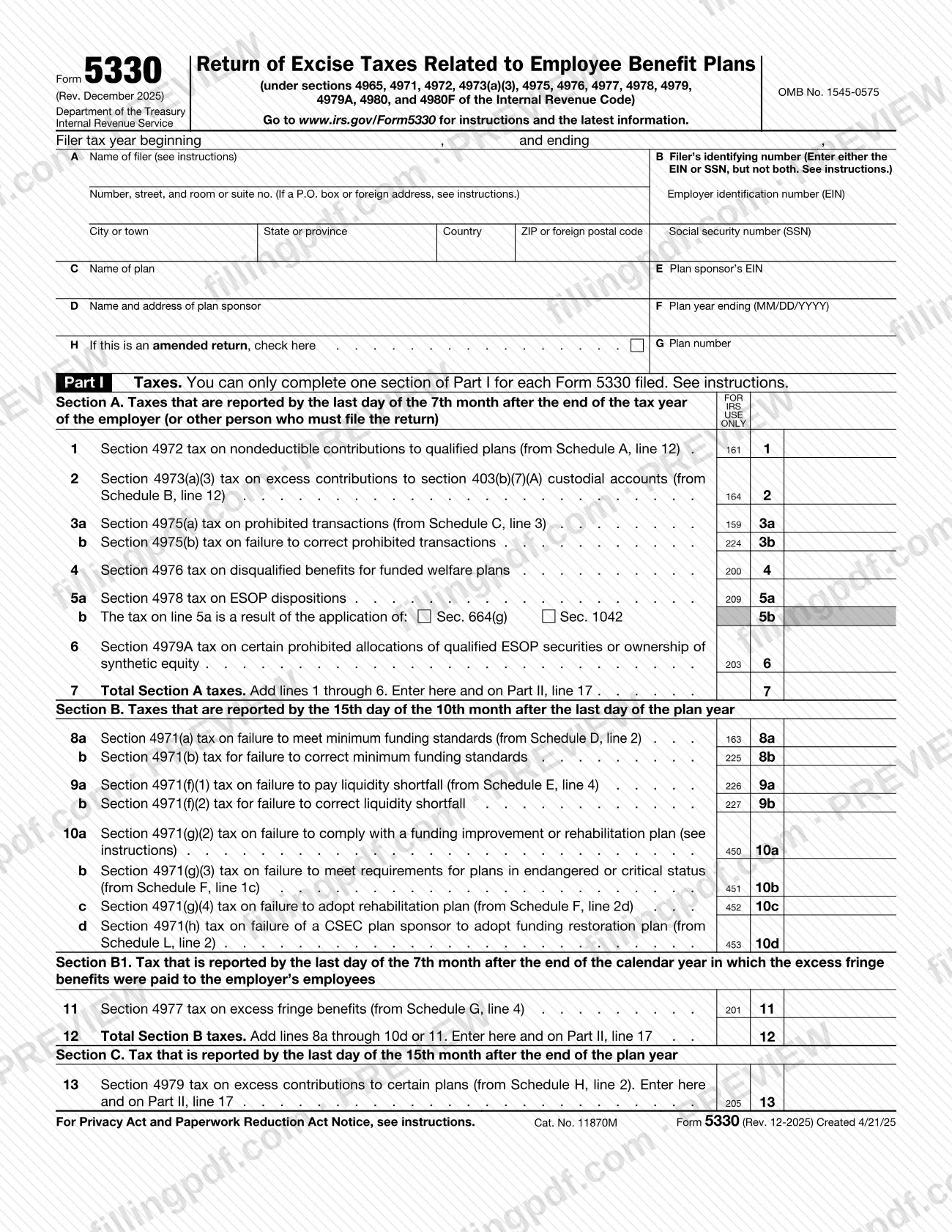
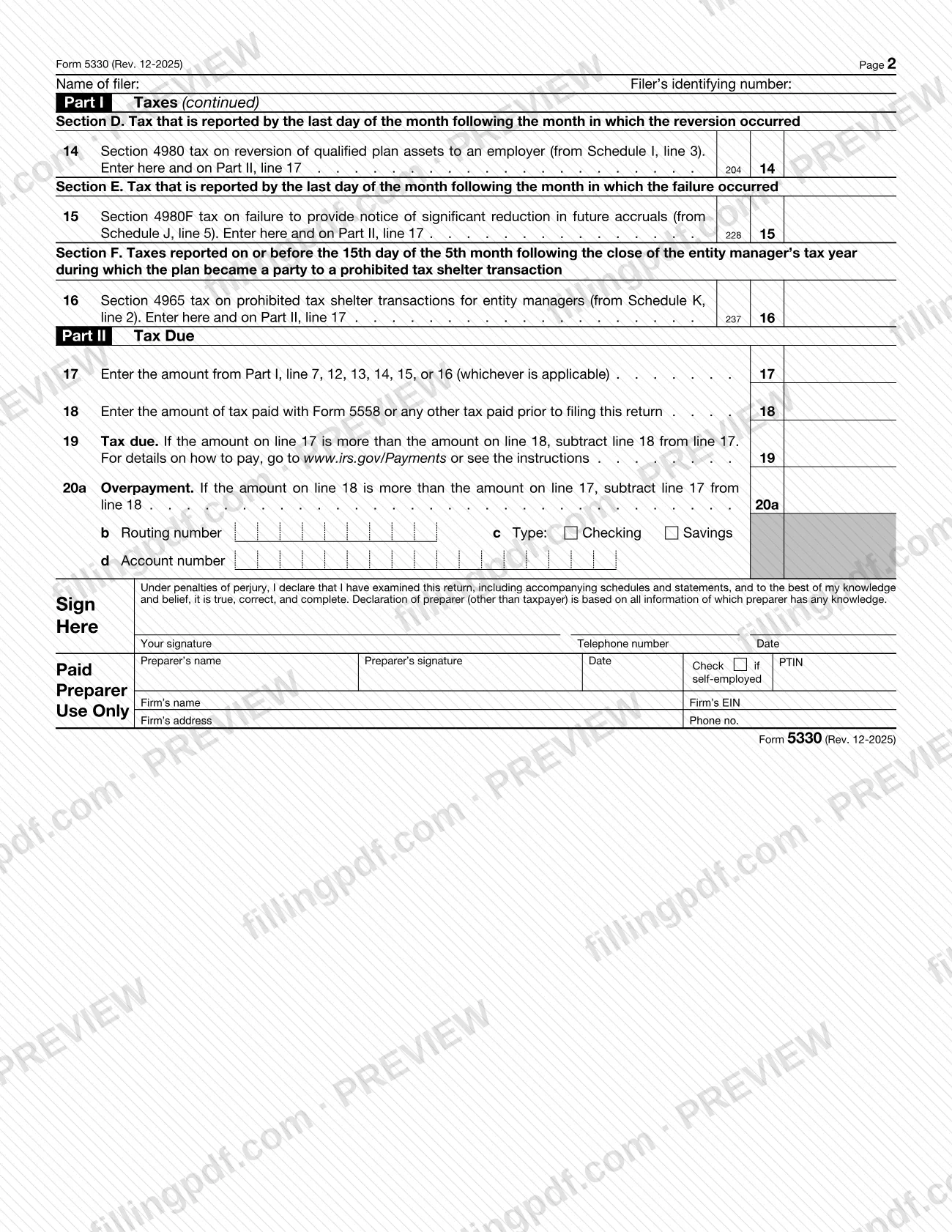
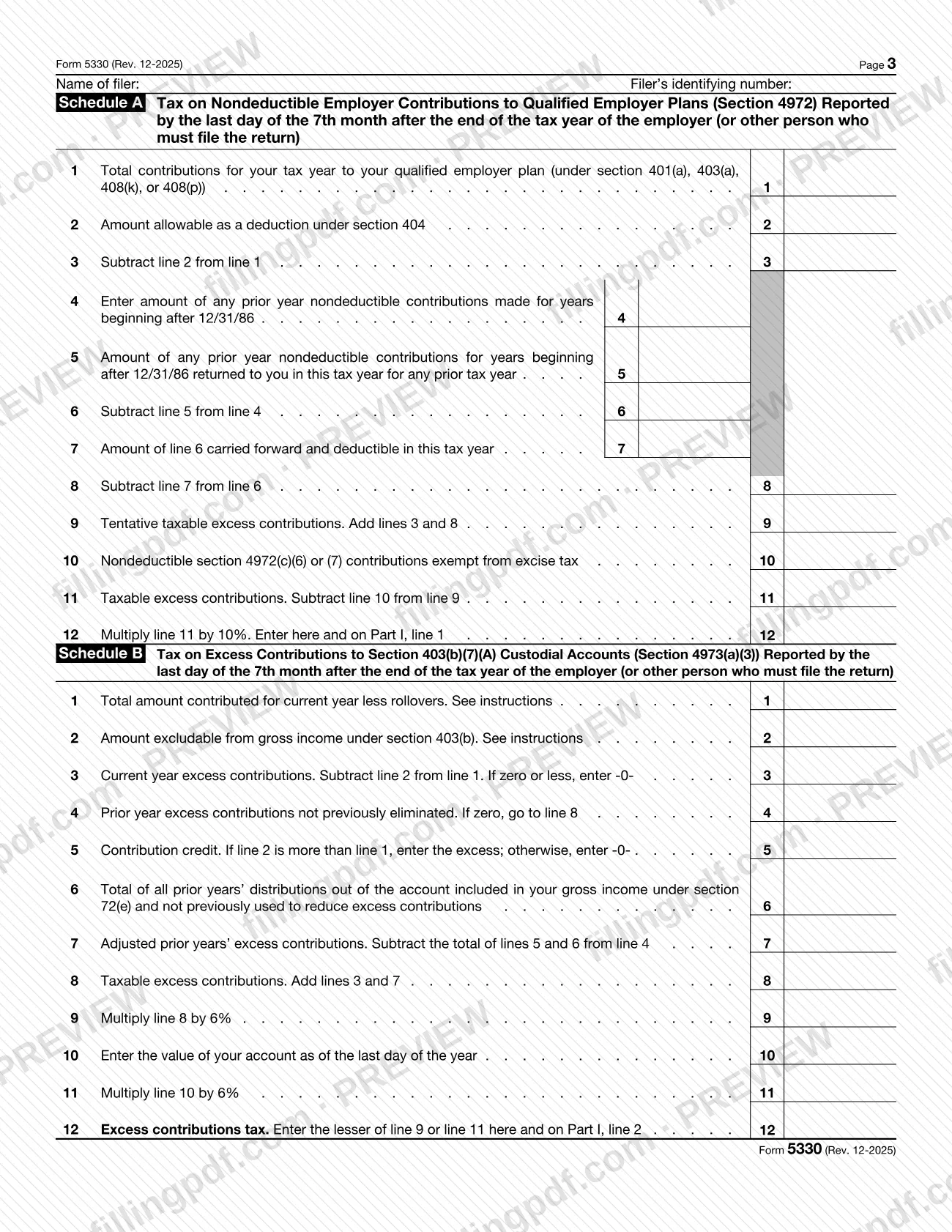
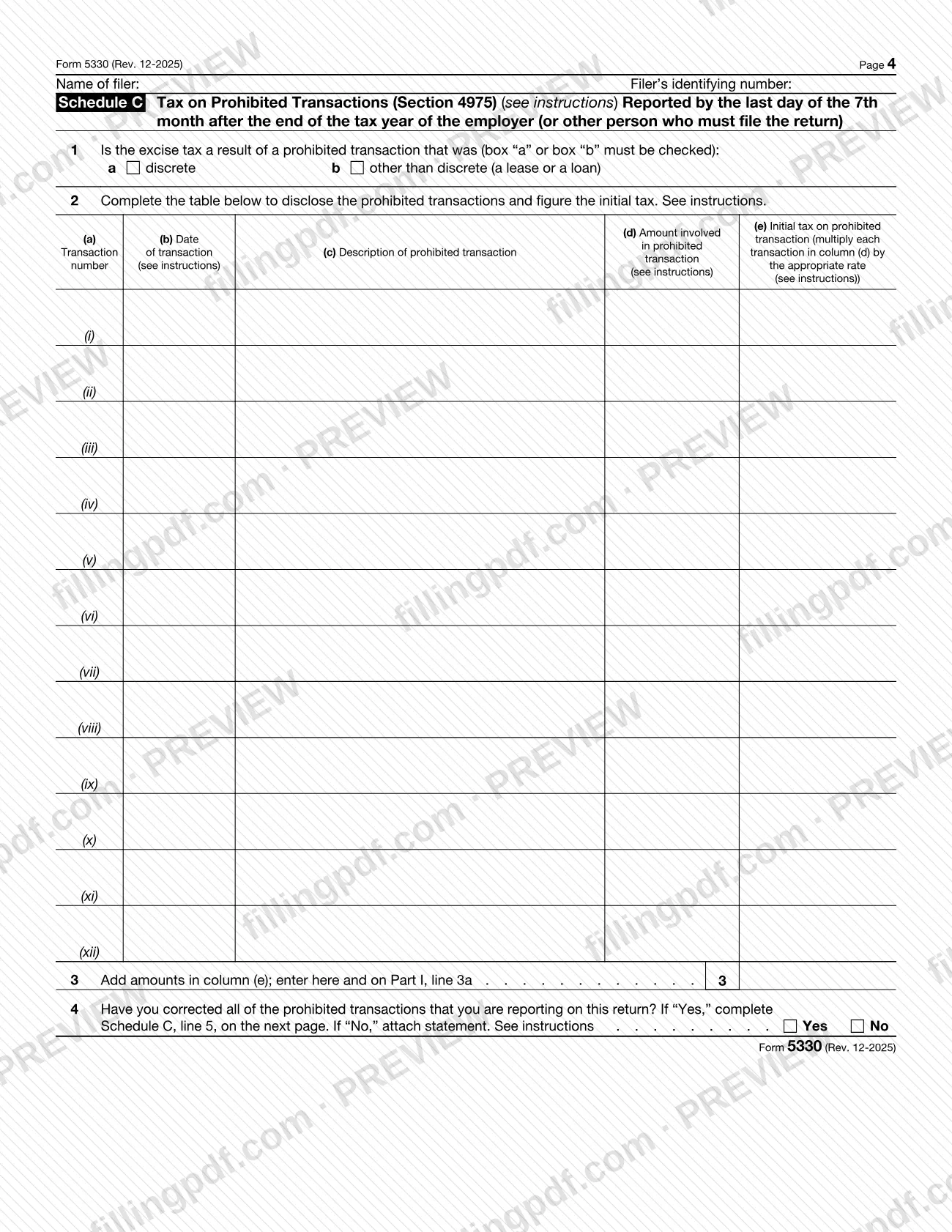
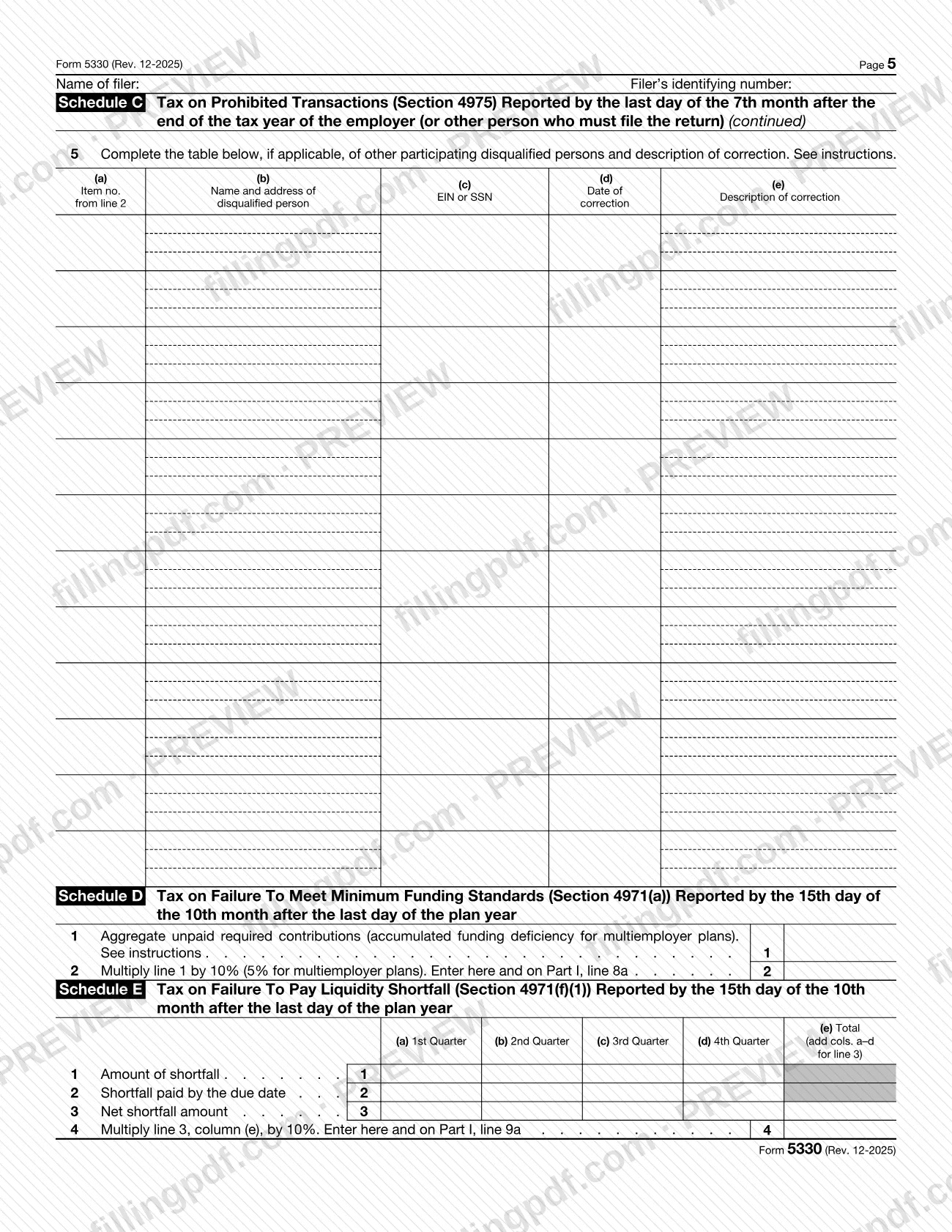
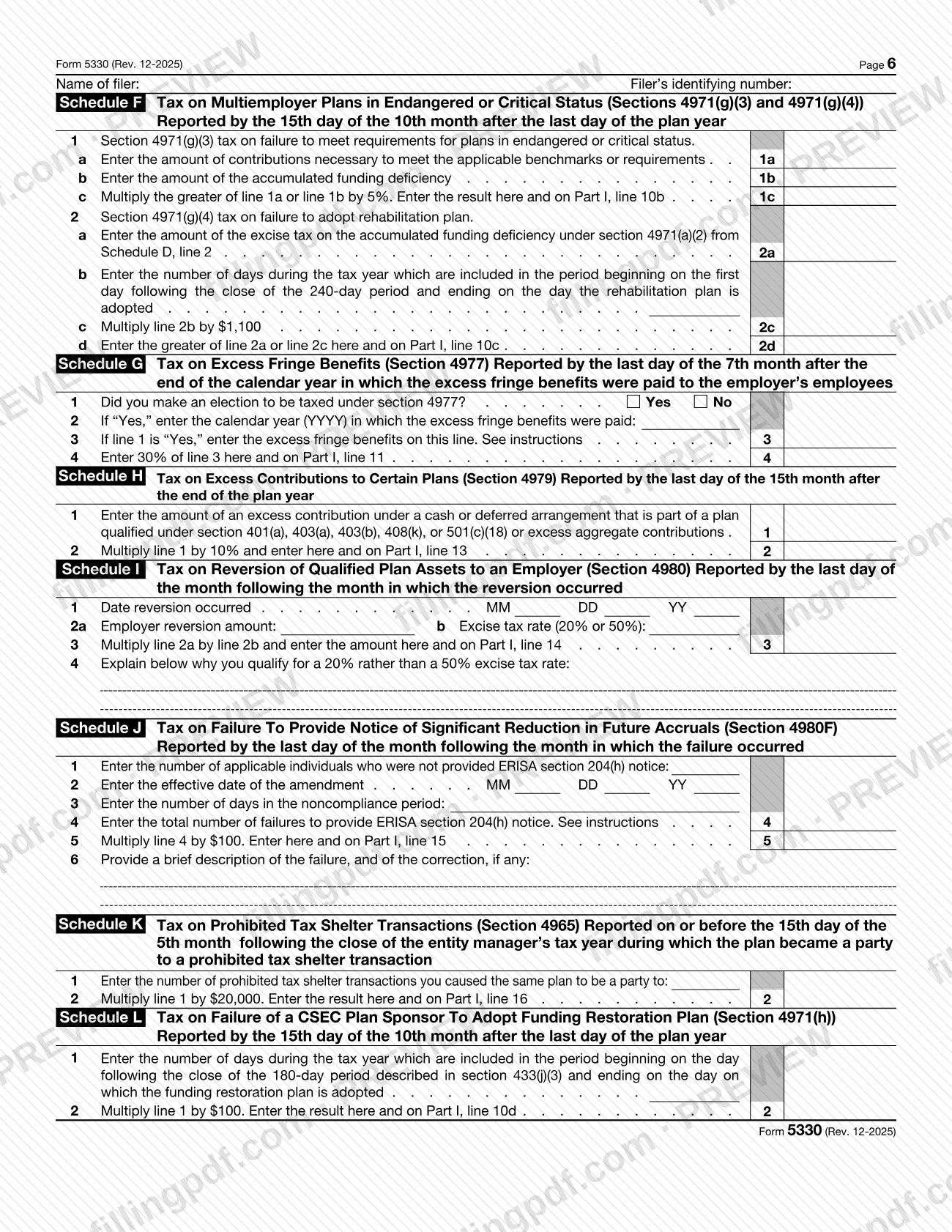
Form 5330 is the Internal Revenue Service (IRS) return used to report and pay excise taxes that arise under sections 4965, 4971, 4972, 4973(a)(3), 4975, 4976, 4977, 4978, 4979, 4979A, 4980, and 4980F of the Internal Revenue Code. Employers, plan sponsors, entity managers, disqualified persons and certain individuals use it when an employee benefit plan triggers one of those taxes. On this page you can fill out the form online on FillingPDF and download or print the completed PDF; the IRS publishes the form and its instructions at www.irs.gov/Form5330.
Last updated
What is 5330?
Form 5330, Return of Excise Taxes Related to Employee Benefit Plans is the IRS return that reports and pays excise taxes tied to employee benefit plans, such as taxes on nondeductible contributions, prohibited transactions, funding failures, plan reversions and prohibited tax shelter transactions.
The Internal Revenue Service (IRS) issues the form under OMB No. 1545-0575. Part I lists the taxes in Sections A through F, each tied to a section of the Internal Revenue Code and to its own due date. Schedules A through L figure the individual taxes:
- Schedule A: nondeductible employer contributions (section 4972).
- Schedule B: excess contributions to section 403(b)(7)(A) custodial accounts (section 4973(a)(3)).
- Schedule C: prohibited transactions (section 4975).
- Schedules D, E, F and L: minimum funding, liquidity shortfall, endangered or critical status, and funding restoration plans (section 4971).
- Schedule G: excess fringe benefits (section 4977).
- Schedule H: excess contributions to certain plans (section 4979).
- Schedule I: reversion of qualified plan assets (section 4980).
- Schedule J: failure to give notice of a significant reduction in future accruals (section 4980F).
- Schedule K: prohibited tax shelter transactions (section 4965).
Part II brings the total tax forward, subtracts tax already paid and shows either tax due or an overpayment, with direct deposit lines for a refund. The same form is used as an amended return when you check the box in item H. The IRS instructions say that Form 5558 is no longer used to extend the time to file Form 5330; Form 8868 is used instead.
Who needs to file 5330?
The IRS instructions list who must file Form 5330 and pay the tax. In summary:
- Employers liable for the section 4971 tax on funding failures, including liquidity shortfalls and, for multiemployer plans, failure to follow a funding improvement or rehabilitation plan.
- Multiemployer plan sponsors and cooperative and small employer charity (CSEC) plan sponsors that fail to adopt a rehabilitation plan or funding restoration plan on time.
- Employers with nondeductible contributions (section 4972), funded welfare plans that provide a disqualified benefit (section 4976), excess fringe benefit elections (section 4977), ESOP dispositions or prohibited allocations (sections 4978 and 4979A), excess contributions to plans with cash or deferred arrangements (section 4979), plan asset reversions (section 4980) and missed section 204(h) notices (section 4980F).
- Individuals liable for the section 4973(a)(3) tax on uneliminated excess contributions to a section 403(b)(7)(A) custodial account.
- Disqualified persons who take part in a prohibited transaction under section 4975, other than a fiduciary acting only as such.
- Plan entity managers of tax-exempt entities who approve or cause the entity to join a prohibited tax shelter transaction.
A financial institution that is a disqualified person in prohibited transactions involving multiple IRAs or plans files only one Form 5330 under its own EIN and attaches a list of the affected IRAs or plans. Taxes from separate plans need separate forms.
When to file 5330
The due date depends on which tax you report, and the instructions give it in Table 1. Examples: sections 4972, 4975, 4976, 4978 and 4979A are due the last day of the 7th month after the end of the tax year of the employer or other filer; section 4971 taxes are due the 15th day of the 10th month after the last day of the plan year; section 4979 is due the last day of the 15th month after the plan year; sections 4980 and 4980F are due the last day of the month following the month of the reversion or failure. If a due date falls on a Saturday, Sunday or legal holiday, you may file on the next business day.
File one Form 5330 for all taxes with the same due date. For a prohibited transaction you file a separate Form 5330 for each tax year.
Form 8868, filed on or before the normal due date, can extend the time to file by up to 6 months. It does not extend the time to pay. Late filing and late payment can bring penalties and interest, billed separately; the instructions allow relief for reasonable cause.
Documents you need
- Statement for Schedule C, line 4: attach it if you answer No because not all prohibited transactions were corrected, giving the item number from line 2 and when the correction will be made.
- Additional statement for Schedule C, line 5, only if you need more space to explain a correction and identify the people involved.
- List of all affected IRAs or plans, only if you are a financial institution that is a disqualified person reporting prohibited transactions for multiple IRAs or plans.
- Check or money order payable to the "United States Treasury" for any balance due, only if you file on paper and pay by check or money order.
- Supporting evidence and a detailed statement of the reasons, only if you file an amended Form 5330 to claim a refund or credit.
- A statement explaining reasonable cause, optional, if you file late and want to ask for relief from the late-filing penalty.
How to fill out 5330
Enter filer tax year and identity
Enter the filer tax year beginning and ending dates, using the plan year dates from Part I of Form 5500 or the tax year of the business return. In item A enter the name and address of the employer, individual or entity liable for the tax, using a P.O. box only if the post office does not deliver to the street address.
Enter the filer's identifying number
In item B enter either the EIN or the SSN, but not both. Individuals other than sole proprietors with an EIN use an SSN; all other filers use an EIN.
Identify the plan and sponsor
Item C: the plan's name, matching Form 5500 if one is required. Item D: the plan sponsor's name and address. Item E: the sponsor's nine-digit EIN.
Enter plan year and plan number
Item F: the plan year ending date in MM/DD/YYYY format. Item G: the three-digit plan number; leaving it out delays processing.
Check the amended return box
Check item H only if this is an amended Form 5330, then follow the Part II amended return instructions.
Complete the Part I section that applies
Complete one section of Part I (A through F) for each Form 5330, using the lines for the tax you owe, such as lines 1 to 6 in Section A. Enter the amounts from the matching schedules on the lines that refer to them, and total Section A on line 7 or Section B on line 12.
Fill out the schedules
Complete only the schedules (A through L) behind the taxes you report. For Schedule C, check box a or b on line 1, list each transaction in the line 2 table, enter the total on line 3 and answer line 4.
Add details for special lines
On line 5b check the box showing whether section 664(g) or 1042 applies. On Schedule I enter the reversion date, amount and rate, and explain on line 4 if you use a rate other than the highest.
Figure tax due in Part II
Line 17: enter the amount from Part I, line 7, 12, 13, 14, 15 or 16. Line 18: tax paid before filing. Line 19: tax due if line 17 exceeds line 18. Line 20a: overpayment if line 18 exceeds line 17.
Enter direct deposit details
If you have an overpayment on line 20a, enter the nine-digit routing number on 20b, check the account type on 20c, and enter the account number on 20d (up to 17 characters, no spaces or special symbols).
Sign and date the return
Sign and date the form and add a daytime phone number. A paid preparer also completes the Paid Preparer Use Only area; an unpaid preparer should not sign.
Review and download the completed PDF
Check that names, numbers and totals match across pages and schedules. Download or print the completed PDF from FillingPDF and file it as described under How to submit.
How to submit 5330
You can file Form 5330 electronically through an IRS Authorized e-file Provider or on paper by mail.
- Electronic filing: returns go through the IRS Modernized e-file (MeF) system. It is mandatory for tax years ending on or after December 31, 2023 if you must file at least 10 returns of any type during the calendar year Form 5330 is due. A paper return from a filer who must e-file is treated as not filed, unless the IRS waives the requirement for undue hardship or you are exempt.
- Paper filing (only if not required to e-file): mail to Department of the Treasury, Internal Revenue Service Center, Ogden, UT 84201. Sign it, and if completing it by hand use only blue or black ink.
- Private delivery services: use a service designated by the IRS (list at IRS.gov/PDS; addresses at IRS.gov/PDSstreetAddresses). These services cannot deliver to P.O. boxes.
- Payment: pay any balance on Part II, line 19 through the options at IRS.gov/Payments. With a paper return you may attach a check or money order payable to "United States Treasury", marked with your name, identifying number, plan number and "Form 5330, Section ____".
Do not mail the form to the Washington, DC address used for comments on the form. FillingPDF lets you fill out and download the PDF; submission follows the channels above.
Common mistakes to avoid
- Filing on paper when the electronic filing rule applies (10 or more returns of any type in the year Form 5330 is due); the IRS treats it as not filed.
- Mailing the form to the Washington, DC address for comments instead of the Ogden, UT address under Where To File.
- Using Form 5558 to ask for more time; the instructions say Form 8868 is used for Form 5330 extensions.
- Assuming Form 8868 extends the time to pay; any tax due must still be paid by the original due date to avoid interest.
- Entering both an EIN and an SSN in item B instead of one identifying number.
- Leaving out the three-digit plan number in item G, which delays processing.
- Entering the plan year ending date in item F in the wrong format instead of MM/DD/YYYY, such as 03/31/2024.
- Filing a separate Form 5330 for each affected IRA or plan when a financial institution should file one under its own EIN with a list.
- Completing more than one section of Part I on a single Form 5330, or combining taxes with different due dates.
- Checking No on Schedule C, line 4 without attaching the required statement.
Frequently asked questions
What is Form 5330 used for?
Form 5330 is the IRS return used to report and pay excise taxes related to employee benefit plans. It covers taxes such as those on nondeductible contributions, prohibited transactions, funding failures, plan reversions and prohibited tax shelter transactions, each reported on its own line and schedule.
When is Form 5330 due?
It depends on the tax. For example, section 4972 and 4975 taxes are due the last day of the 7th month after the filer's tax year ends, and section 4971 taxes the 15th day of the 10th month after the plan year ends. Table 1 in the IRS instructions lists every due date.
Can I get an extension to file Form 5330?
Yes. File Form 8868 on or before the normal due date for up to 6 months more to file. It does not extend the time to pay, so pay any tax due by the original due date. Form 5558 is no longer used for Form 5330.
Where do I mail Form 5330?
Paper returns go to Department of the Treasury, Internal Revenue Service Center, Ogden, UT 84201. Private delivery services cannot deliver to P.O. boxes; use the street address at IRS.gov/PDSstreetAddresses. Only filers not required to e-file may file on paper.
Do I have to file Form 5330 electronically?
You must if you are required to file at least 10 returns of any type during the calendar year Form 5330 is due, for tax years ending on or after December 31, 2023. The IRS may waive this for undue hardship or exempt some filers.
Can I file one Form 5330 for several taxes?
Yes, if the taxes have the same filing due date. File separate forms for taxes from separate plans. Part I allows only one section to be completed per Form 5330, and prohibited transactions need a separate form for each tax year.
Can I fill out Form 5330 online on FillingPDF?
Yes. You can fill out the PDF online on FillingPDF and download or print it. FillingPDF is an independent service and does not file the form with the IRS; you submit it through the IRS channels described under How to submit.
What happens if I file or pay Form 5330 late?
The IRS may charge interest and penalties for late filing and late payment, billed separately after the return is filed. They are not imposed if you show reasonable cause; for late filing you may attach a statement explaining it.
Ready to fill out 5330?
Fill out 5330 now