
Form 5495, Request for Discharge from Personal Liability Under Internal Revenue Code Section 2204 or 6905, is the Internal Revenue Service (IRS) form an executor or fiduciary files to be released from personal liability for a decedent's income, gift and estate taxes. It is used by the executor representing a decedent's estate or by a fiduciary of a decedent's trust. On this page you can fill out the form online on FillingPDF and download or print the completed PDF; the original PDF is published by the IRS at irs.gov.
Last updated
What is Form 5495?
Form 5495, Request for Discharge from Personal Liability Under Internal Revenue Code Section 2204 or 6905, is the IRS form an executor or fiduciary uses to ask to be discharged from personal liability for a decedent's income, gift and estate tax deficiencies.
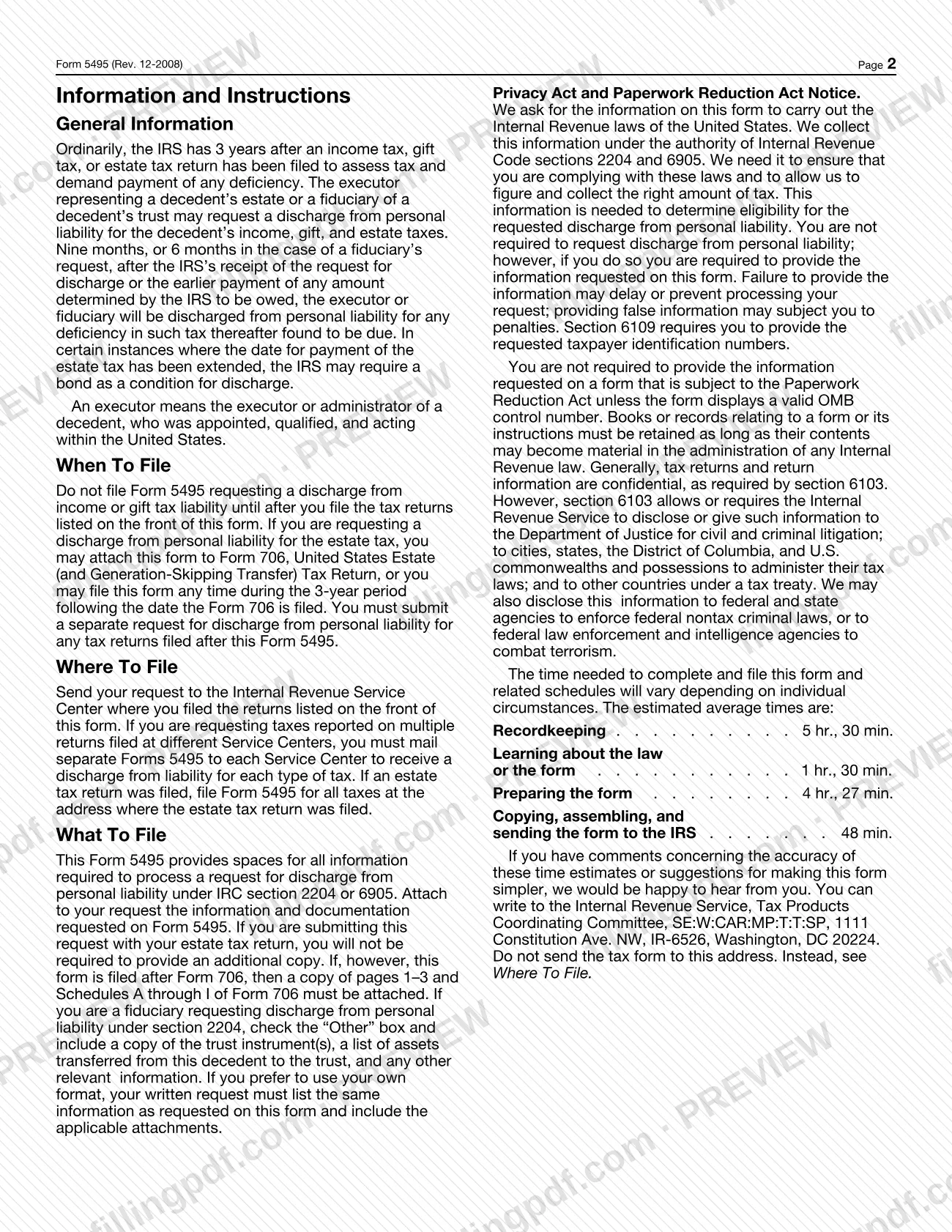
Ordinarily the IRS has 3 years after an income, gift or estate tax return is filed to assess tax and demand payment of any deficiency. Once the IRS receives a discharge request, the executor or fiduciary is discharged from personal liability for any deficiency later found to be due. That happens 9 months after the IRS receives the request, or 6 months in the case of a fiduciary's request, or on the earlier payment of any amount the IRS determines is owed. Where the date for paying the estate tax has been extended, the IRS may require a bond as a condition for discharge.
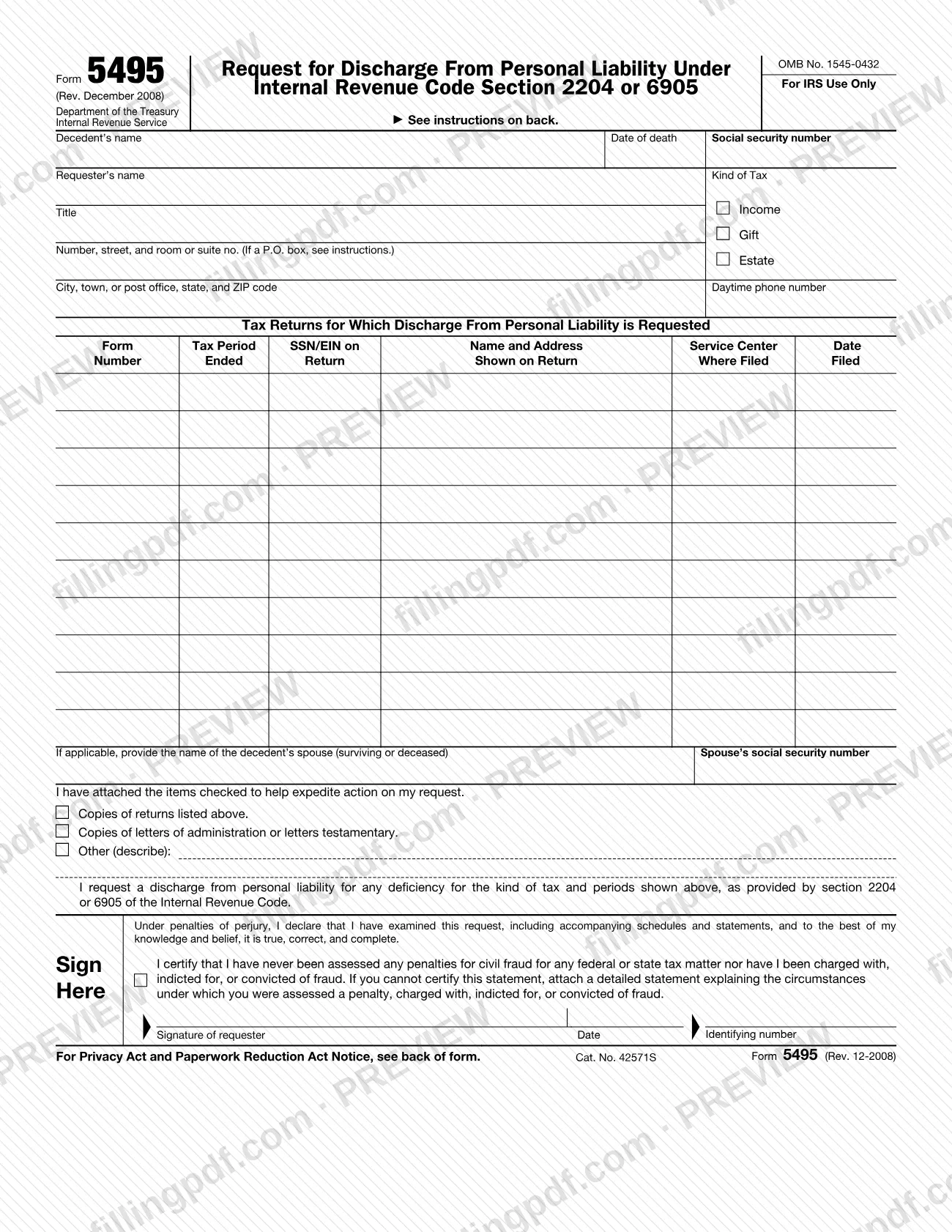
The form is issued under OMB No. 1545-0432 and is revision Rev. December 2008. It has spaces for everything the IRS needs to process the request: the decedent, the requester, the kind of tax (Income, Gift or Estate), a list of the returns involved and a signed certification. If you prefer your own format, a written request must list the same information as the form and include the applicable attachments.
For this form, an executor means the executor or administrator of a decedent who was appointed, qualified and acting within the United States.
Who needs to file Form 5495?
The main filer is the executor representing a decedent's estate. The IRS instructions also allow a fiduciary of a decedent's trust to request a discharge from personal liability for the decedent's income, gift and estate taxes. A fiduciary asking for discharge under section 2204 checks the Other box and attaches the extra items described in the instructions.
Here, an executor means the executor or administrator of a decedent who was appointed, qualified and acting within the United States.
The form is a request, not an obligation. The IRS notice on the form says you are not required to request discharge from personal liability, but if you do, you must provide the information the form asks for. Failure to provide it may delay or prevent processing, and false information may subject you to penalties.
The signer certifies that they have never been assessed civil fraud penalties for any federal or state tax matter and have not been charged with, indicted for or convicted of fraud. A requester who cannot make that certification attaches a detailed statement explaining the circumstances.
When to file Form 5495
For income tax or gift tax, do not file Form 5495 until after you have filed the tax returns listed on the front of the form. For estate tax, you may attach the form to Form 706, United States Estate (and Generation-Skipping Transfer) Tax Return, or file it at any time during the 3-year period that follows the date Form 706 is filed.
A separate request is needed for any tax returns filed after this Form 5495, because one form covers only the returns it lists.
The discharge itself takes effect 9 months after the IRS receives the request (6 months for a fiduciary's request), or earlier if the amount the IRS determines to be owed is paid. The instructions give no other processing time.
Documents you need
- Copies of the returns listed on the form: check the matching box under "I have attached the items checked to help expedite action on my request."
- Copies of letters of administration or letters testamentary: check the matching box when you attach them.
- Copy of pages 1–3 and Schedules A through I of Form 706, only if Form 5495 is filed after Form 706; not needed when the request is submitted with the estate tax return.
- For a fiduciary requesting discharge under section 2204: check the Other box and include a copy of the trust instrument(s), a list of assets transferred from the decedent to the trust, and any other relevant information.
- A detailed statement explaining the circumstances, only if you cannot certify that you have never been assessed civil fraud penalties or been charged with, indicted for or convicted of fraud.
- Any other attachment you describe in the Other line of the checklist.
How to fill out Form 5495
Enter the decedent's details
At the top, write the decedent's name, date of death and Social Security number.
Enter the requester's details
Fill in the requester's name and title, the number, street and room or suite number, the city, town or post office, state and ZIP code, and a daytime phone number.
Select the kind of tax
Check the box for the kind of tax the request covers: Income, Gift or Estate.
List the tax returns
In the table, enter for each return the Form Number, Tax Period Ended, SSN/EIN on Return, Name and Address Shown on Return, Service Center Where Filed and Date Filed.
Add the spouse's details
If applicable, enter the name of the decedent's spouse (surviving or deceased) and the spouse's Social Security number.
Check the attached items
Check the boxes for the copies of returns and the letters of administration or letters testamentary you attach. Use Other (describe) for additional items, such as the trust documents a fiduciary must include.
Read the certifications
The form states the request for discharge under section 2204 or 6905, the penalties of perjury declaration and the fraud certification. If you cannot make the fraud certification, prepare a detailed statement to attach.
Sign and date the request
Enter the requester's signature, the date and the identifying number in the signature block.
Review and download the completed PDF
Check every entry against the returns you list, then download or print the completed PDF from FillingPDF. Assemble the attachments and mail it as described under How to submit.
How to submit Form 5495
Form 5495 is filed by mail with the IRS, or attached to Form 706 when you request estate tax discharge with that return. The instructions name no online channel.
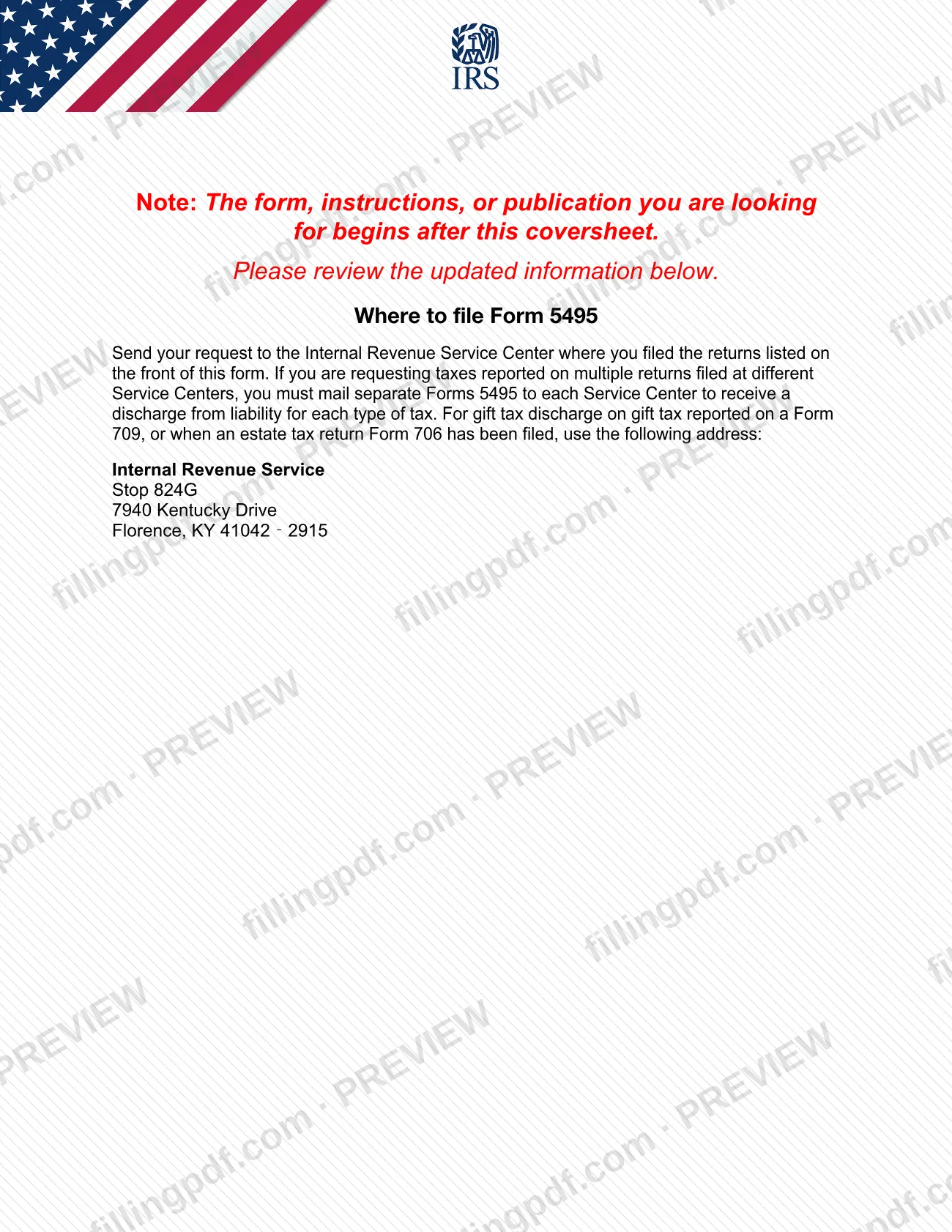
- By mail to the Service Center: send the request to the Internal Revenue Service Center where you filed the returns listed on the front of the form.
- Several Service Centers: if the taxes were reported on returns filed at different Service Centers, mail a separate Form 5495 to each Service Center to receive a discharge for each type of tax.
- Gift tax on Form 709, or an estate tax return already filed: use Internal Revenue Service, Stop 824G, 7940 Kentucky Drive, Florence, KY 41042‐2915. If an estate tax return was filed, file Form 5495 for all taxes at the address where that return was filed.
- With Form 706: attach the form to the estate tax return. You then do not have to provide an additional copy of the Form 706 pages.
Do not send the form to the Tax Products Coordinating Committee address printed in the instructions; that address is only for comments on the form. FillingPDF lets you fill out and download the PDF; submission follows the channels above.
Common mistakes to avoid
- Filing a request for income or gift tax discharge before the returns listed on the form have been filed.
- Using one Form 5495 for taxes reported on returns filed at different Service Centers; the instructions require a separate form for each Service Center.
- Mailing the request to the Tax Products Coordinating Committee address in the instructions, which is for comments on the form only.
- Filing after Form 706 without copying pages 1–3 and Schedules A through I of that return.
- Omitting the trust instrument(s) and the list of assets transferred from the decedent when a fiduciary requests discharge under section 2204.
- Signing the fraud certification when it is not true, instead of attaching a detailed statement of the circumstances.
- Assuming one request covers returns filed later; each later return needs its own request.
- Leaving the signature, date or identifying number blank in the signature block.
Frequently asked questions
What is Form 5495 used for?
Form 5495 is the IRS request for discharge from personal liability under Internal Revenue Code section 2204 or 6905. An executor or trust fiduciary files it so they are no longer personally liable for any deficiency later found in the decedent's income, gift or estate taxes.
Who can file Form 5495?
The executor representing a decedent's estate, or a fiduciary of a decedent's trust. A fiduciary requesting discharge under section 2204 checks the Other box and attaches the trust instrument(s) and a list of assets transferred from the decedent to the trust.
When should I file Form 5495?
For income or gift tax, file only after the returns listed on the form are filed. For estate tax, attach it to Form 706 or file it any time within 3 years after Form 706 is filed. Returns filed later need a separate request.
Where do I mail Form 5495?
Mail it to the IRS Service Center where you filed the returns listed on the form. For gift tax on Form 709, or when Form 706 has been filed, use Internal Revenue Service, Stop 824G, 7940 Kentucky Drive, Florence, KY 41042‐2915.
How long until I am discharged from liability?
Discharge takes effect 9 months after the IRS receives the request, or 6 months for a fiduciary's request. It can come sooner if you pay the amount the IRS determines you owe. The IRS may require a bond when the estate tax payment date was extended.
What do I attach to Form 5495?
You may attach copies of the returns listed and copies of letters of administration or letters testamentary. Filing after Form 706 also requires pages 1–3 and Schedules A through I of that return. A fiduciary adds the trust instrument(s) and an asset list.
Do I need a separate Form 5495 for each Service Center?
Yes. If the taxes were reported on returns filed at different Service Centers, mail a separate Form 5495 to each one to get a discharge for each type of tax. If an estate tax return was filed, file for all taxes where that return was filed.
Can I fill out Form 5495 online on FillingPDF?
Yes, you can fill out the PDF online on FillingPDF and download or print it. FillingPDF is an independent service and does not file the request with the IRS; you mail it or attach it to Form 706 as the instructions describe.
Ready to fill out Form 5495?
Fill out Form 5495 now