
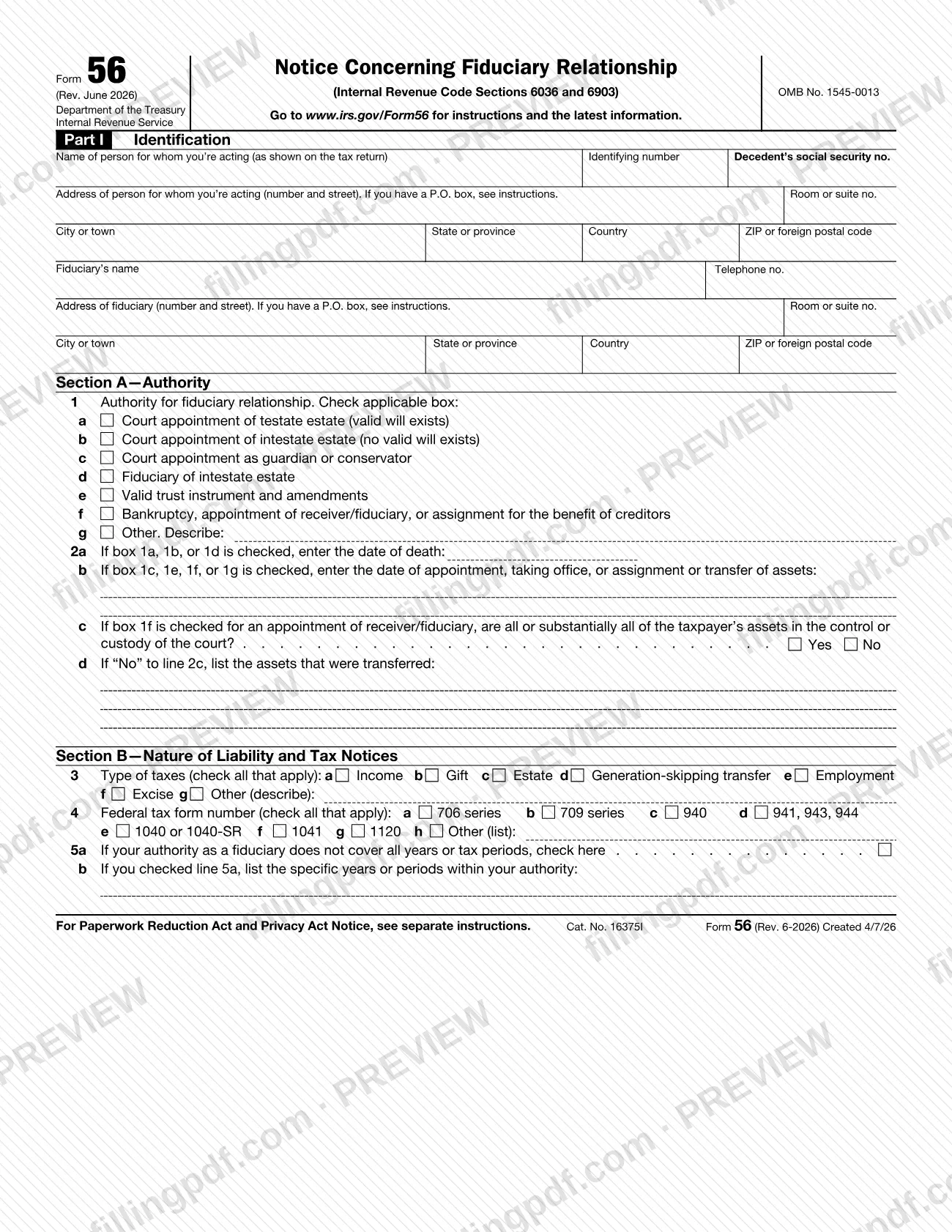
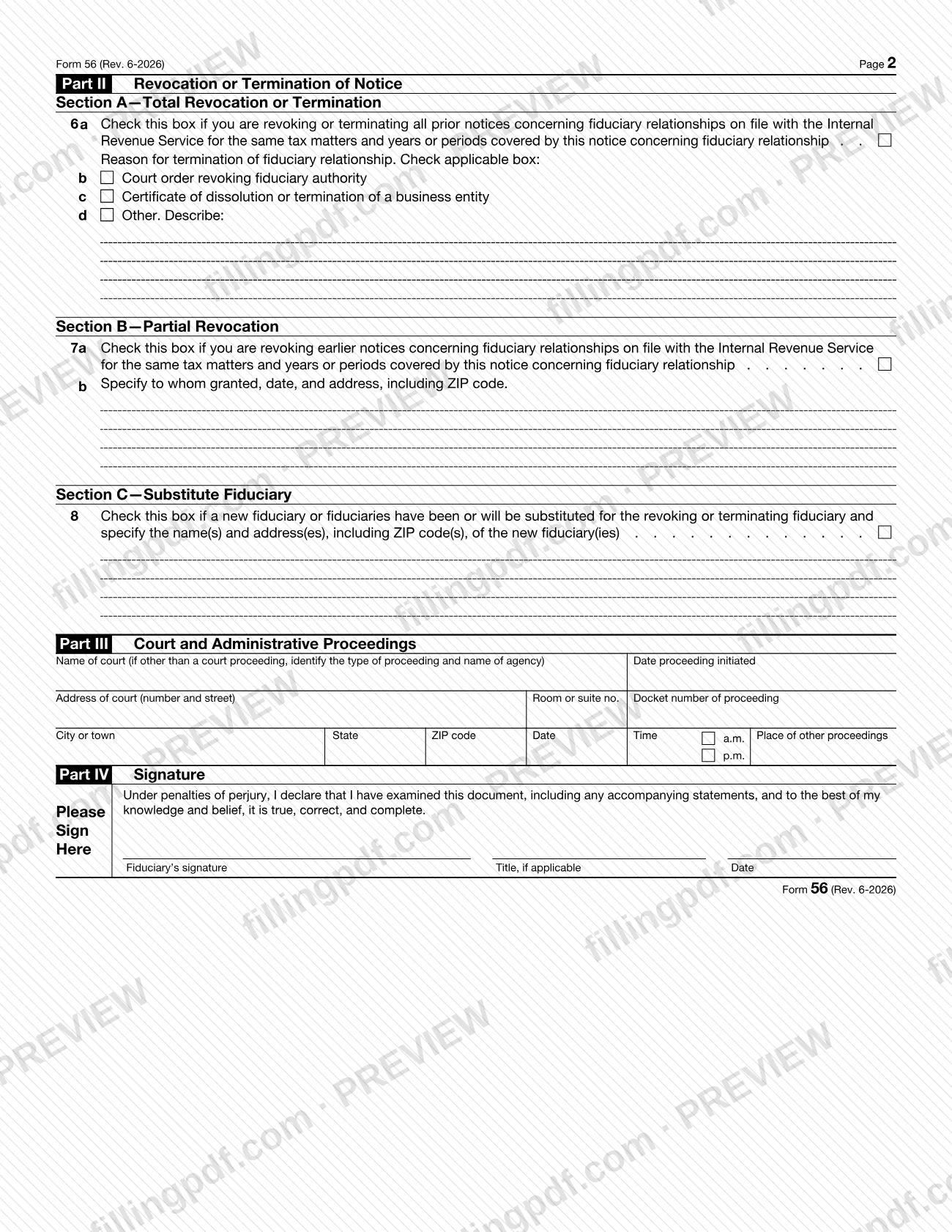
Form 56 is the Internal Revenue Service (IRS) notice that a fiduciary, such as an executor, administrator, guardian, trustee or receiver, files to tell the IRS that a fiduciary relationship has been created or has ended. It also gives notice of qualification under section 6036. You file a separate Form 56 for each person for whom you act. On this page you can fill out the form online on FillingPDF and download or print the completed PDF; the IRS publishes the form and its instructions at www.irs.gov/Form56.
Last updated
What is Form 56?
Form 56, Notice Concerning Fiduciary Relationship, is the IRS form used to notify the Internal Revenue Service of the creation or termination of a fiduciary relationship under Internal Revenue Code section 6903 and to give notice of qualification under section 6036.
The IRS treats a fiduciary as if the fiduciary were the taxpayer. Upon appointment, the fiduciary automatically has both the right and the responsibility to take every action the taxpayer must take, such as filing returns and paying taxes due. The instructions define a fiduciary as any person in a position of confidence acting on behalf of another person; examples include administrators, conservators, executors, guardians, receivers, trustees of a trust, personal representatives and debtors-in-possession.
The form has four parts: Part I, Identification (with Section A, Authority, and Section B, Nature of Liability and Tax Notices); Part II, Revocation or Termination of Notice; Part III, Court and Administrative Proceedings; and Part IV, Signature. It is printed under OMB No. 1545-0013.
Form 56 is not Form 2848, Power of Attorney and Declaration of Representative, which is the form for notifying the IRS that you are the taxpayer's authorized representative. An authorized representative is the taxpayer's agent and can do only what Form 2848 authorizes. Form 56 also cannot update a last known address (use Form 8822, Change of Address, or Form 8822-B, Change of Address or Responsible Party—Business) and cannot be used to request copies of notices and correspondence.
Who needs to file Form 56?
A fiduciary who wants to act for a taxpayer before the IRS, or who needs to tell the IRS that the fiduciary capacity has ended, files Form 56. The instructions name these situations on line 1:
- executors of a testate estate and court-appointed administrators of an intestate estate;
- guardians, custodians and conservators appointed by a court;
- a fiduciary of an intestate estate with no court-appointed administrator, who is the sole person charged with the decedent's property;
- trustees named under a valid trust instrument;
- receivers, other court-appointed fiduciaries and assignees for the benefit of creditors;
- other fiduciaries whose authority is described on line 1g.
Receivers and assignees for the benefit of creditors also file to give notice of qualification under section 6036. A bankruptcy trustee, debtor-in-possession or similar fiduciary in a bankruptcy proceeding is not required to give notice under section 6036; those fiduciaries are subject to the notice requirements of title 11 of the United States Code.
Do not use Form 56 to name an authorized representative; use Form 2848. If there is more than one fiduciary, each must file a separate Form 56 or otherwise give notice of status to the IRS. A terminating entity can establish a fiduciary relationship only while it still exists.
When to file Form 56
Generally, you file Form 56 when you create or terminate a fiduciary relationship. A fiduciary appointed or authorized to act as a receiver in a receivership proceeding, or a similar fiduciary (including a fiduciary in aid of foreclosure), or an assignee for the benefit of creditors, must file on or within 10 days of the date of appointment.
For a terminating entity, such as a corporation, partnership or trust, the instructions say to establish the fiduciary relationship before the entity terminates, because that lets the fiduciary represent the entity on all tax matters afterward.
Part II is completed only when you are revoking or terminating a prior notice of a fiduciary relationship. The instructions give no other deadline for Form 56.
Documents you need
- Current letters testamentary or a court certificate proving your court appointment, attached when you check box 1a (testate estate).
- Current letters testamentary or a court certificate proving your court appointment, attached when you check box 1b (intestate estate with court appointment).
- A brief description of the assets that were assigned, attached by an assignee for the benefit of creditors completing Part III.
- An explanation of the action to be taken on the assigned assets, including any hearings, meetings of creditors, sale or other scheduled action, attached by an assignee for the benefit of creditors.
- A separate schedule of the proceedings, attached when proceedings in Part III are scheduled for more than one date, time or place.
- Evidence that substantiates your authority to act as a fiduciary; you must be prepared to furnish it to the IRS.
How to fill out Form 56
Identify the person you act for
In Part I, enter the name of the person for whom you are acting as shown on the tax return, the address, and the identifying number. For an individual use the SSN or ITIN; for any other person use the EIN; for a decedent also enter the decedent's SSN.
Enter the fiduciary's details
Enter the fiduciary's name, telephone number and address. Use a P.O. box only if the postal service does not deliver to the street address, and do not abbreviate the country on a foreign address.
Check the authority on line 1
In Section A, check the box on line 1 (1a through 1g) that matches your appointment. For box 1g, describe the authority in the space provided.
Complete the dates on lines 2a and 2b
Line 2a (date of death) is for boxes 1a, 1b or 1d. Line 2b (date of appointment, taking office, or assignment or transfer of assets) is for boxes 1c, 1e, 1f or 1g.
Answer lines 2c and 2d if a receiver
Only if you checked 1f for an appointment of a receiver or fiduciary, answer on line 2c whether all or substantially all of the taxpayer's assets are in the court's control or custody. If No, list the transferred assets on line 2d.
Mark the taxes and forms
In Section B, check every type of tax on line 3 and every federal tax form number on line 4 that you will handle as fiduciary. Use the Other lines to describe or list anything not shown.
Limit the years if needed
If your authority does not cover all years or tax periods, check line 5a and list the specific years or periods on line 5b.
Complete Part II only to revoke
Use Part II only if you are revoking or terminating a prior notice. Check line 6a for total revocation and a reason (6b to 6d), line 7a with the details on 7b for a partial revocation, or line 8 with the names and addresses of substitute fiduciaries.
Fill in Part III for proceedings
Complete Part III only if a court or other governmental unit appointed you receiver, trustee or fiduciary in a proceeding other than bankruptcy. Enter the court or agency, date initiated, docket number, address, and date, time and place of other proceedings.
Sign under penalties of perjury
In Part IV, sign and date, and enter a title that describes your role, such as executor, trustee, guardian, receiver or personal representative.
Review and download the completed PDF
Check that each line that applies is complete and that required attachments are ready. Download or print the completed PDF from FillingPDF and send it as described under How to submit.
How to submit Form 56
Form 56 is mailed to an IRS address chosen by the type of fiduciary appointment. The instructions list no online filing channel.
- Most fiduciaries: file with the Internal Revenue Service Center where the person for whom you are acting is required to file tax returns. For example, if that person must file Form 1040, find the mailing address in the Instructions for Form 1040.
- Receivers, similar fiduciaries and assignees for the benefit of creditors: file with the insolvency function at Internal Revenue Service, Insolvency, MS 5027 DAL, Dallas, TX 75242. The receiver or assignee may also file a separate Form 56 with the service center where the person for whom the fiduciary acts files returns, to give the notice required by section 6903.
Attach the proof of authority the instructions call for (see the required documents). Do not send Form 56 to the Tax Forms and Publications address used for comments on the instructions. The instructions say you must be prepared to furnish evidence of your authority to act as a fiduciary. FillingPDF lets you fill out and download the PDF; submission follows the channels above.
Common mistakes to avoid
- Using Form 56 to appoint an authorized representative; the instructions say to use Form 2848, Power of Attorney and Declaration of Representative, instead.
- Using Form 56 to change the last known address of the person you act for; Form 8822 or Form 8822-B must be used.
- Filing one Form 56 for both a decedent and the estate; file one naming the decedent and another naming the estate as the person for whom you are acting.
- Checking box 1d when a court has appointed an administrator or representative; it is only for a sole person charged with the decedent's property and no court appointment.
- Leaving out letters testamentary or a court certificate when you check box 1a or 1b.
- Filling in line 2a for boxes 1c, 1e, 1f or 1g, or line 2b for boxes 1a, 1b or 1d; line 2a is the date of death and line 2b the date of appointment or transfer.
- Abbreviating the country name on a foreign address.
- Sending Form 56 to the Tax Forms and Publications address in the instructions instead of an IRS filing address.
- Filing a receiver or assignee Form 56 later than 10 days after the date of appointment.
Frequently asked questions
What is Form 56 used for?
Form 56 notifies the IRS that a fiduciary relationship has been created or has ended under section 6903, and gives notice of qualification under section 6036. Executors, administrators, guardians, trustees, receivers and similar fiduciaries use it to start acting for a taxpayer before the IRS.
Is Form 56 the same as a power of attorney?
No. A fiduciary steps into the taxpayer's position, while an authorized representative is only the taxpayer's agent. To name a representative, use Form 2848, Power of Attorney and Declaration of Representative; the instructions say not to use Form 56 for that.
Where do I mail Form 56?
Mail it to the IRS Service Center where the person you act for files returns; for a Form 1040 filer, see the Form 1040 instructions. Receivers and assignees for the benefit of creditors file with Internal Revenue Service, Insolvency, MS 5027 DAL, Dallas, TX 75242.
Do I need one Form 56 for a decedent and another for the estate?
Yes, in that case. Instructions say to file a separate Form 56 for each person you act for. An executor filing the decedent's final Form 1040 files one naming the decedent and one naming the estate.
What do I attach to Form 56 as an executor or administrator?
Attach current letters testamentary or a court certificate proving your court appointment when you check box 1a or 1b. Be ready to furnish further evidence of your authority if the IRS asks for it.
What is the deadline for a receiver to file Form 56?
A receiver, similar fiduciary or assignee for the benefit of creditors must file on or within 10 days of the date of appointment. Other fiduciaries generally file when they create or terminate the fiduciary relationship.
How long does it take to complete Form 56?
The IRS estimates averages of 9 minutes for recordkeeping, 38 minutes learning about the law or the form, 55 minutes preparing the form and 19 minutes copying, assembling and sending it. Actual time varies with your circumstances.
Can I fill out Form 56 online?
You can fill out the fillable PDF online on FillingPDF and download or print it. FillingPDF is an independent service and does not send the form to the IRS; you submit it through the IRS mailing addresses described under How to submit.
Ready to fill out Form 56?
Fill out Form 56 now