
Form 5695, Residential Energy Credits, is the Internal Revenue Service (IRS) form for figuring the residential clean energy credit and the energy efficient home improvement credit, and for carrying an unused clean energy credit forward. You attach it to Form 1040, 1040-SR, or 1040-NR. On this page you can fill out the 2025 form online on FillingPDF and download or print the completed PDF; the IRS publishes the form and its instructions at www.irs.gov/Form5695.
Last updated
What is 5695?
Form 5695, Residential Energy Credits, is the Internal Revenue Service (IRS) form that taxpayers attach to Form 1040, 1040-SR, or 1040-NR to figure and take the residential clean energy credit and the energy efficient home improvement credit for 2025.
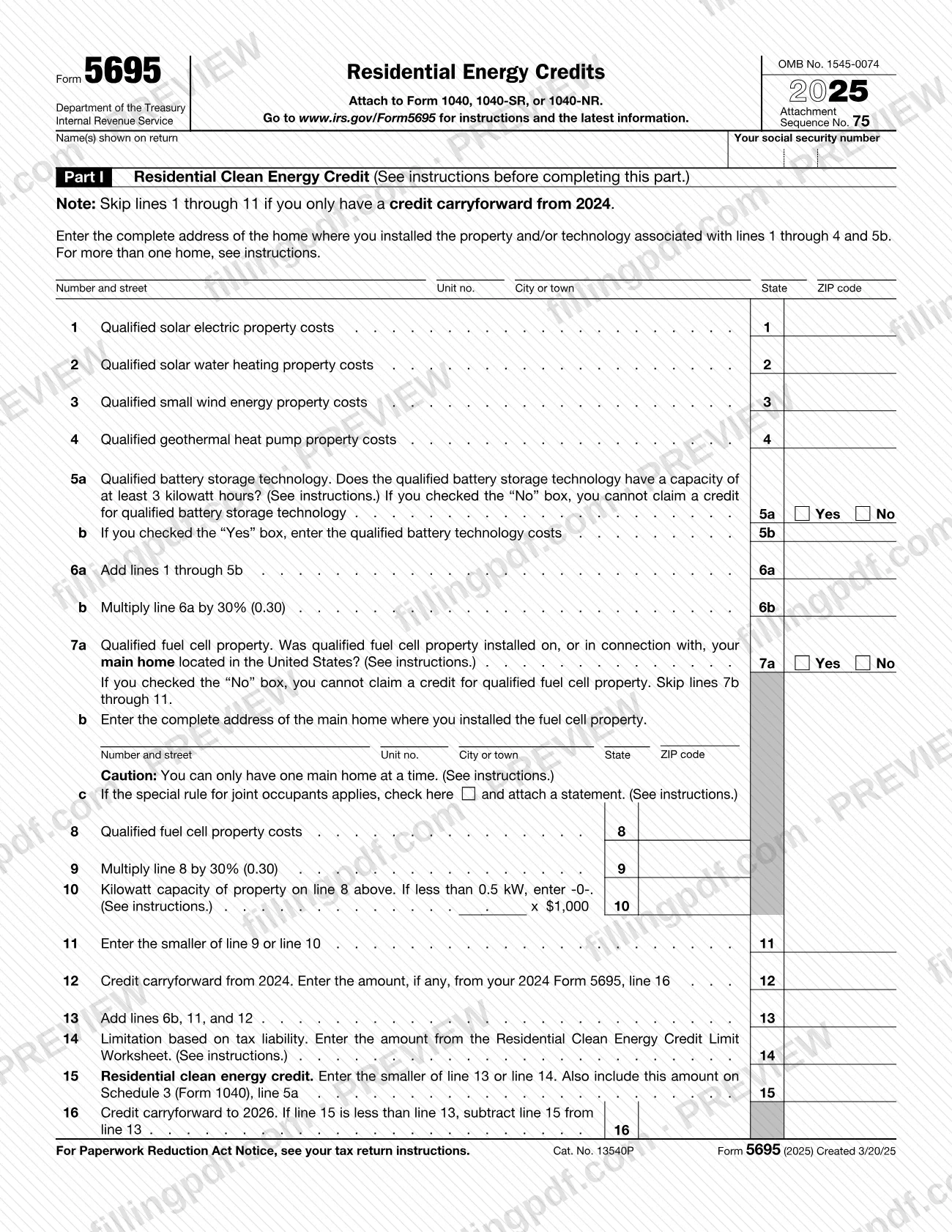
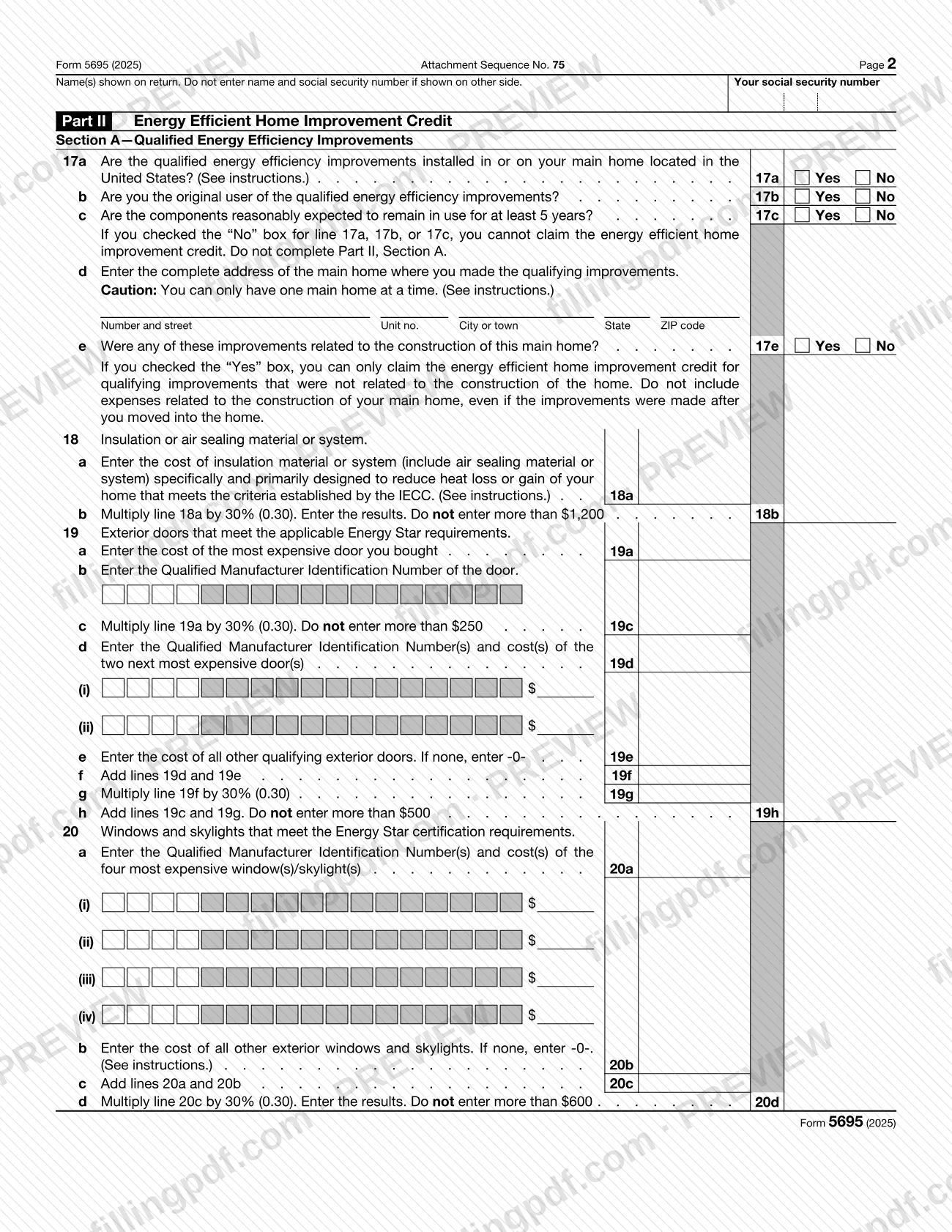
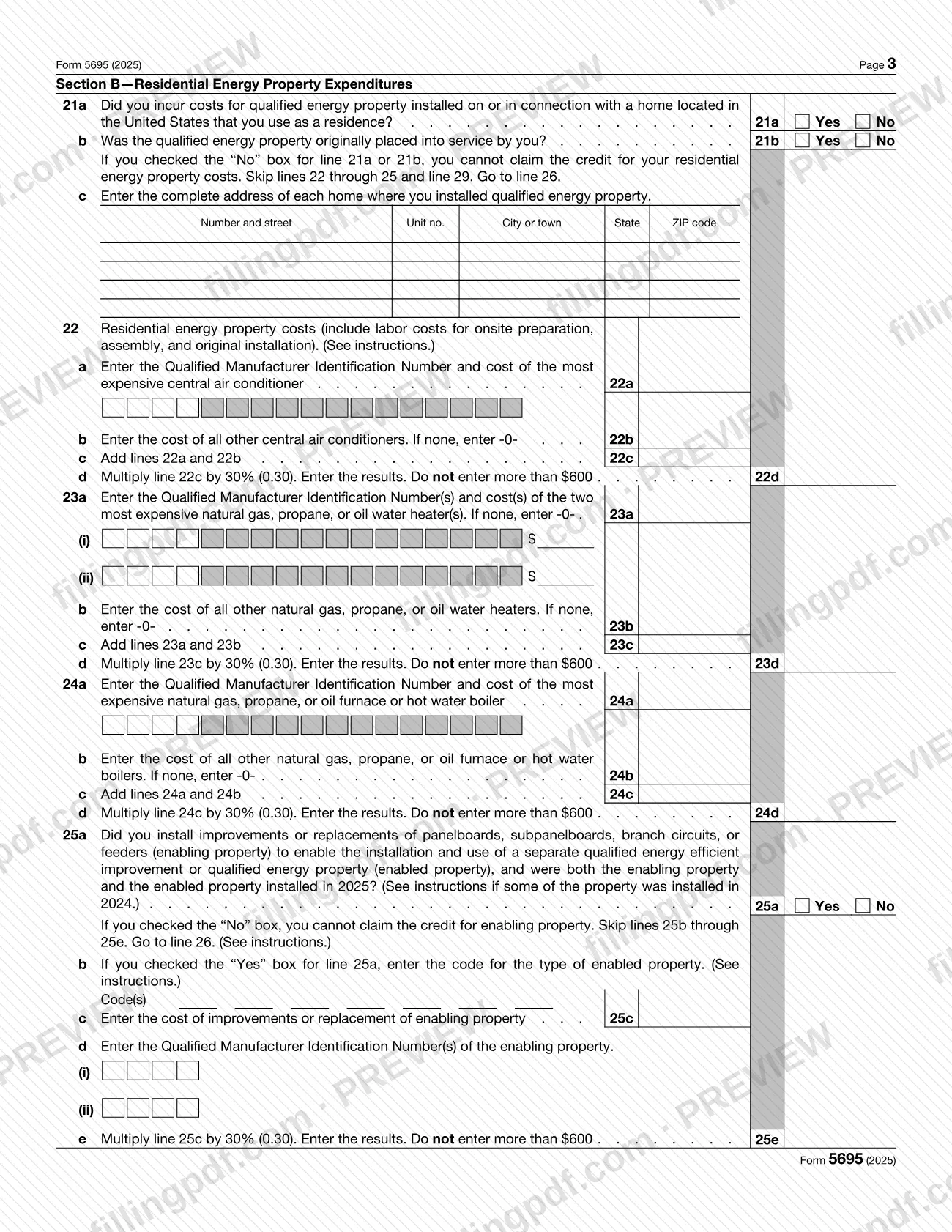
The form has two parts. Part I, Residential Clean Energy Credit, covers the costs of qualified solar electric, solar water heating, small wind energy, geothermal heat pump, battery storage and fuel cell property, and it also handles a credit carryforward from 2024. Part II, Energy Efficient Home Improvement Credit, is split into Section A (qualified energy efficiency improvements such as insulation and air sealing, exterior doors, and windows and skylights) and Section B (residential energy property expenditures such as central air conditioners, water heaters, furnaces and boilers, heat pumps, biomass stoves, panelboard work and home energy audits).
The result of Part I (line 15) goes to Schedule 3 (Form 1040), line 5a. The result of Part II (line 32) goes to Schedule 3 (Form 1040), line 5b. Line 16 carries any unused clean energy credit to 2026.
For 2025 the IRS asks for a four-character alphanumeric qualified manufacturer identification number (QMID) for each item of specified property placed into service in 2025 when you claim the energy efficient home improvement credit. The IRS publishes separate Instructions for Form 5695 (2025); the form itself directs you to www.irs.gov/Form5695 for them.
Who needs to file 5695?
Taxpayers who made energy saving improvements in 2025 to a home located in the United States, where they lived in the home, use Form 5695 to claim the residential clean energy credit, the energy efficient home improvement credit, or both. A home can be a house, houseboat, mobile home, cooperative apartment, condominium or a qualifying manufactured home.
- Part I (clean energy): available for existing homes and homes being constructed. For solar electric, solar water heating, small wind and geothermal heat pump property, the home does not have to be your main home. Fuel cell property must be for your main home.
- Part II (home improvements): available only for existing homes. Most items must be for your main home, and you must be the original user of the improvements.
- Carryforward only: if you only have a clean energy credit carried forward from 2024, the form tells you to skip lines 1 through 11.
- Joint occupants: each occupant of a jointly occupied home completes their own Form 5695. This does not apply to married individuals filing a joint return for the fuel cell rules.
- Condominium and cooperative owners: members and tenant-stockholders are treated as having paid their share of association costs; check the box on line 32b if you hold a fractional share.
You cannot claim residential clean energy credits for expenditures made after December 31, 2025, or energy efficient home improvement credits for property placed in service after that date.
When to file 5695
Complete Form 5695 for 2025 and attach it to your 2025 Form 1040, 1040-SR, or 1040-NR; the form prints no due date of its own, so it is submitted whenever that return is. The credits cover 2025 expenditures: residential clean energy credits cannot be claimed for expenditures made after December 31, 2025, and energy efficient home improvement credits cannot be claimed for property placed in service after December 31, 2025.
The instructions say costs are treated as paid when the original installation is completed. File the form even if you cannot use any of your credit in 2025, because line 16 carries the unused part of the residential clean energy credit to 2026 when your tax liability limits it.
Enabling property and enabled property installed in consecutive tax years may be treated as installed in the later year; the instructions explain this rule for line 25a.
Documents you need
- A statement listing the additional home addresses, attached when you made Part I improvements to more than one home you used as a residence.
- A statement with the address of your spouse's main home, when you file jointly and each have a different main home with qualified fuel cell property costs.
- A statement explaining how costs were allocated among occupants, when joint occupants claim fuel cell property (check line 7c).
- A statement listing the QMID and cost of each item included on line 19e, 20b, 22b, 23b, 24b, 29b, 29d or 29f, whenever you enter an amount on that line.
- A statement explaining how the credit was allocated among occupants, when joint occupants claim the energy efficient home improvement credit (check line 32a).
- Both Forms 5695, when you file jointly and you and your spouse each have a separate main home; combine the line 30 amounts on one form.
- A manufacturer's certification is not attached: you may rely on it that a product qualifies, but you keep it for your records.
How to fill out 5695
Enter your name and Social Security number
At the top of page 1, enter the name(s) shown on your return and your social security number. On page 2, do not repeat them if they are shown on page 1.
Enter the home address and clean energy costs
In Part I, enter the complete address of the home where the property was installed, then your costs on lines 1 through 4 for solar electric, solar water heating, small wind and geothermal heat pump property. For more than one home, list the home with the greatest total cost and attach a statement with the other addresses.
Answer the battery storage question
On line 5a, check Yes or No for whether the battery storage technology has a capacity of at least 3 kilowatt hours. If Yes, enter the costs on line 5b; add lines 1 through 5b on line 6a and complete line 6b as printed.
Complete the fuel cell lines
On line 7a, say whether qualified fuel cell property was installed on your main home in the United States. If Yes, enter the main home address on line 7b, check line 7c for the joint-occupants rule, and complete lines 8 through 11. If No, skip lines 7b through 11.
Figure the clean energy credit and carryforward
Enter any 2024 carryforward from your 2024 Form 5695, line 16, on line 12 and add lines 6b, 11 and 12 on line 13. Complete the Residential Clean Energy Credit Limit Worksheet for line 14, enter the smaller of lines 13 and 14 on line 15, and figure any carryforward to 2026 on line 16.
Answer the Part II eligibility questions
On lines 17a, 17b and 17c, check Yes or No for main home in the United States, original user and 5-year expected use. Any No means you cannot claim the credit, so skip Section A; otherwise enter the main home address on line 17d and answer line 17e.
Report insulation, doors, windows and skylights
Enter insulation and air sealing costs on line 18a, then complete lines 19a through 19h for exterior doors and lines 20a through 20d for windows and skylights. Enter the QMID with each door, window and skylight, and stay within the limit printed on each result line.
Complete Section B property expenditures
On lines 21a and 21b, check Yes or No, and enter each home address on line 21c. Then fill in central air conditioners (line 22), water heaters (line 23), furnaces and boilers (line 24) and enabling property (line 25), with QMIDs where asked.
Add home energy audits and heat pump items
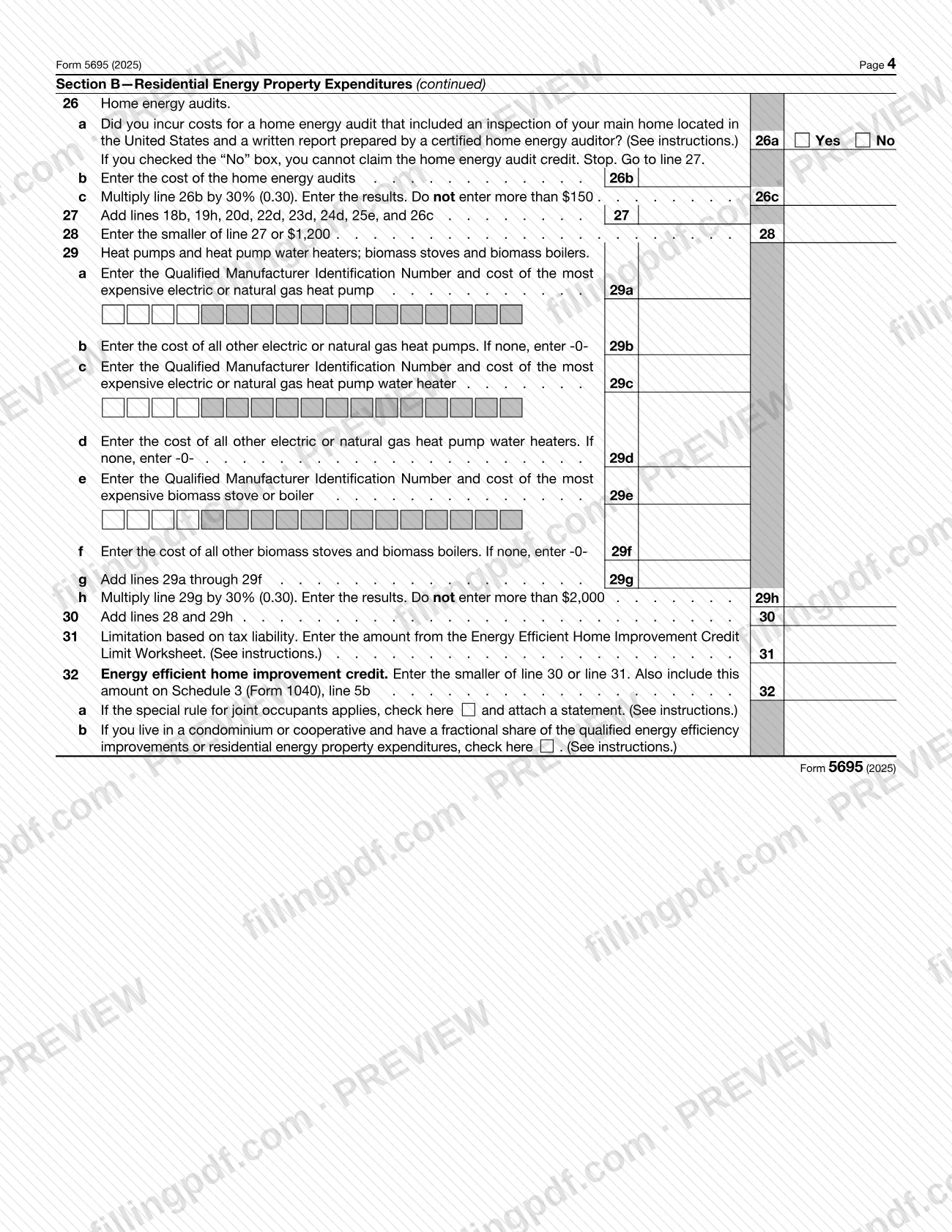
On line 26a, answer the home energy audit question and enter costs on line 26b if Yes. Add the listed lines on line 27, enter the smaller of line 27 or the amount printed on line 28, and complete lines 29a through 29h for heat pumps, heat pump water heaters and biomass stoves or boilers.
Figure the home improvement credit
Add lines 28 and 29h on line 30, complete the Energy Efficient Home Improvement Credit Limit Worksheet for line 31, and enter the smaller of lines 30 and 31 on line 32. Check line 32a for joint occupants or line 32b for a condominium or cooperative fractional share.
Review, download and attach the form
Check every Yes/No answer, QMID and total against the instructions, and gather the statements the lines call for. Download or print the completed PDF from FillingPDF and attach it to your Form 1040, 1040-SR, or 1040-NR as described under How to submit.
How to submit 5695
Form 5695 has no filing channel of its own: you attach it to your Form 1040, 1040-SR, or 1040-NR and submit it with that return by the method you use for the return. The form prints no mailing address, portal or appointment rule.
- With your return: carry the line 15 amount to Schedule 3 (Form 1040), line 5a, and the line 32 amount to Schedule 3 (Form 1040), line 5b.
- Statements to attach: the instructions require a statement in several cases, such as additional home addresses, joint-occupant allocations, and the QMID and cost of items listed on lines 19e, 20b, 22b, 23b, 24b, 29b, 29d and 29f.
- Two main homes, joint return: if you and your spouse lived apart in separate main homes, complete a separate Form 5695 for each home, combine the line 30 amounts on one form, write "More than one main home." on the dotted line to the left of line 30, and attach both forms.
- Do not attach: a manufacturer's certification. Keep it for your records.
FillingPDF lets you fill out and download the PDF; submission follows the channels above.
Common mistakes to avoid
- Claiming residential clean energy credits for expenditures made after December 31, 2025, or home improvement credits for property placed in service after that date.
- Leaving out the four-character QMID for each item of specified property placed into service in 2025, such as doors, windows, skylights and qualified energy property.
- Including onsite preparation, assembly or original installation costs on lines 18a, 19a, 19d, 19e, 20a or 20b; the instructions say not to include them there.
- Entering more than the limit printed on lines such as 18b, 19c, 19h, 20d, 22d, 23d, 24d, 25e, 26c and 29h.
- Claiming the energy efficient home improvement credit for expenses related to the construction of a new home; checking Yes on line 17e means skipping lines 18a through 20d.
- Checking Yes on line 5a for battery storage with a capacity under 3 kilowatt hours; a No answer means you cannot claim battery storage costs.
- Not reducing a cost by a public utility subsidy that was not included in your gross income before figuring the credit.
- Attaching the manufacturer's certification to the return instead of keeping it for your records.
- Skipping the form because you cannot use the credit this year; the instructions say to file it anyway so the unused part can carry to 2026.
Frequently asked questions
What is Form 5695 used for?
Form 5695 is the IRS form for figuring and taking your residential energy credits: the residential clean energy credit (Part I) and the energy efficient home improvement credit (Part II). It also takes a clean energy credit carryforward from 2024 or carries the unused part to 2026.
Can I claim these credits for 2026 expenditures?
No. According to the 2025 instructions, you cannot claim residential clean energy credits for expenditures made after December 31, 2025, and you cannot claim energy efficient home improvement credits for property placed in service after December 31, 2025.
Do I have to file Form 5695 if I can't use the credit this year?
Yes. The instructions say to file the form even if you cannot use any of your credit in 2025. If your tax liability limit leaves part of the residential clean energy credit unused, line 16 carries it to 2026.
What is a QMID on Form 5695?
A QMID is the four-character alphanumeric qualified manufacturer identification number. For 2025, you must include one for each item of specified property placed into service in 2025 when claiming the energy efficient home improvement credit, such as exterior doors, windows, skylights and qualified energy property.
Does the home have to be my main home?
It depends on the item. For solar electric, solar water heating, small wind and geothermal heat pump property, the home does not have to be your main home. Fuel cell property and the Part II energy efficient home improvement credit require your main home in the United States.
What if I share the home with someone else?
Each occupant of a jointly occupied home completes their own Form 5695 and figures the credit on the costs they paid. Check line 7c for fuel cell property or line 32a for the home improvement credit, and attach a statement explaining the allocation.
Do I attach the manufacturer's certification to Form 5695?
No. You may rely on a manufacturer's written certification that a product qualifies, but the instructions say not to attach it to your return. Keep it for your records. A valid QMID must still be reported on the applicable lines.
Where do I send Form 5695?
You do not send it separately. Form 5695 is attached to your Form 1040, 1040-SR, or 1040-NR and submitted with that return. The credit amounts then carry to Schedule 3 (Form 1040), line 5a for Part I and line 5b for Part II.
Can I fill out Form 5695 online?
Yes. You can fill out the fillable PDF online on FillingPDF and download or print it. FillingPDF is an independent service and does not file the form with the IRS; you submit it with your tax return through the IRS channels for that return.
Ready to fill out 5695?
Fill out 5695 now