
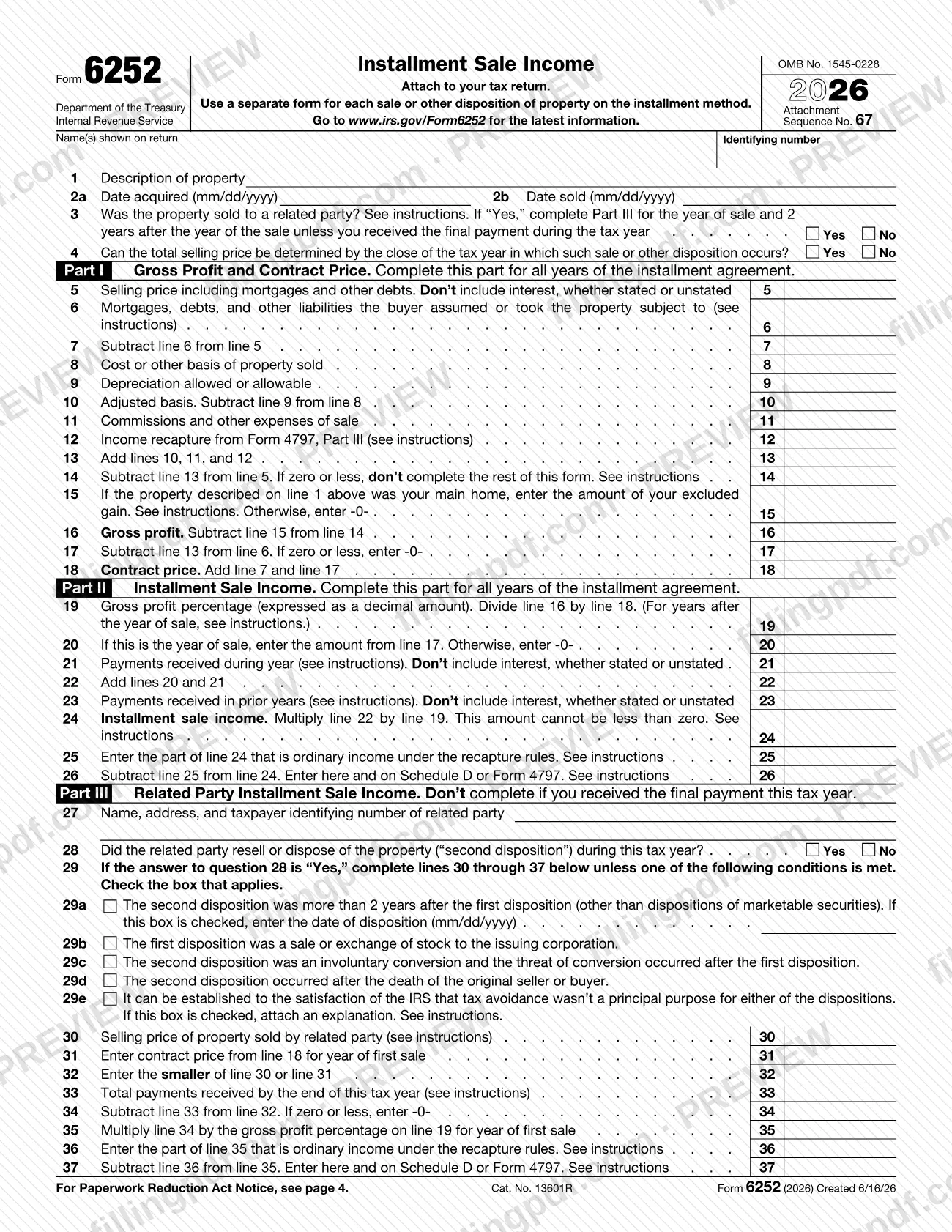
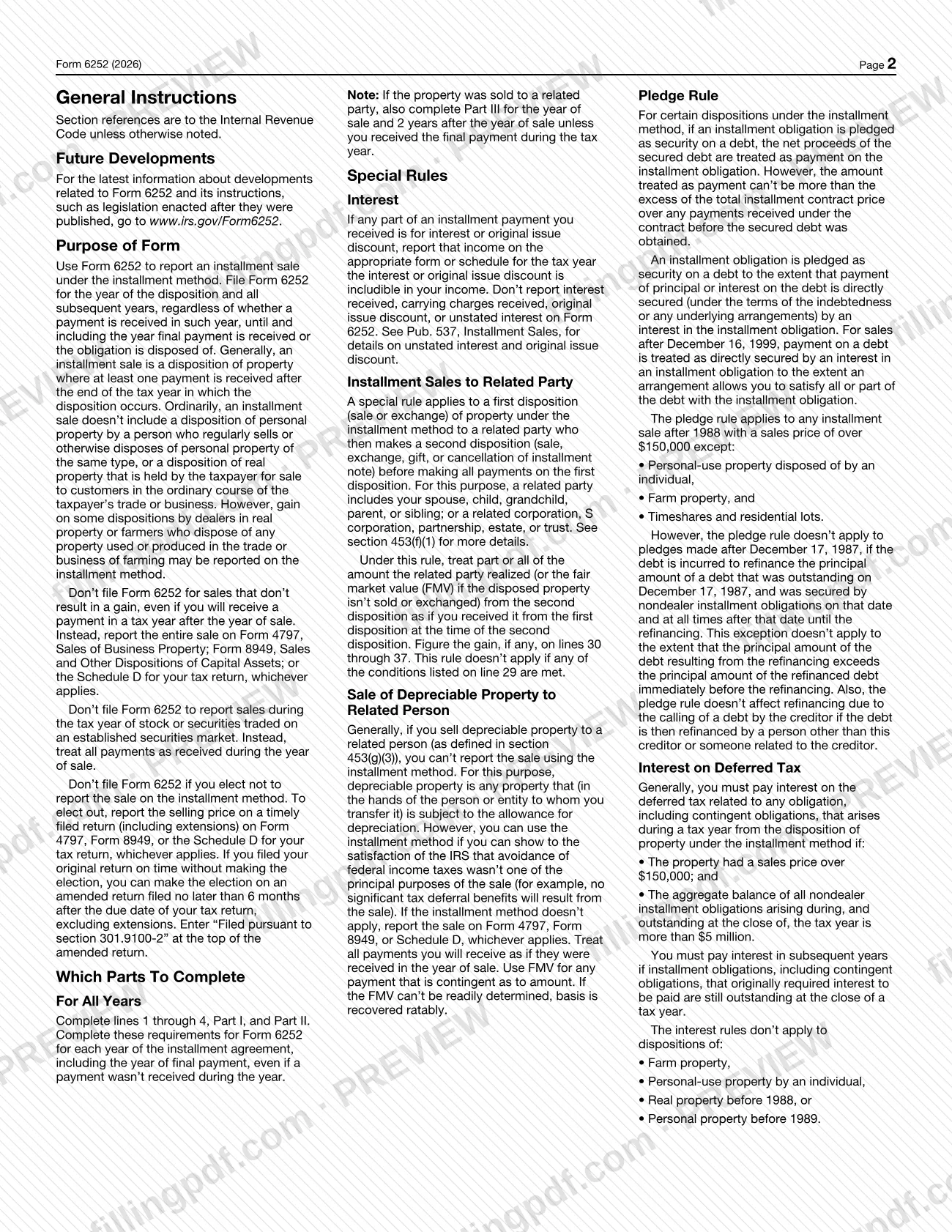
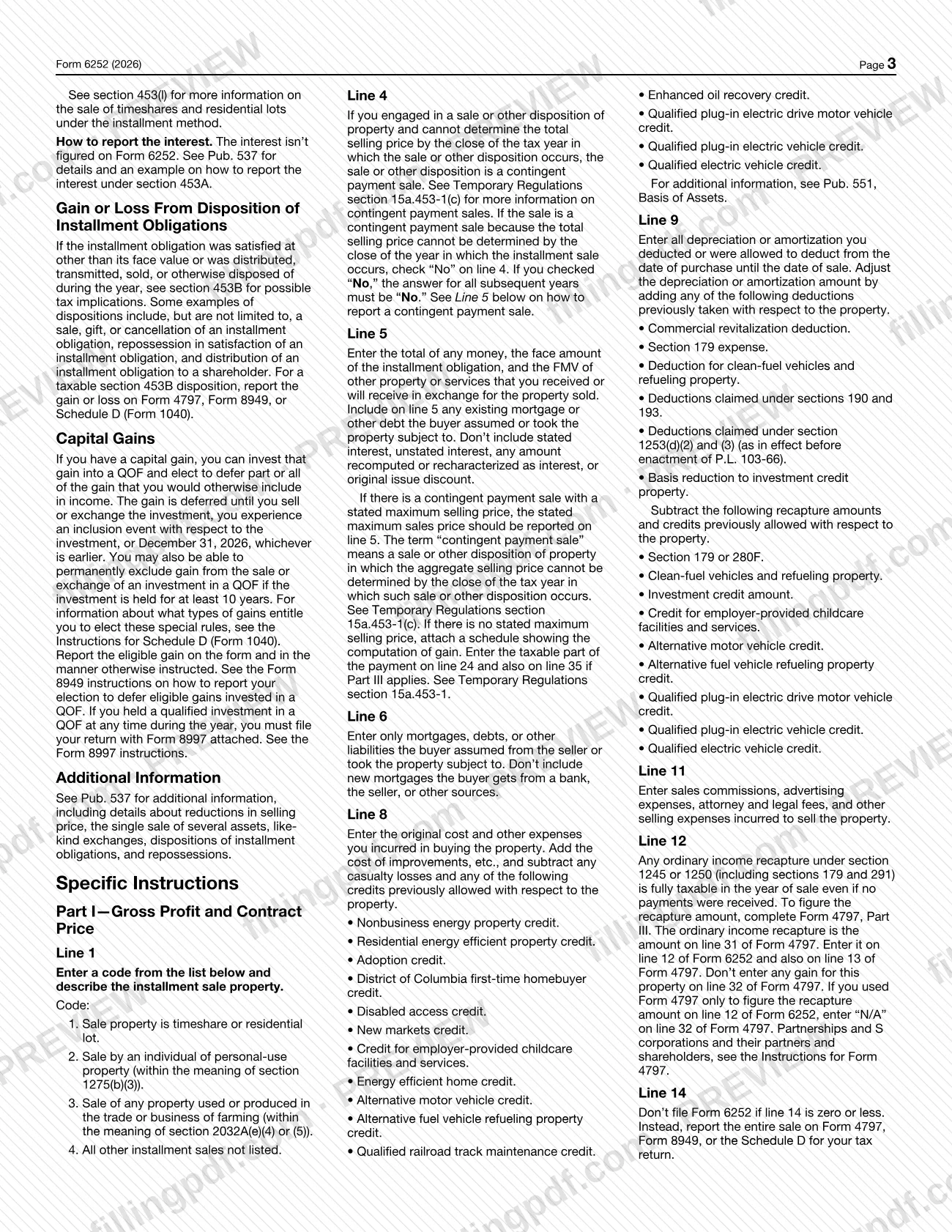
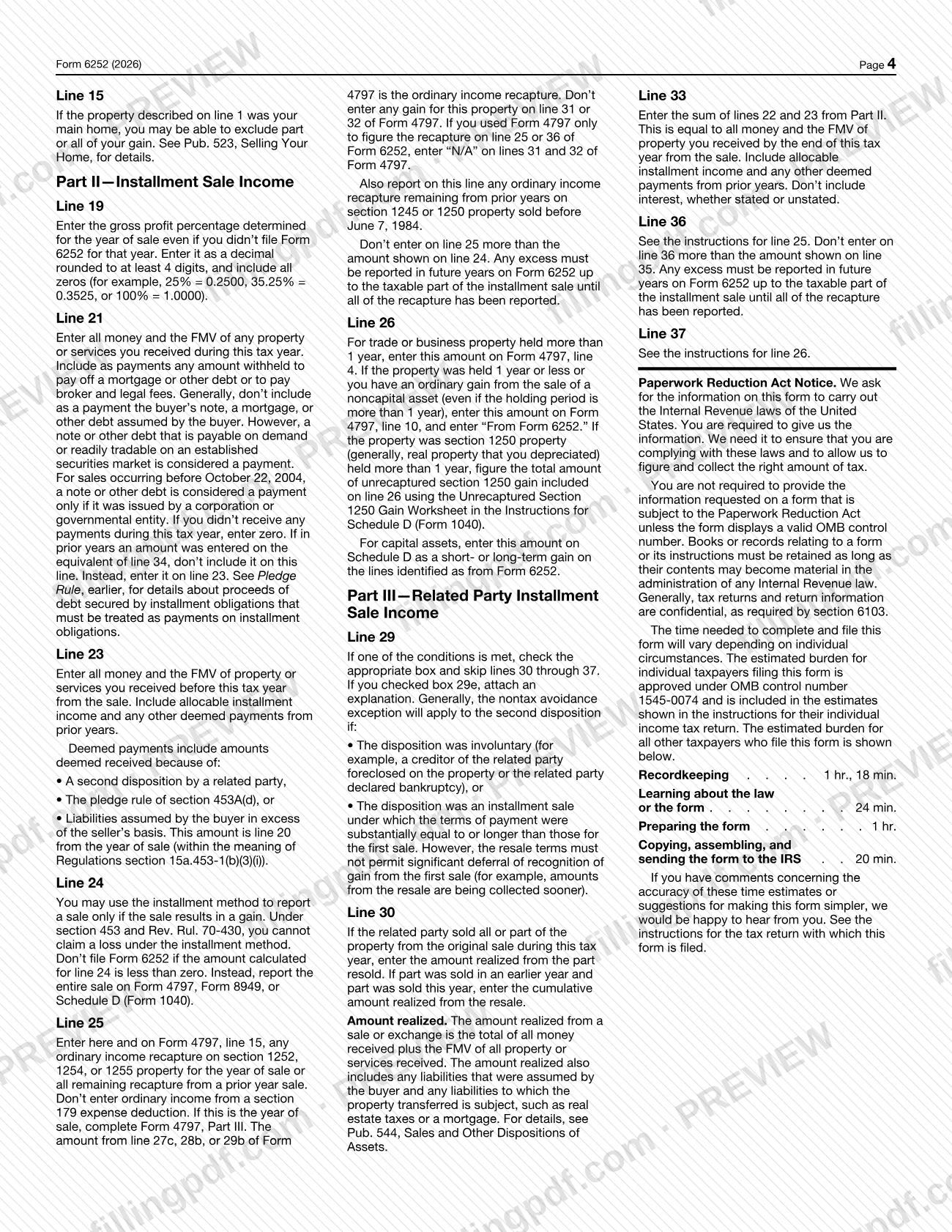
Form 6252, Installment Sale Income, is the Internal Revenue Service (IRS) form you attach to your tax return to report a sale or other disposition of property on the installment method. You use a separate form for each sale, and you file it for the year of the sale and every later year until the final payment is received. On this page you can fill out the 2025 form online on FillingPDF and download or print the completed PDF; the original form and its instructions are published by the IRS at www.irs.gov/Form6252.
Last updated
What is Form 6252?
Form 6252, Installment Sale Income, is the IRS form used to report an installment sale under the installment method. Generally, an installment sale is a disposition of property where at least one payment is received after the end of the tax year in which the disposition occurs.
The form figures how much of each year's payments is taxable. Part I computes gross profit and contract price (lines 5 through 18). Part II applies the gross profit percentage from line 19 to the payments received to arrive at installment sale income (lines 19 through 26), and line 26 is carried to Schedule D or Form 4797. Part III applies only when the property was sold to a related party who then resold or otherwise disposed of it (lines 27 through 37).
The form is attached to your tax return and carries OMB No. 1545-0228 and Attachment Sequence No. 67. The 2025 edition is the one printed on the form.
Form 6252 is not used in every situation. The instructions say not to file it for a sale that produces no gain, for sales of stock or securities traded on an established securities market, or if you elect not to use the installment method. In those cases the sale is reported on Form 4797, Sales of Business Property; Form 8949, Sales and Other Dispositions of Capital Assets; or Schedule D for your tax return, whichever applies. Interest, original issue discount and unstated interest are not reported on Form 6252; see Pub. 537, Installment Sales.
Who needs to file Form 6252?
Taxpayers who sell or otherwise dispose of property and will receive at least one payment after the end of the tax year of the sale use Form 6252 to report it under the installment method. The instructions require a separate form for each sale or other disposition. You file it for the year of the disposition and every later year, whether or not a payment arrives that year, through the year the final payment is received or the obligation is disposed of.
Related-party sales have an extra requirement. If the property was sold to a related party, you also complete Part III for the year of sale and the 2 years after, unless you received the final payment during the tax year. Related party includes your spouse, child, grandchild, parent or sibling, or a related corporation, S corporation, partnership, estate or trust.
Do not file Form 6252 if:
- the sale does not result in a gain (line 14 or line 24 is zero or less);
- you sold stock or securities traded on an established securities market during the year;
- you elect not to report the sale on the installment method;
- you sold depreciable property to a related person, unless you can show that avoiding federal income tax was not one of the principal purposes of the sale.
Dealers in personal property generally cannot use the installment method, with limited exceptions for some dealers in real property and farmers.
When to file Form 6252
File Form 6252 with your tax return for the year of the sale or other disposition, and again with each later year's return until you receive the final payment or dispose of the obligation. You complete lines 1 through 4, Part I and Part II every year, even if no payment was received that year. The form sets no due date of its own; it follows the due date of the return it is attached to.
To elect out of the installment method, report the selling price on Form 4797, Form 8949 or Schedule D on a timely filed return, including extensions. If you filed on time without making the election, you can make it on an amended return filed no later than 6 months after the due date of the return, excluding extensions, writing "Filed pursuant to section 301.9100-2" at the top.
For a related-party sale, complete Part III for the year of sale and 2 years after, unless the final payment was received during the tax year.
Documents you need
- Your tax return: Form 6252 is attached to it, and the instructions say to use a separate form for each sale or other disposition.
- Form 4797, Part III: complete it to figure the ordinary income recapture entered on line 12, and again for line 25 in the year of sale.
- A written explanation: attach it if you check box 29e, saying tax avoidance was not a principal purpose of either disposition.
- A schedule showing the computation of gain: attach it for a contingent payment sale that has no stated maximum selling price.
- Form 8997: attach it to your return if you held a qualified investment in a QOF at any time during the year.
How to fill out Form 6252
Enter your name and identifying number
At the top, enter the name(s) shown on your return and your identifying number. Use a separate form for each sale or other disposition.
Describe the property on line 1
Enter a code from the list (1 timeshare or residential lot, 2 personal-use property sold by an individual, 3 farm property, 4 all other installment sales) and describe the property.
Enter acquisition and sale dates
Line 2a: the date acquired. Line 2b: the date sold. Use mm/dd/yyyy.
Answer lines 3 and 4
Line 3: check Yes or No for a sale to a related party. Line 4: check No if the total selling price cannot be determined by the close of the sale year, which makes it a contingent payment sale; the answer stays No in later years.
Figure the selling price (lines 5-7)
Line 5: total money, installment obligation face amount and fair market value of other property, including debts assumed, without interest. Line 6: only mortgages and debts the buyer assumed or took the property subject to. Line 7: subtract line 6 from line 5.
Compute adjusted basis and expenses (lines 8-13)
Enter cost or other basis on line 8, depreciation allowed or allowable on line 9, and adjusted basis on line 10. Add selling expenses on line 11, and recapture from Form 4797, Part III on line 12. Line 13 adds lines 10, 11 and 12.
Find gross profit and contract price
Line 14: subtract line 13 from line 5; if zero or less, stop. Line 15: excluded gain if the property was your main home, otherwise -0-. Line 16: gross profit. Line 17: line 6 minus line 13, or -0-. Line 18: line 7 plus line 17.
Compute the gross profit percentage
Line 19: divide line 16 by line 18 and enter it as a decimal rounded to at least 4 digits, such as 0.2500. Use the percentage from the year of sale in later years, even if you did not file Form 6252 for that year.
Report payments received (lines 20-23)
Line 20: the line 17 amount in the year of sale, otherwise -0-. Line 21: payments received this year, without interest. Line 22: add lines 20 and 21. Line 23: payments received in prior years.
Figure installment sale income (lines 24-26)
Line 24: multiply line 22 by line 19; it cannot be less than zero. Line 25: the part that is ordinary income under the recapture rules. Line 26: line 24 minus line 25, entered on Schedule D or Form 4797.
Complete Part III for related parties
Only if line 3 is Yes and you did not receive the final payment this year: enter the related party's name, address and taxpayer identifying number (line 27), answer line 28, check any box on line 29, then complete lines 30 through 37 unless a line 29 condition applies.
Review, attach and download the PDF
Check every line against the instructions, then download or print the completed PDF from FillingPDF and attach it to your tax return as described under How to submit.
How to submit Form 6252
Form 6252 is not filed on its own: the form says to attach it to your tax return, and it prints no mailing address, portal or fee. It travels with the return it supports.
- With your return: attach the completed form, using one form for each sale, to the return you file, whether on paper or electronically. Follow the filing instructions for that return.
- Related attachments: if line 12 applies, complete Form 4797, Part III and enter the recapture on line 12. If you hold a qualified investment in a qualified opportunity fund (QOF) at any time during the year, the return must have Form 8997 attached.
- Questions: the IRS publishes the latest information at www.irs.gov/Form6252, and the instructions send comments to the instructions for the tax return the form is filed with.
FillingPDF lets you fill out and download the PDF; submission follows the channels above.
Common mistakes to avoid
- Using one Form 6252 for several sales; the form says to use a separate form for each sale or other disposition of property.
- Skipping Form 6252 in a year with no payment; lines 1 through 4, Part I and Part II must be completed for every year of the agreement.
- Filing the form when line 14 or line 24 is zero or less; the instructions say to report the entire sale on Form 4797, Form 8949 or Schedule D instead.
- Including interest, stated or unstated, on lines 5, 21 or 23; interest and original issue discount are reported elsewhere.
- Entering the gross profit percentage on line 19 with fewer than 4 digits; write it as a decimal with all zeros, such as 25% = 0.2500.
- Putting new mortgages the buyer obtained from a bank or other sources on line 6; enter only debts the buyer assumed or took the property subject to.
- Leaving Part III blank for a related-party sale, or completing it when the final payment was received this tax year.
- Checking box 29e without attaching an explanation.
- Entering more on line 25 than the amount on line 24; any excess is reported in future years.
Frequently asked questions
What is Form 6252 used for?
Form 6252 is the IRS form for reporting an installment sale under the installment method. You file it for the year of the disposition and every later year until the final payment is received or the obligation is disposed of, even in years with no payment.
Who has to file Form 6252?
Anyone who sold or disposed of property and will receive at least one payment after the end of the sale year, and who reports it on the installment method. The instructions say not to file if the sale produced no gain, if the stock was traded on an established securities market, or if you elected out.
Do I attach Form 6252 to my tax return?
Yes. The form says to attach it to your tax return, and it prints no separate address or filing channel. Use a separate form for each sale or other disposition of property.
Do I file Form 6252 if I received no payment this year?
Yes, if the installment agreement is still running. The instructions say to complete lines 1 through 4, Part I and Part II for each year of the agreement, including the year of final payment, even if no payment was received that year.
How do I elect out of the installment method?
Report the selling price on Form 4797, Form 8949 or Schedule D on a timely filed return, including extensions, and do not file Form 6252. If you filed on time without electing, you can elect on an amended return filed within 6 months after the due date, excluding extensions.
When do I complete Part III of Form 6252?
Complete Part III when line 3 is Yes, meaning the property was sold to a related party, for the year of sale and the 2 years after. Skip it if you received the final payment during the tax year. It figures gain when the related party makes a second disposition.
How do I enter the gross profit percentage on line 19?
Divide line 16 by line 18 and write the result as a decimal rounded to at least 4 digits, with all zeros: 25% is 0.2500, 35.25% is 0.3525 and 100% is 1.0000. In later years, use the percentage determined for the year of sale.
Can I fill out Form 6252 online?
You can fill out the Form 6252 PDF online on FillingPDF and download or print it. FillingPDF is an independent service and does not file anything with the IRS; you attach the completed form to your tax return.
Ready to fill out Form 6252?
Fill out Form 6252 now