
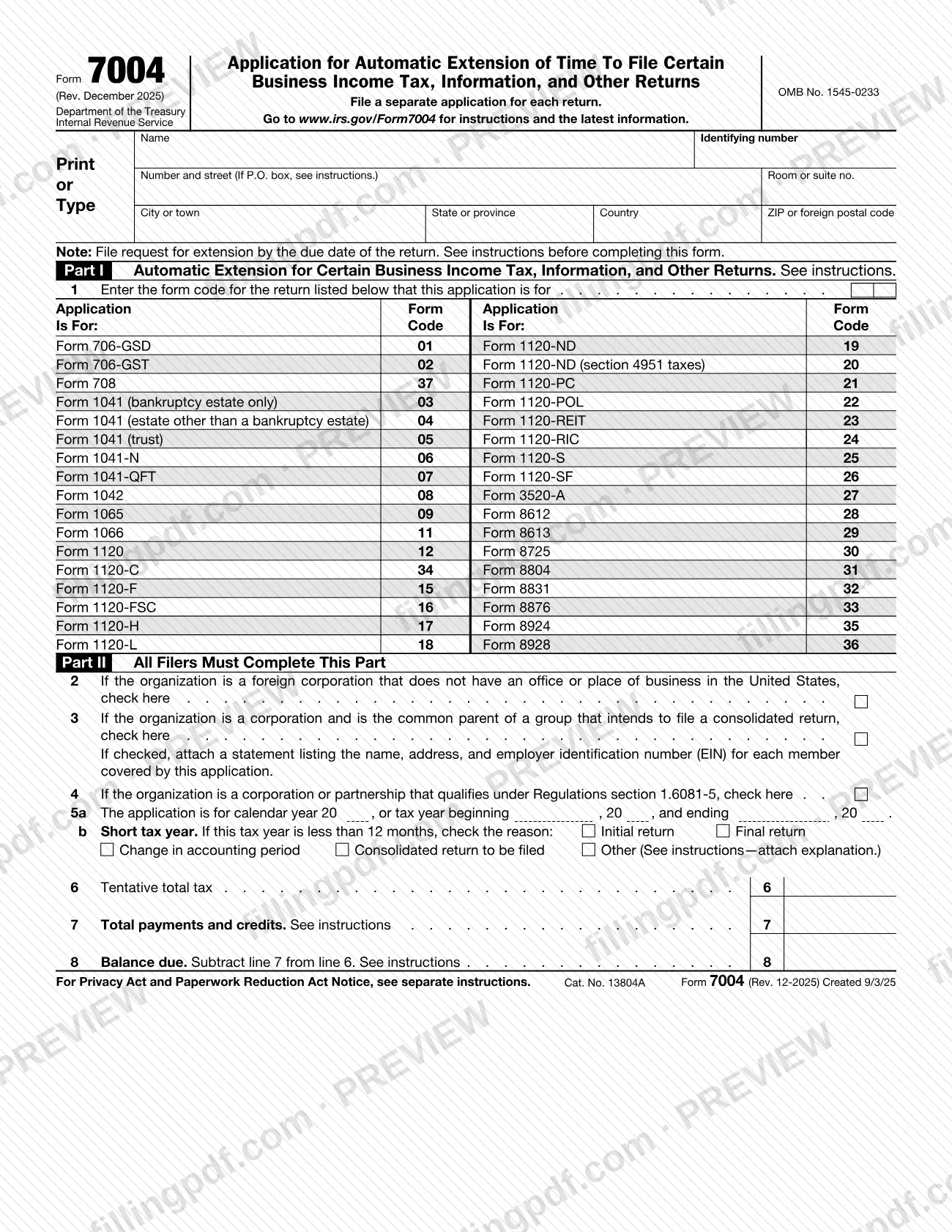
Form 7004 is the Internal Revenue Service (IRS) application for an automatic extension of time to file certain business income tax, information, and other returns, such as Forms 1120, 1120-S, 1065 and 1041. You file a separate Form 7004 for each return, and it extends only the time to file, not the time to pay. On FillingPDF you can fill out Form 7004 online and download or print the completed PDF; the IRS publishes the original form and its instructions at irs.gov.
Last updated
What is Form 7004?
Form 7004, Application for Automatic Extension of Time To File Certain Business Income Tax, Information, and Other Returns, is the IRS form an entity uses to request more time to file one of the returns listed on the form, such as a business income tax, estate, trust, partnership or information return.
The IRS instructions say the extension is granted if you complete the form properly, make a proper estimate of the tax (if applicable), file by the due date of the return, and pay any tax that is due. The automatic extension is generally 6 months. Exceptions apply to an estate (other than a bankruptcy estate) and a trust filing Form 1041, which get 5½ months, and to C corporations with tax years ending June 30, which get 7 months for tax years beginning before January 1, 2026 (6 months for Form 1120-POL).
There are no blanket requests: the extension applies only to the return identified by the two-digit form code on Part I, line 1. The codes run from 01 for Form 706-GSD to 37 for Form 708. Part II asks for the tax year, a short-year reason if any, tentative total tax, payments and credits, and the balance due.
Form 7004 is not used for Form 1041-A; the instructions send the trustee to Form 8868 instead. The form is issued under OMB No. 1545-0233, and no signature is required on it.
Who needs to file Form 7004?
Entities that need more time to file one of the returns listed in Part I, line 1 use Form 7004. The form lists returns including Forms 706-GSD, 706-GST, 708, 1041 (bankruptcy estate, other estate, or trust), 1041-N, 1041-QFT, 1042, 1065, 1066, 1120 and its variants (1120-C, 1120-F, 1120-FSC, 1120-H, 1120-L, 1120-ND, 1120-PC, 1120-POL, 1120-REIT, 1120-RIC, 1120-S, 1120-SF), 3520-A, 8612, 8613, 8725, 8804, 8831, 8876, 8924 and 8928.
Other conditions from the instructions:
- A consolidated group: only the common parent or agent can request the extension for the group's consolidated return (line 3).
- Members of a controlled or affiliated group that do not join in a consolidated return must each file a separate Form 7004.
- A member of a consolidated group that must file a separate return for a short period files its own Form 7004 for that period.
- An association electing to file Form 1120-H files using the original form type assigned to the entity.
Do not use Form 7004 for Form 1041-A; use Form 8868. Certain foreign and domestic corporations and certain partnerships covered by Regulations section 1.6081-5 do not need Form 7004 for the automatic extension to file and pay (see line 4).
When to file Form 7004
File Form 7004 on or before the due date of the return for which you are requesting the extension. The due date appears in the instructions for that return.
Exceptions: a foreign corporation with no office or place of business in the United States (line 2) must file by the 15th day of the 6th month following the close of the tax year. Entities qualifying under Regulations section 1.6081-5 (line 4) need not file Form 7004 for the first extension, but may check line 4 to request an additional extension of time to file: 3 months for partnerships and S corporations, and 4 months for C corporations and Form 1120-POL filers.
Timing of payment differs: Form 7004 does not extend the time to pay, so any balance due on line 8 is generally due by the return's original due date. The IRS may terminate the extension by mailing a notice at least 10 days before the termination date it gives.
Documents you need
- A statement listing the name, address, and EIN of each member of the group, if you check line 3 as the common parent of a consolidated group. On paper, use 8.5 x 11 white paper, 12-point font, one-sided, in two columns.
- An explanation of the short tax year, if you check Other on line 5b because none of the listed reasons applies.
- Form 1138, if a corporation expects a net operating loss carryback and reduces the amount it deposits by the resulting overpayment; file it with Form 7004.
- For a line 4 entity qualifying under Regulations section 1.6081-5: a statement attached to the entity's tax return (not to Form 7004) saying that it qualifies for the extension to file and pay.
How to fill out Form 7004
Enter name, address and identifying number
Print or type the entity's name, mailing address and identifying number (EIN or SSN) at the top. If the name changed since last year's return, enter it as it appeared on that return; use the P.O. box only if the post office does not deliver to the street address.
Enter the form code on line 1
In Part I, line 1, enter the two-digit code for the return this application is for, such as 25 for Form 1120-S or 09 for Form 1065. File a separate Form 7004 for each return.
Check line 2 if it applies
Check the box only if the organization is a foreign corporation without an office or place of business in the United States.
Check line 3 for consolidated groups
If you are the common parent of a group that intends to file a consolidated return, check the box and attach a statement listing each member's name, address and EIN.
Check line 4 if you qualify
Check the box if the corporation or partnership qualifies under Regulations section 1.6081-5 and needs an additional extension of time to file (not to pay).
Enter the tax year on line 5a
Enter the calendar year, or, if you do not use a calendar year, the beginning and ending dates of the tax year.
Mark the short tax year reason
On line 5b, check the reason only if the tax year is less than 12 months: Initial return, Final return, Change in accounting period, Consolidated return to be filed, or Other with an attached explanation.
Estimate tentative total tax on line 6
Enter the total tax, including nonrefundable credits, that the entity expects to owe for the year. Enter -0- if you expect zero.
Enter payments and credits on line 7
Enter total payments and refundable credits, including any write-in payments and credits described in the instructions for the applicable return.
Figure the balance due on line 8
Subtract line 7 from line 6. The balance is generally due by the return's due date, because the form does not extend time to pay.
Review and download the completed PDF
Check the form code, identifying number and amounts, and note that no signature is required. Download or print the completed PDF from FillingPDF and send it as described under How to submit.
How to submit Form 7004
You can file Form 7004 electronically for most returns, or on paper with the IRS service center for your return.
- Electronically: Go to IRS.gov/Efile7004. Form 7004 cannot be filed electronically for Forms 8612, 8613, 8725, 8831, 8876 or 706-GS(D). For tax year 2025, Forms 708, 8924 and 8928 must use the paper form; electronic filing of them starts in tax year 2026.
- By paper: Mail the form to the address in the Where To File table of the instructions. It depends on the return, and for some returns on the location of your principal business, office, or agency, or on total assets at the end of the tax year. For example, Forms 708, 706-GS(T) and 706-GS(D), and Forms 1041-QFT, 8725, 8831, 8876, 8924 and 8928, go to Department of the Treasury, Internal Revenue Service, Kansas City, MO 64999-0019. Forms 1042, 1120-F, 1120-FSC, 3520-A and 8804 go to Internal Revenue Service, P.O. Box 409101, Ogden, UT 84409.
No signature is required. If you file Form 7004 on paper and file your return electronically, the return may be processed before the extension is granted, which may result in a penalty notice.
Payment: EFTPS (EFTPS.gov or 800-555-4477) or the other options at IRS.gov/Pay; filers who e-file Form 7004 can pay by Electronic Funds Withdrawal using Form 8878-A.
FillingPDF lets you fill out and download the PDF; submission follows the channels above.
Common mistakes to avoid
- Filing one Form 7004 for several returns. The instructions allow no blanket requests; file a separate form for each return, with its own code on line 1.
- Filing after the due date of the return. The form must be filed by that due date for the extension to apply.
- Assuming the extension also extends time to pay. The balance due on line 8 is generally due by the return's due date, and interest still runs.
- Entering a name or identifying number that does not match IRS records. The instructions say you will not have a valid extension if the number is incorrect.
- Abbreviating the country name on a foreign address, or entering a foreign address outside the order city, province or state, and country.
- Listing the consolidated group's members only on Form 7004 without an attached list of name, address and EIN for each, which risks the group's inability to elect a consolidated return.
- Using Form 7004 for Form 1041-A. The trustee must use Form 8868 instead.
- Expecting a change of address on Form 7004 to update IRS records. Use Form 8822 or Form 8822-B for that.
- Filing Form 7004 on paper, then e-filing the return: the return may be processed before the extension is granted, which can bring a penalty notice.
Frequently asked questions
What is Form 7004 used for?
Form 7004 requests an automatic extension of time to file certain business income tax, information, and other returns, such as Forms 1120, 1120-S, 1065 and 1041. It extends the time to file only, and each application covers one return, identified by the code on line 1.
How long is the extension granted by Form 7004?
Generally 6 months. An estate (other than a bankruptcy estate) and a trust filing Form 1041 get 5½ months, and C corporations with tax years ending June 30 that begin before January 1, 2026 get 7 months (6 for Form 1120-POL).
When is Form 7004 due?
On or before the due date of the return you want to extend. Find that date in the instructions for the return. A foreign corporation with no U.S. office or place of business must file by the 15th day of the 6th month after the tax year closes.
Does Form 7004 give me more time to pay my tax?
No. The form does not extend the time to pay. Any balance due on line 8 is generally due by the return's regular due date, and interest runs on unpaid tax from that date even when an extension is granted.
Do I have to sign Form 7004?
No. The IRS instructions state that no signature is required on this form.
Can I file Form 7004 electronically?
Yes, for most returns, through IRS.gov/Efile7004. It cannot be e-filed for Forms 8612, 8613, 8725, 8831, 8876 or 706-GS(D), and Forms 708, 8924 and 8928 use the paper form for tax year 2025.
Will the IRS tell me my extension was approved?
No. The instructions say the IRS no longer sends an approval notice. It notifies you only if the request is disallowed, and it can terminate the extension by mailing a notice at least 10 days before the termination date.
Can I fill out Form 7004 online on FillingPDF?
Yes. You can fill out the fillable PDF online on FillingPDF and download or print it. FillingPDF is independent of the IRS and does not file the form; you send it through the IRS e-file option or by mail to the address in the instructions.
Ready to fill out Form 7004?
Fill out Form 7004 now