
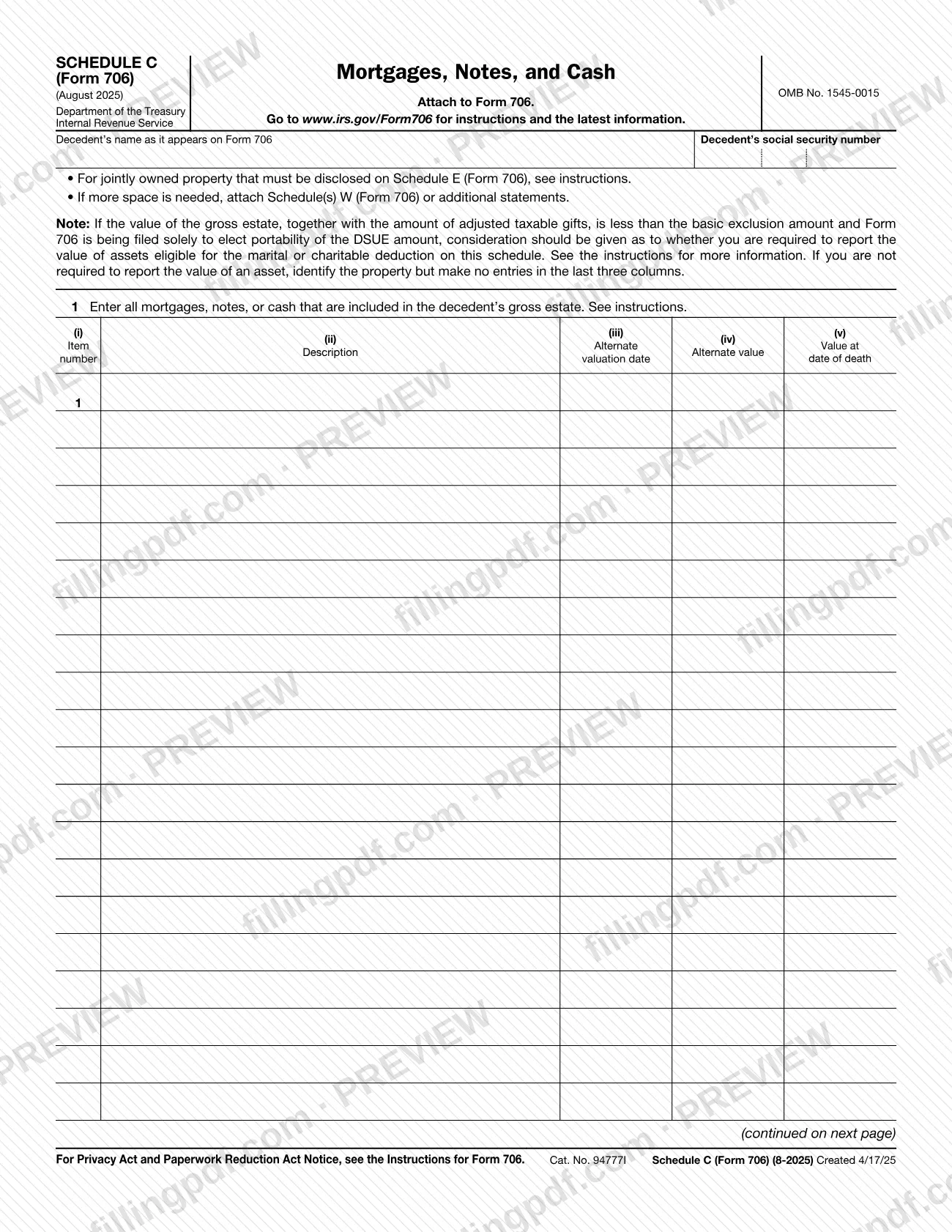
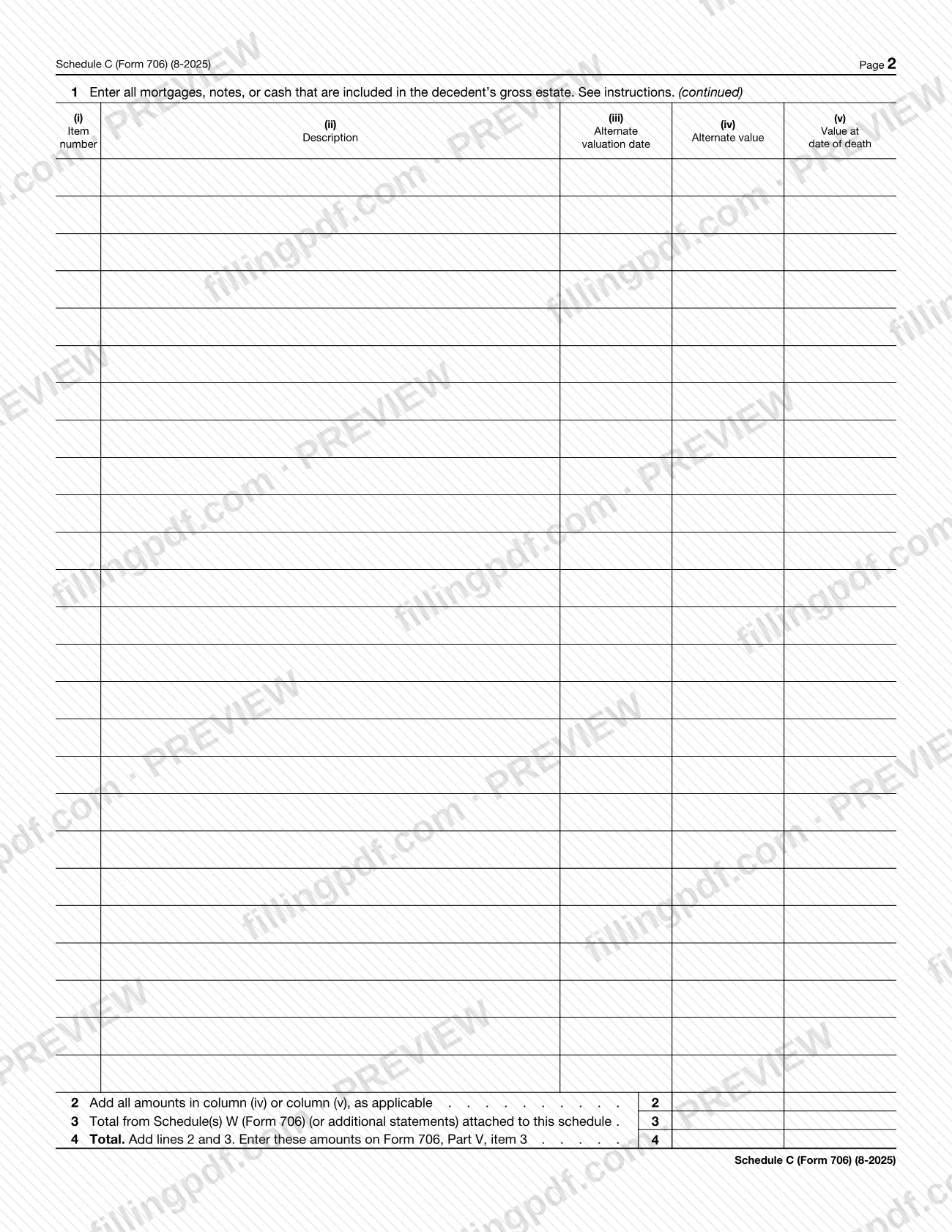
Schedule C (Form 706), Mortgages, Notes, and Cash, is an Internal Revenue Service (IRS) schedule that you attach to Form 706. It is where you enter every mortgage, note, or cash amount included in the decedent's gross estate, and it totals them for Form 706, Part V, item 3. On this page you can fill out the form online on FillingPDF and download or print the completed PDF. The form and its instructions are published by the IRS at www.irs.gov/Form706.
Last updated
What is Schedule C (Form 706)?
Schedule C (Form 706), Mortgages, Notes, and Cash, is the Internal Revenue Service (IRS) schedule, attached to Form 706, on which you list all mortgages, notes, and cash included in the decedent's gross estate and total their value.
The schedule is not filed on its own. It prints the instruction "Attach to Form 706" and asks for the decedent's name as it appears on Form 706 and the decedent's social security number. It carries OMB No. 1545-0015, and the revision printed on it is August 2025.
Line 1 is a table with one row per item. The columns are (i) Item number, (ii) Description, (iii) Alternate valuation date, (iv) Alternate value and (v) Value at date of death. Line 2 adds the amounts in column (iv) or column (v), as applicable. Line 3 picks up the total from any Schedule(s) W (Form 706) or additional statements attached to the schedule. Line 4 adds lines 2 and 3, and that total goes on Form 706, Part V, item 3.
The form also carries two notes. Jointly owned property that must be disclosed on Schedule E (Form 706) is handled according to the instructions. And when Form 706 is filed solely to elect portability of the DSUE amount, the form asks you to consider whether you must report the value of assets eligible for the marital or charitable deduction; see the instructions at www.irs.gov/Form706.
Who needs to file Schedule C (Form 706)?
The person completing Form 706 for a decedent's estate uses Schedule C (Form 706) to report the mortgages, notes, and cash that are included in the decedent's gross estate. The schedule asks for the decedent's name as it appears on Form 706 and the decedent's social security number, so it belongs with a Form 706 prepared for that decedent.
Points the form itself makes:
- Jointly owned property that must be disclosed on Schedule E (Form 706) is covered by the instructions; check them before listing such property here.
- If the value of the gross estate, together with adjusted taxable gifts, is less than the basic exclusion amount and Form 706 is being filed solely to elect portability of the DSUE amount, you must consider whether you are required to report the value of assets eligible for the marital or charitable deduction on this schedule.
- If you are not required to report the value of an asset, identify the property but make no entries in the last three columns.
The form does not say who may sign or file for the estate. For that, refer to the Instructions for Form 706.
When to file Schedule C (Form 706)
Schedule C (Form 706) is completed whenever you complete Form 706, because the form says to attach it to Form 706. It prints no separate due date, so it travels with Form 706 and follows that form's timing. Check the IRS instructions at www.irs.gov/Form706 for the deadline that applies to Form 706.
The total on line 4 is entered on Form 706, Part V, item 3, so finish this schedule before you complete that item. If you need more space, prepare any Schedule(s) W (Form 706) or additional statements at the same time, since their total is added on line 3.
Documents you need
- Schedule(s) W (Form 706) or additional statements, only if more space is needed than the table on line 1 provides; their total is entered on line 3.
- Form 706, to which this schedule is attached; the line 4 total is carried to Form 706, Part V, item 3.
How to fill out Schedule C (Form 706)
Enter the decedent's name and SSN
At the top, write the decedent's name exactly as it appears on Form 706 and the decedent's social security number.
Read the notes before listing items
Check the instructions for jointly owned property that must be disclosed on Schedule E (Form 706). If Form 706 is filed solely to elect portability of the DSUE amount, consider whether you must report assets eligible for the marital or charitable deduction.
Number each item in column (i)
On line 1, enter an item number for each mortgage, note, or cash entry included in the decedent's gross estate.
Describe each item in column (ii)
In the Description column, identify each mortgage, note, or cash item. If you are not required to report the value of an asset, identify the property and leave the last three columns blank.
Enter the values in the value columns
Enter the alternate valuation date in column (iii) and the alternate value in column (iv) if they apply, and the value at date of death in column (v).
Continue on page 2 if needed
Use the continued table on page 2 for additional items. If you still need more space, attach Schedule(s) W (Form 706) or additional statements.
Total the amounts on line 2
Add all amounts in column (iv) or column (v), as applicable, and enter the result on line 2.
Enter the Schedule W total on line 3
If you attached Schedule(s) W (Form 706) or additional statements, enter their total on line 3.
Add lines 2 and 3 on line 4
Enter the sum on line 4, then enter that amount on Form 706, Part V, item 3.
Review and download the completed PDF
Check the name, social security number and totals, then download or print the completed PDF from FillingPDF and attach it to Form 706.
How to submit Schedule C (Form 706)
Schedule C (Form 706) is submitted as an attachment to Form 706. It has no filing channel, address or portal of its own printed on it.
- With Form 706: attach the completed schedule, and any Schedule(s) W (Form 706) or additional statements, to Form 706 and send the package the way you submit Form 706.
- Instructions and updates: the form directs you to www.irs.gov/Form706 for the instructions and the latest information, including how and where Form 706 is filed.
FillingPDF lets you fill out and download the PDF; submission follows the IRS channels that apply to Form 706.
Common mistakes to avoid
- Filing the schedule on its own; the form states it is to be attached to Form 706.
- Leaving out the decedent's name as it appears on Form 706 or the decedent's social security number at the top of the form.
- Adding column (iv) and column (v) together on line 2; the form says to add the amounts in column (iv) or column (v), as applicable.
- Forgetting to enter on line 3 the total from Schedule(s) W (Form 706) or additional statements that you attached for extra space.
- Not carrying the line 4 total to Form 706, Part V, item 3.
- Listing jointly owned property that must be disclosed on Schedule E (Form 706) without checking the instructions first.
- Entering values for an asset you are not required to report when Form 706 is filed solely to elect portability of the DSUE amount; the form says to identify the property and make no entries in the last three columns.
Frequently asked questions
What is Schedule C (Form 706)?
Schedule C (Form 706), Mortgages, Notes, and Cash, is the IRS schedule attached to Form 706 on which you list all mortgages, notes, and cash included in the decedent's gross estate. Its line 4 total goes on Form 706, Part V, item 3.
Can I file Schedule C (Form 706) by itself?
No. The form says "Attach to Form 706," so it is submitted with Form 706. It has no separate address, portal or due date printed on it.
Where does the line 4 total go?
Enter the line 4 total on Form 706, Part V, item 3. Line 4 is the sum of line 2, the total of column (iv) or column (v) as applicable, and line 3, the total from any Schedule(s) W (Form 706) or additional statements.
What if I need more space on Schedule C (Form 706)?
Attach Schedule(s) W (Form 706) or additional statements, as the form says. Enter their total on line 3 so that it is included in the line 4 total.
Which column do I add on line 2?
Add all amounts in column (iv), Alternate value, or column (v), Value at date of death, as applicable. Column (iii) is the alternate valuation date and column (v) is the value at date of death.
Do I have to enter values if Form 706 is only for portability?
Not always. If Form 706 is filed solely to elect portability of the DSUE amount and the gross estate plus adjusted taxable gifts is below the basic exclusion amount, consider whether you must report assets eligible for the marital or charitable deduction. If not required, identify the property and make no entries in the last three columns.
How do I report jointly owned property on this schedule?
The form says that for jointly owned property that must be disclosed on Schedule E (Form 706), you should see the instructions. Those are published at www.irs.gov/Form706.
Can I fill out Schedule C (Form 706) online on FillingPDF?
Yes. You can fill out the PDF online on FillingPDF and download or print it. FillingPDF is an independent service and does not file the form with the IRS; you submit it with Form 706 through the IRS channels.
Ready to fill out Schedule C (Form 706)?
Fill out Schedule C (Form 706) now