
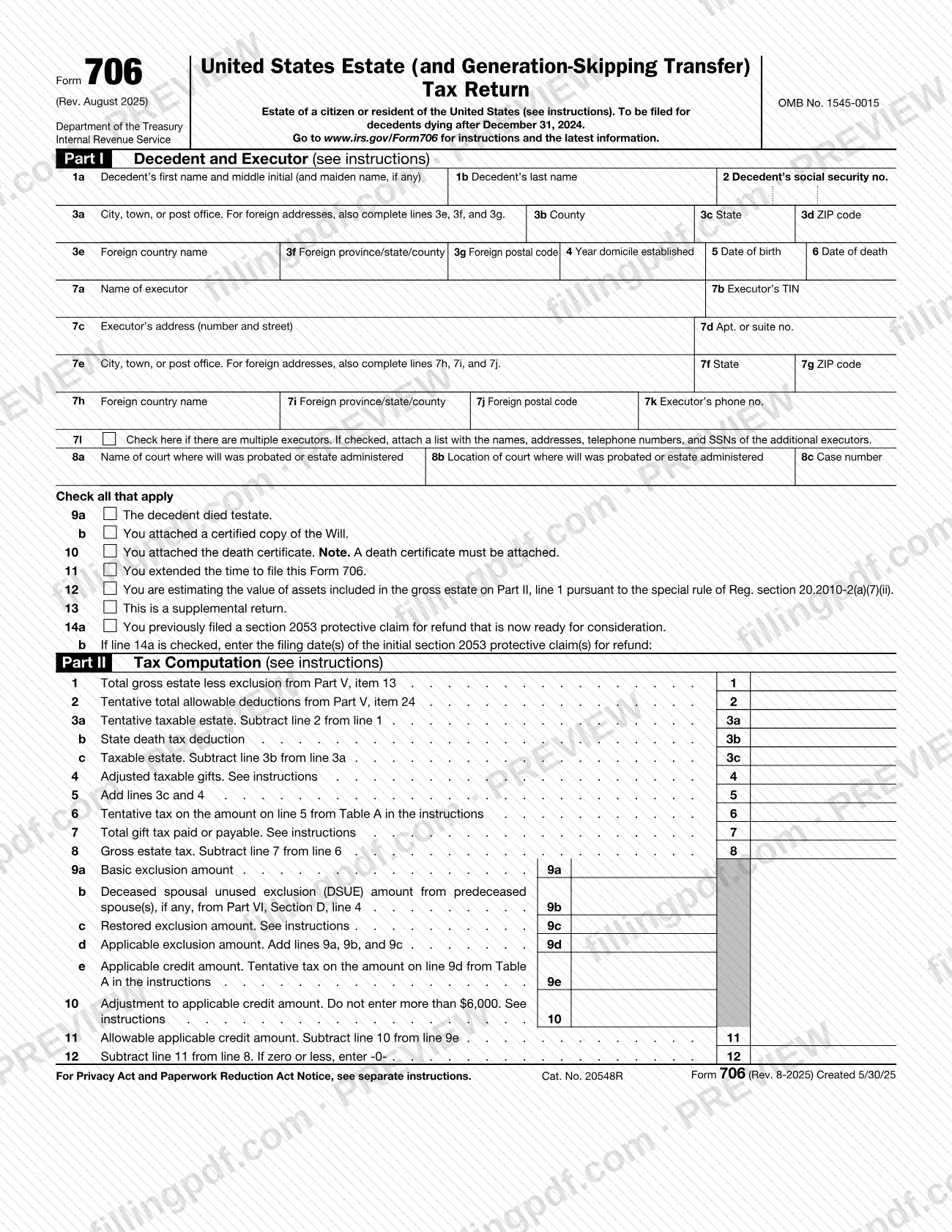
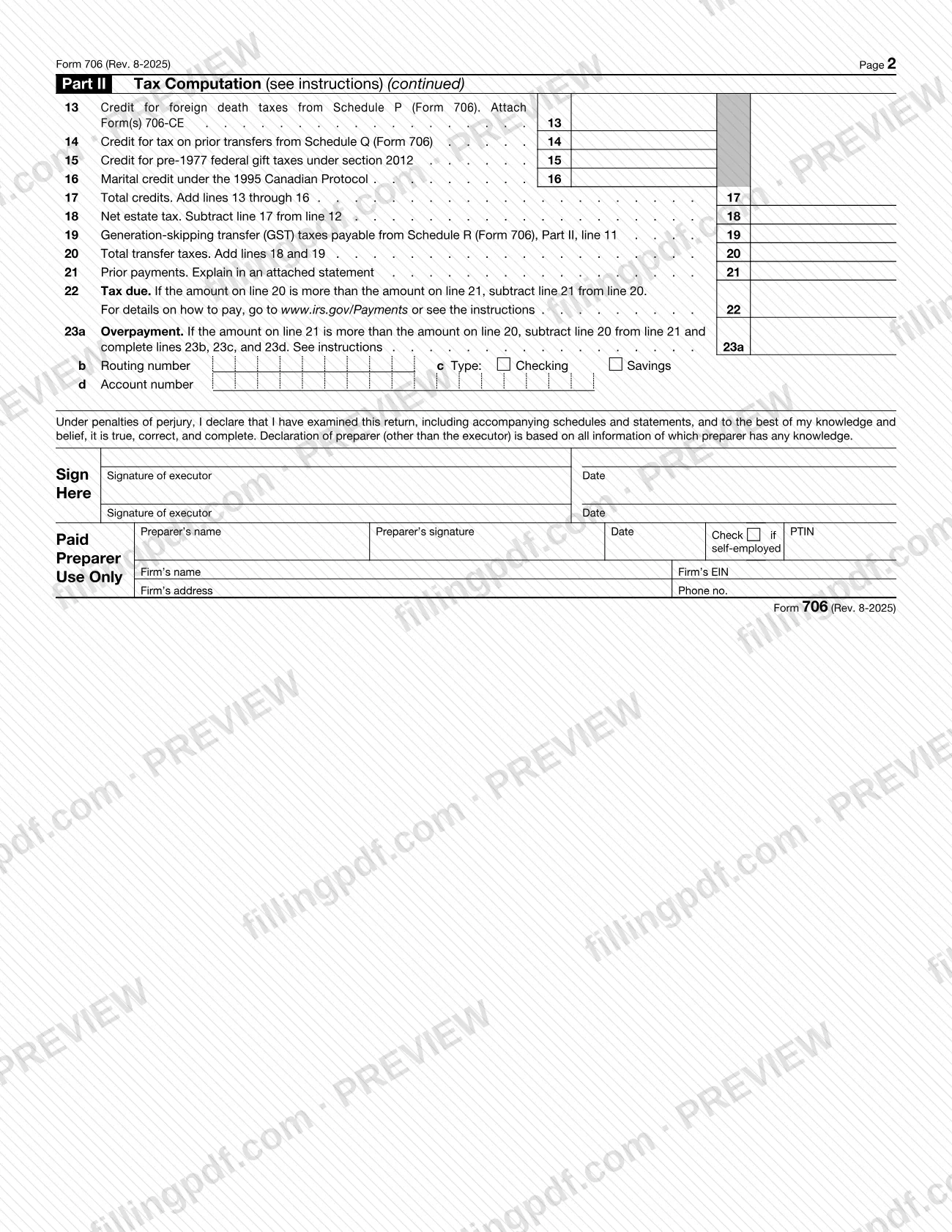
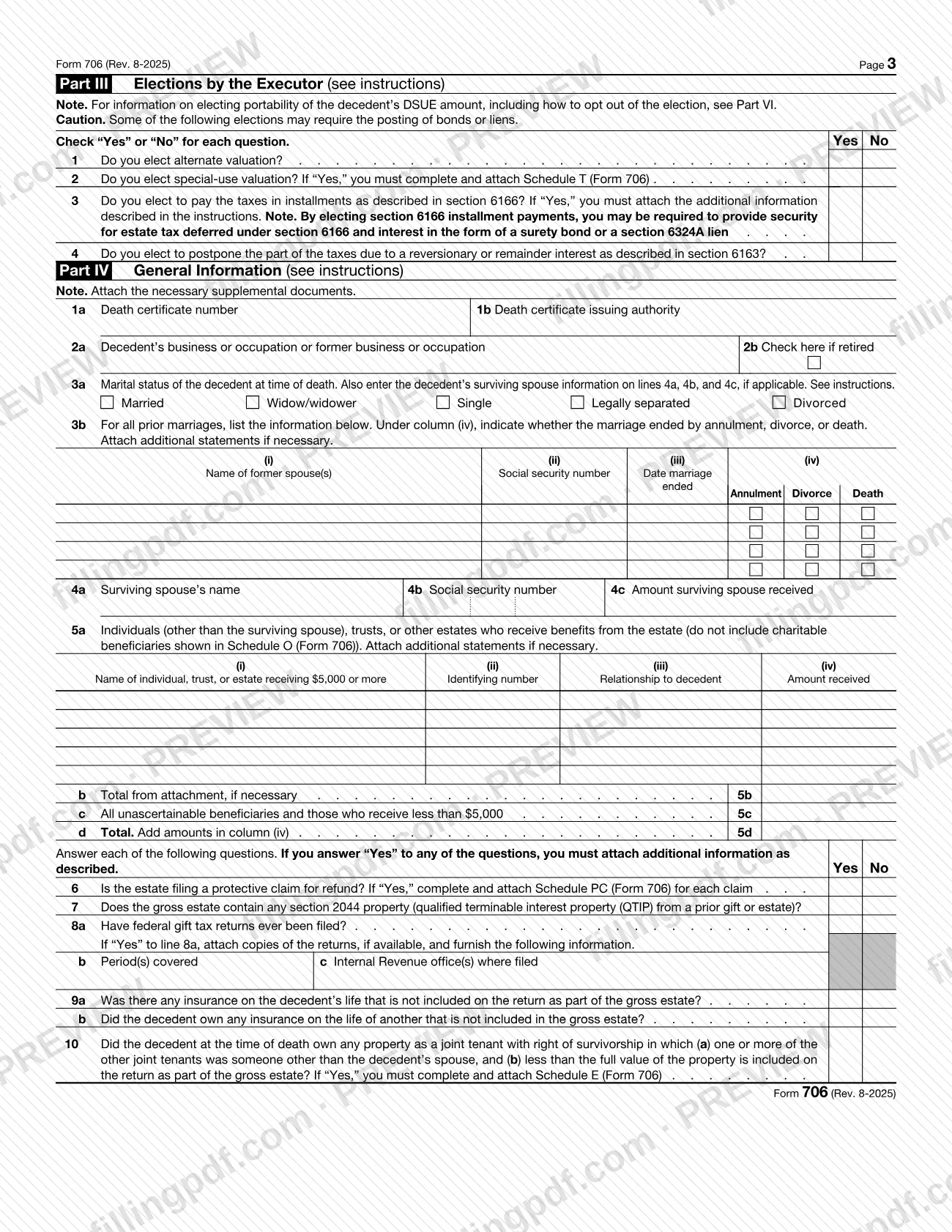
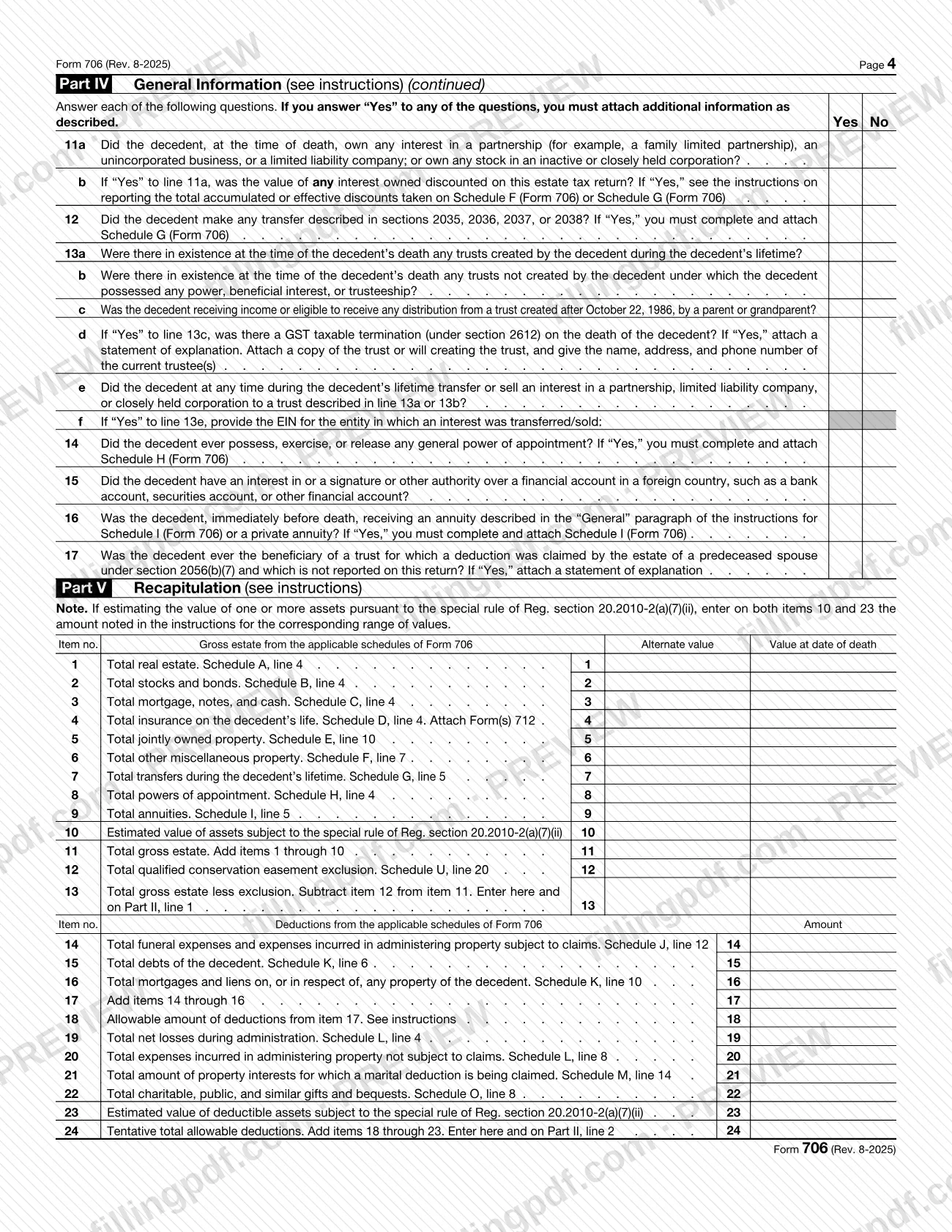
Form 706 is the Internal Revenue Service (IRS) return on which the executor of a decedent's estate figures the federal estate tax and any generation-skipping transfer (GST) tax on direct skips. It is also the return that makes the portability election, which lets a surviving spouse use the decedent's unused exclusion. On FillingPDF you can fill out Form 706 online and download or print the completed PDF; the IRS publishes the form and its instructions at www.irs.gov/Form706, and the return is filed with the IRS as described below.
Last updated
What is 706?
Form 706, United States Estate (and Generation-Skipping Transfer) Tax Return, is the IRS form the executor of a decedent's estate uses to figure the estate tax imposed by chapter 11 of the Internal Revenue Code and the generation-skipping transfer (GST) tax on direct skips.
The estate tax falls on the entire taxable estate, not on the share any one beneficiary receives. The GST tax applies to direct skips, meaning transfers to skip persons of interests in property included in the decedent's gross estate.
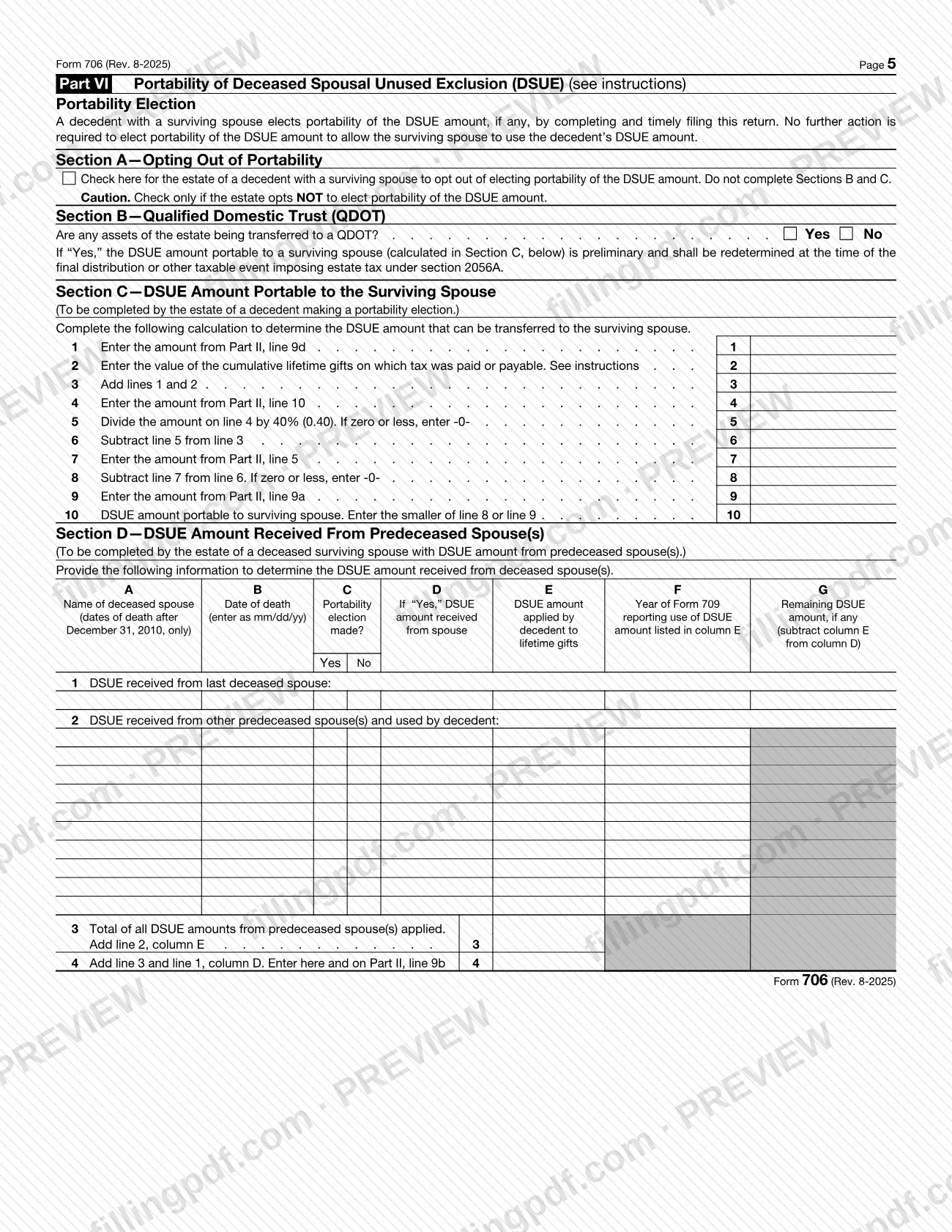
The form has six parts: Part I (decedent and executor), Part II (tax computation), Part III (elections by the executor, such as alternate valuation, special-use valuation and installment payment), Part IV (general information), Part V (recapitulation of the schedules) and Part VI (portability of the deceased spousal unused exclusion, or DSUE). Schedules A through I and the other schedules are completed and attached as needed.
The printed revision of the form (Rev. August 2025) states that it is to be filed for decedents dying after December 31, 2024. The IRS instructions in use here are a Rev. July 2026 edition for decedents dying after December 31, 2025, so check IRS.gov/Form706 for the edition that matches the date of death.
Form 706 is for estates of U.S. citizens and residents. The estate of a decedent who was neither a U.S. citizen nor a U.S. resident at death files Form 706-NA instead.
Who needs to file 706?
The executor of the estate of a U.S. citizen or resident files Form 706 in two situations, according to the IRS instructions:
- The decedent's gross estate, plus adjusted taxable gifts and the specific exemption, is more than the basic exclusion amount for the year of death.
- The executor elects to transfer the DSUE amount to the surviving spouse, whatever the size of the gross estate.
"Executor" includes an executor, personal representative or administrator. If none has been appointed, qualified and acting in the United States, every person in actual or constructive possession of the decedent's property is treated as an executor and must file. Executors must prove their status, for example with certified copies of wills or court orders; a statement by the executor is not enough.
If two or more people are liable to file, they should join in one complete return. An executor may authorize another person to act before the IRS with Form 2848 or Form 8821.
Do not use Form 706 for a decedent who was neither a U.S. citizen nor a U.S. resident at death; file Form 706-NA. Decedents who were citizens of a U.S. territory only because of their connection with it are treated as nonresidents not citizens and also file Form 706-NA.
When to file 706
File Form 706 within 9 months after the date of the decedent's death. The estate and GST taxes are due on the same date unless an extension of time to pay was granted.
If you cannot file on time, use Form 4768 to apply for an automatic 6-month extension of time to file. Form 4768 can also be used to request an extension of time to pay.
The portability election is valid only if the return is filed timely: within 9 months of death or, if an extension was received, before the 6-month extension ends. An executor with no filing requirement under section 6018(a) who missed that date may file on or before the fifth anniversary of the decedent's death under Rev. Proc. 2022-32, stating at the top of the form "Filed Pursuant to Rev. Proc. 2022-32 to Elect Portability under section 2010(c)(5)(A)."
Late filing and late payment can bring penalties under section 6651 unless there is reasonable cause. Do not attach a reasonable-cause explanation to the return; send it if the IRS later sends a penalty notice.
Documents you need
- Death certificate: it must be attached to the return; check the box on line 10.
- Certified copy of the will, if a U.S. citizen or resident decedent died testate; if you cannot get one, attach a copy and an explanation of why it is not certified (lines 9a and 9b).
- Proof of the executor's status, such as certified copies of wills or court orders designating the executor; a statement by the executor is not sufficient.
- Schedule F (Form 706), always; answer its questions even if you report no assets on it. Attach Schedules A through E, G, H and I as the instructions require for each item.
- Form 712, Life Insurance Statement, with Schedule D, for each policy on Part IV line 9 answered "Yes" or for insurance reported in Part V item 4.
- Copies of the decedent's gift tax returns (Form 709), marked "Exhibit to Estate Tax Return", to support lines 4, 7 and 15; also submit a copy of the Line 7 Worksheet.
- Form(s) 706-CE with Schedule P, to claim the credit for foreign death taxes on line 13.
- Trust instrument for each trust if you answer "Yes" to Part IV line 13a or 13b.
- Schedule T (Form 706) and its statements, if you answer "Yes" to special-use valuation on Part III line 2.
- Statement of the additional executors' names, addresses, phone numbers and SSNs, if line 7l is checked.
- Statement explaining any difference between the tax paid with the return and the balance due, and any prior payments (line 21).
- For a supplemental return: a statement of what changed with supporting information, and a copy of the original Form 706.
- Form 2848 or Form 8821, only if the executor authorizes another person to act or receive information.
How to fill out 706
Enter the decedent's identity
In Part I, enter the decedent's name on lines 1a and 1b, the decedent's own SSN on line 2, and the domicile at death on lines 3a through 3g. Add the year the domicile was established on line 4, the date of birth on line 5 and the date of death on line 6.
Enter the executor's details
On lines 7a through 7k, enter the executor's name, TIN, address and phone number. If there are several executors, name the one the IRS should contact, check line 7l and attach a list of the others.
Add court information and check boxes
Lines 8a through 8c ask for the court where the will was probated or the estate administered, its location and the case number. Check lines 9a and 9b (testate, certified will attached), 10 (death certificate attached), and 11 through 14 as they apply, including line 13 for a supplemental return.
Complete the schedules and Part V first
Part II line 1 comes from Part V item 13 and line 2 from item 24, so complete the schedules and the Part V recapitulation before the tax computation. Enter the totals from each schedule on its Part V item, with zero for any item among 1 through 9 that does not apply.
Figure the gross estate tax
In Part II, enter lines 1 through 3c, including any state death tax deduction on line 3b, then adjusted taxable gifts on line 4. Add lines 3c and 4 on line 5, apply Table A on line 6, subtract gift tax on line 7 and enter the gross estate tax on line 8.
Enter the applicable credit
Use line 9a for the basic exclusion amount, 9b for DSUE from Part VI Section D line 4, and 9c for any restored exclusion amount. Add them on 9d, enter the credit on 9e, adjust on line 10 if applicable, and subtract to get lines 11 and 12.
Finish Part II credits and balance
Enter credits on lines 13 through 16 and total them on line 17, then figure net estate tax on line 18. Add GST tax from Schedule R on line 19, enter prior payments on line 21, and show tax due on line 22 or an overpayment on line 23a with direct deposit details in 23b through 23d.
Answer the executor's elections
In Part III, check Yes or No for alternate valuation (line 1), special-use valuation (line 2, requires Schedule T), section 6166 installment payments (line 3) and section 6163 postponement (line 4). Attach the statements each Yes answer requires.
Complete the general information
In Part IV, enter the death certificate number and issuing authority, occupation, marital status and any prior marriages (lines 1 through 3). Complete line 4 even if there is no surviving spouse, entering "None" on line 4a, and list beneficiaries on line 5.
Answer the Yes/No questions
Answer Part IV lines 6 through 17, covering protective claims, section 2044 property, prior gift tax returns, insurance, jointly held property, partnership interests, trusts, powers of appointment, foreign accounts and annuities. Attach the schedule or statement each Yes answer requires.
Handle portability in Part VI
To elect portability, complete Section C to figure the DSUE amount portable to the surviving spouse; to opt out, check the box in Section A and skip Sections B and C. Answer the QDOT question in Section B, and complete Section D if the decedent received DSUE from predeceased spouses.
Sign, review and download the PDF
The executor signs and dates the declaration under penalties of perjury; one co-executor's signature is sufficient, and a paid preparer completes the preparer block. Check that every field is filled, then download or print the completed PDF from FillingPDF and assemble the attachments.
How to submit 706
You file Form 706 with the IRS by mail, using the regular address or, for a private delivery service (PDS), the street address below.
- Original return, by mail: Department of the Treasury, Internal Revenue Service, Kansas City, MO 64999.
- Original return, by PDS: Internal Revenue Submission Processing Center, 333 W. Pershing Road, Kansas City, MO 64108.
- Supplemental Form 706 (line 13 checked), by mail or PDS: Internal Revenue Service Center, Attn: E&G, Stop 824G, 7940 Kentucky Drive, Florence, KY 41042-2915. If the return was already selected for examination, send the additional information to the office conducting the examination.
Put all required pages together in the proper order and attach the death certificate and required schedules; returns filed without entries in each field will not be processed.
To pay any tax due, the IRS recommends paying electronically: EFTPS, same-day wire from your financial institution, or cash at participating retail stores. By check, make it payable to "United States Treasury" and write the decedent's name, SSN (or TIN) and "Form 706" on it. Payments must be in U.S. dollars; digital assets are not accepted.
Form 8971 is filed separately from Form 706 when required. FillingPDF lets you fill out and download the PDF; submission follows the channels above.
Common mistakes to avoid
- Leaving out the death certificate, which the form says must be attached, or forgetting to check line 10.
- Leaving fields blank: the instructions say returns filed without entries in each field will not be processed, and Part V items 1 through 9 need a zero if the gross estate has no assets of that type.
- Entering the spouse's SSN on line 2 instead of the SSN assigned to the decedent.
- Using a hospital or hospice address as the decedent's address on lines 3a through 3g instead of the domicile at the date of death.
- Entering amounts in the "Alternate value" columns without electing alternate valuation on Part III, line 1.
- Skipping Schedule F (Form 706) because no assets are reported; its questions must be answered anyway.
- Filing an amended or corrected return as a new original instead of checking line 13, attaching a statement of the change and a copy of the original return.
- Attaching a reasonable-cause explanation for penalties when filing; the IRS will not consider it, and wants it only after a penalty notice.
- Checking more than one account type on line 23c, or entering a routing number that is not nine digits on line 23b.
- Paying the tax with digital assets, or in a currency other than U.S. dollars.
Frequently asked questions
What is Form 706 used for?
Form 706 is the IRS return the executor of an estate uses to figure the federal estate tax and the generation-skipping transfer tax on direct skips. It is also the return on which the executor elects portability of the decedent's unused exclusion (DSUE) to the surviving spouse.
Who has to file Form 706?
The executor of a U.S. citizen or resident who died must file if the gross estate, plus adjusted taxable gifts and the specific exemption, exceeds the basic exclusion amount. An executor who elects portability files too, whatever the estate's size.
When is Form 706 due?
Within 9 months after the date of death. Form 4768 gives an automatic 6-month extension to file, but the instructions treat the tax as due at 9 months unless an extension of time to pay was granted. A timely return is required for the portability election.
Do I have to file Form 706 just to elect portability?
Yes. Portability is elected by completing and timely filing Form 706; no other action is needed, and the estate opts out by checking the box in Part VI, Section A. If there was no filing requirement, Rev. Proc. 2022-32 allows filing by the fifth anniversary of death.
Where do I mail Form 706?
Mail an original return to Department of the Treasury, Internal Revenue Service, Kansas City, MO 64999. A private delivery service uses Internal Revenue Submission Processing Center, 333 W. Pershing Road, Kansas City, MO 64108. Supplemental returns go to the Florence, KY address in the instructions.
What must I attach to Form 706?
You must attach the death certificate, and a certified copy of the will if the decedent died testate. Schedule F is always required; other schedules, Form 712, Forms 709 and trust documents depend on your answers and the assets reported.
How do I pay the tax shown on Form 706?
The IRS recommends paying electronically through EFTPS or a same-day wire from your financial institution. You can also pay by check to "United States Treasury" with the decedent's name, SSN and "Form 706", or with cash at participating retail stores.
Can I fill out Form 706 online on FillingPDF?
Yes. You can fill out the fillable PDF online on FillingPDF and download or print it. FillingPDF is an independent service and does not file the return or pay tax for you; you file it with the IRS through the channels under How to submit.
What is the difference between Form 706 and Form 706-NA?
Form 706 is for estates of U.S. citizens and residents. Form 706-NA, United States Estate (and Generation-Skipping Transfer) Tax Return, Estate of Nonresident Not a Citizen of the United States, is for decedents who were neither citizens nor residents at death.
How do I correct a Form 706 I already filed?
File another Form 706 and check the box on line 13. Include a statement of what changed with supporting information, and attach a copy of the original return. Mail it to the Florence, KY address in the instructions, unless the return is already under examination.
Ready to fill out 706?
Fill out 706 now