
Form 712, Life Insurance Statement, is an Internal Revenue Service (IRS) form that reports the facts and values of a life insurance policy for estate or gift tax purposes. An officer of the insurance company that issued the policy certifies it, and it travels with Form 706, Form 706-NA, Form 709 or Form 709-NA. On this page you can fill out the form online on FillingPDF and download or print the completed PDF; the IRS publishes the original at www.irs.gov/Form712.
Last updated
What is 712?
Form 712, Life Insurance Statement, is the IRS form on which an insurance company reports the details of a life insurance policy and certifies that the information is true and correct, so the policy can be valued on an estate or gift tax return.
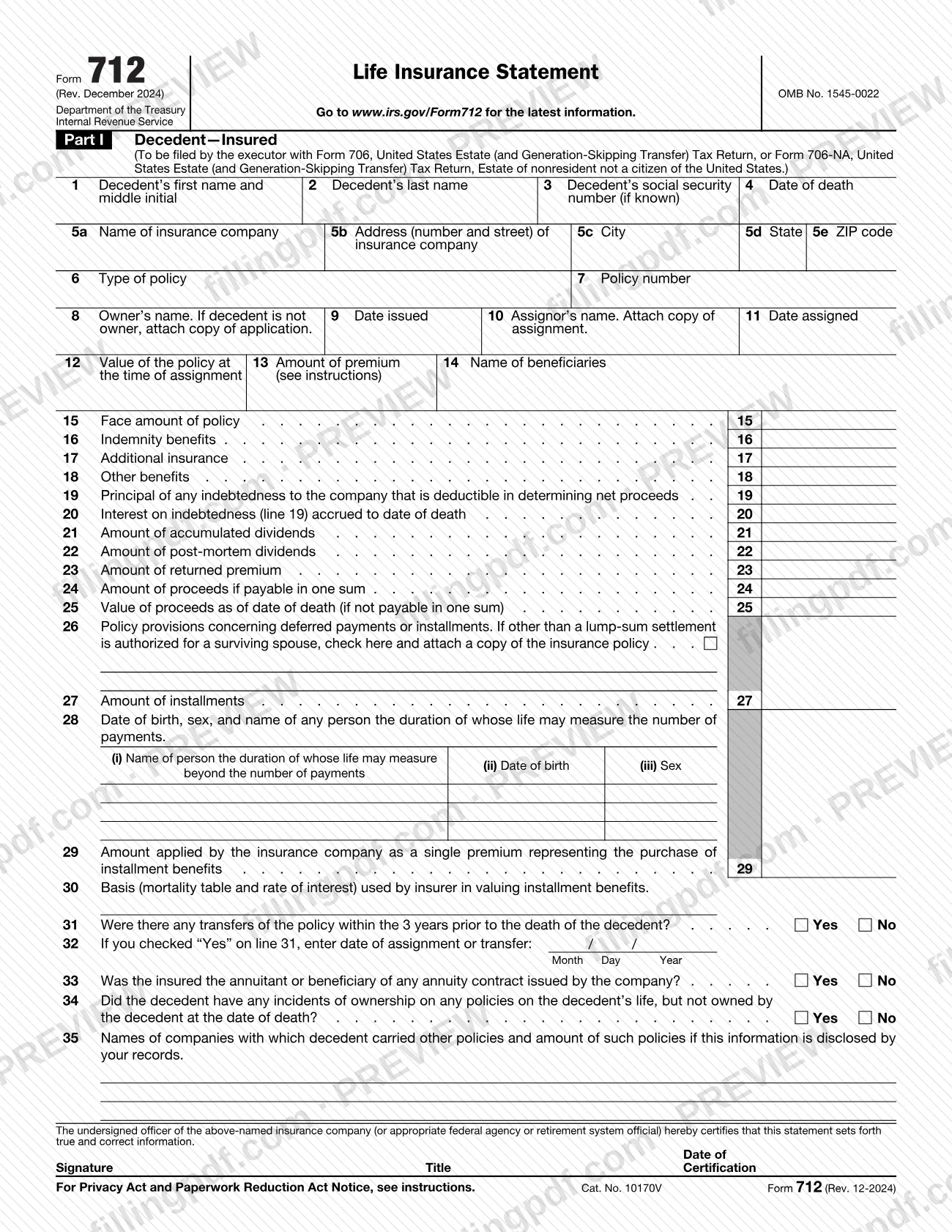
The form has two parts. Part I, Decedent—Insured, covers a policy on the life of a person who has died. It is filed by the executor with Form 706, United States Estate (and Generation-Skipping Transfer) Tax Return, or Form 706-NA, the estate tax return for a nonresident who is not a U.S. citizen. It asks for the policy type and number, owner, assignment, beneficiaries, face amount, benefits, indebtedness, dividends, installment terms and several yes/no questions.
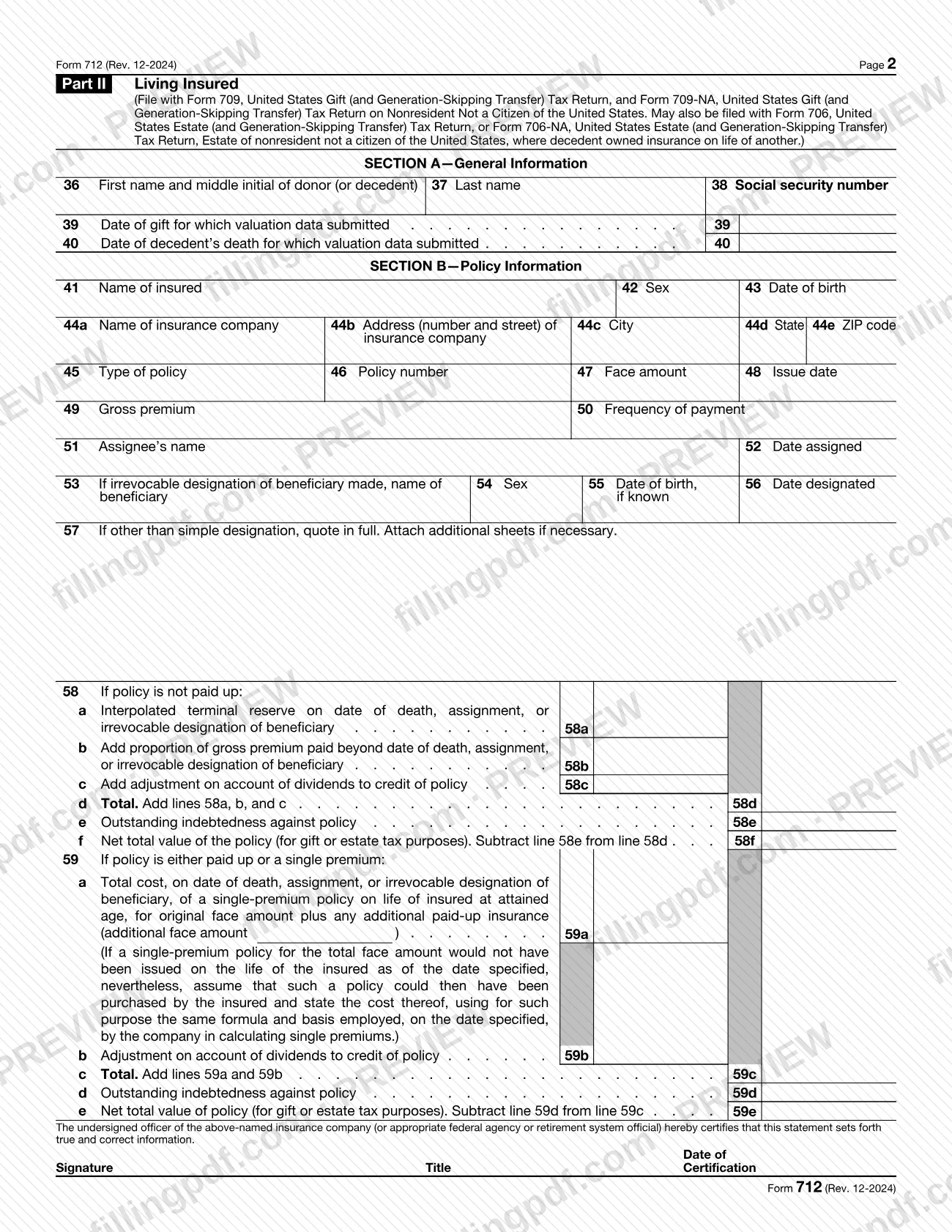
Part II, Living Insured, covers a policy on the life of a person who is still living. It is filed with Form 709, United States Gift (and Generation-Skipping Transfer) Tax Return, or Form 709-NA, and may also be filed with Form 706 or 706-NA where the decedent owned insurance on the life of another. It reports the policy data and works out the net total value of the policy for gift or estate tax purposes on line 58f or 59e.
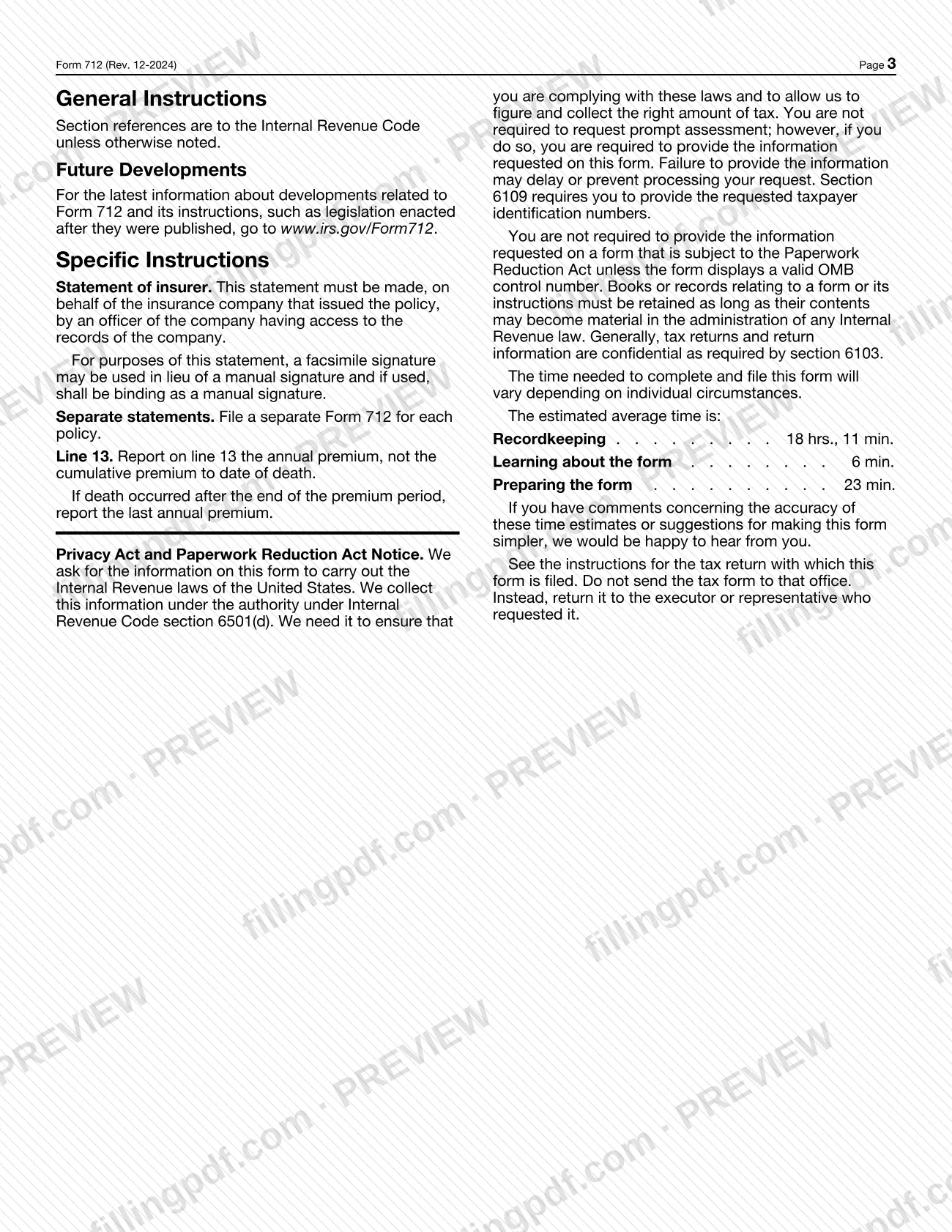
The form is issued under OMB No. 1545-0022. The IRS instructions printed on it require a separate Form 712 for each policy.
Who needs to file 712?
The insurance company that issued the policy completes and certifies Form 712, and the form is used by the person filing the tax return that reports the policy.
- Executors of an estate use Part I, Decedent—Insured, with Form 706 or Form 706-NA for a policy on the decedent's life.
- Donors reporting a gift of a policy use Part II, Living Insured, with Form 709 or Form 709-NA.
- Executors of an estate where the decedent owned insurance on the life of another may file Part II with Form 706 or Form 706-NA.
The statement must be made on behalf of the insurance company by an officer of the company who has access to its records. The signature block also allows an appropriate federal agency or retirement system official. A facsimile signature may be used in place of a manual signature and is binding as a manual signature.
File one Form 712 per policy: an estate or donor with several policies needs several statements.
When to file 712
Form 712 has no due date of its own: it is filed with the return it supports, so its timing is the filing time of Form 706, Form 706-NA, Form 709 or Form 709-NA. Part I is for a policy on the life of a decedent and goes with the estate tax return. Part II is for a living insured and goes with the gift tax return, or with the estate tax return where the decedent owned insurance on the life of another. Because the insurer must certify the statement, request it from the insurance company early enough to include it with the return. For any deadline, check the instructions for the tax return it accompanies and the latest information at www.irs.gov/Form712.
Documents you need
- Copy of the application, if the decedent is not the owner of the policy (line 8, Part I).
- Copy of the assignment, if the policy was assigned (line 10, Part I).
- Copy of the insurance policy, if other than a lump-sum settlement is authorized for a surviving spouse and you check the box on line 26 (Part I).
- Additional sheets, if necessary, to quote in full any designation of beneficiary that is other than a simple designation (line 57, Part II).
- The tax return Form 712 accompanies: Form 706 or 706-NA for Part I; Form 709 or 709-NA for Part II (Form 706 or 706-NA may also be used with Part II when the decedent owned insurance on the life of another).
How to fill out 712
Choose Part I or Part II
Use Part I, Decedent—Insured, for a policy on the life of a decedent, filed by the executor with Form 706 or 706-NA. Use Part II, Living Insured, with Form 709 or 709-NA, or with Form 706 or 706-NA where the decedent owned insurance on another person's life.
Enter decedent and insurer details
In Part I, lines 1 to 4, enter the decedent's first name and middle initial, last name, social security number (if known) and date of death. On lines 5a to 5e enter the insurance company's name, street address, city, state and ZIP code.
Identify the policy and owner
Enter the type of policy on line 6 and the policy number on line 7. On lines 8 and 9 give the owner's name, attaching a copy of the application if the decedent is not the owner, and the date issued.
Report assignment, premium and beneficiaries
If the policy was assigned, enter the assignor's name (line 10, with a copy of the assignment), the date assigned (line 11) and the policy value at assignment (line 12). On line 13 enter the annual premium, not the cumulative premium, and on line 14 the beneficiaries' names.
Enter benefits and proceeds
Complete lines 15 to 18 for face amount, indemnity benefits, additional insurance and other benefits. Then enter indebtedness and interest (lines 19 and 20), dividends (lines 21 and 22), returned premium (line 23), and proceeds on line 24 or line 25 depending on whether they are payable in one sum.
Describe installment payments
On line 26 give the policy provisions on deferred payments or installments, and check the box and attach the policy if a non-lump-sum settlement is authorized for a surviving spouse. Complete lines 27 to 30 for installment amounts, the person whose life measures the payments, the single premium and the insurer's valuation basis.
Answer the yes/no questions
Check Yes or No on line 31 (transfers within 3 years before death), line 33 (annuity contracts) and line 34 (incidents of ownership on policies not owned by the decedent). Enter the transfer date on line 32 if line 31 is Yes, and list other policies and amounts on line 35 if your records disclose them.
Complete Part II general information
In Section A, lines 36 to 38, enter the donor's (or decedent's) name and social security number. Enter the gift date on line 39 or the date of death on line 40, whichever the valuation data supports.
Enter Part II policy information
In Section B, lines 41 to 52, enter the insured's name, sex and date of birth, the insurer's details, policy type and number, face amount, issue date, gross premium, payment frequency, and any assignee and assignment date. Use lines 53 to 57 for an irrevocable designation of beneficiary, attaching additional sheets if necessary.
Value the policy
If the policy is not paid up, complete lines 58a to 58f; line 58f is line 58d minus line 58e. If it is paid up or single premium, complete lines 59a to 59e; line 59e is line 59c minus line 59d.
Certify the statement
The insurance company officer (or appropriate federal agency or retirement system official) signs and enters the title and date of certification at the bottom of Part I or Part II. A facsimile signature may be used.
Review and download the completed PDF
Check that you used a separate form for each policy and that every needed copy is attached. Download or print the completed PDF from FillingPDF and give it to the executor or representative who requested it.
How to submit 712
Form 712 is not mailed to a separate IRS address. It is filed with the tax return it supports, and the form directs you to the instructions for that return.
- With the tax return: attach the certified Form 712 to Form 706, Form 706-NA, Form 709 or Form 709-NA, and follow the filing channels in that return's instructions.
- From the insurer: the form says not to send it to the office named in the tax return instructions. Instead, the insurer returns it to the executor or representative who requested it.
- Attachments: include the copies and additional sheets listed under Required documents when they apply.
The IRS agency page describes Form 712 as filed by executors with Form 706, 706-NA or 709 for insurance policy or premium amounts. FillingPDF lets you fill out and download the PDF; submission follows the channels above.
Common mistakes to avoid
- Reporting several policies on one Form 712; the instructions require a separate Form 712 for each policy.
- Entering the cumulative premium to date of death on line 13 instead of the annual premium; if death occurred after the end of the premium period, report the last annual premium.
- Leaving the certification unsigned or unsigned by an authorized officer of the insurance company (or appropriate federal agency or retirement system official).
- Omitting a copy of the application when the decedent is not the owner (line 8) or a copy of the assignment (line 10).
- Checking the box on line 26 for a non-lump-sum settlement to a surviving spouse without attaching a copy of the insurance policy.
- Completing Part II lines 58 and 59 both, when the policy is either not paid up (line 58) or paid up or single premium (line 59).
- Computing line 58f or 59e incorrectly: subtract line 58e from line 58d, or line 59d from line 59c.
- Sending the form to the office listed in the tax return instructions instead of returning it to the executor or representative who requested it.
Frequently asked questions
What is Form 712 used for?
Form 712 is the IRS Life Insurance Statement. An insurance company completes it to report a policy's details and value for estate or gift tax purposes, and it is filed with Form 706, 706-NA, 709 or 709-NA.
Who fills out and signs Form 712?
An officer of the insurance company that issued the policy, with access to the company's records, makes the statement and signs the certification. An appropriate federal agency or retirement system official may sign instead. A facsimile signature is binding as a manual signature.
Do I need a separate Form 712 for each policy?
Yes. The instructions on the form say to file a separate Form 712 for each policy, so an estate or donor reporting several policies needs one statement for each.
What is the difference between Part I and Part II of Form 712?
Part I covers a policy on the life of a decedent and goes with Form 706 or 706-NA. Part II covers a living insured and goes with Form 709 or 709-NA, and may also go with Form 706 or 706-NA when the decedent owned insurance on another's life.
Where do I send Form 712?
File it with the tax return it supports, following that return's instructions. The form says not to send it to that return's office on its own; the insurer returns it to the executor or representative who requested it.
What goes on line 13 of Form 712?
Enter the annual premium, not the cumulative premium paid to the date of death. If death occurred after the end of the premium period, report the last annual premium.
What do I attach to Form 712?
It depends on the lines you complete: a copy of the application if the decedent is not the owner, a copy of any assignment, a copy of the policy if you check line 26, and additional sheets for line 57 if needed.
Can I fill out Form 712 online?
Yes. You can fill out the PDF online on FillingPDF and download or print it. FillingPDF is an independent service and does not file the form or submit it to the IRS; the form goes with the tax return it supports.
Ready to fill out 712?
Fill out 712 now