
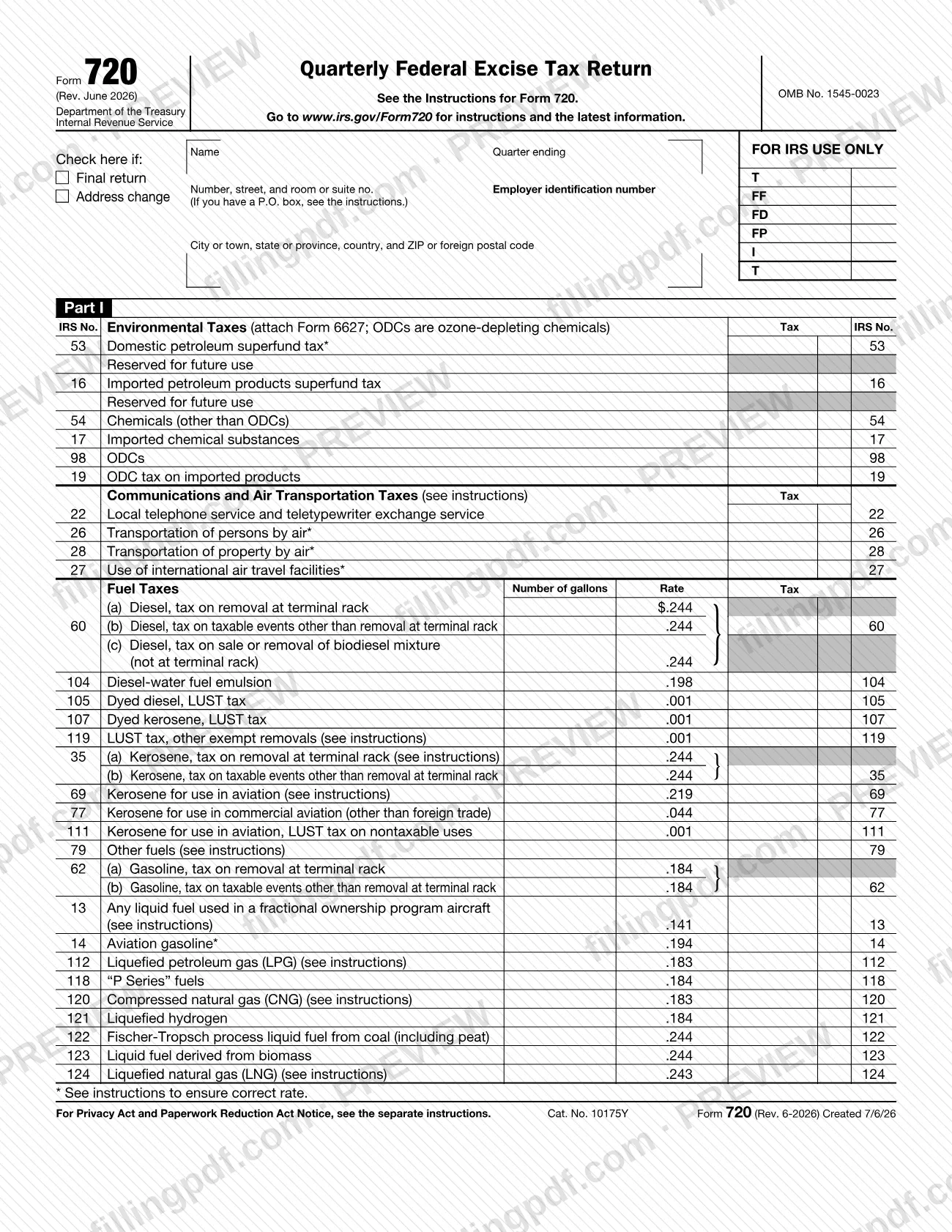
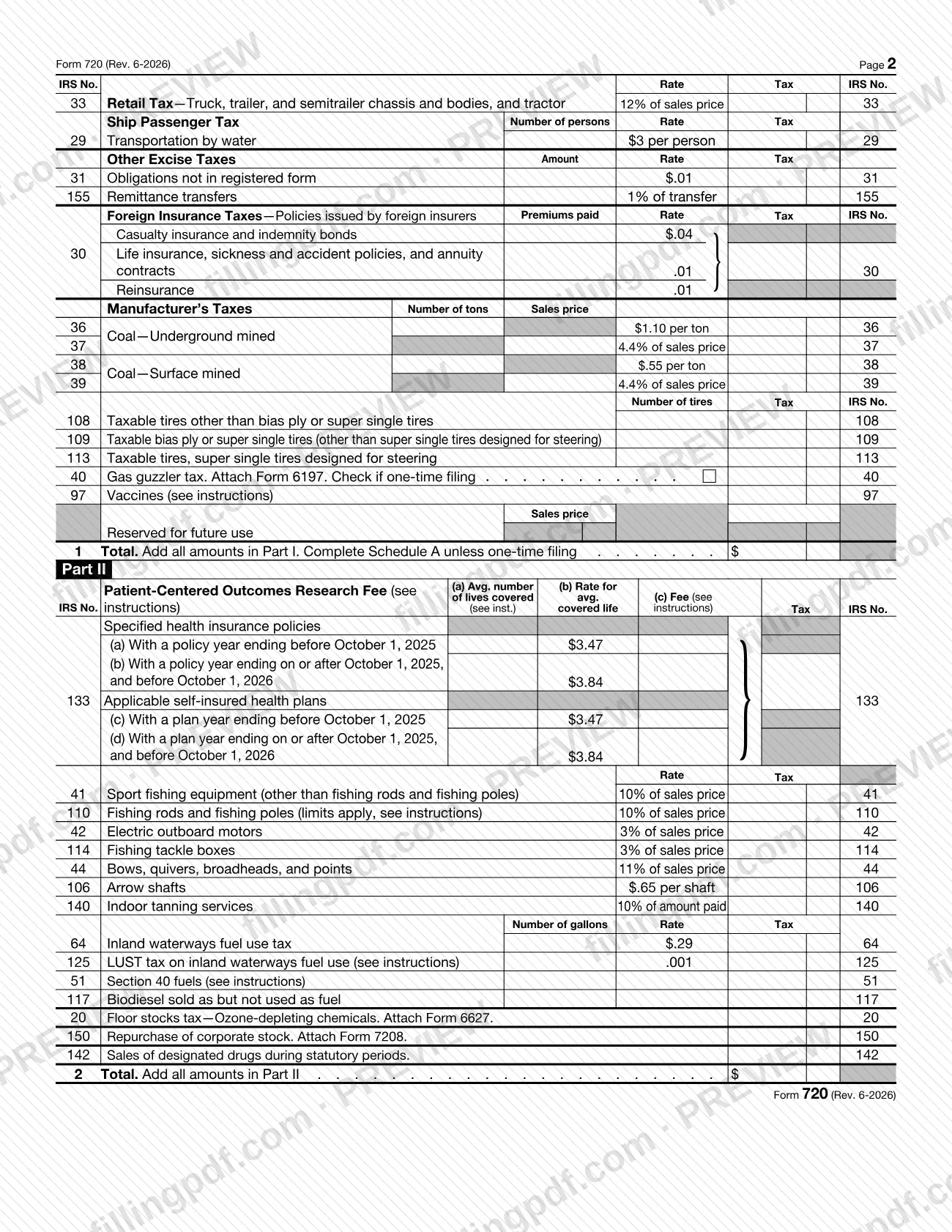
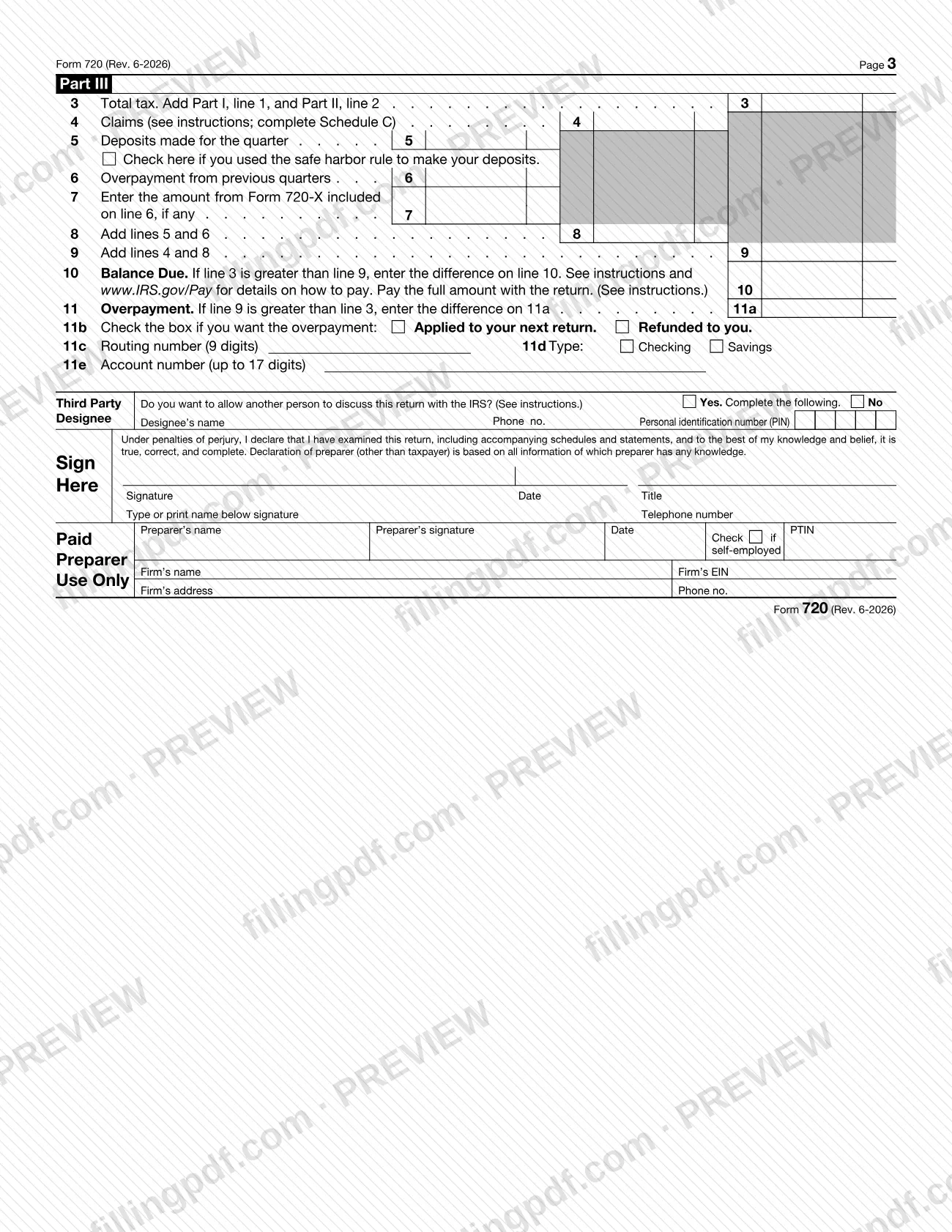
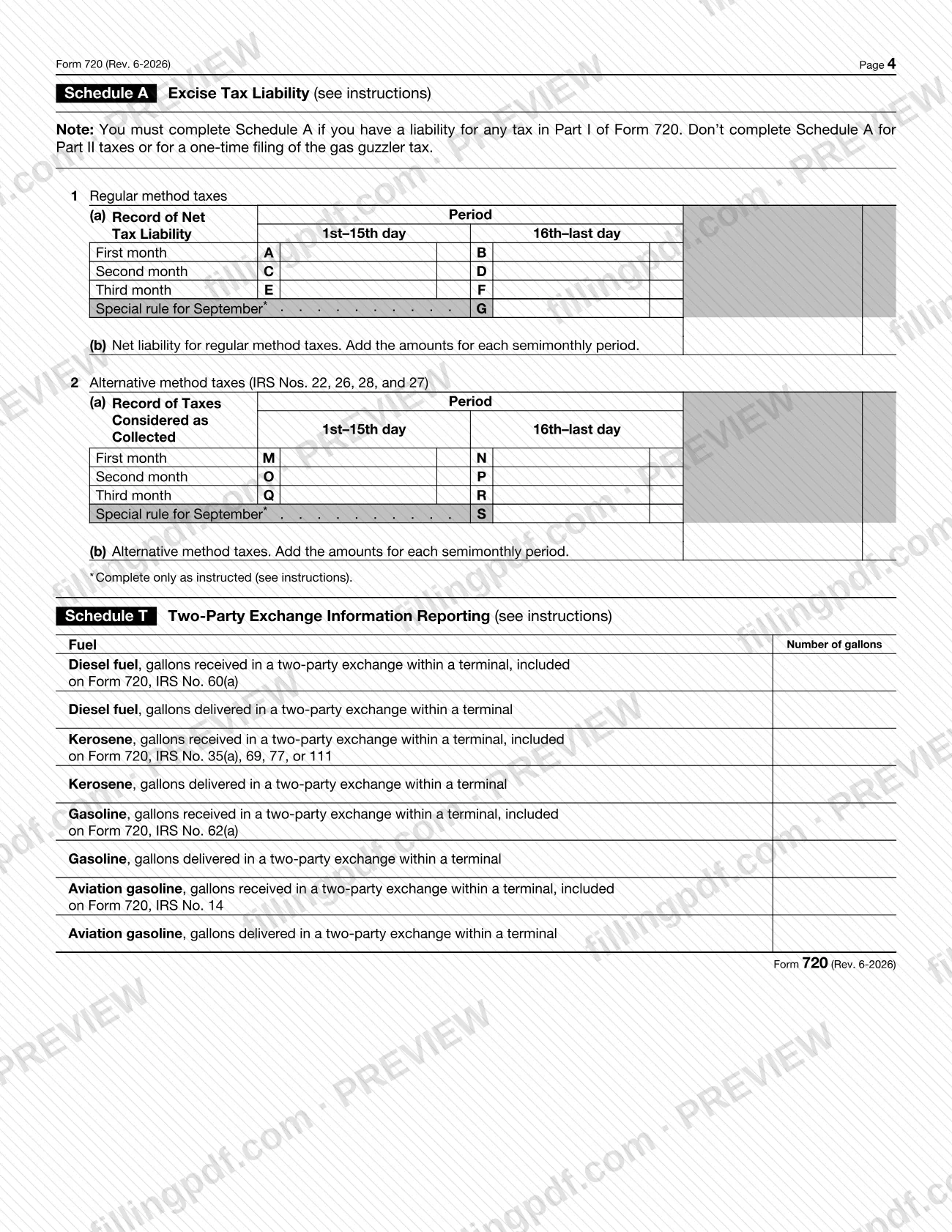
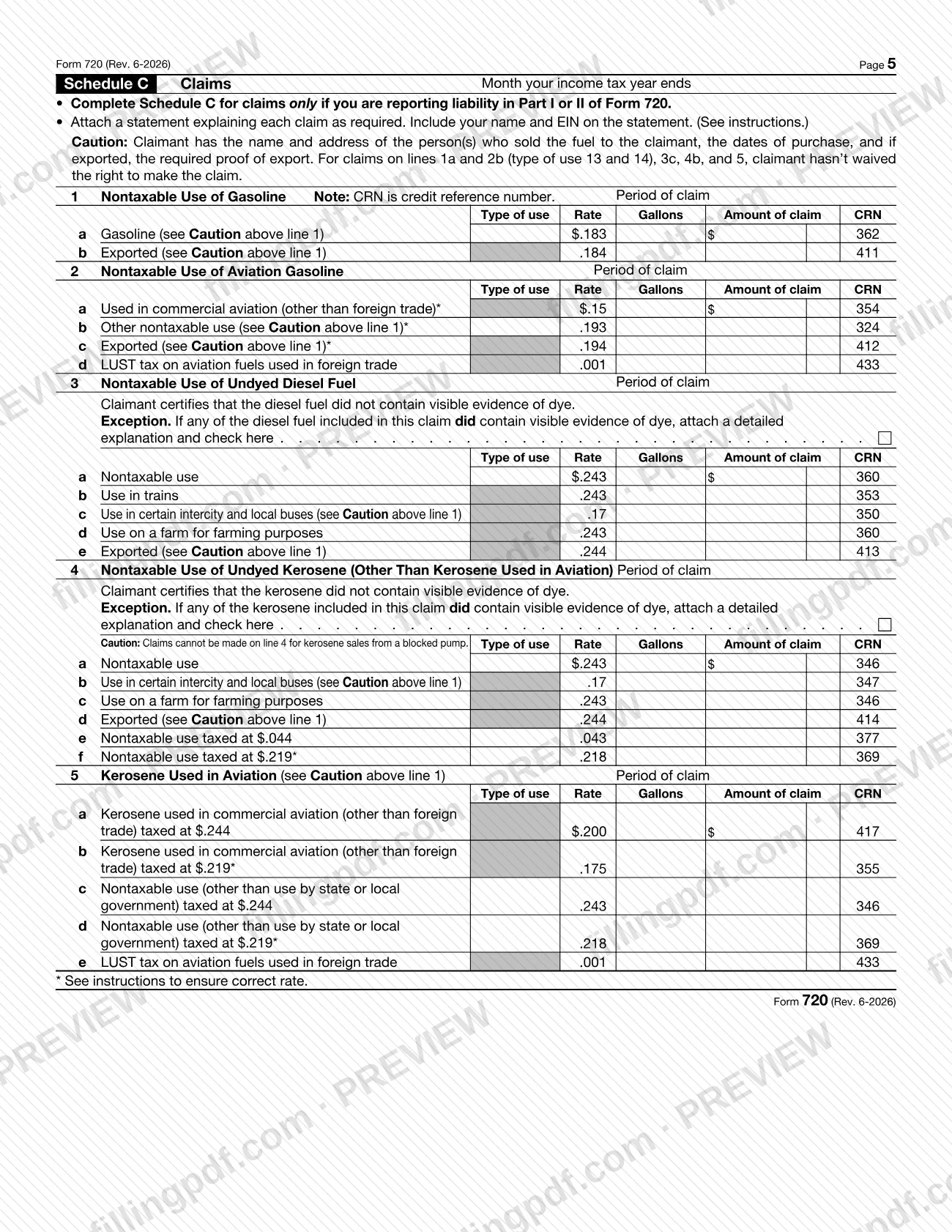
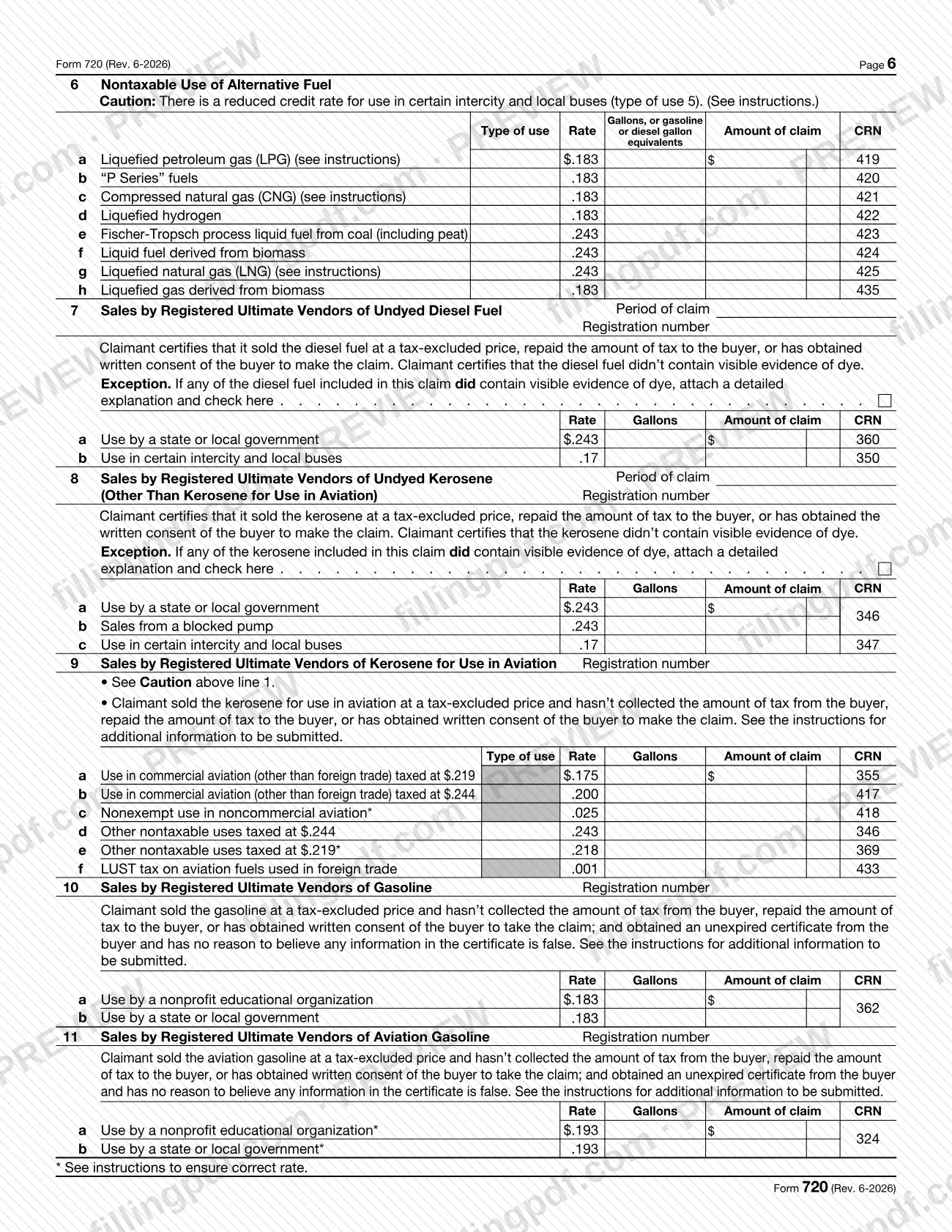
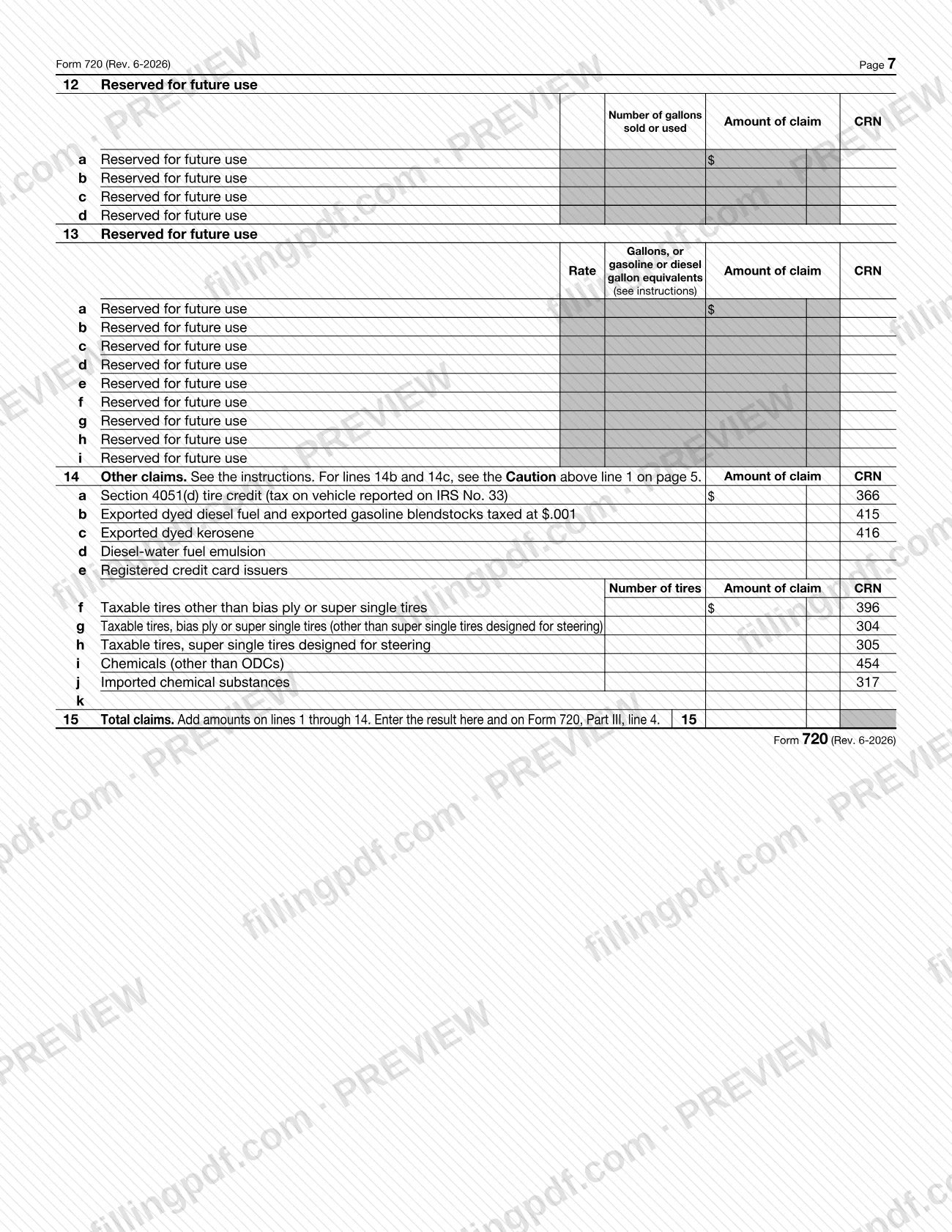
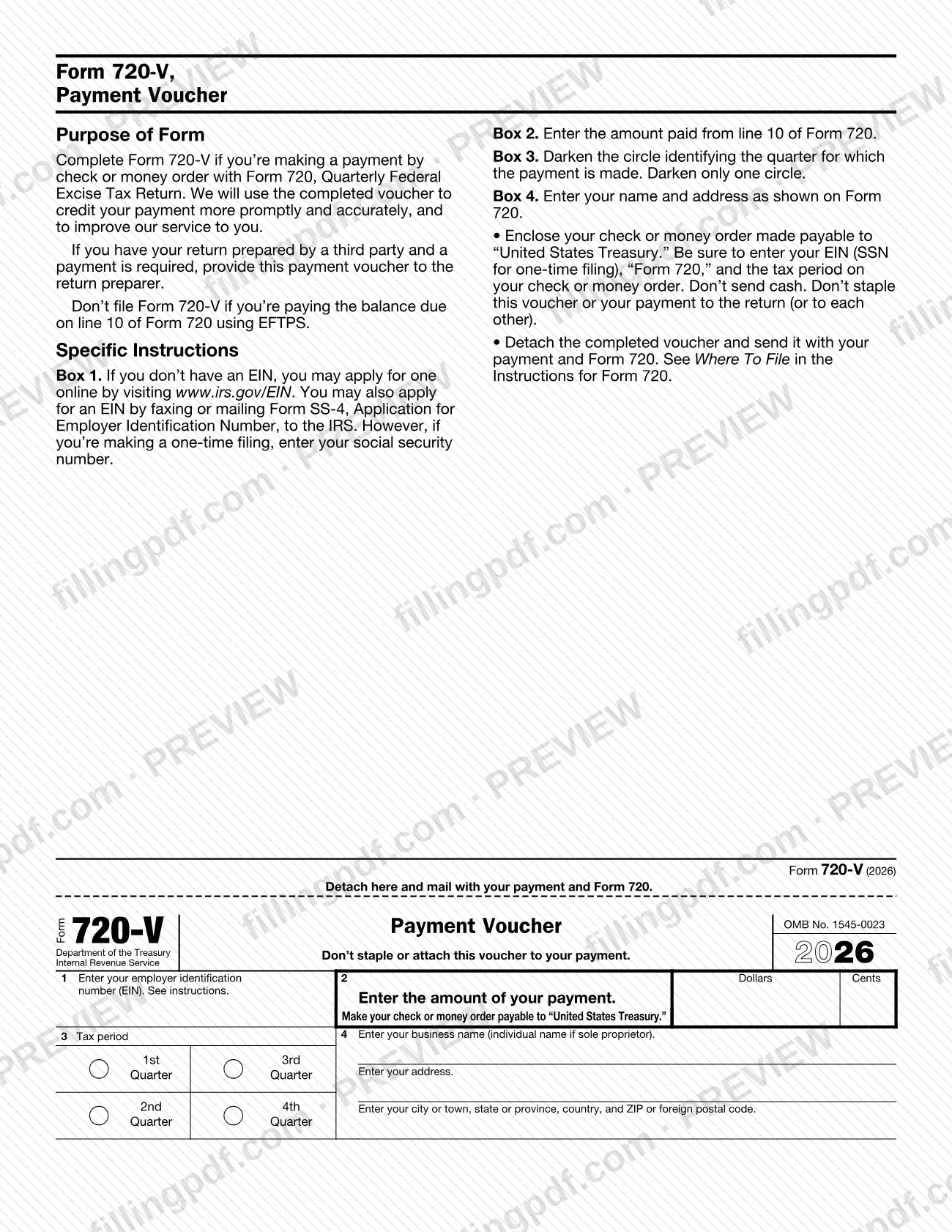
Form 720 is the Quarterly Federal Excise Tax Return that the Internal Revenue Service (IRS) uses to collect federal excise taxes, reported line by line under an IRS No. for each tax. You file it for each quarter in which you are liable for, or responsible for collecting, one of the taxes listed in Parts I and II of the form. On FillingPDF you can fill out the form online and download or print the completed PDF; the IRS publishes the original form and the Instructions for Form 720 at www.irs.gov/Form720.
Last updated
What is 720?
Form 720, Quarterly Federal Excise Tax Return, is the Internal Revenue Service (IRS) form used to report your liability by IRS No. and pay the federal excise taxes listed on it, together with attachments such as Schedule A, Schedule T and Schedule C.
The form has three parts. Part I lists environmental taxes, communications and air transportation taxes, fuel taxes, the retail tax on truck, trailer and semitrailer chassis and bodies, the ship passenger tax, other excise taxes (including obligations not in registered form and remittance transfers), foreign insurance taxes and manufacturers taxes such as coal, tires, the gas guzzler tax and vaccines. Part II covers the patient-centered outcomes research (PCOR) fee, sport fishing equipment, indoor tanning services, inland waterways fuel use, floor stocks tax on ozone-depleting chemicals, repurchase of corporate stock and sales of designated drugs. Part III combines the totals, claims, deposits and the balance due or overpayment.
Three schedules travel with it. Schedule A records excise tax liability by semimonthly period, Schedule T reports two-party exchange gallons of fuel, and Schedule C claims credits for certain fuel and other uses. Form 720-V, the payment voucher, is printed with the form for payments by check or money order.
Form 720 is not used to adjust liabilities reported for prior quarters: the instructions send those adjustments to Form 720-X, Amended Quarterly Federal Excise Tax Return. It also does not replace Form 4136 or Form 8849 for fuel claims made on those forms. The form is issued under OMB No. 1545-0023.
Who needs to file 720?
You must file Form 720 if you are liable for, or responsible for collecting, any of the federal excise taxes listed in Parts I and II for the current quarter. You must also file if you were liable or responsible for a prior quarter and have not filed a final return.
Examples the IRS instructions give:
- The person receiving payment for communications services or air transportation, who collects and submits the tax and files the return.
- The person receiving payment for indoor tanning services, who collects and remits the tax.
- The person who pays a premium to a foreign insurer, or otherwise the person who issued, sold or is insured under the policy.
- Issuers of specified health insurance policies and plan sponsors of applicable self-insured health plans, for the PCOR fee.
- Remittance transfer providers, who collect the tax from certain senders and file quarterly returns.
- An importer making a one-time filing for a gas guzzling automobile, if the conditions in the instructions are met.
Qualified subchapter S subsidiaries and eligible single-owner disregarded entities are treated as separate entities for excise tax and report under their own EINs.
Form 720 must be signed by a person authorized by the entity to sign. A paid preparer who is not an employee of the filer signs and completes the Paid Preparer Use Only section. File a final return if you go out of business or will not owe reportable excise taxes in future quarters.
When to file 720
File Form 720 for each quarter of the calendar year by these dates:
- January, February, March: April 30
- April, May, June: July 31
- July, August, September: October 31
- October, November, December: January 31
If a due date falls on a Saturday, Sunday or legal holiday, you may file on the next business day.
Some items follow their own timing. The PCOR fee is reported on the second-quarter return, due no later than July 31, and a filer reporting only that fee does not file for the first, third or fourth quarter. The floor stocks tax on ozone-depleting chemicals (IRS No. 20) is reported on the return due July 31, with the tax payment due June 30. A one-time filing is made for the quarter in which you incur the liability. Foreign insurers and reinsurers disclosing a treaty position file the annual statement with the first-quarter return. Excise taxes are generally deposited semimonthly, so payment dates can fall before the return is due.
Documents you need
- Form 6627, Environmental Taxes, attached to Form 720 if you report IRS Nos. 53, 16, 54, 17, 98, 19 or the floor stocks tax on ozone-depleting chemicals (IRS No. 20).
- Form 6197, Gas Guzzler Tax, attached if you report IRS No. 40; check the one-time filing box if you qualify for a one-time filing.
- Form 7208, attached if you report the excise tax on repurchase of corporate stock (IRS No. 150).
- Schedule A, Excise Tax Liability, if you have liability for any tax in Part I; not for Part II taxes or a one-time gas guzzler filing.
- Schedule C, Claims, only if you are reporting liability in Part I or II and are claiming a credit; attach a statement for each claim as required, with your name and EIN.
- Schedule T, Two-Party Exchange Information Reporting, if you received or delivered taxable fuel gallons in a two-party exchange within a terminal.
- Form 720-V, Payment Voucher, enclosed with a check or money order made payable to "United States Treasury".
- A schedule of rates and gallons if more than one rate applies on the line for IRS No. 79, with the "Rate" column left blank.
- A first taxpayer's report filed with the return if you report gallons of taxable fuel that may again be subject to tax.
- For treaty-based return positions under section 6114, Form 8833 or a disclosure statement attached to the return.
How to fill out 720
Enter name, address and quarter
Enter your name, address and the quarter ending date (month and year). Check Address change if your address changed; show a P.O. box number only if the post office does not deliver to your street address, and do not abbreviate a foreign country name.
Enter your EIN and check boxes
Enter your correct employer identification number. A one-time filer without an EIN enters a Social Security number or ITIN, and checks Final return if you are going out of business or will owe no reportable excise tax in future quarters.
Report environmental and air taxes
In Part I, report environmental taxes (IRS Nos. 53, 16, 54, 17, 98, 19) from Form 6627, and enter the tax collected or considered collected for IRS Nos. 22, 26, 28 and 27.
Report fuel taxes
Enter the number of gallons on the line for each fuel IRS No., such as 60(a), 60(b), 35, 62(a) and 62(b), and multiply by the rate shown. Where the instructions say so, combine the (a) and (b) lines into one Tax entry.
Complete the remaining Part I taxes
Report the retail tax (IRS No. 33), ship passenger tax (29), other excise taxes (31, 155), foreign insurance taxes (30), coal (36 to 39), tires (108, 109, 113), gas guzzler tax (40) and vaccines (97). Add everything on line 1.
Complete Part II taxes and fees
Report the PCOR fee on IRS No. 133 in columns (a), (b) and (c), then sport fishing and archery items, indoor tanning (140), inland waterways fuel (64, 125), IRS Nos. 51, 117, 20, 150 and 142. Add them on line 2.
Complete Schedule A
Record net tax liability for each semimonthly period: boxes A to G for regular method taxes on line 1, and boxes M to S for IRS Nos. 22, 26, 27 and 28 on line 2 under the alternative method. Complete the September special rule boxes only as instructed.
Complete Schedule T if it applies
Enter gallons of diesel, kerosene, gasoline and aviation gasoline received in or delivered in a two-party exchange within a terminal. Received gallons must also appear on the matching Form 720 line.
Complete Schedule C for claims
Enter the month your income tax year ends as MM and the period of claim as MM/DD/YYYY–MM/DD/YYYY, then fill each claim line with type of use, gallons, rate and amount. Enter the total on line 15 and on Part III, line 4.
Complete Part III lines 3 through 9
Enter total tax on line 3 and claims on line 4. Enter deposits on line 5 (check the safe harbor box if used), prior overpayment on line 6 and any Form 720-X amount on line 7. Add lines 5 and 6 on line 8, and lines 4 and 8 on line 9.
Enter balance due or overpayment
If line 3 is greater than line 9, enter the difference on line 10. If line 9 is greater, enter it on line 11a, check applied or refunded on 11b, and give the routing number, account type and account number on lines 11c to 11e for direct deposit.
Add designee, sign and date
Check Yes or No under Third Party Designee and, if Yes, enter the name, phone number and a 5-digit PIN. A person authorized by the entity signs and dates the return; a paid preparer completes the preparer section with a PTIN.
Review and download the PDF
Check every IRS No. line, schedule and total, then download or print the completed PDF from FillingPDF. Prepare Form 720-V if you will pay by check, and assemble the attachments described under How to submit.
How to submit 720
You can file Form 720 by mail or electronically, and you pay the balance due through the payment options below.
- By mail: Department of the Treasury, Internal Revenue Service, Ogden, UT 84201-0009. Use USPS or an IRS-designated private delivery service (PDS) to meet the timely mailing rule.
- By private delivery service: the current list is at IRS.gov/PDS and the IRS street address to use is at IRS.gov/PDSStreetAddresses. A PDS cannot deliver to an IRS P.O. box, so use USPS for those.
- Electronically: through an electronic return originator, transmitter or intermediate service provider participating in the IRS e-file program for excise taxes; see irs.gov/ETEC.
Payment: the IRS recommends paying electronically. Options include IRS Direct Pay, debit or credit card or digital wallet, Electronic Funds Withdrawal when filing electronically, and EFTPS. To pay by check or money order, make it payable to "United States Treasury", write your EIN, "Form 720" and the tax period on it, and send it with Form 720-V, unstapled. Do not file Form 720-V if you pay by Direct Pay, EFTPS or direct debit. Do not mail deposits directly to the IRS.
Do not file an uncollected tax report with Form 720; mail it to Department of the Treasury, Internal Revenue Service, Cincinnati, OH 45999. FillingPDF lets you fill out and download the PDF; submission follows the channels above.
Common mistakes to avoid
- Entering the expired oil spill taxes on the lines for IRS Nos. 18 and 21; the instructions say not to unless Congress extends them.
- Entering adjustments to prior-quarter liabilities on Form 720 instead of reporting them on Form 720-X.
- Mailing deposits directly to the IRS; deposits must be made by electronic funds transfer, such as EFTPS.
- Filing Form 720-V when you pay the balance due by IRS Direct Pay, EFTPS or direct debit.
- Stapling the payment voucher or the check to the return, or to each other.
- Attaching the communications or air transportation uncollected tax report to Form 720 instead of mailing it to Cincinnati, OH 45999.
- Sending a return to an IRS P.O. box through a private delivery service, which cannot deliver there.
- Leaving out Schedule A when you have liability for any Part I tax, even if the net liability is small.
- Including the excise tax on coal in the sales price when choosing the rate for IRS Nos. 36, 37, 38 and 39.
- Leaving line 3 blank when you have no tax to report, instead of entering "None" and signing and dating the return.
Frequently asked questions
What is Form 720 used for?
Form 720 is the IRS Quarterly Federal Excise Tax Return. You use it, with its schedules, to report your liability by IRS No. and pay the federal excise taxes listed in Parts I and II, such as fuel, communications, air transportation, indoor tanning and foreign insurance taxes.
When is Form 720 due?
Each quarter's return is due by April 30, July 31, October 31 and January 31, for the quarters ending in March, June, September and December. If the date is a Saturday, Sunday or legal holiday, you may file on the next business day.
Where do I mail Form 720?
Mail it to Department of the Treasury, Internal Revenue Service, Ogden, UT 84201-0009. If you use a private delivery service, get the IRS street address at IRS.gov/PDSStreetAddresses; a PDS cannot deliver to a P.O. box.
Can I file Form 720 electronically?
Yes. The instructions say you can e-file through an electronic return originator, transmitter or intermediate service provider participating in the IRS e-file program for excise taxes. See irs.gov/ETEC. FillingPDF does not e-file the form for you.
How do I pay the balance due on Form 720?
Pay the amount on line 10 by IRS Direct Pay, EFTPS, check or money order, or Electronic Funds Withdrawal if you file electronically. Send Form 720-V only with a check or money order, not when paying by Direct Pay, EFTPS or direct debit.
What do I do if I owe no excise tax this quarter?
If you normally report a tax but have none now, enter zero on that line. If you have no tax to report at all, enter "None" on Part III, line 3, then sign and date the return. Check the Final box if you will owe no excise tax in future quarters.
Can I correct a prior-quarter Form 720?
Do not enter adjustments to previously reported liabilities on Form 720. The instructions direct you to Form 720-X, Amended Quarterly Federal Excise Tax Return, for that purpose.
Is the PCOR fee reported on Form 720 every quarter?
No. The PCOR fee (IRS No. 133) is reported once a year on the second-quarter return, due by July 31. If you file only to report that fee, you do not file for the first, third or fourth quarter.
Can I fill out Form 720 online on FillingPDF?
Yes. You can fill out the PDF online on FillingPDF and download or print it. FillingPDF is an independent service and does not file the return or pay the tax; you submit it to the IRS by mail or through e-file.
Ready to fill out 720?
Fill out 720 now