
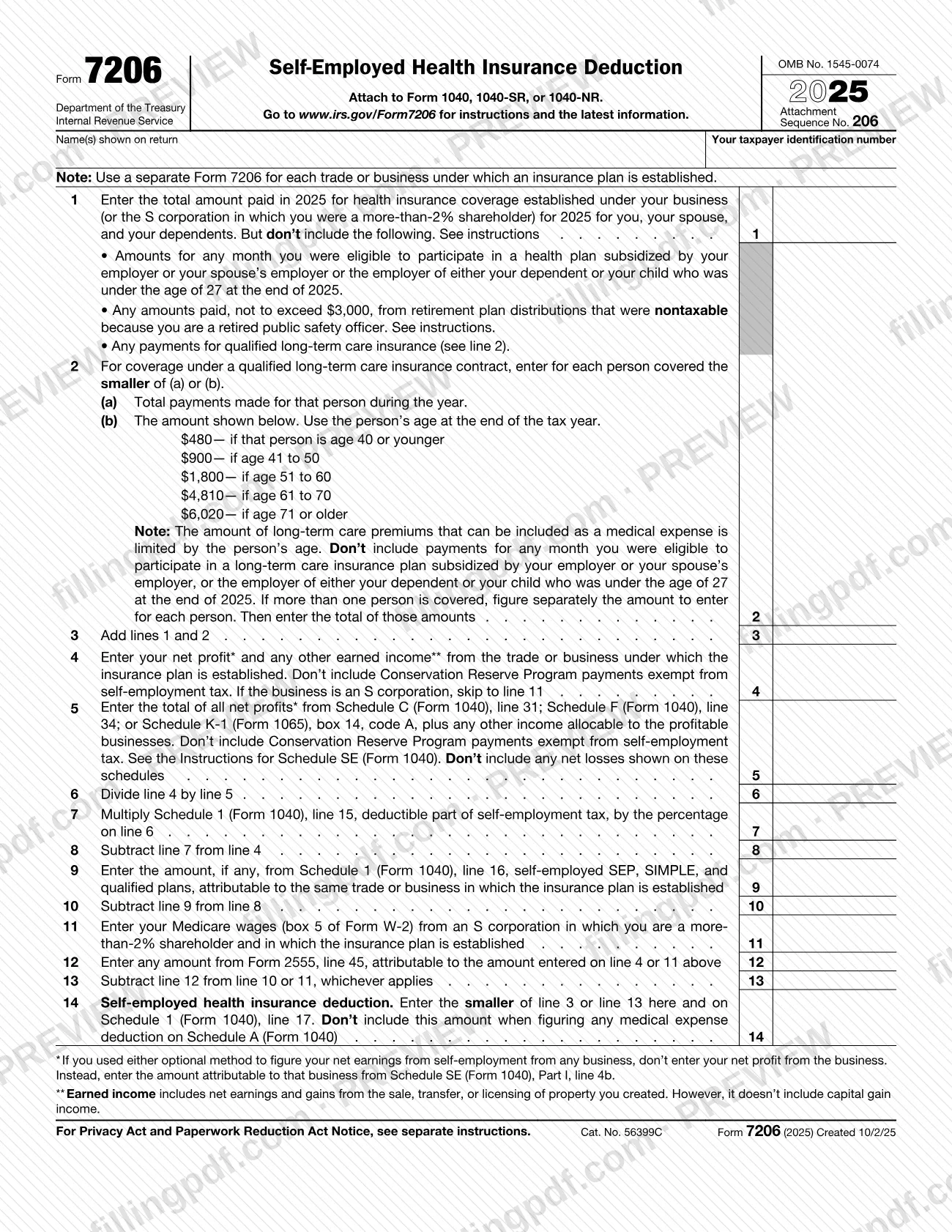
Form 7206, Self-Employed Health Insurance Deduction, is the Internal Revenue Service (IRS) form that works out how much of your health insurance premiums you may deduct on Schedule 1 (Form 1040), line 17. It is attached to Form 1040, 1040-SR, or 1040-NR and has replaced the worksheet that used to be published in Pub. 535. On FillingPDF you can fill out Form 7206 online and download or print the completed PDF; the IRS publishes the form and its instructions at www.irs.gov/Form7206.
Last updated
What is Form 7206?
Form 7206, Self-Employed Health Insurance Deduction, is the IRS form used to determine the amount of the self-employed health insurance deduction you may be able to claim and report on Schedule 1 (Form 1040), line 17, for the 2025 tax year.
The deduction covers premiums for medical, dental and vision insurance and for qualified long-term care insurance, paid for yourself, your spouse and your dependents. The insurance can also cover a child who was under age 27 at the end of 2025, even if that child was not your dependent. The plan must be established, or considered established, under your business.
The form works in three stages. Lines 1 to 3 total the premiums that qualify, with qualified long-term care premiums limited by each covered person's age on line 2. Lines 4 to 13 apply an earnings limit based on net profit from the business (or, for an S corporation, Medicare wages), reduced by the deductible part of self-employment tax and by retirement plan contributions. Line 14 takes the smaller of line 3 or line 13.
Form 7206 replaced the Self-Employed Health Insurance Deduction Worksheet that was previously published in Pub. 535, Business Expenses. The amount on line 14 is not also counted as a medical expense on Schedule A (Form 1040), and the deduction cannot be subtracted when figuring net earnings for self-employment tax from the business that established the plan.
Who needs to file Form 7206?
Form 7206 is for taxpayers who may claim the self-employed health insurance deduction. According to the IRS instructions, one of these must be true:
- You were self-employed and had a net profit reported on Schedule C (Form 1040) or Schedule F (Form 1040).
- You were a partner with net earnings from self-employment reported on Schedule K-1 (Form 1065), box 14, code A.
- You used one of the optional methods to figure net earnings from self-employment on Schedule SE (Form 1040).
- You received 2025 wages from an S corporation in which you were a more-than-2% shareholder.
Generally you can use the worksheet in the Form 1040 instructions instead. You must use Form 7206 if you had more than one source of income subject to self-employment tax, if you file Form 2555, or if you are using qualified long-term care insurance payments to figure the deduction.
Do not count amounts for any month you were eligible for a health plan subsidized by your employer or your spouse's employer, even if you did not enroll. Members of clergy should see Pub. 517, and anyone with Marketplace coverage and advance payments of the premium tax credit should see Pub. 974.
When to file Form 7206
Form 7206 is completed for the tax year in which you paid the premiums and is attached to your Form 1040, 1040-SR, or 1040-NR, so it is due whenever that return is filed. The form prints no separate deadline of its own. This page covers the 2025 revision.
If you have more than one health plan and each plan is established under a different business, complete a separate Form 7206 for each one, since each plan has its own net earnings limit. Prepare all of them before you finish Schedule 1, because the deduction from line 14 is carried to Schedule 1 (Form 1040), line 17.
Documents you need
- Schedule C (Form 1040), line 31, Schedule F (Form 1040), line 34, or Schedule K-1 (Form 1065), box 14, code A: the net profit figures you need for lines 4 and 5, if you are not an S corporation shareholder.
- Form W-2, box 5 (Medicare wages) from the S corporation: needed for line 11 if you are a more-than-2% shareholder in an S corporation that established the plan.
- Schedule 1 (Form 1040), line 15 (deductible part of self-employment tax) and line 16 (self-employed SEP, SIMPLE, and qualified plans): needed for lines 7 and 9.
- Form 2555, line 45: needed for line 12 only if an amount on that line is attributable to the amount on line 4 or 11.
- Schedule SE (Form 1040), Part I, line 4b: needed instead of net profit if you used either optional method to figure net earnings from self-employment.
How to fill out Form 7206
Enter your name and taxpayer ID
At the top, write the name(s) shown on your return and your taxpayer identification number. Use a separate Form 7206 for each trade or business under which an insurance plan is established.
Enter premiums paid on line 1
Enter the total amount paid in 2025 for health insurance coverage established under your business (or your S corporation) for you, your spouse and your dependents. Leave out months you were eligible for an employer-subsidized plan, retired public safety officer amounts, and long-term care payments.
Figure long-term care amounts on line 2
For each person covered by a qualified long-term care insurance contract, enter the smaller of the payments made for that person or the amount for their age at the end of 2025. Total the separate amounts and enter the result on line 2.
Add lines 1 and 2
Enter the sum on line 3.
Enter net profit on line 4
Enter your net profit and any other earned income from the business under which the plan is established, without Conservation Reserve Program payments exempt from self-employment tax. If the business is an S corporation, skip to line 11.
Total your net profits on line 5
Enter the total of net profits from Schedule C line 31, Schedule F line 34 or Schedule K-1 (Form 1065) box 14, code A, plus other income allocable to profitable businesses. Do not include net losses.
Work lines 6 through 8
Divide line 4 by line 5 on line 6. On line 7, multiply Schedule 1 (Form 1040), line 15 by the line 6 percentage, then subtract line 7 from line 4 on line 8.
Subtract retirement contributions on lines 9 and 10
On line 9, enter the Schedule 1 (Form 1040), line 16 amount attributable to the same business that established the plan. Subtract line 9 from line 8 on line 10.
Enter S corporation wages on line 11
If you are a more-than-2% shareholder, enter your Medicare wages (Form W-2, box 5) from the S corporation that established the plan. Others leave line 11 blank.
Complete lines 12 and 13
On line 12, enter any Form 2555, line 45 amount attributable to the amount on line 4 or 11. On line 13, subtract line 12 from line 10 or line 11, whichever applies.
Enter the deduction on line 14
Enter the smaller of line 3 or line 13 on line 14, and carry it to Schedule 1 (Form 1040), line 17. Do not count this amount in a Schedule A medical expense deduction.
Review and download the completed PDF
Check each line against your Schedule C, F or K-1, Schedule 1 and any W-2. Download or print the completed PDF from FillingPDF and attach it to your return as described under How to submit.
How to submit Form 7206
Form 7206 is submitted as an attachment to your income tax return, so it travels with Form 1040, 1040-SR, or 1040-NR by whichever method you use to file that return. The form prints no address, portal or appointment rule of its own.
- With your return: attach each completed Form 7206 to the return. Use a separate form for each trade or business under which an insurance plan is established.
- On Schedule 1: enter the amount from line 14 on Schedule 1 (Form 1040), line 17.
- Where to get help: the IRS publishes the form, its instructions and the latest information at www.irs.gov/Form7206.
For mailing addresses, electronic filing and payment options, follow the instructions for the return you attach it to. FillingPDF lets you fill out and download the PDF; submission follows the channels above.
Common mistakes to avoid
- Including premiums for any month you were eligible for a health plan subsidized by your employer or your spouse's employer, even if you did not enroll in it.
- Putting qualified long-term care premiums on line 1 instead of line 2, where each person's amount is limited to the smaller of premiums paid or the age-based amount.
- Using one Form 7206 for several businesses; the form calls for a separate one for each trade or business under which an insurance plan is established.
- Including net losses from Schedule C, Schedule F or Schedule K-1 on line 5; the line asks only for net profits.
- Filling in lines 4 to 10 as an S corporation shareholder instead of skipping from line 4 to line 11.
- Entering net profit from a business on line 4 when you used an optional method; enter the amount from Schedule SE (Form 1040), Part I, line 4b instead.
- Counting retirement plan distributions that were nontaxable because you are a retired public safety officer toward the premiums on line 1.
- Including the line 14 amount again as a medical expense on Schedule A (Form 1040).
Frequently asked questions
What is Form 7206 used for?
Form 7206 is the IRS form that determines the amount of the self-employed health insurance deduction you may be able to claim. The result on line 14 is reported on Schedule 1 (Form 1040), line 17, and the form is attached to Form 1040, 1040-SR, or 1040-NR.
Do I have to use Form 7206, or can I use a worksheet?
Generally you can use the worksheet in the Form 1040 instructions. You must use Form 7206 if you had more than one source of income subject to self-employment tax, you file Form 2555, or you are using qualified long-term care insurance payments to figure the deduction.
Who can claim the self-employed health insurance deduction?
The instructions require one of four situations: a net profit on Schedule C or F, partner net earnings on Schedule K-1 (Form 1065), box 14, code A, use of an optional method for self-employment earnings, or 2025 wages from an S corporation in which you owned more than 2%.
Can I fill out Form 7206 online?
Yes. You can fill out the Form 7206 PDF online on FillingPDF and download or print it. FillingPDF is an independent service and does not file anything with the IRS; you attach the form to your return and submit it through the IRS channels for that return.
Do I need a separate Form 7206 for each business?
Yes, when each health plan is established under a different business. The form says to use a separate Form 7206 for each trade or business under which a plan is established, because each plan has its own net earnings limit.
Can I include long-term care insurance premiums on Form 7206?
Yes, for a qualified long-term care insurance contract. Enter them on line 2, not line 1, and for each covered person include only the smaller of the premiums paid for that person or the amount that applies to their age at the end of the tax year.
Can I deduct premiums for months I could join my employer's health plan?
No. The instructions say you cannot take the deduction for any month you were eligible to participate in a subsidized health plan of your employer or your spouse's employer, even if you did not actually participate.
Does the deduction on line 14 also go on Schedule A?
No. Do not include the line 14 amount when figuring a medical expense deduction on Schedule A (Form 1040). Medical insurance payments that are not deductible on Schedule 1, line 17 can be included as medical expenses on Schedule A if you itemize.
Ready to fill out Form 7206?
Fill out Form 7206 now