

Form 730 is the Internal Revenue Service (IRS) return on which you report the gross amount of wagers you accepted during a month and figure the tax due under section 4401 of the Internal Revenue Code. People who run a wagering business, a wagering pool or a lottery file it every month, even in a month with no taxable wagers. On FillingPDF you can fill out Form 730 online and download or print the completed PDF. The IRS publishes the form and its instructions at www.irs.gov/Form730, and the return itself is mailed to the IRS.
Last updated
What is Form 730?
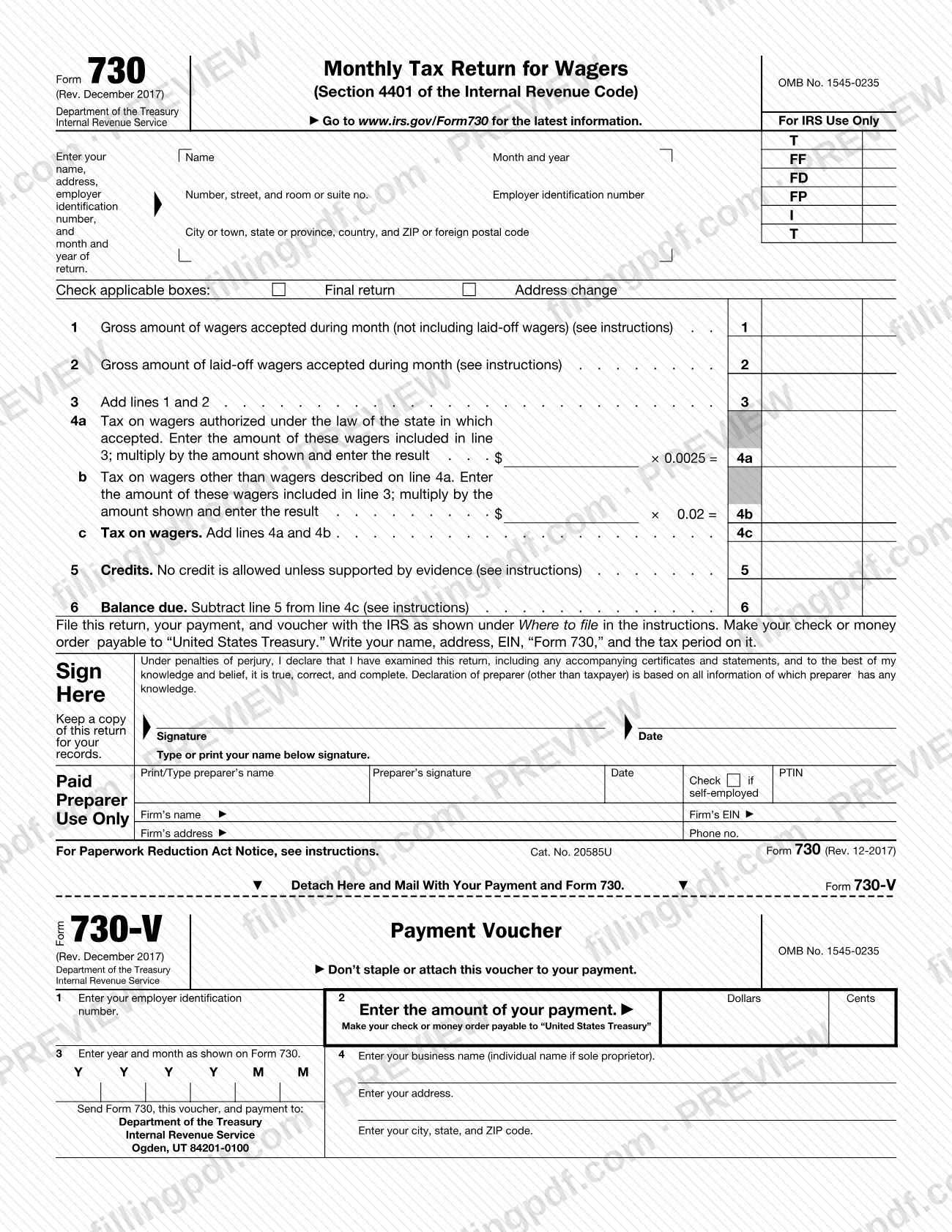
Form 730, Monthly Tax Return for Wagers is the IRS return used to report the gross amount of wagers accepted during one calendar month and to compute the wagering tax imposed by section 4401 of the Internal Revenue Code (OMB No. 1545-0235).
The return is short. Line 1 reports wagers accepted during the month, not counting laid-off wagers. Line 2 reports laid-off wagers accepted. Line 3 adds them. Lines 4a and 4b apply the tax to wagers authorized under the law of the state in which they were accepted and to all other wagers, and line 4c adds the two. Line 5 holds credits, and line 6 is the balance due.
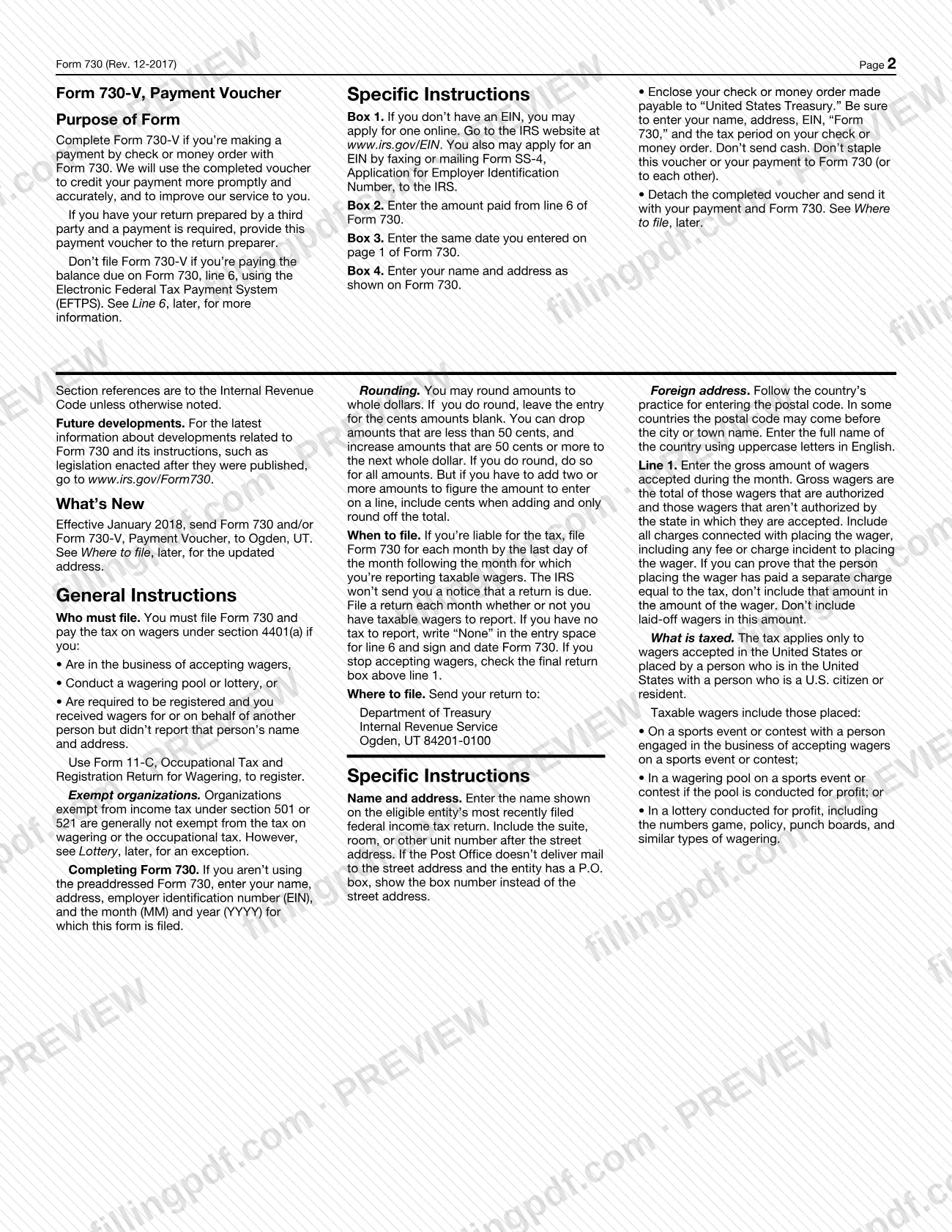
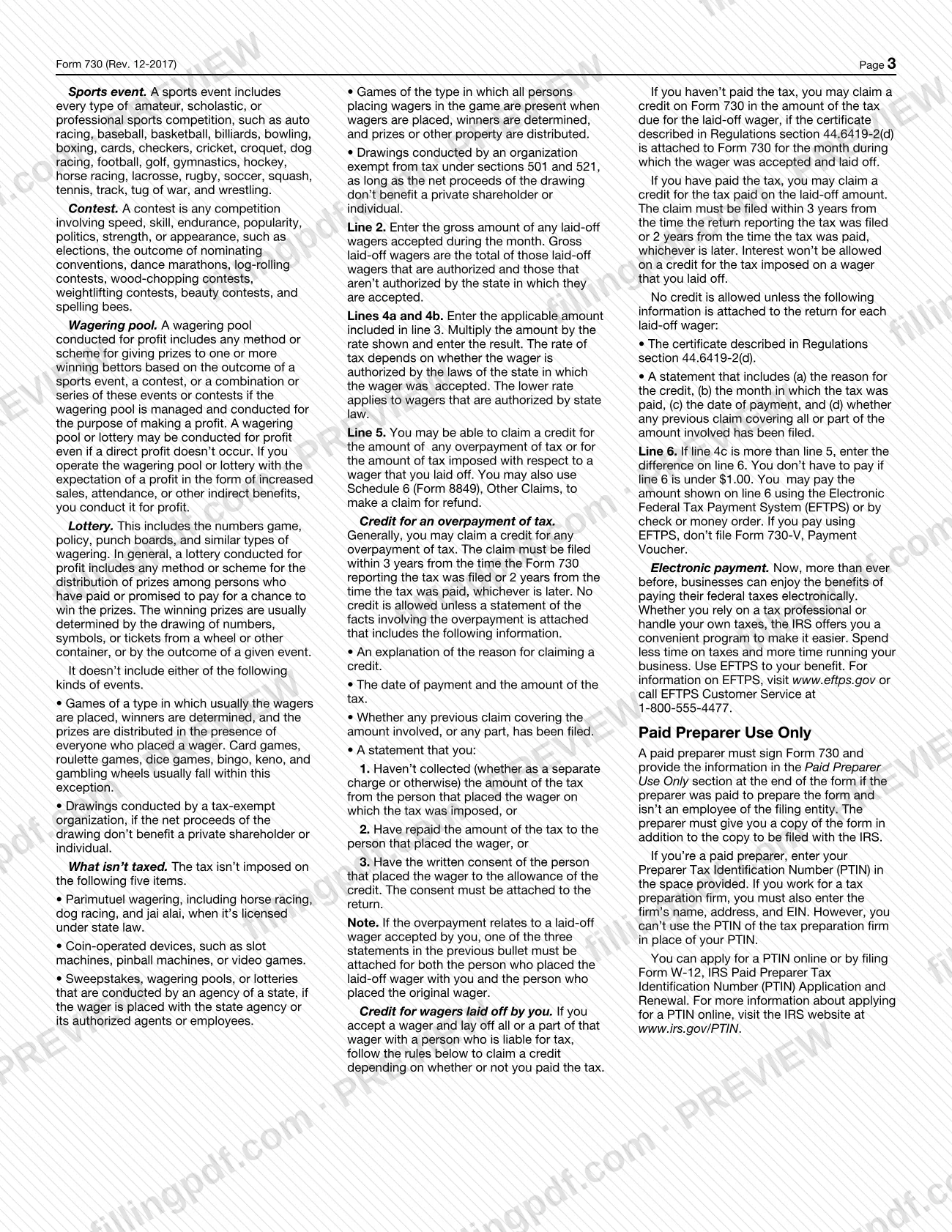
The tax applies only to wagers accepted in the United States, or placed by a person in the United States with a U.S. citizen or resident. The instructions list what is taxed: wagers on a sports event or contest with a person in the business of accepting such wagers, wagers in a wagering pool on a sports event or contest conducted for profit, and wagers in a lottery conducted for profit.
The instructions also list what is not taxed, including parimutuel wagering licensed under state law, coin-operated devices, and sweepstakes, pools or lotteries conducted by a state agency when the wager is placed with the agency or its authorized agents.
Page 1 of the PDF is Form 730. It is followed by Form 730-V, Payment Voucher, which you use when you pay by check or money order. Form 730 is not the registration form: the instructions send you to Form 11-C, Occupational Tax and Registration Return for Wagering, to register.
Who needs to file Form 730?
You must file Form 730 and pay the tax on wagers under section 4401(a) if you:
- are in the business of accepting wagers;
- conduct a wagering pool or lottery; or
- are required to be registered and you received wagers for or on behalf of another person but did not report that person's name and address.
You file for each month, whether or not you have taxable wagers to report. If you stop accepting wagers, you check the final return box above line 1 on your last return.
Exempt organizations: organizations exempt from income tax under section 501 or 521 are generally not exempt from the tax on wagering or the occupational tax. The instructions describe an exception for certain drawings conducted by tax-exempt organizations, in the discussion of lotteries.
A paid preparer who is not an employee of the filing entity must also sign the return and complete the Paid Preparer Use Only section. Someone who is not in one of the three groups above, or whose wagers fall in one of the untaxed categories in the instructions, is not required to file on the strength of those wagers alone.
When to file Form 730
File Form 730 for each month by the last day of the month following the month for which you are reporting taxable wagers. The IRS does not send a notice that a return is due.
You file every month whether or not you have taxable wagers to report. If you have no tax to report, write "None" in the entry space for line 6 and sign and date the return. If you have stopped accepting wagers, check the Final return box above line 1.
Late filing or late payment can bring penalties and interest. The instructions say the late-filing or late-payment penalty is not imposed if you can show the failure was due to reasonable cause; if you receive a penalty notice after filing, you reply to the notice with an explanation rather than attaching one to the return.
Claims for credit for an overpayment must be filed within 3 years from the time the Form 730 reporting the tax was filed or 2 years from the time the tax was paid, whichever is later. Keep records at least 4 years from the latest of the dates the instructions list.
Documents you need
- Form 730-V, Payment Voucher: complete and send it with your check or money order and Form 730; do not file it if you pay the balance through EFTPS.
- Check or money order payable to "United States Treasury", only if you pay the line 6 balance by check or money order; do not send cash.
- For a credit on line 5 for a wager you laid off and have not paid tax on: the certificate described in Regulations section 44.6419-2(d), attached to Form 730 for the month the wager was accepted and laid off.
- For any credit for a laid-off wager: a statement giving the reason for the credit, the month and date the tax was paid, and whether a previous claim covering any part of the amount was filed.
- For a credit for an overpayment of tax: a statement of the facts explaining the reason for the credit, the date and amount of payment, and whether a previous claim was filed.
- For an overpayment credit: a statement that you did not collect the tax from the person who placed the wager, or repaid it, or hold that person's written consent; attach any written consent.
How to fill out Form 730
Enter name, EIN, month and year
At the top, enter your name, address, employer identification number (EIN), and the month (MM) and year (YYYY) of the return. Use the name shown on your most recently filed federal income tax return; if you have no EIN, the instructions point to www.irs.gov/EIN.
Check the final return or address change box
Check Final return if you have stopped accepting wagers, and Address change if your address differs from your last return.
Report gross wagers on line 1
Enter the gross amount of wagers accepted during the month, not including laid-off wagers. Include all charges connected with placing the wager, but not a separate charge equal to the tax that you can prove the bettor paid.
Report laid-off wagers on line 2
Enter the gross amount of laid-off wagers accepted during the month, both those authorized and those not authorized by the state in which they were accepted.
Add lines 1 and 2 on line 3
Enter the total of lines 1 and 2.
Figure the tax on lines 4a and 4b
On line 4a, enter the part of line 3 that is authorized under the law of the state where accepted and multiply by the rate printed on the form. On line 4b, do the same for all other wagers in line 3.
Total the tax on line 4c
Add lines 4a and 4b and enter the result on line 4c.
Claim credits on line 5
Enter any credit for an overpayment of tax or for tax on a laid-off wager, and attach the supporting certificate or statement the instructions describe. Leave it blank if you have none.
Enter the balance due on line 6
Subtract line 5 from line 4c. If you have no tax to report, write "None" in the entry space for line 6. You may round to whole dollars, leaving the cents blank.
Sign and date the return
Sign and date under the penalties-of-perjury declaration and type or print your name below the signature. A paid preparer who is not your employee also completes the Paid Preparer Use Only section, including a PTIN and, if applicable, the firm's name, address and EIN.
Complete Form 730-V if paying by check
If you pay by check or money order, complete Form 730-V: box 1 your EIN, box 2 the amount from line 6, box 3 the year and month (YYYYMM) as on Form 730, and box 4 your business name and address.
Review and download the completed PDF
Check that the month and year, EIN and each line match your records, and that the return is signed. Download or print the completed PDF from FillingPDF, keep a copy, and mail it as described under How to submit.
How to submit Form 730
Form 730 is filed by mail, and the balance due is paid by check or money order sent with Form 730-V, or electronically through the Electronic Federal Tax Payment System (EFTPS).
- Mail the return to: Department of the Treasury, Internal Revenue Service, Ogden, UT 84201-0100. Effective January 2018, this is the address for Form 730 and Form 730-V. Do not send the return to the Tax Forms and Publications address printed for comments on the form.
- Pay by check or money order: make it payable to "United States Treasury" and write your name, address, EIN, "Form 730," and the tax period on it. Do not send cash. Detach Form 730-V, complete it, and send it with your payment and Form 730. Do not staple or attach the voucher to your payment, and do not staple the payment to the return.
- Pay through EFTPS: if you pay the line 6 balance with EFTPS, do not file Form 730-V. The instructions point to www.eftps.gov for information.
Keep a copy of the return for your records. If a paid preparer prepares it, the preparer must give you a copy in addition to the copy filed with the IRS. FillingPDF lets you fill out and download the PDF; submission follows the channels above.
Common mistakes to avoid
- Skipping the return in a month with no taxable wagers. The instructions require a return every month; enter "None" on line 6, then sign and date it.
- Including laid-off wagers in line 1. Line 1 excludes laid-off wagers, which are reported separately on line 2.
- Counting a separate charge equal to the tax in the wager amount when you can prove the bettor paid it; the instructions say not to include that amount.
- Filing Form 730-V when you pay the line 6 balance through EFTPS; the instructions say not to file the voucher in that case.
- Stapling or attaching Form 730-V to the payment, or stapling the payment to the return.
- Claiming a line 5 credit without the supporting certificate or statement. The form says no credit is allowed unless supported by evidence.
- Sending the return to the Tax Forms and Publications address in the comments section instead of Ogden, UT 84201-0100.
- Using the PTIN of a tax preparation firm in place of the individual preparer's own PTIN in the Paid Preparer Use Only section.
- Forgetting to check the Final return box on the return for the month you stop accepting wagers.
Frequently asked questions
What is Form 730 used for?
Form 730 is the IRS monthly tax return for wagers. You use it to report the gross amount of wagers you accepted during the month and to pay the tax imposed by section 4401 of the Internal Revenue Code on those wagers.
Who has to file Form 730?
You must file if you are in the business of accepting wagers, conduct a wagering pool or lottery, or are required to be registered and received wagers for another person without reporting that person's name and address. Registration is made on Form 11-C.
When is Form 730 due?
By the last day of the month following the month you are reporting. For example, a return for one month is due by the end of the next month. The IRS does not send a notice that a return is due, and you file every month even with no taxable wagers.
Do I file Form 730 if I had no wagers this month?
Yes. The instructions say to file each month whether or not you have taxable wagers to report. Write "None" in the entry space for line 6, then sign and date the form. If you have stopped accepting wagers, check the Final return box.
Where do I mail Form 730?
Mail it to Department of the Treasury, Internal Revenue Service, Ogden, UT 84201-0100. That address, effective January 2018, also applies to Form 730-V. Pay by check or money order made payable to "United States Treasury," or pay through EFTPS.
When do I use Form 730-V?
Use Form 730-V, the payment voucher, when you pay the line 6 balance by check or money order. Do not file it if you pay through EFTPS, and do not staple or attach it to your payment. Send it with the payment and Form 730.
How do I claim a credit on line 5 of Form 730?
You may claim a credit for an overpayment of tax or for tax on a wager you laid off, but only with supporting evidence attached, such as the certificate under Regulations section 44.6419-2(d) or a statement of facts. Claims must be made within the time limits in the instructions.
Can I fill out Form 730 online?
Yes. You can fill out the form 730 PDF online on FillingPDF and download or print it. FillingPDF is an independent service and does not file the return or take payment for the IRS; you mail the return to the IRS and pay by the methods above.
Ready to fill out Form 730?
Fill out Form 730 now