
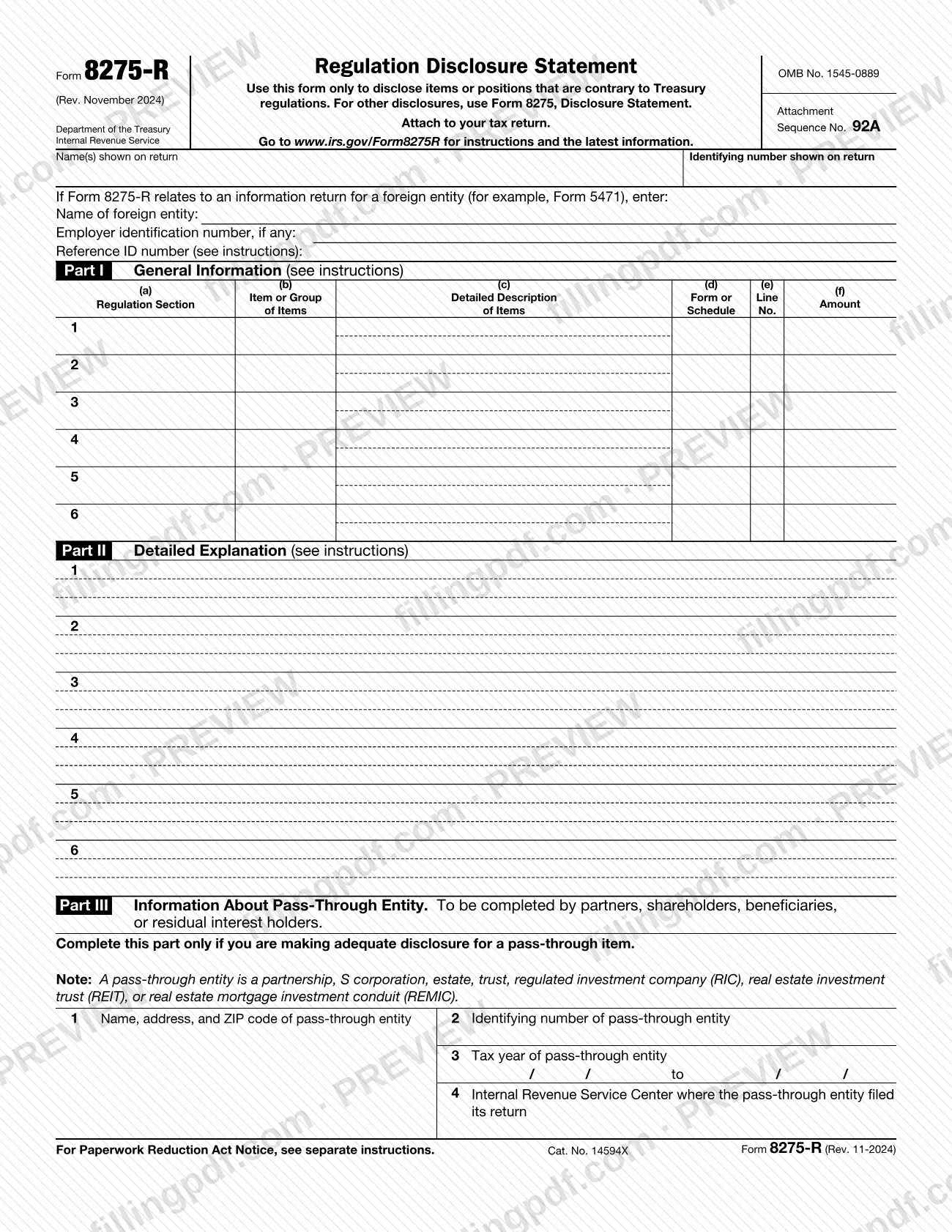
Form 8275-R is the Internal Revenue Service (IRS) Regulation Disclosure Statement, the form taxpayers and tax return preparers attach to a return to disclose a position that is contrary to Treasury regulations. It is used by individuals, corporations, pass-through entities and preparers who want the disclosure to count as adequate. On this page you can fill out the form online on FillingPDF and download or print the completed PDF; the form and its instructions are published by the IRS at www.irs.gov/Form8275R.
Last updated
What is 8275-R?
Form 8275-R, Regulation Disclosure Statement, is the Internal Revenue Service (IRS) form that taxpayers and tax return preparers attach to a tax return to disclose positions taken on that return that are contrary to Treasury regulations.
The form is filed to avoid the portions of the accuracy-related penalty that arise from disregard of regulations or from a substantial understatement of income tax on non-tax shelter items, when the return position has a reasonable basis. It can also be used for disclosures relating to the economic substance penalty and to the preparer penalties for understatements caused by positions contrary to regulations. For the disregard-of-regulations penalty, the position must also represent a good-faith challenge to the validity of the regulation and have a reasonable basis.
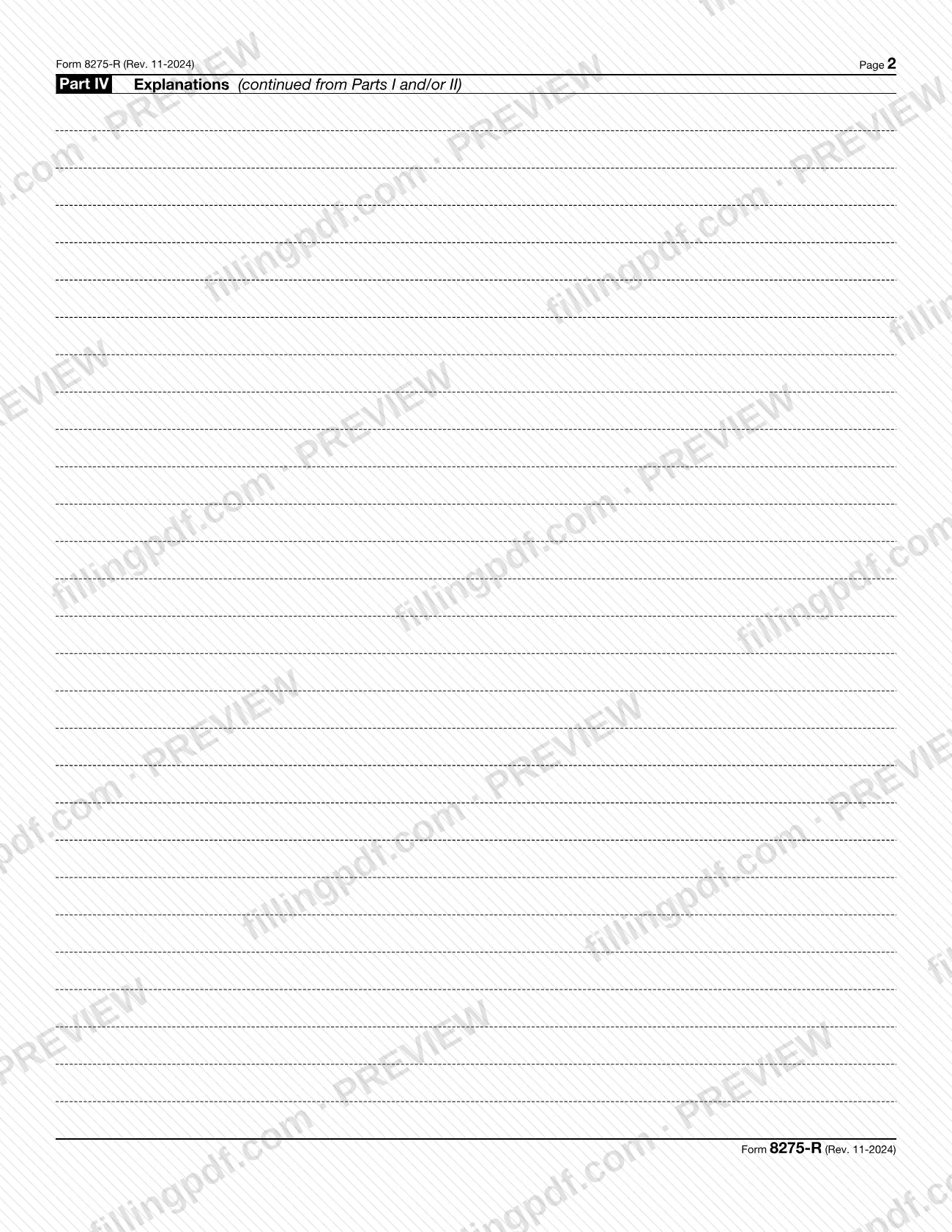
The form has four parts. Part I identifies each regulation and item in columns (a) through (f). Part II gives the detailed explanation. Part III is completed only for pass-through items, and Part IV on page 2 continues Parts I and II. The form is identified as OMB No. 1545-0889, Attachment Sequence No. 92A.
Form 8275-R is not the general disclosure form. It is to be used only for items or positions contrary to Treasury regulations. For items or positions that are not contrary to regulations but are not otherwise adequately disclosed, the IRS directs you to Form 8275, Disclosure Statement.
Who needs to file 8275-R?
Form 8275-R is filed by individuals, corporations, pass-through entities and tax return preparers. You use it when a return position is contrary to regulations; the IRS instructions say that in that case you must file the form.
- Pass-through items. For items attributable to a pass-through entity, disclosure should be made on the entity's own tax return. If the entity does not disclose, the partner, shareholder or similar owner can make adequate disclosure of the items. A pass-through entity is a partnership, S corporation, estate, trust, regulated investment company (RIC), real estate investment trust (REIT) or real estate mortgage investment conduit (REMIC).
- Foreign entities. If the form relates to an information return for a foreign entity, such as Form 5471, the top of the form asks for the entity's name, employer identification number (if any) and reference ID number.
- Reportable transactions. If the position relates to a reportable transaction, you must also make the disclosure required by Regulations section 1.6011-4(d); see Form 8886.
Do not use Form 8275-R for items that are not contrary to regulations; use Form 8275. Disclosure on this form also cannot avoid the penalty portions tied to negligence, disregard of rules other than regulations, or a substantial understatement on a tax shelter item, among others listed in the instructions. It does not help if you failed to keep proper books and records or to substantiate items.
When to file 8275-R
File Form 8275-R with your original tax return, because the instructions say all Forms 8275-R go with the original return, and keep a copy for your records. You may also be able to file it with an amended return; see Regulations sections 1.6662-4(f)(1) and 1.6664-2(c)(3).
Timing differs by item. Carryover and carryback items are disclosed in the tax year in which they originated, and you do not file another Form 8275-R for the years in which they are taken into account. Recurring items, such as depreciation expense, require a Form 8275-R for each tax year in which the item occurs.
For the economic substance penalty, the instructions say you may disclose the relevant facts with a timely filed original return (determined with regard to extensions) or a qualified amended return. A filer of Schedule UTP (Form 1120) may not need Form 8275-R for that purpose.
How to fill out 8275-R
Enter your name and identifying number
At the top, write the name(s) shown on your return and the identifying number shown on the return.
Complete the foreign entity block
If the form relates to an information return for a foreign entity, such as Form 5471, enter the entity's name, its employer identification number if any, and the reference ID number. Use the same reference ID as on the information return, and file a separate form for each foreign entity.
Cite the regulation and name the item
In Part I, column (a), enter the full regulation citation, for example 1.482-7(d)(1)(iii). In column (b), identify the item by name, and mark it as such if it comes from a pass-through entity.
Describe the items
In Part I, column (c), give a complete description of the items, such as listing theater tickets and catering under entertainment expenses. For a group of similar items with the same tax treatment in the same year, describe the group.
Locate the item on your return
Enter the form number or schedule in column (d), the line number in column (e) and the amount of the item(s) in column (f).
Write the detailed explanation
In Part II, use the line matching each Part I row to describe the relevant facts, enough to show the IRS the item, its amount and the nature of the controversy, and to state why you believe the regulation is invalid.
Complete Part III for pass-through items
Only for pass-through items, enter the entity's name, address and ZIP code on line 1, its identifying number on line 2 and its tax year on line 3. On line 4, give the IRS Service Center where it filed, or "e-file" if it filed electronically.
Use Part IV for extra space
If Parts I or II need more room, continue in Part IV on page 2, with the corresponding part and line number. Put your name and identifying number on any continuation sheet.
Review and download the completed PDF
Check that each regulation citation, description and amount matches your return, then download or print the completed PDF from FillingPDF and attach it to your tax return.
How to submit 8275-R
Form 8275-R is not filed on its own: you attach it to your tax return and it travels through the same channel as that return. The form prints "Attach to your tax return" and prints no separate mailing address, portal or appointment rule.
- With the original return. File all Forms 8275-R with your original tax return and keep a copy.
- With an amended return. You may also be able to file the form with an amended return; see Regulations sections 1.6662-4(f)(1) and 1.6664-2(c)(3).
- Separate forms. Complete and file a separate Form 8275-R for items reported by each pass-through entity, and a separate one for each foreign entity.
The disclosure is adequate only if made on Form 8275-R itself; an attached letter or a different form does not replace it. If you need more room, use Part IV or continuation sheets that carry your name and identifying number. For channels and mailing addresses, follow the instructions for the return the form accompanies. FillingPDF lets you fill out and download the PDF; submission follows the channels above.
Common mistakes to avoid
- Disclosing a position on an attached letter or another form instead of Form 8275-R; the disclosure is not valid unless the form is completed and attached to the return.
- Using Form 8275-R for an item that is not contrary to regulations; the form says to use Form 8275, Disclosure Statement, for other disclosures.
- Citing a regulation loosely, such as "482 regs" or "1.482-7", instead of the full citation with every lettered or numbered unit, such as "1.482-7(d)(1)(iii)".
- Combining items from more than one pass-through entity or more than one foreign entity on one form; a separate Form 8275-R is required for each entity.
- Leaving out the statement of why you believe the regulation is invalid in Part II; the disclosure needs both the relevant facts and that statement.
- Assuming disclosure cures every penalty, such as negligence or a substantial understatement on a tax shelter item, or relying on it when books and records were not kept.
- Skipping the form for a recurring item such as depreciation in a later year; it must be filed for each tax year in which the item occurs.
- Continuing on extra sheets without your name and identifying number on each sheet, or without the part and line number from page 1.
Frequently asked questions
What is Form 8275-R used for?
Form 8275-R is the IRS Regulation Disclosure Statement. Taxpayers and return preparers attach it to a tax return to disclose a position that is contrary to Treasury regulations, so that portions of the accuracy-related penalty can be avoided when the position has a reasonable basis.
What is the difference between Form 8275-R and Form 8275?
Form 8275-R is only for items or positions contrary to Treasury regulations. Form 8275, Disclosure Statement, is used for items or positions that are not contrary to regulations but are not otherwise adequately disclosed, according to the IRS instructions.
Where do I file Form 8275-R?
Attach it to your tax return. The form does not print its own mailing address, so it goes wherever the return goes. File it with the original return and keep a copy; the IRS says you may also be able to file it with an amended return.
Do I need a separate Form 8275-R for each pass-through entity?
Yes. To adequately disclose items reported by a pass-through entity, you complete and file a separate Form 8275-R for the items of each entity. The same applies to positions related to more than one foreign entity: one form per foreign entity.
Do I file Form 8275-R every year for a recurring item?
Yes, for recurring items such as depreciation expense you file Form 8275-R for each tax year in which the item occurs. Carryover and carryback items differ: they are disclosed in the year they originated, with no new form for later years.
Can an attached letter replace Form 8275-R?
No. The IRS instructions say the disclosure is adequate only if made on Form 8275-R. Attaching other documents, such as an acquisition agreement or a letter, does not make the disclosure valid if the form is not completed and attached to the return.
Does Form 8275-R protect me from every accuracy-related penalty?
No. Disclosure cannot avoid the portion of the penalty attributable to negligence, disregard of rules other than regulations, or a substantial understatement on a tax shelter item, among others the instructions list. It also does not help if you failed to keep proper books and records.
Can I fill out Form 8275-R online on FillingPDF?
Yes. You can fill out the PDF online on FillingPDF and download or print it. FillingPDF is an independent service and does not file the form with the IRS; you attach the completed form to your tax return and submit it through the return's channels.
Ready to fill out 8275-R?
Fill out 8275-R now